Categories
Business Model Innovation Meat

Prime Future 57: The packers get Standard Oil’d. Then what?

This is neither political commentary or prediction. This is a look at the hypothetical implications of a hypothetical scenario that has a zero percent chance of happening.


If an oligopoly market is when 4 firms have 50+ percent share, then US beef, pork, and poultry are undeniable oligopolies. These concentrated markets aren’t uncommon though, we run into them from cereal (Kellogg’s, General Mills, Post, and Quaker) to cell phones (Apple, Samsung, Huawei).

But these examples are child’s play compared to the most extreme example of market power: the classic story of Standard Oil. In the 1880’s, John D. Rockefeller realized the oil business was a fantastic business except for the nagging issue of price volatility. So he found a solution to that little problem, by developing an effective monopoly through the Standard Oil trust. A Supreme Court ruling in 1911 forced the trust to split into 34 companies to increase market competition.

The current rally cry of many US producers is that the problem with the cattle business is concentration among the packers. This is not new; tale as old as time. But carry that rally cry out to the most extreme outcome of de-concentrating processing capacity….what does it really solve?

Just for fun, let’s say the DOJ goes full 1911 and ‘Standard Oils’ the meat industry.

Every plant becomes its own company.

The ‘Big 4’ become the ‘Midsize 22’.

Then what? Before we lock into any hypotheses about a re-fragmented meat industry, what was the result of busting the Standard Oil trust?

Keep in mind that also around 1911 the rise in automobiles meant gasoline (previously a worthless byproduct) was suddenly worth more than kerosene, and that other regions of the world began producing oil competitively so the entire oil market was shifting as Standard Oil was split. Here’s a snapshot of oil prices before and after:
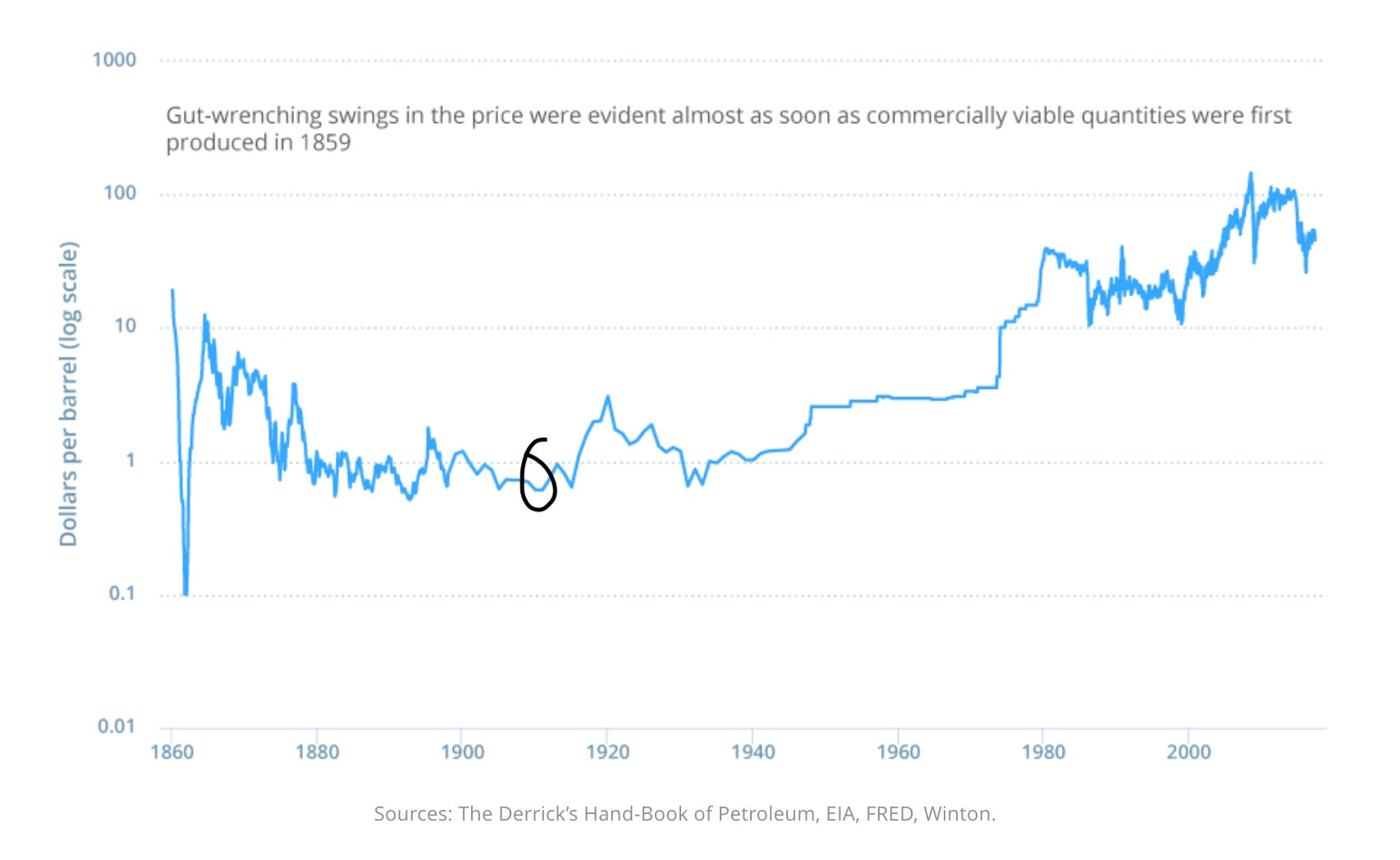
So the Standard Oil trust was busted and then prices went…up? While there are clearly more factors at play than we’ll dig into here, my takeaway from this chart is that this whole scenario is not as straight forward as anyone would like it to be. There are a lot of factors at play; markets are dynamic and impacted by all the things from pandemics to stimulus programs to weather.

The livestock & meat industry’s common hypothesis is that if the packers were less concentrated, then market power would ‘return’ to feedyards & producers upstream and downstream customers in foodservice/retail. It would ‘free up margin’ by taking away the packer’s pricing power on the buy and sell side. Econ 101.

But is reality as clean as an econ textbook? Are we *certain* that the net effect of increasing packer competition would definitively be positive for the rest of the value chain?

The 2 dimensions I’m interested in are price (purchasing live cattle, selling boxed beef) and innovation (finding new ways to better serve customers & end consumers).

Let’s start with downstream. What would the implications be for further processors, retailers, foodservice, and end consumers?

Price: Packers sell to further processors, distributors, retail and foodservice…segments that also happen to be highly concentrated. Let’s say a national retailer like Walmart who sells ~20% of US retail beef today buys from 1 or 2 companies. Each supplier has multiple plants that service multiple Walmart distribution centers with multiple SKU’s at tailored specs. Plants have become specialized with specific programs or specific customers. The big processors were able to flex reasonably well as COVID shut down foodservice because of diversification of channels across plants – individual plants didn’t have that diversification.

In a Standard Oil trust busted world, is a national retailer now going to work with 10 independent plants that are each independent suppliers? What does that do the retailers ability to keep meat cases full with homogenous supply of fresh meat at spec? Big companies like to deal with big companies that can handle big business. What does that increased friction in the whole process do to the price of meat at retail? On the other hand, what would increased competition among packers do to the price of meat for retailers?

Innovation: A key rationale for minimizing oligopoly or monopoly markets is that competition leads to innovation. Agree, of course. But you know what else leads to innovation? Resources. What is the optimal mix of incentive to innovate and resources to innovate as a function of market power? I don’t know. But low margin businesses without scale don’t tend to be fountains of innovation.

Innovation = Incentive + Resources

Then let’s look upstream. What would the implications be for cow-calf producers and feedyards?

  • Price: Cow-calf producers don’t sell to packers, they sell to sale barns or stockers or feedyards. The feed yard space is way less concentrated than processing but way more concentrated than cow-calf. Say feedyards have more pricing power if packers are split up….does that trickle up to cow-calf producers or does it just mean feedyards are the new margin sinkhole of the beef supply chain?
  • Innovation: Let’s say more of the total value chain margin stays upstream. Maybe that leaves some financial wiggle room to focus on things besides survival So do producers start thinking about things consumers are talking about like carbon footprint? I don’t think so. Not unless the incentive structure changes and packers pay more to feedyards who pay more for calves that are raised a certain way at the cow-calf operation.

A complicating factor is that even if you increase processing competition nationally, it does not necessarily mean you increase competition regionally.

And if packers cannot consolidate processing capacity, would the result be more vertical integration in an attempt to consolidate supply chain control?

An obvious factor that makes meat processing different from cereal is that it’s a capital intensive business so barriers to entry are high, really high. It’s an economies of scale business, so it’s a business that ‘wants’ to be consolidated to chase more economies of scale.

But even if the US government regulated away processor’s ability to consolidate, what would that mean for the US industry’s ability to compete against emerging regions? The world’s largest hog farm was recently built in China for 84,000 sows to produce 2.1 million hogs annually….wouldn’t it stand to reason that the world’s largest processing plant(s) will soon follow?

Would a Standard Oil’ing of meat packing be good for downstream players? Maybe, in the short run. Probably not in the long run.

Would a Standard Oil’ing of meat packing be good for upstream players? Maybe, in the short run.

But what’s not good for downstream players in the long run cannot be good for upstream players in the long run.

Hear me loud & clear that profitability at all stages of the value chain is the #1 foundation of a viable cattle industry. Increasing margin capture throughout the value chain is a good thing, a great thing. But is reducing packer power the panacea that people often describe it as? I may be wrong, but I just don’t think it is.

Maybe looking at impact of competition on pricing power & innovation is the wrong framework….maybe higher margins don’t lead to innovation, maybe innovation leads to higher margins.

Are oligopolies good or bad? Should the big 4 be broken up? Irrelevant questions.

The actionable question is, how do you win when you buy from or sell to an oligopoly marketplace? Control the control-ables and innovate the innovate-able.

At the end of the day, animal protein is a commodity driven business. And what do commodity markets do? They move in cycles. Sometimes tree growers profit, sometimes lumber mills profit. Sometimes the cow-calf producer wins, sometimes the packer wins. Sometimes dairy producers make hand over fist, sometimes processors do. Sometimes oil drillers print money, sometimes refineries do.

‘your margin is our opportunity’

Look at other industries where big companies in one segment of a value chain amassed market share and then stopped innovating. Think IBM in the 80’s. You know what happened when those companies got satisfied with their market share and stopped innovating? Apple. Microsoft. Dell. A resurgence of insurgents jumped in with new innovation that captured market share…and then those ‘new’ tech companies get big and face their own anti-trust scrutiny. It’s almost like everything is a cycle and the cycle is what creates opportunity…

You could easily argue that type of insurgency is what upstarts like Cooks Venture or Shenandoah Valley Organic could be in the US poultry business.

Carl Lippert recently summed this up well in his article The Farm Barbell,

“The future of agriculture is large farms producing commodities and small farms creating value added products.”

That’s true for producers AND for processors.

The only way to stay in a commodity driven business AND get out of the trappings of commodity cycles is to build a competitive moat, to pursue value added markets. That’s also true for producers AND for processors. We’ve talked about this before:

The livestock & poultry industry has spent decades driving cost out of animal production systems to increase profit. And we’ve done it well. Really well. More pounds per animal. Less feed per pound of gain. Least cost feed formulation. Increased efficiency.

And yet, we see record high number of farm bankruptcies, near record low farm income, and volatile train wrecks of milk, live cattle and hog markets the last 6 months. All of which point to revenue challenges in animal agriculture.

Commodity production is an existence governed by a ruthlessly brutal dictator: The Market. It’s time to focus on enabling livestock producers to increase Revenue, to escape the commodity game that’s ruled the industry, to differentiate.

The punchline of Lippert’s article sums up the implications of this whole discussion for startups in animal ag:

“Startups should build penny shaving machines for scaled farms and margin capture machines for small farms.”

Yes.

(For more on the Standard Oil saga, I highly recommend the book Titan by Ron Chernow.)


Livestock Market Transparency is Possible. Here’s how. (link)

On a related note, this piece was written at the height of 2020’s chaos:

Pricing is a hot topic in light of live cattle and boxed beef prices heading in opposite directions, and the same dynamic to a lesser extreme in pork. These pandemic market dynamics highlight the need for improved price discovery and market transparency across the entire meat, poultry, and livestock sector. These are great problems for technology to solve. Here’s why: (link)


Prime Future is a weekly newsletter that allows me to learn out loud. I’m on the Merck Animal Health Ventures team. Prime Future represents my personal views only.


Categories
D2C

A D2C Revolution Is On Its Way

Hypothesis: Direct to Consumer (D2C) business models will be a high growth sales channel for all meat & poultry companies within 5 years.

I wrote that sentence 3 weeks ago.

3 weeks before the whiplash shift in demand from ~50% of animal protein sold through foodservice to ~85% moving through retail sales channel amidst the global COVID-19 pandemic.

3 weeks before we saw meat cases empty as quickly as grocery store workers could fill them.

COVID-19 doesn’t change my hypothesis, it accelerates its race to reality.

In this first of a three part series, we’ll look at the proof points supporting the hypothesis above.

At a recent meat industry conference for packers & retailers, I asked around about what folks think about ButcherBox and similar D2C models. Responses ranged from “never heard of them” to “remind me what they do?” Except for those paying attention to ButcherBox who responded with raging enthusiasm.

That same week, I asked my Instagram followers if they’ve used ButcherBox or the like and feedback on the product & experience. Of ~100 people who saw the question, ~40 had either used ButcherBox themselves or had a family member who had.

Here’s what this highly unscientific research tells me:

  1. Consumers are dialed into companies that allow them to buy what they want, when they want, how they want.
  2. Packers are dialed into selling meat the way we’ve always sold meat, through retail, foodservice, or export channels.

Now with the pandemic among us and grocery stores often sparse, even consumers who’ve never bought food through delivery apps are doing so, or through D2C services. (If ButcherBox were publicly traded I’d be buying stock right now based on what I assume can only be massive explosion in sales over the last 10 days.)

What is ButcherBox? It’s a subscription service for meat & poultry. You sign up online, you select the composition of your box, you receive a box at your doorstep.

Look up ButcherBox on Crunchbase, a company that tracks all funding rounds for startups, and you’ll see that ButcherBox raised $210,000. Five years ago. (In the pre-corona world, this is like saying they raised 2 nickels.)

What does that tell us?

  1. ButcherBox is growing.
  2. ButcherBox is growing profitably. In the world of startups and D2C business models, profitable growth is the holy grail.

Contrast the ButcherBox story with Blue Apron, one of several meal kit delivery services whose growth was largely fueled by venture capital then effectively dismissed by public market investors looking for profitable growth, not growth at all costs. Caveat: Blue Apron is having a COVID-19 renaissance as consumers are re-activating an appetite for meal kit delivery. Is this a permanent trend or just a moment in time? We’ll find out.

Bottom line: ButcherBox has proven the D2C business model works…at scale.

They’ve proven there is consumer demand for D2C meat & poultry and that at least some consumers are willing to pay for this service. More interestingly, multiple variations of this business model have popped up recently: we’re in the early Wild West days of D2C in animal protein.

And the experience many consumers are having amidst COVID19 of seeing meat cases empty at the grocery store will leave a mark; a mark that is likely to drive many consumers further towards either wanting to fill up a freezer with meat OR have a reliable subscription service that will deliver meat even when the grocery store’s meat case has been picked clean.

So back to the beginning – why did a conference full of packers & retailers not know anything / not want to talk about the rise of D2C business models?

That’s easy, it’s the Innovator’s Dilemma.

When big companies are disrupted by upstarts, many assume it was because the big co didn’t see what the upstart saw, e.g. Kodak, Blockbuster. But author Dr. Clayton Christenson argues that big companies see the early trends just fine, they just are not positioned, structured, or incentivized to act on early trends. Leaders at established companies have to focus on market share and profitability of today’s largest customers. For packers, that means ignoring ButcherBox and its peers who represent a fraction of a percent of total meat dollars at present, in order to focus on growing market share and profitability with large retail and foodservice customers. This is rational behavior.

The trick will be, how quickly do packers jump on the growing trend of D2C? Wait too long and there’s the risk of “disruption”. Jump too early and the market may not be fully developed, leaving an unprofitable sales channel in the short run.

Further complicating the matter is that D2C companies stand to not only disrupt packers, food retailers are also at risk.

And with a trend that’s been building for years now compounded by consumers being quarantined in their homes for weeks, potentially months?  

Demand for D2C will accelerate. The only question is how the meat industry will capitalize.

Check out the rest of this series.

Processing…
Success! You're on the list.
Categories
Animal AgTech

Prime Future 146: Closing Loops

This is a mish-mash of follow-ups to previous newsletter editions, including some great feedback from some of you which I always appreciate.

(1) The overlap between FTX and funny business in cattle feeding (link)

NPR did a podcast series on the $244 million Tyson Foods / Easterday saga of 265,000 ‘ghost’ cattle that existed only on paper. Ooph, it was a doozy and well worth the listen.

My big takeaways from the way NPR told the story were that ‘trust but verify’ isn’t just a nifty saying, but also the reminder that in most situations like this, the person doesn’t set out to blow up their business/life, it happens over time as need and opportunity collide.

At the risk of stating the obvious, both the FTX saga and the Tyson/Easterday saga point to the rationale for better governance & systems that reduce the opportunity for bad behavior in the first place.

(2) 1975 should call the pork people (link)

The feedback on this one was fun because it generally fell into 3 camps:

  • Multiple producers reached out to highlight that there are already pockets of high-quality pork production in the US, like Berkshire programs or brands out of Clemens Foods Group, for example. And yet, they also readily admit there’s still an industry-level quality gap that the pork industry has not solved while the beef industry now has a super high percentage of carcasses that grade very high quality.
  • There have been prior attempts in the US to implement quality grading, including recent attempts. But the pushback from packers is that the increased complexity of plant logistics are not worth the benefit. While it makes sense that anything that hampers throughput is met with skepticism, this pushback strikes me as over-weighting the short-term costs against the long-term rewards of being able to grow the fresh pork pie, so to speak. Fresh pork has as big of an adoption problem as farm management software, and it seems like it’s going to take a new approach to the business model or branding or something (and probably something big) to solve it.
  • Fresh pork as a meh kinda product is a US issue, not European for example, as evidenced by products like Iberico pork which “comes from the distinctive Black Iberian Pig. Native to areas of Portugal and central and southern Spain, the pigs’ diet of acorns and elements of the natural forests in these areas impacts the meat directly, giving it a nutty, evocative flavour. Black Iberian Pigs – also known as ‘Pata Negra’ – are bred to contain a higher fat content than many other pigs. That means that the pork they produce has a delightful tenderness that is sure to impress foodies.” While this is a great example, it’s clearly a specialty item and not the everyday version of pork that middle-class meat eaters are putting on the table.

(3) Lunatic farmers (link)

I love finding comments in the wild that support an idea. When we talk about lunatic farmers doing things that look absurd to the coffee shop boys until suddenly they look brilliant, here’s a great example of that dynamic in action:

(4) It’s time to call it: farm mgmt software was a wash. (link)

Shane Thomas and Rhishi Pethe built on my analysis with their own comments that furthered the conversation.

In Upstream Ag Insights Shane framed his analysis around network effects (or lack there of):

The first thing to consider is what underpins a “winner-take-all” market? The answer: Network effects.

Network effects are the incremental benefit gained by an existing user for each new user that joins the network. Every additional user to the telephone creates a stronger network effect. Same with Facebook or any social media.

The assumption in the farm management software space was that as more acres were gained on a platform, that would mean more data accrued leading to a deeper understanding of that customer and therefore deeper value delivery to the farmer which would mean more data for the organization to add value to other farmers which would increase switching costs of the farmer and make it difficult for any other farm management software player to break into the market. Farmers in theory would derive so much decision making value they would gladly play $5, $7 or $10/ac to access this. A winner-take-all scenario.

Because of these assumptions the emphasis became customer acquisition. Hundreds of million (billions in total) poured into pulling customers onto the software.

What’s important to note is that in order for a network effect to take off there needs to be utility for the user and ideally a tight feedback loop. Think of Google. Everytime you search on their platform you derive utility, almost immediately. And Google has a tight feedback loop surrounding time spent on the page, what you clicked on etc. ultimately enhancing their offering and making them better which means you keep going back to Google. The externalities influencing the system are close to none and there are only so many parameters that can influence the outcome.

Now if we think about this from a farming perspective, we get the opposite. The first issue is that the farmer has an arduous onboarding process and not only doesn’t derive immediate benefit, they might not derive any benefit for months, or years. This stems from data challenges and disparate connectivity issues.

Rhishi Pethe, who writes Software is Feeding the World, put it this way:

Janette is spot on in her analysis of a flawed market being a winner-take-all market. The faulty winner-take-all assumption was compounded by a few other factors. When Monsanto acquired The Climate Corporation, the assumptions on productivity improvement through analytics were in the range of 15-20 bushels per acre, when the prices of corn and soy were some of the highest prices in the history of commodity markets.

Even as late as 2017, it was common to talk about improvements in profitability of $ 100 per acre, based on farm management software analytics. It created an overhang on farm management software companies like The Climate Corporation (full disclosure – I worked there from 2017 to 2020), and Granular. There was a belief about creating a data flywheel to continue to drive more value and in turn bring in more data from commodity row crop farmers and drive even more value. The reality was a bit different.

I want to highlight my conclusion once again because some folks seemed to skip that part😉

So, what do we learn from agtech 1.0?

About pricing new products, and how people don’t tend to value what they don’t pay for.

About user experience and automating data entry.

About value creation….and that there has to be enough of it!

About how digital products matter strategically for incumbents, and that checking a box is not a strategy.

I also think there are lessons about aligning financing and business expectations with long-term customer interests. Agtech 1.0 created the opportunity, or revealed the opportunity, for sector-focused investors to have an edge over generalist VC’s simply by understanding the business of agriculture and its nuances.

While it’s time to call Agtech 1.0 a wash, I don’t think we can call it a bust.

It attracted capital and talent to a previously overlooked space. And even though you can’t point to individual significant long-term successes in this category, we can safely assume the learnings that founders, investors, strategics, and farmers had through this process has informed how Agtech 2.0, 3.0, 4.0…25.0 will play out.

Oh and the whole thing of not knowing exactly how things will play out, isn’t that really a feature of creating and building the new, not a bug?

What a time to be alive 😉

Categories
AgTech Animal AgTech Developing economies Markets

Prime Future 145: What would Norman say?

Ugh. That was my reaction when my book club chose a book about life in a Mumbai slum called, ironically, behind the beautiful forevers.

We normally read historical non-fiction narratives like The Splendid and The Vile, Endurance, and The Warburgs. Books that have that great combo of inspiration and interesting information. Not books that make me want to cringe at the bitter reality of people sharing the planet at the exact same time I am and yet our lives could not possibly be more opposite.

I just finished this book and am left with a simultaneous sense of relief (thank goodness the book is over and I can go back to my bubble) and lingering dread at the weight of a book like this that kinda seeps into your soul and gets stuck. It’s the reminder of real human suffering because someone put a name and the specifics of a story to a statistic, to the million ways that poverty slices at human dignity, as the struggle to meet the most basic needs of survival leads to the horrors of corruption, parents forced to choose between awful and terrible options to keep their kids fed, etc.

Ugh, indeed.

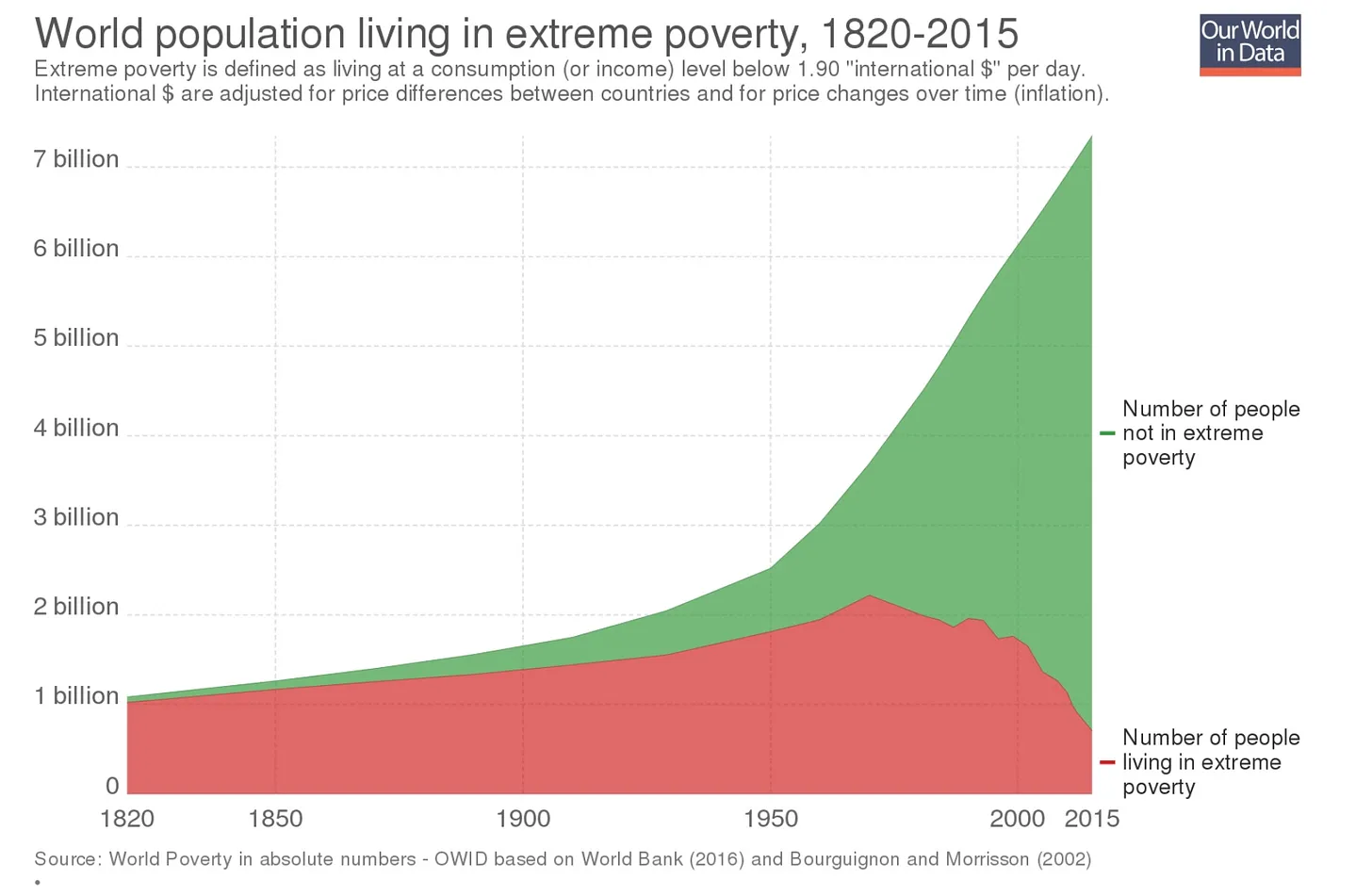
And yet, contrary to popular assumption there’s so much reason to celebrate progress and to be optimistic; there are fewer people in extreme poverty today than ever before, both in absolute numbers and as a percentage of the total population.

This outdated mental model from ‘our world in data’ stands out:

“Two centuries ago the majority of the world population was extremely poor. Back then it was widely believed that widespread poverty was inevitable. But this turned out to be wrong. Economic growth is possible and poverty can decline.”

Clearly, the reasons behind the positive story in this chart are multi-factorial, but industrialization and continued innovation have played a major role in reducing the number of people on the planet in poverty, including agricultural innovations. (After all economic development in developing economies is, by definition, agricultural development.)

That inflection in 1950 is interesting, while I don’t what caused it, I wonder…

…what if the real promise of agtech is to be the next inflection point to elevate more people from extreme poverty?

This whole topic converges with Prime Future’ish topics when you set it next to:

  1. The seemingly unending discussion <waves hands> about reducing the GHG footprint of livestock.
  2. The discussion about whether animal agtech is venture viable.

If we want to reduce the global GHG footprint of livestock, meat & dairy, then emerging markets have to be the focal point for interventions and innovations.

A lot of capital is being plowed into reducing methane emissions in livestock but largely for regions with livestock production systems that are already highly efficient, especially in comparison to their counterparts in developing economies. Not only are many of those solutions only nominally interesting in terms of value creation for producers (and tbd for consumers), many are also only nominally interesting in terms of the job those interventions would be hired to do which is to reduce the global GHG footprint of livestock.

I recently heard Frank Mitloehner from UC Davis say that ~80% of the global livestock GHG footprint comes from developing economies.

So focusing on reducing the GHG footprint of the beef industry in the US or the dairy industry in New Zealand is just playing around the edges of the global problem, at best. Mathematically, it just doesn’t matter much.

If reducing the global GHG footprint is the goal, then the biggest impact is far and away to be made by enabling emerging economies to shift from smallholder agriculture to commercial-scale agriculture to become, by definition, more efficient in the business of producing meat, milk and eggs, and simultaneously lower the GHG intensity.

As an example, as more innovations unlock value in India’s dairy industry, will they still have 200 million dairy producers milking 300 million dairy cows & water buffalo in 20 years? In 10 years? Maybe it becomes 100M producers milking 80M cows as they increase output with less animals – that’s the history of the US beef and dairy industries, as well as other highly efficient markets. Better economically & environmentally.

(The CLEAR Institute did a great write-up on this phenomenon and why efficiency has to be part of the GHG conversation.)

All of this unlocks the basic economic idea of specialization – those who are good at the business of producing milk produce more milk and those who are not good at it go find something else they are good at that contributes to the economy.

But obviously, the challenges that developing economies face are incredibly complex; if these were simple problems they’d be solved by now. I don’t mean to sound reductive, and in no way am I suggesting that agtech is, will be, or ever could be The Answer for developing economies…but ag innovation can be a piece of the puzzle.

And we know this is possible because we’ve seen it happen before.

Exhibit A: Norman Borlaug’s work on dwarf wheat. (If you haven’t read his biography, you’re missing out – incredible story of the ridiculously high impact potential of ag innovation.)

The question is which agtech solutions can be as high impact as dwarf wheat?

Changing agricultural economies requires things we take for granted in places like Ireland, Canada, or France….things like access to capital, access to efficient markets, access to buyers with high-value processing capacity, strong risk management tools, etc. Those sound like problems agtech can at least play a part in solving, don’t they?

(Tho of course, you need things like natural resources, roads, access to water, electrification, political peace, reliable governments, strong property laws, etc – none of which agtech can solve.)

Oh, and VC’s want venture returns to justify continued agtech investment? And agtech founders want to create real value for the world?

It’s not gonna happen with marketplaces in the US. Replacing relatively efficient analog marketplaces with digital marketplaces does not create much value here, it’s incremental at best.

But mention marketplaces to Mark Kahn from VC firm Omnivore that invests in agtech companies in India and he’ll tell you marketplaces can change entire sectors by giving buyers and sellers a cost-effective means to connect and transact.

In emerging markets that are mega fragmented and low yielding, agtech innovations can be legit game-changing. And not just marketplaces, all the things we throw in the agtech bucket.

What if the real promise of agtech is that the combination of existing & emerging tech with existing & emerging business models can actually change economic trajectory?

We can keep funding agtech that tweaks around the edges of production in developed economies, or we can direct technology and solutions to the places where they can create the largest delta, the most change between current state and future state.

Clearly this isn’t a new idea tho, I’m late to the party – there’s a lot of startups and investors who are way ahead in this idea of far greater potential for emerging agtech in emerging markets.

Maybe I’m having an agtech crisis of belief, or maybe I’m just tired of talking about first-world problems like how to make the really efficient thing marginally more efficient.

Either way, maybe emerging markets really are the path forward for agtech to make its dent in the universe.

Not for the sake of cool tech but for the sake of progress that actually enables human flourishing. At the end of the day, isn’t that what it’s all about?

I think Norman would have said so.

Categories
Animal AgTech Innovation

Prime Future 144: Goliath’s big fat feet.

It’s the most chaotic time of the year in the US for college basketball fans, with the NCAA tournament in full swing. Aka March Madness.

The thing about March Madness is that, because it’s a one-and-done tournament, your team having a high seed is great but also nerve-wracking. Because on any given day of the tournament, some pesky David can slay Goliath and dash an entire year of hopes and dreams.

I’m a devoted Arizona basketball fan, so I speak from way too much experience on this, including our own inglorious Goliath-style loss in the first round of the tourney this year. 🙄

The very next night #1 seed Purdue experienced the same fate when a school I’d never heard of just owned this OG basketball program.

Pure magic for David, complete devastation for Goliath.

There are a lot of ways to measure the gap between David and Goliath, but coaches’ salaries are a decent indicator in this case.

Purdue’s coach makes a cool $3.85 million salary, with bonuses for post-season wins.

The tiny no-name school that beat them?

Their coach makes $22,990. TWENTY-TWO THOUSAND DOLLARS. This guy could have made more money this year as the Walmart greeter. (tho, of course, he did just punch his ticket to greener pastures)

Amidst all the David & Goliath’ing in basketball this weekend, I’ve also been reflecting on the complete and utter chaos of the Silicon Valley Bank situation that unfolded last week and into the weekend.

The crux of the matter (as I understand it) was poor risk management, specifically mismanagement of duration risk as SVB bought long-term treasuries. It was all fine and well until interest rates rose and the value of the bond portfolio decreased. This paragraph from the WSJ nails it:

There are a handful of startups that raised capital in the past few years and set out to disrupt SVB, to become the new default banking choice for startups and VC’s.

But these startups gunning for SVB had zero to do with why SVB failed.

SVB failed because of unforced errors.

For as much as we love a story of David defeating Goliath, I wonder if more often than not in business, incumbent Goliaths fail because of their own unforced errors.

Maybe Goliaths are more apt to stumble on their big fat giant feet than they are to be slayed by David’s slingshot, especially in agriculture.

The backdrop to all of the above is the Animal Agtech Summit & World Agritech last week.

Both events were filled with fledgling enterprises trying to bring their insight to life in enough time to stay alive, some with the hope of proving their value enough to be acquired by an industry incumbent but many with the hope of disrupting incumbents, of being the David to fell Goliath.

But the thing about giants is that they have at least some degree of staying power; that is their superpower.

I look around animal ag at the incumbents in all the major segments (animal health, animal nutrition, equipment, packers, etc) and I think they are far more likely to die of unforced errors than by David's disruptive slingshot.

For starters, despite 15+ years of really great stuff in agtech, I can’t point to a single major incumbent in any segment of agriculture that failed because they were disrupted. Not one.

One could argue that this says more about how incumbents have responded to innovation, or about the oligopoly structure of many segments. One could also argue it reflects the type of innovation emerging in agtech. One could also argue the past is not a predictor of the future, and it’s only a matter of time until this happens.

Maybe this is a purely philosophical question, or maybe it’s a good time to look out for big fat giant feet. Or maybe it warrants the question, who is most likely to be the Netflix to the Blockbuster of ag? (Though I’ve also read variations of that story that indicate it too was far more of an unforced error situation than the version we tend to think of.)

Categories
Animal AgTech

Prime Future 143: What if it doesn’t work?

97% of why I work out at Orange Theory Fitness is their tech system: a connected heart rate monitor that feeds into a leaderboard at the front of the studio on a scoreboard that shows everyone’s heart rate at any point in time throughout the class.

And I *love* the system. I am not one of those psychos who actually enjoy working out, so I distract myself by doing mental math the entire workout about my heart rate, calories burned, number of reps, whatever. (I mean, tell me you’re a nerd without telling me you’re a nerd…)

But y’all, when I’m working hard and that connected heart rate monitor does not recognize my clearly elevated heart rate? I feel an irrational anger BECAUSE WHY WORK OUT IF YOU AREN’T GETTING CREDIT FOR IT 💀

The reason I hate it so much when the tech does not work properly is that I love it so much when it does work properly.

Now back to livestock.

There’s this weird but common objection to <insert any new hardware/software product> that any tech salesperson has heard:

“Sure, this could solve my problem but what if I become reliant on it and then it doesn’t work?”

To be clear, that eye roll is not about the expectation that hardware/software has to work. Of course it does, full stop. The eye roll is about the idea that we’d rather struggle with an existing way of doing business in order to not be reliant on technology….

I am 1000% dependent on my iPhone and sometimes the battery dies and it is devastating. But it’s still better than life without my iPhone, ya know?

If the “i don’t wanna be reliant on this tech product” pops into your head as a tech buyer/user/customer, here are 4 ideas to consider:
  1. If you don’t want to buy the technology, that’s cool. But you can find a better reason to justify your decision than the circular logic of “sure I can’t find enough people to do x and that technology could help me with x but then I won’t have as many people who know how to do x”. Bro, aren’t you saying that you already don’t have enough people to do x?
  2. Consider what threshold for reliability would make it worth trying. Get specific and be clear in your mind (and if you want, with the tech co). What threshold would make it worth piloting? Fully implementing? What threshold makes it better than the current state?
  3. Identify the broader concerns that might be behind this objection. Maybe there’s something bigger that justifies not adopting the tech, but a lot of times this one tends to be more of a front for hesitation to change. Which is a human thing.
  4. Design a backup plan for what you’ll do if you adopt the new tech and there comes a day when it doesn’t work quite right. Ironically, a backup plan usually looks something like your status quo today without the technology. In my workout example, my plan B is relying on my Apple watch instead of the OTF heart rate monitor, and plan C is going waaaay old school and just working out without any wearable device like it’s 1923. The horror.
If you are selling a new technology, it’s only a matter of time until you encounter this objection. 3 ideas for navigating it:
  1. Make your product so relevant that it changes the game; make it so good that it IS wildly noticeable when it doesn’t work. Make it so that customers are furious when it doesn’t work because it makes their life so good when it does.
  2. Ask open-ended questions to diagnose and understand the fear/concern behind the stated fear/concern. “And if that happens, what consequences would you see? How would those consequences be felt? How does that compare to the current consequences of x problem? What are the consequences of not taking action to solve x problem you are currently experiencing?”
  3. I hate to state the completely obvious but I’m going to….sell a product that works. Customers don’t care what kind of redundancy you have to build in or what hard things you have to solve to make sure it works, they care that it works. Especially in livestock & dairy where continuity and consistency are foundational to good performance, or in packing plants where minutes of a shuttered line cost thousands of dollars. And if I get up at 4 am for a 5 am workout, I don’t really care what it takes to make the tech work but I expect my heart rate monitor to document said workout 99.9999% of the time, ya know?

But of course there are more & bigger objections to tech adoption than that.

The thing I love about the adoption of technology, and all the commercial dynamics around it in ag, is that it’s this deliciously messy intersection of human psychology and business decisions.

Today’s newsletter was intended to be just that one brief idea related to tech adoption & objections, but then someone sent me an article by consulting giant McKinsey, “Agtech: Breaking down the farmer adopting dilemma.” Much of it is a summary of the obvious, but it includes a few things that kinda can’t be said too often.

Before we get to those, check out this paragraph:

Despite start-up and investment interest in farm-management software solutions, cost is a major barrier for farmers, with 47 percent of respondents citing it as a top concern. In fact, 50 percent of farmers globally are unwilling to pay for these solutions at all—this may be because input manufacturers, distributors, and equipment companies have historically offered deep discounts or no-charge subscriptions to comprehensive digital platforms, leaving farmers to question the ROI of newer offerings.

Remember in the conversation around farm management software and the idea that agtech 1.0 was a wash when we talked about how agribusinesses have trained customers to expect free stuff?! Me too.

Anyway, the McKinsey article did speak to some of the bigger dynamics impaction adoption of hardware & software products in the livestock, meat & dairy space:

A clearer value proposition that focuses on ROI will likely encourage more adoption—30 percent of farmers cited an unclear ROI as a top barrier to adoption and, based on their responses, the minimum-expected ROI to consider adoption is 3:1. This suggests that the current solutions’ impacts aren’t easily measurable.

Agtech companies are presently trying to move away from one-time purchases and flat-fee annual renewals of software or solutions and focus more on business-model adaptation and exploration. They are also shifting toward monetizing solutions with combinations of hardware, software, services, and analytical innovations to enhance the financial viability of their businesses.

Usage-based models (for example, $/per acre, $/per module/per acre) are by far the most common pricing models, with prices as low as $1 an acre to as high as $60 an acre. Despite the attractiveness of these models to agtech players, even products in the lower per-acre price range have struggled to scale.

Demonstrating the ROI of agtech solutions to farmers is challenging. Productivity gains (such as yield increase and yield stability) are confounded by a host of variables that affects overall performance. For example, external factors (including extreme weather events) often mask any improvements, especially where farmers are only testing the solutions on select areas of land.

Models with fewer up-front expenditures for hardware, such as leasing or renting, and scalable pricing structures (for instance, per acre, module, or sensor) are expected to be the easiest models with which to grow adoption. This may be particularly relevant in the upcoming years where 31 percent of farmers are projecting lower profits than in years before.”

The fact that the biggest barrier to adoption of tech products, generally speaking, is unclear ROI seems like another data point supporting our discussion last week about the tiny number of companies in animal ag that are actually scalable.

That 3:1 ROI thing? Table 👏 stakes👏.

Maybe we should stop talking about adoption problems, which puts the onus on the customer, and talk instead about value problems, which rightfully puts the onus on tech companies.

What’s the most common objection you experience as a customer of technology, or hear as a seller of technology?

Categories
Animal AgTech Venture Capital

Prime Future 142: Is animal agtech venture viable?

When I started writing this newsletter in 2020, if you had asked me what I’d be doing in 2023, I would have told you I’d likely be raising a venture fund solely to invest in animal agtech and meat tech. My thesis was this:

  1. Animal agtech lags behind the crop side of agtech in maturity, in # of deals, in size of deals, in adoption, in all of it.
  2. Animal agriculture is roughly equal in market value to row crops and therefore an equally large opportunity from a startup/venture perspective.
  3. Animal ag faces unique challenges & opportunities from growing consumer demand and increasing consumer expectations.
  4. Animal ag / meat / dairy is a category overlooked by most VC’s and so there’s huge opportunity in going all in on this space.

Spoiler alert: I’m not raising a fund to invest in an animal ag thesis, and have no plans to do so. And in a 180* turn, I actually believe raising a venture fund solely to focus on animal ag would be a mistake.

Not only that, a nagging question has been in the back of my mind recently:

Is animal agtech even venture viable?

If we’re going to have this conversation, two quick ground rules:

  1. Read all the way to the end because this is a nuanced discussion, and know that I know I’m only scratching the surface here.
  2. Remember that this newsletter is about learning out loud, which includes asking uncomfortable questions.

Let’s jump in.

What’s generally true of a venture-backable business?

  1. It has the potential to return the investor’s entire fund upon exit. This means things like having a large TAM (total addressable market), including line of sight to large adjacent markets.
  2. It has a lever(s) that allows them to scale in an exponential’ish way. Think of cloud-based software where the marginal cost to add one more user is nominal, or online banks that can scale product delivery and customer experience through tech rather than more humans, or a business with network effects that can lower customer acquisition costs.

Are those things true in animal ag? It depends.

It depends on the individual segment of livestock, meat, and dairy that you’re talking about…and the geography.

For example, selling a SaaS product to poultry integrators in the US is very much an enterprise sales process, whereas selling to individual poultry farmers in Thailand might be much more of an SMB process. Or selling into 10k+ dairies in the US versus selling to the typical dairy producer in India who has 2 animals. I’ve been thinking recently about the tradeoffs between market size (bigger is better!) and concentration among customers (sometimes bigger is better, sometimes bigger is just costlier to sell & serve and creates risk from a lack of customer diversification). More on that another day.

It depends on what problem the startup is trying to solve, and more importantly on the startup’s solution.

A solution that looks and feels more like a consulting business is not a good candidate for venture capital but a business that looks and feels more like a pure SaaS play could be.

It depends on how many adjacent markets a startup can reasonably expect to move into.

Well, reasonably isn’t a good word here…replace reasonably with aggressively optimistically. Rightfully so, founders and VC’s have to suspend disbelief long enough to consider the best case scenario if everything goes right (before preparing for the inverse).

The challenge here is that founders love to think that once they prove out their solution in their home country then global domination is within reach, but given the diversity of production systems and industry structures around the world, it’s rarely true that startups can scale their solution globally within their species of focus. It’s all the more rare that a solution in livestock can move from one species to another – the home run solution in dairy is unlikely to be fit for purpose in poultry, for example.

And to that point, it also depends on how easy or hard it is to scale the startup’s solution.

Let’s play devil’s advocate though, and lay out both the bull and the bear case for venture capital in animal agtech.

The bull case centers around macro dynamics like growing demand for animal protein, increasing emphasis on sustainability, bifurcation of consumer preferences, etc.

An industry in growth mode attracts innovation and investment, full stop.

The bear case that animal agtech is NOT venture backable?

(1) No billion dollar exits. Animal ag has not seen its equivalent of a Climate Corp (billion dollar acquisition), or FBN or Indigo who are likely to IPO.

The easy rebuttal to #1 is that just because it hasn’t happened, doesn’t mean it won’t happen. The 2nd easiest rebuttal is there aren’t that many more big wins in crop tech than livestock so it’s not like livestock is super far behind.

(2) No dedicated funds. Sometimes its difficult to tell if something doesn’t exist because the right person hasn’t made it happen yet, or if something doesn’t exist because others have considered it and decided it’s not a good investment. The notion of an animal agtech fund feels like more of the latter.  If it were going to happen, it feels like the time would have been in the cheap capital frenzy of the last few years.

So let’s just say animal agtech is not a good fit for venture capital in the long run; then what?

How does new innovation get funding in the absence of venture capital?

(1) More customer-backed companies. Except this often means companies need a short time from inception to value businesses (rather than multi-year development before commercialization), which either means lighter touch R&D plays (and more software than hardware or deep tech, or at least more engineer-founded companies) or more startups that find interim revenue that may not be scalable (e.g. consulting revenue) to fund the development of their larger vision.

(2) Strategic investors.

(3) Family offices, particularly family offices who's capital was/is primarily generated through livestock, meat & dairy.

I like family offices because they can often move quickly to make investment decisions and where there’s an industry link, they can quickly get high conviction about a startup’s problem & solution.

The challenge for family offices is the time required to drive deal flow and manage investments for what is likely a fraction of the portfolio. I suppose you could make a case then for pooling funds amongst multiple family offices and hiring a general partner to manage the investment pipeline and portfolio. I suppose you would then have to call it a fund, and if they are investing in venture then you’d call it a venture fund. <face palm>

(4) Rely on independently wealthy entrepreneurs to enter the space. Yuck, yuck, yuck. This would mean that a lot of great would-be companies would never see the light of day.

Or, maybe being a non-venture viable category just means that tech comes to livestock later in the lifecycle of any specific tech, once cost of goods have dropped and (effective) off the shelf technology is available that reduces the time from inception to a viable product.

I recently read that the number of venture funds fell by roughly half from ~2008 to ~2010 as the financial crisis drove a lot of new venture funds out. The economic chaos of COVID, inflation, and a new high interest rate environment are very different from the financial crisis and yet macro economic factors have a huge impact on venture capital. If LP’s can get higher return with lower risk elsewhere as they can today, they are likely to commit less to the next venture fund than they might have committed to the last venture fund.

We’re seeing now how interest rate environment plays a big role in venture capital markets: in how much capital is available, in fund size, in how risk tolerant GP’s are, in valuations, etc etc etc.

All that to say, if ever there were going to be a venture fund focused solely on animal agtech, the time to raise that fund was probably between 2019 and 2022.

But even if an entire fund centered on animal agtech doesn't make sense, there will continue to be some businesses within livestock/meat/dairy that are a fit for venture capital and will make sense as investments in a broader agtech portfolio, or SaaS portfolio, or deep tech portfolio, or climate portfolio.

This highlights the distinction between a specific category as the foundation of the fund’s thesis (e.g. animal agtech) versus as part of a broader portfolio, like 30% animal agtech investments as part of a broader agtech portfolio.

Success in venture funds is all about portfolio construction – the venture model accounts for the fact that most companies will not return any capital and the meaningful returns come from the very small percentage of companies with successful exits.

Individual fund returns are generally not publicly available but industry-wide, the vast majority of venture returns accrue to a tiny number of venture firms & funds, just like the vast majority of returns to funds are accrued by a tiny number of companies.

A few years ago I was convinced that animal agtech startups represented <20% of most agtech funds’ investments because there was less venture capital available.

Now I’m convinced there are fewer venture backed animal agtech companies, and less venture capital invested in the category, because there are fewer venture backable animal agtech startups.

Chicken or the egg? Maybe it doesn’t matter which came first, as long as there are paths forward for innovation in both.

(Btw I 100% assume since I’ve lent public voice to my 180* turn, that someday soon someone will launch a livestock-focused fund, and over the next decade, they will crush it.)

Categories
AgTech Artificial Intelligence Genetics

Prime Future 141: 7 acres —> 1 takeaway

The hosts of my favorite podcast, Acquired, talk about the idea that actual tech enablement always shows up in a company’s P&L, whether in the form of decreased cost structure or increased revenue. If it doesn’t show up in the P&L, the business isn’t truly tech-enabled. A lot of non-native tech companies want to be tech companies; few have the financials to prove it.

Set that idea aside for just a moment.

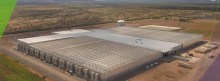
I recently had the privilege to tour Bayer’s new plant breeding facility outside Tucson. They describe the facility as enabling the transition from selecting genetics to designing genetics, which Bayer calls precision plant breeding.

Photo from Bayer’s website

The facility is 7 acres under greenhouse glass, replacing the need for 20,000 acres of farm ground. And because 365 days of the year make up the growing season, they get 3-4 entire crop cycles per year rather than 1. The facility is automated from start to finish, including full traceability for every seed that is planted into a germination tray all the way to seeds that are shipped out to be planted in field trials.

Not to mention, every seed is ‘chipped’, meaning a tiny sliver of the kernel is sliced off in order to run genomics testing so that selection decisions can be made from the combination of phenotype and genotype data.

The combination of these capabilities allows them to capture more data, apply high-powered analytics, and make better and faster decisions.

The name of the plant genetics game is speed, balanced against accuracy, so you can imagine how these capabilities complement one another. Bayer describes the net impact as moving 15x faster, realizing 4x genetic gain, and accelerating the genetic cycle by 30%, which has a compounding effect.

One of the presenters explained that achieving those 15x, 4x, and 30% outcomes is possible because of the emergence & convergence of multiple technologies simultaneously: greenhouse robotics & automation, plant genotyping, machine learning, massive cloud computing capacity, etc.

A very short time ago, the idea of capturing thousands of data points on every seed planted would have been completely unwieldy, let alone to do predictive analytics with that scale of data.

My takeaway is that this facility Bayer has assembled is not unique because of any individual technology but because of an incredibly rich tech stack.

It's not any one technology that is unlocking their genetic acceleration; it's the portfolio of technologies and how that portfolio has been assembled.

This is instructive for companies up and down the animal protein value chain…or any other value chain, tbh.

While a technology here or a technology there can create real value, competitive advantage is carved out both by assembling a tech stack, or a portfolio of tech solutions, that fits the company’s strategy.

You might even say that adopting a single technology solution is a way to create short-term competitive advantage, while assembling a strategic tech stack is a way to create long-term competitive advantage.

As I walked through the facility with trays of corn plants at various stages of development moving on tracks overhead from one part of the greenhouse to the next, I kept thinking how difficult it would be to replicate what Bayer has created and, perhaps more importantly, to replicate how they are using it.

That’s a competitive advantage; that’s a real moat…in this case, the moat is around their innovation engine. That seems likely to cast an even longer-term moat shadow.

Circling back to the idea from the Acquired podcast. While the Bayer presenters didn’t speak to this specifically, my hypothesis is that Bayer will see the impact of this precision breeding capability show up in the P&L primarily in the form of increased revenue as they launch more products of higher value. I think the Acquired podcast hosts would say that business is transitioning to become a truly tech-enabled business.

This is an extreme example, of course. Not every dairy or feedyard or poultry integrator is going to be able to make an investment like this, for starters, because those businesses do not have the same margin structure as an R&D-driven crop input company.

But the principle holds:

Short-term competitive advantage can be created by adopting individual technologies; long-term competitive advantage is created by assembling a portfolio of technologies that unlock a company’s business model strategy.

What a time to be alive😉


Categories
Meat Meat retail

Prime Future 140: Flip retained ownership on its tail.

Just for giggles, let’s play a game.

Imagine a world in which packers borrowed the retained ownership model and applied it to the meat case.

  • How would the risk & reward equation change for packers? for retailers?
  • How would incentives change?
  • What positive or negative impacts would be felt upstream, if any?

The background:

Much of the ag industry is structured around one thing: risk management. Ownership structures, commercial agreements, procurement models….all largely built around the equation of risk relative to reward.

Risk seekers want room to roll the dice to maximize upside, risk mitigators want to minimize the downside.

Almost every decision about buying or selling a commodity (however loosely defined) can be distilled down to an implicit risk/reward equation.

The setup:

A common model in US cattle feeding is retained ownership, in which a cow-calf producer or stocker will retain ownership of their cattle through the feedyard instead of outright selling the animals to the feedyard. If they sell the cattle to the feedyard then the feedyard owns the production & market risk on those animals, whereas if they retain ownership of those cattle then the producer or stocker owns the production & market risk on those animals.

Retained ownership of calves through feeding is not an uncommon model and it can have interesting implications for behavior. For example, a cow-calf producer who is going to make or lose money based on the live performance of an animal in the feedyard might make different decisions early on than a producer who sells weaned calves at the local auction barn.

Meanwhile the transaction between food retailer and packer remains largely the same: the retailer forecasts how much of each SKU they will need for any given time period and what price they will pay the packer. Of course there are different flavors on the transaction but at the end of the day it all comes down to $x per pound * y pounds = total amount retailer owes packer.

This standard arrangement has implications:

(1) The burden of forecasting how much fresh meat will sell through the meat case rests with the retailers.

But demand planning is a tricky business. Underestimate demand and the meat case will sit empty, overestimate demand on fresh meat that has a very real expiration date means when that meat is sold in the spot market it’s a fire sale situation.

Both are bad. So this capability of demand planning is critical to the P&L of the meat department at any retailer. Part of the challenge is that you’re forecasting multiple variables at once; get any one of them wrong and you get the whole picture wrong.

(2) Then there’s the portfolio effect for retailers.

Aka how the meat case lever is positioned within the food retailer’s broader strategy.

(3) Meanwhile the big challenge for packers is the idea of balancing the carcass.

Balancing the carcass means selling the primals at an equivalent rate relative to their percent of the carcass. This is a continual high-wire act because not all cuts are in equivalent demand at any one time, it’s why in times of high wing demand chicken processors wish for an 8 winged chicken.

The thought exercise:

So let’s apply that retained ownership model to the meat case and play it out. What if the retained ownership model was used by packers to retain ownership of fresh meat through the meat case until the end consumer purchases it?

This would mean retailers could adopt what cattle feeders call the “hotel model” where the cattle feeder gets paid a flat rate by customers for the use of that space (and management, feed, meds, etc). So imagine the retailer gets paid a lease fee by the packer for the use of their retail meat case.

In theory, it completely shifts the burden of demand planning to the packer who….drum roll please….has an even bigger incentive to get demand planning right.

One meat industry friend put it this way when I posed our scenario:

It would allow packers to be radical in retail pricing to balance the carcass. An example is strips and ribeye steaks are most often priced the same at retail but the primal values are wildly different. This makes demand uneven so if we could drive pricing off actual primal values, then we could better balance demand for the carcass.”

At the highest level, I’d summarize the pros & cons this way:

Although, perhaps you could make the argument that for those retailers who are less good at demand planning and therefore often have revenue loss from being out of stock or fire sale’ing excess fresh meat, perhaps on a net basis they could wind up in a better position through this model?

On the other hand, for some packers the idea of a bird in the hand (relatively fixed price per pound) might be better than the potential upside of the riskier model.

But let’s say this became a thing. If packers can own the meat through the meat case at retail, why can't the stocker who retains ownership of their cattle through the feedyard, retain ownership through the plant or all the way through the meat case?

The absurd thought experiment:

Now let your imagination really run wild, what if a cow-calf producer could retain ownership all the way through the meat case?

This would take deep pockets because the cash cycle in this scenario is 18+ months. That’s a while and likely few producers would have the appetite for that type of timeline unless the return were significantly higher.

It also makes me wonder if this type of arrangement wouldn’t lead to more vertical integration into cow-calf production. Specifically, it makes me wonder what would have to be true for vertical integration in beef to happen at scale, but more on that another time.

But maybe this is all silliness and would never happen for reasons I’ve totally missed here:

  1. I’d love to know those reasons.
  2. What’s a better hypothetical alternative to business as usual at the meat case?
Categories
Leadership

Prime Future 139: Working Genius

If you’ve been around here very long, you know my obsession with this idea from Allen Nation:

“The innovative farmer is seen by his farm neighbors as a lunatic farmer. And a lunatic is not seen as a role model. As a result, what the innovator does on his/her farm is literally invisible to the neighbors. This is true even if the innovation is producing visible wealth. The normal reaction to unconventional success is the old it-might-work-there-but-not-here syndrome.

The sad truth is that the vast majority of farmers prefer to fail conventionally rather than to succeed unconventionally. It is very, very difficult to be more innovative than the community in which you live.”

(Turns out Nation was paraphrasing the economist John Maynard Keynes who made the observation that most humans would rather fail conventionally than succeed unconventionally. Checks out, doesn’t it?)

Lunatic farmers make agriculture dynamic. They are the single most interesting thing this industry has going for it, IMO.

It’s fascinating talking with farmers who have a drastically different business today than they did 30, 20, or even 5 years ago. They’ve 10x’d capacity, created a new market, or redesigned their business model….or they’ve done some magical combination of all 3.

I always wonder what separates these lunatic farmers from the farmers whose businesses only incrementally change with time and the slow carving of going with the flow of traditional market forces.

A lot of things could explain the gap: attitude, skills, relationships, market timing, location, access to capital. The list goes on.

But increasingly, I think it’s all about the decision maker(s) DNA.

I’m a sucker for tools like StrengthsFinders or the Enneagram, tools that help us better understand ourselves and other people and how to be more effective doing work that involves people (aka all work). None of these tools are perfect but most of them offer some little nugget to increase self-awareness and effectiveness.

I recently found a new one called Working Geniuses by Patrick Lencioni. And it hit me that this theory likely explains a super high percentage of what makes lunatic farmers lunatics.

See it? The lunatic farmers are the ones whose Working Genius leads to 10x’ing a business, who naturally derive energy and joy from doing the things that radically drive their business whether strategic planning, forging new markets & customers, implementing win-win partnerships that allow both sides to grow their business profitably, or exploiting (in the good way) emerging trends and technology.

The lunatic farmer derives energy & joy from doing things that drain energy & joy from the average farmer.

From Patrick Lencioni’s ‘Working Genius Assessment’

Lencioni’s theory is that each person has 2 areas of Working Genius, 2 areas of Working Competency, and 2 areas of Working Frustration.

It’s not about what someone’s geniuses are, it’s about how they put them to work.

If the Working Genius model is true, then those same producers whose own Working Geniuses are the DNA that drives their business to continually higher levels also have 2 areas of Working Frustrations, things that drain their energy.

My hypothesis is that lunatic farmers with 10x capabilities are the ones who put their own geniuses to work and then find business partners with complementary working geniuses.

The book First Friends: The Powerful, Unsung (And Unelected) People Who Shaped Our Presidents illustrates this idea in politics. But the pattern is everywhere: the visionary leader with the execution-focused partner, the partnership-centric CEO with the get-it-done COO, the agronomic wunderkind working with the markets guru, the production-focused partner and the customer-focused partner, etc.

So the idea of being fiercely collaborative at an organization level is directly connected to this idea of maximizing return on all the things (opportunity, talent, capital, joy) by smartly collaborating at an individual level.

Lunatics who get 10x results do both. Long-term games with long-term people.

Categories
Leadership Supply Chain

Prime Future 138: The future is fiercely collaborative.

This week we throwback to Prime Future 68 as a welcome to new followers & as the setup for next week.


There’s a local ranching family that’s been raising cattle on the same land for 7 generations. In that time they have not sold an acre of land, not one. They have withstood droughts, drug cartel activity, wildlife predators, market crashes, high interest rates. You name it, they’ve survived it.

Some years ago they got into a lil spat with the US government over the renewal terms for grazing permits on public land, so the federal government rounded up the family’s cattle that were on public lands and kindly delivered them to the sale barn.

Someone recently summarized the family’s mentality this way, “They are  fiercely independent, they just don’t trust anyone. Then again, that’s probably how they’ve survived and why they’re still ranching.”

This struck me. I have a deep respect for the challenges producers face and the resilience they embody….but I wonder if that fierce independence won’t actually work against producers in a rapidly evolving world where collaboration is rewarded more than independence. (And though this first example is a rancher, every segment of the value chain has players with a similar mentality, a transactional ‘us vs everyone else’ mentality.)

Collaborating raises new questions, new situations, new risks to manage…and new opportunities. If done thoughtfully and effectively, new collaborators can grow the pie (and it’s individual slices) in ways that independent actors cannot.

In today’s world, mastering the art of highly effective collaboration increases the probability of survival.

Let’s start with one of the most successful examples of a systems approach, one that has stood the test of time: McDonald’s. (If you aren’t familiar with the 3 legged stool model, here’s a good primer.)

Each supply category has a limited number of suppliers that are held to very high standards but rewarded with high volumes of business, typically on a cost plus basis. Suppliers do not float in and out of the system frequently, these are not transactional relationships – they are partnerships built for the long term.

Now contrast the McDonald’s system with two alternative structures that land in different places along the continuum of Transactional to Collaborative, the independent rancher and the contract poultry grower:

  1. Let’s assume the rancher sells weaned calves at the sale barn, the epitome of price taking at the market’s daily whims. The definition of transactional – the buyer is literally whoever is willing to pay the most on any given day.
  2. Let’s assume the contract poultry grower supplies the labor and facilities, then executes the management program prescribed by the poultry integrator. The grower is paid on a $.xx/lb produced with some level of base pay that is set, and the remainder of pay determined by how the contract grower’s live performance stacks up against the flocks that are processed that week (the lottery system).

Regardless of the business (weaned pigs, broilers, or hamburger patties), it seems there are 3 core drivers around engaging in collaborative ecosystems with dedicated partners:

  1. Profit. Maybe its about finding higher value races to the top of the value pyramid, rather than vice versa. Maybe it’s about cost plus arrangements that may not maximize revenue on a given transaction, but could look smart over the long haul and the ups & downs of market cycles.
  2. Predictability. Creating predictable revenue can radically impact business planning and operations. Some would prefer to make $.1/lb day in day out, some would prefer to make $1.00/lb on 1 load knowing they might lose $.90/lb on the next.
  3. Potential (long term growth). What’s the growth potential of the ecosystem? Is this a chance to grow the pie and grow your business accordingly?

Below is a rough analysis of how different systems compare – maybe these are over or under stated, but the big idea is that there are tradeoffs under each model.

🙂=sufficient. 😃=heck yeah. 😑=maybe? 😂=that’s funny.

Of course this doesn’t capture some of the intangible tradeoffs of collaborative partnerships, like losing some degrees of freedom. I think my real point is that there are increasingly more alternative ways to approach business models and these alternatives should be considered.

  1. What is the upside potential? Downside risk?
  2. What are the tradeoffs compared with the risks of the status quo?
  3. Are those tradeoffs bearable compared to the next best alternative?

The answer to those questions will always be situation/people/goal dependent.

And I’m no Pollyana – there are risks with entering partnerships where multiple parties are reliant on one another. The obvious caveat is that not all systems are created equal; not all partners are good partners, not all collaborations are worthy bets. Sometimes the business model isn’t right, sometimes the leadership isn’t right…or any other number of reasons that a system doesn’t work out.

One of the most practical pieces of advice came from my friend’s dad: when you create a plan to enter a partnership, create the plan for how you will exit the partnership.

(Those of you much more seasoned than me are probably nodding your head vigorously at that advice since you’ve seen the dangers of not preparing for partnership dissolution in advance. “Hope for the best, prepare for the worst” and whatnot.)

A great irony from a producer standpoint is that although it might be easy to reject taking on the risk of entering partnerships, the fewer strategic alliances a producer makes with customers, by definition, the more reliant the producer is on commodity markets where price takers have zero control which introduces…risk.

Maybe the real questions are around where you want control (price? management freedom?), where you want predictability, and what type of risk you are willing to accept or are more comfortable managing.

I recently saw a list of about 30 aligned beef supply chains in the United States, here’s a snapshot of one. ‘Run our program to help us deliver a better product to our customers and we’ll all win’ is the summary idea. If you read Prime Future you know I think we’ll continue seeing more of these:

The above examples focus on how producers might engage supply chains & customers, but what about managing suppliers? I recently heard of a producer who decided to double down on supplier relationships by choosing one strategic supplier for every major input category. They gave up the transactional, shop-around-for-the-best-price-on-this-transaction in pursuit of the best supply arrangement on the next 1,000 transactions. Another dimension of a collaborative approach.

What does collaboration look like in Agtech?

Now let’s talk about where a collaborative mindset can drive progress in agtech:

  • Among co-founders – its doable to be a solo founder but as someone who hit The Great Wall of Burnout trying this route, I can tell you it is HARD and there is not an ounce of virtue in trying to defy the odds by being a solo founder.
  • Among founders and venture investors – there are huge tradeoffs in choosing to bootstrap a business which typically means slow and steady growth versus raising venture capital and committing to the high growth model. Neither is right or wrong, they are just different models with different paths.
  • Among founders and early customers – That early feedback from first customers – and how founders respond – can set the entire trajectory of an early stage company. Ask any successful tech company and they will tell you about the early customers who made them.
  • Among big companies and startups – each brings something to the table in terms of successfully scaling innovation, figuring out how to get the best of each can unlock magic.
  • Among startups and startups – the punishment for tech forward producers right now is that every single hardware/software product tends to have its own login. What farmer wants to login to multiple systems to manage their business? Zero. But not every company can be THE platform. This will drive partnerships that may not be what every company wants, but will drive customer experience and <drumroll please> grow the pie of tech adoption.

The best summary of those last points came from a recent Future of Ag podcast interview with Jim Ethington, an early employee of Climate Corp who is now CEO of Arable:

“We could have said we can’t afford to give up a piece of this pie and we’re going to go it alone but that’s not the path that moves the industry forward. …we can all be good at our pieces and hey sometimes we compete, most of the time we can collaborate but that’s what moves the industry forward.…being able to put the puzzle pieces together where 1+1 = 3 for the customer.

What if they try to replace us? Come in with the assumption that a) it doesn’t matter because this integration is what the customer wants – start with the customer and work backwards, and they want one integrated system. …and b) when this plays out even at the largest companies in the world…guess what their roadmap is full. ….everybody’s roadmap is packed – don’t flatter yourself they aren’t going to go build your product. And if they do, they were probably going to anyway and your partnership didn’t do anything to accelerate it. I think you have to let go a little bit and go back to the customer problem, growing the pie, making this a better overall technology space….and put aside the natural fears of what risks does this pose to us. The benefits outweigh the risks because those fears usually aren’t as real as you think.”

Does an independence-at-all-cost mentality create the trajectory to thrive in the ag economy of the future?

There’s perseverance in independence that will get you somewhere.

But my hypothesis is that moving forward it will be the smart collaborators who channel that same perseverance for the sake of a larger business objective who will win; those who grow the pie in a way that creates long term value for every link in their chain.

…aka the spoils will go to the effective collaborators. The collaborative’ists, if you will.

“If you want to go fast go alone; if you want to go far go together.”

What a time to be alive 😉


Did you miss early editions of Prime Future?

Access an ebook with editions 1 through 81 here: Prime Future PDF

Get the ebook

Categories
Emerging Tech Funding Venture Capital

Prime Future 137: It’s time to call it, farm mgmt software was a wash.

Riddle me this: What do you call a category of companies that raised a ton of venture capital and, a decade later, had not one sustainable business to show for it?

There are a few categories that are in the process of playing out as we speak, including plant-based meat, cell-based meat, and indoor farming. But each of those is still too early to call for sure, they are still playing out. Maybe they’ll fit the above description when the chapter closes, or maybe they’ll be raging successes. TBD.

But there’s another category that is 10+ years old, and a post-mortem is timely because, well, it’s basically commercially corpse-like.

The category is farm management software, the row crop genre.

Most would call farm management software companies Agtech 1.0. It was the wave that initially put agtech on the map, kicked off by Monsanto’s billion-dollar acquisition of Climate Corp in 2013.

Most companies in this category were started between 2005 and 2010. There were a bunch of these early companies that didn’t make it beyond Series A, sometimes attributed to the fact that they didn’t understand farmers or they didn’t get that not all farms operate the same or that a farmer growing corn & soy in Illinois is not the same as a diversified farm in Missouri is not the same as a vegetable farmer in Yuma, Arizona. But let’s ignore the majority of companies here.

Using back-of-the-envelope math on only the handful of companies that broke through and made it to an IPO or major acquisition, the final players alone raised over $400 million in venture capital.

And their acquirers (and in one case, public market investors) paid close to $2 billion in total, plus or minus $200 million.

So where are they now?

In general, they are running on fumes, are afterthoughts within their organizations, or have been divested entirely.

$400+ million in venture capital, ~$2 billion in acquisitions, and the row crop farm management category has not one sustainable business to show for it.

The major crop input companies acquired these farm management companies to jumpstart their own digital capabilities. By all accounts, these software products were intended to be functional, sustainable profit centers – able to stand on their own two feet like a real grown-up business.

For the most part, the idea behind the acquisition was to turn the data from farm management software into higher-value products like analytics or insurance (Climate Corp’s original thesis). But if the data isn’t good (clean), then the analytics are worthless. So then the common path was to downgrade the push for revenue to instead use free access to software as an incentive to switch to that company’s seed and chem products from their core portfolio.

I wonder if part of the issue was that farmers had been trained to expect access to farm management software at low to no cost by venture-subsidized businesses that were in all-out pursuit of growth.

The corollary is how Uber & Lyft used to be cheaper than a taxi, by far. Being cheaper and more convenient made it a no-brainer. Then Uber & Lyft went public and now what used to be a $15 ride is a $30 ride because it’s not venture subsidized and these companies have to stand on their own two feet. But that new (real) price for a rideshare is close to what a taxi costs and, especially at an airport,  it can be easier to grab a taxi than hunt for your Uber driver, the needle in a carstack. All of which changes the long term market for rideshare…just like farm mgmt software?

My hypothesis is that founders of Agtech 1.0 companies, and investors, had the hypothesis that farm management was a winner-take-all market. If you believe that only 1 or 2 players will dominate a market, then it is logical to invest aggressively in growth in order to be one of those winners.

But few markets are really winner-take-all.

In an industry such as farming where the potential user base is so diverse, their needs are so diverse, their business structure and profit margins are so diverse…the pie is so varied that it would be difficult for any one company to take the entire market, simply from a capability standpoint.

Perhaps the question that the agtech world should be asking itself, a decade+ in, is how to measure the success of a venture category. There are a few ways you could think about it:

  1. How much venture capital was raised? Everyone knows this isn’t a long term measure of value, but it does indicate something. Or sometimes it indicates something. But let’s agree it’s an insufficient metric at best and a vanity metric at worst.
  2. How many exits did the category have / how healthy were those exits? This is a much better indicator than #1, and it is certainly an indicator of success for founders and investors. But it’s like calling the game-winner at halftime.
  3. How commercially viable is the business over the long run? This is the only measure I know that reflects commercial reality; how much value is created for farmer customers and captured by the acquirers. Unless the test of time and commercial value is passed, then it was all just financial engineering and/or short term wins.
If we agree that #3 is the real measure, and after a decade of post-acquisition signals from the category, I think we have enough data points to say that in the end, this category was…a wash.

The caveat is that there are some niche examples of variations on farm management software where the above does not apply, often where the company has dialed in on a value proposition that is not simply storing & visualizing basic farm data but building higher value propositions. And some of those companies were not juiced in a big way by venture capital, they tended to grow more slowly over time. But overall, TBD on these.

So, what do we learn from agtech 1.0?

About pricing new products, and how people don’t tend to value what they don’t pay for.

About user experience and automating data entry.

About value creation….and that there has to be enough of it!

About how digital products matter strategically for incumbents, and that checking a box is not a strategy.

I also think there are lessons about aligning financing and business expectations with long-term customer interests. Agtech 1.0 created the opportunity, or revealed the opportunity, for sector-focused investors to have an edge over generalist VC’s simply by understanding the business of agriculture and its nuances.

While it’s time to call Agtech 1.0 a wash, I don’t think we can call it a bust.

It attracted capital and talent to a previously overlooked space. And even though you can’t point to individual significant long-term successes in this category, we can safely assume the learnings that founders, investors, strategics, and farmers had through this process has informed how Agtech 2.0, 3.0, 4.0…25.0 will play out.

How would you rate Agtech 1.0?

Oh and the whole thing of not knowing exactly how things will play out, isn’t that really a feature of creating and building the new, not a bug?

What a time to be alive 😉


Did you miss early editions of Prime Future?

Access an ebook with editions 1 through 81 here: Prime Future PDF

Get the ebook!