Categories
D2C Meat

Prime Future 60: Tighten the packer feedback loop

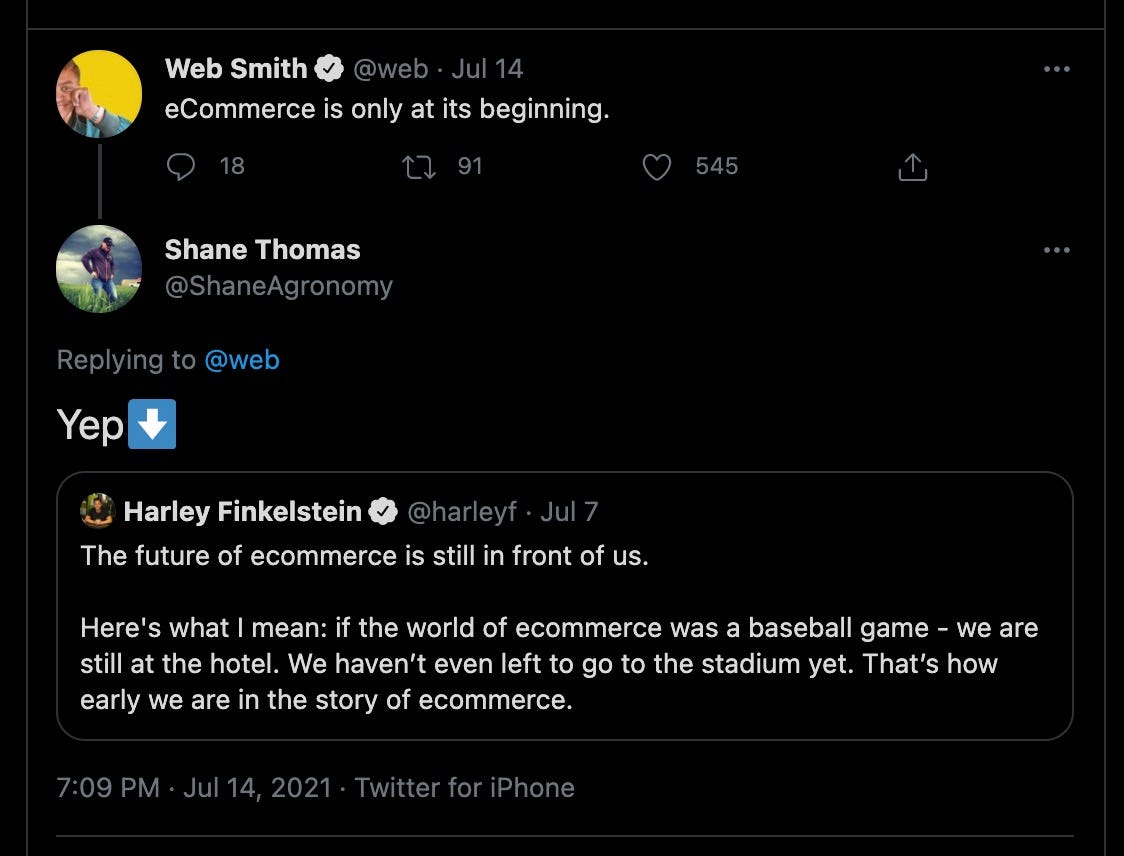
In early 2020 I went down the rabbit hole of exploring what D2C might mean for the meat business. Today I want to revisit some ideas from way back then but with the benefit of a little hindsight after the trend wildly accelerated during the pandemic. This tweet sets the directional stage for the obviousness that D2C is, and will continue to be, a thing for all segments, including meat:

So here’s the quick recap of my no longer provocative hypothesis:

Hypothesis: Direct to Consumer (D2C) business models will be a high growth sales channel for all meat & poultry companies within 5 years.

And to capitalize on the D2C trend, packers must get serious about building capability…soon.

For those who might say this market is still too small for packers to pay attention yet, remember in part 1 we talked about the Innovator’s Dilemma. Quick summary:

“Established companies see the early trends of new markets, they are just not structured or incentivized to act on them. Leaders at established companies must focus on market share and profitability of today’s largest customers & segments….not tomorrow’s.”

Given that D2C is definitively not going to suddenly be the largest sales segment overnight, why should packers focus there?

There are 2 obvious reasons:

  1. If COVID has taught us anything, its that a large segment of consumers are comfortable ordering online and want more ways to secure access to protein.
  2. As more companies seek to build brands and move closer to the consumer in order to increase margin, D2C presents an obvious opportunity.

Now let’s transition to the still relevant & under-appreciated elements around D2C, starting with this:
There’s a less obvious reason for packers to bet on D2C, one that could impact the packer’s ability to serve their entire customer portfolio.

The strategic reason to engage in D2C is to drastically increase visibility into consumer behavior.

To illustrate this point, here’s a case study from the insurance industry.

Back in the day insurance carriers built out the agent distribution system, so products and processes were built for selling through the distribution system. The carriers receive data related to policies sold. Now, many carriers are trying to figure out how to layer digital into the customer experience but its….clunky.

Contrast this with Lemonade, the homeowners insurance startup with a digital first experience for buyers that’s grown from $0 to $100M revenue in 3 years. As a digital first experience, shoppers not only buy their policy online, they also file claims online, most of which are settled with incredible speed.

So what? In its few years in existence, Lemonade has captured data about buyer behavior that provides them better insight to their buyer than the mega companies who have been in existence for decades.

Take <insert 100+ yr old insurance company>. That company captures data about buyers who purchased a policy. That’s it.

Meanwhile Lemonade is able to understand exactly how buyers moved through every inch of the buying process, such as:

  1. What options did they consider? Did they select one before going back to select another?
  2. Which options did the buyer take the most time to select?
  3. How far did the buyer get in the process before dropping out entirely?

And that’s just the tip of the iceberg.

This treasure trove of data informs Lemonade’s understanding of their target customer including buying behavior, which then informs Lemonade’s ability to improve the customer experience through better processes AND better products. The power of a shortened feedback loop.

Now let’s do the meat industry. Packers get point of sale data from retailers that tells them what a customer bought…that’s it. Meanwhile <name your digital first D2C company> understands the buyer’s behavior at a granular level, including which cuts a customer almost bought but didn’t, which cuts a customer bought once but never repeated, etc, etc, etc.

Think about how a packer could build a compelling competitive advantage in terms of marketing and product development not just in their D2C channel, but across retail and foodservice as well. Unlocking the power of a shortened feedback loop could power innovation and growth across the entire customer portfolio.

The packers are now dabbling with their 2 primary options:

  1. Supply a growing D2C platform as a customer
  2. Build their own D2C platform

Packers are approaching this opportunity differently, but it doesn’t take a crystal ball to see that this trend is here to stay.

My curiosity is not in how packers continue engaging this sales channel, but how the sales channel will impact their broader business via shortened feedback loops…and how might those impacts flow upstream to producers.

Here’s the original 3 part series on D2C & what it could mean for packers and producers:

  1. A D2C revolution is on its way
  2. The real reason packers should go all in on D2C
  3. Capturing the D2C Market: Farmers vs Packers

I’m interested in all things technology, innovation, and every element of the animal protein value chain. I grew up on a farm in Arizona, spent my early career with Elanco, Cargill, & McDonald’s before moving into the world of early stage startups.

I’m currently on the Merck Animal Health Ventures team. Prime Future is where I learn out loud. It represents my personal views only, which are subject to change…’strong convictions, loosely held’.

Thanks for being here,

Janette Barnard


Categories
Animal AgTech D2C Funding

Can grass fed beef scale in the USA? ButcherBox CEO & founder, Mike Salguero, paints a vision for it.


I am thrilled to share a conversation with Mike Salguero, founder & CEO of ButcherBox. If you’ve read Prime Future for more than a minute, you know I’m bullish on business models that leverage tech and reorganize supply chains in ways that create more value for producers (on one end) and consumers (the other end).

Enter ButcherBox.

ButcherBox was started in 2015 to “ship meat in the mail” with a focus on meat with claims that vary by protein. In the beef category, the company intended to sell grass fed beef which meant sourcing from Australia/New Zealand. But as their business matures, ButcherBox is looking to source grass fed beef in the US…a segment that does not currently exist at scale. There are several oft quoted “reasons this won’t work” that have to be eliminated in order for the US to develop a robust grass fed segment from genetics to pasture management to processing. It will take creativity, technology, incentive alignment, and a lot of time in front of the white board to figure out grass fed beef in the US but where there’s a market, there’s a way.

Mike is a tech entrepreneur turned meat industry believer who is building a brand for the long haul, as in 100-year-time-horizon. This is all the more interesting given Mike’s surprise when he started exploring the meat category that there (really) are no brands in meat, especially as retailers have dialed up private label offerings. But one segment’s miss is another segment’s opportunity, and here we are seeing how business model innovation can create value. Delicious.

I hope you enjoy Mike’s insights as much as I did. A few time points in time to highlight:

  • 7:30 minutes – Why the only early outside capital into ButcherBox was via a Kickstarter campaign, instead of the traditional venture capital model.
  • 14 minutes – Mike talks about some of the messy early challenges of getting ButcherBox off the ground.
  • 24 minutes – The 2 reasons ButcherBox customers are customers? Mike says its split between convenience (easy order, get a box the next day) and access (to meat with specific claims).
  • 31 minutes – Mike talks about the future of ButcherBox which has implications for retail (how consumers purchase meat) and livestock/meat value chain as they look at how to source grass fed beef, at scale, in the US.

Processing…
Success! You're on the list.

Categories
D2C

The 20 year overnight success story of Newman Farm: business model innovation in pork

Listen to this interview with David Newman on the Future of Agriculture podcast (link)

Building a moat is the only way to escape the tyranny of commodity markets, and in this podcast interview David Newman explains why Newman Farm began building a moat, and what they learned along the way.

This isn’t mom & pop stuff, this is business model innovation at scale.

20 years ago Newman Farm made the initial leap from a typical commodity hog operation using scale to manage costs, and began looking for value added opportunities. They ultimately found success selling a premium product directly to white table cloth restaurants. Then as restaurant sales slowed down due to COVID, Newman Farm flipped a switch and entered the direct to consumer business.

What’s clear from David is that making the shift from commodity to value added requires a transformation of every element of the business model:

  • Production decisions: Manage costs —> Increase value proposition
  • Commercialization: Manage commodity market volatility —> Create demand for a unique offering through a sales & marketing capability
  • Ecosystem: I am an independent operation —> I work with high quality partners, we all win and grow together
  • Capabilities: I can figure it out —> Identify & hire critical capabilities to grow

This conversation is for the packer considering the Direct to Consumer sales channel, the producer looking to margin up, or anyone interested in the clever evolution of business models.

Oh, and at the end of the podcast you’ll hear a short interview with the founder of Barn2Door, a software company enabling producers to quickly establish D2C sales capabilities. IMO this is such a smart tech play, it’s basically Shopify for producers.

Listen to David Newman on the Future of Agriculture podcast (link)

Thanks to Tim Hammerich, host of Future of Agriculture, for sharing the mic for this episode!

Processing…
Success! You're on the list.

Pre-Order The Investor’s Guide to Animal Protein (link)

I shared recently that I’m writing a book for investors & innovators about the challenges and opportunities for tech within animal agriculture and that I’m interested in talking with 25 investors and 25 producers in the process. Thanks to so many of you who already reached out to share your insights!

This week I spoke with Luis Azevedo, The Yield Lab partner and former Novus executive, and here are a few interesting quotes:

“There’s a vicious cycle because you have investors who only want to see animal health & nutrition or only want to see technologies for row crops so you miss the technologies or business models that could converge across both. So then the size of the market is smaller and no one is excited as they could be.”

“In the end there is more risk in animal ag because of complexity in scaling those businesses.”

“Animal health & nutrition business models are mostly transactional models. They develop a product, they promote it, they sell it. Meanwhile crop science companies not only develop and commercialize products, they are adding precision services that are changing the business models. More robust business models creates broader connection with producer and the belief that the program is the product.”

(Shoot me a message here if you are interested in sharing your view on animal ag innovation.)

Categories
D2C

The real reason packers should go all in on D2C

Hypothesis: Direct to Consumer (D2C) business models will be a high growth sales channel for all meat & poultry companies within 5 years.

And to capitalize on the D2C trend, packers must get serious about building capability…soon.

For those who might say this market is still too small for packers to pay attention yet, remember in part 1 we talked about the Innovator’s Dilemma. Quick summary:

“Established companies see the early trends of new markets, they are just not structured or incentivized to act on them. Leaders at established companies must focus on market share and profitability of today’s largest customers & segments….not tomorrow’s.”

Given that D2C isn’t going to be the largest segment overnight, why should packers focus there?

There are 2 obvious reasons:

  1. If COVID has taught us anything, its that a large segment of consumers are comfortable ordering online and want more ways to secure access to protein.
  2. As more companies seek to build brands and move closer to the consumer in order to increase margin, D2C presents an obvious opportunity.

There’s a less obvious reason though, one that could impact the packer’s ability to serve their entire customer portfolio.

The real reason packers should invest in D2C is to capture the broader benefit of drastically increased visibility into consumer behavior.

To illustrate this point, here’s a case study from the insurance industry.

Back in the day insurance carriers built out the agent distribution system, so products and processes were built for selling through the distribution system. The carriers receive data related to policies sold. Now, many carriers are trying to figure out how to layer digital into the customer experience but its….clunky.

Contrast this with Lemonade, the homeowners insurance startup with a digital first experience for buyers that’s grown from $0 to $100M revenue in 3 years. As a digital first experience, shoppers not only buy their policy online, they also file claims online, most of which are settled with incredible speed.

So what? In its few years in existence, Lemonade has captured data about buyer behavior that provides them better insight to their buyer than the mega companies who have been in existence for decades.

Take <insert 100+ yr old insurance company>. That company captures data about buyers who purchased a policy. That’s it.

Meanwhile Lemonade is able to understand exactly how buyers moved through every inch of the buying process, such as:

  1. What options did they consider? Did they select one before going back to select another?
  2. Which options did the buyer take the most time to select?
  3. How far did the buyer get in the process before dropping out entirely?

And that’s just the tip of the iceberg.

This treasure trove of data informs Lemonade’s understanding of their target customer including buying behavior, which then informs Lemonade’s ability to improve the customer experience through better processes AND better products. The power of a shortened feedback loop.

Now let’s do the meat industry. Packers get point of sale data from retailers that tells them what a customer bought…that’s it. Meanwhile <name the digital first D2C company> understands the buyer’s behavior at a granular level, including which cuts a customer almost bought but didn’t, which cuts a customer bought once but never repeated, etc, etc, etc.

Think about how a packer could build a compelling competitive advantage in terms of marketing and product development not just in their D2C channel, but across retail and foodservice as well. Unlocking the power of a shortened feedback loop could power innovation and growth across the entire customer portfolio.

The packers are dabbling with their 2 primary options:

  1. Supply a growing D2C customer
  2. Built their own D2C platform

(I have a hypothesis on a 3rd path but let’s save that for another day.)

Recently we’ve seen Cargill hiring a few ecommerce roles, JBS’ investment Wild Fork, and Perdue standing up their own ecommerce website. Good starting points. But the time for dabbling is gone.

It’s time to go all in, to drive a new era of innovation in the entire meat category through investment in the shortened feedback loops of D2C sales channels.

Processing…
Success! You're on the list.
Categories
D2C

Capturing the D2C Market: Farmers vs Packers

This is the 2nd article in a series about D2C models and their impact in the meat supply chain.

Hypothesis 1: Direct to Consumer (D2C) business models will be a high growth sales channel for all meat & poultry companies within 5 years. Hypothesis 2: D2C business models will accelerate as a high growth sales channel for farmers.

If we look at the beef industry, there’s always been a tension between packers and producers, largely tied to what percent of the consumer’s beef dollar that each segment of the value chain keeps.

But we’ll soon enter a new competition and in this round, producers and packers won’t be competing for margin.

They’ll be competing for customers. Who will capture the D2C market?

The large-scale beef industry was built for Business to Business (B2B) relationships. The mass beef supply chain is very, very good at what it was built to do: efficiently produce, process & sell beef at low cost.

  • Cow-calf producers specialize in getting calves on the ground and weaned to sell to stockers.
  • Stockers specialize in adding weight to calves and preparing them for the feedyard.
  • Feedyards specialize in putting weight on cattle before selling live cattle to packers.
  • Packers specialize in plant efficiency to lower per pound processing costs. Then packers sell large amounts of meat to large customers at varying specs depending on the customer.

The system works well; every participant focuses on what they do best. Specialization. Economies of scale. An economist’s dream come true.

And margins shift through the supply chain based on commodity cycles. Which raises a natural tension. While processors are operating at record high margins today, producers are…not.

And with declining margins, producers are actively looking for ways to capture more value.

With the unfolding COVID-19 chaos in boxed beef & live cattle markets as well as the consumer frenzy at retail leaving empty shelves, consumers are swarming looking for alternative sources to stock up on meat. Local farmers and D2C to the rescue.

The last several years I’ve seen friends using social media to sell a few head at a time for freezer beef to friends & family, but that’s now expanding. <Pre-Covid this trend was expanding, now its exploding> Not only are more producers looking to cut out the rest of the supply chain and go direct, they’re scaling their efforts and doing it with increased sophistication. The rise of easy to use online tools for things like building a website, digital marketing, and payment processing is enabling producers to feed cattle to market weight, process locally, and sell directly to consumers.

Technology is enabling a segment of the supply chain to reorganize itself to connect cattle producers directly with consumers.

And, the Direct to Consumer (D2C) supply chain is built around the consumer. The D2C supply chain is optimized for the consumer experience.

Contrast that with the conventional beef supply chain that is optimized for B2B customers, for efficiency at scale.

There’s a Harvard Business Review article that says all businesses must pick a max of 2 dimensions from the following 3, on which to compete:

  • Better (quality)
  • Faster (speed)
  • Cheaper (price)

Packers have optimized for efficiency as they compete against one another on price. That’s the nature of a commodity business. Its also why, in the search to move away from commodity price competition, in the last few years there has been a wave of packers building/acquiring “premium” brands whether grass fed, Wagyu, etc.

But in recent years across the broader economy, there’s growing demand for companies that compete on a 4th dimension: customer experience.

Customer experience can mean a lot of things, here are a few examples:

  • Convenience – flexibility in ordering, delivery, right-sized portions
  • Wow factor – packaging, meal ideas, etc.
  • Community – is there a reason your customer would want to connect with others like them/you, and are you creating a way for them to do so?
  • How are you creating an experience your customer wants to share on Instagram?

What advantages do farmers/producers have going for them?

They have a story to tell. A local connection. A quality message. An experience to offer. Families with a picture of two adorable little cowgirls above (my nieces??), that show the love and heritage in raising beef. And they have the added benefit of simply not being a large institution, in an era of lack of trust in large institutions.

But there are challenges. Food safety liabilities, distribution, cost of customer acquisition. As more cattle producers look to sell directly to consumers and technology enables them to expand their reach, the biggest bottleneck becomes processing capacity. Let’s assume someone solves for this bottleneck though. Not only will the producer capture more margin than if they’d sold into the traditional supply chain, they’ll likely capture a higher percent of a high price.

And as more product goes directly from producer to consumer, more product bypasses both packer and retailer. The supply chain bifurcates at this point; how much beef that goes through the major packers today will instead go through local/regional processors in 5 years? 10 years?

I am, of course, not suggesting a majority of meat will sell through D2C channels. Retail, foodservice, and export will continue to dominate.

But D2C will be the fastest growing sales channel this decade. A sales channel that will demand packers engage in it. Which then creates a bifurcation point in the supply chain of how much meat sells through D2C channels in 5 years, 10 years…and more interestingly, is that additive or at the expense of the traditional retail channels?

The packers will always win the volume game, they’ll always win the competition of lowest cost to process in order to sell the “mountain of meat”.  Packers can process cattle at a much lower cost. They have economies of scale along every dimension. They have cattle supply. Those are not insignificant advantages. Are packers prepared to compete on consumer experience? Of course not.

But let’s face it, <insert packer name> doesn’t have the capability today to market directly to consumers like a ButcherBox would.

Packers and farmers will compete for the D2C market on different dimensions, likely attracting different customers with different buying motivations.

So, what will it look like for packers to compete in the D2C market?

We’ll discuss in part 3, stay tuned.

Processing…
Success! You're on the list.
Categories
D2C

A D2C Revolution Is On Its Way

Hypothesis: Direct to Consumer (D2C) business models will be a high growth sales channel for all meat & poultry companies within 5 years.

I wrote that sentence 3 weeks ago.

3 weeks before the whiplash shift in demand from ~50% of animal protein sold through foodservice to ~85% moving through retail sales channel amidst the global COVID-19 pandemic.

3 weeks before we saw meat cases empty as quickly as grocery store workers could fill them.

COVID-19 doesn’t change my hypothesis, it accelerates its race to reality.

In this first of a three part series, we’ll look at the proof points supporting the hypothesis above.

At a recent meat industry conference for packers & retailers, I asked around about what folks think about ButcherBox and similar D2C models. Responses ranged from “never heard of them” to “remind me what they do?” Except for those paying attention to ButcherBox who responded with raging enthusiasm.

That same week, I asked my Instagram followers if they’ve used ButcherBox or the like and feedback on the product & experience. Of ~100 people who saw the question, ~40 had either used ButcherBox themselves or had a family member who had.

Here’s what this highly unscientific research tells me:

  1. Consumers are dialed into companies that allow them to buy what they want, when they want, how they want.
  2. Packers are dialed into selling meat the way we’ve always sold meat, through retail, foodservice, or export channels.

Now with the pandemic among us and grocery stores often sparse, even consumers who’ve never bought food through delivery apps are doing so, or through D2C services. (If ButcherBox were publicly traded I’d be buying stock right now based on what I assume can only be massive explosion in sales over the last 10 days.)

What is ButcherBox? It’s a subscription service for meat & poultry. You sign up online, you select the composition of your box, you receive a box at your doorstep.

Look up ButcherBox on Crunchbase, a company that tracks all funding rounds for startups, and you’ll see that ButcherBox raised $210,000. Five years ago. (In the pre-corona world, this is like saying they raised 2 nickels.)

What does that tell us?

  1. ButcherBox is growing.
  2. ButcherBox is growing profitably. In the world of startups and D2C business models, profitable growth is the holy grail.

Contrast the ButcherBox story with Blue Apron, one of several meal kit delivery services whose growth was largely fueled by venture capital then effectively dismissed by public market investors looking for profitable growth, not growth at all costs. Caveat: Blue Apron is having a COVID-19 renaissance as consumers are re-activating an appetite for meal kit delivery. Is this a permanent trend or just a moment in time? We’ll find out.

Bottom line: ButcherBox has proven the D2C business model works…at scale.

They’ve proven there is consumer demand for D2C meat & poultry and that at least some consumers are willing to pay for this service. More interestingly, multiple variations of this business model have popped up recently: we’re in the early Wild West days of D2C in animal protein.

And the experience many consumers are having amidst COVID19 of seeing meat cases empty at the grocery store will leave a mark; a mark that is likely to drive many consumers further towards either wanting to fill up a freezer with meat OR have a reliable subscription service that will deliver meat even when the grocery store’s meat case has been picked clean.

So back to the beginning – why did a conference full of packers & retailers not know anything / not want to talk about the rise of D2C business models?

That’s easy, it’s the Innovator’s Dilemma.

When big companies are disrupted by upstarts, many assume it was because the big co didn’t see what the upstart saw, e.g. Kodak, Blockbuster. But author Dr. Clayton Christenson argues that big companies see the early trends just fine, they just are not positioned, structured, or incentivized to act on early trends. Leaders at established companies have to focus on market share and profitability of today’s largest customers. For packers, that means ignoring ButcherBox and its peers who represent a fraction of a percent of total meat dollars at present, in order to focus on growing market share and profitability with large retail and foodservice customers. This is rational behavior.

The trick will be, how quickly do packers jump on the growing trend of D2C? Wait too long and there’s the risk of “disruption”. Jump too early and the market may not be fully developed, leaving an unprofitable sales channel in the short run.

Further complicating the matter is that D2C companies stand to not only disrupt packers, food retailers are also at risk.

And with a trend that’s been building for years now compounded by consumers being quarantined in their homes for weeks, potentially months?  

Demand for D2C will accelerate. The only question is how the meat industry will capitalize.

Check out the rest of this series.

Processing…
Success! You're on the list.