Categories
D2C

The real reason packers should go all in on D2C

Hypothesis: Direct to Consumer (D2C) business models will be a high growth sales channel for all meat & poultry companies within 5 years.

And to capitalize on the D2C trend, packers must get serious about building capability…soon.

For those who might say this market is still too small for packers to pay attention yet, remember in part 1 we talked about the Innovator’s Dilemma. Quick summary:

“Established companies see the early trends of new markets, they are just not structured or incentivized to act on them. Leaders at established companies must focus on market share and profitability of today’s largest customers & segments….not tomorrow’s.”

Given that D2C isn’t going to be the largest segment overnight, why should packers focus there?

There are 2 obvious reasons:

  1. If COVID has taught us anything, its that a large segment of consumers are comfortable ordering online and want more ways to secure access to protein.
  2. As more companies seek to build brands and move closer to the consumer in order to increase margin, D2C presents an obvious opportunity.

There’s a less obvious reason though, one that could impact the packer’s ability to serve their entire customer portfolio.

The real reason packers should invest in D2C is to capture the broader benefit of drastically increased visibility into consumer behavior.

To illustrate this point, here’s a case study from the insurance industry.

Back in the day insurance carriers built out the agent distribution system, so products and processes were built for selling through the distribution system. The carriers receive data related to policies sold. Now, many carriers are trying to figure out how to layer digital into the customer experience but its….clunky.

Contrast this with Lemonade, the homeowners insurance startup with a digital first experience for buyers that’s grown from $0 to $100M revenue in 3 years. As a digital first experience, shoppers not only buy their policy online, they also file claims online, most of which are settled with incredible speed.

So what? In its few years in existence, Lemonade has captured data about buyer behavior that provides them better insight to their buyer than the mega companies who have been in existence for decades.

Take <insert 100+ yr old insurance company>. That company captures data about buyers who purchased a policy. That’s it.

Meanwhile Lemonade is able to understand exactly how buyers moved through every inch of the buying process, such as:

  1. What options did they consider? Did they select one before going back to select another?
  2. Which options did the buyer take the most time to select?
  3. How far did the buyer get in the process before dropping out entirely?

And that’s just the tip of the iceberg.

This treasure trove of data informs Lemonade’s understanding of their target customer including buying behavior, which then informs Lemonade’s ability to improve the customer experience through better processes AND better products. The power of a shortened feedback loop.

Now let’s do the meat industry. Packers get point of sale data from retailers that tells them what a customer bought…that’s it. Meanwhile <name the digital first D2C company> understands the buyer’s behavior at a granular level, including which cuts a customer almost bought but didn’t, which cuts a customer bought once but never repeated, etc, etc, etc.

Think about how a packer could build a compelling competitive advantage in terms of marketing and product development not just in their D2C channel, but across retail and foodservice as well. Unlocking the power of a shortened feedback loop could power innovation and growth across the entire customer portfolio.

The packers are dabbling with their 2 primary options:

  1. Supply a growing D2C customer
  2. Built their own D2C platform

(I have a hypothesis on a 3rd path but let’s save that for another day.)

Recently we’ve seen Cargill hiring a few ecommerce roles, JBS’ investment Wild Fork, and Perdue standing up their own ecommerce website. Good starting points. But the time for dabbling is gone.

It’s time to go all in, to drive a new era of innovation in the entire meat category through investment in the shortened feedback loops of D2C sales channels.

Processing…
Success! You're on the list.
Categories
D2C

Capturing the D2C Market: Farmers vs Packers

This is the 2nd article in a series about D2C models and their impact in the meat supply chain.

Hypothesis 1: Direct to Consumer (D2C) business models will be a high growth sales channel for all meat & poultry companies within 5 years. Hypothesis 2: D2C business models will accelerate as a high growth sales channel for farmers.

If we look at the beef industry, there’s always been a tension between packers and producers, largely tied to what percent of the consumer’s beef dollar that each segment of the value chain keeps.

But we’ll soon enter a new competition and in this round, producers and packers won’t be competing for margin.

They’ll be competing for customers. Who will capture the D2C market?

The large-scale beef industry was built for Business to Business (B2B) relationships. The mass beef supply chain is very, very good at what it was built to do: efficiently produce, process & sell beef at low cost.

  • Cow-calf producers specialize in getting calves on the ground and weaned to sell to stockers.
  • Stockers specialize in adding weight to calves and preparing them for the feedyard.
  • Feedyards specialize in putting weight on cattle before selling live cattle to packers.
  • Packers specialize in plant efficiency to lower per pound processing costs. Then packers sell large amounts of meat to large customers at varying specs depending on the customer.

The system works well; every participant focuses on what they do best. Specialization. Economies of scale. An economist’s dream come true.

And margins shift through the supply chain based on commodity cycles. Which raises a natural tension. While processors are operating at record high margins today, producers are…not.

And with declining margins, producers are actively looking for ways to capture more value.

With the unfolding COVID-19 chaos in boxed beef & live cattle markets as well as the consumer frenzy at retail leaving empty shelves, consumers are swarming looking for alternative sources to stock up on meat. Local farmers and D2C to the rescue.

The last several years I’ve seen friends using social media to sell a few head at a time for freezer beef to friends & family, but that’s now expanding. <Pre-Covid this trend was expanding, now its exploding> Not only are more producers looking to cut out the rest of the supply chain and go direct, they’re scaling their efforts and doing it with increased sophistication. The rise of easy to use online tools for things like building a website, digital marketing, and payment processing is enabling producers to feed cattle to market weight, process locally, and sell directly to consumers.

Technology is enabling a segment of the supply chain to reorganize itself to connect cattle producers directly with consumers.

And, the Direct to Consumer (D2C) supply chain is built around the consumer. The D2C supply chain is optimized for the consumer experience.

Contrast that with the conventional beef supply chain that is optimized for B2B customers, for efficiency at scale.

There’s a Harvard Business Review article that says all businesses must pick a max of 2 dimensions from the following 3, on which to compete:

  • Better (quality)
  • Faster (speed)
  • Cheaper (price)

Packers have optimized for efficiency as they compete against one another on price. That’s the nature of a commodity business. Its also why, in the search to move away from commodity price competition, in the last few years there has been a wave of packers building/acquiring “premium” brands whether grass fed, Wagyu, etc.

But in recent years across the broader economy, there’s growing demand for companies that compete on a 4th dimension: customer experience.

Customer experience can mean a lot of things, here are a few examples:

  • Convenience – flexibility in ordering, delivery, right-sized portions
  • Wow factor – packaging, meal ideas, etc.
  • Community – is there a reason your customer would want to connect with others like them/you, and are you creating a way for them to do so?
  • How are you creating an experience your customer wants to share on Instagram?

What advantages do farmers/producers have going for them?

They have a story to tell. A local connection. A quality message. An experience to offer. Families with a picture of two adorable little cowgirls above (my nieces??), that show the love and heritage in raising beef. And they have the added benefit of simply not being a large institution, in an era of lack of trust in large institutions.

But there are challenges. Food safety liabilities, distribution, cost of customer acquisition. As more cattle producers look to sell directly to consumers and technology enables them to expand their reach, the biggest bottleneck becomes processing capacity. Let’s assume someone solves for this bottleneck though. Not only will the producer capture more margin than if they’d sold into the traditional supply chain, they’ll likely capture a higher percent of a high price.

And as more product goes directly from producer to consumer, more product bypasses both packer and retailer. The supply chain bifurcates at this point; how much beef that goes through the major packers today will instead go through local/regional processors in 5 years? 10 years?

I am, of course, not suggesting a majority of meat will sell through D2C channels. Retail, foodservice, and export will continue to dominate.

But D2C will be the fastest growing sales channel this decade. A sales channel that will demand packers engage in it. Which then creates a bifurcation point in the supply chain of how much meat sells through D2C channels in 5 years, 10 years…and more interestingly, is that additive or at the expense of the traditional retail channels?

The packers will always win the volume game, they’ll always win the competition of lowest cost to process in order to sell the “mountain of meat”.  Packers can process cattle at a much lower cost. They have economies of scale along every dimension. They have cattle supply. Those are not insignificant advantages. Are packers prepared to compete on consumer experience? Of course not.

But let’s face it, <insert packer name> doesn’t have the capability today to market directly to consumers like a ButcherBox would.

Packers and farmers will compete for the D2C market on different dimensions, likely attracting different customers with different buying motivations.

So, what will it look like for packers to compete in the D2C market?

We’ll discuss in part 3, stay tuned.

Processing…
Success! You're on the list.
Categories
D2C

A D2C Revolution Is On Its Way

Hypothesis: Direct to Consumer (D2C) business models will be a high growth sales channel for all meat & poultry companies within 5 years.

I wrote that sentence 3 weeks ago.

3 weeks before the whiplash shift in demand from ~50% of animal protein sold through foodservice to ~85% moving through retail sales channel amidst the global COVID-19 pandemic.

3 weeks before we saw meat cases empty as quickly as grocery store workers could fill them.

COVID-19 doesn’t change my hypothesis, it accelerates its race to reality.

In this first of a three part series, we’ll look at the proof points supporting the hypothesis above.

At a recent meat industry conference for packers & retailers, I asked around about what folks think about ButcherBox and similar D2C models. Responses ranged from “never heard of them” to “remind me what they do?” Except for those paying attention to ButcherBox who responded with raging enthusiasm.

That same week, I asked my Instagram followers if they’ve used ButcherBox or the like and feedback on the product & experience. Of ~100 people who saw the question, ~40 had either used ButcherBox themselves or had a family member who had.

Here’s what this highly unscientific research tells me:

  1. Consumers are dialed into companies that allow them to buy what they want, when they want, how they want.
  2. Packers are dialed into selling meat the way we’ve always sold meat, through retail, foodservice, or export channels.

Now with the pandemic among us and grocery stores often sparse, even consumers who’ve never bought food through delivery apps are doing so, or through D2C services. (If ButcherBox were publicly traded I’d be buying stock right now based on what I assume can only be massive explosion in sales over the last 10 days.)

What is ButcherBox? It’s a subscription service for meat & poultry. You sign up online, you select the composition of your box, you receive a box at your doorstep.

Look up ButcherBox on Crunchbase, a company that tracks all funding rounds for startups, and you’ll see that ButcherBox raised $210,000. Five years ago. (In the pre-corona world, this is like saying they raised 2 nickels.)

What does that tell us?

  1. ButcherBox is growing.
  2. ButcherBox is growing profitably. In the world of startups and D2C business models, profitable growth is the holy grail.

Contrast the ButcherBox story with Blue Apron, one of several meal kit delivery services whose growth was largely fueled by venture capital then effectively dismissed by public market investors looking for profitable growth, not growth at all costs. Caveat: Blue Apron is having a COVID-19 renaissance as consumers are re-activating an appetite for meal kit delivery. Is this a permanent trend or just a moment in time? We’ll find out.

Bottom line: ButcherBox has proven the D2C business model works…at scale.

They’ve proven there is consumer demand for D2C meat & poultry and that at least some consumers are willing to pay for this service. More interestingly, multiple variations of this business model have popped up recently: we’re in the early Wild West days of D2C in animal protein.

And the experience many consumers are having amidst COVID19 of seeing meat cases empty at the grocery store will leave a mark; a mark that is likely to drive many consumers further towards either wanting to fill up a freezer with meat OR have a reliable subscription service that will deliver meat even when the grocery store’s meat case has been picked clean.

So back to the beginning – why did a conference full of packers & retailers not know anything / not want to talk about the rise of D2C business models?

That’s easy, it’s the Innovator’s Dilemma.

When big companies are disrupted by upstarts, many assume it was because the big co didn’t see what the upstart saw, e.g. Kodak, Blockbuster. But author Dr. Clayton Christenson argues that big companies see the early trends just fine, they just are not positioned, structured, or incentivized to act on early trends. Leaders at established companies have to focus on market share and profitability of today’s largest customers. For packers, that means ignoring ButcherBox and its peers who represent a fraction of a percent of total meat dollars at present, in order to focus on growing market share and profitability with large retail and foodservice customers. This is rational behavior.

The trick will be, how quickly do packers jump on the growing trend of D2C? Wait too long and there’s the risk of “disruption”. Jump too early and the market may not be fully developed, leaving an unprofitable sales channel in the short run.

Further complicating the matter is that D2C companies stand to not only disrupt packers, food retailers are also at risk.

And with a trend that’s been building for years now compounded by consumers being quarantined in their homes for weeks, potentially months?  

Demand for D2C will accelerate. The only question is how the meat industry will capitalize.

Check out the rest of this series.

Processing…
Success! You're on the list.
Categories
Uncategorized

Agriculture’s next AI: Augmenting Innovation

“For startups, 2010 – 2020 was about disrupting, 2020 – 2030 will be about augmenting. Its saying here’s what you as incumbents do well, here’s what we as tech startups do well, here’s how we combine the two to provide a better customer experience.”

This is a quote from a financial technology (fintech) founder talking about how fintech startups have/will interact with incumbent banks. 

My bet is that we can apply that quote to the ag industry for the next decade also.

Over the last several years Farmers Business Network and Indigo Ag collectively raised over $1 billion dollars to “disrupt” ag incumbents. There’s so much Silicon Valley lore wrapped in the word “disrupt”, which can lead to the assumption that to build a big business you have to do what Uber did to the taxi industry. 

Upend, eliminate, replace.

But disruption in the traditional sense is not always necessary to drive innovation and create new value. Look at Visa’s recent $5B acquisition of Plaid, a financial infrastructure software – think of it as the pipes that connect our accounts where we want them to, or the pipes that connect incumbent financial institutions with fintech startups. Plaid didn’t disrupt the financial services industry by eliminating, they’re actually enabling growth of the pie.

This idea of innovating with and for incumbents makes even more sense when you look at the agriculture industry. Agribusinesses have grown and consolidated because these businesses are often enormously capital intensive and operate in wildly volatile markets so scale is a prerequisite. They may be hated by some almost as much as the taxi industry was, but there are legitimate reasons these companies have evolved as they have.

With that pragmatism in mind, what could the next 10 years of ag innovation that improves existing supply chains look like? 

On the row crop side, look at AgVend and Bushel, two startups with the express objective to AUGMENT the ag incumbents’ offerings. Ag input retailers looking to add an online buying channel? AgVend. Elevators looking to digitize communication processes with farmers? Bushel. 

Not disrupt, improve. 

Not eliminate, augment.

Or look at animal protein. Over the last several years a lot of money has been raised and invested in plant based or cell cultured meat companies. But recently, it seems there is increasing attention being turned to innovation that will help players throughout the supply chain improve the process of raising, harvesting, distributing and marketing animal protein.

What’s interesting about this type of worldview is that it unlocks….the world.

Not only will this likely lead to more innovation funded in more realistic ways (meaning, more realistic expectations on company outcomes) but it should also lead to better outcomes for customers and ultimately for consumers whether in the form of improved quality, traceability, etc.

But the really exciting thing is to think about how this type of approach grows the pie, grows the ecosystem.

Here’s an example from the world of insurance technology (insurtech) and fitness tech (umm FitTech?).

Axa Singapore is an online insurance company offering life and health insurance. ClassPass is a global company connecting ClassPass members to sign up for fitness classes across an entire network of fitness providers. (It’s Airbnb but for unused capacity in a fitness class instead of a spare bedroom…and its a genius customer experience, 10/10 recommend.) These two seemingly disparate companies just announced a partnership that would give Axa customers access to ClassPass studios. Absent ClassPass’s network of all kinds of fitness studios, how would you give a customer access to so many studios and options in one shot? You wouldn’t. The rationale of the partnership isn’t what’s interesting here, its the fact that a technology enabled businesses can aggregate market players in unique ways that unlock entirely new value. Which unlocks new alignments among companies to create new value.

This is an unrelated-to-ag example of how technology begets new business models which can beget new partnerships. And that’s what’s exciting about the potential of a decade defined by innovation that improves the agriculture ecosystem.

We’ll see more of this across all segments of agriculture as new business models are unlocked, now connectivity established among market segments, and more value chains align virtually. 

  • What are some non-ag examples you’ve seen? 
  • What are some problems in animal agriculture where you’d like to see an augmented approach to innovation?

Processing…
Success! You're on the list.
Categories
Uncategorized

Amazon Just Walks Out: why it matters to the meat industry

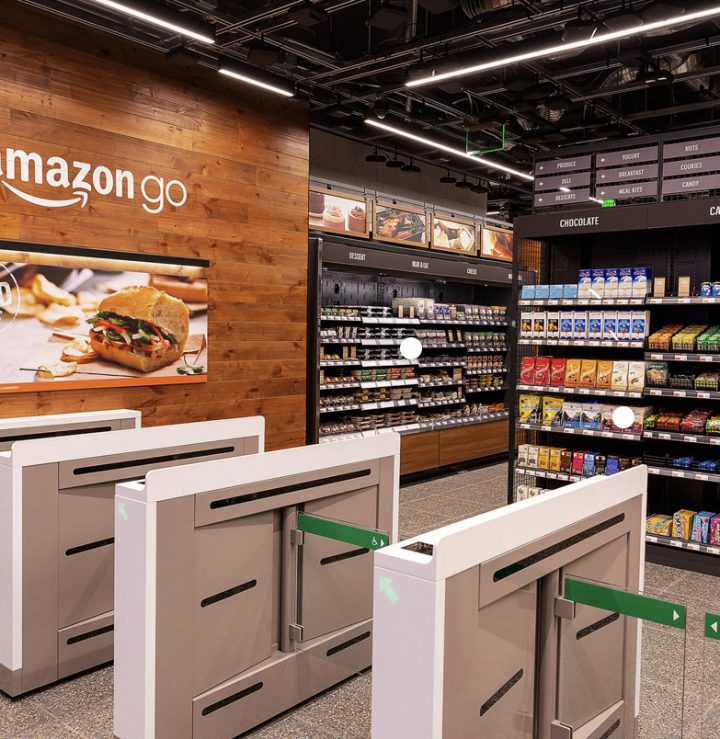
In 2018, Amazon quietly began piloting a new store format, Amazon Go. The premise was this: a shopper walks into the store, scans their Amazon Go app to be allowed through the turnstile, selects items off store shelves, and then walks out of the store. Seconds later, the shopper receives an email with receipt. That’s it. 

The shopper just walks out.

How? According to The Verge, “Amazon Go stores use overhead cameras and computer vision technology to track both shoppers and items throughout the store. That way, the system can identify when a specific person has picked something off the shelf and placed it in their cart, and even when they decided to put something back.”

Two recent announcements should catch the attention of meat processors of all stripes:

  1. Amazon is now expanding the use of the technology into a larger grocery format at their new Go Grocery store in Seattle.
  2. More importantly, Amazon is now licensing the technology to other retailers. And branding the technology, cleverly, as Just Walk Out.

According to the Wall Street Journal, “Amazon hopes the grocery store will serve as a showcase for its technology as it seeks to sell its system to other businesses. The company has recently been in talks with potential partners and is targeting retail options including convenience stores and shops in airports and sports arenas, according to people familiar with the matter. Amazon has discussed multiple revenue models, including a fixed licensing fee or a revenue-sharing agreement, one of the people said.”

How will this impact the meat case, and more broadly the animal protein supply chain? 

Here are the 3 reasons I believe this creates an inflection point in the retail value chain:

  1. Puts the consumer experience on the consumer’s termsIt lets them talk with a store employee when they want to do so, not because they have to in order to make the purchase. As consumers – all of us – continue down the path of customization options to buy when we want, how we want, and what we want, this is a big step in that direction for food retail. And on a related note, I expect this to dial up consumer expectations for the retail experience. How long will it be before checking out with an actual cashier will feel like stepping into 1950? 
  2.  Frees up labor to increase service level / create opportunities for a new consumer experience at the meat case. How will retailers reassign labor and take advantage of a way to improve the experience as consumers shop for one of their biggest ticket items in a grocery store? How will packers equip retail partners to do this well?
  3. Enables an Amazon driven value chain, e.g. a data driven value chain. Today, all packers get is sales data – what moved at retail and how much. Imagine Amazon/retail partners being able to report back to packers the average amount of time a consumer spent looking at one item vs another and how that correlated with purchases. Or how many times consumers picked up one packaging type vs another, and how that correlated with purchases. Imagine all the ways this increasingly granular view into shopper behavior could drive relevant data to packers to drive everything from packaging decisions to new product development? 

A parallel example is Lemonade Insurance vs Every-100-Plus-Year-Old-Insurance. Insurance companies are set up to sell policies through a distribution network of agents, so the data that flows back to insurance companies only comes from shoppers who submit information to get a policy, or actually buy a policy. All the micro-behaviors in the middle of that buying process are lost because there is no mechanism to capture data for traditional insurance companies. 

But that’s not true for Lemonade Insurance, a startup with a buying experience that is digital first. Because Lemonade engineered an online buying process, they are capturing an enormous amount of data about micro-behaviors in the buying process such as, at what point do most shoppers drop out of the buying process. That’s incredibly valuable information to inform either product development OR engineering of the buying process itself. 

I see Just Walk Out as a technology that will enable retailers and their packer suppliers to move from making blindfolded decisions with end result data on sales only, to being able to operate like Lemonade Insurance with an eye opening new level of data granularity to drive better consumer outcomes – either in the product itself or how its sold. 

….this will be an industry defining inflection point. Who’s poised to take advantage of it?

Categories
Funding

There’s a Meat Vacuum in AgTech; how do we fill it?

$16.9B in venture funding went to agtech companies in 2018. Sensors, robotics, machine learning, CRISPR, plant based <anything>, wearable tech for livestock, and so on. A ton of activity in row crops, a lot of activity in dairy, some interesting plays in livestock…but what about the meat sector? 

What about that massively critical phase from the time an animal leaves the farm (swine, poultry) or feedyard (cattle) until it shows up on the front step of a retailer, foodservice, or consumer. Where’s the venture backed innovation in that space?

Think of all that happens in that black hole from plant gate to table: 

  • Harvest
  • Carcass disassembly – there’s still many manual processes, complex decisions about how to disassemble the carcass most profitably
  • Selling meat – let’s not kid ourselves, price discovery could use a little upgrading as well as the processes around transactions of all sizes
  • Shipping a perishable product to customers likely to unpack, further process, repack, and ship again

All of this complexity while operating in a world where consumers increasingly expect transparency and sustainability.

The meat value chain is complex, it’s capital intensive, and it’s a bit of an innovation black hole with very few venture backed businesses working within the sector.

Processing…
Success! You're on the list.

So disruptors are coming from outside. And from the outside, it appears the best way to disrupt the meat business is to replace the most complicating factor about it: the animal. More than $2B dollars have been invested into plant based meats alone!

But why isn’t more venture capital being deployed to tackle the problems *within* the meat industry? To radical innovation that allows consumers to feel great about eating meat? To allow producers to feel good about their relationship with the rest of the value chain? To drive cost out of the system (something this industry knows how to do!) and expand industry relevance and revenue (something slices of the industry know how to do).

Is it because the market isn’t big enough? Negative.

Is it because the industry isn’t interested in innovation? If you can show ROI, companies will follow the money.

So what gives?

Here’s my hypothesis: the lack of venture backed startups solving problems in the meat industry is because the meat value chain is essentially a black box to those outside the industry. Within the industry, game-aware leaders know where the industry needs help. They know the big problems that need solving. And they need outside innovation but often don’t know where to go to get it, for a few reasons:

  1. Meat is a nuanced space. These aren’t widget factories. Even with improved genetics and refined feed rations, there’s variability in nature that must be reconciled in the processing plant. 
  2. The industry has exploded based on scale & cost efficiencies. Now the pendulum is swinging to other growth drivers: distribution, packaging, product, sustainability. 
  3. Limited incentive to disrupt from within as scale has been the path to market share and profitability, when commodity cycles cooperate. 

The upside of the venture capital subsidized plant meat venture backed ad frenzy is that meat is a relevant topic right now. More and more people – and entrepreneurs – are interested in the meat industry….but they don’t have first hand, up close experience with the problems that – if solved – could elevate the industry.

So what if….

What if there was a way to get the big players to bring identified unsolved problems to the table, and entrepreneurs to bring startup scrappiness and fresh views, and bridge the gap that’s prevented the meat industry from benefiting from the Agtech boom? 

This article isn’t a thought exercise, I’m looking for discussion 🙂  What do you think would drive more innovation around the meat industry? 

Processing…
Success! You're on the list.