Categories
Leadership

Prime Future 86: Let’s not kid ourselves – 2 narratives that need to go.

A wise industry leader recently described the elaborate R&D system within their production system as having one primary purpose, to “know I’m not kidding myself.” #goals

There are 2 pervasive ideas floating around the ag industry that are the epitome of kidding ourselves. They get thrown around on social media, at trade shows, and anywhere else producers gather. They are two sides of the same coin:

  1. The idea that farmers need to be thanked.
  2. The idea that consumers need to be educated.

Let’s talk about why those ideas are destructive, how they are connected, and the empowering narrative that should replace them.

‘Thank a farmer’ is not just a harmless pro-industry sentiment, it’s hubris:

  1. It’s industry level self-aggrandizing, and self-aggrandizement is not endearing to anyone but the aggrandizing. This drives the wedge further between producer and end user, mentally.
  2. Do you thank a plumber? an electrician? a trucker? a software engineer? a grocery store stocker? or any of the other jobs that keep a well-functioning society humming along? Implicit in the ‘thank a farmer’ mentality is the idea that the work of farmers is more important than the work of anyone else.
  3. Most importantly, it egregiously flips the narrative from “what have I done lately for my customers?” to “what have my customers done lately for me?”

And, obviously, no producer is in ag to be thanked. They might be in the business of agriculture because….

  • The financial returns meet your objectives.
  • Like the business, or the people.
  • Like the lifestyle it allows you to live.
  • Feel a sense of purpose and pride in producing something tangible.
  • See land as the best long term investment and agriculture as an industry that will always exist. People gotta eat.

…or a million other compelling reasons. Needing an external pat on the back is not one of them. It’s a silly & superficial premise to begin with.

Related, here’s why the idea of ‘educating consumers’ is also destructive:

  1. Abraham Lincoln established the land grant university system in 1862 which means we have 160 years of agricultural research backing up every aspect of how we produce food. And then we dump that 160 years of research onto the unsuspecting consumer that just was looking for the slightest reason to feel even better about buying pork loin at the meat case. Not ideal.
  2. It’s arrogant. It puts the burden on consumers to learn something that they may or may not be interested in learning, because we want them to do so.
  3. It’s hubris. It assumes that once consumers know what we know, then they’ll see it our way. Look I also prefer grain finished beef but if there’s a market for grass finished beef, for the love of capitalism, somebody produce some grass finished beef!
  4. Which consumers are we talking about? Consumers are not a monolith – there are a million sub-segments, that continue to further sub-segment.

Producers & processors who talk about educating consumers are kidding themselves. That’s not a thing. That’s an expensive path and a terrible use of time and capital. It’s a great way to spin our wheels and end up talking amongst ourselves with righteous indignation, lamenting those poor dummy consumers who aren’t buying our product as we think they ought. Sigh…

Do you see how these 2 ideas are connected?

Both narratives put producers at the center of the universe, expecting to bend consumer demands to the will of the producer.

But that’s not how capitalism works.

Whether we have trade associations to thank for generating these two ideas and embedding them in the psyche of American agriculture, or whether they were already embedded and trade associations simply tap into them, I do not know. But it’s time for these ideas to go.

I’m convinced the mentality behind these two ideas is what keeps folks complaining that it’s not how it used to be, instead of finding the opportunity in how it will be.

The alternative narrative is one that is as familiar to forward thinking producers as the air they breathe. It’s what every free market enterprise in the world has to do.

Create new value.

Market new value.

Capture new value.

No other industry educates, they M-A-R-K-E-T.

Forward thinking producers & processors are enterprising value creators that anticipate their customers’ wants & needs, and deliver accordingly.

Create new value. Market new value. Capture new value. Until that value is commoditized (look, its the nature of the business) and then find new value. Repeat forever, or at least as long as you want to be in this game.

Enterprising value creators don’t defend, they create. Don’t justify, they adapt. Don’t feel stuck, they pioneer.

They don’t kid themselves.

If industry associations want to move the needle in the right direction, the first step is to scrap every scheduled social media post or campaign that includes these outdated and misguided concepts.

I suppose it’s ironic I’m writing about this topic since the producers that drink their own koolaid are not the ones interested in emerging trends, technology & innovation in livestock, meat, and dairy. Maybe I just needed to get this off my chest. 🙃

Back to emerging trends next week. What a time to be alive!

Categories
Animal AgTech

Prime Future 85: Minimum viable management isn’t enough

If we’re gonna do this topic then we have to follow the story all the way to the end. Are you in?

Last week an exceptionally forward thinking rancher said in a sustainability discussion that the lowest hanging fruit to level up the US cattle herd is for every calf to get an eartag. Not an EID, an old school humble visual tag.

That simple step, and marrying the calf’s number with the cow’s number, allows producers to get a handle on each cow’s productivity and performance which allows them to manage their herd more precisely.

That simple step is the first baby step in shifting from managing at a herd level to an individual cow level. It is cattle 101, something the good & great (even mediocre) producers have been doing for decades.

Yet, you’re telling me there’s a meaningful chunk of the US cattle industry that is not even tagging their calves?

The idea that tagging calves represents a meaningful way for a meaningful chunk of producers to level up is….alarming. And it should be alarming for the mediocre/good/great producers. If tagging calves is the bar, the bar is…low.

In a time where hyper-innovative producers are deploying advanced genetics strategies, intensive rotational grazing, or non-traditional marketing agreements, over on the other end of the spectrum putting a mere visual tag in every calf’s ear can be considered a proxy for minimum viable management.

Suboptimal cattle production isn’t just an innocuous segment that has no effect on the rest. Poorly managed cattle are a drag on the whole system. And the impacts of the drag are worsening as the industry looks to address the big challenges.

This begs a few questions.

What is good management? It starts with a business approach, not a lifestyle mentality, which means things like:

  1. Sound financial management.
  2. Strong resource management – capital, land/soil, water, grass, livestock.
  3. Clear KPI’s to manage and optimize.
  4. Pursuit of excellence – however you measure it for yourself and your business.

“If a man is called to be a street sweeper, he should sweep streets even as Michelangelo painted, or Beethoven composed music, or Shakespeare wrote poetry. He should sweep streets so well that all the hosts of heaven and earth will pause to say, ‘Here lived a great street sweeper who did his job well. ‘” – MLK

There are many excellence-oriented producers.

There are also many existence-oriented producers. (Synonyms in this context: mediocre, ordinary, status quo maintainers, hobbyists.)

And the gap between the two is widening. Imagine that at the extreme edge of excellence-oriented producers are those pushing boundaries in all areas or maybe even hounding feedyards and packers for individual animal data on how cattle perform in the feedyard and on the rail so the producer can use that data to iterate on genetics and produce a more premium end product. And on the opposite end of the extreme edge of existence-oriented producers are those still operating at a brand level (herd level), largely raising cattle the same way cattle were raised back in the day: low cost, low touch, no tech.

The easy thing to do would be to assume that large operations are better managed than small operations. In the United States, ~10% of cattle producers own 100+ cows, yet this segment owns ~56% of total beef cows. The average is ~43 cows, which means the average of the ~44% of cows is actually much lower than 43.

But herd size isn’t necessarily a good predictor. We have talked previously about an alternative mental model to think about quality of an enterprise than simply scale:

“Big business can be good, small business can be bad. Vice versa. Size is not the indicator of success and it’s definitely not the goal.

My hypothesis is that scale is a lagging indicator; velocity of business model innovation is the leading indicator of success.

I think the successful producers (or packers or xyz business) who will thrive come-what-may are the ones who don’t think of their business based solely in terms of the output (corn, soy, weaned calves, whatever), but rather view their business as a business model that is is in continual refinement. They constantly ask what’s the process that most effectively generates the output. They think in systems that can optimized.

It seems that the really successful producers are the ones that have a vision of where they are going and how they will get there. There’s no doing it this way because that’s how we’ve done it, there’s no growth for the sake of the growth. There is only relentless learning and improvement.

The great producers realize that they aren’t selling just a commodity output, they are selling their business model.”

Some portion of those <50 head operations are incredibly well managed operations that consistently send high quality cattle into the value chain.

And, some of those small herds exist for the fun of it, or so that someone’s ego is flattered by the status symbol of owning cattle, or so that a landowner qualifies for an ag exemption, reducing their property taxes by assessing the productive value of the land rather than the market value of land.

But again, excellence oriented producers come in all herd sizes. The distinction is in their objective and their management framework.

Take a producer with a lifelong goal to improve their business and steward their resources and pass on a viable cattle business to the next generation like the producer on Twitter who said he was going to start writing an annual report about his family’s cattle business for the benefit of both current and future shareholders, presumably his children. Then take the producer who really just wants an excuse to wear a cowboy hat, or a way to reduce their property tax burden, or does this because it’s all they know and they raise cattle the way their grandparents did.

The two are not the same.

As one cattle producer puts it, “it isn’t hard to be above average in this business.”

In the past, it’s been kinda easy for the excellent producers to ignore the existence producers, the below average producers. But as the industry leans in to address big problems (which happens to create opportunity for those at the front edge), the existence-oriented producers are creating a drag that could become an existential threat to the entire industry.

Which raises the next set of questions:

How do we level up the industry by bringing up the bottom x%?

How do you get producers to shift from existence to excellence?

How do you help those producers to level up or get out?

Maybe you don’t, maybe it is what it is.

Or, maybe you lobby USDA to pay them not to produce, or to produce something different. (Yes of course it’s a terrible idea but don’t act shocked – we’ve had crazier agricultural policies in this country.) Or, maybe you lobby to refine the ag exemption in the tax code (though sometimes its better not to poke the bear).

Changing behavior in a value chain often comes down to regulations 🥴 or market incentives, aka premiums & discounts.

As the aligned supply chain trend continues to grow and the variance increases from one aligned supply chain to the next as far as what farm/ranch level practices are incentivized, that could present an opportunity to incentivize these producers to level up…but only if they have a profit motive. Even then, there’s a high cost of coordination with small producers. Perhaps there’s a need for an aggregator platform to connect small producers with aligned supply chains.

Alternatively, as more innovative producers shift cattle into aligned supply chains, then more of the commodity value chain will be composed of cattle from existence-oriented operations. That doesn’t seem to be a good thing either, does it?

Look clearly I don’t know the answer, I’m just spitballing. And clearly it’s a complex problem.

What I do know is that as the industry looks to address the big problems like methane footprint, it’s going to take excellence across the entire value chain to be successful.

Anyone not striving for excellence is a drag on the beef industry.

Minimum viable management isn’t enough.

This extreme level of variance in production is largely only a cattle industry dynamic. Two questions:

  1. If different than above, how would you define minimum viable management in beef?
  2. What’s the proxy for minimum viable management in dairy? Swine?
Categories
Emerging Tech

Prime Future 83: Just a heart transplant, or a catalyst?

Today’s word is xenotransplantation, ‘the transplant into a human of an organ from a nonhuman animal’.

This week a pig heart was transplanted into a human, the first (so far) successful xenotransplantation of its kind. Somewhat downplayed in the media coverage was the role of CRISPR in making this transplant possible:

Xenotransplantation has seen significant advances in recent years with the advent of CRISPR–Cas9 genome editing, which made it easier to create pig organs that are less likely to be attacked by human immune systems. The latest transplant, performed at the University of Maryland Medical Center (UMMC), used organs from pigs with ten genetic modifications.

To make the pig heart used in the transplant, the company knocked out three pig genes that trigger attacks from the human immune system, and added six human genes that help the body to accept the organ. A final modification aims to prevent the heart from responding to growth hormones, ensuring that organs from the 400-kilogram animals remain human-sized.

…the future of xenotransplantation probably includes tailoring the modifications to suit particular organs and recipients.

Another report said “Researchers reported in 2015 that they had used Crispr, a new gene-editing technology, to inactivate pig viruses that otherwise might infect humans transplanted with pig organs.”

Can we just geek out for a moment about how wild this all is? Not just for novelty’s sake, but because….

…if gene editing can turn off/down genes to ‘inactivate viruses’, why can’t ASF & PRRS be edited away in commercial swine herds? (Research that is already underway.)

…if gene editing can modulate growth hormones, why can’t Average Daily Gain and Feed:Gain metrics be drastically improved in new and novel ways?

…if gene editing can alter how an animal organ interacts with human biology, why can’t gene editing enable meat & milk to play a bigger role in ‘food as medicine’ for humans?

I previously went down the CRISPR path, considering how gene editing could hit livestock:

In The Code Breaker: Jennifer Doudna, Gene Editing, and the Future of the Human Race the author focuses on human uses for CRISPR, only using the word agriculture once and almost as an afterthought. So, let’s brainstorm how a tiny little biochemical thingamajig could be used to make a potentially big impact in livestock, meat & dairy.

(Heads up: I’m not constraining this list to any nonsensical details like what’s scientifically possible 🙃)

  • Efficiency. The most obvious and least exciting use for CRISPR is to improve efficiency of production metrics like growth rates or feed conversion or carcass yield. Could beef someday have the same feed conversion as chicken, or even fish?
  • Quality improvements. Can gene editing increase meat tenderness in certain cuts? Increase flavor in pork? Eliminate that nagging issue of woody breast in chicken? Could CRISPR unlock the Honeycrisp apple of the meat case?
  • Health management. Imagine if you could eliminate Mastitis in dairy cows, or BRD in beef cattle, or ASF or PRRS in swine, or Coccidiosis in poultry…all of which have massive economic impact around the globe.
  • Methane emissions.  Could CRISPR gene editing somehow (magically?) reduce methane emissions and put that whole issue to pasture?
  • Demand response. Imagine you could use gene editing to get more of what the market is asking for, like more loin per carcass for a higher ratio of high value middle meats in beef & pork. Or let’s throw common sense to the wind – what if you could get more wings per bird? That would look pretty good in times when wings trade at $3/lb and breast meat trades at $1.

To be fair, this week’s development has no direct impact on livestock production or the milk & meat biz. Zero. It has far more implications for the field of medicine.

Yet there could be game changing indirect benefits, since the animal-organs-for-human-transplant use case for CRISPR gene editing will force regulators to put some guardrails in place. It will also nudge the general public towards an implicit verdict on CRISPR gene editing in animals.

The beauty of the pig heart transplant is that it accelerates the broader CRISPR+livestock conversation, starting with an initial use case that is almost inarguably good for humanity.

I previously described the risks this way:

The only way CRISPR can make a meaningful impact is if both regulators and consumers embrace the technology.

  • Regulators. What will the regulatory framework for CRISPR gene editing in livestock look like and who will oversee it? How will different countries approach it? For use in humans, scientists think of CRISPR having 3 different uses: to prevent disease, to treat disease, or for enhancements like making your offspring taller, smarter, stronger, etc. (Obviously there are varied opinions among the CRISPR scientific community about using it only for disease prevention & treatment to alleviate human suffering, rather than selecting for certain characteristics because we can.) Another screen, and debated distinction, is whether gene editing will impact only that patient/generation (somatic editing) or if it will impact that patient/generation and all future offspring (germline editing). If similar screens are applied in livestock, the list of possible CRISPR use cases would change.
  • Consumers. If GMOs in plant breeding signals how CRISPR might be viewed in livestock, then the odds of widespread consumer acceptance of CRISPR editing in livestock are less than my chances of competing in the 2021 Olympics. The staggering advantages of GMO’s in crop production – less resource use per unit of production – have not satisfied the anti-GMO camp enough to offset their concerns of genetic modification. Good science has not been enough for a good outcome.

However, there’s one factor in livestock that isn’t part of the equation for crops, and that is animal welfare. How will the risk/reward equation adjust itself if CRISPR provides ways to reduce animal disease and therefore improve animal well being?

I have to believe that the xenotransplantation use case for CRISPR will create momentum for additional CRISPR use cases that directly benefit commercial livestock producers and the broader meat industry.

So, was this heart transplant just a transplant? Or, was it a catalyst for all the ways CRISPR could change not just how we think about livestock genetics but nutrition, health, management, and more?

My hypothesis is that history will call this a catalyst for more….how much more, and on what time horizon, remain TBD.

What a time to be alive!


Beef-on-Dairy ebook available!

This ebook summarizes the Prime Future beef-on-dairy series when we looked at everything from what this trend really is, why it’s emerging so rapidly and what it really means for the industry. Here ya go:

Get the ebook!

Categories
Business Model Innovation

Prime Future 82: Tacos-as-a-service?

Taco Bell has been testing a subscription service: $10/month for 1 taco every day.

Set aside concerns for subscribers health and the egregious assault on tacos that is Taco Bell, the idea of Tacos-as-a-Service is kinda interesting.

Tacos-as-a-Service is proof that recurring revenue models are no longer confined to the tech industry.

Salesforce pioneered Software-as-a-Service (SaaS) by jumping on the cloud based software trend in its early days. Recurring revenue is now the preferred pricing model for software companies and their investors, but it’s a model that has spread to other types of business from hardware to….tacos.

Recurring revenue pricing models are awesome. They create more predictable revenue, which helps companies plan and scale more predictably than a business model built around one-off transactions. Recurring revenue means decreased customer acquisition costs (CAC) which increases the value of that revenue from a company valuation standpoint. And recurring revenue is great for customers, as would be capital expenses get moved to the income statement. Anything-as-a-Service models also allow for more flexibility from a customer standpoint.

We don’t see many recurring revenue businesses in agriculture, except for software and (some) hardware. And it makes sense that agriculture is a transaction based industry since inputs like fertilizer, seed, and feed are all physical things that have fixed and variable costs associated with producing 1 more unit of stuff.

But so do tacos.

If Taco Bell (and a growing number of non-digital companies) can build an effective subscription service of a physical good, who’s to say we won’t see…

Feed-as-a-Service?

Genetics-as-a-Service?

Processing-as-a-Service?

What would need to be true for subscription pricing models to be economically sustainable for companies selling physical goods?

Taco Bell said that the subscription service “grew its rewards program by 20%.” I’ll bet you a crunchy taco that there’s a team of Taco Bell pricing analysts who know the precise expected impact on Customer Lifetime Value of each enrollment in a rewards program, all of which factors into the equation of why the subscription pricing model works.

Maybe Taco Bell’s foray into subscription pricing is another PR stunt. Or, maybe this is a sign that subscription pricing is rapidly expanding beyond digital products and we are on the cusp of more business model innovation, even in livestock, meat & dairy.

Now set tacos aside, let’s talk tractors.

John Deere announced the upcoming launch of “a fully autonomous tractor that’s ready for large-scale production.”

“To use the autonomous tractor, farmers only need to transport the machine to a field and configure it for autonomous operation. Using John Deere Operations Center Mobile, they can swipe from left to right to start the machine. While the machine is working the farmer can leave the field to focus on other tasks, while monitoring the machine’s status from their mobile device.

John Deere Operations Center Mobile provides access to live video, images, data and metrics, and allows a farmer to adjust speed, depth and more. In the event of any job quality anomalies or machine health issues, farmers will be notified remotely and can make adjustments to optimize the performance of the machine.”

Much analysis has been done around the implications of this announcement, so all I have to say after watching the range of takes from farmers on ag twitter is this:

The age old skepticism-to-belief curve, aka the adoption curve, closely links to our final thought today.

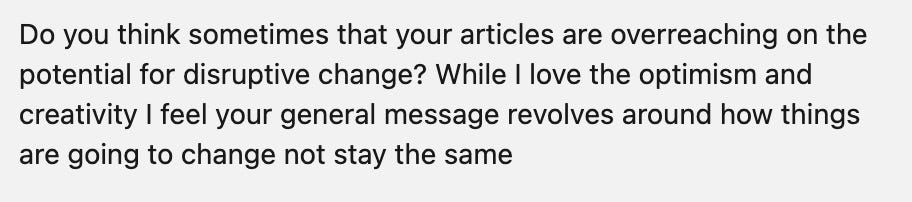
We’re <2 weeks into the year with potential new food pricing models and potential new farm operating models, yet I received this message:

I am keenly aware that writing publicly means you’ll see many of my hypotheses proven wrong, like ‘Peak Oil by 1950’ level wrong.

Actually the only thing I’m 100% confident in is that I am wildly underestimating the actual change we will see. The gap between Here and There will be significant, whether There is 1, 10, or 100 years from now.

Although it’s true that identifying what is not going to change is important, this is a newsletter for innovators in livestock, meat & dairy. The whole purpose of this newsletter is to spark & attract conversations about emerging trends and how those trends create opportunities.

The gap between Here and There, where emerging trends are still emerging, is where innovative companies, brands, and leaders live

…as long held assumptions no longer hold, as supply chains reorganize, as tech changes production methods & unlocks new business models, as consumers segment by new values.

I think of it like this: Traders love volatile markets, whether it’s the stock market, livestock market, or any other market. If markets are stable, traders don’t make money. If markets are moving, traders can make money.

Volatility creates opportunity for traders; trends create opportunity for innovators.

And IMHO, the only way to discern the actual high impact emerging trends from the noise is through dogged curiosity.

Photo from Brene Brown’s new book:

Here’s to curiosity & 2022; what a time to be alive 😉
Categories
Leadership

Prime Future 81: Three macro-meat dynamics to watch in 2022

There are 3 macro-meat dynamics I’ll be following closely as we enter the new year.

(1) Will meat & livestock forge a new economic model?

Will retail shoppers continue paying what they’re paying at the meat case? If so, what does that mean for the traditional high throughput/low cost model of the packers? And if the packers’ model changes, what does that mean for those who supply live animals to packers?

My granddad tells the story of a young farmer in the ’70s who bought a set of feeder cattle. They guy was excited about his new venture, especially since he saw this as a low risk investment – the cattle market had reached a new normal, it was never going back down. To this optimistic young producer, the market had found a new floor. You are cringing, aren’t you? You know how this ends.

Sure enough, not 60 days later and the market did what the market does, serving a heaping helping of humble pie.

I can’t imagine what made me think of this story…

(2) Will the packers forge a new operating model?

Tyson recently announced that one of their plants is piloting a 27 hour work week that would allow plant employees to qualify for full time benefits, as a way to attract people. The next day they announced a $1.3B investment in automation.

Changes are afoot in how processing plants do the work of disassembling carcasses.

(3) Are we on the cusp of an infinite consumer market bifurcation?

Remember the ‘beef: it’s whats for dinner’ campaign? It was wildly successful as a mass market campaign in selling the mass category of beef.

But mass categories and mass campaigns are over.

We're in an era of niche, hyper targeted markets and aligned supply chains will allow brand owners to serve certain segments of customers by aligning incentives throughout the entire value chain to meet a specific customer group's objectives. Objectives which are always nuanced, and could even be competing.

Take the retail shopper who wants to purchase grass fed beef because they don’t like the idea of feedlots. Does that same customer also care about methane emissions? Because if that customer were optimizing for lowest methane emissions per steak, they would buy steak from grain finished cattle. How’s that for nuance?!

Brands are going to have to do the (really) hard and messy work of teasing out who actually cares about what attributes, and then aligning their supply chain and marketing accordingly.

My only prediction is that 2022 is going to be a fun year to be in the biz 😎 I’m taking next week off so I’ll meet you back here in the new year. Happy holidays!


My holiday reading:

  1. The Truth Machine: The Blockchain and the Future of Everything.
  2. The AI First Company: How to Compete and Win with Artificial Intelligence.
  3. Wanting: The power of mimetic desire in everyday life. Fair warning, this book is about why we want what we want and it will mess with your mind. It offers a compelling explanation of why we want the toy that the other kid picks up. The idea of mimesis, and how it drives behavior of individuals and markets, is likely to be very relevant over the next decade as the role of animal protein sorts itself out.

Tis the season for…a life retreat.

Last year I wrote about my favorite life hack, an annual life retreat. It still holds:

Hopefully you are sliding into holiday mode and the most troublesome thing on your mind is nailing the ratio of rosemary:thyme:garlic for the prime rib. Me too.

I’m deviating from our normal topics to share one of my favorite end of the year traditions: a Life Retreat. It’s one of the highest life ROI ways to invest a few days, carving out time to step away from daily life to distill my learnings from the year ending and gear up for the year ahead. It’s my best chance to recalibrate day to day life with long term objectives, to pressure test the trajectory I’m on with the trajectory I want to be on.

In my experience, the real keys to crafting a high impact Life Retreat are:

  • Take 2-3 days. Any thing less doesn’t allow you to completely separate from day to day life.
  • A relaxing setting, for me it’s a mountain range somewhere.
  • Really good food + abundant charcuterie. This is critical.
  • A good porch view for optimal coffee drinking & contemplation.
  • The perfect mix of hiking to clear the mind & reflect, and down time to journal or whiteboard or whatever seems like the best way to mind map.
  • Capturing high/lows from the year wrapping up & the lessons/learnings to carry forward & put to work.
  • Identify in advance the big questions/topics you want to mentally wrestle down.
  • A mix of inspiring & educational books/podcasts.
Categories
AgTech

Prime Future 80: Can farmer facing agtech startups IPO?

Two late stage Agtech companies have each raised ~$1B in venture capital but they haven’t IPO’d yet. There were 4 agtech SPACs this year, but there have not been as many good old fashioned IPOs. Since the Agtech era was kickstarted by the 2013 Monsanto acquisition of Climate Corp, there haven’t been any notable agtech IPOs to point to as success signals.

Why?

Set aside all the obvious financial hurdles of what it takes to be IPO ready. For startups who sell directly to farmers, my hypothesis is that there are also tricky customer dynamics to navigate in the transition from privately held company with undisclosed financials to publicly traded company with fully disclosed financials.

If this sounds like an overstatement then maybe you missed how Farmers Edge was excoriated by #agtwitter after their IPO, with farmers relentlessly mocking the company’s financial results.

(Aside: check out Upstream Ag Insights analysis on the Farmers Edge IPO)

But it makes sense that farmers would experience a disconnect in the financials of an agtech company compared with their own approach to accessing capital.

Could two financing models possibly be more juxtaposed than the VC backed, growth now profit (hopefully) later tech startup model and the typical traditional debt financing model for most farms? I doubt it. Technology companies often IPO while showing big losses in the pursuit of growth as long as unit economics make sense; while farmers who operate at persistent losses go bankrupt.

Completely different financing models for completely different business models in completely different markets.

While farmers are generally not impressed with venture capital hype, there doesn’t seem to be much of a customer perception win for farmer facing agtech companies who go public. Let’s take 2 extreme possible outcomes of an IPO:

(1) The company IPO’s and their financials reveal that the company is operating with high EBITDAWait, high EBITDA? That must mean the company is taking advantage of producers. Who are we, a bunch of suckers? Riot.

(2) The company’s financials reveal that the company is operating at huge lossesHuge losses? This isn’t even a real business? Riot.

What if the only acceptable and respectable option in the eyes of a farmer customer base is to be profitable but ya know, not too profitable.

Impress investors at the risk of disenfranchising your farmer customer base, and vice versa.

Rock. Hard place.

So, are late stage agtech startups delaying IPOs and staying private longer because they are concerned about what farmer customers will think of their financials, or because they are concerned about what The Street (public investors) will think of their financials?

Assuming these late stage agtech companies are substantive businesses, the number of mature non-ag startups that have IPO’d in the last 2-4 years with high revenue yet operating at huge losses (e.g. Uber, Lyft, Airbnb, Lemonade, etc etc etc) seems to negate the idea that mature agtech startups are delaying IPOs because of lack of public investor appetite.

I readily admit that this hypothesis that farmer facing agtech startups are delaying IPOs because of farmer perception concerns may be wrong. I’d love to hear your counterarguments, here are my own:

(1) Each of those non-ag companies mentioned above (Uber, etc) had raised significantly more capital in private markets than these agtech companies have, their total addressable markets (TAM) were larger, and presumably they went public at much higher revenue than what these agtech companies will when they IPO. So it’s not apples to apples. Maybe it’s not even fair to apply the label ‘late stage agtech companies’, maybe in the grand scheme of things they are just mid stage and have a long way to go & grow in private markets. Perhaps.

(2) Many companies upstream and downstream from farmers have been public for years or decades and seen tremendous growth. Maybe that means the hypothesis is wrong, or that even if the hypothesis is correct and farmer customers won’t like seeing the financials of a venture backed company gone public, that it doesn’t matter whether the company is privately held or publicly traded because we humans (including farmers) are just one news cycle away from something else to get worked up about. Perhaps.

(3) Did Farmers Edge experience a negative commercial impact after the IPO? If not, then the noise about it all was just noise and my hypothesis is incorrect. Perhaps.

(4) The burdens of being a public company are so much higher than being privately held, why would anyone IPO before they have to?? Perhaps.

What I find really interesting are the agtech founders able to thread the needle of operating in a ‘VC light model’, where they find ‘patient’ venture capital that allows them to build a company that reflects their farmer customers values and sets them up for long term success, not flash in the pan hype of the venture treadmill but rather build for the long term, one brick at a time. A ‘fit the financing to the business’ approach rather than ‘fit the business to the business to the financing’ approach.

That takes discipline, especially in a market like we’re in now. And just to contradict my own hypothesis, maybe accessing private capital further into the company’s life allows late stage startups to do that. Perhaps.

For how long will late-stage agtech companies continue raising capital in private markets and avoid the inevitable scrutiny of publicly traded companies? TBD.

Categories
Blockchain Emerging Tech

Prime Future 79: Blockchain…all dressed up but where to go?

Technology only has a fighting chance in agriculture when it definitively improves producer outcomes🤑 and/or consumer outcomes😃. Tech for the sake of tech is a road to nowhere.

Moreover, I get reeally skeptical when seemingly overnight cult-like obsessions form, as has happened in the second half of 2021 in the tech world with DAOs.

Unpopular opinion: DAOs are just blockchains all dressed up & looking for something to do on a Friday night.

What’s a DAO? Decentralized Autonomous Organizations. (Oh that wasn’t self-explanatory? Weird…)

Constitution DAO is probably the most public example, recently formed to purchase a copy of the US Constitution that was going up for auction. The group raised ~$40M which wasn’t quite enough to snag the prize, so the DAO was dissolved.

One definition of a DAO is, “a group organized around a mission that coordinates through a shared set of rules enforced on a blockchain.” Hmmm. Here’s another perspective:

“Formal definitions are a good place to start when things are new, but there does not seem to be one for DAO—even though many attempts have been made. DAOs are a new type of organization and to understand the key characteristics of a DAO, it is helpful to review some blockchain fundamentals. A programmable blockchain, like Ethereum, enables applications to run on a decentralized trust system—removing our need to rely on any single actor as an intermediary of trust. Another way of looking at it, is that blockchains convert computing power into trust. Everyone is keeping an eye on everyone else, so that we can all keep performing economic activity on the network.

In truly decentralized systems, no one needs permission to join in on this action. The underlying consensus algorithm is publicly accessible. This means that anyone can become a network participant and help verify the behavior of other participants. This is the key innovation we have all gravitated towards in the crypto space. A DAO is an ecosystem with loose operational borders that comprise coordination tools.

The public blockchain act as a cozy blanket of trust that applications can be built on.”

Decentralized ownership? Loose operational borders? Ummm….who’s gonna tell the tech bros this that they invented co-ops? Bravo.

Sure, these co-ops are on a blockchain, but the underlying concept is not new. And co-ops are fraught with traps, that’s why ag history is littered with failed co-ops.

Organizing humans around objectives is not a technology problem, it’s a human problem.

(Though there have also been some wildly successful co-ops in ag & I’m keen to understand why that is – if you have insights into why organizations like Land O’Lakes, Fonterra, Tilamook, Cabot Cheese, etc have worked so well, please reach out.)

If co-ops are fraught with management & organizational risk (which they are), imagine further decentralizing decision making and planning. 😵‍💫 I recently read about a real estate DAO that would allow all members (anyone can join a DAO, that’s a key feature) to put forward potential real estate deals and then all members would vote on which deals the DAO would execute. YIKES. Wisdom of the crowd is a great concept only when the crowd is wise on a given topic.

This isn’t blockchain’s first run at insanity. Remember ICOs?

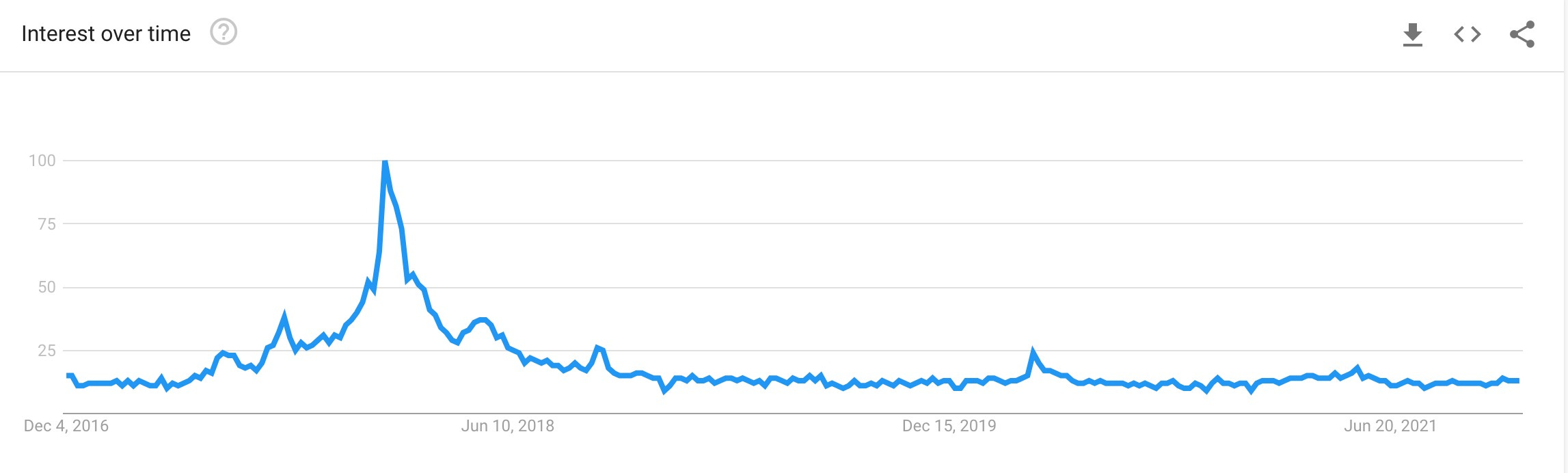
Around 2017 a phenomenon started where startups would issue ‘Initial Coin Offerings’ as a blockchain based way to raise capital, even if their product had nothing to do with blockchain. The google search history for ICOs tells the story:

My hypothesis is that DAOs are 2021’s ICOs; a flash in the pan that we’ll look back on only when the next blockchain craze comes around.

One hypothetical examples of DAOs was specific to D2C meat, which you know is a topic I’m here for – here’s how the author described it:

Going to a high-end butcher and buying your meat piecemeal might run you anywhere from $10/lb for ground to $30-40/lb for top cuts.

It’s much more financially manageable to buy a fraction of a cow from a ranch directly. That might cut your costs by 50-75%. But most people can’t eat a whole cow. So you team up with some friends and buy one together.

Let’s say you can buy a cow for $3,000. That’ll yield you around 450 lbs of meat, so you’re paying an average $6.66 per pound for everything from ground to filet.

You probably don’t need a whole cow at once though, so let’s say you buy ⅓ of one. So your cost is $1,000.

But instead of buying one directly, you buy a membership to the new CowDAO. CowDAO is a DAO focused on making high quality meat more accessible to all its members. Membership comes in the form of an NFT, which is initially priced at 0.07 ETH with a supply of 1,000. Pretty typical for a new NFT drop.

Your membership entitles you to lifetime discounts on the finest quality meat sourced from around the country, and eventually, free meat. Here’s how CowDAO does it.

(You can read the full piece here including the how’s, though I recommend popping some Tylenol first.)

Let’s dissect the CowDAO idea. So a lot of people want non-commodity meat but don’t necessarily want to purchase a whole or half carcass? Yes and amen.

But you don’t need a DAO to solve that problem as CrowdCow, ButcherBox, and Barn2Door are proving because…

…it’s not a technology problem, it’s a business model problem.

DAOs are tech for the sake of tech.

And so far, so is blockchain.

Buzz about blockchain seemed to really pick up around 2016. The ag industry speculated that blockchain would finally enable traceability in food value chains.

But traceability isn’t a technology problem, its a market problem.

Who wants traceability and who is willing to pay for it? Five years later and in most markets, its still unclear.

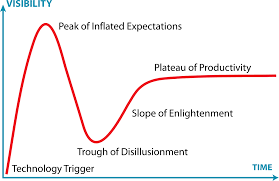
Remember the hype cycle for emerging technologies:

So where are we in the blockchain hype cycle? It’s hard to say. I *do* think blockchain will find its footing, eventually. Why & when will it happen? No idea, except that it it’s likely to be when blockchain is the right solution for a customer problem, and the technology fits the business context. Not a second before then.

Yet given enough time, anything can happen. QR codes were invented in 1994 and hey, it only took 26 years and a global pandemic for that technology to hit it’s stride.

My caveat to all the above is that not only am I by no means an expert, I did just purchase a couple of blockchain books to read over the holidays. So I reserve the right to change my mind. And let’s just assume that because I’ve now taken such a public & negative view on DAOs, that they might actually become a real thing. 🙂

Share


Get past editions of Prime Future in one place:

Get Prime Future PDF!

Categories
AgTech Business Model Innovation

Prime Future 78: The gate’s closing on 2021

With the gate rapidly swinging shut on 2021, here’s a look at the 5 most popular Prime Future editions this year:

(5) Egos & Incentives

Sometimes in the B2B world it’s easy to assume business decisions are driven solely by an ROI calculation, neatly tied with an Excel bow around a carefully curated formula. Or in the farm world, that every decision is justified by the output of the almighty shirt pocket calculator.

But in the real world, rarely can an ROI be fully captured numerically. Other factors impact decisions, including the psychological factors. I summarize this as Egos & Incentives.

Numerical ROI is necessary, but it’s not sufficient. At the margin, decisions are made based on their impact to our egos and incentives, including decisions about adopting new products, practices or ideas:

  • Incentives: How does this help me achieve what I’m incentivized to achieve, what I want to achieve?
  • Egos: How does this impact my view of myself and my place in the world, aka my ego?

We’re all out here responding to incentives, intentionally or unintentionally, doing the things to get the job, the bonus, the contract, the new customer, the promotion, the upsell, the renewal, the fill in the blank. And no surprise, we all have egos. Every last one of us, even those who say they don’t (perhaps especially those). The advertising industry is built around these fundamental truths of human nature.

And though it can be framed at an individual level, I believe it’s just as true at an organizational level because, of course, organizations are just big groups of individuals, still responding to egos and incentives.

The fundamental question to ask about new products is, where does value accrue and where is cost incurred?  If the packer accrues the value but the producer incurs the cost, well….that’s probably not going to go well because incentives are not aligned. The challenge of incentive alignment is why business model innovation can be just as high impact as tech innovation, if not more so.

Read more


(4) 💡3 reasons why dairy is the new beef

I started this series with an assumption that beef breeds create better beef carcasses than dairy breeds, or dairy x beef crossbreds. But here’s the surprising little secret: Beef x Dairy cross carcasses are as good or better than straight beef carcasses, or ‘natives’ as the people say.

The beef on dairy genetics jigsaw puzzle allows dairy producers to make decisions that get the best of beef and dairy breeds, to use ‘elite terminally focused genetics’ on the beef side that offset the dairy deficiencies.

Consistency is the name of the beef on dairy game. There are 3 elements of consistency that beef on dairy can offer to the beef value chain:

  • Year round continuous supply of calves to the feedyard, and then to the plant.
  • Genetic consistency given how narrow the genetic base of dairy cattle are since AI has been used so widely for so long.
  • Management consistency – while a beef animal could move through 2-3 sale barns between weaning and arriving at the feedyard, beef-dairy crosses are much less likely to go through a sale barn at all. They’re more likely to move in large lots from calf ranch to grow yard to feedyard, or directly from calf ranch to feedyard with consistent management in each phase.

Value is only value when it’s recognized by the buyer, in this case the packer. The value chasm is wide between a dairy animal and a beef animal, so the challenge for beef-dairy animals is to get them priced like a native. One producer said it this way, “packers are looking for a reason to price a beef-dairy cross like a dairy animal. You have to get the animals on a grid to get a base price where it should be.”

Capturing full value of the beef-dairy animal requires closely aligned partnerships all the way through the value chain to the packer. Aka aligned supply chains or coordinated supply chains.

Will it be surprising if Dairy Beef aligned supply chains grow and consolidate over time to find the efficiencies of scale without the capital intensity of true vertical integration? Not at all, that’s the nature of the agriculture game.

So, the 3 ideas that make beef-on-dairy shine:

  1. Beef x Dairy cross carcasses are as good or better than straight beef carcasses. (Think of it as having your cake and eating it too, but ya know, beef.)
  2. Beef-dairy crosses hold a consistency advantage over the traditional fragmented beef value chain.
  3. Beef-dairy cross value chains are forcing new partnerships in order to capture full value at the packer level.

Which is all fine and well, until we come back to the math of beef on dairy. If we are really only talking about 5M calves annually, out of 25 million total fed cattle, it raises the question of….so what?

What happens with 5M beef dairy crosses is interesting, but the really fun part will be seeing how the 5M could influence the 20M.

Read more


(3) Where’s the honeycrisp of the meat case?

I love wandering the aisles of a boujee grocery store. HEB, Whole Foods, Wegman’s…here for them all. Naturally a highlight is walking the produce aisle, letting your eyes take in the color explosion and the magic of plant genetic creativity brought to life: fizzy grapes, plucots, strawberries with more shelf life, sweet peppers with more flavor. Or, the crown jewel of the entire produce aisle: the Honeycrisp apple….pure magic. (I’m honestly not convinced they aren’t laced with something highly addictive.)

While plant based burgers aren’t my thing, objectively the product itself has completely transformed – and continues improving – as a result of innovation and R&D investment. Pat Brown, CEO of Impossible Foods, has been vocal about his strategy: bring about a world without livestock for meat by offering a plant based meat product to the world that meets consumer’s objectives on taste, cost, and nutrition so they do not have to make a values based tradeoff.

Which is a smart strategy! It’s the Tesla strategy. It’s ‘product first’ which inherently means high investment in product development.

Now let’s go to the retail fresh meat case where things have remained unchanged for, um, a while. That steak or pork chop or chicken breast is basically the same as it has been for the last 30 years. Why is that?

Most genetic progress in livestock centers around live performance, not end product outcomes.

We talk about genetics in terms of live performance metrics: Feed conversion. Growth rates. Calving ease. Hatchability. None of these are attributes you can see at the meat case.

Improved live performance is producer language, not meat case language.

We all know the amazing genetic progress over the last 50 years across livestock. Drastically improved feed conversions and growth rates have led to much lower production costs per pound of meat/poultry/milk. Great for producer, beneficial for consumer. I’m not taking anything away from the economic or environmental impact of that live progress….but I am saying, maybe it’s not enough?

Like it or not, we live in a what-have-you-done-for-me-lately world….so where are the product development innovations in meat that are noticeable to the consumer?

Where’s the meat case equivalent of the Honeycrisp apple?

Read more


(2) Lunatic farmers & velocity 🚀

The owner of a dairy was lamenting the rise of mega dairy systems and the risks they pose to small dairies like hers. How many cows does her dairy milk?

7,000

It’s a laughable story except that this dairy farmer & her family have grown the herd from a few hundred to several thousand over the course of their career. They’ve struggled and strived, taken risk after risk to get where they are. And yet in their minds, they still identify as small, scrappy, insurgent producers trying to survive.

There’s a special irony in the tendency among farmers to want to be bigger than neighboring operations. Sometimes bigger is better, sometimes smaller is better. But farm size is not the sole indicator of success and it definitely should not be the sole goal.

My hypothesis is that scale is a lagging indicator; velocity of business model innovation is the leading indicator of success.

The more commoditized the business, the stronger the pull to scale to reduce cost per unit.  The more value oriented the business, the stronger the pull to create incrementally more value per unit. There’s no clever analysis in those statements – those are natural forces that are a function of capitalism and a mature agriculture industry.

I think the successful producers (or packers or xyz business) who will thrive come-what-may are the ones who don’t think of their business based solely in terms of the output (corn, soy, weaned calves, whatever), but rather view their business as a business model that is is in continual refinement. They constantly ask what’s the process that most effectively generates the output. They think in systems that can optimized.

It seems that the really successful producers are the ones that have a vision of where they are going and how they will get there. There’s no doing it this way because that’s how we’ve done it, there’s no growth for the sake of the growth. There is only relentless learning and improvement.

The great producers realize that they aren’t selling just a commodity output, they are selling their business model.

Size is not the determinant of success. It’s about business discipline, management, relationships, processes, team, leadership, ambition. Successful producers have a vision for the future that they rally the team around, there’s an ever evolving plan for increasing revenue per unit produced or decreasing cost per unit produced, or both.

I recently asked a really large operator how they grew their business over the last 20 years from something not at all uncommon to something truly extraordinary. Did they have access to capital that others didn’t have? Some other advantage not available to similar producers? “I don’t think so, I think we just do things in a different way than most people are interested in doing. We do a lot of things that aren’t uncommon for most growing businesses, they are just uncommon for production ag businesses. We have a yearning for learning.”

Let’s call a spade a spade – capital is abundant and cheap in 2021, as it has been the last several years. Ideas are a dime a dozen. It’s everything else that separates the aggressive producers from the rest.

I’ve referenced Allen Nation’s book before, but germane to this conversation is a chapter on how farmers approach innovation with insights pulled from a 1962 book “Diffusion of Innovation” that studied extension efforts to get farmers to switch from open pollinated to hybrid corn post WW2.

“The innovative farmer is seen by his farm neighbors as a lunatic farmer. And a lunatic is not seen as a role model. As a result, what the innovator does on his/her farm is literally invisible to the neighbors. This is true even if the innovation is producing visible wealth. The normal reaction to unconventional success is the old it-might-work-there-but-not-here syndrome. The sad truth is that the vast majority of farmers prefer to fail conventionally rather than to succeed unconventionally. It is very, very difficult to be more innovative than the community in which you live.

Here’s the really germane part: “No farmer referenced what a farmer smaller in acreage than themselves was doing as applicable or worthy of study. Everyone preferred to learn from someone larger than themselves.” Isn’t that fascinating?

I’ve recently observed some markers that lunatic farmers seem to have that indicate high velocity of business model innovation:

  • They ask questions. A lot of questions. They find smart people to ask questions. They find smart people in non-traditional places to ask questions.
  • They read. Not just industry magazines, they look outside.
  • They have a sense that what they are saying sounds half crazy, dare I say they know it might make them sound like a lunatic farmer.
  • They surround themselves with high quality people, high quality teammates.
  • They have a system they are building/running, a flywheel they are looking to spin faster.
  • They have some insight that most of their peers don’t, some belief that isn’t widely held.
  • They know new practices & ideas take time to implement correctly, so they allow margin (time, energy, $) to experiment.

Read more


(1) The packers get Standard Oil’d. Then what?

If an oligopoly market is when 4 firms have 50+ percent share, then US beef, pork, and poultry are undeniable oligopolies. These concentrated markets aren’t uncommon though, we run into them from cereal (Kellogg’s, General Mills, Post, and Quaker) to cell phones (Apple, Samsung, Huawei).

But these examples are child’s play compared to the most extreme example of market power: the classic story of Standard Oil. In the 1880’s, John D. Rockefeller realized the oil business was a fantastic business except for the nagging issue of price volatility. So he found a solution to that little problem, by developing an effective monopoly through the Standard Oil trust. A Supreme Court ruling in 1911 forced the trust to split into 34 companies to increase market competition.

The current rally cry of many US producers is that the problem with the cattle business is concentration among the packers. This is not new; tale as old as time. But carry that rally cry out to the most extreme outcome of de-concentrating processing capacity….what does it really solve?

Just for fun, let’s say the DOJ goes full 1911 and ‘Standard Oils’ the meat industry.

Every plant becomes its own company.

The ‘Big 4’ become the ‘Midsize 22’.

Then what? Before we lock into any hypotheses about a re-fragmented meat industry, what was the result of busting the Standard Oil trust?

Would a Standard Oil’ing of meat packing be good for downstream players? Maybe, in the short run. Probably not in the long run.

Would a Standard Oil’ing of meat packing be good for upstream players? Maybe, in the short run.

But what’s not good for downstream players in the long run cannot be good for upstream players in the long run.

Hear me loud & clear that profitability at all stages of the value chain is the #1 foundation of a viable cattle industry. Increasing margin capture throughout the value chain is a good thing, a great thing. But is reducing packer power the panacea that people often describe it as? I may be wrong, but I just don’t think it is.

Maybe looking at impact of competition on pricing power & innovation is the wrong framework….maybe higher margins don’t lead to innovation, maybe innovation leads to higher margins.

Read more


Categories
Leadership

Prime Future 77: Ridiculous Generosity

It’s Thanksgiving week in America and if the pilgrims had celebrated with prime rib instead of turkey, it would be my definitive favorite holiday. Alas, I still love the idea of pausing life to be grateful even if it means eating turkey.

Gratitude inevitably leads to generosity.

A mentor of mine was recently talking about business relationships, and said “I may have made some decisions that looked dumb to outsiders, but my bent towards generosity has never once disappointed me.

I love that idea. When you say the word generosity, people usually think of things like donating to a charity. But there’s another aspect of generosity that is rarely discussed but just as powerful. It’s relational generosity, or generosity of influence.

Andy Stanley talks about the leadership principle of generously leveraging your influence on behalf of other people which reminds me of this:

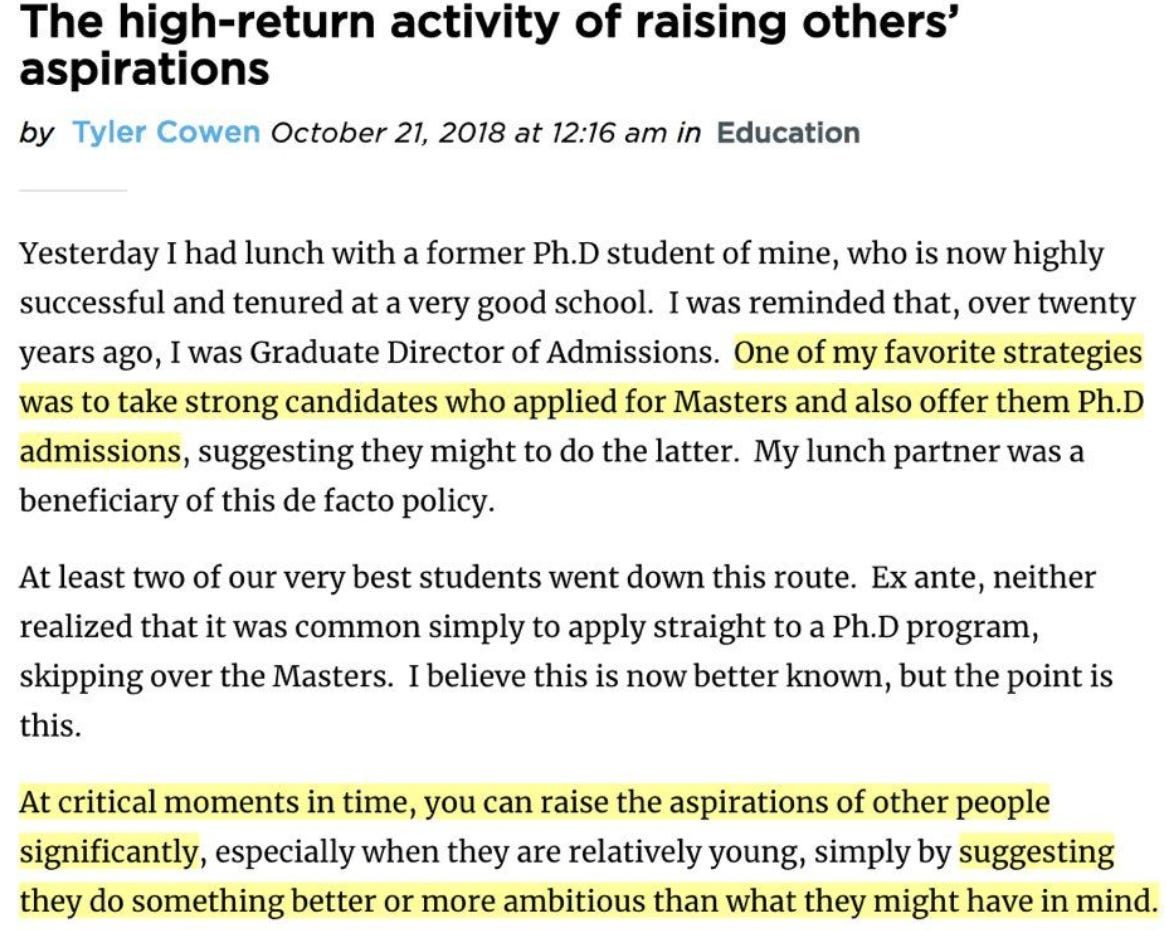
“At critical moments in time, you can raise the aspirations of other people significantly”

I know that people can create an inflection point in someone else’s career with generosity because I’ve experienced it again and again. When I was young and dumb and clueless (so like, yesterday), people invested in me with their time and wisdom. And people connected me with other people. And all of those people, bit by bit, completely expanded my view of the world and the possible.

People have shown me Ridiculous Generosity.

The leaders I respect & admire exercise Ridiculous Generosity, it’s core to their ethos. Ridiculous Generosity is a mental model of how to engage the world, a life philosophy.

My hypothesis is that it’s rooted in abundance mentality.

Folks with a scarcity mindset perceive that if you win, then they lose…so of course they don’t help anyone else. But those with an abundance mentality perceive that not only is there room for everyone to win, there is room to grow the pie so that everyone wins bigger.

Ridiculous generosity is the other side of the ‘play long term games with long term people’ coin.

Playing long term games with long term people means putting an abundance mentality to work even when a scarcity mentality tries to creep in. It means helping people today whether the pay off is in 15 minutes, 15 years, or the pay off never happens.

Because of the Ridiculous Generosity I’m so grateful to have received, few things in life bring me more joy than making thoughtful connections for other people. Here’s how I’ve seen Ridiculous Generosity in action:

  • make the thoughtful & well timed intro (psa: only after both sides opt in)
  • share the learning
  • send the 10 word text to answer the question
  • offer the meaningful advice or insight
  • share the link to the friend’s new project
  • grab coffee with the newbie
  • have the brainstorming session
  • give the feedback (to the person who asks for the feedback, even when it makes you a bit uncomfortable)

Have I mentioned this is still aspirational for me and I don’t say this as someone who has this nailed? This is #goals.

Ridiculous Generosity isn’t necessarily about the big business decisions or the decisions that cost real dollars, time, political capital, or reputation risk. Though it could bleed into those through a relentless focus on long term win-wins.

The real power of Ridiculous Generosity is in the daily interactions that cost little to nothing besides bending towards generosity.

You might be thinking this is all fine and well, but we each have finite time and finite focus. I’d 100% agree. Even if we wanted to help everyone, we can’t….the time math doesn’t work. So Ridiculous Generosity *has* to have boundaries around it. The two big ones for me are:

(1) Not everyone receives Ridiculous Generosity. It’s kinda like qualifying sales leads, only in this case it’s qualifying people asking for a favor. Maybe you only show Ridiculous Generosity to people you already have a relationship with, or only to people who’ve shown that they are serious minded, or only to the cold outreacher who put in the effort with a thoughtful ask that shows they’ve done their homework. Maybe when the random person reaches out asking for a call to talk about x, you ask them to first email the specific questions they’d like to discuss. (Funny thing, this is where a lot of requests suddenly go silent because the person wasn’t serious about it so the qualifying filter paid off.)

(2) Ridiculous Generosity has time boundaries. There are times when you can barely squeeze another email into the day, let another phone call or coffee date. And that’s ok. If it’s someone you want to help and you don’t have the mental or emotional or calendar capacity right now? Tell them to check back in some specific time frame. If it’s someone that you really don’t want to help? Tell them that. Well, soften it and say it kindly but yeah, let them know this is not something you will be helping on. Even when we can't be as generous as we'd like, we can always be polite.

This actually reminds me of when we talked about the idea of discernment and that knowing WHEN to do something can be higher impact than knowing WHAT to do.

If I were to rewrite the Ecclesiastes framework for people building & creating, it would look something like this… There is a right time for everything.

A time to expand optionality and a time to hyper commit.

A time to ignore to the skeptics and a time to listen carefully.

A time to meticulously plan and a time to just👏🏽get👏🏽started👏🏽.

A time to generously schedule intro calls and a time to ruthlessly guard your calendar.

A time to talk to every single sales leads and a time to relentlessly qualify leads.

A time to burn the ships and a time to hedge your bet.

Lastly, make it easy for people to help you.

Some ideas:

  • Send an email that they can forward on to make the intro you are hoping for.
  • Follow up after the intro to let them know the outcome.
  • With people you trust, be clear about where you’re trying to go – if people know they can help.
  • Just ask politely, recognizing that you are asking for a favor. People who demand or expect Ridiculous Generosity don’t get it. An extreme example is that I once worked for a company that had a corporate bully in a senior position who was eventually ‘invited’ to leave the company. The bully then wanted an intro to the new company I had joined but instead of asking me for an intro, he sent me an email telling me to make an intro. lol nope

(Most) people like to help people. And we all like to help people who help us. I find it interesting that generosity is a bit of a currency in both the startup world and in the ag world, maybe there’s a correlation between people doing hard things and an embracing of generosity?

Here’s to more abundance mentality.

Here’s to turning gratitude into Ridiculous Generosity.


Get the first 50 editions of Prime Future in 1 ebook:

Get the ebook!


Categories
Emerging Tech

Prime Future 76: Meat the metaverse

Facebook recently announced the company is changing its name to Meta, a head nod to their bet on the ‘metaverse’. The Internet had a lot of jokes about it, including:

But jokes aside, if the 7th most valuable company in the world (~$943B) is changing their name to bet on a single idea, then that idea is probably worth being aware of. Whether they are correct or not is an entirely different discussion. (Some say it’s a PR stunt to distract from the bad press Facebook has received lately, but I don’t think you change the corporation’s name and stock ticker symbol just to change the news cycle…Meta believes the metaverse will be a big thing.)

The metaverse may seem like a topic outside Prime Future scope. I like to dig into trends happening in livestock & meat & milk production but this is not even clearly a thing, let alone one impacting the animal protein world. And yet…

There is a general trajectory in tech that new tech usually hits consumer use first, then trickles to B2B uses over time. What’s happening today in the consumer world can give clues about what’s coming to the B2B world in say, 3-10 years.

And the world of gaming is often the ‘canary in the coal mine’ for consumer facing tech. What’s happening today in gaming can give clues about what’s coming to the consumer world of tech in say, 3-10 years. And many in the gaming world argue that the metaverse, or some early variation of it, is here.

So while on the one hand I could not care less what’s happening in gaming (my idea of gaming is re-reading the Ron Chernow biography on Alexander Hamilton), it does kinda give some clues about what tech is headed to the broader consumer world and then to the B2B world. And tech trends for the B2B world puts us squarely in the domain of what matters in livestock, meat, & milk value chains…so here we are.

What is the metaverse?

Before you write off the metaverse as something from & for SciFi nerds only, here are some descriptions of the metaverse:

  • The metaverse is a complex topic to describe, even for experts, but roughly speaking it’s a world where people work, shop, play, and do everything else they normally do IRL—just in digital form. Zuckerberg describes it as “the next chapter of the internet.”
  • The metaverse, which is a future vision of the internet that is a persistent shared digital space (and probably includes AR or VR tools).
  • Metaverse is not about a digital representation of the physical world, its about an entirely digital space.

Here’s the official party line from Meta:

Meta builds technologies that help people connect, find communities, and grow businesses. When Facebook launched in 2004, it changed the way people connect. Apps like Messenger, Instagram and WhatsApp further empowered billions around the world. Now, Meta is moving beyond 2D screens toward immersive experiences like augmented and virtual reality to help build the next evolution in social technology.

Notice the word immersive. Immersion into the digital world is a pillar of the metaverse.

This is an oversimplifying, but the metaverse is largely about new ways to do what we already do online. Which is to say, the metaverse will provide more digitally immersive ways to connect and socialize and work. Perhaps with new tools (like VR glasses), for sure with better graphical interfaces, likely with new digital infrastructure to facilitate it all. But generally, the idea of the metaverse seems more evolutionary than revolutionary, at least from a user perspective.

(Scroll down to skip to the ‘so what’)

Another metaverse pillar is decentralization, as in decentralization of the ownership of the platforms, from Not Boring:

“To understand why (decentralization matters), it’s useful to think about the Metaverse as a virtual version of the real world, a place in which people work, play, shop, and socialize as avatar versions of themselves, or many, depending on the context. Just like we buy outfits for our physical bodies and just like gamers buy skins in Fortnite, everyone will buy outfits for their avatars. Just like people want to buy nice homes and decorate them to reflect their personal taste, we’ll buy and decorate virtual spaces. And on and on.  We will spend real time and real money in virtual worlds.

If the Metaverse operated like the internet does today, though, we wouldn’t actually own any of those things. They’d be tied to whichever platform we bought or earned them in. Platform changes its mind, lose the items or see their value deflated. Leave the platform, lose the items.”

How do you allow people to maintain ownership of digital assets as they move through the metaverse? Decentralized ownership of the platforms is part of the answer, but also this is where cryptocurrency enters the metaverse conversation – but that’s for another day. The Journal said this:

For the metaverse to take off, we’ll need upgrades to existing computer systems and technology, tech executives say, including more raw computing power and higher-quality graphics as well as a universal framework that allows users to move seamlessly from one part of the metaverse to another. Also essential will be programming tools simple enough to allow anyone to create their own virtual realms and experiences, not just skilled developers.

Consider that many of us have just spent 18 months on 3+ hours of video calls every day. Zoom is great, but also, doesn’t there have to be a better way than ‘virtual coffees’? The metaverse just might unlock that…or at least try to do so.

Back to the idea of gaming as the canary in the coal mine for new tech, there are already some big companies working solely in this space of immersive digital experiences. Ask the 16-20 year old in your life about the company Discord, which started as a place for gamers to find each other and chat but morphed into being for “anyone who could use a place to talk with their friends and communities.” That includes companies using Discord for non-Zoom, more digitally immersed team meetings. Oh and Discord has 250m+ users and is supposedly generating several hundred million dollars in revenue – it’s a real thing (some) people use today, not just the idea of a future thing.

Ok with all of that background, the real question will be, how and when and WHY will people use the metaverse? It’s hard to say because it’s early innings still, maybe the game hasn’t even started. 🤷🏻‍♀️

If consumers get comfortable with the metaverse, what will that mean for consumer expectations?

…of how they buy meat & milk? What will consumers expect from the buying experience, but also the products themselves?

Think about this generationally. Millenials are the first digitally native generation – we learned to type in kindergarten and had social media accounts in high school. We grew up with SimFarm and Oregon Trail and that weird ski game where the bear ran out to eat the skier. Millenials grew up way more immersed in the digital world than Gen X’ers, and so there’s always been a different set of expectations about the world, that there should be an online element for all things.

Gen Z’ers though, they make Millenials look like we’re back here using a rotary phone. Their expectations about digital experiences are vastly higher. They experience life with their peers via Snapchat and TikTok. They are way more immersed than Millenials, so have different expectations. And so on and so on.

As technology changes, our experience changes, and our expectations.

Imagine if Starbucks or Chick Fil A didn’t have a website in 2011, or a mobile app in 2021. If the metaverse becomes a thing, then let’s assume that in 2031 brands will have to have a metaverse presence.

Even if not all consumers engage in the metaverse, just as not all consumers use a restaurant’s app, the brands will have to be there because that's where their customer base is leading them.

Expect to see the tech forward food brands & retailers at the bleeding edge of this trend.

How will the metaverse impact input companies, and meat & milk processors?

I don’t really know but I think it largely centers around how people work. Just as consumer expectations for brands evolves, people’s expectations for workplaces evolve to continue expecting more/better digital tools. So…

The first metaverse native generation will have expectations about how work works in the metaverse.

Because oh by the way….

“Last week, Facebook rebranded to Meta, and outlined its vision for the budding metaverse. This week, Microsoft announced its own entry into the metaverse — and its early vision sounds a lot like Meta’s. Both companies are all-in on:

(1) VR headsets

(2) Digital avatars: Microsoft Teams is adding 3D avatars and using AI to listen to a user’s voice and animate their avatar, while Zuck revealed Meta’s Codec Avatars that closely mimic users’ appearance

(3) Virtual workspaces: Both companies revealed virtual whiteboards and other collaborative settings that position the metaverse as a place to get work done

Each company has distinct advantages to fulfilling its metaverse dreams.”

So maybe the metaverse will simultaneously find a fit with consumer and business use cases early on?

For livestock producers, there could be opportunity in the contrast.

Perhaps as more of life becomes more digital, it has the potential to make the physical world more engaging as a contrast. Why do people like to go to pumpkin patches in the fall and Christmas tree farms in December? (besides the Insta worthy pics, obviously) It’s because there’s something appealing in the contrast with being on a computer all week, even in today’s version of the digital world. And if that is an accurate hypothesis, then a further dive into the digital world with the metaverse will mean a stronger contrast between the digital and the physical world. How will farmers capitalize on that? Will we see more ‘Fair Oaks Farms’ equivalents? (If you don’t know Fair Oaks, it’s like livestock Disneyland. Agritourism is way too lame of a word to describe what they flawlessly execute.)

And in that same vein, could the metaverse somehow be a catalyst for more farmer D2C sales? Like Barn2Door but in the metaverse??

If the metaverse materializes, what will *not* change?

Engaging with brands, buying decisions, ordering, etc may all happen digitally – maybe even in the metaverse eventually – but you know what can never be digital? Food consumption and food production.

Food production will continue to be augmented with technology but the growing of the food and the shipping of the food and the processing of the food? That all happens in the physical world. People can’t eat digital food or live in digital houses. Agriculture will always be the anchor of the physical world.

The Journal also said this:

Concerns over privacy and security will need to be addressed as well. And then there’s the matter of the metaverse’s potential pitfalls, including the possibility that people will find the virtual realm so compelling that they neglect their real-world needs.

“There’s a potential to preferring it to traditional life,” Rachel Kowert, an Ontario, Canada-based psychologist who has studied the mental health of gamers, says of the metaverse, adding that the risks are higher for children. “Their primary learning about how to behave and engage with the world is through their peers and social interaction,” she says. “It’s a critical component of how we learn to be people.”

…but, doesn’t that sound like what people have been saying for 10 years about social media?? There is nothing new under the sun.

The question for the animal protein industry will be:

How do you continue bridging the physical & digital worlds to be relevant in both by meeting customers where they are?

What a time to be alive!


Get the first 50 editions of Prime Future in 1 ebook

Get the ebook!