Categories
Leadership

Prime Future 75: Nobody knows how the future of work will work.

There is no such thing as “The Cattle Market”. There is a price for live cattle futures contracts, or this week’s average price of bred heifers at the local sale barn, or the average price of feeder calves at Oklahoma City in the fall. We could go on and on with specific sub-markets across regions and categories, none of which are “The Cattle Market”. Markets are local and specific…also true for labor.

“The Labor Market” isn’t a real thing.

Labor markets are local; yet simultaneously, in a world of more remote work and increased flexibility, the market for talent is global.

It’s all relative to any individual’s next best alternative.

Yes, we’re talking labor today. The challenges, the chaos, & the principles to get from here to there….whatever ‘there’ ends up looking like knowing that none of us can see much more than faint outlines of the future of work.

But we’re going to use the word talent instead of labor because this whole thing is about people; the trick is how to get the best people to take your job and keep it. That’s not a new problem, but it has been exacerbated in the last 18 months as ‘The Great Resignation’ has unfolded, with droves of people leaving bad jobs, crummy bosses, and uncompelling companies behind. No one really knows where this massive realignment leads or what the workplace of the future looks like but things are uncertain and the stakes are high.

Caveat: The activities involved in turning livestock into meat & milk are physical; they happen in the real world not the virtual one. You can’t have a WFH pen rider, a remote based employee on the deboning line in a plant, or a Zoom based truck driver transporting pigs from farm to plant. The worlds of front line physical work and office based ‘information economy’ work seem to be moving further apart (for better or worse), yet many of the challenges facing company leadership for both types have a lot of crossover, especially the monumental challenges of recruiting & retaining talent.

How to recruit and retain talent today is a tricky question with zero easy answers. But leaning into the trickiness and wrestling with it is a great place to start.

The thing about The Great Resignation is that most people are going somewhere; they are just leaving one company to go play on someone else’s team. So the question is, are people running to your company or away from it?

Today’s conversation is not about unemployment policy, federal vaccine rules, inflation, or any of the other factors outside a business owner/leader’s control. Those things are what they are. The worthwhile conversations are about how we navigate this new world and its many complexities, focusing on the controllable levers.

Humility: are you looking in the mirror?

When people leave your organization, what’s the conversation in the management meeting? If it centers around ‘people these days’ or ‘those <insert generation> don’t know how to work’ or lamenting government policies or anything else outside of the people in the room, well….the next few years may not go well for you. I believe there will be long term implications of choices being made now, of postures being taken. To be clear, I’m not necessarily talking about company policies, I’m literally just talking about management attitudes. I’m betting my $$ on the management teams who’s conversations sound like this:

  • “We haven’t done it before, but what if we….”
  • “We need to learn more about how to structure it, but could we….”
  • “We’d need to experiment a bit, but perhaps we could work with people to….”
  • “What’s 1 thing we can learn from their departure?”

Winning in a chaotic talent market is not about having all the answers, it’s being willing to wrestle new questions.

And that takes humility. Sometimes a lot of it.

I like the way my friend Jim Bishop, founder of Conjunction Leadership, describes it:

At the core, the entire “Covid experience” enabled people to understand the value of their time. Now suddenly individuals were able to understand the opportunity cost of giving up their time.  While working at home, they realized that an extra hour could be invested into what was most important to them. Almost in unison, employees across the globe are using this moment in time to assert what is important to them and with a “labor shortage” as wind in their sails, taking it upon themselves to create the life that they’ve wanted all along.

However, most ill-prepared organizations are caught flat-footed and stand to lose talent during this time.  Organizational leaders that have stubbornly dismissed The Great Resignation as something dreamed up by “entitled employees who’ve gotten spoiled during the last 24 months” will certainly lose.  They will numerically lose numbers of employees as well as physically losing the hearts and engagement of those who simply feel too trapped to leave.  Simply put, they’ve got to stop believing that they own the employee’s time for a set number of hours per day – an archaic mindset and belief rooted in the industrial revolution when employees “clocked in” for their jobs and today results in the unhealthy practice of presentee-ism.

Jim’s comments are right in line with the takeaway from a recent WSJ article, “How a side hustle can boost your job performance”:

Organizations want exclusive rights to their employees, but perhaps that idea of ownership is misplaced,” says Dr. Sessions. He believes that if companies restrict moonlighting, they risk losing employees. “People need to choose their own path outside of their day jobs,” Dr. Sessions says. “For some, that means pursuing career development, personal fulfillment or just engaging with new and interesting people in a side hustle—all of which can elevate their moods and be beneficial to their regular jobs.”

What are some of the upsides of this massive realignment?

It seems like all the headlines focus on the downsides of The Great Resignation, but every cloud has a silver lining…

  • In a world of options, people who show up every day are showing up because they choose to be there. When people in my orbit complain about a role/company for months on end, I’m asking them when they are going to do something about it…especially right now. The upside of people having so many options today is that if people are showing up its because they want to show up. (Ok its that or they couldn’t get a job elsewhere but let’s assume you didn’t hire many of those in the first place😬)
  • Will there be new perspective gained & other benefits from office folks pitching in on the front lines? From fast food to grocery stores to factories, there have been several examples over the last 18 months of management & office staff being called to the front lines. I have to believe that getting a fresh perspective could have huge impacts on how these business operate at the front lines, whether Trader Joe’s having all office hands on deck to staff cash registers or KFC sending the office troops to stores to cook chicken.
  • Opportunities in rural areas. I love that WFH means people can do big city work from small town places. I don’t want to risk sounding like a bad country song writer here, but I love this point.
  • Incentive to tap non-traditional talent pools. I think the two most wildly underutilized & widely available talent pools in general are stay at home moms who are college educated with great work experience but want part time / flexible hours, and the recently retired who have great experience & want to contribute somewhere without full time stress.
  • I recently heard on a podcast that companies who go back to in the office full time will probably lose 1/3 of their people, and companies who go fully remote will probably lose 1/3 of their people. Which means we’re likely to end up in the hybrid model as the dominant work model, and there’s so much we don’t have solved for that model. We really don’t know yet how the future of work will work so this is an opportunity to re-evaluate assumptions. We’ve been swimming in the same work assumptions since the 1920’s and we haven’t really had a good reason to hold up the assumptions to examine them. Now we have to do so. What’s true about how we work that is critical vs what’s true about how we work that is just what we’re used to? Time, place, people, scope, terms, processes….it's all up for a revamp…

…just how ‘up for a revamp’ are old assumptions? The Hustle put it this way in a recent article aptly titled, “To reinvent work, we have to destroy the clock:

The pandemic has accelerated conversations about remote work, hybrid scheduling, and 4-day workweeks (an idea that has been trotted out since at least the 1970s and never stuck). But some scholars propose a more radical alternative to time-based work: destroying the clock altogether and just getting stuff done.

That means working when we’re at our best, and around our family and health priorities, instead of from 9 to 5, or 8 to 6, or longer to try to impress our boss.

When someone asks us how many hours we work every week, we should all have the same answer: I don’t know.

That same article describes the Best Buy experiment with a concept called Results Only Work Environment, which rested on 2 key concepts: autonomy and accountability. On that experiment:

Many employees didn’t work less — some reported working more — but they felt in control. They skipped out of the office for the occasional afternoon matinee, took conference calls while hunting, and picked up their kids from school.

This is the hard part about results-based work:

  • It comes unnaturally to executives and managers, given their contributions (how much does delegation and leadership really count for?) are difficult to gauge.
  • They also have the most to learn and the most to give up as they grant greater autonomy to employees.

That’s really what time-based work schedules have been taking away from us: our freedom.

By losing the structure of time and focusing on the results, we can get freedom back. Freedom to take care of children or elderly parents. Freedom to exercise. Freedom to start a new hobby. Even the freedom to do our best work.

But even in a new world, some old principles still apply.

Here are some favorite mental models around retaining talent – if you’ve experienced these in the wild then you know why they matter:

  1. Always be recruiting. I’m not talking externally, I’m talking internally. Just like the lowest cost customer to acquire is the one you keep, the lowest cost top talent to acquire is the one you keep.
  2. A players recruit A players, B players recruit C players. In remote based teams this dynamic is multiplied.
  3. Good managers help their people get where they wanna go inside the company, great managers help their people get where they wanna go inside or outside the company.
Ok those are some ideas for employers.

A big idea for employees:

McKinsey estimates that 75% of companies in the S&P 500 will fall out by 2027.

75%! That is staggering. And it means that it's wildly risky for any employee to assume their employer will exist in the future.

The industry is the new company. Here’s what I mean by that – you and I both know people who see their network (the career relevant, meaningful set of relationships) as existing within the confines of the organization. That’s not only myopic, it’s toxic for your career (and for company culture, but that’s a separate discussion). Meaningful networks don’t exist just within the confines of a company; the real relationships are the ones that span companies and time. Your real network is the list of people you call when your role gets cut, your company gets acquired, you’re looking for talent, or you’re looking for feedback on a business idea. Cultivate that list with generosity. It’s a big world of opportunity and options and really smart people doing really great work on really cool stuff.

A final note for us all

According to Axios, “more than half of frontline grocery store employees have plans to leave their jobs due to pandemic-induced burnout. The pandemic revealed how much we rely on low-wage, frontline workers, but it also exposed the ugly ways in which these essential workers are treated by employers and consumers alike.”

…a good reminder that simply being kind can be a competitive advantage.

What a time to be alive!

Categories
Supply Chain

Prime Future 74: Vertical Integration 2.0

Along with many other processors, a poultry integrator recently announced increased wages for processing plant employees and truck drivers. Because poultry is so vertically integrated, I’ve just assumed that most poultry co’s own the trucks and trailers to transport eggs from breeder farm to hatchery, chicks from hatchery to growout farms, feed from mill to farms, and live haul to take birds from farm to plant.

However, what I’ve learned is that there is actually a shift away from company owned truck fleets because of the management and capital required to keep those assets on the books. While some truck drivers are still employed directly by the integrator, like for delivering chicks to farms, and some of the trucks and/or trailers are company owned, more and more of these activities are outsourced to third parties.

I find this really interesting. We tend to think of the livestock, meat & milk business as part of an inevitable march towards increased consolidation and increased integration. (Note: those are 2 related but very separate concepts. Consolidation is when a company buys a competitor, vertical integration is when a company buys a supplier or customer.)

Yet here is an example, albeit potentially small, of reducing vertical integration by outsourcing at least some portion of a reallly critical activity.

One data point may not indicate a trend, but the whiff of vertical disintegration in trucking & logistics for meat & poultry companies does raise some questions:

  1. Why are the integrators moving away from owning trucking capacity?
  2. How will truck driver shortages of 2020-2021 (and likely 2022) impact that trend?
  3. Is this a one off trend or a part of something larger? Are integrators divesting assets in other important-but-not-core activities?

More importantly, given the chaos in labor markets & truck driver shortages of 2020-2021 (and likely 2022), how will this impact the ownership model for integrators moving forward?

"There are only two ways to make money in business: one is to bundle; the other is to unbundle."

The tech industry loves that quote, and it’s usually used in the context of bundling & unbundling consumer products, e.g. cable TV vs Netflix. Sometimes it’s used in the context of bundling & unbundling companies to create shareholder value, e.g. GE of 1990 vs GE of 2021.

What if it also applies to how we think about supply chains? Such as, oh idk, commodity supply chains like meat, milk & poultry? We could even use the alternative phrases of vertical integration & vertical disintegration to describe bundling & unbundling.

Metrics: what financial metrics matter?

An interesting example of vertical disintegration happened in the US beef business a few years ago as packers spun off their cattle feeding capacity. Why? Because feeding cattle is massively capital intensive and depending on where we are in the cattle cycle, can negatively impact Return on Equity, a key finance metric.

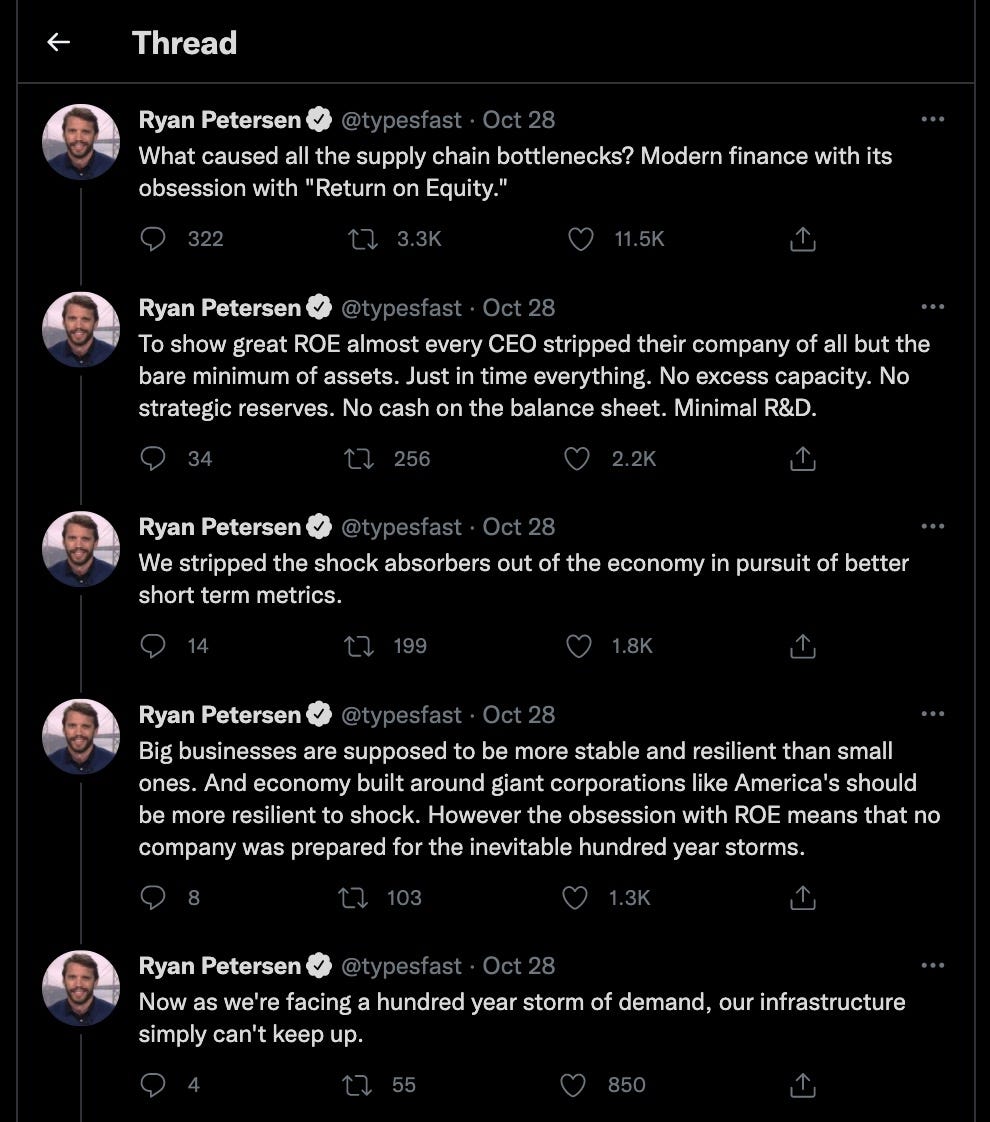
It’s not a direct corollary to meat, but here’s an interesting thread on that concept; replace ‘supply chain’ and ‘logistics’ with ‘meat’ and see if some of this doesn’t resonate:

Yet over the same time frame that packers divested their cattle feeding businesses, let’s call it the last 10 years, retailers have increased their degree of vertical integration in protein with examples like Walmart’s milk plants and Costco’s chicken plant. Also over the same time frame, packers have moved further downstream into further processing, e.g. case ready plants. Mixed signals, eh?

Cold storage represents another dichotomy in vertical integration.

According to the Global Cold Chain Alliance, cold chain operators see insourcing (customers building their own facilities for cold storage) as a top 3 threat to the business behind driver & workforce shortage and balancing supply & demand. Yet these same third party logistics providers in the cold chain space see that increased customer outsourcing represents a growth opportunity.

Which is it? When is it which?

(Interestingly two other growth drivers for cold chain ahead of customer outsourcing were robotics & automation and growth of ecommerce. 👀)

There are probably a million factors that can impact a management team’s decision to increase/decrease vertical integration, things like:

  • market conditions
  • company financial health
  • company ownership structure
  • company strategy
  • relative risk level
  • supplier structure
  • net cash position
  • cost of capital
  • competitive landscape

etc etc etc etc etc…..

My working hypothesis is that ultimately the two driving dimensions for vertical integration are:

1) risk vs control - what is the risk of not having control of this link in the supply chain?

2) reduced cost vs added value - will owning this link in the supply chain reduce cost or increase revenue?

….sometimes those two sets of dimensions are at odds with one another. But here’s the thing – that laundry list of factors above? Those are true or false at a given point in time, not in perpetuity. So the structure of the industry should have some ebb and flow over time with regards to the degree of vertical integration. Some hypotheticals:

  • If land prices fall 50% in the next 5 years, would poultry integrators decide to buy the farm ground to grow corn & soy themselves?
  • If fed cattle prices increase 60%, would beef packers get back in the cattle feeding game?
  • What would need to be true to cause pork processors to own their own cold storage instead of leasing capacity as needed?
  • What would need to be be true to lead pork integrators to divest their growout operations? Sow farms?

Or, is it possible that as packers/integrators increase their core business through consolidation, that it makes more sense to decrease integration? I’ll leave that one to economists and CEO’s.

Back to the original question, how will the current transportation crisis impact the future movement of livestock, meat & milk?

My hypothesis is that we could see a shift back to company owned logistics as a way to control risk, given the massive logistics & labor risk the last 18 months have revealed. At least until autonomous trucking becomes a thing, then we should see more business model innovation unleashed…

…because, keep in mind, this whole discussion about the future of supply chain & logistics is set against a backdrop of not only how rapidly the tech is accelerating but how that technology is enabling new business models, like the one mentioned last week of the WeWork model for freight warehousing. (If you’re not familiar, WeWork is a startup that takes long term leases on commercial office buildings and sells short term leases for customers wanting flex office space. WeWork is also a deliciously disastrous startup trainwreck story for reasons other than their business model.)

Use WeWork or Uber or Airbnb or whatever other consumer business model you want, but the question is, how will those sharing-economy type business models drift into asset heavy, large scale, B2B manufacturing/disassembly businesses? The options used to be either lease or buy the asset, but having more variations in both of those options could change the risk/reward calculus of owning or outsourcing certain parts of the process involved in getting meat, poultry & milk to end customers.

Alternatively, having more predictability could change the calculus. Another example from last week was the idea of freight tech companies that are moving all the pen & paper or Excel based processes to digital, and improving not only visibility of information but of actual cargo in transit. How will those moves towards digitization reduce the risks that integrators perceive, ultimately enabling them to have high confidence in those suppliers to do the activities that need doing but without the integrator having that capability on their own books? Not just in trucking either.

On a final note, consider this perspective from Seizing the Middle: Chess Strategy:

Rockefeller’s strategy was part of a wider transition to a new type of industry, beginning in the 1840s and ending with the crash of the 1920s. Businesses started “seizing the middle” and taking control of the resources they depended on. A single company could take charge of everything from the natural resources required to make a product to the transport systems necessary to deliver it to customers. The implications of this were dramatic.

…the change in business practices allowed managers to start thinking like chess players: a few moves ahead. Being able to anticipate and plan had the undeniably significant effect of allowing companies to invest more in research and development because they could forecast where current trends headed:

“In allocating resources for future production and distribution, the new methods extended the time horizon of the top managers. Entrepreneurs who personally managed large industrials tended, like the owners of smaller, traditional enterprises, to make their plans on the basis of current market and business conditions. . . . The central sales and purchasing offices provided forecasts of future demand and availability of resources.”

To control the game, one tries to control as much of the board as possible. At the outset, using your pieces to seize the middle of the playing field is a great strategy, because it gives you the widest possible vantage point from which to control the movement of the other pieces.

But maybe that word ‘outset’ is the key here. The above description of Standard Oil (and many other businesses across many commodity segments) was reflected in principal in how the meat industry organized itself at the outset….but we aren’t at the outset of the meat business anymore – it’s an old, established business.

So perhaps we are at the outset of a new era. One with new alignments and new business models and new considerations that will inform how ‘vertical integration 2.0’ shapes up across meat, milk & poultry.

What a time to be alive!
Categories
Supply Chain

Prime Future 73: Never let a (supply chain) crisis go to waste

“If you think about it, the breakout moment for Fintech was the financial crisis of 2008-2009. It forced banks and financial institutions to do things differently. There was backlash against big institutions, we had new regulations like Dodd-Frank.

While what’s happening in supply chain is a little different, for our industry this is our moment of taking our crisis and building the next generation of tech and services. What’s happening around freight tech is very similar to what we saw in fintech in 2008-2009, so the great next decacorns (companies valued $10B+) that come out of venture capital will be associated with some element of supply chains and supply chain technology.”

When you see all the activities & excitement  & naïveté born by founders and skepticism born by incumbents, this is very similar to where financial services were. We will see some companies emerge from this part of the cycle that go on to be the great leaders of tomorrow. “

That’s a quote by Craig Fuller, founder of Freight Waves, a company who’s content has been my go to resource in learning about what’s happening with logistics right now.

Craig Fuller grew up in a family that was all about the trucking business. Craig started his career in fintech before starting Freight Waves. Here’s how he explains that company:

“If ESPN and Bloomberg had a baby in the back of a truck, it would be Freight Waves. The impetus behind Freight Waves was to create a real time information source for the global supply chain industry.

We originally started to create a tradable instrument based on trucking and trucking rates. We saw a massively volatile market and no way to hedge or offload that risk onto a third party. We actually launched a tradable instrument but that wasn’t very successful and a lot of that had to do with the lack of information in the market. It was an opaque market, there wasn’t a real time data service that provided information so people could trade off of it, and there wasn’t uniformity in the freight market. We’ve tried to focus on all 3 of those things.

A byproduct of creating a failed product is that you find what customers do want, if you have enough capital to survive. The Freight Waves playbook was taken from financial services. Bloomberg’s business model is what we tried to emulate.”

My chat with Craig was one of the most eye opening conversations since I started Prime Future-ing. You can listen to the full audio here (and I totally recommend it):

Now back to Craig’s big thesis about freight tech having its moment, let’s put that in perspective. Fintech is the darling of venture capital  investors these days, with 1 in 5 VC dollars invested going into the category and 65+ privately held companies valued at >$1B.

So why would Craig think the tiny little logistics space could catch up to financial services in terms of tech investment? Here’s why:

“This is a massive category, let’s not forget that we’re talking about 12% of global GDP. Financial services & insurance are 7.5% of domestic GDP. Supply chain & logistics represent 8.5% of GDP in the US and 12% globally, so we’re talking about an industry that is bigger and more nuanced than financial services.

It’s also easier to trade information which is essentially what a fintech platform is. But what we’re talking in supply chain is the physical movement of goods. You have this massively fragmented set of  decisions, set of parties, set of activities which make it much broader than what you see with fintech. It is so fragmented and so many activities that take place inside the industry, which means it’s ripe with opportunity.”

Here are a few of the many subcategories of freight tech, as Craig sees them:

“(1) Movement of freight – everything around DTC & ecommerce, how do you interact with the big parcel carriers. There are companies that consolidate shipments or create API’s or consolidated workflows.

(2) Warehouse automation services.

(3) Flex warehouse space –  The two most successful are Stord and Flex who are doing this with on demand warehouse space with short term agreements instead of long term agreements.

(4) Ocean cargo – ocean booking systems, electronic contracts.

(5) Air freight – Flexport is the most successful forwarding organization that does both ocean & air.

(6) Trucking brokerage – arbitrage, managing freight on behalf of shippers. Companies like Convoy and Transfix doing this.

(7) Visibility – how do I know where all of this freight is and how do I have information about where its going? What’s my eta? Companies like Project 44 and Four Kites are playing here.”

As an aside, you may have seen in the last few days how the CEO of Flexport unleashed the power of Twitter with some semi-simple ideas on how to start unlocking the bottleneck at the ports in CA. I recommend the whole thread here:

Twitter avatar for @typesfastRyan Petersen @typesfast

Update: The city of LB just announced it has temporarily suspended container stacking limitations. Thank you everybody who called the governor and the mayor to request. They got the message, you can stop now…

Ryan Petersen @typesfast

Yesterday I rented a boat and took the leader of one of Flexport’s partners in Long Beach on a 3 hour of the port complex. Here’s a thread about what I learned.

Ok so anyway, of course I had to ask Craig about the role of autonomous trucking because to us outsiders, that seems like the almost-ready technology likely to disrupt logistics. If there’s an 80k+ truck driver shortage that’s only expected to grow, isn’t autonomous trucking the answer? Here’s what Craig had to say about it:

“Automation and autonomous trucking are great, it all plays well and broader media loves it. The reality is that autonomous trucking is not going to happen as quick as people believe it will in the mainstream. This stuff is 10-20 years out. It will be massively transformative of our economy, but it’s not going to happen overnight. Autonomous trucking is getting all the attention but what I’m really excited about is all the pipes and mechanics of movement of cargo, money and info.

Ports have been early adopters (of autonomous trucking). The Port of Rotterdam has had a semi autonomous, closed loop environment for years. You’ll see these closed loop environments maybe around an airport or a warehouse where you’re shuttling trailers or containers from one door to another, that happens a lot. Those applications will see autonomous first. But I don’t think we’ll see autonomous trucking  services in the US before we see it in other parts of the world – places like Japan that has major demographic challenge and are very tech forward. They have a labor problem and its different than ours than ours because of their elderly population.

You have to remember that in order to have full autonomous trucking you need the federal, state and local rules and laws to correspond. Imagine the difficulties of that. When talking about autonomous trucking, you have a situation where the #1 job in 29 states is truck driver. And that is in states that are traditionally pro-business, so it creates a lot of difficulty to expect that technology to be adopted quickly.

The reality is that we are in the very early days, but there is so much opportunity.”

I also asked Craig, what should us normies know about the logistics industry?

“People don’t realize how BIG the industry is. 8 million people are employed by logistics in the US, 100 million across the world. So it’s a massively important segment. This is the physical economy. You can’t sell agricultural products unless you can transport them, and transportation costs impact the overall cost of finished goods.

People are waking up to the fact that supply chain is so prone to disruption and weather and geopolitical events. The reality is we’re now aware of it. I use the analogy of your power company – no one thinks about the power company until the power is out and then it’s ALL you think about. No one thinks about how product gets from point A to point B until the product doesn’t show up. At the end of the day the market has always worked this way and there’s always been issues but we’ve never had so much freight in the economy at a time when so few people were willing to drive trucks and work warehouses. So its created this massive bottleneck.”

“No one thinks about the power company until the power is out and then it’s all you think about. No one thinks about how product gets from point A to point B until the product doesn’t show up.”

Here’s what Hill Pratt, Managing Director of the Transportation Business Unit for Dairy.com, had to say about the tech that will enable the future of logistics in milk hauling:

“The dairy industry increasingly recognizes that it is in a competition for qualified drivers against all other industries.  A high volume of local moves and consistent year-round shipping activity provides some advantages.  But, there are negatives as well… Cows don’t take any holidays, so Sundays, Thanksgiving, Christmas and Easter are regular workdays for dairy haulers.  Also, some plants are notorious for excessive wait times and denying detention pay.  It doesn’t take very many incidents of drivers missing family dinners or their kids’ sporting events before they start looking at want ads from other industries offering predictable hours and fat signing bonuses.

Therefore, the industry is increasingly focused on resolving the causes of long and unpredictable plant waits and developing consistent, automated detention programs.  Technology is at the center of these solutions. Specifically, real-time shared integrated scheduling/trading and transportation platforms are essential to developing and coordinating plans that keep wheels moving and inventory turning.  Also essential is integrating these platforms with real-time load tracking/GPS platforms, so that:

(1) Real time bottlenecks and delays are identified and resolved earlier.

(2) Accurate load-level historical wait time data is captured, enabling business intelligence tools that sit on top of these massive datasets to help supply chain managers identify delay patterns, develop solutions, and create business cases to justify process change, staff adds, and capital investments.

(3) Provide accurate plant in/out time data to power automated detention tracking and payment approaches—so that haulers get what they deserve without the headache of creating detention invoices, and, plants are accurately charged for detention.  Automated detention relies on integration of scheduling, load arrival and load departure data—so plants don’t get dinged if haulers arrive early or miss an appointment times, but haulers are compensated accurately when plants hold them up.”

On a very related note, James Turner, General Manager of M2X US, added this context around the gap between current state and future state:

“In the United States, agricultural products are the single largest user of freight services comprising 24% of the share across all loads by tonnage. While agriculture products hold this position of significant overall volume in the US supply chain, its logistics network lacks technology facilitating communication and efficient transportation within the industry sector. Generally, the agriculture supply chain to date is tightly bound to lagging information communicated through paper, phone calls, emails, and more often than you could bear to imagine in this era, handwritten documents.

Additionally, with the ever-growing demands on industries to find more sustainable methods of producing goods, the agriculture supply chain has a unique opportunity to adopt smart technology which, through optimization, can reduce empty miles driven while also reducing costs. This results in higher profit margins for carriers and lowers costs for shippers all the while significantly reducing the overall carbon footprint of the agriculture supply chain.”

(What is M2X? From their website: “M2X was founded with the vision to improve the efficiency and sustainability of livestock transport across New Zealand. We now offer TMS solutions for carriers and enterprise customers across many industries including livestock, milk, forestry, bulk and agricultural products, and general freight. Our integrated Platform approach enables carriers and enterprise companies to work together to achieve and share the benefits of digital efficiencies and optimisation.”)

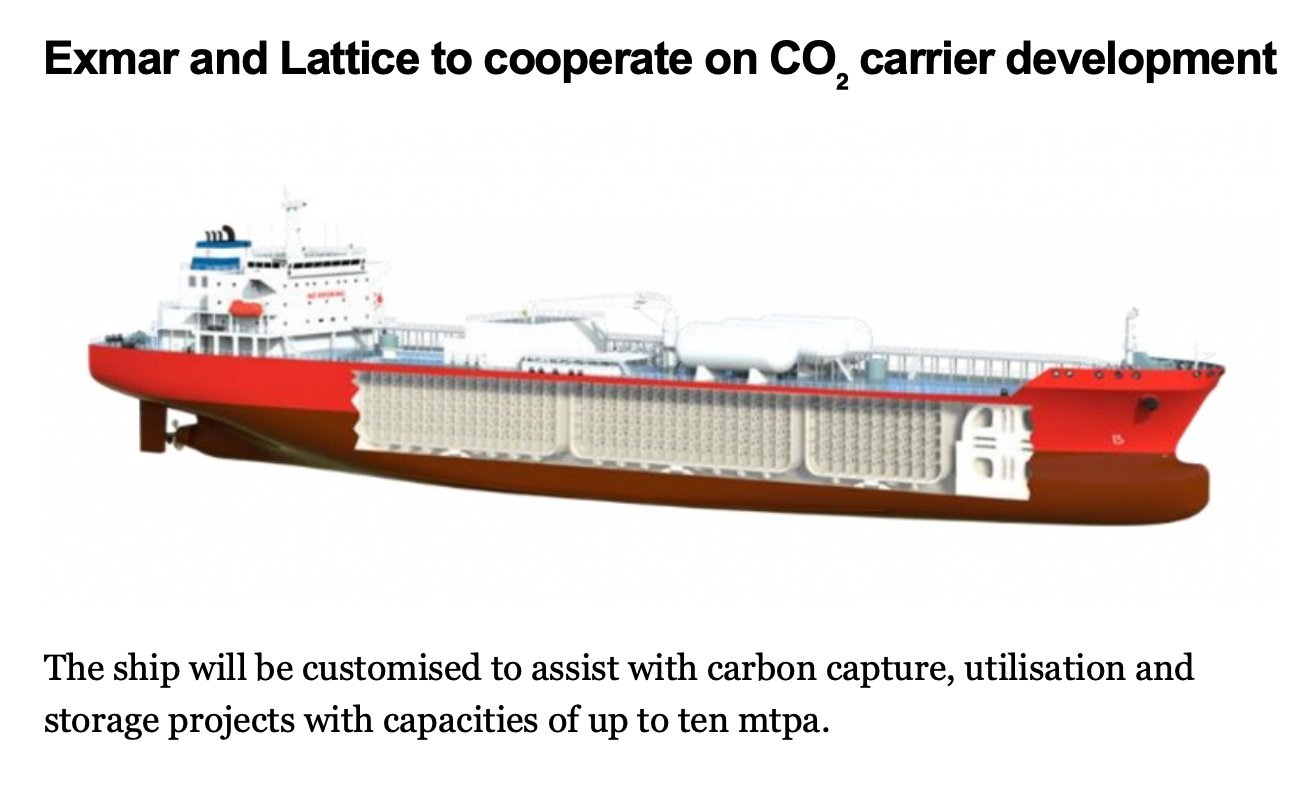
James’ carbon comments also lead us to ship technology. A few weeks ago I subscribed to a newsletter on ship technology (cleverly called Ship Technology), and its staggering how many of their stories have to do with ship companies launching new types of ships that have a carbon / emissions improvement angle. These are not announcements of investors putting money into these projects, these are announcements by customers of the technology which signals its much closer to reality. Here’s one that even mentions carbon capture:

Image

What a fascinating time in supply chain as today’s supply chain crisis intersects with abundant capital and rapid tech developments. Winston Churchill said it best:

“never let a good crisis go to waste”


Previous installments of this supply chain series

(1) Love Me Tenders: a supply chain story (link)

“Supply chain talk is e.v.e.r.y.w.h.e.r.e these days so I’m kicking off a series on how supply chain disruptions & dynamics are impacting livestock, meat & dairy. To start, we look at 2 macro concepts, what’s happening in milk hauling, and a chicken supply situation at the fictitious fast food chain, Love Me Tenders.”

(2) Sea cowboys & flying sheep (link)

“Meat isn’t the only thing exported, live animals are also exported. The global annual value of live animal exports is $24 billion. Put that in perspective – that’s roughly the equivalent of the entire US swine industry. It’s also a tiny little speck of the ~$800B global meat business. But every day there are five million head of livestock criss crossing the oceans of the world. That seems like something worth looking into for curious people like us…”

Categories
Supply Chain

Prime Future 72: Sea cowboys & flying sheep

I love the messiness & complexity & massive scale of the global animal protein business, that there’s always something to learn, new corners of the industry. Today’s topic is definitely an obscure little corner of the industry. We usually look at big picture accelerating trends in Prime Future but this one is both tiny picture and a trend that is, at best, unlikely to grow. But it’s interesting, so here we go 😁

In exploring how feed, livestock, and meat move around the world I stumbled on a post WW2 story of some church groups who wanted to take livestock to regions where the local livestock population had been destroyed in the war. These ‘sea cowboys’ as they were called, put livestock (and themselves) on ships to deliver the animals to war ravaged parts of Europe. Turns out, the sea cowboys were the origin of Heifer International, the non-profit who’s model is built around creating long term economic sustainability through livestock.

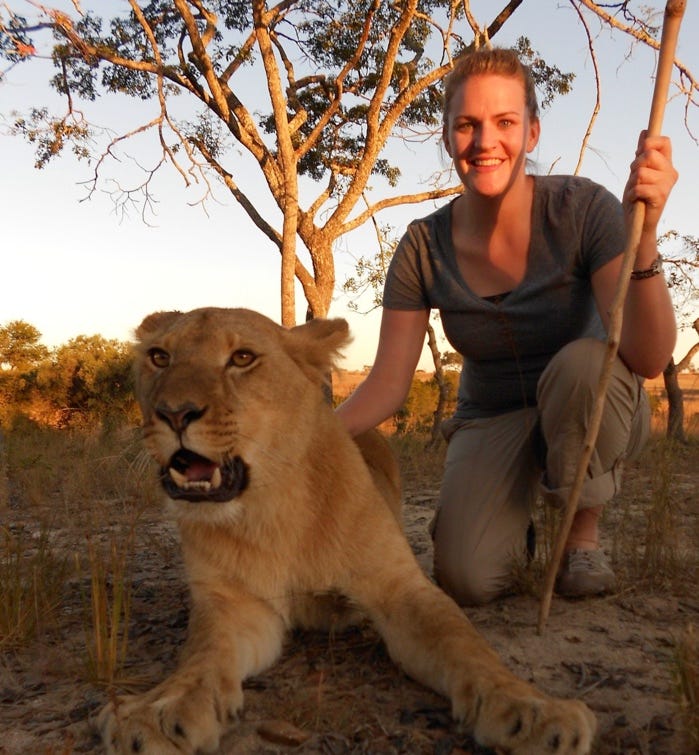
From a trip with Heifer International to Zimbabwe to see their model in action…and some local wildlife. (Don’t worry, Mom)

Why are we talking about sea cowboys in the midst of a series on how supply chain chaos is impacting livestock, meat & dairy?

First, let’s generalize the flow of livestock related stuff (at least within the US):

  • Feed ingredients shipped primarily via rail to feedmills, then feed is shpped via truck to producers
  • Animals shipped primarily via truck from point to point, ultimately to processing plants
  • Meat shipped primarily via truck within the US, before being put on ships for export outside of North America

Shipping chilled or frozen meat around the globe is it’s own complex thing that we’ll come back to at some point because cold chains might be one of the highest impact innovations of all time. But meat isn’t the only thing exported, live animals are also exported.

The global annual value of live animal exports is $24 billion. Put that in perspective – that’s roughly the equivalent of the entire US swine industry. It’s also a tiny little speck of the ~$800B global meat business.

Being from Arizona, when I hear ‘live animal exports’ I think about feeder cattle from Mexico brought into the US but there’s a whole world out there beyond. In fact, every day there are five million head of livestock criss crossing the oceans of the world. That seems like something worth looking into for curious people like us…

Who’s shipping livestock where?

Ok, so that $24B global ‘live animal export’ includes the mundane, like live cattle import from Mexico into the US or live pigs exported from Canada to the US, a combined ~$2-3B. It also includes a lot of movement of live animals across borders within the EU, ~$10B. Those animals are put on a truck and moved to their new country, and outside of additional regulations, it’s no different than moving pigs from Minnesota to Iowa or some other interstate movement within the country. So that’s not super interesting, let’s set all that aside.

A large portion of the remainder of animals represented in that $24B, are moving via water, or even air(!), from country A to country B. Now that’s interesting.

Let’s call this segment the Plane & Ship Animals. It seems to be worth about ~$10B globally annually, a rounding error in the grand scheme. Maybe I’m alone in this intrigue, but that rounding error of a supply chain of live animals moving via ships & planes is not a supply chain I’ve spent much time around. I have some questions…

Who: who is shipping animals to whom?

The Plane & Ship Animals are largely moving from Australia and the EU to the Middle East & northern Africa.

After the US (with imports from Mexico & Canada), China is the largest importer of live bovines. After a trade deal struck a few years ago, Australia has a growing live export to China of both beef cattle for feedyards and dairy heifers. That growing export to China pales in comparison to Australia cattle exports to Indonesia.

(Interestingly, dairy heifer exports to China is one of the reasons that the beef-on-dairy genetics strategy is much more challenging to implement in Australia than the US right now – the math on ‘next best alternative’ is very different in the two countries.)

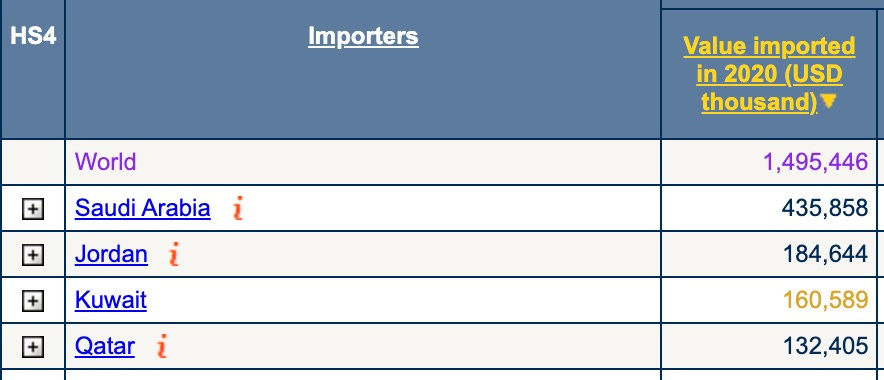
There is also a large & established trade of slaughter ready sheep shipped from Australia to the Middle East. Here’s a numeric look, according to Trade Map:

How: how are live animals shipped by air and sea?

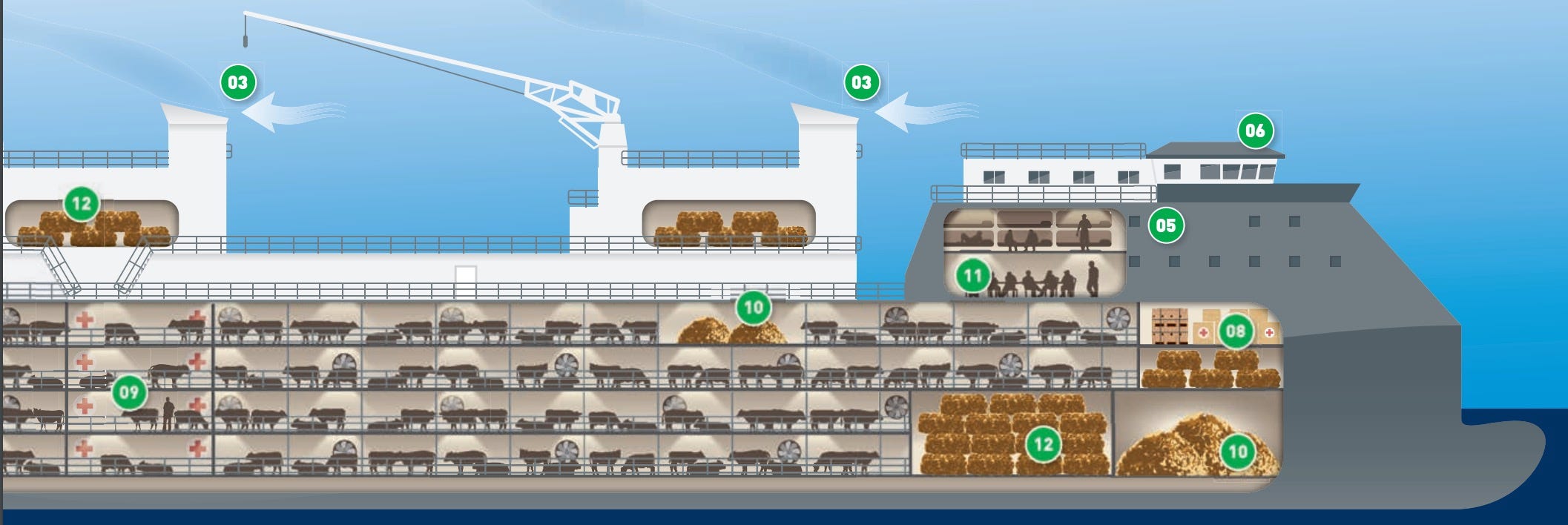
Let’s start with export via water, enabled by cargo carriers converted to livestock carriers. One livestock carrier is equipped to handle 75,000 sheep or 18,000 cattle. (Cruises are my nightmare, this is now my meta nightmare🤢)

Here’s how an Australia industry group describes some of the mechanics:

  • “Desalination equipment produces fresh drinking water from sea water. Additional water supplies are carried on board together with spare parts to quickly repair the system and maintain water supply in case of a mechanical breakdown.”
  • “Fresh air is continuously circulated by a powerful ventilation system. This is constantly monitored and alarms alert the crew to any changes. Additional electrical generators and spare parts enable air circulation to continue in case of a mechanical breakdown.”
  • “A ship may have two engines or additional generators in case of a mechanical breakdown, to ensure continued operation of ventilation, lighting, water desalination, feed and water distribution, and refrigeration systems.”
Photo cred to the Australian Livestock Export Corporation

Ok so obviously I know shipping animals across the world’s ponds isn’t new, but I didn’t realize the scale of it today. But think about the shrink on a load of cattle moving 100 miles…that has to be miniscule compared to the shrink on livestock shipped on a livestock carrier ship, right? So then it’s not hard to imagine that higher value animals are much more likely to be transported by plane than ship.

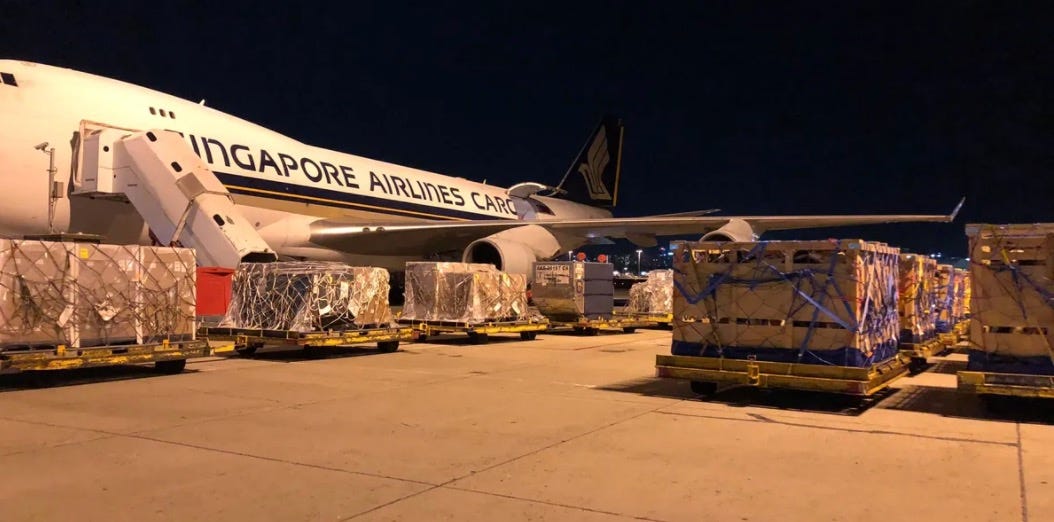
Here’s what Live Air Australia says about exporting animals via plane:

  • Livestock are contained within crates and can be transported in the lower bellyhold of passenger flights or on freighter aircrafts.
  • Each animal is transported in a specifically designed crate for the animal type. Allowing room for the animal to move freely, good ventilation and specifically designed flooring to keep the crates and aircraft clean from livestock excreta.
  • Livestock can be transported to Asia within 24 hours or Europe within 36 hours. Ideal for pregnant livestock or  accessing global destinations that have climatic challenges or new markets.
  • With numerous departure dates and locations,  air transport is a viable alternative for land locked areas for all types of animals, no matter how many livestock are required.
photo cred to Livestock Air Australia

(It turns out that Houston-Bush Intercontinental Airport has a Livestock Facility, so there’s some helpful holiday dinner trivia.)

I do not know the cost comparison of shipping livestock via ship vs plane, but it does raise some questions about what ‘high value’ means in this context and when plane travel pencils out, like for high value dairy heifers.

Why: what’s the business rationale for shipping live animals on planes & ships?

The real question is, what are the operational and market contexts that make exporting live animals the better option to exporting meat?

There are 3 potential markets live animal exports are destined for: breeding, feeding, and slaughter. I couldn’t find any good estimates breaking down the % of each of the total live animal export, let alone those percentages within the Plane & Ship Animals (the ~$10B). So we’re in hypothesis territory now.

The animals intended for slaughter are largely sheep headed to the Middle East for local slaughter for religious reasons. It’s not an economic question of whether it’s more cost efficient to ship carcasses/primals or to ship live animals. The customer demand is for live animals, so that’s what the market delivers….where there’s a market, there’s a way. ✅

Of the Plane & Ship Animals (ignoring the trade within North America or the EU), the animals being shipped to then be fed to market ready weights seem likely to be driven by regions where demand for meat is outpacing production capacity. I’m surmising that those same regions are also building up their breeding herds as well, so shipping breeding animals is either about expanding quickly or expanding better through improved genetics, or both. Whether due to re-population after disease outbreaks, or extended droughts, or any other cause of a previous herd reduction trend that needs to be reversed. Or simply the rapid rise of a middle class ready to level up their diet with animal protein, e.g. China.

But that raises the question, in an era of vastly accelerating technology to accelerate genetic progress, why would a producer import bulls instead of semen? Or heifers instead of embryos? Some version of ‘speed to offspring’ seems to be the likely answer?

As you can imagine, there is enormous animal welfare pressure around live animal exports (all variations, but especially shipped via livestock carriers) and when trying to find info on this space there is way more perspective available from activists than from industry (shocking, I know). The debate seems to be whether animals intended for slaughter should be shipped, or only animals intended for breeding and everything else going in carcass form. Regulations vary from country to country and fluctuate, like New Zealand’s ban on live animal export for slaughter a few years ago.

One thing the live animal export industry has going for it? While ports are backed up waiting to unload cargo ships, livestock carriers dock and unload at designated facilities so they aren’t impacted by the current dynamics wreaking havoc in the rest of the shipping sector. Although, I suppose you do need labor to unload livestock….

Live animal export is a tiny slice of the global protein industry pie but high value niches can make non-obvious operational decisions look obvious…like flying first class sheep across the world.


If you’re geeking out & need to see a bit more…

Here’s a video of Jersey heifers prepping to leave North Carolina for Qatar:

And this one takes a look at the process for sheep, cattle, swine, and goats leaving Australia (Planes & Ships):


Categories
Business Model Innovation Supply Chain

Prime Future 71: Love Me Tenders: a supply chain story

“There does not seem to be any relief on the horizon.”

Supply chain: the red headed step child of business school disciplines; the silent function that just effortlessly does its thing; the heartbeat keeping blood (stuff) moving through the body (economy) without a second thought required.

Or at least that’s how it seemed until we started seeing signs like “due to supply chain shortages, we are out of guacamole and Ford F-250’s.”

Supply chains are in the spotlight now, as they have been since toilet paper-gate began in March 2020.

As we kick off this series on how supply chain disruptions & dynamics are impacting meat & poultry and how this could play out in the future, today we’ll look at 2 macro concepts, what’s happening in milk hauling, and a chicken tender supply situation.

Supply Chain Inception

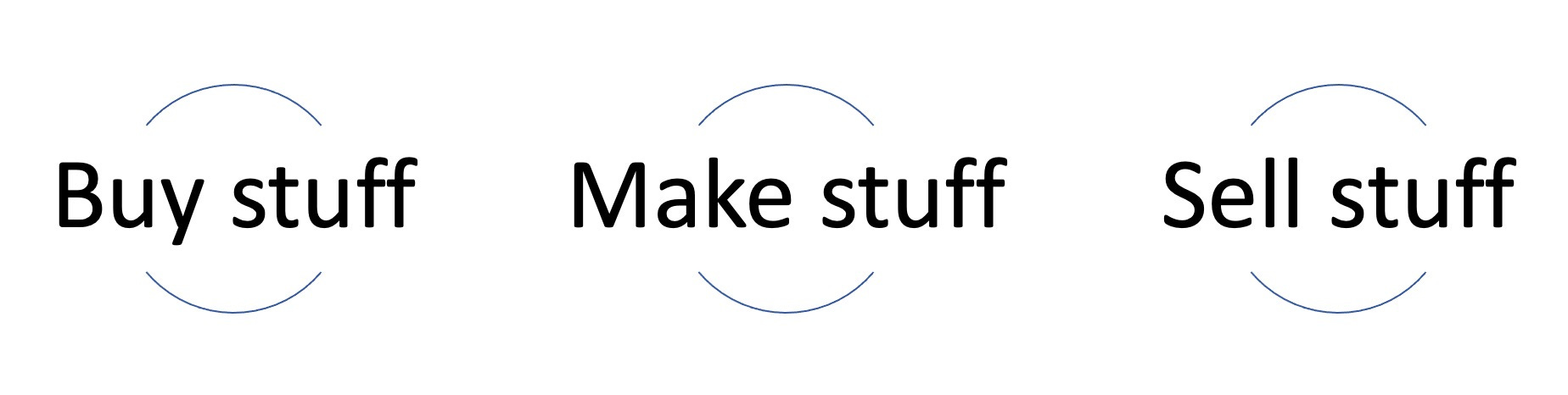
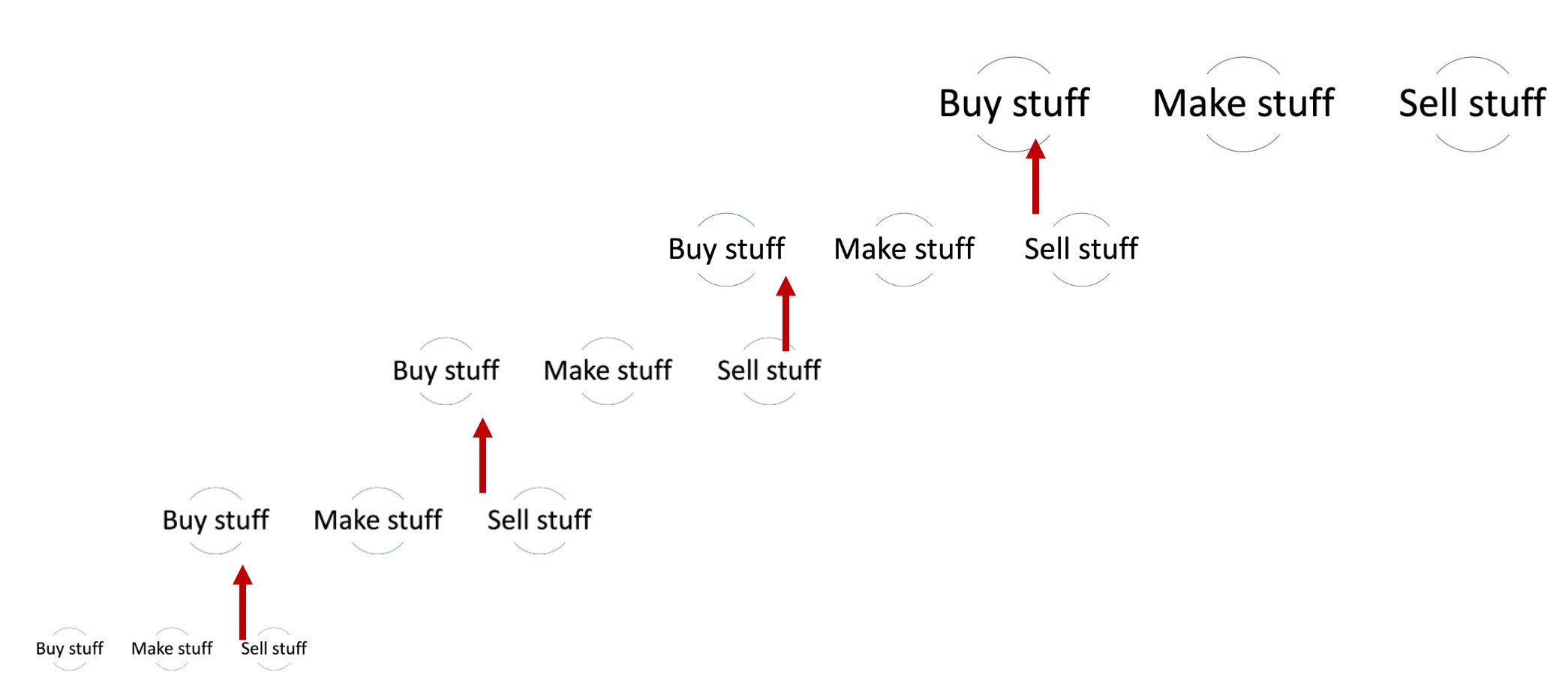
Every company buys stuff to make stuff to sell stuff, which is a simplified version of Wikipedia’s definition of a supply chain as “a system of organizations, people, activities, information, and resources involved in supplying a product or service to a customer.”

So we start with Company A’s supply chain, who buys inputs from Company B who buys inputs from Company C and so on and so on. Suppliers are dependent on their suppliers to provide inputs; customers are dependent on supply chains to function. The layers keep pulling back like some sort of supply chain inception:

Supply Chain Inception

Sometimes the supply chain inception is called The Global Supply Chain, a generic term being thrown around a lot right now that may or may not be relevant. No one cares about THE supply chain, they care about disruptions to MY supply chain.

In theory vertical integration solves some of this, but not entirely. More on that in a moment…

Supply Chain Chaos: The Bullwhip Effect +

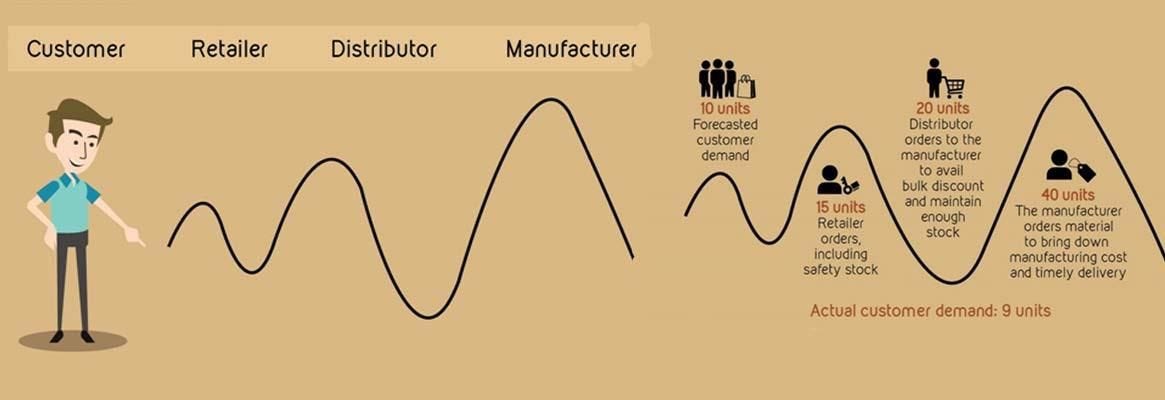
“The bullwhip effect is a supply chain phenomenon describing how small fluctuations in demand at the retail level can cause progressively larger fluctuations in demand at the wholesale, distributor, manufacturer and raw material supplier levels. The effect is named after the physics involved in cracking a whip.”

The big idea is that with a small demand increase, the further upstream you go the bigger the impact.

For a lot of companies, the 2020 demand increase didn’t start until a little ways into the pandemic, maybe even after the first stimulus check. But for meat companies it was immediate in March as the ~50% of total meat sold through foodservice shuttered and shifted to retail, where grocery store shoppers stocked up for what felt at the time like the looming apocalypse, emptying the meat case day after day after day.

Simultaneously, getting enough employees to run the plant went from challenging to existentially difficult. I cannot remember a single livestock or meat industry conference that didn’t discuss labor as a critical issue – labor as a challenge is not at all new….what’s new is the severity of the issue.

As we know the 2020 Bullwhip effect created huge and harmful waves upstream to livestock producers, especially as it was compounded with a supply constraint and labor shortage. We basically had supply and demand shocks competing with one another, compounded by labor shortage. I picture the hypothetical equation looks something like this:

It’s not hard to imagine this wild combination of competing & simultaneous dynamics will go in supply chain textbooks as the COVID effect…and the effects continue playing out. Truthfully, we don’t actually know how it ‘ends’.

While this isn’t the place to hypothesize on labor impacting policies or the root origins of the labor shortage, the fact is that in the United States there are 5 million fewer people in the workplace today than in April 2020. That labor shortage is felt in two key ways:

(1) Labor to transport goods. If trucking is a “job of last resort” in a time where people don’t need to resort to their last and worst option, well….here we are. Truckers are required in order to move product from Point A to Point B at every transaction, and some in between. The red arrows are red because those are now high risk potential bottlenecks:

(2) Labor to do the making. If you don’t have labor in the manufacturing plant, you won’t have anything to transport. The red boxes are red because those are also high risk potential bottlenecks:

Plants have struggled to keep the fabrication floor staffed up, often at the expense of further processing capacity which means selling more bone in hams rather than higher value boneless hams, as one example. The Daily Livestock Report provided this commentary on the recently increased volatility of the pork cutout in the US:

“While one can point to a number of factors driving this day to day volatility, we think a major issue has been the widening spread between bone- in and boneless items. The wide spread reflects the impact that limited labor has had on the ability of packers to run boning and trimming lines, be this for hams, loins or other products.”

….and that’s nothing compared to the situation in the UK. According to Bloomberg:

“U.K. farms have begun the daunting task of destroying pigs as worker shortages leave 120,000 animals with nowhere to go, meaning livestock could end up as pet food instead of pork. A worker crunch — driven by Brexit and the pandemic — has seen processors cut slaughter rates by as much as 25% since early August.”

People tend to, uh, get grumpy when impacted by shortages, delays, price hikes, or (more likely) some combo of all 3 effects caused by supply chain bottlenecks. Managers & owners want to maximize profit, which they can’t do without being sufficiently staffed. Buyers want predictability of price and availability, which they don’t get on non-existent or delayed goods. Sellers want commissions, which they don’t get on product unavailable to sell.

How is the driver shortage impacting milk hauling?

Hill Pratt, Managing Director of the Transportation Business Unit for Dairy.com provided these astute observations:

The driver shortage has become the limiting factor in getting dairy loads moved.  Since June of this year, short-notice and weekend loads have become difficult (and at times, impossible) to cover and spot hauling rates have shot up to the highest levels we have ever recorded.

Covid has impacted many haulers and some haulers report large numbers of parked trucks due to lack of drivers. Hauling companies have added pay and (especially) benefits to attract drivers and are working hard to accommodate driver lifestyle preferences.  Many dairy haulers feel that drivers are simply not available—at any pay level—in their market areas.  Owners of smaller and medium-sized hauling companies are often back to driving trucks on a fulltime basis and see no way to replace drivers who leave.

Nearly all hauler input costs—drivers, equipment, parts, tires, insurance and fuel—have spiked in the last couple of years.  To avoid maintenance headaches, hauling companies had begun replacing trucks earlier, but with delivery on new trucks ordered today delayed until 2023, hauling companies are forced to keep old trucks in service longer—driving up maintenance costs and downtime (given the shortage of replacement parts).”

On how this situation might evolve in the future, Hill said this:

“There does not seem to be any relief on the horizon.  If anything, the capacity crunch that hit the industry this summer may become worse as milk production increases this winter (if it follows typical seasonal patterns.)

Whereas plant processing capacity has historically been the limiting factor (which has caused instances of “dumped milk”), the industry faces the prospect of dairy hauling shortfalls causing milk (and milk components) to build up beyond the capacity to store them.  This may force dairy companies to cease production, dump milk products and/or miss/delay orders.”

Ouch.

Love Me Tenders

To continue pulling this thread, let’s take the POV of the head poultry buyer at a fictitious fast food chain, Love Me Tenders. This chain has 10 distribution centers and 2,000+ stores across the country where they sell air fried chicken tenders (and accept only cryptocurrency as payments, but that’s a topic for another day).

The buyer’s responsibility is to manage 3 variables while procuring chicken tenders:

  • Quality – everything coming into the DC & the stores must meet company specs.
  • Availability – the product HAS to be there or else the company can’t make the stuff to sell the stuff to the people who pay the money.
  • Price – responsibly managing COGS.

(There’s a whole discussion to be had about how different procurement organizations think about the prioritization of these 3 variables relative to their business model. For today let’s assume that our buyer ranks them in the order above.)

So our buyer calls their 3-5 strategic suppliers. Our buyer has negotiated long term agreements with suppliers in order to manage the 3 priorities above but hey, its 2020-2021 and its the wild west out here…hard to say how well suppliers will be able to fulfill their commitments on time. Because these are large poultry integrators, each of our buyer’s suppliers will source product from 2-4 different processing plants within the company but because our buyer only buys the tender, each of those processing plants has to balance their other customers who buy the rest of the bird.

Two truths about the poultry supply chain (pictured here):

  1. Things have to move. For meat & milk supply chains to work, trucking capacity is an existential necessity at multiple points. Every arrow above represents the movement of one physical thing from one step in the supply chain to the next (eggs, chicks, feed, birds, meat). Until localized bullet trains for birds get built, this trucking thing is a big deal.
  2. Things have to move on time. Every step in a supply chain with live animals has its own ‘turkey timer’ so to speak. Chicks have to come out of the hatchery once they hatch and they have to go to a farm, they can’t hang out in the chick trays at the hatchery. Placement numbers in a broiler house are calculated based on density targets by the end of the flock, so birds have to leave the farm at a certain time which means they have to be processed within a very tight window. And once the birds are processed, fresh meat has to move or else it has to be frozen which is a value destroyer. Everything has to happen on time in order for the supply chain to work.

Ford pickups and John Deere tractors can be parked while manufacturers wait on chips to arrive from Taiwan before being shipped to customers in Iowa, but live animals (or milk) can’t be parked in the side lot for days or weeks.

The buyer at Love Me Tenders is reliant on so many supply chain elements to go right, the vast majority being out of the buyer’s control. Which should mean the buyer is signaling to management that we probbbbably need to create some additional back ups for our additional back up plans that were busted to bits over the last 18 months.

The idea of supply chain resilience is everywhere, “the capacity of a supply chain to persist, adapt, or transform in the face of change.” But supply chain leaders will tell you that being prepared for any contingency has always been a core objective, tho perhaps the degree of ‘change’ to be prepared for is increasing in scope/severity.

We’ll continue exploring the complexity around supply chains & the current chaos over the next few weeks but needless to say, there are no easy answers for the Love Me Tenders of the world…or anyone else in meat, poultry & milk supply chains.

Share

Categories
Animal AgTech Leadership

Prime Future 70: Why I’m wary of too much certainty 🙅🏻‍♀️


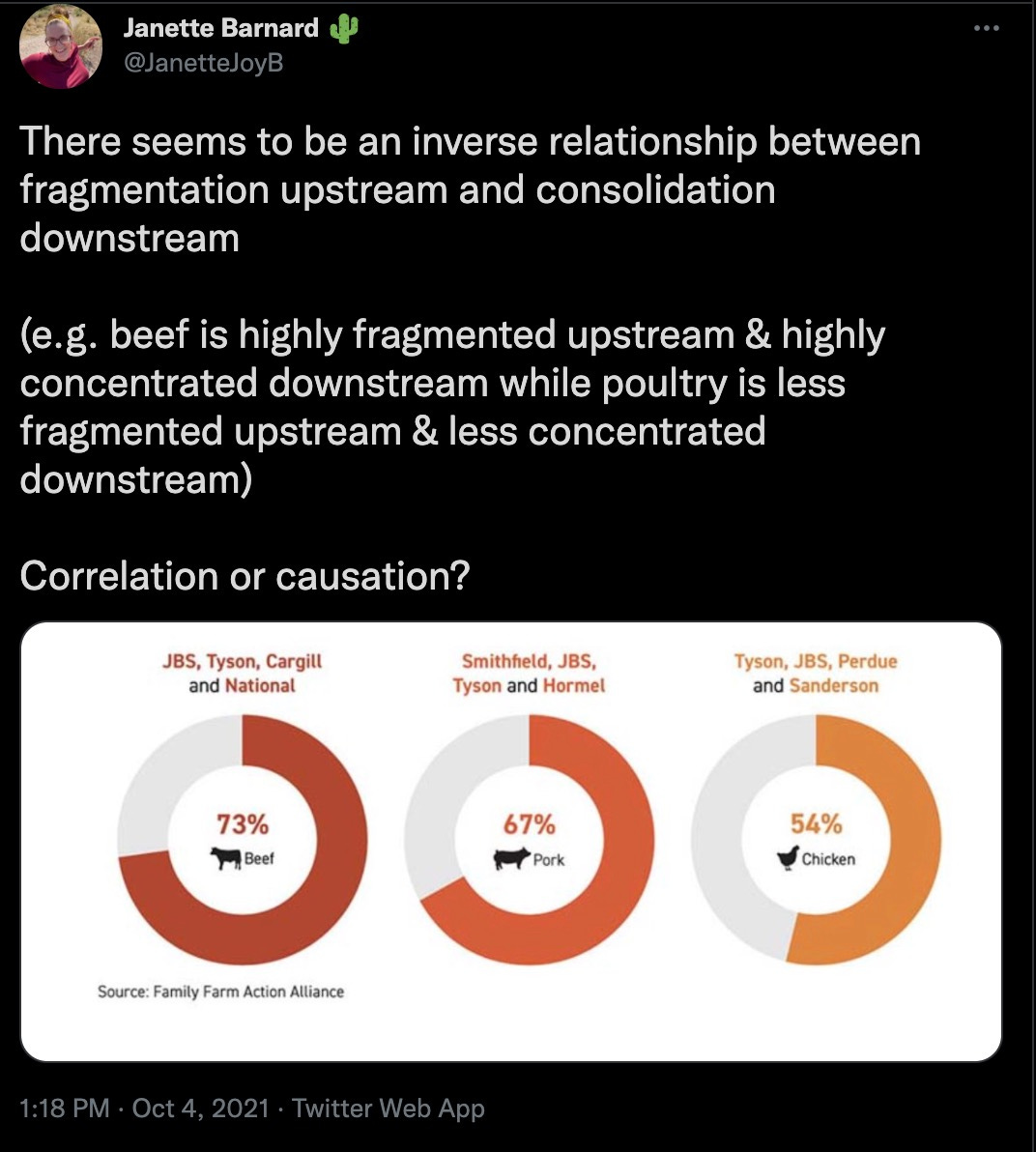
Is beef more concentrated at the packer level because the animals are heavier? More valuable? Or because there’s more’s variation in sourcing? Variation in plant size? Or maybe it’s this:

The answer to why the fragmentation/concentration conundrum exists doesn’t seem to be super obvious, but clearly it’s super complex. Happened-over-time things like packer concentration don’t take place in a vacuum. So simple solutions like the top x processors shouldn’t have more than y% capacity don’t take into account the competing dynamics that led to the current state.

And yet, there is *a lot* of certainty floating around about the topic without much (any?) tolerance for nuance.

But ag isn’t alone in having limited capacity for nuance. (Look, if I was the Debate Commissioner at every presidential debate before a candidate articulated their own position, they would have to summarize the other side’s policy position and say 1 positive thing about it, sans sarcasm.)

There’s another prickly conversation where we need nuance – climate change. I wish people didn’t point to an individual weather events as evidence of climate change. As climate researchers say, it’s not the individual events that are concerning, it is the trends in the data over time – the frequency and severity of extreme weather events. Which means there’s some level of variation that is normal.

Floods, hurricanes, tornados, droughts, heat waves – these are not new events. They were not created by climate change. So pointing at individual weather events as evidence of climate change is either disingenuous or intellectual laziness. Why not highlight more clearly weather events & trends that are within normal variation, versus what’s outside that normal variation?

Another nuance that’s really important is around the distinction of who’s driving change in the industry: consumers or food companies. From Climate + Ag: what gets measured gets monetized (link):

Who’s leading who in climate + ag?

“Consumer wants drive value chain decisions.”

I’ll start by pushing back on the narrative that protein value chains are driven by consumers, on climate or any other topic. Consumers….those nebulous creatures of food commerce who somehow sound like the unknowable inhabitants of an alternative universe when we refer to them. Two flaws with the Consumers-R-In-Control narrative:

  1. Consumers are not a monolith. Segments of consumers want certain attributes, sub-segments are willing to pay for those attributes. Variation among consumers is no less nuanced than variation among farming systems. Mis-identifying what consumers want and what they will pay for x is as fatal of a flaw as over-estimating how many consumers will pay for x.
  2. Although staggeringly critical to the system, consumers are not everyone’s customers. Consumers don’t transform supply chains or recalibrate industry norms. Food companies do. Food companies are where the power lies. Brand owners make decisions about how to market meat & milk to their customer: retail consumers. Food companies make decisions about how to market meat & milk, and then where needed those same companies use their scale and influence to set product specs & requirements as they procure raw materials or finished product from a certain set of suppliers. No one is talking about the fried chicken wars of Mar Jac vs Wayne Farms chicken, they’re talking about KFC vs Chick Fil A. The two directional power of influence lies with brand holders across foodservice and retail. Leading brands lead consumers by positioning xyz about their brand that is better than competitors. Food brands tap into consumer trends, but they lead consumer segments with differentiated products. Sometimes those changes are then adopted by other food brands & their supply chains. The massive shift in NAE (no antibiotics ever) production in US poultry is my go to example for this dynamic – when 1-2 major food companies said we will buy NAE chicken, then NAE chicken is what suppliers learned to produce, at scale. So then more food co’s buy NAE chicken. It’s a cycle that starts with a food brand, moving vertically in that supply chain and then expanding horizontally as more food brands (and their supply chains) adopt whatever the thing is.

We oversimplify the value chain when we attribute all influence to consumers, and we underweight the actual centers of leverage.

This week McDonald’s announced their net zero emissions by 2050 commitment. That’s a big deal – we are talking about a legacy, conservative, brand conscious company not some fly by night, here-today-gone-tomorrow brand. This is one of the largest buyers of beef, lettuce, tomatos, pork, potatos, strawberries, etc on the face of the planet. When companies like that start jumping in, it bends the arc towards action – it’s a sign that we’re past the niche-y early adopters and moving right to the middle of the bell shaped curve.

Some interesting context on the McDonald’s announcement from Meatingplace:

Efforts underway since 2018 have resulted in an 8.5% reduction in the absolute emissions of the company’s restaurants and offices and a 5.9% decrease in supply chain emissions intensity measured against a 2015 baseline, McDonald’s reported.

Although the most recent announcement does not specify where in the supply chain the fast-food company will look for its emissions reductions, in an earlier post on its website, the company said, “In collaboration with franchisees, suppliers and producers, McDonald’s will prioritize action on the largest segments of our carbon footprint: beef production, restaurant energy usage and sourcing, packaging and waste. These segments combined, account for approximately 64 percent of McDonald’s global emissions.”

Food companies have leverage, consumers do not.

Another source of leverage is capital. Right now there is an enormous amount of capital (we could put a period there) flowing into climate tech & solutions. More than $33.9 BILLION in venture capital investment has gone into climate tech….in 2021 alone.

Venture capital doesn’t automatically lead to good outcomes and solutions, but it increases the odds of good outcomes when its put behind good founders and good visions and great products. I recently heard someone say “venture capital subsidizes risk taking at scale”.

It’s safe to say that investment in a category tends to be a leading indicator of tech/innovation.

In 2015 Bill Gates founded Breakthrough Energy, a billion dollar fund to “support the innovations that will lead the world to net-zero emissions.” In 2021 Chris Sacca raised an $800M fund to invest in climate tech, with 2 objectives: 1) lower emissions to net zero, 2) get carbon out of the air.

Two interesting quotes on Lowercarbon Capital’s website:

  • “Give or take, we’ll need to suck at least a trillion tons of CO2 out of the sky between now and 2100.”
  • “Fixing the planet is just good business. Shame and guilt won’t get us there, markets will.”

A few previous comments that are germane to this conversation for livestock:

The extreme positions on either end of the sustainability spectrum will not create actionable, consumer-satisfying, carbon-reducing, market-growing solutions. But nuance…that’s how we find the productive middle ground. Nuance acknowledges that one size does not fit all – what works in geographies that get 40+ inches of annual rain fall won’t necessarily work in areas that get <15 inches. Systematic management changes like transitioning from continuous grazing to intensive rotational grazing are complex, as is anything related to managing the biology of plants or animals.

Regardless of the abundant unknowns about how things will evolve, this whole “climate thing” is not a topic where producers can look away and hope it will disappear. This is a mega trend. There will be winners and losers – my hypothesis is that the difference will be those who collaborate and find workable solutions…or don’t. This is a mega trend to engage, to lead by looking for the ‘and’ solutions…the places of overlap between what’s good for climate related metrics AND for cattle AND for successful cattle operators AND for food companies AND consumers. This is a place to ask questions like, what if? What needs to be true? What opportunities will be created in this mega trend?

Maybe nuance isn’t realistic though – not even because of the formats in which we consume information (140 characters doesn’t leave much room for nuance), but because the human brain can only absorb so much information about so many topics in the midst of living our lives. So sweeping statements and catchy slogans leave us with soundbite driven opinions – and which soundbites we latch onto depends on who we’re listening to.

Anyway, I guess my philosophical point this fine Tuesday is that topics like packer consolidation and climate change are wildly complex with no simple answers, and I’m wary of too much certainty, of the simplistic answers. Anyone peddling simple answers is likely trying to scare or shame to sell something or get a vote (either side).

I think embracing nuance will serve us all well in these discussions.


ICYMI: why is carbon more likely to be a monetizable mega trend than an emotion driven fad? (link)

<insert corporation name> will not be able to buy 2 units of sustainability to offset 2 units of un-sustainabillity. But, <insert corporation name> will likely be able to buy 2 units of carbon sequestration to offset 2 units of carbon emissions.

As more companies make net-zero commitments around carbon and seek to offset carbon in their supply chains, carbon markets are the likely place to turn. To make this carbon economy go, the entire structure will have to be underpinned by rigorous standards of measurement and verification. Sound methodology and precision processes are the only way for carbon markets to deliver on the promise for participants and their investors, customers, and consumers.

Another concept bubbling up is carbon labeling on food. Only high end, niche brands are pursuing carbon labeling now, but will this become a more widely adopted practice? The concept behind these labels is numerical representation of the carbon involved in production….the (potentially) magical word for livestock producers is “numerical”. To the extent that sound methodology and high integrity math drive carbon labeling, it represents an opportunity for livestock producers to win by numerically capturing the net positive carbon impacts of livestock production.

People way smarter than me can go deeper on carbon markets and carbon labeling. My point is simply this:

Carbon could be the real deal for producers because both B2B carbon markets and consumer facing carbon labeling on food would require data driven approaches to drive an actual functioning net zero carbon economy based on measurements.


I’m interested in all things technology, innovation, and every element of the animal protein value chain. I grew up on a farm in Arizona, spent my early career with Elanco, Cargill, & McDonald’s before moving into the world of early stage Agtech startups.

I’m currently on the Merck Animal Health Ventures team. Prime Future is where I learn out loud. It represents my personal views only, which are subject to change…’strong convictions, loosely held’.

Thanks for being here,

Janette Barnard

Categories
Leadership

Prime Future 69: Lunatic farmers & velocity 🚀

The owner of a dairy was lamenting the rise of mega dairy systems and the risks they pose to small dairies like hers. How many cows does her dairy milk?

7,000

It’s a laughable story except that this dairy farmer & her family have grown the herd from a few hundred to several thousand over the course of their career. They’ve struggled and strived, taken risk after risk to get where they are. And yet in their minds, they still identify as small, scrappy, insurgent producers trying to survive.

There’s a dynamic that plays out across the ecosystem of food production where size matters. To everyone. A lot. There’s an awareness (obsession?) about the size of suppliers, customers, processors, neighboring operations:

  • Big retailers want to deal with big food brands, not small insurgents. There are tangible costs to dealing with more suppliers, smaller suppliers, inexperienced suppliers with unproven track records, etc.
  • Some consumers want to buy food produced on a ‘small family farm’, whatever that means. (Why does ‘family’ have to imply a modest sized business? And who decides what size is the right size? And don’t *all* small business to either evolve, grow, or die? I digress…)
  • Some (most?) producers would like to sell livestock to small(er) processors who have less pricing power than processors in an oligopoly have. (What if the packers got Standard Oil’d?)
  • Many producers fantasize about having more acres, or head of cattle, or poultry & hog barns.

There’s a special irony in the tendency among farmers to want to be bigger than neighboring operations. It’s almost a tendency to criticize the operators who run more acres or head than they do. (But is it criticism or envy? Sometimes the two look eerily similar.) It’s like a Russian nesting doll situation where the 700 acre farmer judges the 2,000 acre farmer who criticizes the 15,000 acre farmer as too big. I’ve heard this lament from midsize farmers a few times recently and it raises some questions…How many acres is too big? How much profit per acre is too much? How much revenue per year is deemed over the top? These sound like questions that supporters of alternative economic structures would ask, not those who enjoy the benefits of a capitalistic economy….

The primary counter to the notion that small business > big is the idea of available resources. Who is in a position to commit more resources to ensuring appropriate nutrition – the backyard poultry farmer or the large integrator? Who is in a position to invest in technology that reduces deboning costs in the plant – the custom processor killing 50 head/day or the large plant killing 5,000 head/day?

The primary counter to the notion big business > small is, well, we just know this isn’t always true, right?

Big business can be good, small business can be bad. Vice versa. Some small businesses are amazing employers, some are terrible. Some small businesses are terrible suppliers, some big businesses are amazing customers. Vice versa.

I’m less intrigued by the external voices extolling or incriminating business size. I’m more intrigued by the view of producers, and what causes some producers to maintain status quo and some to find a model that allows them to scale.

Sometimes bigger is better, sometimes smaller is better…size is not the indicator of success and it’s definitely not the goal.

A recent Reddit thread on personal finance included a comment by a couple making $500,000/year who un-ironically identified themselves as a middle class family with middle class money concerns. It’s a similar dynamic with the large producer who still has the mentality of scrappy insurgent, maybe (likely?) that mentality is what helped them get where they are – what helped them do things their peers weren’t doing, to get different outcomes than ‘average’ producers.

Can we just admit that the obsession with farm business size is….kinda odd? Or at a minimum, it’s not very helpful.

My hypothesis is that scale is a lagging indicator; velocity of business model innovation is the leading indicator of success.

The more commoditized the business, the stronger the pull to scale to reduce cost per unit.  The more value oriented the business, the stronger the pull to create incrementally more value per unit. There’s no clever analysis in those statements – those are natural forces that are a function of capitalism and a mature agriculture industry.

I think the successful producers (or packers or xyz business) who will thrive come-what-may are the ones who don’t think of their business based solely in terms of the output (corn, soy, weaned calves, whatever), but rather view their business as a business model that is is in continual refinement. They constantly ask what’s the process that most effectively generates the output. They think in systems that can optimized.

(This is a great article on the founders of Premium Standard Farms, the ‘inventors’ of the mega farm / consolidation model in pig production and the mental models they put to work…some worked, some didn’t. Btw I’m still waiting for a good book about this phenomenon in poultry – can somebody write that plz? 🙂)

It seems that the really successful producers are the ones that have a vision of where they are going and how they will get there. There's no doing it this way because that's how we've done it, there's no growth for the sake of the growth. There is only relentless learning and improvement.

The great producers realize that they aren’t selling just a commodity output, they are selling their business model.

Size is not the determinant of success. It’s about business discipline, management, relationships, processes, team, leadership, ambition. Successful producers have a vision for the future that they rally the team around, there’s an ever evolving plan for increasing revenue per unit produced or decreasing cost per unit produced, or both.

I recently asked a really large operator how they grew their business over the last 20 years from something not at all uncommon to something truly extraordinary. Did they have access to capital that others didn’t have? Some other advantage not available to similar producers? “I don’t think so, I think we just do things in a different way than most people are interested in doing. We do a lot of things that aren’t uncommon for most growing businesses, they are just uncommon for production ag businesses. We have a yearning for learning. ”

Let’s call a spade a spade – capital is abundant and cheap in 2021, as it has been the last several years. Ideas are a dime a dozen. It’s everything else that separates the aggressive producers from the rest. (The rebuttal I’m expecting is what about the market, the weather, etc etc etc…..luck and timing play huge roles in ag, I’ll never downplay that. But there’s more to this phenomenon than that.)

I’ve referenced Allen Nation’s book before, but germane to this conversation is a chapter on how farmers approach innovation with insights pulled from a 1962 book “Diffusion of Innovation” that studied extension efforts to get farmers to switch from open pollinated to hybrid corn post WW2.

“The innovative farmer is seen by his farm neighbors as a lunatic farmer. And a lunatic is not seen as a role model. As a result, what the innovator does on his/her farm is literally invisible to the neighbors. This is true even if the innovation is producing visible wealth. The normal reaction to unconventional success is the old it-might-work-there-but-not-here syndrome. The sad truth is that the vast majority of farmers prefer to fail conventionally rather than to succeed unconventionally. It is very, very difficult to be more innovative than the community in which you live.

Here’s the really germane part: “No farmer referenced what a farmer smaller in acreage than themselves was doing as applicable or worthy of study. Everyone preferred to learn from someone larger than themselves.” Isn’t that fascinating?

There’s irony in that if you’ve made it this far, then there’s a huge chance that you are in the groups referenced in this last quote from Allen Nation:

“The innovators and the early adopters form approximately 15% of the total farming community. Interestingly this percentage is almost exactly the same as the number of farmers who earn an upper class income from agriculture.”

I’ve recently observed some markers that lunatic farmers seem to have that indicate high velocity of business model innovation:

  • They ask questions. A lot of questions. They find smart people to ask questions. They find smart people in non-traditional places to ask questions.
  • They read. Not just industry magazines, they look outside.
  • They have a sense that what they are saying sounds half crazy, dare I say they know it might make them sound like a lunatic farmer.
  • They surround themselves with high quality people, high quality teammates.
  • They have a system they are building/running, a flywheel they are looking to spin faster.
  • They have some insight that most of their peers don’t, some belief that isn’t widely held.
  • They know new practices & ideas take time to implement correctly, so they allow margin (time, energy, $) to experiment.

I’ll wrap up today with a tweet:

Share


I’m interested in all things technology, innovation, and every element of the animal protein value chain. I grew up on a farm in Arizona, spent my early career with Elanco, Cargill, & McDonald’s before moving into the world of early stage Agtech startups.

I’m currently on the Merck Animal Health Ventures team. Prime Future is where I learn out loud. It represents my personal views only, which are subject to change…’strong convictions, loosely held’.

Thanks for being here,

Janette Barnard

Categories
Leadership

Prime Future 68: Bet on the collaborative-ists

There’s a local ranching family that’s been raising cattle on the same land for 7 generations. In that time they have not sold an acre of land, not one. They have withstood droughts, drug cartel activity, wildlife predators, market crashes, high interest rates. You name it, they’ve survived it.

Some years ago they got into a lil spat with the US government over the renewal terms for grazing permits on public land, so the federal government rounded up the family’s cattle that were on public lands and kindly delivered them to the sale barn.

Someone recently summarized the family’s mentality this way, “They are  fiercely independent, they just don’t trust anyone. Then again, that’s probably how they’ve survived and why they’re still ranching.”

This struck me. I have a deep respect for the challenges producers face and the resilience they embody….but I wonder if that fierce independence won’t actually work against producers in a rapidly evolving world where collaboration is rewarded more than independence. (And though this first example is a rancher, every segment of the value chain has players with a similar mentality, a transactional ‘us vs everyone else’ mentality.)

Collaborating raises new questions, new situations, new risks to manage…and new opportunity. If done thoughtfully and effectively, new collaborators can grow the pie (and it’s individual slices) in ways that independent actors cannot.

We live in a world where the art of highly effective collaboration increases the probability of survival.

Let’s start with one of the most successful examples of a systems approach, one that has stood the test of time: McDonald’s. (If you aren’t familiar with the 3 legged stool model, here’s a good primer.)

Each supply category has a limited number of suppliers that are held to very high standards but rewarded with high volumes of business, typically on a cost plus basis. Suppliers do not float in and out of the system frequently, these are not transactional relationships – they are partnerships built for the long term.

Now contrast the McDonald’s system with two alternative structures that land in different places along the continuum of Transactional to Collaborative, the independent rancher and the contract poultry grower:

  1. Let’s assume the rancher sells weaned calves at the sale barn, the epitome of price taking at the market’s daily whims. The definition of transactional – the buyer is literally whoever is willing to pay the most on any given day.
  2. Let’s assume the contract poultry grower supplies the labor and facilities, then executes the management program prescribed by the poultry integrator. The grower is paid on a $.xx/lb produced with some level of base pay that is set, and the remainder of pay determined by how the contract grower’s live performance stacks up against the flocks that are processed that week (the lottery system).

Regardless of the business (weaned pigs, broilers, or hamburger patties), it seems there are 3 core drivers around engaging in collaborative ecosystems with dedicated partners:

  1. Profit. Maybe its about finding higher value races to the top of the value pyramid, rather than vice versa. Maybe it’s about cost plus arrangements that may not maximize revenue on a given transaction, but could look smart over the long haul and the ups & downs of market cycles.
  2. Predictability. Creating predictable revenue can radically impact business planning and operations. Some would prefer to make $.1/lb day in day out, some would prefer to make $1.00/lb on 1 load knowing they might lose $.90/lb on the next.
  3. Potential (long term growth). What’s the growth potential of the ecosystem? Is this a chance to grow the pie and grow your business accordingly?

Below is a rough analysis of how different systems compare – maybe these are over or under stated, but the big idea is that there are tradeoffs under each model.

🙂=sufficient. 😃=heck yeah. 😑=maybe? 😂=that’s funny.

Of course this doesn’t capture some of the intangible tradeoffs of collaborative partnerships, like losing some degrees of freedom. I think my real point is that there are increasingly more alternative ways to approach business models and these alternatives should be considered.

  1. What is the upside potential? Downside risk?
  2. What are the tradeoffs compared with the risks of the status quo?
  3. Are those tradeoffs bearable compared to the next best alternative?

The answer to those questions will always be situation/people/goal dependent.

And I’m no Pollyana – there are risks with entering partnerships where multiple parties are reliant on one another. The obvious caveat is that not all systems are created equal; not all partners are good partners, not all collaborations are worthy bets. Sometimes the business model isn’t right, sometimes the leadership isn’t right…or any other number of reasons that a system doesn’t work out. One of the most practical pieces of advice came from my friend’s dad: when you create a plan to enter a partnership, create the plan for how you will exit the partnership.

(Those of you much more seasoned than me are probably nodding your head vigorously at that advice since you’ve seen the dangers of not preparing for partnership dissolution in advance. “Expect the best, prepare for the worst” and whatnot.)

A great irony from a producer standpoint is that although it might be easy to reject taking on the risk of entering partnerships, the fewer strategic alliances a producer makes with customers, by definition, the more reliant the producer is on commodity markets where price takers have zero control which introduces…risk. Maybe the real question is around where you want control (price? management freedom?), where you want predictability, and what type of risk you are willing to accept / are more comfortable managing.

I recently saw a list of about 30 aligned beef supply chains in the United States, here’s a snapshot of one. ‘Run our program to help us deliver a better product to our customers and we’ll all win’ is the summary idea. If you read Prime Future you know I think we’ll continue seeing more of these:

The above examples focus on how producers might engage supply chains & customers, but what about managing suppliers? I recently heard of a producer who decided to double down on supplier relationships by choosing one strategic supplier for every major input category. They gave up the transactional, shop-around-for-the-best-price-on-this-transaction in pursuit of the best supply arrangement on the next 1,000 transactions. Another dimension of a collaborative approach.

What does collaboration look like in Agtech?

Now let’s talk about where a collaborative mindset can drive progress in agtech:

  • Among co-founders – its doable to be a solo founder but as someone who hit The Great Wall of Burnout trying this route, I can tell you it is HARD and there is not an ounce of virtue in trying to defy the odds by being a solo founder.
  • Among founders and venture investors – there are huge tradeoffs in choosing to bootstrap a business which typically means slow and steady growth versus raising venture capital and committing to the high growth model. Neither is right or wrong, they are just different models with different paths.
  • Among founders and early customers – That early feedback from first customers – and how founders respond – can set the entire trajectory of an early stage company. Ask any successful tech company and they will tell you about the early customers who made them.
  • Among big companies and startups – each brings something to the table in terms of successfully scaling innovation, figuring out how to get the best of each can unlock magic.
  • Among startups and startups – the punishment for tech forward producers right now is that every single hardware/software product tends to have its own login. What farmer wants to login to multiple systems to manage their business? Zero. But not every company can be THE platform. This will drive partnerships that may not be what every company wants, but will drive customer experience and <drumroll please> grow the pie of tech adoption.

The best summary of those last points came from a recent Future of Ag podcast interview with Jim Ethington, an early employee of Climate Corp who is now CEO of Arable:

“We could have said we can’t afford to give up a piece of this pie and we’re going to go it alone but that’s not the path that moves the industry forward. …we can all be good at our pieces and hey sometimes we compete, most of the time we can collaborate but that’s what moves the industry forward.…being able to put the puzzle pieces together where 1+1 = 3 for the customer.

What if they try to replace us? Come in with the assumption that a) it doesn’t matter because this integration is what the customer wants – start with the customer and work backwards, and they want one integrated system. …and b) when this plays out even at the largest companies in the world…guess what their roadmap is full. ….everybody’s roadmap is packed – don’t flatter yourself they aren’t going to go build your product. And if they do, they were probably going to anyway and your partnership didn’t do anything to accelerate it. I think you have to let go a little bit and go back to the customer problem, growing the pie, making this a better overall technology space….and put aside the natural fears of what risks does this pose to us. The benefits outweigh the risks because those fears usually aren’t as real as you think.”

Does an independence-at-all-cost mentality create the trajectory to thrive in the ag economy of the future?

There’s perseverance in independence which will get you somewhere, but my hypothesis is that moving forward it will be the smart collaborations who channel that same perseverance for the sake of a larger business objective who will win; those who grow the pie in a way that creates long term value for every link in their chain.

…aka the spoils will go to the effective collaborators. The collaborative’ists, if you will.

“If you want to go fast go alone; if you want to go far go together.”


I’m interested in all things technology, innovation, and every element of the animal protein value chain. I grew up on a farm in Arizona, spent my early career with Elanco, Cargill, & McDonald’s before moving into the world of early stage Agtech startups.

I’m currently on the Merck Animal Health Ventures team. Prime Future is where I learn out loud. It represents my personal views only, which are subject to change…’strong convictions, loosely held’.

Thanks for being here,

Janette Barnard

Categories
Business Model Innovation Genetics

Prime Future 67: When does beef x dairy show up at the meat case?

Every company on the face of the planet (and someday on Mars) does 3 things:

  1. buys stuff to
  2. make stuff to
  3. sell stuff

Using that oversimplified framework, in our last stop in this series let’s look at the downstream implications of ‘beef on dairy’ for cattle feeders, packers, and retailers.

Keep in mind, we’re talking about a max of ~5 million out of ~25 million fed cattle per year in the US.

Feeders gonna feed.

Success in cattle feeding is based on a 3 variable equation:

  1. Quantity & price of lbs out the door (selling cattle right)
  2. Minus the quantity & price of lbs in the door (buying cattle right)
  3. Minus the cost of lbs added at the feedyard (feeding & managing cattle right)

Those 3 levers make feedyards the segment in the beef value chain with the most flexibility. That flexibility makes cattle feeding a reeeeally dynamic business allowing feeders to shift strategy with trends in the market, the cattle cycle, or grain prices. It’s also what makes cattle feeding really hard.

When it comes to feeding native cattle (beef), dairy, or beef x dairy crosses, cattle feeders find what works as they triangulate risk profile on the buy, feeding & management, and relationships/proximity to plants that process certain types of cattle. There are both the management & nutrition elements of feeding different or new-to-you types of cattle that can take some time in learning how to adjust lever #3 above, cost of gain. But just as important are levers #1 and #2 which are driven by the relationships and partnerships and arrangements that surround a cattle feeder’s strategy as it relates to how they buy and how they sell cattle. All 3 levers have some degree of learning curve when it comes to beefxdairy, though waaay less than a beef cattle feeder jumping into feeding dairy cattle.

My hypothesis is that because large dairies are leading the way with ‘beef on dairy’, the animals tend to move as large lots under negotiated agreements rather than moving as smaller lots through sale barns. The result is increased visibility to production history, and decreased risk….not a bad combo for a cattle feeder.

One opportunity for cattle feeders is if these large dairy systems look to maintain ownership of cattle through the supply chain to capture more value all the way to the packer, will that create more low risk custom feeding opportunities. If the balance of feedyard owned cattle vs custom feeding cattle for others tends to cycle with the broader cattle cycle and feed price fluctuations, could this increase the amount of predictable custom fed business? Maybe, maybe not.

~5 million dairy calves have been part of the beef value chain for decades. All ‘beef on dairy’ does is create an opportunity to level up, to get the best of beef and dairy genetics for performance in a feedyard and in the plant. Shifting from 280 days in a feedyard for Holsteins to <180 days in a feedyard for Hogus cattle is, um, a big deal.

One aside: For the segment of dairy cows that are bred to a beef bull using AI, the math doesn’t (yet) make sense to use sexed semen so 50% of those offspring will be heifers. Heifers are typically considered less profitable for a feedyard than steers. If/when it becomes economical to use sexed semen for all calves from a dairy that are headed into the beef value chain, there will be another inflection point. The view on heifers is another example of the difference in beef goals vs (traditional) dairy goals, since heifers are significantly more valuable to the dairy producer.

Packers gonna pack…but at what price?

We talked about the BIG idea of beef on dairy value chains to accelerate aligned supply chains in beef since they are absolutely critical to maximizing the value of beef x dairy carcasses. Beef on dairy value chains *have* to have a direct relationship with the packer. This partnership mentality, from producer to calf ranch to feedyard to packer, is essential to ensuring beef-dairy cattle are priced according to the value of the carcass, with its beef characteristics.

But as long as the ‘right’ genetics have been selected to drive desirable carcass traits the packers are looking for, then these animals should be priced like their native peers. If the dairy’ness has been offset by the terminal beef genetics, then once the animal arrives at the packing plant there *should* be no subsequent difference in process or how that beef is sold. It’s just beef by the time the carcass is disassembled and prepared for the meat case at retail.

Which leads us to….

Retailers gonna…cringe a bit.

To the extent beef x dairy meat went into mainstream channels & programs at the packer, then they show up in the meat case just like meat from any native (beef) animal. Zero impact there.

The real question is, will retail brands be built around beef on dairy?

Here are the reasons FOR beef x dairy focused brands:

  1. Consistency in supply, consistency in product given the tight dairy gene pool. The consumer will get the same experience every.single.time. That seems brand’able.
  2. Transparency into supply given the ‘aligned supply chain’ nature of this beast that is required. Want to know how this animal was raised, where it’s been, how it was fed? We gotchu.
  3. Sustainability. Let’s say for illustrative purposes (don’t @ me) that each cow uses 1 unit of environment per year. The beef cow produces 1 unit of food supply per year with a calf. So we can loosely say that beef = 1:1 output to input ratio. But wait a sec, here comes the dairy cow who also uses 1 unit of environment per year but she produces 1 unit of food supply per year through milk production PLUS 1 unit of food supply with a high value beef x dairy calf. Dairy = 2:1 output to input ratio. The dairy cow is the super star when you frame it that way.

It’s a made-for-the-meat-case story.

But there’s a catch: The calf ranch.

Regardless of how well cared for the calves are, kept out of the elements, given appropriate feed and water and nutrition…brand new baby calves in hutches isn’t something thats likely to play well in a social media world that runs on sound bites & spin rather than nuance. Until there’s an alternative to the current calf rearing link in the supply chain, there’s likely to be limited retailer / brand appetite for marketing beef x dairy crosses in a direct way.

And yet, given how great the value proposition is for a fully aligned beef x dairy supply chain from dairy to meat case, I have to believe that someone is going to find a meat case friendly solution for calf rearing.

And when that happens? Game on.

Summary

We’ve covered a lot of ground in this 5 part series – I have learned so much from all the people who’ve shared their insights along the way. My takeaway from the series is that beef on dairy isn’t everything, but it is definitively something:

the 3 ideas that make beef-on-dairy punch above its weight class:

  1. Beef x Dairy cross carcasses are as good or better than straight beef carcasses. (Think of it as having your cake and eating it too, but ya know, beef.)
  2. Beef-dairy crosses hold a consistency advantage over the traditional fragmented beef value chain.
  3. Beef-dairy cross value chains are forcing new partnerships in order to capture full value at the packer level.

Which is all fine and well, until we come back to the math of beef on dairy. If we are really only talking about 5M calves annually, out of 25 million total fed cattle, it raises the question of….so what?

What happens with 5M beef dairy crosses is interesting, but the really fun part will be seeing how the 5M could influence the 20M.

Imagine that cattle feeders and packers and retailers get used to all those benefits mentioned above that are inherent to the beef x dairy value chain. Now use the exceptionally limited amount of imagination to picture those expectations bleeding over into the other 80% of beef, the natives. Not much imagination required, huh?

The unknown is how the beef value chain will respond and how long it will take to catch up & recreate the rapidly accelerating advantages of the beef on dairy value chain. Is this a 30 year dynamic or a 5 year dynamic? TBD.


ICYM the rest of the series

The first 4 of this 5 part series on how the ‘beef on dairy’ genetics strategy could impact the beef & dairy industry in the United States:

(1)  How the ‘beef on dairy’ genetics strategy will impact cow-calf producersSpoiler alert: not much, mathematically speaking.

(2) What’s driving this beef on dairy thing from the dairy producers POVtldr: its complicated.

(3) 💡 3 reasons why dairy is the new beefIt’s not about the 5M, it’s about how the 5M influence the remaining 20M fed cattle.

(4) If dairy is the new beef, where do the alts fit? A look at how alternative milk and meat market share might impact milk and meat prices now that the two are even more interdependent.

GET THE BEEF-ON-DAIRY EBOOK 🐄


I’m interested in all things technology, innovation, and every element of the animal protein value chain. I grew up on a farm in Arizona, spent my early career with Elanco, Cargill, & McDonald’s before moving into the world of early stage Agtech startups.

I’m currently on the Merck Animal Health Ventures team. Prime Future is where I learn out loud. It represents my personal views only, which are subject to change…’strong convictions, loosely held’.

Thanks for being here,

Janette Barnard

Categories
Business Model Innovation Genetics

Prime Future 66: If dairy is the new beef, where do the alts fit?

Move over hippies and hipsters, man buns and punk rock. The new counter culture move is….drinking milk?

“I traveled around Europe this summer. I drank icy frappes on the beaches of Greece and stirred foamy café au lait at the bistros of Paris. I was in a simpler, more sensible world, one without an alt mylk or nondairy creamer in sight. The real international delight, I realized, is pouring whole, full-dairy milk into your coffee; it is perhaps the most civilized activity in which a person can partake.”

….her answer edged on spiritual fulfillment. “There’s this quest for absolution in the foods we eat,” she said. “I think consumers were fed this lie by what I call the Goop Industrial Complex that if you cut dairy from your diet you will have more energy, clearer skin, and you will never ever fart ever again. But the case against dairy ignores many of the complexities of our food system, and I think people are starting to realize that.”

Now set that against this other recent headline:

When I hear people talking about the ultimate demise of animal protein as we know it, I assume it’s either an alternative protein investor who has capital on the line, or someone who wants to be seen as a forward thinker, even in the industry. It sounds more futurist to describe a future without plant fed animal protein than it is to say “I think there’s a market for plant based or cell cultured protein but not necessarily at the expense of plant fed protein.” It sounds more contrarian to say “livestock production will end in 10 years” than it is to say here are the markets where alternative protein is likely to take share but here’s where it’s unlikely to gain traction.

There’s little reward for a nuanced position in most conversations right now though…

Consider this quote by Jeff Bezos:

“I very frequently get the question: “What’s going to change in the next 10 years?” That’s a very interesting question.

I almost never get the question: “What’s not going to change in the next 10 years?” And I submit to you that that second question is actually the more important of the two.

You can build a business strategy around the things that are stable in time. In our retail business, we know that customers want low prices, and I know that’s going to be true 10 years from now. They want fast delivery; they want vast selection. It’s impossible to imagine a future 10 years from now where a customer comes up and says, “Jeff I love Amazon, I just wish the prices were a little higher.” Or, “I love Amazon, I just wish you’d deliver a little slower.” Impossible.

So we know the energy we put into these things today will still be paying off dividends for our customers 10 years from now. When you have something that you know is true, even over the long term, you can afford to put a lot of energy into it.”

How great is that?

That framing is likely to generate the richness of a whole lotta nuance, the tension of simultaneously asking what will change and what will remain the same. And when it comes to the impact of alternative proteins in milk or meat, it’s largely TBD.

How do alternative milks & alternative meats fit with our ‘beef on dairy’ series?

Kinda like this:

This is obviously a wildly oversimplified drawing of wildly complex markets. Pricing for beef, pork, chicken, eggs, and milk have always been dynamic. These are competitive, commodity driven markets with so many interdependencies with macro factors and grain markets and processing capacity and export markets, and, and.

Alternative milks have captured up to 16% market share, depending on who you ask. Does that impact dairy milk prices? You betcha. Now what happens if something similar happens in meat over the next 3-10 years, will it impact meat prices? You betcha. I put a square around both of them above because they are x factors moving forwards, unknownslet’s ignore those who speak with certainty about the future (in either direction) and assume the impact will fall somewhere between ‘zero’ and ‘destruction’.

Market share for alternative milk has been a driver of milk prices, and market share for alternative meat could become a driver of meat prices…but what if market share for alternative milk becomes an indirect driver of meat prices and market share of alternative meat becomes an indirect driver of milk prices. 🤯

What is the increasing link between beef and dairy? The increasing supply of beef-dairy crosses flowing from dairy producers into the beef value chain.

I suppose the potential mega trend is that protein markets could get even messier with more x factors:

  • What happens to beef prices when a rancher generates more revenue selling carbon credits than selling weaned calves?
  • What happens to infrastructure heavy industries with super high asset specificity when the fickleness of consumer fads bears down in unpredictable ways?
  • What happens to dairy profitability when plant based ground chicken gets traction?
  • What happens to the broader animal protein industry when the ethanol mandate disappears? increases?
  • What happens to cattle feeder profitability when plant based milk loses market share?

I think I’m with Bezos:

It’s important to ask what will change in 10 years; it’s critical to ask what will stay the same.

Kick this to the nuanced thinkers in your network to see what they’d add to this discussion:


ICYM the ‘beef on dairy’ series so far

  1. If dairy is the new beef, are cow-calf producers necessary? (link)
  2. If dairy is the new beef, what are the dairy drivers? (link)
  3. 💡3 reasons why dairy is the new beef (link)

GET THE BEEF-ON-DAIRY EBOOK 🐄


I’m interested in all things technology, innovation, and every link in the animal protein value chain. I grew up on a farm in Arizona, spent my early career with Elanco, Cargill, & McDonald’s before moving into the world of early stage Agtech startups.

I’m currently on the Merck Animal Health Ventures team. Prime Future is where I learn out loud. It represents my personal views only, which are subject to change…’strong convictions, loosely held’.

Thanks for being here,

Janette Barnard