Categories
Blockchain

Prime Future 96: NFTs have entered the chat.

“Buy land. They aren’t making any more of it.”

It seems like every farm kid across the entire face of God’s green earth grew up hearing some variation on this idea. Farmland has historically appreciated ~12% annually.

While farmland has been a reliable investment class over time, many would say that’s true of the broader real estate market.

So this tweet caught my eye:

If you’ve never felt older than after reading that tweet, you are not alone.

What non-physical things are ‘young crypto investors’ investing in? The obvious is cryptocurrencies, but there are also DAOs (which we’ve briefly touched on) and NFTs.

“A non-fungible token (NFT) is a non-interchangeable unit of data stored on a blockchain, a form of digital ledger, that can be sold and traded. Types of NFT data units may be associated with digital files such as photos, videos, and audio. Because each token is uniquely identifiable, NFTs differ from most cryptocurrencies, such as Bitcoin, which are fungible.

NFT ledgers claim to provide a public certificate of authenticity or proof of ownership, but the legal rights conveyed by an NFT can be uncertain. NFTs do not restrict the sharing or copying of the underlying digital files, do not necessarily convey the copyright of the digital files, and do not prevent the creation of NFTs with identical associated files.”

Think of it this way – while land is tangible and scarce, NFTs are intangible and not necessarily scarce.

Let’s say you mint an NFT for a photo of your neighbor’s tractor. Does that mean you own your neighbor’s tractor? Nope.

Let’s say you mint an NFT for someone else’s tweet, does that mean no one else can view or retweet that tweet? Nope. It just means you own an NFT. 🤷🏻‍♀️

The characteristics of NFTs are the exact opposite of the characteristics of land, which are the reasons many investors love land.

And yet Opensea, the largest platform for buying & selling NFTs, facilitated $14 billion in NFT trading in 2021. Maybe this was a pandemic/stimulus induced fluke, though the NFT bulls will tell you there are two types of NFTs:

  1. Collectibles like art, or a tweet you like, or your 5 year old’s drawing
  2. Utility.

But dear reader, I have tried and failed to understand the potential utility of an NFT.

Take the new NFT being launched by the hosts of The Modern Acre podcast. Here’s the pitch:

As someone who is skeptical but curious, I thought this might be a fun way to learn more about NFTs.

Then the pricing information came out. One NFT to join Modern Acre’s Co-op is priced at .3 ETH.

To put that .3 ETH into context, here’s how this works:

When you buy an NFT, you do not pay for it in dollars – you pay for it in ethereum, the second most traded cryptocurrency with a market cap of $347B. So you put dollars into a crypto account to buy ethereum (ETH) then use ETH to buy your NFT. When you’re buying a newly created NFT, it’s called minting. Oh and anytime you do a transaction with ETH, you’ll get charged what is effectively a transaction fee, called a ‘gas fee’. The kicker is that you don’t know precisely how much that fee will be until after the fact, could be $50 or could be $250+. Cool.

As of this writing, one ETH is trading at $3,037.

So minting an NFT at .3 ETH is $911, plus gas fees.

First let me say that I truly tip my hat to the Nuss brothers for running this experiment & pioneering what seems to be the first ag related NFT.

But as far as I can tell, the benefits of minting an NFT to join the Modern Acre co-op are (1) a heaping dose of novelty and (2) access to a group chat.

Granted it’s likely a group chat with other curious minded ag folks but $911+ in order to <checks notes> join a group chat? That’s a pass from me, at least for now. Especially since there are a million different ways to find & connect with like minded humans.

That decision brings us back to the same questions I ask about blockchain, and DAO’s, and now NFTs:

  • What is the value proposition?
  • What is the ROI?
  • What is the use case where the technology solves an Actual Problem or creates a real opportunity?

While I trust the Modern Acre guys will prove my skepticism wrong in spectacular fashion over time, my general word cloud around NFTs today is: unclear, scammy, bubbly, huh.

I’m skeptical if there is a ‘there there’ with NFTs, but I grew up with “they aren’t making more land” mentality. I’m also operating with the awareness that potentially (1) NFT bulls know something I don’t know, and/or (2) there could be a use case for NFTs that becomes evident, eventually.

Back to the juxtaposition in that tweet about young crypto investor mentality vs older real estate investor mentality, it makes you wonder if it is a generational difference in technology understanding or if it is simply a reflection of markets today.

Does the next generation not invest in real estate because they know something about digital investing that real estate investors do not?

Or do they invest in digital investments because that's the cool thing to do right now and/or because they've been priced out of real estate markets?

Alternatively, perhaps those framing NFTs as an emerging investment class have the wrong framing entirely. The speculative nature of collectible NFT’s are good old fashioned speculation. And if the utility of token-gated communities is access to a glorified group chat of people with a shared interest, then that’s an investment in the sense that getting a degree is an investment. That’s a learning & network investment, not a financial one.

There’s a gaggle of interesting startups innovating around buying, selling & renting farmland: Farmland Finder, Acre Trader, & Tillable, just to name a few. If digital investing really is introducing a paradigm shift, then will we see a gaggle of startups innovating around NFTs within ag? What would that look like? What would drive it? What value could it create?

Your turn:

  • What is your impression of NFTs?
  • Once the novelty wears off, what value could they add to agriculture?
  • What kind of utility would compel you to purchase an NFT?

Categories
Blockchain Emerging Tech

Prime Future 79: Blockchain…all dressed up but where to go?

Technology only has a fighting chance in agriculture when it definitively improves producer outcomes🤑 and/or consumer outcomes😃. Tech for the sake of tech is a road to nowhere.

Moreover, I get reeally skeptical when seemingly overnight cult-like obsessions form, as has happened in the second half of 2021 in the tech world with DAOs.

Unpopular opinion: DAOs are just blockchains all dressed up & looking for something to do on a Friday night.

What’s a DAO? Decentralized Autonomous Organizations. (Oh that wasn’t self-explanatory? Weird…)

Constitution DAO is probably the most public example, recently formed to purchase a copy of the US Constitution that was going up for auction. The group raised ~$40M which wasn’t quite enough to snag the prize, so the DAO was dissolved.

One definition of a DAO is, “a group organized around a mission that coordinates through a shared set of rules enforced on a blockchain.” Hmmm. Here’s another perspective:

“Formal definitions are a good place to start when things are new, but there does not seem to be one for DAO—even though many attempts have been made. DAOs are a new type of organization and to understand the key characteristics of a DAO, it is helpful to review some blockchain fundamentals. A programmable blockchain, like Ethereum, enables applications to run on a decentralized trust system—removing our need to rely on any single actor as an intermediary of trust. Another way of looking at it, is that blockchains convert computing power into trust. Everyone is keeping an eye on everyone else, so that we can all keep performing economic activity on the network.

In truly decentralized systems, no one needs permission to join in on this action. The underlying consensus algorithm is publicly accessible. This means that anyone can become a network participant and help verify the behavior of other participants. This is the key innovation we have all gravitated towards in the crypto space. A DAO is an ecosystem with loose operational borders that comprise coordination tools.

The public blockchain act as a cozy blanket of trust that applications can be built on.”

Decentralized ownership? Loose operational borders? Ummm….who’s gonna tell the tech bros this that they invented co-ops? Bravo.

Sure, these co-ops are on a blockchain, but the underlying concept is not new. And co-ops are fraught with traps, that’s why ag history is littered with failed co-ops.

Organizing humans around objectives is not a technology problem, it’s a human problem.

(Though there have also been some wildly successful co-ops in ag & I’m keen to understand why that is – if you have insights into why organizations like Land O’Lakes, Fonterra, Tilamook, Cabot Cheese, etc have worked so well, please reach out.)

If co-ops are fraught with management & organizational risk (which they are), imagine further decentralizing decision making and planning. 😵‍💫 I recently read about a real estate DAO that would allow all members (anyone can join a DAO, that’s a key feature) to put forward potential real estate deals and then all members would vote on which deals the DAO would execute. YIKES. Wisdom of the crowd is a great concept only when the crowd is wise on a given topic.

This isn’t blockchain’s first run at insanity. Remember ICOs?

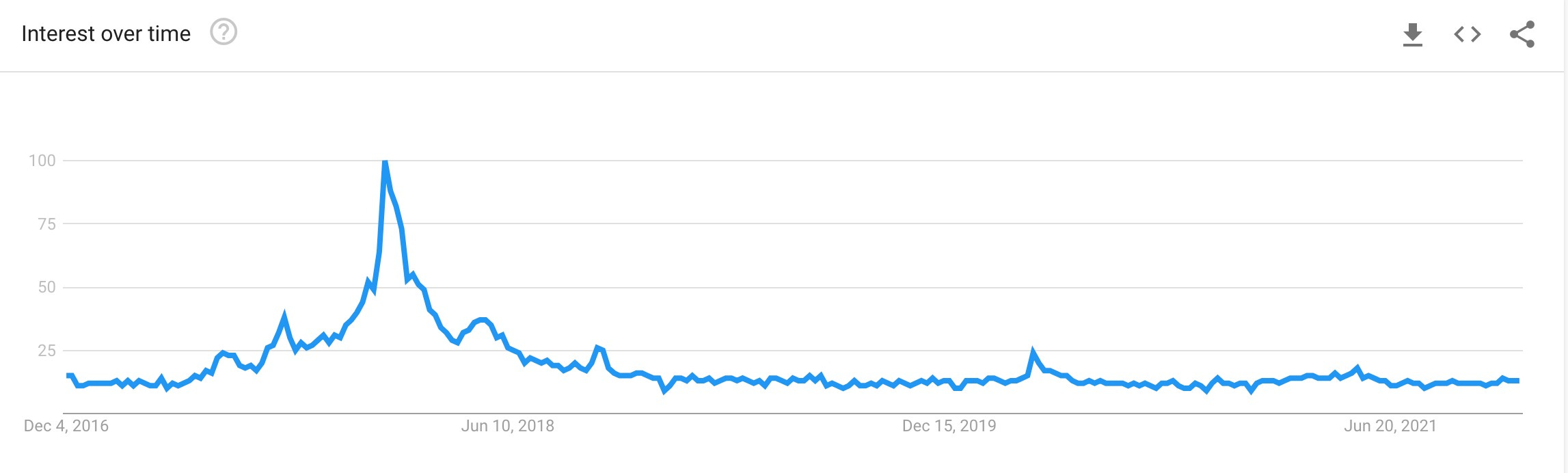
Around 2017 a phenomenon started where startups would issue ‘Initial Coin Offerings’ as a blockchain based way to raise capital, even if their product had nothing to do with blockchain. The google search history for ICOs tells the story:

My hypothesis is that DAOs are 2021’s ICOs; a flash in the pan that we’ll look back on only when the next blockchain craze comes around.

One hypothetical examples of DAOs was specific to D2C meat, which you know is a topic I’m here for – here’s how the author described it:

Going to a high-end butcher and buying your meat piecemeal might run you anywhere from $10/lb for ground to $30-40/lb for top cuts.

It’s much more financially manageable to buy a fraction of a cow from a ranch directly. That might cut your costs by 50-75%. But most people can’t eat a whole cow. So you team up with some friends and buy one together.

Let’s say you can buy a cow for $3,000. That’ll yield you around 450 lbs of meat, so you’re paying an average $6.66 per pound for everything from ground to filet.

You probably don’t need a whole cow at once though, so let’s say you buy ⅓ of one. So your cost is $1,000.

But instead of buying one directly, you buy a membership to the new CowDAO. CowDAO is a DAO focused on making high quality meat more accessible to all its members. Membership comes in the form of an NFT, which is initially priced at 0.07 ETH with a supply of 1,000. Pretty typical for a new NFT drop.

Your membership entitles you to lifetime discounts on the finest quality meat sourced from around the country, and eventually, free meat. Here’s how CowDAO does it.

(You can read the full piece here including the how’s, though I recommend popping some Tylenol first.)

Let’s dissect the CowDAO idea. So a lot of people want non-commodity meat but don’t necessarily want to purchase a whole or half carcass? Yes and amen.

But you don’t need a DAO to solve that problem as CrowdCow, ButcherBox, and Barn2Door are proving because…

…it’s not a technology problem, it’s a business model problem.

DAOs are tech for the sake of tech.

And so far, so is blockchain.

Buzz about blockchain seemed to really pick up around 2016. The ag industry speculated that blockchain would finally enable traceability in food value chains.

But traceability isn’t a technology problem, its a market problem.

Who wants traceability and who is willing to pay for it? Five years later and in most markets, its still unclear.

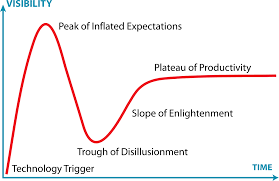
Remember the hype cycle for emerging technologies:

So where are we in the blockchain hype cycle? It’s hard to say. I *do* think blockchain will find its footing, eventually. Why & when will it happen? No idea, except that it it’s likely to be when blockchain is the right solution for a customer problem, and the technology fits the business context. Not a second before then.

Yet given enough time, anything can happen. QR codes were invented in 1994 and hey, it only took 26 years and a global pandemic for that technology to hit it’s stride.

My caveat to all the above is that not only am I by no means an expert, I did just purchase a couple of blockchain books to read over the holidays. So I reserve the right to change my mind. And let’s just assume that because I’ve now taken such a public & negative view on DAOs, that they might actually become a real thing. 🙂

Share


Get past editions of Prime Future in one place:

Get Prime Future PDF!