Categories
Blockchain

Prime Future 96: NFTs have entered the chat.

“Buy land. They aren’t making any more of it.”

It seems like every farm kid across the entire face of God’s green earth grew up hearing some variation on this idea. Farmland has historically appreciated ~12% annually.

While farmland has been a reliable investment class over time, many would say that’s true of the broader real estate market.

So this tweet caught my eye:

If you’ve never felt older than after reading that tweet, you are not alone.

What non-physical things are ‘young crypto investors’ investing in? The obvious is cryptocurrencies, but there are also DAOs (which we’ve briefly touched on) and NFTs.

“A non-fungible token (NFT) is a non-interchangeable unit of data stored on a blockchain, a form of digital ledger, that can be sold and traded. Types of NFT data units may be associated with digital files such as photos, videos, and audio. Because each token is uniquely identifiable, NFTs differ from most cryptocurrencies, such as Bitcoin, which are fungible.

NFT ledgers claim to provide a public certificate of authenticity or proof of ownership, but the legal rights conveyed by an NFT can be uncertain. NFTs do not restrict the sharing or copying of the underlying digital files, do not necessarily convey the copyright of the digital files, and do not prevent the creation of NFTs with identical associated files.”

Think of it this way – while land is tangible and scarce, NFTs are intangible and not necessarily scarce.

Let’s say you mint an NFT for a photo of your neighbor’s tractor. Does that mean you own your neighbor’s tractor? Nope.

Let’s say you mint an NFT for someone else’s tweet, does that mean no one else can view or retweet that tweet? Nope. It just means you own an NFT. 🤷🏻‍♀️

The characteristics of NFTs are the exact opposite of the characteristics of land, which are the reasons many investors love land.

And yet Opensea, the largest platform for buying & selling NFTs, facilitated $14 billion in NFT trading in 2021. Maybe this was a pandemic/stimulus induced fluke, though the NFT bulls will tell you there are two types of NFTs:

  1. Collectibles like art, or a tweet you like, or your 5 year old’s drawing
  2. Utility.

But dear reader, I have tried and failed to understand the potential utility of an NFT.

Take the new NFT being launched by the hosts of The Modern Acre podcast. Here’s the pitch:

As someone who is skeptical but curious, I thought this might be a fun way to learn more about NFTs.

Then the pricing information came out. One NFT to join Modern Acre’s Co-op is priced at .3 ETH.

To put that .3 ETH into context, here’s how this works:

When you buy an NFT, you do not pay for it in dollars – you pay for it in ethereum, the second most traded cryptocurrency with a market cap of $347B. So you put dollars into a crypto account to buy ethereum (ETH) then use ETH to buy your NFT. When you’re buying a newly created NFT, it’s called minting. Oh and anytime you do a transaction with ETH, you’ll get charged what is effectively a transaction fee, called a ‘gas fee’. The kicker is that you don’t know precisely how much that fee will be until after the fact, could be $50 or could be $250+. Cool.

As of this writing, one ETH is trading at $3,037.

So minting an NFT at .3 ETH is $911, plus gas fees.

First let me say that I truly tip my hat to the Nuss brothers for running this experiment & pioneering what seems to be the first ag related NFT.

But as far as I can tell, the benefits of minting an NFT to join the Modern Acre co-op are (1) a heaping dose of novelty and (2) access to a group chat.

Granted it’s likely a group chat with other curious minded ag folks but $911+ in order to <checks notes> join a group chat? That’s a pass from me, at least for now. Especially since there are a million different ways to find & connect with like minded humans.

That decision brings us back to the same questions I ask about blockchain, and DAO’s, and now NFTs:

  • What is the value proposition?
  • What is the ROI?
  • What is the use case where the technology solves an Actual Problem or creates a real opportunity?

While I trust the Modern Acre guys will prove my skepticism wrong in spectacular fashion over time, my general word cloud around NFTs today is: unclear, scammy, bubbly, huh.

I’m skeptical if there is a ‘there there’ with NFTs, but I grew up with “they aren’t making more land” mentality. I’m also operating with the awareness that potentially (1) NFT bulls know something I don’t know, and/or (2) there could be a use case for NFTs that becomes evident, eventually.

Back to the juxtaposition in that tweet about young crypto investor mentality vs older real estate investor mentality, it makes you wonder if it is a generational difference in technology understanding or if it is simply a reflection of markets today.

Does the next generation not invest in real estate because they know something about digital investing that real estate investors do not?

Or do they invest in digital investments because that's the cool thing to do right now and/or because they've been priced out of real estate markets?

Alternatively, perhaps those framing NFTs as an emerging investment class have the wrong framing entirely. The speculative nature of collectible NFT’s are good old fashioned speculation. And if the utility of token-gated communities is access to a glorified group chat of people with a shared interest, then that’s an investment in the sense that getting a degree is an investment. That’s a learning & network investment, not a financial one.

There’s a gaggle of interesting startups innovating around buying, selling & renting farmland: Farmland Finder, Acre Trader, & Tillable, just to name a few. If digital investing really is introducing a paradigm shift, then will we see a gaggle of startups innovating around NFTs within ag? What would that look like? What would drive it? What value could it create?

Your turn:

  • What is your impression of NFTs?
  • Once the novelty wears off, what value could they add to agriculture?
  • What kind of utility would compel you to purchase an NFT?
Categories
Meat

Prime Future 95: Is lamb the Cinderella of the meat case?

With Easter approaching, lamb meat is on the move in grocery stores. It’s always bumfuzzled me that lamb doesn’t get much love in the US where, for most consumers, it is a special occasion kind of meat, if that.

Today we explore why (1) lamb might be the most underrated protein, (2) there’s more than meats the eye to this so-called niche protein, and (3) the humans are fickle.

The backstory on lamb production in the US (it’s a doozy)

Per capita beef consumption in the US is 67 pounds. Per capita lamb consumption is ~1 pound.

In 2019, US domestic lamb sales were $433 million. Beef sales that year were ~$30 billion.

In 1884 there were 62 million people in the United States and 51 million sheep. Today there are 330 million people in the US and 6 million sheep.

What drove the sheep population off a cliff? Here’s a quick synopsis from an article that’s worth the read:

Americans are among the world’s top consumers of beef, pork, and poultry and near the bottom when it comes to sheep. In 2020, according to the US Department of Agriculture Economic Research Service, on average Americans consumed less than one pound of lamb or mutton per capita. Why does lamb make only seasonal appearances on the American table? Why do Americans prefer other meats to lamb? And why, in a famously dynamic country, has this preference lasted for hundreds of years?

The Spanish conquistadors brought the first sheep to North America in the 16th century, when they arrived in present-day New Mexico. In the early 17th century, English, Dutch, and Swedish settlers brought sheep to the East Coast and from there brought sheep elsewhere in North America. Sheep met the settlers’ immediate needs for wool to weave into fabric for cold-weather wear, as well as for meat. Sheep were eaten seasonally in the spring and summer on the farms where they were raised. Beyond that there was little or no market for mutton in the United States.

In the early 19th century, sheep farming developed into a larger industry because of an increased demand for wool in both national and international markets. By 1830 the wool-manufacturing industry occupied an important place in the American economy. This resulted in increased meat output, as sheep were slaughtered at the end of their wool-producing years. At that time, the meat industry was locally concentrated: Farmers sold the animals to nearby butcher shops. For many more years, however, meat was a secondary product to wool.

From the 1860s on, as the nation industrialized, urbanized, and grew wealthier amid a wave of European immigration, demand for mutton rose.

Sheep meat markets developed in major cities such as Boston, Philadelphia, and New York. Mutton and lamb, more expensive than other meats, were more appealing to the upper classes, so for much of the 19th century, sheep meat was a rich person’s meal.

In the 1880s and 1890s, young lamb meat gained some popularity as a festive food among the upper classes. An industry, known as a “hothouse,” developed on the East Coast and in the Midwest for young lambs, which reached the market by Christmas. Most were slaughtered by early spring. It was a prosperous business that remained seasonal.

Greater production reduced some costs and lowered prices, making sheep meat more affordable for low-income households. But beef and pork production also increased, and those meats became cheaper, too. Beef sold the best. The large meatpackers that had come to dominate the industry after the development of refrigerated railcars focused on beef cattle.

Lamb and mutton’s cachet among the wealthy didn’t last long. Americans came to see mutton as an inferior substitute for beef and pork — you ate it only when there was nothing better available.

And then the nails in the coffin, WW1 and WW2.

During the First World War, an “eat no meat” campaign in 1917 discouraged eating sheep that were needed for wool. The mature sheep slaughtered during wartime meat shortages didn’t help sheep’s reputation — they had a strong flavor and a tough texture.

Americans’ aversion to lamb and mutton persisted. A century later, lamb remains an acquired taste in America, making only seasonal appearances at Easter and Christmas.”

Here’s what Twitter had to say about the anti-mutton movement after WW2:

This lines up with a fantastic Bloomberg back story as well:

“Lamb has been saddled with a bad rap in the U.S. ever since World War II, when returning servicemen wanted nothing to do with it after years of canned mutton. “We’re still a niche protein when compared to beef, pork or chicken,” said Anders Hemphill, vice president of marketing at Superior Farms based in Sacramento, California. Typically, he said, “Americans eat 60 pounds of beef, 100 pounds of chicken, 50 pounds of pork—and 1.1 pounds of lamb.”

So Americans just don’t like lamb anymore? False.

From the same Bloomberg article:

But that number has been steadily rising in recent years—up from a low of 0.6 pounds per person in 2011, he said. “The pandemic has caused that number to bump up more,” Hemphill said. So why the lockdown renaissance? Adventurous millennial eaters and home chefs willing and able to spend more time cooking have fueled a good portion of retail demand.

But there’s another factor that’s been boosting lamb’s popularity in recent years—growing demand among first-generation Americans from the Middle East and southern Europe, where lamb is closer to a staple.

The rise of several Mediterranean fast casual restaurants has also helped fuel demand. As Covid-19 increased retail sales last summer, Superior Farms invested millions of dollars to get facilities ramped up to meet the retail demand, Hemphill said. One lesson learned from the pandemic, he explained, is that survival is “about being nimble and able to adapt quickly.”

“Unless we [U.S. producers] start farming lamb in additional areas, I don’t know how it keeps up with growing demand over the next 10-20 years,” said Smith.

Ok, so rising demand in the US without a clear path to satisfying that demand domestically? Interesting.

Especially since Australia’s lamb industry has an export super power. Some of that is live export to the Middle East for Halal slaughter, but much of it is.

“The value of Australian sheep meat exports is forecast to reach $4.4 billion in 2021–22. This is being driven by strong sheep meat exports to the United States. Between July and November 2021, exports to the United States were 45% higher than the same time in 2020. In the United States, meat prices have been rising faster than general price inflation and domestic sheep meat production has been relatively low. These two factors have been driving up the value of Australia’s sheep meat exports to the country.

China and the United States are Australia’s largest sheep meat export markets, in which we compete with New Zealand. New Zealand is the largest exporter of sheep meat to China and the second largest exporter of sheep meat to the United States.”

Set the above context next to the fact that 60% of fresh lamb sold in the US is imported.

This raises two questions:

  1. Could lamb be an every day protein instead of a special occasion protein once again in the US?
  2. If there is so much growing demand in the US, why is the invisible hand not doing its job and increasing domestic production?

I don’t have answers to those questions, but one thing is for sure…

People are fickle.

We humans tend to like what other humans like. We like what other humans in our sub-cultures like. We like what we know.

But if it's true that pendulums swing (and it is), I wonder when the pendulum will swing back to an increased popularity of lamb in the US.

What if lamb is the cinderella of the American meat case?

Sheep grazing in New Zealand…so cool, right?!

I say this quietly, but…livestock producers are also fickle.

I grew up hearing macho cowboys hate on sheep. The sheep growers vs cattle growers battles of the western United States are legend and the attitude has lived on in a lot of geographies. (Absurd, but legend. If you want some weird American history, here’s the history of the “sheep wars” from 1870 – 1920.)

Yet there is growing evidence that grazing sheep and cattle either together or sequentially, can be a way to maximize grass utilization since sheep will eat what cattle will not. If graziers’ objective is to maximize value creation from grass, and grazing sheep in addition to cattle is one way to do that, why hasn’t the US seen more of this….particularly given the challenging cow-calf economics of the last few years?

I’m guessing the answer to that question is as rooted in culture as the reasons that the US eats <1 lb of lamb per capita while Mongolia eats 88+ lbs.

We clearly just scratched the surface about lamb, but there are a lot of threads to pull about the role of the sheep industry. Especially as you look around the world where different output carries different value:

  • Lamb 😋
  • Mutton 🤢
  • Live export animals for local Halal slaughter (oh hey Australia)
  • Wool
  • And perhaps most importantly because Manchego is my spirit cheese…milk. (Interestingly there are <200 sheep dairies in the US, all tiny, because that is a suuuper tough business to be in.)

Name another animal with that much built in diversification of revenue streams!

Though, of course, most producers select breeds that optimize whether the primary output is meat or wool. And we haven’t even touched on the wool industry yet, which is a minuscule ~$40M industry in the United States. But that’s not surprising in a historical context either: “The demand for wool has declined since the mid-1940s with the advent of synthetic fibers.”

All that to say, Happy Easter and what a time to be alive 😃


Bonus: Was the herd dog the OG innovation in sheep production?

Categories
Alternative Meat

Prime Future 94: Animal protein started it, will plant-based end it?

We recently bid adieu to plant-based meat mania with the (really) bearish case for the plant-based meat category:

(1) Timing – conditions over the last 24 months were all that plant-based meat companies could have hoped for, but it wasn’t enough.

(2) Competition is fierce and growing, which will continue pressuring (already negative) margins.

(3) Plant-based meat: it’s still just a veggie burger.

But the canary in the coal mine is McDonalds, and the test they are running with the oh-so-cleverly named McPlant burger. For 3 reasons:

  1. McDonalds menu board space is precious. Items have to earn their spot.
  2. McDonalds menu board space is all the more precious now, since the menu has been pared down to simplify operations and decrease wait times amidst labor shortages.
  3. Amidst a pared down menu board, sales have increased. Correlation or causation is hard to say, but it does seem reasonable to think that the hurdle to add something to the menu has been raised.

If McDonalds rolls out plant based burgers on a broad scale beyond the current trial, then my view might change.

And with perfect timing for this follow up, speculation about the McDonalds pilot results began popping up this week:

Beyond Meat’s high-profile collaboration with McDonald’s is not meeting expectations, with underwhelming sales of the plant-based McPlant burger triggering concerns from Wall Street analysts.

The downgrade came on the back of a tepid report on the McPlant’s rollout last week by analysts at another investment bank, BTIG, who described the burger’s sales performance as “underwhelming” after examining sales at 600 McDonald’s locations across the Bay Area and Dallas-Fort Worth region. According to BTIG, McDonald’s franchisees reported that “they don’t see enough evidence to support a national rollout [of the McPlant] in the near future”—with its lower sales volumes consequently “slowing down service times, as the product was being cooked to order.”

The analysts noted that while McDonald’s was expecting to sell 40 to 60 of the plant-based patties each day, its locations in the Bay Area and Dallas Fort-Worth were only selling 20 per day. Sales at rural East Texas franchises were even more anemic, numbering between three and five sandwiches per day. While remaining open to the product’s viability in “higher income, urban markets,” BTIG said “a wide-scale launch [of the McPlant] seems a ways off at this point.”

To put this in perspective, McDonald’s sells an estimated 50,000,000 burgers every day in its ~38,000 stores across the world. Let’s make the (incorrect) assumption that sales are equal across all stores, which would mean each store sells ~1,300 burgers per day.

So let’s say the McDonalds pilot stores sell ~1,300 burgers every day and have a target to sell 40-60 plant-based burgers.

And yet, those stores are only moving 20 plant-based burgers per day? (if the article above is accurate)

Yikes. I have a hard time believing the McPlant pilot doesn’t go in the McTrash in the very near future.

Of course McDonalds is not the only path to foodservice growth, so perhaps plant-based companies will find growth in more regional or local chains? Maybe…or maybe McDonalds results really are the canary in the coal mine and the foodservice channel sales growth curve will begin to look eerily similar to the disappointing retail growth curve for plant-based meat: down and to the right.

In my last article, I readily admitted that I’m a skeptic but want to hear more of the bullish case for plant-based meat and why we bears might have it all wrong. What did they have to say?

One of the plant-based bulls responded to my last article on the topic with an astute analysis:

“Plant-based milk is today 15% of total dollar sales of retail milk (source: SPINS/GFI). That tells me that 15% of consumers are willing to go for a plant-based product if it meets their expectations in terms of taste, price, and convenience.

Plant-based meat is just 1.4% of total retail sales (same source). But if these products keep improving — which they are — then they could likely grow to at least 15% of the total market.”

I appreciate this analysis because realistically milk is the best indicator of how plant-based could perform in meat.

But the unknown is IF plant-based meat can meet consumer expectation in terms of taste and price.

That same source referenced above, SPINS, recently said “the U.S. retail plant-based food industry grew 6% in 2021 to $7.4 billion, a slower pace than the year before. In 2020, total U.S. retail plant-based food sales grew 27%, to $7 billion.”

From 27% growth in 2020 to 6% growth in 2021 is not the trajectory you want to see if you are investing in a plant-based future.

SPINS also said, “New retail sales data …. shows that Plant-based meat sales remained steady in 2021, with $1.4 billion in sales. That compares to a growth rate of 45% in 2020.”

Plant-based meat went from a 45% growth rate in 2020 at retail to flat growth in 2021? 😵‍💫

Unless there is a really clear driver that explains those 2021 numbers, and why those numbers are an anomaly not a permanent downward trend, it’s unclear why they would magically bounce back up.

Other plant-based bulls site the need to feed the 9 billion people who will inhabit the planet by 2050, or the rising middle class looking to level up diets as incomes increase. For either of those arguments, cell-based or fermented meat technology seems like the more likely competitive threat to plant-fed meat, not plant-based. But more on that another day….including dissecting the 9 by 2050 holy grail itself. 🤭

Before we wrap up this plant-based discussion, let’s acknowledge how things have come full circle…

The animal protein industry has increasingly relied on absence marketing to differentiate meat, poultry & dairy products at retail. Consumers see labels like hormone-free chickenantibiotic-free meatrBST free milk. This approach is used so often, it almost feels like the only tool in the typical brand manager’s toolkit.

Only now, the toolkit has been hijacked:

This isn’t simply milk raised without xyz, it’s NOT MILK.

There’s an irony in this, isn’t there? Animal protein perfected the game of marketing on absence claims. Now the plant-based category is running the same playbook, and taking it to a whole new level.

NOT MILK – a brand 100% centered around what it is not – seems to be the extreme outcome, the height of decades of absence-based marketing.

On the optimistic hand, perhaps this extreme NOT MILK example means that the pendulum is about to swing back towards products that differentiate based on what they are, instead of what they are not.

I’m 100% here for that pendulum swing.

Bonus: a TikTok on how to make your own oat milk at home. Go nuts.

Categories
AgTech Animal AgTech

Prime Future 93: Un-manured money in animal agtech

Last week was the Animal Agtech Innovation Summit held on the front end of the World Agritech Innovation Summit, which is largely focused on non-livestock agtech.

With a livestock lens, here are 7 takeaways:

(1) Many things in life fall into a normal bell curve distribution…startups do not.

There are a lot of really uninteresting startups and a few really really interesting startups. Since animal agtech companies are largely still super early stage, the dimensions that divide the un and the interesting are pretty basic: problem being solved, product, business model, team, vision, etc.

There are the many startups that are just noise (so.much.noise). And there are the few fantastic startups that could radically improve the livestock, meat & dairy business.

But….

(2) ….the same is also true of investors. There is a lot of money investing in ag, that doesn’t know ag…especially animal ag.

Venture investing is risky. Venture investing in a nuanced space without respecting the nuances is really risky.

According to AgFunder’s newly released Agrifoodtech Investment Report, venture capital into ‘agrifood’ increased 85% from $27.8 billion in 2020 to $51.7 billion in 2021. AgFunder further divides into upstream investment (farm to processing), which grew from $15.8 billion in 2020 to $18.9 billion in 2021. AgFunder does not segment the Upstream category into crop vs livestock solutions but I expect livestock funding follows a similar growth trend, albeit smaller than the crop category.

On the one hand, this growth in capital is fantastic news for the category. More capital = more innovation.

Except, a lot of the money is being managed by folks in their standard VC Patagonia vest who’ve never been on a farm or had their boots covered in cow/pig/chicken 💩💩💩 or heard first hand all the dynamics that livestock producers are navigating. That’s a problem.

Some might be tempted to call this dumb money, but let's call this 'un-manured money'.

The cynical view is that too much un-manured money means the wrong companies get backed, and the market gets oversaturated with zombie startups that won’t generate venture returns because they won’t create real producer value.

If investors then start to believe they can’t win in the category, then future capital might not flow into the category and it will go to ClimateTech or FinTech or some other hot category.

And if early adopter producers have negative experiences, then the target market grows skeptical. (Ask any mid-large row crop farmer what it was like 2014-2019 when they were getting daily calls from inside sales reps from the 10th farm management software company.)

And yet, the optimistic view is that regardless of the capital source, more venture capital means more companies get backed and more innovation flows to livestock, milk & meat, and even if only a small fraction of companies that get backed are solving legitimate problems and could have a shot at creating meaningful impact, well there’s still a shot at meaningful impact. So the net result is positive for the industry.

(3) There’s a lot of dogma in agtech investing.

Traceability, regenerative, etc. Which of these will prove to be actual market opportunities and which will turn out to be overhyped & untested investor assumptions? TBD.

But I get really nervous that folks have lost the plot when people stand on a conference stage and say with a straight face that consumers want to pay more for food.

Are some consumers willing & able to pay more for food produced with specific attributes & claims of production practices? Absolutely.

Are all consumers willing & able to pay more for food? Absolutely not. And to assume so is to be embarrassingly out of touch with the reality of the majority of humans on the planet.

(4) Start with the customer and their problem and work back.

Start with the customer and their problem and work back.

Start with the customer and their problem and work back.

Early stage animal agtech companies that have this kind of mantra on repeat will be the winners…the rest will struggle.

One of Amazon’s disciplines is that at the start of product development for any new product, the team writes a press release as if the product were being released today. The press release has to frame the product in terms of benefits to the customer. That press release is aggressively iterated until the product vision is clear.

There are a lot of early stage agtech companies that could benefit from this exercise.

(Related: no one cares about your technology for the sake of technology that sounds cool…I’m looking at you, blockchain.)

(5) The myth of the hoodie wearing 20 year old wunderkind founder is not the rule in broader venture, and it’s really not the rule in ag.

“Mark Zuckerberg launched Facebook at the age of 19, but this is the exception rather than the rule when it comes to successful founders. Most successful founders in the United States have tended to be over 40 years old when launching their company. As of 2018, the average age of the top 0.1 percent of startups in term of growth was 45 years.”

Given the complexities of livestock, the most effective animal agtech founders are those that either know the problem they’re solving because they’ve worked directly in it, or because they’ve invested the time to know the problem as well as their customers do. That’s when magic happens.

(6) The number of livestock & dairy focused startups feels significantly higher than it was even 2-3 years ago.

But the number of startups working on solutions for meat processors seems flat. I think MeatTech might be the 3rd wave of innovation after agtech and animal agtech.

(7) Animal agtech is still so, so, so early.

The Animal Agtech event is actually only a few years old and although it’s growing, it has less than half the attendees compared with the longer running World Agritech event. The evolution of the two events mirrors the two distinct waves of innovation in that agtech innovation for crops is about 7-10 years ahead of animal agtech in terms of funding, maturity, scale, impact.

Almost by definition, the majority of tech companies working in livestock are early stage companies.

There aren’t venture-backed animal agtech companies that have IPO’d, who’s quarterly earnings can be analyzed. There’s no rumor mill about which animal agtech companies are about to IPO. Unlike their counterparts in broader agtech that are raising Series F & Series G funding rounds, the most mature of animal agtech companies are still at the beginning of the alphabet. The category is just early.

That earliness shows up in the still relatively small number of companies, and especially  in the smaller still number of companies that have reached product-market fit. A producer who looked at the category today might be skeptical since many animal agtech companies are still in their Wilderness years. And yet, I think that’s how the broader agtech category felt circa 2012.

If the pattern holds, then by 2032 the animal agtech landscape will look completely different from today, in the best of ways.

No news flash here: I’m bullish on the category and excited to see high-impact animal agtech companies grow in the next decade.

What a time to be alive 😉

Categories
AgTech Alternative Meat

Prime Future 92: RIP plant-based meat mania

I am often asked about my view on alternative meats and the threat they pose to old fashioned, plant-fed meat. I’ve stayed away from that question, for the most part because I’m just more interested in plant-fed meat.

First, it’s important to separate “alternative meat” into 3 distinct buckets: plant-based, fermented, cell-based.

Today we are looking at the plant-based meat category. Spoiler alert: I find the plant-based meat category bland and uninspiring. And honestly, I think we can reasonably lay plant-based meat mania to rest in peace in the history books, right alongside 1990’s emu farming mania in the US.

Some background on VC’s appetite for the category:

“Plant-based meat, egg, and dairy companies received $2.1 billion in investments in 2020 — the most capital raised in any single year in the industry’s history and more than three times the $667 million raised in 2019. Plant-based meat, egg, and dairy companies have raised $4.4 billion in investments in the past decade (2010–2020). Almost half, or $2.1 billion, was raised in 2020 alone. This included Impossible Foods’ record $700 million funding haul.”

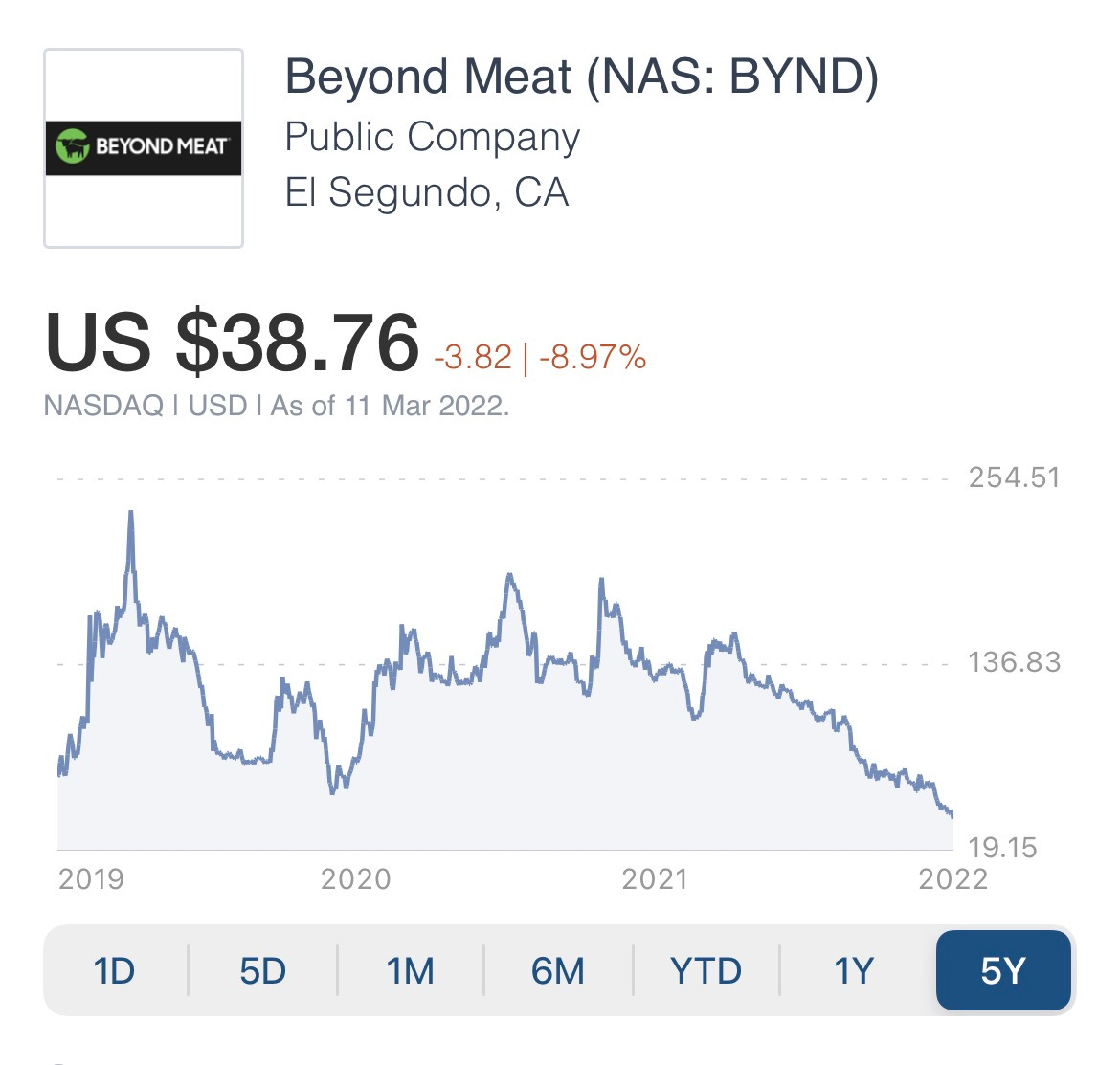
In addition to Impossible Foods, the other elephant in the plant-based room is Beyond Meat, which has sent investors on a roller coaster since their 2019 IPO.

Here’s the category update, according to the Wall Street Journal:

“Beyond shares peaked above $234 in mid-2019 after the company’s initial public offering at a price of $25 earlier that year. Shares have fallen since then as meat alternative makers have dealt with pandemic-related challenges and uncertainty around the products’ growth prospects. Beyond’s stock has fallen about 71% in the past 12 months.

Maple Leaf Foods Inc, a Canadian meat company that in 2017 acquired plant-based food maker Lightlife Foods, this week said that an internal company analysis showed that after years of rapid growth, the category had stalled.

“All major brands and products across the category are experiencing similar challenges, which largely seems to be driven by consumers’ experience in terms of taste, price, degree of processing and ease of preparation, said Curtis Frank, Maple Leaf’s president.”

Womp, womp…

Now layer on 3 dynamics about plant-based meat mania….

(1) Timing – conditions over the last 24 months were all that plant-based meat companies could have hoped for, but it wasn’t enough.

Beyond Meat when public in 2019, then record levels of venture capital flowed into the category in 2020. This was during a time when total money flowing into the venture capital class was exploding, and public markets were frothy.

And, it was at a time when plant-fed meat began selling at record prices in the meat case over the last two years, at times even being unavailable.

And yet, the plant-based meat category appears to have stalled.

(2) Competition is fierce and growing, which will continue pressuring (already negative) margins.

Plant based meat is an increasingly crowded market, including private label brands intent on competing on price, driving down margins of the whole category. If I’m a retail sales exec for a meat packer, I’m looking at this dynamic and thinking ‘welcome to the real world, kids!’

Like with any emerging trend, what matters is not the absolute size of the plant-based category relative to plant-fed meat….what matters is the growth rate.

But if the growth rate is slowing, and more emerging brands are popping up then suddenly the category is crowded and competing on price and suddenly the whole category is much less interesting to investors.

This picture is from the meat case in Safeway. Notice the seeming price differential. In reality, the plant-based burgers are $.749/oz while the prime chuck burgers are $.519/lb. But ignore the price differential, the visual quality cues here are striking, right?

You have to really want plant-based meat to pick up the one on the right; you have to have a compelling why behind that purchase….don’t you?

Especially in a time when plant-fed meat quality is high. As in ~90%-of-US-cattle-grading-choice-or-prime kinda high. That’s really high.

(3) Plant-based meat: it’s still just a veggie burger.

We’ve talked before about the 2 things venture capital has funded for plant-based meat companies are product development and marketing.

The plant-based meat category was not invented by Beyond Meat or Impossible Foods, but it was dressed up & juiced up by venture capital.

What I find most interesting about Beyond’s latest quarter results is that while total revenue was only down 1.2% YoY, retail sales were down 19.5%. Foodservice is the sales channel where Beyond is moving more product YoY. But my hypothesis is that much of the foodservice lift is from QSR chains like Burger King and White Castle trying to get a PR lift.

But the canary in the coal mine is McDonalds, and the test they are running with the oh-so-cleverly named McPlant burger. For 3 reasons:

  1. Menu board space is precious. Items have to earn their spot.
  2. Menu board space is all the more precious now, since the menu has been pared down to simplify operations and decrease wait times amidst labor shortages.
  3. Amidst a pared down menu board, sales have increased. Correlation or causation is hard to say, but it does seem reasonable to think that the hurdle to add something to the menu has been raised.

If McDonalds rolls out plant based burgers on a broad scale beyond the current trial, then my view might change.

Ok that’s a lot of negativity in one article….oops. But now let’s talk about the most important aspect: taste.

I’ve done the obligatory tasting of an Impossible burger and it tasted 97% like mushy cardboard.

But let’s say 90% of my reaction was influenced by my bias towards plant-fed meat. So let’s say the burger actually only tasted 7% like mushy cardboard. Is there really a massively growing market of repeat buyers for something that has even a hint of  a mushy cardboard eating experience? Especially in a time when meat quality is at all time highs.

But actually the obvious risk to my entire analysis is that I’m operating out of a complete bias towards plant-fed meat and it’s cultural, nutritional, environmental, societal, and experiential superiority over plant-based meat. I’m unabashedly bullish on animal protein. So perhaps this entire analysis will be proven laughably wrong over time…

One reason I do not anticipate that to be the case though, is The Lindy Effect:

“the Lindy effect proposes the longer a period something has survived to exist or be used in the present, it is also likely to have a longer remaining life expectancy. Longevity implies a resistance to change, obsolescence or competition and greater odds of continued existence into the future.”

I can’t think of a better example of The Lindy Effect than meat. Humans have been eating meat for a long, long time…that won’t change with marketing splash.

Where are my plant-based bulls?

I’ve lined out the (really) bear case about the plant-based meat category and why the sizzle will fizzle out and the category will continue to be a fixture in the meat case, albeit a shrinking fixture.

And yet, many many folks see the bull case for plant-based. That’s who I want to hear from – if you are a plant-based bull, tell me more about why that is.

What do you see that makes you optimistic the category’s growth rate will return to pre-2021 levels and sustain or even accelerate?

Categories
AgTech

Prime Future 91: Red meat & venture capital don’t go together

Riddle me this: why are there multiple venture-backed poultry production companies, but zero venture-backed pork, beef, or dairy production companies?

Kicking that around raises questions about potential disruption in meat and livestock.

Venture + Poultry

According to Crunchbase, Shenandoah Valley Organic (Farmer Focus brand) has raised $24.2 million in venture capital to “revolutionize the industry by creating sustainable, innovative partnerships between SVO and family farms. These partnerships allow farmers to retain ownership and grow profitability while also providing traceable, organic meat.”

Meanwhile Cooks Venture just closed $50M in debt financing, after raising ~$75M in venture capital to fund “building an alternative to America’s meat industry, to deliver great food from independent, regional farms. Our core values include a commitment to true transparency, and prioritizing the health of the land and the well being of our workers.”

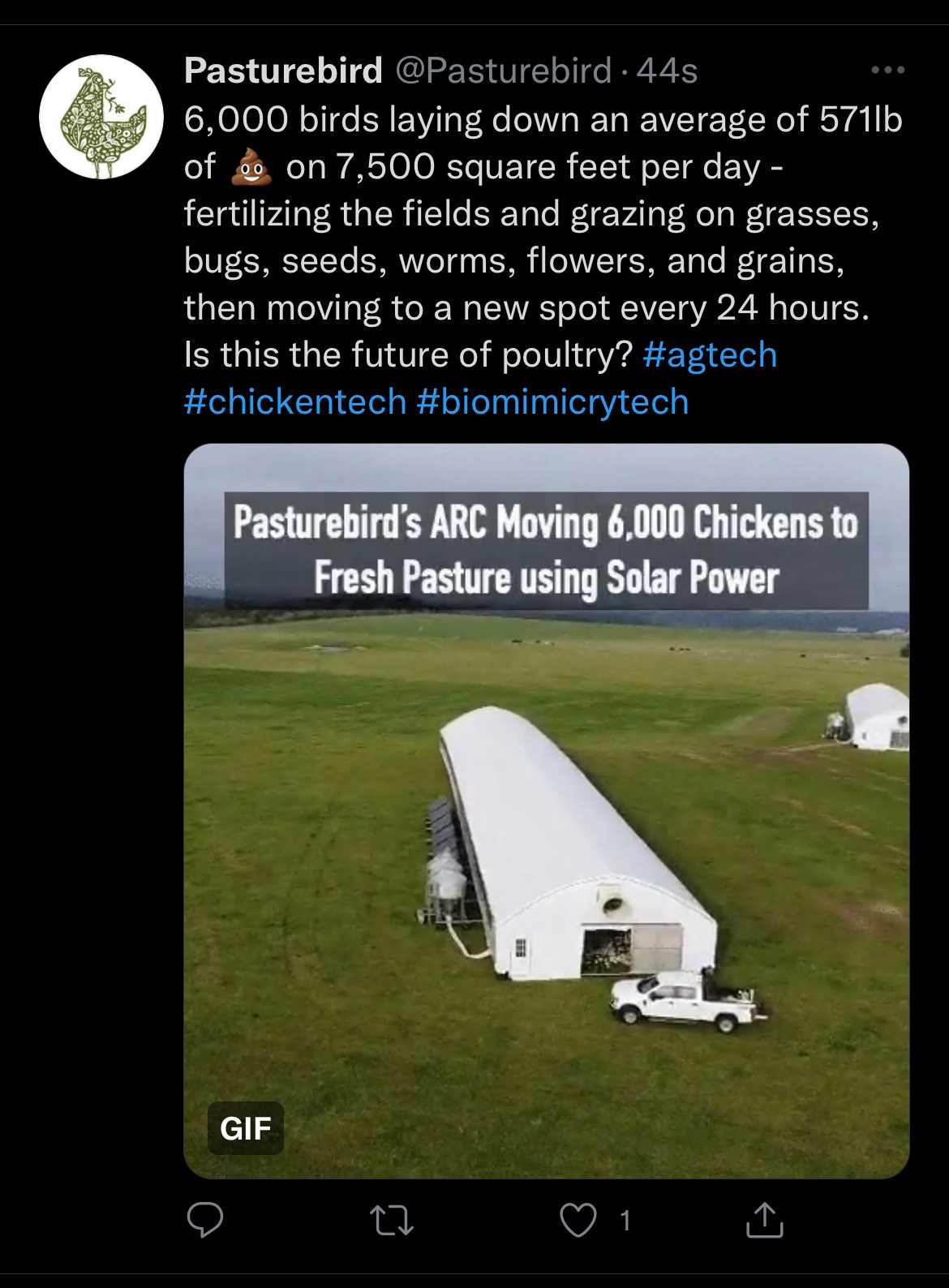
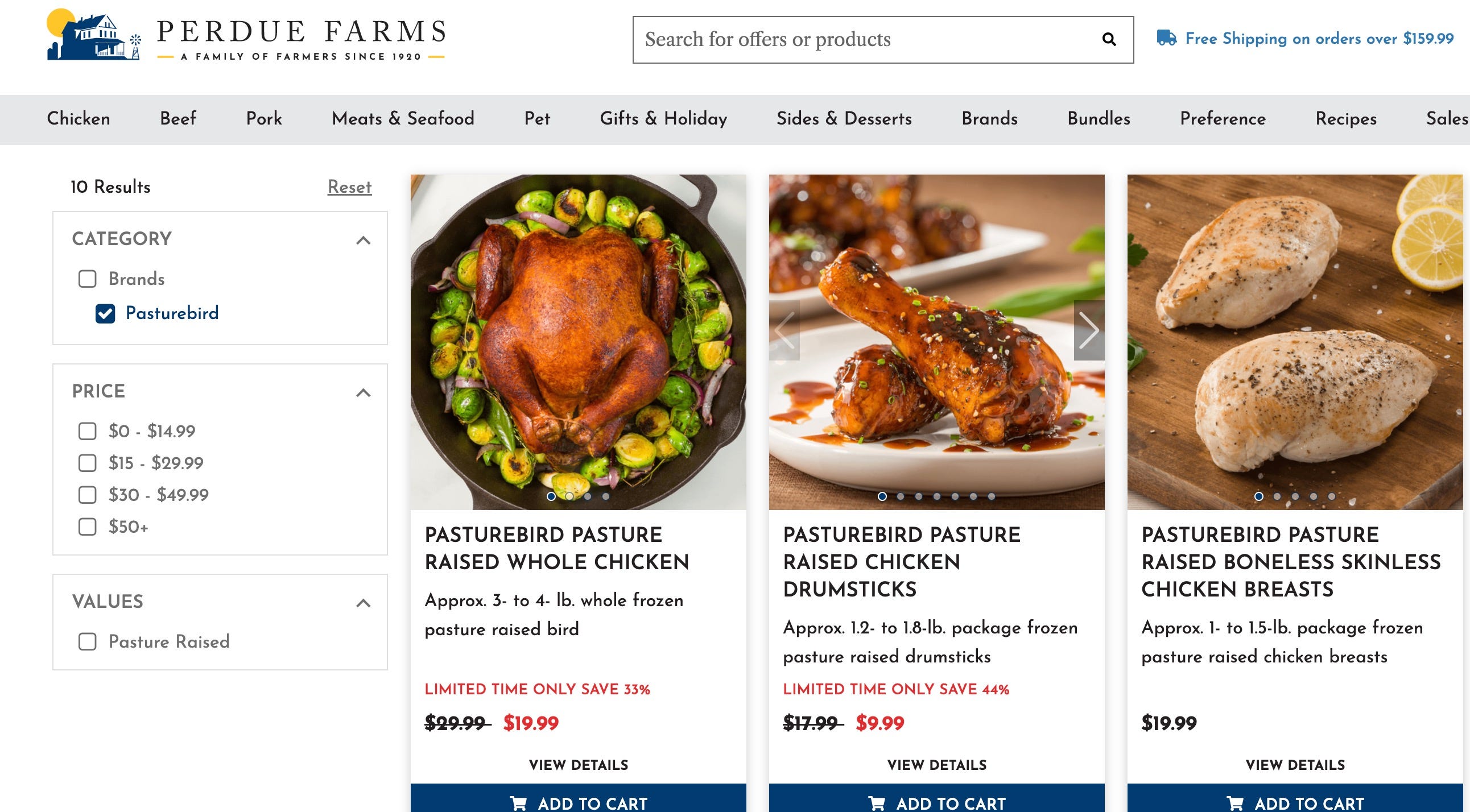
And then there’s Pasturebird, a pastured poultry + poultry tech company, which was acquired by Perdue Farms early in the company’s growth, but otherwise would likely have gone down the venture-backed path.

So that’s (almost) 3 venture backed production companies in poultry.

Yet we haven’t seen a single venture backed production company in beef, pork or dairy. Why?

Two potential reasons:

  1. The venture model is inherently more compatible with poultry production than the other proteins. We will not see venture backed production companies in beef, dairy, or pork.
  2. The other proteins have not yet found the right production model that is compatible with the venture model. We will see venture backed production companies in beef, dairy, and pork….it just hasn’t happened yet.

Note that I am specifically raising the question about companies actually producing beef, pork, or dairy. Currently the venture backed companies in beef, pork, and dairy fall into the overly broad categories of (1) solutions & tools for producers, or (2) meat & milk alternatives.

The caveat to this discussion is that venture capital is simply a financing tool – one of many. It’s not better or worse than debt financing or bootstrapping a business. It’s the right tool only when it’s the right scenario.

Also, keep in mind that venture capital is one of the highest risk asset classes. Really high risk only makes sense when there is potential for really big rewards. Venture capital is the most effective when it is funding companies that are:

  1. High growth
  2. Low CapEx

Said differently, venture capital most effectively fuels asset-light, high-growth companies. That’s why VC’s love to love software companies.

As a reference, consider three comparisons of asset intensive vs asset light business models:

  • Hotels: Marriott (asset-intensive with ownership of individual hotel properties) with Airbnb (asset-light with regular people renting out their homes)
  • Rental Cars: Hertz (asset-intensive with ownership of cars) with Getaround (asset-light with regular people renting out their cars)
  • Education: brick & mortar universities (asset-intensive with campuses) with BloomTech (asset-light with online only delivery)

Venture capital loves asset-light, high-growth companies. And it’s hard to imagine a more directly opposite business model than that of livestock production.

Production requires livestock inventory, land, and facilities. I think we can all agree that red meat & milk production is an incredibly asset intensive business. So….asset-intensive, (generally) low-growth. Probably not a fit for venture.

Not to mention, read meat & milk producing livestock naturally tie up cash for longer periods than poultry. In the Future of Ag podcast episode, Paul Grieve from Pasturebird talked about when they were starting the company that he would put the cost of purchasing chicks on his credit card and by the time the credit card payment was due, he had income from selling the birds for meat. That’s not really an option for red meat or milk production.

It’s why Bo Pilgrim & John Tyson were able to scale up their vertically integrated poultry model so quickly in the 60’s and 70’s, yet not only did beef never vertically integrate, what integration did exist has been undone as the packers sold off cattle feeding.

But back to our two options. Is the venture model just not a fit for red meat & milk production, or have we just not seen the venture back-able business model yet?

The most reasonable answer is that a venture backed beef/pork/dairy company isn’t a viable thing for the same as the reason that vertically integrated cattle production isn’t a thing – the asset-intensive nature of the business.

However the techno-optimist in me thinks that there is some future business model that will leverage technology and aligned supply chains in an asset light, scalable way that will benefit livestock producers, and packers, and consumers.

What is the future business model for livestock production that is asset-light, high-growth, and compatible with venture capital? I don’t know. But the most interesting companies are the ones that make previously held assumptions about what won’t work, look obvious in hindsight that it will.

This topic gets all the more relevant if let’s say, oh idk, the plant-based meat category fizzles and sends investors on a search for ways to disrupt animal protein from within. But more on that next week…

For you:

Let’s say you had $15 million to start a business to produce pork, beef or milk.

There are no other constraints but the business has to produce one of those 3.

What would the business model be?

Categories
Leadership Supply Chain

Prime Future 90: The outset of a new era for meat packers & food retailers?

I’m part of a group chat titled “The Advisory Board”. We live in different parts of the country but we’ve all known each other since high school. Over the last several years this friend group has evolved into something you might call a mastermind group or peer group. We approach the world with equal curiosity, ambition, & bullishness on agriculture….and from vastly different perspectives.

This group is about helping each other get where we want to go, and encouraging each other in the journey. One guy in the group describes it as “just about becoming better, in every area of life”.

It’s part sounding board, part therapy, part financial planning, part business coaching…its every bit as ridiculous and awesome as it sounds.

I’m wrapping up a retreat with this group that was like a 3 day mental IV of motivation and courage from all the brainstorming and game planning amidst Montana mountain views.

As a result, for today’s Prime Future I’m throwing back to some thoughts on vertical integration that are the backdrop for next week’s discussion – stay tuned.

Someday I’ll write about the ingredients for a great retreat like this but an important one is good views

The outset of a new era for meat packers & food retailers?

(Originally published in 2021)

We tend to think of the livestock, meat & milk business as part of an inevitable march towards increased consolidation and increased integration.

(Note: those are 2 related but very separate concepts. Consolidation is when a company buys a competitor, vertical integration is when a company buys a supplier or customer.)

Along with many other processors, a poultry integrator recently announced increased wages for processing plant employees and truck drivers. Because poultry is so vertically integrated, I’ve just assumed that most poultry co’s own the trucks and trailers to transport eggs from breeder farm to hatchery, chicks from hatchery to growout farms, feed from mill to farms, and live haul to take birds from farm to plant.

However, what I’ve learned is that there is actually a shift away from company owned truck fleets because of the management and capital required to keep those assets on the books. While some truck drivers are still employed directly by the integrator, like for delivering chicks to farms, and some of the trucks and/or trailers are company owned, more and more of these activities are outsourced to third parties.

Interesting. Here is an example, albeit potentially small, of reducing vertical integration by outsourcing at least some portion of a reallly critical activity.

One data point may not indicate a trend, but the whiff of vertical disintegration in trucking & logistics for meat & poultry companies does raise some questions:

  1. Why are the integrators moving away from owning trucking capacity?
  2. How will truck driver shortages of 2020-2021 (and likely 2022) impact that trend?
  3. Is this a one off trend or a part of something larger? Are integrators divesting assets in other important-but-not-core activities?

More importantly, given the chaos in labor markets & truck driver shortages of 2020-2021 (and likely 2022), how will this impact the ownership model for integrators moving forward?

“There are only two ways to make money in business: one is to bundle; the other is to unbundle.” The tech industry loves that quote, and it’s usually used in the context of bundling & unbundling consumer products, e.g. cable TV vs Netflix. Sometimes it’s used in the context of bundling & unbundling companies to create shareholder value, e.g. GE of 1990 vs GE of 2021.

What if it also applies to how we think about supply chains? Such as, oh idk, commodity supply chains like meat, milk & poultry? We could even use the alternative phrases of vertical integration & vertical disintegration to describe bundling & unbundling.

Metrics: what financial metrics drive vertical integration?

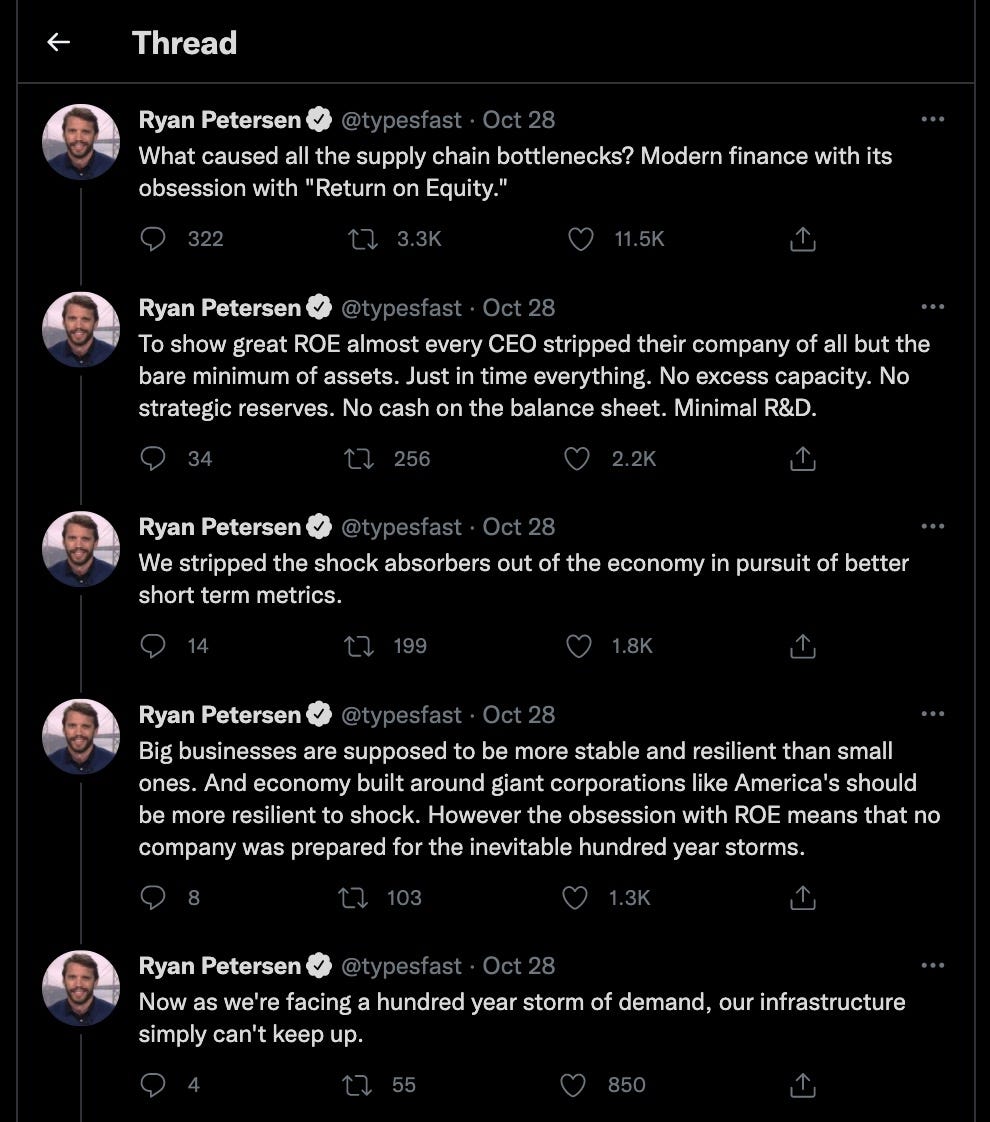
An interesting example of vertical disintegration happened in the US beef business a few years ago as packers spun off their cattle feeding capacity. Why? Because feeding cattle is massively capital intensive and depending on where we are in the cattle cycle, can negatively impact Return on Equity, a key finance metric.

It’s not a direct corollary to meat, but here’s an interesting thread on that concept; replace ‘supply chain’ and ‘logistics’ with ‘meat’ and see if some of this doesn’t resonate:

Yet over the same time frame that packers divested their cattle feeding businesses, let’s call it the last 10 years, retailers have increased their degree of vertical integration in protein with examples like Walmart’s milk plants and Costco’s chicken plant. Also over the same time frame, packers have moved further downstream into further processing, e.g. case ready plants. Mixed signals, eh?

Cold storage represents another dichotomy in vertical integration.

According to the Global Cold Chain Alliance, cold chain operators see insourcing (customers building their own facilities for cold storage) as a top 3 threat to the business behind driver & workforce shortage and balancing supply & demand. Yet these same third party logistics providers in the cold chain space see that increased customer outsourcing represents a growth opportunity.

Which is it?

When is it which?

(Interestingly two other growth drivers for cold chain ahead of customer outsourcing were robotics & automation and growth of ecommerce…obvious but also 👀)

There are probably a million factors that can impact a management team’s decision to increase/decrease vertical integration, things like:

  • market conditions
  • company financial health
  • company ownership structure
  • company strategy
  • relative risk level
  • supplier structure
  • net cash position
  • cost of capital
  • competitive landscape

etc etc etc etc etc…..

My working hypothesis is that ultimately the two driving dimensions for vertical integration are:

1) risk vs control - what is the risk of not having control of this link in the supply chain?

2) reduced cost vs added value - will owning this link in the supply chain reduce cost or increase revenue?

….sometimes those two sets of dimensions are at odds with one another. But here’s the thing – that laundry list of factors above? Those are true or false at a given point in time, not in perpetuity. So the structure of the industry should have some ebb and flow over time with regards to the degree of vertical integration. Some hypotheticals:

  • If land prices fall 50% in the next 5 years, would poultry integrators decide to buy the farm ground to grow corn & soy themselves?
  • If fed cattle prices increase 60%, would beef packers get back in the cattle feeding game?
  • What would need to be true to cause pork processors to own their own cold storage instead of leasing capacity as needed?
  • What would need to be be true to lead pork integrators to divest their growout operations? Sow farms?

Or, is it possible that as packers/integrators increase their core business through consolidation, that it makes more sense to decrease integration? I’ll leave that one to economists and CEO’s.

Back to the original question, how will the current transportation crisis impact the future movement of livestock, meat & milk?

My hypothesis is that we could see a shift back to company owned logistics as a way to control risk, given the massive logistics & labor risk the last 18 months have revealed. At least until autonomous trucking becomes a thing, then we should see more business model innovation unleashed…

…because, keep in mind, this whole discussion about the future of supply chain & logistics is set against a backdrop of not only how rapidly the tech is accelerating but how that technology is enabling new business models, like the one mentioned last week of the WeWork model for freight warehousing. (If you’re not familiar, WeWork is a startup that takes long term leases on commercial office buildings and sells short term leases for customers wanting flex office space. WeWork is also a deliciously disastrous startup trainwreck story for reasons other than their business model.)

Use WeWork or Uber or Airbnb or whatever other consumer business model you want, but the question is, how will those sharing-economy type business models drift into asset heavy, large scale, B2B manufacturing/disassembly businesses? The options used to be either lease or buy the asset, but having more variations in both of those options could change the risk/reward calculus of owning or outsourcing certain parts of the process involved in getting meat, poultry & milk to end customers.

Alternatively, having more predictability could change the calculus. Another example from last week was the idea of freight tech companies that are moving all the pen & paper or Excel based processes to digital, and improving not only visibility of information but of actual cargo in transit. How will those moves towards digitization reduce the risks that integrators perceive, ultimately enabling them to have high confidence in those suppliers to do the activities that need doing but without the integrator having that capability on their own books? Not just in trucking either.

On a final note, consider this perspective from Seizing the Middle: Chess Strategy:

Rockefeller’s strategy was part of a wider transition to a new type of industry, beginning in the 1840s and ending with the crash of the 1920s. Businesses started “seizing the middle” and taking control of the resources they depended on. A single company could take charge of everything from the natural resources required to make a product to the transport systems necessary to deliver it to customers. The implications of this were dramatic.

…the change in business practices allowed managers to start thinking like chess players: a few moves ahead. Being able to anticipate and plan had the undeniably significant effect of allowing companies to invest more in research and development because they could forecast where current trends headed:

“In allocating resources for future production and distribution, the new methods extended the time horizon of the top managers. Entrepreneurs who personally managed large industrials tended, like the owners of smaller, traditional enterprises, to make their plans on the basis of current market and business conditions. . . . The central sales and purchasing offices provided forecasts of future demand and availability of resources.”

To control the game, one tries to control as much of the board as possible. At the outset, using your pieces to seize the middle of the playing field is a great strategy, because it gives you the widest possible vantage point from which to control the movement of the other pieces.

But maybe that word ‘outset’ is the key here. The above description of Standard Oil (and many other businesses across many commodity segments) was reflected in principal in how the meat industry organized itself at the outset….but we aren’t at the outset of the meat business anymore – it’s an old, established business.

So perhaps we are at the outset of a new era. One with new alignments and new business models and new considerations that will inform how ‘vertical integration 2.0’ shapes up across meat, milk & poultry.

What a time to be alive!

Categories
AgTech

Prime Future 89: How could pastured poultry scale?

The US chicken industry processes ~9 billion birds each year.

I can’t find good data on what percentage of that is pasture raised, but my guess is <.001%. Why is pasture raised poultry a negligible piece of the industry?

Because mainstream chicken is raised in amazingly efficient systems, where costs are managed to the fraction of a cent and live performance metrics like feed conversion are managed to the hundredth of a pound. Amazingly efficient systems = amazingly affordable protein.

Meanwhile pasture raised poultry is land intensive, labor intensive, and therefore cost outlandish for most people. It’s the very definition of a niche category.

So, why waste time talking about a tiny sliver of the industry when the day in day out poultry is produced by large scale vertically integrated companies?

Because we are here 👏🏼for 👏🏼the 👏🏼 script 👏🏼flips.

Pasturebird is working to break down the barriers that make pasture raised poultry impractical at scale; they’re using technology to flip the script.

Paul Greive, founder of Pasturebird, joined the Future of Ag podcast for an interview about the dynamics that led to the creation, early growth, and acquisition of the company.

Click the image to listen to the episode

Pasturebird has two elements that make their business interesting:

  1. Proprietary technology to decrease production costs.
  2. Consumer facing chicken brand.

Paul describes their proprietary technology as an “automated range coop, a solar powered 6000 bird structure that’s 150 feet by 50 feet with independent drive motors that actually drives the system to fresh pasture each day.” The technology was designed to reduce the extremely high labor costs associated with pasture raised poultry.

Pasturebird was acquired by Perdue Farms, a company that bets on brand and markets on production attributes.

Paul covered a ton of interesting ground in the interview, but here are 5 takeaways from Paul’s insights:

(1) Impact demands scale. “We wanted to take the best from conventional ag and the best from small scale pastured poultry. Our whole mission as a company is to make nutrient dense pasture poultry more accessible and affordable. In order to scale pasture poultry, we need to take the labor out and start to get some of the efficiencies as conventional production.” Do you hear the AND at the center of their thesis? Thats a pragmatism that’s often missing from folks on the niche end of the industry.

(2) Low cost, and… “For 30-40 years people asked the big companies for cheap chicken, and they’ve delivered. People are now starting to ask for something different and companies are trying to figure out how to do that. Now people are saying it’s not just about a good price, it’s also nutrients, etc.”

(3) Nutrient based pricing? “We’ve relied on attribute based marketing in meat for 30 years. Now there’s an opportunity to shift to outcome based marketing. There’s a big opening in the market to go deeper with data and analytics and lab results than ever before.” Imagine a world where instead of looking at a price per pound of chicken sticker, you were looking at a price per unit of protein, omega 3’s, Vitamin E, etc. Crazy, right? 🤯 Maybe not.

(4) Omnichannel expectations. Pasturebird customers can purchase chicken direct from Pasturebird, via CrowdCow, or via Perdue Farms’ ecommerce site. Paul points out in the episode that it’s not about exclusivity to any single D2C channel, customers rightly expect to be able to purchase their brands anywhere shoppers in that target market might be. Omnichannel = convenience.

(5) Most importantly, make the niche less of a niche. “Electric vehicles will become cheaper when they reach scale. I don’t know if that will be our story but I think we can get competitive. If we can get within 10-20% of the ‘Walmart baseline’ then we can be competitive. We have to get away from the current 3x price to have impact though.

It’s easy to write pasture raised poultry off as a hyper-niche segment but remember the central idea of the Innovator’s Dilemma is that incumbents run the risk of missing emerging trends because emerging trends begin on a minuscule scale - by definition.

Emerging trends grow gradually then suddenly.

My favorite business strategy podcast is Acquired. In each episode they deep dive into a different company’s strategy, particularly acquisitions (obvs), followed by an analysis based on Hamilton Helmer’s 7 powers. The 7 powers are:

  • Scale economies
  • Network economies
  • Counter positioning
  • Switching costs
  • Branding
  • Cornered resource
  • Process power

From that framework, Pasturebird seems to leverage the following powers:

  • Counter positioning. The ~899,999,990,000 chicken processed in the US each year are raised in wildly efficient systems of stationary indoor housing and every few flocks, chicken litter is moved from inside the house to on the field. Pasturebird said hey what if we can do the opposite.
  • Scale. In a niche where small is the default, Pasturebird built the business around the assumption that scale is necessary.
  • Cornered resource. Pasturebird does not currently sell their proprietary technology, they use it for their own poultry production. Given what a critical role the technology plays in the business model, this gives Pasturebird a competitive advantage in its category by having this cornered technology resource.

Many thanks to Tim Hammerich for sharing the Future of Agriculture podcast mic for this episode, and to Paul for his insights.


If you are new to Prime Future, welcome!

To catch up on almost 2 years of Prime Future content, here are two available downloads:

Prime Future editions 0 – 81

Get the ebook with editions 0 – 81 🚀

Beef x Dairy: What does this emerging trend mean for the beef industry?

Get the beef-on-dairy ebook 🐄


I’m interested in all things technology, innovation, and value creation for every link in the animal protein value chain. I’m on the Merck Animal Health Ventures team where we invest in early stage technology companies who are creating value for livestock producers.

Prime Future is where I learn out loud. It represents my personal views only, which are subject to change…’strong convictions, loosely held’.

Thanks for being here,

Janette Barnard

Categories
Animal AgTech Business Model Innovation

Prime Future 88: The infinite game plays on

You probably know the now infamous quote: “There are only two ways to make money in business: one is to bundle; the other is to unbundle.”

Bundling vs unbundling is an example of two extremes in a market. But my hypothesis is that the insight isn’t about those 2 specific extremes, the insight is that every market has its own extremes from which the pendulum swings.

Let’s talk about 3 livestock & meat industry pendulums that miiiight be on the verge of gaining momentum. Who knows how much they’ll actually move, but it’s at least worth exploring out of curiosity.

(1) Farms moved from integrated to specialized, or from closed loop systems to open loop systems. Now there’s a movement back towards farming systems that integrate crops & livestock.

Before synthetic fertilizer was available, the fertilizer options were livestock manure or importing bat guano from South America. Then along came the Haber-Bosch process, an invention that converted atmospheric nitrogen into ammonia for fertilizer. This was a lynchpin in the evolution of the modern ag industry as it meant farms no longer ‘needed’ livestock manure in a closed loop system. It allowed farmers to sever the natural link between crops and livestock farming, allowing farms to specialize in crop OR livestock production. This was an incredible move towards efficiency.

Now there’s a movement to pull the pendulum closer to closed loop systems, to get the best of both worlds.

Even a few years ago, even in ‘sustainability’ circles, the idea of grazing cattle behind crops was quasi-heretical. Today the idea is not at all heretical.

How seriously the pendulum is swinging, to what degree, and at what pace are all still TBD.

The two extremes in farming are integrated systems or specialized systems. 

(2) Processing was geographically concentrated near population centers, then moved to be near the cattle. Now a segment of consumers want local production and processing.

Packing plants were originally located near population centers, like 1800’s originally. Live cattle were driven to the plants because live cattle traveled better than meat did. The development of the refrigerated rail allowed the pendulum to swing, leading to packing plants being located near the cattle, and cattle were increasingly located near grain. Ever since, meat has done the majority of the traveling.

Now some segments of the meat industry are rethinking that paradigm. Increased regional packing capacity is being constructed today in response to this dynamic…how the business model evolves to make these plants work is still a bit tbd, but regardless, capital is following this pendulum swing.

The two extremes in packing are large scale/centralized/high throughput and small-mid size/decentralized. Can this pendulum move meaningfully?

(3) Specialization in red meat value chains led to an effective separation between the livestock industry and the meat industry. More people are trying to re-converge the two.

The livestock, dairy, and meat business used to be synonymous. Then those segments each specialized. So today it’s not uncommon to find producers who don’t understand the nuance of the meat business. Neither is it uncommon to find folks in the meat business who do not appreciate the complexity of live production.

The two extremes are distinct livestock & meat industries, or an animal protein industry.

The complexity of nonstop recalibration

What makes the ag industry fun is its complexity. The examples above are just a few of the many pendulums that are continually & simultaneously recalibrating all while consumer behavior collides with producer economics, record packer profits, and the rise of soil health as the center of all the things.

This whole ag industry thing is not just as simple as bundling and unbundling as in other sectors, this is the complexity of a multi-player game with many moving parts, each simultaneously sending signals upstream and downstream.

We tend to think of these big pendulum swings as Either/Or, when reality is more of an And.

Speaking of pendulums with momentum, take the example of rapidly changing layer housing systems. On one extreme are super-efficient-and-great-for-low-cost-production-cage-systems and on the other end is cage free production, aka what the market is signaling it wants:

“Without much fuss and even less public attention, the nation’s egg producers are in the midst of a multibillion-dollar shift to cage-free eggs that is dramatically changing the lives of millions of hens in response to new laws and demands from restaurant chains.

In a decade, the percentage of hens in cage-free housing has soared from 4% in 2010 to 28% in 2020, and that figure is expected to more than double to about 70% in the next four years.

The egg industry also initially sought national standards that would allow larger cages but ultimately relented, said J. T. Dean, president of Iowa-based Versova, a leading egg producer.

The key, said Dean, was getting long-term commitments for guaranteed buyers of eggs at a higher price and then finding financing that would work for his company.

Jayson Lusk, who heads the Agricultural Economics Department at Purdue University, found that after a mandatory shift on Jan. 1 to cage-free in California, the price of a dozen eggs in the state jumped by 72 cents — or 103% — over the average U.S. price, although the gap could shrink as the market adapts.”

Where there’s a market there’s a way.

The invisible hand, and whatnot.

A few ideas from Simon Sinek’s book The Infinite Game bring this all together:

“Sinek explains that finite games (e.g. chess and football) are played for the purpose of ending play consistent with static rules. There are set rules, and every game has a beginning, middle and end, and a final winner is distinctly recognizable. Infinite games (e.g. business and politics) are played for the purpose of continuing play rather than to win. Sinek claims that leaders who embrace an infinite mindset, aligned with infinite play, will build stronger, more innovative, inspiring, resilient organizations.

Sinek argues that business fits all the characteristics of an infinite game, notably that: there may be known as well as unknown players; new players can join at any time; each player has their own strategy; there is no set of fixed rules (though law may operate as semi-fixed rules); and there is no beginning or end. Further drawing on Carse’s work, Sinek extends the distinction between end states in finite games to claim that business, when viewed through an infinite mindset, do not have winners and losers, but rather players who simply drop out when they run out of the will, the desire, and/or the resources to continue play.

The protein industry is by definition an infinite game. Individual businesses within the game are only infinite to the extent they continually earn the right to keep playing.

The pendulums swing but the infinite game plays on.

Categories
Animal AgTech

Prime Future 87: Precision livestock management, so what?

Have you ever taken a work out class at Orange Theory Fitness? I’m a recent convert, mostly because of this:

The scoreboard inside Orange Theory Fitness gyms

That front & center, color coded, real time scoreboard. There are big screens at the front of the gym with everyone’s names in a block that changes color as your heart rate increases, relative to your resting heart. The color zones are based on your current heart rate as a % of your maximum heart rate, and it progresses from gray to blue to green to orange to red. The data is pulled from the heart rate monitor you wear during the workout.

So wherever I am in the gym, I can look up and quickly see how I’m performing in my workout…and how my performance compares to others in the class.

Orange Theory says that to maximize calorie burning, you should get at least 12 “Splat Points” per workout. A splat point is added for every 1 minute your heart rate is 84% and above your maximum heart rate. Each individual’s progress towards splat points is also displayed on the big screen.

This gives me a a real time quantifiable, measurable, trackable goal while I’m in the moment and can still dial up my effort to change the outcome of the workout.

After the workout, I open the OTF app to see how this workout compared to prior workouts. The app gives me a visual record of progress, of momentum. Which is wickedly motivating.

Before wearable fitness trackers, you only had documentation about whether the workout occurred, or what happened during the workout, if you wrote it down yourself. People just worked out for the sake of working out. <shudders>

That same shift, the same unlocking, is happening with the rise of precision livestock management. Let’s talk about what that means & why it matters.

There are three defining dimensions to precision agriculture technology, whether livestock or crops:

  1. Shrinking the unit of management. In crops, it is about going from field to acre, or acre to plant/tree. In livestock, it’s about going from herd to animal, or swine barn to pen, or poultry house to zone.
  2. Timing of the measurement. Real time data capture, or close to it.
  3. Actionable. What is the ‘splat points’ equivalent? The thing that gives the user something to GO DO differently, based on the data captured. Without a thing to GO DO differently, 1& 2 don’t matter and the whole concept falls down. There is near zero value created if the data cannot be actioned.

…and precision livestock management applies those 3 dimensions in a framework to optimize relevant inputs (animals, feed, grass, etc) and outputs (livestock, meat, milk). A critical caveat here is that ‘optimization’ is unique to each producer’s objectives and what they are optimizing for.

Contrast a future state with high value creating precision tools with the historical norm, in which livestock managers have had the most relevant data available at closeout with metrics like feed conversion, ADG, or profit/loss.

Quick timeout for 2 definition refreshers:

(1) Lagging indicators vs leading indicators. Lagging indicators tell us what happened in the past. Leading indicators tell us what’s happening now. And effective leading indicators predict outcomes.

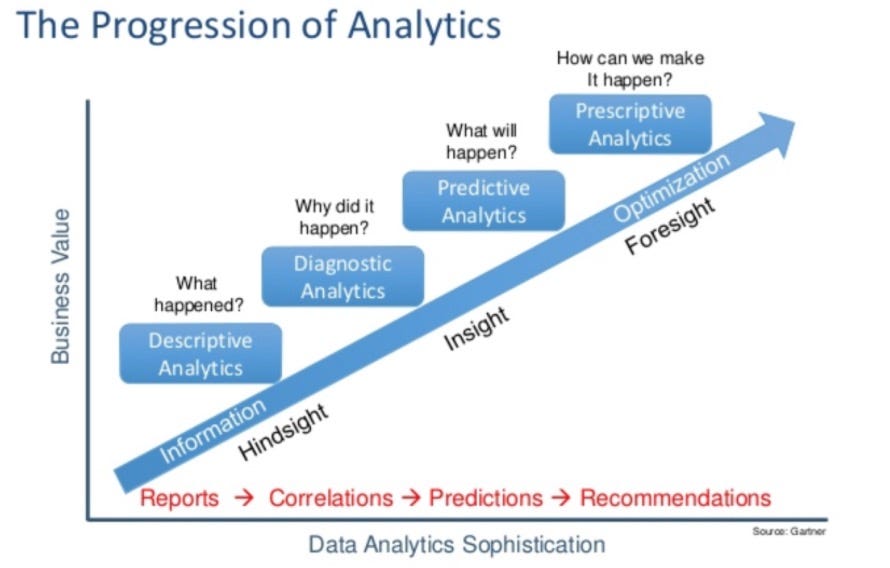
(2) You’ve probably seen this a hundred times, as it’s a common framework to think about the progression of analytics in terms of both business value & degree of difficulty:

So, closeout data is both a lagging indicator and an example of descriptive analytics, the lowest value version of analytics. Closeout data can only tell us what happened – not why it happened or what’s likely to happen next, in time to course correct. 😕

In the absence of real time data around leading indicators, we rely on the combination of lagging indicators and qualitative evaluations. Like when a poultry vet walks into a poultry house and looks at litter conditions as an indication of bird health which is an indicator of how the flock will perform at close out.

But the promise of IoT is that with connected sensors, we can have real time data that enables more effective leading indicators of performance & outcomes.

It’s almost like there are 4 elements to make that promise of IoT hold up:

  1. What relevant data is captured?
  2. How is the data presented? (Think of the OTF scoreboard!)
  3. How does the ‘scoreboard’ change behavior?
  4. What is the value created by the change?

5 Considerations for livestock owners & managers

(1) Behavior change. Because precision livestock tools only create value when they drive a specific decision or set of decisions, these tools should change how we manage and/or what we manage. Full stop.

(And the more specific precision livestock products get about what they solve, the easier it is for decision makers to decide how to deploy the technology. Everything is the enemy of Something.)

(2) Scorecards motivate people. Humans like to see results, evidence of progress. It’s why every single management system in the world talks about the importance of keeping some sort of scorecard in front of people, whether it’s Andy Grove’s OKR system or Franklin Covey’s 4 disciplines of execution. Data turned into leading indicators turned into compelling scorecards can align work to be done & drive progress.

(3) New ways to get it right...or wrong. Incentivize the wrong metrics and you could end up with suboptimal results. Which potential metrics are simply ‘interesting’ and which potential metrics can move the needle on the most important outcomes? Getting really clear about vanity metrics vs useful metrics will be more important than ever.

(4) Linking leading indicators with lagging indicators. Find the leading indicators with Actual Predictive Value of lagging indicators. Not to mention that one segment’s lagging indicators at closeout, might be leading indicators as the product (livestock or meat) moves through the value chain.

(5) Find the right role for qualitative evaluation. I love the idea of human + machines, or qualitative + quantitative, or marrying what the data says and what the well trained human eye detects. Real time data doesn’t mean you don’t need people to manage livestock, obviously. But it should mean that you can allocate those human resources in higher value ways.

Long time Prime Future readers know that I am not interested in tech for the sake of interesting tech – it is always and only about value creation.

We are in the early early days of precision livestock management and aligning the right tech around the right business problems to create compelling value. I’m bullish on animal protein in the long run, and on precision livestock technologies as an enabler of that long run.

“The future is here, it’s just not evenly distributed.”

Share


To catch up on almost 2 years of Prime Future content, here are two available downloads:

Prime Future editions 0 – 81

Get the ebook with editions 0 – 81 🚀

Beef x Dairy: What does this emerging trend mean for the beef industry?

Get the beef-on-dairy ebook 🐄