Categories
Alternative Meat

Prime Future 124: Plant-based meat? We’ll see.

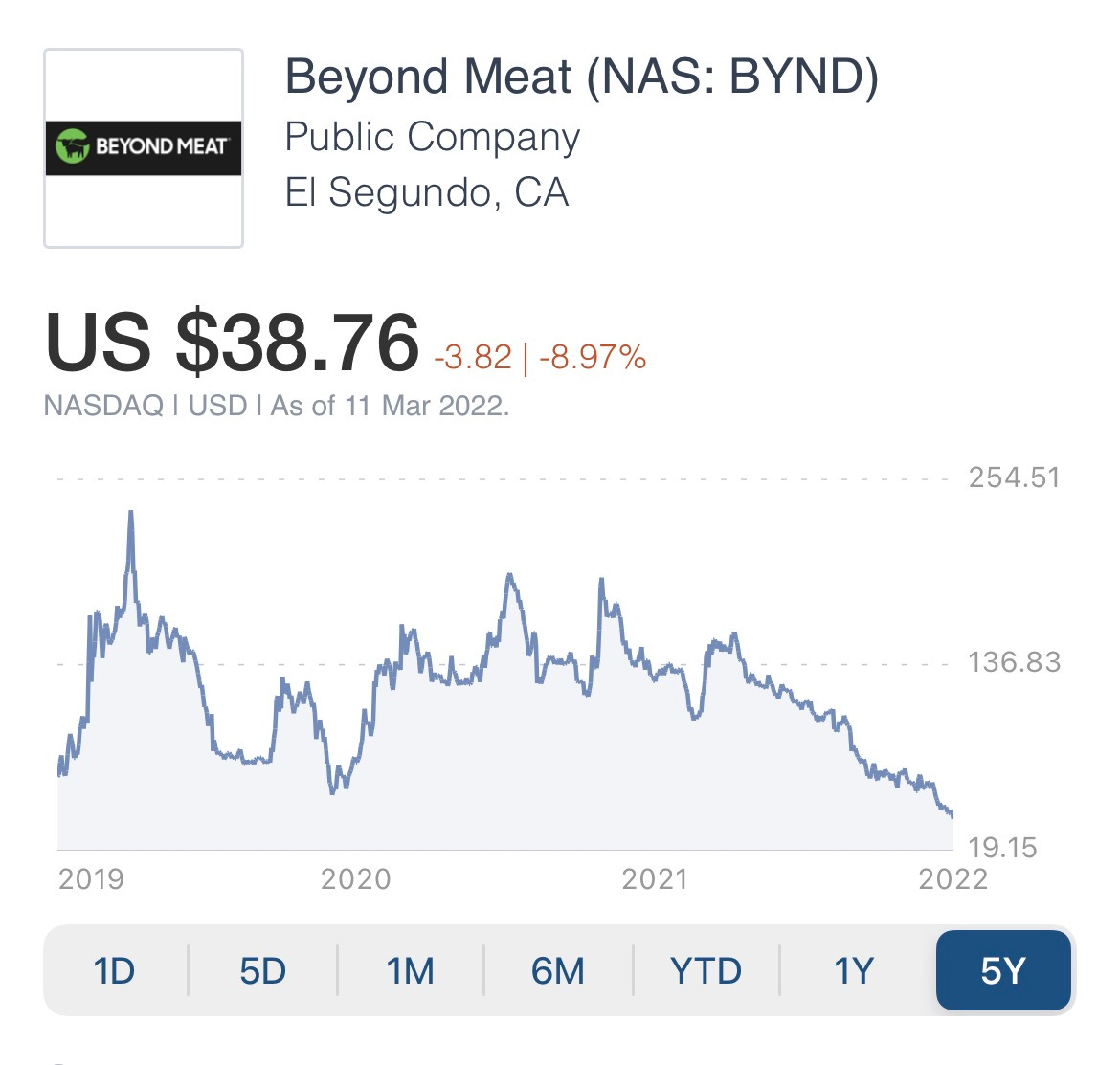
As of this writing, Beyond Meat is trading at $12.63/share down from a 52-week high of $109.76. Absolutely brutal.

Meanwhile, JBS shut down Planterra and McDonald’s scratched plans to roll out the McPlant burger nationally.

Across the meat industry these days, there seems to be a lot of jumping up and down on the anticipated graves of plant-based meat companies, and the entire category.

In March I wrote RIP plant-based meat mania (full text below), an analysis that still largely reflects my POV on the category.

But in spite of those celebrating what looks like the plant-based meat category losing its sizzle, here are 3 things to keep in mind…

1) The hype cycle:

Where is plant-based meat on this chart? Maybe the trough of disillusionment, at least for investors but also a lot of customers & consumers. A question is whether it follows the trajectory here, or continues to fall.

Though perhaps the question is whether plant-based meat even belongs on this chart, was there even an innovation trigger? Or was the entire plant-based meat category boondoggle based on a narrative trigger from some skilled-at-storytelling anti-animal founders dressing up the veggie burger with a whole lotta venture capital?

2) The X factor

Even if plant-based meats have peaked and it’s all downhill from here, there is another X factor that we have no idea how it will impact meat: cell-based meat.

The cell-based meat category has also had massive investment, but companies in that category are largely still working out the technical and scaling risk.

It remains to be seen a) how regulators will deal with cell-based meat, b) how well cell-based meat can compete on taste and texture, c) how well cell-based meat can compete on price, and d) how consumers will respond to it / which markets will be a fit.

3) A Chinese proverb:

A farmer and his son had a beloved stallion who helped the family earn a living. One day, the horse ran away and their neighbors exclaimed, “Your horse ran away, what terrible luck!” The farmer replied, “Maybe so, maybe not. We’ll see.”

A few days later, the horse returned home, leading a few wild mares back to the farm as well. The neighbors shouted out, “Your horse has returned, and brought several horses home with him. What great luck!” The farmer replied, “Maybe so, maybe not. We’ll see.”

Later that week, the farmer’s son was trying to break one of the mares and she threw him to the ground, breaking his leg. The villagers cried, “Your son broke his leg, what terrible luck!” The farmer replied, “Maybe so, maybe not. We’ll see.”

A few weeks later, soldiers from the national army marched through town, recruiting all the able-bodied boys for the army. They did not take the farmer’s son, still recovering from his injury. Friends shouted, “Your boy is spared, what tremendous luck!” To which the farmer replied, “Maybe so, maybe not. We’ll see.”

The moral of this story, is, of course, that no event, in and of itself, can truly be judged as good or bad, lucky or unlucky, fortunate or unfortunate, but that only time will tell the whole story.

All that to say, plant-based meat? We’ll see.


Prime Future 92: RIP plant-based meat mania (link)

I am often asked about my view on alternative meats and the threat they pose to old fashioned, plant-fed meat. I’ve stayed away from that question, for the most part because I’m just more interested in plant-fed meat.

First, it’s important to separate “alternative meat” into 3 distinct buckets: plant-based, fermented, cell-based.

Today we are looking at the plant-based meat category. Spoiler alert: I find the plant-based meat category bland and uninspiring. And honestly, I think we can reasonably lay plant-based meat mania to rest in peace in the history books, right alongside 1990’s emu farming mania in the US.

Some background on VC’s appetite for the category:

“Plant-based meat, egg, and dairy companies received $2.1 billion in investments in 2020 — the most capital raised in any single year in the industry’s history and more than three times the $667 million raised in 2019. Plant-based meat, egg, and dairy companies have raised $4.4 billion in investments in the past decade (2010–2020). Almost half, or $2.1 billion, was raised in 2020 alone. This included Impossible Foods’ record $700 million funding haul.”

In addition to Impossible Foods, the other elephant in the plant-based room is Beyond Meat, which has sent investors on a roller coaster since their 2019 IPO.

Here’s the category update, according to the Wall Street Journal:

“Beyond shares peaked above $234 in mid-2019 after the company’s initial public offering at a price of $25 earlier that year. Shares have fallen since then as meat alternative makers have dealt with pandemic-related challenges and uncertainty around the products’ growth prospects. Beyond’s stock has fallen about 71% in the past 12 months.

Maple Leaf Foods Inc, a Canadian meat company that in 2017 acquired plant-based food maker Lightlife Foods, this week said that an internal company analysis showed that after years of rapid growth, the category had stalled.

“All major brands and products across the category are experiencing similar challenges, which largely seems to be driven by consumers’ experience in terms of taste, price, degree of processing and ease of preparation,” said Curtis Frank, Maple Leaf’s president.”

Womp, womp…

Now layer on 3 dynamics about plant-based meat mania….

(1) Timing – conditions over the last 24 months were all that plant-based meat companies could have hoped for, but it wasn’t enough.

Beyond Meat when public in 2019, then record levels of venture capital flowed into the category in 2020. This was during a time when total money flowing into the venture capital class was exploding, and public markets were frothy.

And, it was at a time when plant-fed meat began selling at record prices in the meat case over the last two years, at times even being unavailable.

And yet, the plant-based meat category appears to have stalled.

(2) Competition is fierce and growing, which will continue pressuring (already negative) margins.

Plant based meat is an increasingly crowded market, including private label brands intent on competing on price, driving down margins of the whole category. If I’m a retail sales exec for a meat packer, I’m looking at this dynamic and thinking ‘welcome to the real world, kids!’

Like with any emerging trend, what matters is not the absolute size of the plant-based category relative to plant-fed meat….what matters is the growth rate.

But if the growth rate is slowing, and more emerging brands are popping up then suddenly the category is crowded and competing on price and suddenly the whole category is much less interesting to investors.

This picture is from the meat case in Safeway. Notice the seeming price differential. In reality, the plant-based burgers are $.749/oz while the prime chuck burgers are $.519/lb. But ignore the price differential, the visual quality cues here are striking, right?

You have to really want plant-based meat to pick up the one on the right; you have to have a compelling why behind that purchase….don’t you?

Especially in a time when plant-fed meat quality is high. As in ~90%-of-US-cattle-grading-choice-or-prime kinda high. That’s really high.

(3) Plant-based meat: it’s still just a veggie burger.

We’ve talked before about the 2 things venture capital has funded for plant-based meat companies are product development and marketing.

The plant-based meat category was not invented by Beyond Meat or Impossible Foods, but it was dressed up & juiced up by venture capital.

What I find most interesting about Beyond’s latest quarter results is that while total revenue was only down 1.2% YoY, retail sales were down 19.5%. Foodservice is the sales channel where Beyond is moving more product YoY. But my hypothesis is that much of the foodservice lift is from QSR chains like Burger King and White Castle trying to get a PR lift.

But the canary in the coal mine is McDonalds, and the test they are running with the oh-so-cleverly named McPlant burger. For 3 reasons:

  1. Menu board space is precious. Items have to earn their spot.
  2. Menu board space is all the more precious now, since the menu has been pared down to simplify operations and decrease wait times amidst labor shortages.
  3. Amidst a pared down menu board, sales have increased. Correlation or causation is hard to say, but it does seem reasonable to think that the hurdle to add something to the menu has been raised.

If McDonalds rolls out plant based burgers on a broad scale beyond the current trial, then my view might change.

Ok that’s a lot of negativity in one article….oops. But now let’s talk about the most important aspect: taste.

I’ve done the obligatory tasting of an Impossible burger and it tasted 97% like mushy cardboard.

But let’s say 90% of my reaction was influenced by my bias towards plant-fed meat. So let’s say the burger actually only tasted 7% like mushy cardboard. Is there really a massively growing market of repeat buyers for something that has even a hint of  a mushy cardboard eating experience? Especially in a time when meat quality is at all time highs.

But actually the obvious risk to my entire analysis is that I’m operating out of a complete bias towards plant-fed meat and it’s cultural, nutritional, environmental, societal, and experiential superiority over plant-based meat. I’m unabashedly bullish on animal protein. So perhaps this entire analysis will be proven laughably wrong over time…

One reason I do not anticipate that to be the case though, is The Lindy Effect:

“the Lindy effect proposes the longer a period something has survived to exist or be used in the present, it is also likely to have a longer remaining life expectancy. Longevity implies a resistance to change, obsolescence or competition and greater odds of continued existence into the future.”

I can’t think of a better example of The Lindy Effect than meat. Humans have been eating meat for a long, long time…that won’t change with marketing splash.

Where are my plant-based bulls?

I’ve lined out the (really) bear case about the plant-based meat category and why the sizzle will fizzle out and the category will continue to be a fixture in the meat case, albeit a shrinking fixture.

And yet, many many folks see the bull case for plant-based. That’s who I want to hear from – if you are a plant-based bull, tell me more about why that is.

What do you see that makes you optimistic the category’s growth rate will return to pre-2021 levels and sustain or even accelerate?

Categories
Alternative Meat

Prime Future 109: Without vision, the people perish.

We’ve talked about reasons the plant-based meat mania party seems to be winding down, but let’s talk about why the party even started, let alone turned into a full blown Great Gatsby style rager.

(RIP, plant-based meat mania.)

I attribute plant-based momentum to the clarity of vision of Pat Brown, founder of Impossible Foods:

“Plant-based products are going to completely replace the animal-based products in the food world within the next 15 years. That’s our mission. That transformation is inevitable.”

We can disagree with the quality of that end game, but we cannot deny that Pat cast a crystal clear vision.

He painted a picture of a future state that he could see; a potential reality that invited people into its journey. His vision created energy; it rallied investors, employees, and early customers.

And that stands out because it feels like an increasingly rare skill. Because it seems like there’s an absolutely stunning lack of leadership in a lot of places right now <gestures vaguely at the world>.

Lack of leadership shows up in government leaders more concerned about winning votes today than the long-term health of an economy, in corporate leaders more concerned about their next promotion than long-term value creation for customers, in community leaders more concerned about gaining power than building a future, in institutions more concerned with survival than executing on their purpose.

Lack of leadership seems to almost always have a selfishness to it, a cowardice about it. Did they not know the right decision to make? Or did they not have the backbone to make the hard decisions? Is it a lack of imagination or a lack of courage?

Most leadership books are trash, IMO; normally when I read about leadership I go to biographies of great leaders. But I’m currently reading the book 15 Commitments of Conscious Leadership – it has some juice to it.

One of the big ideas is to face the world as it is, not as we want it to be:

“As long as we believe that there is a way the world should be and a way the world shouldn’t be, life won’t work according to our beliefs. What if there is no way the world should be? What if the world just shows up the way the world shows up? What if the great opportunity of life isn’t in trying to get the world to be a certain way, but rather in learning from whatever the world gives us? What if curiosity and learning are really the big game, not being right about how things should be?”

The solution proposed by the author is taking radical responsibility. “I am responsible for my circumstances.

We see radical responsibility in every great leader we can name, right? (Should we all just get “I am responsible for my circumstances” tattooed on our right arms?)

I think all of this is why I’m so drawn to the Lunatic Farmers who are casting a vision in their own organizations and bringing those visions to life, because in a world with a dearth of leadership….in what sometimes feels like an industry with a dearth of leadership, Lunatic Farmers are a complete breath of fresh air.

In an industry that does a lot of pearl-clutching and fear-mongering from within, Lunatic Farmers stand out because they’re busy turning that thing everyone else is freaking out about into a new market, a new customer, or a competitive advantage.

Sarah Nolet of Tenacious Ventures made the astute observation that while other industries talk about the futuremuch of agriculture tends to talk about the past. Not that we shouldn’t learn from the past but yikes if that’s where we get stuck instead of looking forward.

Yikes if leaders are talking more about the past than creating a vision for the future.

Without vision, the people look back.

Much of the livestock, meat, and dairy industry needs some inspiration, needs a vision. A vision for a future that is good for, and creates energy for, producers and their customers, all the way to consumers.

And it’s not “thank a farmer / educate consumers” or “feed the world.” That ain’t it.

Without vision, the people perish.

Categories
Alternative Meat

Prime Future 94: Animal protein started it, will plant-based end it?

We recently bid adieu to plant-based meat mania with the (really) bearish case for the plant-based meat category:

(1) Timing – conditions over the last 24 months were all that plant-based meat companies could have hoped for, but it wasn’t enough.

(2) Competition is fierce and growing, which will continue pressuring (already negative) margins.

(3) Plant-based meat: it’s still just a veggie burger.

But the canary in the coal mine is McDonalds, and the test they are running with the oh-so-cleverly named McPlant burger. For 3 reasons:

  1. McDonalds menu board space is precious. Items have to earn their spot.
  2. McDonalds menu board space is all the more precious now, since the menu has been pared down to simplify operations and decrease wait times amidst labor shortages.
  3. Amidst a pared down menu board, sales have increased. Correlation or causation is hard to say, but it does seem reasonable to think that the hurdle to add something to the menu has been raised.

If McDonalds rolls out plant based burgers on a broad scale beyond the current trial, then my view might change.

And with perfect timing for this follow up, speculation about the McDonalds pilot results began popping up this week:

Beyond Meat’s high-profile collaboration with McDonald’s is not meeting expectations, with underwhelming sales of the plant-based McPlant burger triggering concerns from Wall Street analysts.

The downgrade came on the back of a tepid report on the McPlant’s rollout last week by analysts at another investment bank, BTIG, who described the burger’s sales performance as “underwhelming” after examining sales at 600 McDonald’s locations across the Bay Area and Dallas-Fort Worth region. According to BTIG, McDonald’s franchisees reported that “they don’t see enough evidence to support a national rollout [of the McPlant] in the near future”—with its lower sales volumes consequently “slowing down service times, as the product was being cooked to order.”

The analysts noted that while McDonald’s was expecting to sell 40 to 60 of the plant-based patties each day, its locations in the Bay Area and Dallas Fort-Worth were only selling 20 per day. Sales at rural East Texas franchises were even more anemic, numbering between three and five sandwiches per day. While remaining open to the product’s viability in “higher income, urban markets,” BTIG said “a wide-scale launch [of the McPlant] seems a ways off at this point.”

To put this in perspective, McDonald’s sells an estimated 50,000,000 burgers every day in its ~38,000 stores across the world. Let’s make the (incorrect) assumption that sales are equal across all stores, which would mean each store sells ~1,300 burgers per day.

So let’s say the McDonalds pilot stores sell ~1,300 burgers every day and have a target to sell 40-60 plant-based burgers.

And yet, those stores are only moving 20 plant-based burgers per day? (if the article above is accurate)

Yikes. I have a hard time believing the McPlant pilot doesn’t go in the McTrash in the very near future.

Of course McDonalds is not the only path to foodservice growth, so perhaps plant-based companies will find growth in more regional or local chains? Maybe…or maybe McDonalds results really are the canary in the coal mine and the foodservice channel sales growth curve will begin to look eerily similar to the disappointing retail growth curve for plant-based meat: down and to the right.

In my last article, I readily admitted that I’m a skeptic but want to hear more of the bullish case for plant-based meat and why we bears might have it all wrong. What did they have to say?

One of the plant-based bulls responded to my last article on the topic with an astute analysis:

“Plant-based milk is today 15% of total dollar sales of retail milk (source: SPINS/GFI). That tells me that 15% of consumers are willing to go for a plant-based product if it meets their expectations in terms of taste, price, and convenience.

Plant-based meat is just 1.4% of total retail sales (same source). But if these products keep improving — which they are — then they could likely grow to at least 15% of the total market.”

I appreciate this analysis because realistically milk is the best indicator of how plant-based could perform in meat.

But the unknown is IF plant-based meat can meet consumer expectation in terms of taste and price.

That same source referenced above, SPINS, recently said “the U.S. retail plant-based food industry grew 6% in 2021 to $7.4 billion, a slower pace than the year before. In 2020, total U.S. retail plant-based food sales grew 27%, to $7 billion.”

From 27% growth in 2020 to 6% growth in 2021 is not the trajectory you want to see if you are investing in a plant-based future.

SPINS also said, “New retail sales data …. shows that Plant-based meat sales remained steady in 2021, with $1.4 billion in sales. That compares to a growth rate of 45% in 2020.”

Plant-based meat went from a 45% growth rate in 2020 at retail to flat growth in 2021? 😵‍💫

Unless there is a really clear driver that explains those 2021 numbers, and why those numbers are an anomaly not a permanent downward trend, it’s unclear why they would magically bounce back up.

Other plant-based bulls site the need to feed the 9 billion people who will inhabit the planet by 2050, or the rising middle class looking to level up diets as incomes increase. For either of those arguments, cell-based or fermented meat technology seems like the more likely competitive threat to plant-fed meat, not plant-based. But more on that another day….including dissecting the 9 by 2050 holy grail itself. 🤭

Before we wrap up this plant-based discussion, let’s acknowledge how things have come full circle…

The animal protein industry has increasingly relied on absence marketing to differentiate meat, poultry & dairy products at retail. Consumers see labels like hormone-free chickenantibiotic-free meatrBST free milk. This approach is used so often, it almost feels like the only tool in the typical brand manager’s toolkit.

Only now, the toolkit has been hijacked:

This isn’t simply milk raised without xyz, it’s NOT MILK.

There’s an irony in this, isn’t there? Animal protein perfected the game of marketing on absence claims. Now the plant-based category is running the same playbook, and taking it to a whole new level.

NOT MILK – a brand 100% centered around what it is not – seems to be the extreme outcome, the height of decades of absence-based marketing.

On the optimistic hand, perhaps this extreme NOT MILK example means that the pendulum is about to swing back towards products that differentiate based on what they are, instead of what they are not.

I’m 100% here for that pendulum swing.

Bonus: a TikTok on how to make your own oat milk at home. Go nuts.

Categories
AgTech Alternative Meat

Prime Future 92: RIP plant-based meat mania

I am often asked about my view on alternative meats and the threat they pose to old fashioned, plant-fed meat. I’ve stayed away from that question, for the most part because I’m just more interested in plant-fed meat.

First, it’s important to separate “alternative meat” into 3 distinct buckets: plant-based, fermented, cell-based.

Today we are looking at the plant-based meat category. Spoiler alert: I find the plant-based meat category bland and uninspiring. And honestly, I think we can reasonably lay plant-based meat mania to rest in peace in the history books, right alongside 1990’s emu farming mania in the US.

Some background on VC’s appetite for the category:

“Plant-based meat, egg, and dairy companies received $2.1 billion in investments in 2020 — the most capital raised in any single year in the industry’s history and more than three times the $667 million raised in 2019. Plant-based meat, egg, and dairy companies have raised $4.4 billion in investments in the past decade (2010–2020). Almost half, or $2.1 billion, was raised in 2020 alone. This included Impossible Foods’ record $700 million funding haul.”

In addition to Impossible Foods, the other elephant in the plant-based room is Beyond Meat, which has sent investors on a roller coaster since their 2019 IPO.

Here’s the category update, according to the Wall Street Journal:

“Beyond shares peaked above $234 in mid-2019 after the company’s initial public offering at a price of $25 earlier that year. Shares have fallen since then as meat alternative makers have dealt with pandemic-related challenges and uncertainty around the products’ growth prospects. Beyond’s stock has fallen about 71% in the past 12 months.

Maple Leaf Foods Inc, a Canadian meat company that in 2017 acquired plant-based food maker Lightlife Foods, this week said that an internal company analysis showed that after years of rapid growth, the category had stalled.

“All major brands and products across the category are experiencing similar challenges, which largely seems to be driven by consumers’ experience in terms of taste, price, degree of processing and ease of preparation, said Curtis Frank, Maple Leaf’s president.”

Womp, womp…

Now layer on 3 dynamics about plant-based meat mania….

(1) Timing – conditions over the last 24 months were all that plant-based meat companies could have hoped for, but it wasn’t enough.

Beyond Meat when public in 2019, then record levels of venture capital flowed into the category in 2020. This was during a time when total money flowing into the venture capital class was exploding, and public markets were frothy.

And, it was at a time when plant-fed meat began selling at record prices in the meat case over the last two years, at times even being unavailable.

And yet, the plant-based meat category appears to have stalled.

(2) Competition is fierce and growing, which will continue pressuring (already negative) margins.

Plant based meat is an increasingly crowded market, including private label brands intent on competing on price, driving down margins of the whole category. If I’m a retail sales exec for a meat packer, I’m looking at this dynamic and thinking ‘welcome to the real world, kids!’

Like with any emerging trend, what matters is not the absolute size of the plant-based category relative to plant-fed meat….what matters is the growth rate.

But if the growth rate is slowing, and more emerging brands are popping up then suddenly the category is crowded and competing on price and suddenly the whole category is much less interesting to investors.

This picture is from the meat case in Safeway. Notice the seeming price differential. In reality, the plant-based burgers are $.749/oz while the prime chuck burgers are $.519/lb. But ignore the price differential, the visual quality cues here are striking, right?

You have to really want plant-based meat to pick up the one on the right; you have to have a compelling why behind that purchase….don’t you?

Especially in a time when plant-fed meat quality is high. As in ~90%-of-US-cattle-grading-choice-or-prime kinda high. That’s really high.

(3) Plant-based meat: it’s still just a veggie burger.

We’ve talked before about the 2 things venture capital has funded for plant-based meat companies are product development and marketing.

The plant-based meat category was not invented by Beyond Meat or Impossible Foods, but it was dressed up & juiced up by venture capital.

What I find most interesting about Beyond’s latest quarter results is that while total revenue was only down 1.2% YoY, retail sales were down 19.5%. Foodservice is the sales channel where Beyond is moving more product YoY. But my hypothesis is that much of the foodservice lift is from QSR chains like Burger King and White Castle trying to get a PR lift.

But the canary in the coal mine is McDonalds, and the test they are running with the oh-so-cleverly named McPlant burger. For 3 reasons:

  1. Menu board space is precious. Items have to earn their spot.
  2. Menu board space is all the more precious now, since the menu has been pared down to simplify operations and decrease wait times amidst labor shortages.
  3. Amidst a pared down menu board, sales have increased. Correlation or causation is hard to say, but it does seem reasonable to think that the hurdle to add something to the menu has been raised.

If McDonalds rolls out plant based burgers on a broad scale beyond the current trial, then my view might change.

Ok that’s a lot of negativity in one article….oops. But now let’s talk about the most important aspect: taste.

I’ve done the obligatory tasting of an Impossible burger and it tasted 97% like mushy cardboard.

But let’s say 90% of my reaction was influenced by my bias towards plant-fed meat. So let’s say the burger actually only tasted 7% like mushy cardboard. Is there really a massively growing market of repeat buyers for something that has even a hint of  a mushy cardboard eating experience? Especially in a time when meat quality is at all time highs.

But actually the obvious risk to my entire analysis is that I’m operating out of a complete bias towards plant-fed meat and it’s cultural, nutritional, environmental, societal, and experiential superiority over plant-based meat. I’m unabashedly bullish on animal protein. So perhaps this entire analysis will be proven laughably wrong over time…

One reason I do not anticipate that to be the case though, is The Lindy Effect:

“the Lindy effect proposes the longer a period something has survived to exist or be used in the present, it is also likely to have a longer remaining life expectancy. Longevity implies a resistance to change, obsolescence or competition and greater odds of continued existence into the future.”

I can’t think of a better example of The Lindy Effect than meat. Humans have been eating meat for a long, long time…that won’t change with marketing splash.

Where are my plant-based bulls?

I’ve lined out the (really) bear case about the plant-based meat category and why the sizzle will fizzle out and the category will continue to be a fixture in the meat case, albeit a shrinking fixture.

And yet, many many folks see the bull case for plant-based. That’s who I want to hear from – if you are a plant-based bull, tell me more about why that is.

What do you see that makes you optimistic the category’s growth rate will return to pre-2021 levels and sustain or even accelerate?