Categories
Animal AgTech Processing

Tyson’s Moonshot Part 2: Three ways the largest meat company could morph into a tech company.

Tyson recently announced their next CEO and there’s only one way that decision makes sense: Tyson intends to be a tech company.

The natural next questions are, why & how would Tyson do this?  

To answer the Why, follow the margin.

Here’s a snapshot of Tyson’s FY Q3 margins across business lines for 2020 vs 2019 from the latest earnings report. Clearly 2020 represents the COVID anomaly, but 2019 is representative of “normal” times.

Takeaway: a good margin target for fresh meat is 5% while further processed should merit 10% margin. With 20% of its business in higher margin further processing, the Hillshire, AdvancedPierre, and several other acquistions over the last 6 years are meaningful to Tyson profitability. Meanwhile Tyson’s competitors are slowly increasing their value added business but largely fighting for that 3-8% margin on fresh meat. 

Contrast even the ‘high’ margins of value added with software margin targets ~80+% and hardware margin targets ~50+%. While hardware margins may not be attractive to software investors, when compared against those 5% fresh meat targets, well, they look pretty good.

There’s a compelling case for a commodity company to chase the higher margins of technology.

Now let’s shift to the 3 possible definitions for “become a tech company”:

  1. Tech as a revenue generating business line. Its own business unit, P&L, staff, etc.
  2. Tech as a core business enabler. Labor represents 50-60% of processing costs. Let’s say Tyson can reduce labor costs by 50% by deploying more robotics in the plant. Apply that reduction across the 45M chickens, 155k cattle, 461k hogs that Tyson processes weekly….

Here’s some (really) crude math around these two paths so before you say that my numbers are wrong, I know. These are wild assumptions for illustrative purposes only to show the (very) rough potential impact on Tyson’s bottom line.
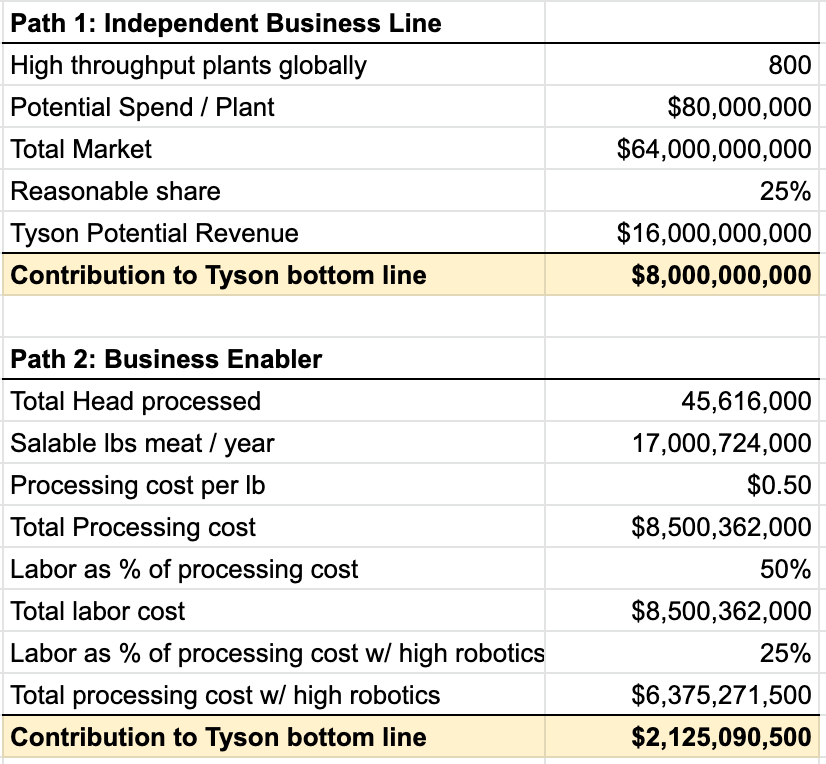
Tyson generated $3.9B EBITDA in 2019 so even if we cut the numbers above in half, these 2 paths represent potential EBITDA growth ranging from 20% – 200%. ??

Now here’s the catch: hardware is difficult. Really difficult. That’s why most VC’s turn and run the second they hear the word ‘hardware’. But if you can navigate the financial & execution challenges of hardware, the light at the end of that tunnel is incorporating software with its oh-so-attractive 80-90% margins. Could Tyson pull that off? Perhaps. 

The beauty of hardware is that not only can it improve efficiency of a task, it naturally lends itself to data collection. But what does one do with copious amounts of newly collected data? This is where software gets deployed: to capture, distribute, and analyze the data to derive high value insights. It’s a virtuous cycle, and the hardest part is the hardware. If Tyson can crack the hardware code, the software can (relatively) easily be layered on and the flywheel prints the money.  Beautiful.

Which leads to the 3rd path, The Hybrid. The hybrid of the two paths laid out above is Tyson beginning by deploying its own robotics to improve its cost structure in the processing plant, and then also selling the technology to competitors.

But there are a lot of questions as to the viability of the hybrid path given the competitive nature of the industry.  Would the Cargills of the world be willing to purchase plant robotics from Tyson that can capture data, and software to analyze that data? Would the Justice Department allow them to do so? I’m skeptical on both accounts.

The rough math indicates this aggressive tech-centric strategy has potential to grow both top line sales and bottom line profit while also mitigating risk for future labor threats like pandemics. 

In the first 6 months of COVID-19, Tyson spent $340 million on various measures to protect employees. So a risk mitigation strategy probably sounds good to the Tyson board right about now.

Now that we’ve uncovered the compelling Why and 3 possible How’s to Tyson’s tech strategy, let’s acknowledge the extremely real challenges of redirecting a behemoth like Tyson Foods: the cultural challenges, the technical challenges, the industry challenge, the subject matter expertise challenge, and many more. It will require an absolute Herculean effort if Tyson is to get anywhere close to successful with this transformation.

When I wrote the initial analysis of the Dean Banks selection for CEO, I was honestly feeling pretty bearish on Tyson Foods. But after doing the above analysis, I may hold on to my stock….just in case Tyson’s quasi-ridiculous bet-the-farm strategy pays off.


Processing…
Success! You're on the list.

Categories
Animal AgTech Processing

Tyson’s Moonshot: what the new CEO’s resume really tells us about the future of Tyson Foods

This week Tyson Foods named Dean Banks as its next Chief Executive Officer.

Dean Banks was named president of Tyson Foods last December, but the media references his experience as a “ tech executive” and his time at Alphabet. Curious about this experience, I went to his LinkedIn profile.  

Was he a C-level executive at Alphabet? Division President?

At Alphabet’s X (Moonshot Factory) he was, umm, a Project Lead. Oh. 

According to LinkedIn, beyond his project management experience, he’s done some consulting, some angel investing. His CEO experience includes a brief stint at what appears to be <50 person company and an even shorter stint at a company with <10 employees. The assumption that he’s probably managed a maximum of $50 million P&L is likely generous.

Meanwhile Tyson Foods employees 122,000 people across the globe to generate ~$40 Billion in annual revenue.

Unless I’m missing something, this guy has the perfect pedigree to be a partner in a venture fund, run a scaling startup, or lead a newly created tech division of Tyson Foods.

It is not obvious from his resume that he is capable of being the CEO of a company of this size, scale, and complexity. 

Tyson Foods is the opposite of Alphabet & its Moonshot Factory in almost every way.

Moonshot Factory makes long term plays that may not deliver results for years or even decades. (its in the name…moonshot)

Tyson Foods faces the earnings music with Wall Street every quarter.

Moonshot Factory is funded by Alphabet, a $1.02 Trillion market cap company with $18 Billion cash on hand. 

Tyson Foods is a low margin, commodity business clawing its way to higher value through further processing, product innovation, and branding. This is a ‘grind it out and strengthen your balance sheet to prepare for the inevitable lean times that come with a volatile, cyclical industry’ kinda business. This is ‘hope that you are diversified sufficiently across proteins, sales channels, regions of the world to weather a black swan better than your competitors’. 

But, there is one scenario under which this stretchiest of stretch hires makes sense: 

Tyson doesn’t want to be a user of tech and a customer of tech companies. 

Tyson doesn’t want to be an early adopter of solutions created by tech companies.

Tyson Foods intends to be a tech company.

Tyson’s biggest problem is labor, specifically plant labor. This has been their biggest problem for some time, and COVID shined the spot light on the many risks associated with labor intensive processing including access to labor, contingency plans when labor is unavailable, health & safety, and liability. Labor represents 50-60% of processing costs, a huge opportunity to drive margin by reducing these costs.

Equipment suppliers were not solving Tyson’s biggest problem in a timely manner, so Tyson Foods is taking matters into its own hands.

Over the past three years, Tyson has invested about $500 million in technology and automation including the Tyson Manufacturing Automation Center opened in 2019. Banks’ work at Moonshot Factory was in automation and robotics. Rumor has it they’ve brought in similar profiles from General Motors and similar companies.

Hiring people with tech/automation pedigrees raises the question, what’s the internal mandate as it relates to plant automation??

Is it, reduce processing costs by x% to improve competitive position? Or  is it, reduce processing costs by x% and generate $y revenue in automation solutions such that tech becomes the growth business? 

If it were merely a competitive advantage play, Banks would have been made head of the tech division. So it must be a bigger play in which Tyson leverages its knowledge of problems to be solved with the leadership expertise to bring about new products and an entirely new business direction.

Perhaps even a new business model for Tyson Foods. 

Does Tyson Foods start selling plant robots to competitors or do they launch a Processing-As-A-Service business? Maybe they launch the processing plant equivalent of a Ghost Kitchen in which they effectively become a contract processor for other companies because their costs are 30-50% lower? That might be bit outrageous, but you get the idea – this initiative must be central to the very fabric of Tyson Foods in order to make Banks CEO of the entire company.

In 5 years, what % of Tyson Foods revenue will come from technology sales?

How will this impact operations? 

How will this impact returns?

How will this impact culture?   

How will this impact Tyson’s venture activity?

So many questions & only time will tell.

What a company says about their future is mildly interesting, the tell is in who they hire. And the largest meat company in the world just hired an automation tech project manager as their next CEO. Which can only mean 1 thing:

Tyson is betting the farm on its future as a tech company.

Processing…
Success! You're on the list.


Categories
Animal AgTech

A silver lining: how COVID could spark a fire in animal ag

Set aside the immediate pain in animal ag caused by COVID, and let’s talk about the silver lining of how post-COVID trends could mean great things for animal agtech, based on two assumptions about the world:

  • More people will work remotely
  • Tech adoption will continue to increase

Proximity. Tech giants like Twitter and Facebook are giving employees the option to be remote forever. Instead of an engineer making 180k and paying $3k/month for a studio apartment in San Francisco, that engineer can move to Denver or Kansas City or even smaller towns and do the same work remotely while lowering cost of living dramatically and, in some cases, maintaining their earning level. As evidence this is actually happening a mere 3 months into the pandemic, 1 bedroom rentals in San Francisco are down 10%. The exodus from urban centers like SF & NYC has begun. 

This likely means engineering talent will be closer to people who know animal agriculture. 

This likely means entrepreneurial talent will be closer to people in animal ag.

This likely means people solving problems will be closer to people who need problems solved. 

Which can only mean good things for the quality of solutions and rate of adoption.

Proximity means access to more prospective customers so entrepreneurs can avoid the “n of 1” problem, of building a solution for 1 customer that isn’t representative of the many. (A lot of folks attribute slow adoption in crop farming to the early assumptions made by entrepreneurs that all farmers are alike and all production systems are alike…a fatally flawed assumption.)

Proximity means the ability to actually get on farms, to gain direct visibility to the practical constraints of how a solution fits into a production system and a producer’s decision making process

Farmer Adoption. Satya Nadella, CEO of Microsoft, recently said “As COVID-19 impacts every aspect of work and life globally, Microsoft has seen two years’ worth of digital transformation in just two months.”

For example, many producers are getting a taste of new-to-them consumer technologies. The farmer who had never used Zoom just spent the last 12 weeks on Zoom for his/her Bible Study. Or the producer who always scoffed at urbanites ordering groceries online learned how to snag an elusive time slot for grocery pickup on Walmart’s website. Or they joined a Slack channel to access market intel from their risk management advisor. 

With tech merging into the heartland and producers increasingly using technology, this sets up a perfect storm. I really hate COVID-19 and its destruction, but these resulting trends should lead to good outcomes & new solutions in animal agriculture.

Processing…
Success! You're on the list.
Categories
Animal AgTech

What Lewis & Clark teach us about Expeditions & Startups

To find “the most direct and practicable water communication across this continent, for the purposes of commerce.” That was the mission of the grand expedition taken by Captains Meriwether Lewis & Wiliam Clark to explore the newly acquired land in the Louisiana Purchase in 1804. The expedition travelled two years and eight thousand miles through a land largely uncharted by citizens of the newly formed United States. They interacted with previously unknown Indian tribes, identified new plant and animal species, and can you even imagine the wonder of seeing the Rockies but then having to describe the majestic view with words only? 

I’ve recently been on a road trip through Idaho, Wyoming & Montana. All areas with rugged mountains, roaring rivers, and truly breathtaking views. I’m not doing the exact route of Lewis & Clark but trust me, I’m paying my respects to their expedition and the Native Americans who enabled them to make a successful journey. But let’s face it, “exploring” from the safety of my Ford Escape on a paved road with A/C and Spotify is hardly the same as getting in a canoe and pushing off the bank hoping that you’ll find enough bison to get the expedition through the winter or that the river runs where you hope it runs. But still, its exploration of its own kind.

Similarly, all startups are – by definition – an exploration, an exploration for the right product, the right business model, the right pricing model, the right market. In my mind there are two types of startups:

  1. The Navigating-the-Rockies-for-the-first-time kind
  2. The Off-the-beaten-path-but-navigating-with-Google-maps kind

In the first version you are creating the map as you go in every sense, while the second one has well defined routes but requires a navigator with the appetite to explore and good judgement to navigate the unexpected.

Let me be clear, both are valid. Not all innovation has to be groundbreaking. Not every startup has to have a mission to change the world. Farm management software, for example, is a very useful tool for producers to help them manage their business. Yet 20 years ago Salesforce created the pay-as-you-go business model, what we call SaaS, so farm management software providers have a business model playbook to run. It’s “simply” a matter of identifying the right use cases, workflows, etc. (Caveat: that wasn’t true several years ago, like when the Millers were developing CattleSoft. They were pioneering.)

A manager of a large feed yard recently told me that the worst consumer apps still represent better technology than software being marketed to feed yards. Meaning, there’s still room in this market. Or, launching a digital marketplace – might be needed in a market, but its a known technology and there’s a relatively known playbook to do so. 

Meanwhile startups like GoTerra (waste management via flies) or P&P Optica (sophisticated imaging for meat plants) are bringing breakthroughs to market. 

We’ll soon start looking at specific categories within animal protein value chains, and the innovation happening within those categories. I’ve been thinking about how to break down the big problems and below is my first attempt, but any framework has to establish producer profitability and consumer satisfaction as two equally important pillars. 

Value chain Profitability 

  • Live performance. Animal health, nutrition, genetics. Alternatives to antibiotics.
  • Precision health / Precision nutrition. Managing health & nutrition at granular levels. Improved feedback loops.
  • Labor / automation. Access to reliable labor sources. Access to automation alternatives where appropriate.
  • Channel diversification. If COVID has taught us anything it’s that diversification matters for producers & processors.
  • Market transparency. Price discovery. Improved workflows for transactions.

Customer satisfaction

  • Environmental footprint. Reducing GHG & the carbon footprint of livestock production. Waste management.
  • Quality. Product innovation – cuts, packaging, etc. Animal health, nutrition, genetics.
  • Food safety 
  • Channel diversification. If COVID has taught us anything its that diversification matters for consumers, e.g. consumers want options to buy how and when they want.
  • Price – speed – quality. The Harvard Business School model said that you could differentiate on up to 2 factors among price, speed, quality. Today’s consumers want all 3.

There are a lot of problems in search of solutions, and a lot of technology in search of problems. Some are version 1 startups, some are version 2. I’m excited to dig in and identify startups of each type that are creating value in animal protein. 

What are some interesting startups working throughout animal agriculture in any of these areas, or related? Send the names my way!

Processing…
Success! You're on the list.

Categories
Animal Health

It’s Zoetis’ (digital) world, we’re just living in it

ICYMI, Zoetis recently acquired Performance Livestock Analytics, an analytics software for small to midsize feed yards. Today we’ll look at 2 elements:

  1. The venture funds that backed the company early, one in particular with a fantastic investment thesis around animal ag.
  2. Zoetis’ digital strategy that drove the acquisition, including the $140M valuation (according to AgFunder).   

“In April, Zoetis acquired Performance Livestock Analytics, a technology company that simplifies data and analytics for the livestock industry. This acquisition will help Zoetis to accelerate progress in precision livestock farming and improve sustainability of producers’ operations.” 

Here we go  ?

The VC’s Behind Performance Livestock Analytics

According to Crunchbase, PLA raised $3.3M from Cavallo Ventures, the venture arm of Wilbur Ellis, and Builders VC. Interestingly, Builders VC has created an entire thesis around investing in livestock.

“While Silicon Valley technologists search for the science-crafted animal replacements to address the world’s growing need for protein, they are ignoring the most impactful solution – bringing efficiency, process, and basic analytics to the existing $1.7 trillion industry.”

Yes!!! This is a critical point that gets overlooked by VC’s and entrepreneurs in search of the next big opportunity in row crops or alt meats. Furthermore…

“Beef and livestock have never been considered “sexy” industries, especially for VC firms focused on the next big thing. However, these are massive, core industries. As the global protein supply is strained, the potential for long-term growth through sustainable, technology-driven solutions creates tremendous opportunities as global protein supply is strained. As with most antiquated industries, IT and biotech contain untapped benefits for these sectors. Entrepreneurs will be a critical part of fixing these laggard industries through technology. What problem could be more important than feeding the world?”

Now it gets interesting with the explanation of the PLA investment and the problem being solved:

“Many small and medium sized feedyards are struggling with negative gross margins and high variability year to year. Performance Livestock Analytics helps these feedlots better manage their operations. Their technology allows farmers to see daily performance and farm profitability, something previously only calculated at bi-annual reconciliations. Using bluetooth scale devices, a mobile data platform, and real-time feed prices, they allow feedyards to make data-driven decisions. This is crucial at a time when overall profitability is declining.”

A feedyard manager recently said “the worst apps in the real world are better than what we have for use in livestock”, which validates this:

“Whether solutions are to be found in operations technology, or in genetic improvement, there is a lot of potential growth in the livestock industry. While other industries readily adopted IoT years ago, only now can we see feedyards do the same. Technology is just beginning to penetrate this sector, with incredible potential for higher yields, growth optimization, and improvements in animal health.”

This next point is one I wrote about recently, “Can Robots Save the Meat Industry”?

“The food production industry now has at least two incentives to invest in non-human mechanization. Mechanization, via the reduced dependence on human labor, reduces the exposure to human pandemics. Mechanization is risk mitigation not just for the private businesses, but for governments as well. Ultimately, restricted production because of human labor hurdles will cause beef prices to rise. Higher prices will create the incentives for investments in production technologies.”

More on their portfolio companies & problems to be solved:

  1. “Another issue is the efficiency of cow-calf operations. Often they do not focus on efficiency because cattle are not a substantial portion of income. However, Agriwebb is changing this. They have created farm management software that increases the efficiency of cow-calf operations and enables animal traceability. Resources are allocated more efficiently, and grazing becomes more effective. Agriwebb matches business goals with operational metrics.
  2. On the biotech side, a lot can be done to create superior cattle. Ascus Biosciences utilizes a platform for microbial discovery to identify naturally occurring bacteria that increase nutrient uptake and overall health. Their technology has increased the milk fat concentration by 10% in dairy cows, and has demonstrated decreased mortality rates for other animals such as chicken. 
  3. Finally, beef is only one area of potential technology impact. Swine, dairy, poultry, and aquaculture all stand to benefit from increased efficiency. For example, Soma Detect is a company using spectroscopy to directly monitor dairy milk quality and the health of an animal at the stall. Their technology can monitor diseases before they are visible to the rancher, helping to decrease the use of antibiotics, and creating healthier animals.“

I couldn’t agree more with this thesis and the most compelling dynamic is that much of this thesis can be extrapolated to dairy, poultry, and swine. 


The Acquisition Strategy (Zoetis)

CEO Kristin Peck highlighted the company’s digital strategy in her recent letter to shareholders. This is a company that believes every company of the future must be a technology company, even animal health companies.

Zoetis has identified key future value drivers and built an acquisition strategy to enable the digital offering that their customers expect. This is not haphazard, it’s a clear vision to “skate where the puck is heading” which could make it hard for their competitors to catch up and compete along this digital dimension. And “this digital dimension” should not be viewed as a small silo, but as an enabler of their core portfolio and future portfolio.

“Leading in digital and data analytics” is one of the company’s strategic objectives. The following is an explanation of how they will achieve it and why it matters.

“At the same time, the profile of our customers is changing as well established practices and producers are consolidating, and as new distribution channels and e-commerce players become more prevalent. As these trends shape the future of animal health, our customers’ successes and competitive advantages will depend increasingly on a partner who brings them comprehensive solutions and choices to predict, prevent, detect and treat disease for their animals—an approach we call the continuum of care. To that end, areas like diagnostics, genetics, precision livestock farming, nutrition, digital and data analytics will all be increasingly important to our customers over the next decade.”

This context aligns pre-COVID trends in the macro-environment with trends in the farm economy, all of which are accelerated by COVID.

“As new distribution channels and e-commerce create more avenues for selling Zoetis products, we are working to further improve our engagement with customers while also making it easier for them to do business with us. This includes selling more products through e-retail sites while ensuring that our veterinary customers can still offer our products at competitive prices. More than ever, our customers are relying on technology including smartphones, servers and tablets— and the data they produce— to run their operations. At the same time, they’re using these tools to detect and treat sick animals; pursue more sustainable practices; monitor pet health; and provide virtual veterinary consultations in rural areas. To address this trend, Zoetis is investing in digital and data capabilities in the following ways: 

  • Expanding our portfolio with new digital products and digitally connected solutions like our Smartbow® digital ear tag technology for cows and our poultry biodevices that can help automate hatchery operations.
  • Delivering the best customer experiences through greater personalization, relevance and consistency based on new, cloudbased marketing software that generates data insights to better understand our customers’ needs.
  • Reaching new customers through digital channels that complement our direct touchpoints—such as our U.S. Petcare Rewards program, which gives pet owners credits they can use for products and services at their vet clinics. 

And the punchline that positions this capability as a core business capability:

“At the same time, we know that digital tools must be a core part of how we operate our own business to drive. The future of animal health will depend on integrating many different solutions and technologies to help producers and veterinarians make early and accurate decisions to prevent disease, and deliver targeted, effective treatment. …by integrating our products and solutions in a way that truly advances animal health, we will help our customers achieve better results…”

You can see why startups like PLA fit into the future Zoetis is creating. So with a string of acquisitions under their belt to enable this strategy, who are the next acquisition targets Zoetis might pursue? 

  • Smart tag companies targeting beef cattle and/or smart scale companies for feed yards, swine or poultry houses
  • Companies using computer vision for animal recognition and detection of key on farm measures
  • Data analytics companies like Data Robot that simplify forecasting and AI

One of the most interesting ideas wrapped up in their strategy is the pet insurance offering. The next iteration of Marc Andreesen’s 2011 “software is eating the world” is the idea that every company eventually becomes a FinTech (financial technology) company. As Zoetis builds its data capability, could it be poised to offer some intriguing FinTech products across the food animal space….perhaps even compete with financial institutions like RaboBank? It’s far fetched but, in short, yes.

Processing…
Success! You're on the list.

Categories
Uncategorized

5 Ways Land Grants can triumph in the post-COVID agriculture industry

The world is moving fast. Universities seem to move…less fast.


With universities making plans for education delivery in the upcoming academic year, it raises some interesting questions about enrollment, revenue, and sustainability of the current model. 

The question for universities is not how they will serve students this fall. It’s how they will serve their purpose in 5 years. To be frank, will they serve their purpose in 5 years?

Because of their historical importance to the agriculture industry in educating workforce and conducting research, I’m most interested in the future of land grant institutions. I hold degrees from two land grant schools (University of Arizona and Texas A&M) so I’m a product of the system signed into law by President Lincoln in 1862, and a big fan.

But I’m also an advocate that the system needs to change, to evolve alongside the industry and its consumers. Or risk slipping into the oblivion of irrelevance while drowning in bureaucracy.

We in agriculture love to talk about how important agriculture is because “people have to eat”, a self-congratulating notion that the world cannot do without us. Although it is a given that people must eat, it is not a given that people must eat food produced by the current formation of the agriculture industry. The “people have to eat” crowd typically use this to justify the status quo instead of looking at how their customers’s expectations are evolving. As a corollary, I suspect inside the halls of many universities there is some “people have to learn” mentality. <steps off soapbox>


But if you are reading this, chances are you agree that everything about the agriculture industry looks & operates & feels wildly different than it did in 1862 when land grant institutions were established, and that the rate of change is accelerating…resulting in a growing disconnect between universities and the “real world”. You already know the statistics about agtech startup funding & how digital and other technologies are moving into every aspect of the industry. You know that status quo in education is not an option for universities.


Caveat: Of course this loving critique applies in varying degrees to different universities, colleges of ag, departments within a college, etc. And of course I expect multiple Purdue grads to reference Mitch Daniels leadership & results to point to a shining antithesis to my critique, rightfully so.

Why does it matter if colleges of agriculture are maintaining status quo while the industry and consumers rapidly shift?

Let’s play this out in slightly exaggerated fashion:

  • Colleges of Ag move classes move online this fall because of COVID-19. More students realize they can access a similar quality of information in cheaper ways through online learning options. Enrollment drops, revenue drops. 
  • Meanwhile more employers start looking for hustle and skills instead of a piece of paper.  Enrollment drops, revenue drops. 
  • The education offered drifts further from what the marketplace actually needs. Enrollment drops, revenue drops.

Setting aside pressure from COVID-19, new education models like Lambda School are popping up that are designed to reduce  the student’s financial burden while accelerating measurable & marketable skills that deliver a strong ROI to students. Lambda School offers a software programming education, but what happens when that model is applied to meat science or crop science?

Pressure will pile up on traditional education paths in a hurry. But the downward spiral does not have to be! COVID-19 could be the positive catalyst that set land grant universities on a trajectory to play a starring role in shaping the future of the industry. 


Here are 5 ways to increase relevance of land grant schools to industry:

  1. Bridge industry and academia. Create alignment between the most pressing questions being asked in and of the industry and what’s being researched at universities.  Although land grants were started to promote “the liberal and practical education”, many have become increasingly disconnected from the practicalities of the industry. 
  2. Commercialization alignment. I know the c-word violates the academic purist’s sensibilities. And I concede that independent research has merit, but perhaps there is a middle ground that necessarily pulls academic research back to the practical center where more research has commercial applications and influence in the industry. Perhaps its become a little bit too independent in recent decades and lacks the practical perspective. Some land grants now have dedicated roles created to have a point person who can facilitate and bridge the gap between those who might commercialize new technologies and those doing the discovering. And yet, we all know that there is no greater bureaucracy than a university. I know of ONE startup that successfully pulled technology out of a university setting in order to commercialize. I know of a lot of people that have tried, but gave up because well, The Bureaucracy. 
  3. Incorporate tech & entrepreneurship, make it as critical as Ag Econ 101. Texas A&M University and University of Nebraska-Lincoln are doing an exceptional job of fostering entrepreneurship in agriculture through their startup centers. We need more of this. Interestingly, Wayne Farms just announced partnerships with community colleges in Alabama “to develop an apprenticeship program to prepare students for careers in an industry that is advancing technologically and increasingly competing for skilled labor”. Given the $300M investments they recently made in automation for processing plants, their work force needs are changing rapidly. Isn’t that a role we want colleges of ag to fill? To send agronomists, ag educators, meat scientists out in the world without exposure to technology & entrepreneurship is to woefully under-prepare for the future. 
  4. Build meaningful recruitment bridges. The land grants in the midwest do an exceptional job of facilitating relationships between top employers and top students. The rest could handle some improvement in this area. In a world that is largely remote, land grant schools need to think about building recruitment connectivity outside of a regional geography. This is a huge opportunity especially for schools outside of the midwest! What is the new model to connect students with global companies? What is the new model that will allow small startups to work with universities to tap talent without the time suck of interfacing with The Bureaucracy?
  5. Alumni networks that work. Many universities tout their alumni network as a compelling reason to attend, yet  few universities have an alumni network that can meaningfully move the needle, largely because the network isn’t fostered at a high level. We always say it’s a small world in the ag industry, how do we leverage that fact alongside university networks? How can alumni networks help technologists access commercial co-founders, and vice versa? 

Let me repeat, I offer this critique of the current state and ideas for the future state precisely because I believe in the power and potential of education & research to advance the industry. Land grants are one of the American ag industry’s secret super power…if channeled effectively.

Meanwhile the increasing expectation of every organization (private or public) is higher value, lower cost.  

What high value, high impact roles would you like to see colleges of agriculture play in the future?

Processing…
Success! You're on the list.
Categories
Animal AgTech

Why?

10 weeks into writing the weekly Prime Future newsletter, I’ve been  wrestling with the where-are-we-going-with-this questions like, who am I really writing for and why?

The bleeding-edge livestock producer?

The soon-to-be founder?

The seasoned entrepreneur?

The investor considering the space?

The biz dev lead sourcing M&A targets?

For the last 3 months I’ve been quarantining at the farm where I grew up, working from the farm office. In addition to bass fish, (the perfect Zoom frame) on the walls are plaques for award-winning corn yields in 1984, my grandparents, and in 1949, my great-grandparents. There’s a 1964 announcement as my granddad began to sell a brand new financial product: crop-hail insurance. There’s a 1946 photo of my granddad and his brothers showing pigs at the Fort Worth Stock Show. In the last 3 months we’ve talked a lot about the stories of resilience in the face of hard times….not surprisingly, most of those stories involve the cattle market!

As I sit in this office thinking about what animal protein value chains could look like in 10 or 20 years, while surrounded by a family history of people who’ve built a life and a living raising livestock while building families and communities, I’m reminded how personal this is.

Agriculture is deeply personal. It’s personal for producers and for consumers.

And it’s a business. A business that has changed dramatically over the last 50 years, especially the last 10. Consolidation, volatile markets, changing consumer preference, increasing global demand, and more. An industry comparable in value to plant agriculture – highly valuable yet largely ignored by tech.

My desire to shape the future of animal agriculture stems directly from my desire to insure there *IS* a future of animal agriculture. 

…as someone who grew up on a farm.

…as someone who loves growth businesses and trajectory changing ideas.

….as someone who lives for a perfectly marbled Ribeye steak.

….as someone who knows firsthand how central livestock production is to rural communities.

For those of us who want to see a strong future for meat & poultry industries, here are three truths we must create:

  1. In order for animal agriculture to have a future, meat & poultry has to be relevant to consumers.
  2. In order for meat & poultry to remain relevant to consumers, we have to address The Big Issues like supply chain transparency, environmental impact & sustainability.
  3. In order for new technologies to be relevant to livestock producers, they have to fit into the practicalities of current production systems and practices while proving a demonstrable ROI.

The challenge will be threading the needle to increase relevance of business-improving solutions for producers while increasing the relevance of meat and poultry for consumers. 

It turns out, I’m writing Prime Future for anyone who shares an interest in accepting that challenge. 

Your turn. Why do you care about the trajectory of animal agriculture? 

Processing…
Success! You're on the list.
Categories
Uncategorized

Tired of being a price taker? Build a moat.

The livestock & poultry industry has spent decades driving cost out of animal production systems to increase profit. And we’ve done it well. Really well. 

More pounds per animal. Less feed per pound of gain. Least cost feed formulation. Increased efficiency.

And yet, we see record high number of farm bankruptcies, near record low farm income, and volatile train wrecks of milk, live cattle and hog markets the last 6 months. All of which point to revenue challenges in animal agriculture.

It’s time to focus on enabling livestock producers to increase Revenue by getting out of the commodity game that’s ruled the industry, and differentiate.

Let’s look at The Who & How to make it happen. Note this is most pertinent to cattle, dairy, and independent hog producers.

Producers: Stop producing a commodity.

By definition, producers of commodity products are price-takers. The 1,200 lb steer JBS buys from Five Rivers is effectively the same as the 1,200 lb steer JBS buys from Cactus Feeders. And the hams in a combo that JBS sells are effectively the same as the hams in a combo that Tyson sells. The #2 yellow corn from one farmer is the same as #2 yellow corn from another farmer. There’s no distinguishing characteristics, no value added. And as long as this is the game you’re playing, you as a producer are completely subject to the whims of markets. And given the violent whims markets have had lately, why wouldn’t you choose to play a different game?

This essay by Tren Griffin breaks down the way Charlie Munger & Warren Buffet evaluate moats (competitive advantage) as they consider potential investments and evaluate 1) whether the company has a defensible moat, and 2) how sustainable that moat is. “If you have an exclusive supplier of a necessary input, that supplier controls your profits. It is wise to have multiple suppliers of any good or service, at least potentially.” The same is true for demand, if you are selling into one sales channel governed by a commodity market. 

Griffin goes on, “The reality is that the nature of moats is not binary. Moats come in all varieties, from strong to weak. They are always in flux and vary on multiple dimensions. For example, some big moats are more brittle than others. Some moats protect valuable market segments and some do not. In other words, moats can be classified along a spectrum from strong to weak, valuable to non valuable and from big to small.”

Commodity production is a moatless existence governed by the ruthless dictatorship of the commodity market.

Producers: Build a moat. The underlying principle involved in moat creation and maintenance is simple: if you have too much supply of a good or service, price will drop to a point where there is no long-term industry profit above the company’s cost of capital.”

The alternative to producing a commodity, is to differentiate. To create distinct value for the customer. Value drivers can be grouped into 3 buckets: price, speed, or quality. Let’s set price aside since that is, by definition, the commodity game we’re trying to get out of. Which leaves speed and quality. Speed could also be thought of as convenience. Quality could be multiple aspects including the quality of the customer experience in addition to the quality of the product itself.

Another classic framework to think about potential dimensions to drive a moat around is the 4 P’s: price, place, promotion, product. Again, set aside price. Place – where & how does the customer buy the product? Promotion – how does the customer learn about the brand? What do they know about the brand, and the product? Product – how is your product better in some way than every other producers product? How it’s raised? How it’s packaged? How it’s processed? So many options.

Founders: Put tech to work on revenue. Its time for a new wave of startups focused on increasing revenue and helping farmers claw their way out of the commodity cycle; this is where animal ag and tech should be colliding. Technology can be a massive point of leverage for producers building moats to increase revenue. 

Look at the FarmTech Map by Seana Day of Better Food Ventures. The vast majority of startups have value propositions built around driving cost out of the system through some means of increased efficiency. I recently wrote about the lag of Precision Farming (health, nutrition, etc) in animal agriculture compared with crop production. But maybe that lag isn’t a bad thing. Precision technologies are about increasing efficiencies to the nth degree in order to ultimately reduce cost. But how much can precision production reduce cost in animal systems?  Are we 5% away from a current finite minimum? 3%? Who knows. But we can chase the 1-4% cost reduction as a means to increase profit, to eke out a smidge more cost from the system in order to stay alive another day in the commodity game. OR, we can chase a 10-30% increase in revenue to increase profit by building differentiation into the business along any number of dimensions.

Here are a few non-ag examples of tech startups enabling revenue:

  • Shopify – giving small businesses an online store front and a way to reach more customers.
  • Stripe – enabling online payments so businesses (of all size) can do more sales / safer ecommerce transactions.
  • Stitch Fix – while the rest of retail was being eaten by Amazon, Stitch Fix was exploding from startup to IPO by giving its customers an experience, a better way to buy, and in the process helping fashion brands sell more product. This product wasn’t for the masses, it was for the women who wanted to dress well without the hassle of shopping and styling. 

Here are a few specific ways tech startups can support the moat constructing producer:

  1.  Low cost, on farm processing
  2. Marketing mechanisms to reach consumers directly
  3. Tap into coordinated supply chains, like Agri Beef’s Snake River Farms brand
  4. Traceability & transparency claims in the supply chain (link the mechanism to facilitate this with the right pricing model & value capture through the supply chain – an equation that hasn’t been solved yet)

Not all of these buckets have market-ready tech solutions, but I hope they will soon because the point is that there’s a massive opportunity for startups to apply technology to REVENUE problems for animal producers, and not just value propositions designed to help producers reduce cost. 

Here’s the caveat: This requires a 180* flip of the mental model, for both producers and founders. For producers accustomed to winning the commodity game by cost reduction and scale, it’s wildly different to evaluate a value proposition designed to increase producers’ revenue. What’s the control to compare against? This creates an additional challenge for founders selling a revenue based value proposition.

Animal agriculture has a unique opportunity for differentiation in a way that the majority of crop production does not. Meat and poultry aren’t ingredients, they are the main event of (most) meals! That central-to-the-plate distinction translates to margin opportunity for producers that can adapt their systems and processes to differentiated market opportunities. 

Tired of being a price taker? Build a moat.

Processing…
Success! You're on the list.

Categories
Funding

How to Bring Sexy Back to Animal Ag Innovation

Kerryann Kocher, Principal at Rock Road Consulting, recently presented this content to highlight the need for innovation in animal agriculture and ways the industry and entrepreneurs can foster adoption of new technologies. This is a summary of her presentation.

Rock Road Consulting has tracked a total of 166 startups with offerings across Animal Ag Tech. The companies range from Seed to Series B Funding and their target customer is the livestock producer. We’ve categorized this startups and the one question you ask when looking at the companies broken out by category is, are we innovating in the areas of greatest industry need?

The answer: NO.

Here are a few highlights from these 166 startups:

  • 6%  are improving Genetics/Breeding
  • 9% are working on Robotics
  • 2% are building solutions around the Environment

Entrepreneurs are solving for the wrong things, like digital or data. The biggest problems we need solved in animal agriculture are:

  1. Labor
  2. Transparency

What solution are you building to enable producers to use less labor or increase transparency through the supply chain? This is where we need entrepreneurial and engineer talent rallied.

So we attempted to look at what attracts meaningful innovation to an industry.  I would propose that with 19.8B in venture-backed food and ag tech, that animal ag tech is not getting their share.  Is it because animal agriculture is not as attractive as crops?

The answer: NO

Here are the proof points to back up that emphatic answer:

  1. Per capita consumption of animal protein in the U.S. set a new record in 2019. 
  2. According to the ERS, on a national basis the economic size of the crop sector and the animal sector are about equal as measured by the value of production by USDA and have been since 1990.
  3. Animal ag gets branded as being slow to adopt, perhaps due to the “closed systems” of livestock producers, making it difficult to know the needs to solve for. On the flipside the integration and specialization of the industry also creates fewer producers to reach….in comparison.
  4. For cattle, we’ve heard VC’s say they don’t see the market of producers running cattle as a business as a large enough market

So of these factors that attract innovation, Kocher contends that adoption is where to start.

Which leads to her 4 key points about how the industry can improve technology adoption by creating a culture of innovation:

  1. Solve for real needs. This requires us as an industry to be clear on what those needs are…this is critical path to the future of protein.  This invites problem solvers to seek solutions for our industry vs, apply technology to our problems!  It also attracts new fresh talent to grow in our industry. 
  2. Invite Access. If you’re a producer or processor, create access points for entrepreneurs and problem solvers to feel, see, understand our challenges.  Culture is defined by behaviors. What if we are known as the most available, accessible, open and enthusiastic market for innovation….instead of slow adopters, a brand that does not attract entrepreneurial talent or venture capital to the space.
  3. Adopt and Iterate. Once we have provided access, allowed new comers into our farms and ranches, tried new theories and created space to do things different than they have always been done.  And then it FAILS…the defining behavior is what comes next.   Do we ITERATE…or do we penalize the proposed solution and give up. How do we remove the fear of failure and subsequent product adoption, but iterate to  mutual solution. 
  4. Be Proactive. If every organization in our industry said we will set aside 5 days a year to seek out and engage within innovation ecosystems, try new technology or just do something in a new way, we could start down the path of creating a create a culture of innovation .

Processing…
Success! You're on the list.

Categories
Processing

Can robots save the meat industry?

Access to consistent & reliable labor has historically been a challenge for the meat & livestock industry. But COVID-19 has highlighted the risk in the food supply of a highly consolidated processing sector largely dependent on manual labor.

At least 15 plants have closed for some time due to labor shortages amidst the COVID pandemic, with many more (most?) running below capacity. And according to the Wall Street Journal on April 23, “U.S. beef production fell 24% compared with a month earlier, with pork off 20% and poultry down 10%, according to estimates from CoBank.”

The drastic and immediate impact on both live animal prices and meat/poultry prices is a perfect storm of 3 trends:

  • Highly consolidated processing segment
  • Highly labor dependent processing plants
  • Public health crisis that is stress testing every institution & organization

What are the possible solutions, and what role could technology play?

Increase regional processing capacity. Twitter is abuzz with producers talking about the need for more regional processing capacity. Let’s say you find the capital to build or buy a plant. Great, now you have to find a way to run that plant efficiently with a fraction of the throughput of the big plants. Yet you are likely competing in the same commodity markets…yikes. Then you have to find a way to sell the whole carcass, not just the high demand middle meats….double yikes.

Scale matters in processing, as does operational and sales expertise. These unpopular truths are why most attempts by producer groups to move into processing fail. As Jayson Lusk said about the current hog market mess, “we’d need 100 brand new small packing plants to make up for the loss of one large plant.”

Though there is a critical place for small plants in D2C farmer plays, regional processing is not a silver bullet.

Decrease labor dependency. Processing is labor intensive with many of the big plants employing 500+ employees per shift. While newer plants are employing more automated equipment, increasing the use of robotics & automation in processing plants would reduce dependency on labor while potentially lowering costs in the process. At a time when poultry integrators are cracking eggs, hog farmers are euthanizing hogs, and feedyards have reduced placements by 25%, the current crisis highlights the risks to the entire animal protein value chain of being so highly dependent on labor in processing plants.

Labor represents 50-60% of processing costs. Decreasing labor dependence not only has the potential to increase “resilience” of the processing sector if we have another pandemic (no thank you), it also has the potential to decrease processing costs while increasing yields. E.g. steaks cut with the water jet significantly improves yield, without worker safety risks.

Depending on the upfront costs, robotics actually have the potential to increase the regional processor’s ability to compete with larger processors.

According to AgFunder, $179M venture capital was invested in (crop) farming robotics & equipment startups in 2019. There isn’t even a number that registers investment in automation for meat and poultry processing despite the huge opportunity in a $213B industry. If robotics are having a moment in crops, why is there such a lack of robotics/automation innovation in meat processing?

My hypothesis is that its an issue of access. It’s easy enough to find a farmer that will talk about their operation and problems to be solved, yet it’s close to impossible to understand the inner workings of meat processing unless you’ve worked inside.

To overcome the access hurdle, the industry needs to invest in the innovation ecosystem, to provide a way for entrepreneurial and technical talent to engage on the biggest problems vexing the industry. This could take many different forms from strategic venture funds to a NAMI sponsored startup event to industry backed startup studios.

Its time for industry leaders to find ways to align the best and brightest engineering and entrepreneurial talent around key opportunities in plants…do this well and smart money will follow.

Questions:

  1. What founders or investors do you know that are working on robotics for processing?
  2. What aspects of processing do you see as most appropriate for automation?
  3. What is your organization doing to explore increased automation in processing?

Processing…
Success! You're on the list.