Categories
Meat Processing

Prime Future 117: Walmart: 800 pound gorillas make really weird dance partners

In 2019, the now $371.4 billion market cap retailer announced that they were tired of being treated like the red-headed stepchild by major beef packers and being the grocery store that shoppers went to for everything except beef. Walmart had decided to do something about it. It was time to level up:

In 2021, Walmart announced the launch of its premium fresh beef brand in 500 stores across the southeastern US, McClaren Farms:

In 2022, Walmart announced this:

A lot of folks say the minority investment in Sustainable Beef is a game changer.

I disagree.

It’s interesting, but it’s nothing more than an incremental continuation of their current strategy. Not a shift, certainly not a game changer.

A Walmart minority investment in a slaughter plant makes sense given its recent investment in the supply chain behind its McClaren Farms brand, including the acquisition of a case-ready plant.

But if Walmart were serious about beef processing, they’d build/buy their own slaughter plant. Not make a minority investment in someone else’s.

Today we look at why this minority investment is not a big deal, future potential moves Walmart might make that would be a big deal, and wargame how packers and other retailers might respond.

First, let’s look at the scale of Walmart’s retail beef business.

In the US, 2021 fresh beef sales at retail were $30.1 billion. And in 2021, Walmart had 18% of US grocery market share. Using rough math we can estimate Walmart beef sales at $5.1 billion. Given Walmart’s efforts to improve the quality of fresh beef sold in their stores to increase per pound revenue AND volume, let’s say they’re targeting $8 billion in beef sales by 2025. Whether they hit that or not, this is not a tiny business.

But the bigger impact on the Walmart P&L might be from the ‘basket lift’, or the increase in the total spend, when a shopper buys beef. I don’t have any idea whether that number is .25% or 25% or anywhere in between. But safe to say that when applied across Walmart’s scale, it represents meaningful revenue.

Now contrast those beef numbers with the dairy case, specifically looking at fluid milk. Total 2021 US retail fluid milk sales were estimated at $12.6 billion so an estimated Walmart share is $2.3 billion.

Yet in 2016 Walmart announced it would be building its own milk processing plant in Indiana.

Milk is a much smaller business than fresh beef, yet Walmart opted for total control. That’s one reason my hypothesis is:

If Walmart were serious about beef, they would be buying or building their own kill plant.

Unless this minority investment is a precursor to a bigger move, the baby step before the monumental leap.

Let’s assume Walmart has learned a lot in the last few years from their McClaren Farms aligned supply chain, working with 44 Farms to source Angus genetics and maintain alignment from cow-calf to feedyards to slaughter at Creekstone Farms to final processing at the Walmart case-ready plant operated by FPL Foods.

Contrast that with the supply chain for the remainder of their beef that is NOT McClaren Farms brand. That supply chain, from a Walmart perspective, is both simple and standard for a retailer: buy meat from the packer. Easy as pie.

With a few years of McClaren Farms learnings under their belt, let’s assume the Walmart team has learned A LOT about aligning incentives, navigating industry fragmentation, the challenges of managing a complex biological system, managing costs through the supply chain, and more.

So it makes sense that the minority investment in a slaughter plant is another step in that journey both to scale and expand the McClaren Farms brand beyond the 500-store pilot, AND to continue learning in order to inform Walmart’s future strategy to continue elevating and differentiating its fresh beef offering.

Just for fun, let’s play out some possible scenarios. What might Walmart’s presence in the beef industry look like in 5-10 years?

  1. Status Quo. Slowly grow the new McClaren Farms supply chain in & beyond the current 500 stores. Possible.
  2. Decelerate. Walmart exits Sustainable Beef, exits case-ready plant, winds down McClaren Farms brand. Possible but unlikely.
  3. Accelerate. Walmart decides that beef is as strategically central to its future in food retail as the rotisserie chicken is to Costco’s strategy, and echoes Costco’s decision to build a rotisserie chicken plant by buying/building a wholly owned Walmart beef slaughter plant. Highly likely, IMO.

Let’s say Walmart purchases or builds a beef slaughter plant in the next 3-5 years. How would Walmart’s suppliers respond? What about retail competitors?

Let’s briefly wargame this from 3 angles:

  • What Sustainable Beef might do if Walmart bought/built a plant
  • What the big 4 packers might do (Cargill, JBS, Tyson, National Beef)
  • What other retailers might do (Kroger, Albertson’s, Amazon)

Let’s start with Sustainable Beef. Perhaps a Walmart acquisition is the likely exit strategy for early investors in Sustainable Beef. We recently talked about the criticality for these upstart plants of building a consistent customer base for carcass balance and revenue maximization, so let’s assume that Walmart is that anchor customer in the short run. So one scenario is that Walmart as anchor customer gets the plant to full utilization, and then if the business proves successful, Walmart buys out the other investors. That’s potentially a great outcome for those investors.

But also, there’s a risk that Walmart uses both the relationship with Sustainable Beef, and the insights gained from that relationship, as leverage with their other packer suppliers. Those other packer suppliers also happen to be the companies who, over the long term, are better positioned to be supplier partners to Walmart than Sustainable Beef because of their scale and diversity of capability.

The kicker is that if the McClaren Farms brand only sells into 500 stores today, that’s only a fraction of the total beef Walmart needs to source. The rest comes from the big 4.

So now that Walmart is a minority owner in Sustainable Beef, Walmart is both customer and quasi-competitor to the large processors.

This is messy stuff. You can’t ignore Walmart, it is definitely the 800 lb gorilla of beef retail customers. In this case, you have to dance with the 800 lb gorilla, but wow is it an awkward dance if you are both its competitor and supplier.

And what about other retailers? Would Kroger or Albertson’s follow suit? Would this be what drove Amazon into the packing business? I can see these players trying to replicate the aligned supply chain of McClaren Farms, or even buying their own case-ready plants. But I’m skeptical that it would make sense for any other retailer to make a move into slaughtering cattle given the necessary scale.

And then there are the known unknowns that could impact future Walmart decisions like how the macro environment might change from inflation to interest rates, how the cattle cycle moves, or how capital markets move. And whether in a few years the upstart plants breaking ground now are being sold as those operators realize the challenges of starting & running a beef processing plant (see Prime Future 114 below).

And then there are the unknown unknowns, the next black swan that either pushes Walmart further upstream or pulls them back to their safe space at retail.

That’s a lot of unknowns. But the one thing we know for sure is that Walmart is the 800-pound gorilla of the retail meat case. And that gorilla won’t be ignored.

What a time to be alive 😉

Categories
Meat Processing

Prime Future 114: Meatpacking isn’t rocket science.

It’s weird how often people/media say that meat supply chains broke during COVID.

Were supply chains stress-tested? Absolutely.

Did supply chains bend? Yep.

Did supply chains break? I don’t think so.

Consumers being forced to settle for a flank steak because the ribeyes are cleared out does not mean the supply chain broke, nor does being forced to settle for bone-in chicken thighs instead of boneless. These are objectively #firstworldprobz.

For those whose worldview says that supply chains broke, the go-to solution seems to be more localized, regional supply chains. To these folks, the cohort of soon-to-be-built processing plants looks like a golden next era of the meat business.

Then there are those who see packers as the source of all evil in the livestock value chain, those wretched keepers of the margin. To these folks also, the soon-to-be-built processing plants might also appear to mark the beginning of a golden era.

All that to say, there are a lot of folks cheering on the development of these new regional plants. As am I, if for no other reason than because competition makes everyone level up.

And yet, there's a phenomenon that has played out across the US beef industry for a few decades. Here’s how it goes:

  1. The cattle cycle swings margin to packers
  2. Cattle producers think “hey, they can’t have all the margin”
  3. Cattle producers think “meatpacking isn’t rocket science, we should buy/build a plant and capture some of that margin ourselves”
  4. Cattle producers pool their money and buy/build a plant
  5. The cattle cycle swings margin to cow-calf producers & feeders, away from packers
  6. Cattle producer-investors declare bankruptcy on their processing business
  7. Repeat at the next swing in the cattle cycle

With more recent announcements about plans for building regional packing plants, I’ve been thinking about some of the traps those plants will have to deftly navigate in order to avoid step 6 above.

Here are 4 watch outs for upstart meat processors:

(1) Sourcing cattle. With the drought in the US shrinking the cow herd by the day, the next 24-36 months could be a reeeally tough time to be establishing a processing business when competing with not only the big players but also a growing number of regional players for a smaller pool of cattle. Smaller supply + higher demand is great for producers but tough for processors…especially upstarts.

But cattle markets are local, and depend on the triangulation of (1) where these plants are located, (2) where the cattle they will source are located, all in relation to (3) where the big 4’s plants are located. This location triangulation becomes all the more critical the higher transportation costs are, and the tighter cattle supply is.

(2) Competitive margins. These regional plants processing fewer head per day than their larger counterparts will have higher processing costs per pound, simply because of the math of spreading fixed costs across more pounds. And if you can’t compete on cost, then you have to remain competitive via topline revenue which means either premium programs or some other path to higher sales price per pound. The big players largely play the commodity game with the mountain of meat; these emerging plants will have to create and play a different game.

(3) Carcass balance. Sourcing cattle and processing them efficiently are big enough challenges, but perhaps the biggest challenge of all is selling the entire carcass. Anybody can sell high-value middle meats, it takes a well-oiled sales machine to sell the entire carcass, even more so to do that at premium prices.

(4) Ability to recruit & retain talent, at all levels. Several hundred million dollars in capital projects for automation investments have been announced by the big 4 in the last few months, because of the labor crisis. Both accessing humans to do work, and the cost at which the humans are willing to work in a processing plant. This is not a small problem. This is not ‘build it and they will come’. A labor strategy right sized (read as: plan for higher wages than you would have even a year ago) for the current labor market is critical.

I wanted to test my hypothesis of the above traps with industry experts who’ve actually managed large-scale beef plants and know what it’s like to manage the business of buying cattle, processing and disassembling carcasses, and navigating customers relationships.

As someone who knows the beef processing business well, Nicole Johnson-Hoffman said, “I would agree with your watch outs and add that complexity is a factor. Unless you have a large organization to spread the costs across, you struggle to afford the high cost of compliance and sophisticated talent.”

Meatpacking may not be rocket science, but it is wickedly complex.

Another industry friend added, “It’s all about double shifting to be the most efficient. That’s a big battle and takes a lot of start-up capital for many years to turn the corner on profits. At first, you lose more the more cattle you kill as a total but you have to kill more cattle to ever get over the hump. It’s a double edge sword.

Carcass utilization is the biggest link to packer profitability. You need international sales channels for items, plus retailers, plus food service. You need all 3 to balance the carcass. Plus hide, blood, rendering products that pay the bills. On top of that is the case-ready piece. If you’re building a plant and not thinking about cutting the final product to a retail/food service customer then you can’t last playing the commodity game with the big 4. But you have to have a customer to do case ready.”

There is a reason meatpacking has seen so much consolidation; it may not be rocket science but it is a deceptively challenging business.

Now for the bull case for these new plants:

  1. If large cattle producers are invested in the plants, then that should increase the ability of the plant to secure cattle even when the big 4 are paying more for cattle than the regional plant can. The producer-investors will have a different level of economic commitment.
  2. There are more opportunities than ever for branded programs and unique selling propositions that target a specific customer segment in a specific market.
  3. Some argue the market has structurally changed in recent years with packer consolidation and that the cattle cycle is no longer the same. Maybe so. Maybe that structural change will mean these emerging packers will be operating in a different environment than prior attempts at this playbook with a higher probability of success.
  4. I’m always going to be on the side of people making bold moves. I hope these moves pay off and that these producer-investors get Scrooge McDuck rich, start acquiring competitors, and keep growing until they themselves are considered big players who need shaking up by the next generation of upstarts. Circle of life.

Time will tell whether this time was different, whether this really is a new era in US meatpacking🤞

Meat industry folks – what did I miss here? What would you add?

Categories
Animal AgTech Processing

Tyson’s Moonshot Part 2: Three ways the largest meat company could morph into a tech company.

Tyson recently announced their next CEO and there’s only one way that decision makes sense: Tyson intends to be a tech company.

The natural next questions are, why & how would Tyson do this?  

To answer the Why, follow the margin.

Here’s a snapshot of Tyson’s FY Q3 margins across business lines for 2020 vs 2019 from the latest earnings report. Clearly 2020 represents the COVID anomaly, but 2019 is representative of “normal” times.

Takeaway: a good margin target for fresh meat is 5% while further processed should merit 10% margin. With 20% of its business in higher margin further processing, the Hillshire, AdvancedPierre, and several other acquistions over the last 6 years are meaningful to Tyson profitability. Meanwhile Tyson’s competitors are slowly increasing their value added business but largely fighting for that 3-8% margin on fresh meat. 

Contrast even the ‘high’ margins of value added with software margin targets ~80+% and hardware margin targets ~50+%. While hardware margins may not be attractive to software investors, when compared against those 5% fresh meat targets, well, they look pretty good.

There’s a compelling case for a commodity company to chase the higher margins of technology.

Now let’s shift to the 3 possible definitions for “become a tech company”:

  1. Tech as a revenue generating business line. Its own business unit, P&L, staff, etc.
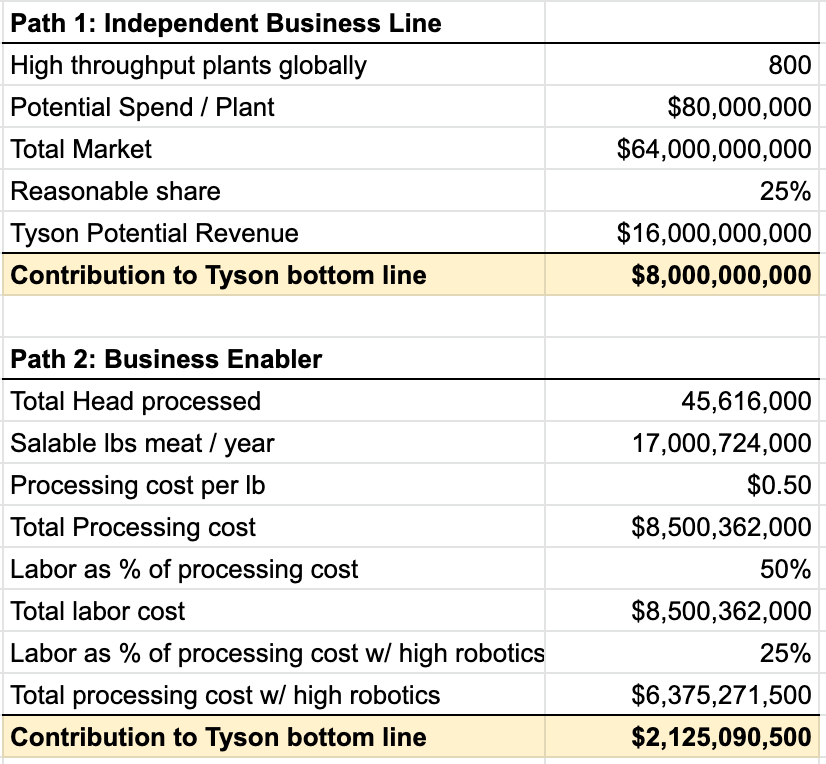
  2. Tech as a core business enabler. Labor represents 50-60% of processing costs. Let’s say Tyson can reduce labor costs by 50% by deploying more robotics in the plant. Apply that reduction across the 45M chickens, 155k cattle, 461k hogs that Tyson processes weekly….

Here’s some (really) crude math around these two paths so before you say that my numbers are wrong, I know. These are wild assumptions for illustrative purposes only to show the (very) rough potential impact on Tyson’s bottom line.

Tyson generated $3.9B EBITDA in 2019 so even if we cut the numbers above in half, these 2 paths represent potential EBITDA growth ranging from 20% – 200%. ??

Now here’s the catch: hardware is difficult. Really difficult. That’s why most VC’s turn and run the second they hear the word ‘hardware’. But if you can navigate the financial & execution challenges of hardware, the light at the end of that tunnel is incorporating software with its oh-so-attractive 80-90% margins. Could Tyson pull that off? Perhaps. 

The beauty of hardware is that not only can it improve efficiency of a task, it naturally lends itself to data collection. But what does one do with copious amounts of newly collected data? This is where software gets deployed: to capture, distribute, and analyze the data to derive high value insights. It’s a virtuous cycle, and the hardest part is the hardware. If Tyson can crack the hardware code, the software can (relatively) easily be layered on and the flywheel prints the money.  Beautiful.

Which leads to the 3rd path, The Hybrid. The hybrid of the two paths laid out above is Tyson beginning by deploying its own robotics to improve its cost structure in the processing plant, and then also selling the technology to competitors.

But there are a lot of questions as to the viability of the hybrid path given the competitive nature of the industry.  Would the Cargills of the world be willing to purchase plant robotics from Tyson that can capture data, and software to analyze that data? Would the Justice Department allow them to do so? I’m skeptical on both accounts.

The rough math indicates this aggressive tech-centric strategy has potential to grow both top line sales and bottom line profit while also mitigating risk for future labor threats like pandemics. 

In the first 6 months of COVID-19, Tyson spent $340 million on various measures to protect employees. So a risk mitigation strategy probably sounds good to the Tyson board right about now.

Now that we’ve uncovered the compelling Why and 3 possible How’s to Tyson’s tech strategy, let’s acknowledge the extremely real challenges of redirecting a behemoth like Tyson Foods: the cultural challenges, the technical challenges, the industry challenge, the subject matter expertise challenge, and many more. It will require an absolute Herculean effort if Tyson is to get anywhere close to successful with this transformation.

When I wrote the initial analysis of the Dean Banks selection for CEO, I was honestly feeling pretty bearish on Tyson Foods. But after doing the above analysis, I may hold on to my stock….just in case Tyson’s quasi-ridiculous bet-the-farm strategy pays off.

Processing…
Success! You're on the list.

Categories
Animal AgTech Processing

Tyson’s Moonshot: what the new CEO’s resume really tells us about the future of Tyson Foods

This week Tyson Foods named Dean Banks as its next Chief Executive Officer.

Dean Banks was named president of Tyson Foods last December, but the media references his experience as a “ tech executive” and his time at Alphabet. Curious about this experience, I went to his LinkedIn profile.  

Was he a C-level executive at Alphabet? Division President?

At Alphabet’s X (Moonshot Factory) he was, umm, a Project Lead. Oh. 

According to LinkedIn, beyond his project management experience, he’s done some consulting, some angel investing. His CEO experience includes a brief stint at what appears to be <50 person company and an even shorter stint at a company with <10 employees. The assumption that he’s probably managed a maximum of $50 million P&L is likely generous.

Meanwhile Tyson Foods employees 122,000 people across the globe to generate ~$40 Billion in annual revenue.

Unless I’m missing something, this guy has the perfect pedigree to be a partner in a venture fund, run a scaling startup, or lead a newly created tech division of Tyson Foods.

It is not obvious from his resume that he is capable of being the CEO of a company of this size, scale, and complexity. 

Tyson Foods is the opposite of Alphabet & its Moonshot Factory in almost every way.

Moonshot Factory makes long term plays that may not deliver results for years or even decades. (its in the name…moonshot)

Tyson Foods faces the earnings music with Wall Street every quarter.

Moonshot Factory is funded by Alphabet, a $1.02 Trillion market cap company with $18 Billion cash on hand. 

Tyson Foods is a low margin, commodity business clawing its way to higher value through further processing, product innovation, and branding. This is a ‘grind it out and strengthen your balance sheet to prepare for the inevitable lean times that come with a volatile, cyclical industry’ kinda business. This is ‘hope that you are diversified sufficiently across proteins, sales channels, regions of the world to weather a black swan better than your competitors’. 

But, there is one scenario under which this stretchiest of stretch hires makes sense: 

Tyson doesn’t want to be a user of tech and a customer of tech companies. 

Tyson doesn’t want to be an early adopter of solutions created by tech companies.

Tyson Foods intends to be a tech company.

Tyson’s biggest problem is labor, specifically plant labor. This has been their biggest problem for some time, and COVID shined the spot light on the many risks associated with labor intensive processing including access to labor, contingency plans when labor is unavailable, health & safety, and liability. Labor represents 50-60% of processing costs, a huge opportunity to drive margin by reducing these costs.

Equipment suppliers were not solving Tyson’s biggest problem in a timely manner, so Tyson Foods is taking matters into its own hands.

Over the past three years, Tyson has invested about $500 million in technology and automation including the Tyson Manufacturing Automation Center opened in 2019. Banks’ work at Moonshot Factory was in automation and robotics. Rumor has it they’ve brought in similar profiles from General Motors and similar companies.

Hiring people with tech/automation pedigrees raises the question, what’s the internal mandate as it relates to plant automation??

Is it, reduce processing costs by x% to improve competitive position? Or  is it, reduce processing costs by x% and generate $y revenue in automation solutions such that tech becomes the growth business? 

If it were merely a competitive advantage play, Banks would have been made head of the tech division. So it must be a bigger play in which Tyson leverages its knowledge of problems to be solved with the leadership expertise to bring about new products and an entirely new business direction.

Perhaps even a new business model for Tyson Foods. 

Does Tyson Foods start selling plant robots to competitors or do they launch a Processing-As-A-Service business? Maybe they launch the processing plant equivalent of a Ghost Kitchen in which they effectively become a contract processor for other companies because their costs are 30-50% lower? That might be bit outrageous, but you get the idea – this initiative must be central to the very fabric of Tyson Foods in order to make Banks CEO of the entire company.

In 5 years, what % of Tyson Foods revenue will come from technology sales?

How will this impact operations? 

How will this impact returns?

How will this impact culture?   

How will this impact Tyson’s venture activity?

So many questions & only time will tell.

What a company says about their future is mildly interesting, the tell is in who they hire. And the largest meat company in the world just hired an automation tech project manager as their next CEO. Which can only mean 1 thing:

Tyson is betting the farm on its future as a tech company.

Processing…
Success! You're on the list.


Categories
Processing

Can robots save the meat industry?

Access to consistent & reliable labor has historically been a challenge for the meat & livestock industry. But COVID-19 has highlighted the risk in the food supply of a highly consolidated processing sector largely dependent on manual labor.

At least 15 plants have closed for some time due to labor shortages amidst the COVID pandemic, with many more (most?) running below capacity. And according to the Wall Street Journal on April 23, “U.S. beef production fell 24% compared with a month earlier, with pork off 20% and poultry down 10%, according to estimates from CoBank.”

The drastic and immediate impact on both live animal prices and meat/poultry prices is a perfect storm of 3 trends:

  • Highly consolidated processing segment
  • Highly labor dependent processing plants
  • Public health crisis that is stress testing every institution & organization

What are the possible solutions, and what role could technology play?

Increase regional processing capacity. Twitter is abuzz with producers talking about the need for more regional processing capacity. Let’s say you find the capital to build or buy a plant. Great, now you have to find a way to run that plant efficiently with a fraction of the throughput of the big plants. Yet you are likely competing in the same commodity markets…yikes. Then you have to find a way to sell the whole carcass, not just the high demand middle meats….double yikes.

Scale matters in processing, as does operational and sales expertise. These unpopular truths are why most attempts by producer groups to move into processing fail. As Jayson Lusk said about the current hog market mess, “we’d need 100 brand new small packing plants to make up for the loss of one large plant.”

Though there is a critical place for small plants in D2C farmer plays, regional processing is not a silver bullet.

Decrease labor dependency. Processing is labor intensive with many of the big plants employing 500+ employees per shift. While newer plants are employing more automated equipment, increasing the use of robotics & automation in processing plants would reduce dependency on labor while potentially lowering costs in the process. At a time when poultry integrators are cracking eggs, hog farmers are euthanizing hogs, and feedyards have reduced placements by 25%, the current crisis highlights the risks to the entire animal protein value chain of being so highly dependent on labor in processing plants.

Labor represents 50-60% of processing costs. Decreasing labor dependence not only has the potential to increase “resilience” of the processing sector if we have another pandemic (no thank you), it also has the potential to decrease processing costs while increasing yields. E.g. steaks cut with the water jet significantly improves yield, without worker safety risks.

Depending on the upfront costs, robotics actually have the potential to increase the regional processor’s ability to compete with larger processors.

According to AgFunder, $179M venture capital was invested in (crop) farming robotics & equipment startups in 2019. There isn’t even a number that registers investment in automation for meat and poultry processing despite the huge opportunity in a $213B industry. If robotics are having a moment in crops, why is there such a lack of robotics/automation innovation in meat processing?

My hypothesis is that its an issue of access. It’s easy enough to find a farmer that will talk about their operation and problems to be solved, yet it’s close to impossible to understand the inner workings of meat processing unless you’ve worked inside.

To overcome the access hurdle, the industry needs to invest in the innovation ecosystem, to provide a way for entrepreneurial and technical talent to engage on the biggest problems vexing the industry. This could take many different forms from strategic venture funds to a NAMI sponsored startup event to industry backed startup studios.

Its time for industry leaders to find ways to align the best and brightest engineering and entrepreneurial talent around key opportunities in plants…do this well and smart money will follow.

Questions:

  1. What founders or investors do you know that are working on robotics for processing?
  2. What aspects of processing do you see as most appropriate for automation?
  3. What is your organization doing to explore increased automation in processing?

Processing…
Success! You're on the list.