Categories
Emerging Tech Funding Venture Capital

Prime Future 137: It’s time to call it, farm mgmt software was a wash.

Riddle me this: What do you call a category of companies that raised a ton of venture capital and, a decade later, had not one sustainable business to show for it?

There are a few categories that are in the process of playing out as we speak, including plant-based meat, cell-based meat, and indoor farming. But each of those is still too early to call for sure, they are still playing out. Maybe they’ll fit the above description when the chapter closes, or maybe they’ll be raging successes. TBD.

But there’s another category that is 10+ years old, and a post-mortem is timely because, well, it’s basically commercially corpse-like.

The category is farm management software, the row crop genre.

Most would call farm management software companies Agtech 1.0. It was the wave that initially put agtech on the map, kicked off by Monsanto’s billion-dollar acquisition of Climate Corp in 2013.

Most companies in this category were started between 2005 and 2010. There were a bunch of these early companies that didn’t make it beyond Series A, sometimes attributed to the fact that they didn’t understand farmers or they didn’t get that not all farms operate the same or that a farmer growing corn & soy in Illinois is not the same as a diversified farm in Missouri is not the same as a vegetable farmer in Yuma, Arizona. But let’s ignore the majority of companies here.

Using back-of-the-envelope math on only the handful of companies that broke through and made it to an IPO or major acquisition, the final players alone raised over $400 million in venture capital.

And their acquirers (and in one case, public market investors) paid close to $2 billion in total, plus or minus $200 million.

So where are they now?

In general, they are running on fumes, are afterthoughts within their organizations, or have been divested entirely.

$400+ million in venture capital, ~$2 billion in acquisitions, and the row crop farm management category has not one sustainable business to show for it.

The major crop input companies acquired these farm management companies to jumpstart their own digital capabilities. By all accounts, these software products were intended to be functional, sustainable profit centers – able to stand on their own two feet like a real grown-up business.

For the most part, the idea behind the acquisition was to turn the data from farm management software into higher-value products like analytics or insurance (Climate Corp’s original thesis). But if the data isn’t good (clean), then the analytics are worthless. So then the common path was to downgrade the push for revenue to instead use free access to software as an incentive to switch to that company’s seed and chem products from their core portfolio.

I wonder if part of the issue was that farmers had been trained to expect access to farm management software at low to no cost by venture-subsidized businesses that were in all-out pursuit of growth.

The corollary is how Uber & Lyft used to be cheaper than a taxi, by far. Being cheaper and more convenient made it a no-brainer. Then Uber & Lyft went public and now what used to be a $15 ride is a $30 ride because it’s not venture subsidized and these companies have to stand on their own two feet. But that new (real) price for a rideshare is close to what a taxi costs and, especially at an airport,  it can be easier to grab a taxi than hunt for your Uber driver, the needle in a carstack. All of which changes the long term market for rideshare…just like farm mgmt software?

My hypothesis is that founders of Agtech 1.0 companies, and investors, had the hypothesis that farm management was a winner-take-all market. If you believe that only 1 or 2 players will dominate a market, then it is logical to invest aggressively in growth in order to be one of those winners.

But few markets are really winner-take-all.

In an industry such as farming where the potential user base is so diverse, their needs are so diverse, their business structure and profit margins are so diverse…the pie is so varied that it would be difficult for any one company to take the entire market, simply from a capability standpoint.

Perhaps the question that the agtech world should be asking itself, a decade+ in, is how to measure the success of a venture category. There are a few ways you could think about it:

  1. How much venture capital was raised? Everyone knows this isn’t a long term measure of value, but it does indicate something. Or sometimes it indicates something. But let’s agree it’s an insufficient metric at best and a vanity metric at worst.
  2. How many exits did the category have / how healthy were those exits? This is a much better indicator than #1, and it is certainly an indicator of success for founders and investors. But it’s like calling the game-winner at halftime.
  3. How commercially viable is the business over the long run? This is the only measure I know that reflects commercial reality; how much value is created for farmer customers and captured by the acquirers. Unless the test of time and commercial value is passed, then it was all just financial engineering and/or short term wins.
If we agree that #3 is the real measure, and after a decade of post-acquisition signals from the category, I think we have enough data points to say that in the end, this category was…a wash.

The caveat is that there are some niche examples of variations on farm management software where the above does not apply, often where the company has dialed in on a value proposition that is not simply storing & visualizing basic farm data but building higher value propositions. And some of those companies were not juiced in a big way by venture capital, they tended to grow more slowly over time. But overall, TBD on these.

So, what do we learn from agtech 1.0?

About pricing new products, and how people don’t tend to value what they don’t pay for.

About user experience and automating data entry.

About value creation….and that there has to be enough of it!

About how digital products matter strategically for incumbents, and that checking a box is not a strategy.

I also think there are lessons about aligning financing and business expectations with long-term customer interests. Agtech 1.0 created the opportunity, or revealed the opportunity, for sector-focused investors to have an edge over generalist VC’s simply by understanding the business of agriculture and its nuances.

While it’s time to call Agtech 1.0 a wash, I don’t think we can call it a bust.

It attracted capital and talent to a previously overlooked space. And even though you can’t point to individual significant long-term successes in this category, we can safely assume the learnings that founders, investors, strategics, and farmers had through this process has informed how Agtech 2.0, 3.0, 4.0…25.0 will play out.

How would you rate Agtech 1.0?

Oh and the whole thing of not knowing exactly how things will play out, isn’t that really a feature of creating and building the new, not a bug?

What a time to be alive 😉


Did you miss early editions of Prime Future?

Access an ebook with editions 1 through 81 here: Prime Future PDF

Get the ebook!

Categories
AgTech

Prime Future 80: Can farmer facing agtech startups IPO?

Two late stage Agtech companies have each raised ~$1B in venture capital but they haven’t IPO’d yet. There were 4 agtech SPACs this year, but there have not been as many good old fashioned IPOs. Since the Agtech era was kickstarted by the 2013 Monsanto acquisition of Climate Corp, there haven’t been any notable agtech IPOs to point to as success signals.

Why?

Set aside all the obvious financial hurdles of what it takes to be IPO ready. For startups who sell directly to farmers, my hypothesis is that there are also tricky customer dynamics to navigate in the transition from privately held company with undisclosed financials to publicly traded company with fully disclosed financials.

If this sounds like an overstatement then maybe you missed how Farmers Edge was excoriated by #agtwitter after their IPO, with farmers relentlessly mocking the company’s financial results.

(Aside: check out Upstream Ag Insights analysis on the Farmers Edge IPO)

But it makes sense that farmers would experience a disconnect in the financials of an agtech company compared with their own approach to accessing capital.

Could two financing models possibly be more juxtaposed than the VC backed, growth now profit (hopefully) later tech startup model and the typical traditional debt financing model for most farms? I doubt it. Technology companies often IPO while showing big losses in the pursuit of growth as long as unit economics make sense; while farmers who operate at persistent losses go bankrupt.

Completely different financing models for completely different business models in completely different markets.

While farmers are generally not impressed with venture capital hype, there doesn’t seem to be much of a customer perception win for farmer facing agtech companies who go public. Let’s take 2 extreme possible outcomes of an IPO:

(1) The company IPO’s and their financials reveal that the company is operating with high EBITDAWait, high EBITDA? That must mean the company is taking advantage of producers. Who are we, a bunch of suckers? Riot.

(2) The company’s financials reveal that the company is operating at huge lossesHuge losses? This isn’t even a real business? Riot.

What if the only acceptable and respectable option in the eyes of a farmer customer base is to be profitable but ya know, not too profitable.

Impress investors at the risk of disenfranchising your farmer customer base, and vice versa.

Rock. Hard place.

So, are late stage agtech startups delaying IPOs and staying private longer because they are concerned about what farmer customers will think of their financials, or because they are concerned about what The Street (public investors) will think of their financials?

Assuming these late stage agtech companies are substantive businesses, the number of mature non-ag startups that have IPO’d in the last 2-4 years with high revenue yet operating at huge losses (e.g. Uber, Lyft, Airbnb, Lemonade, etc etc etc) seems to negate the idea that mature agtech startups are delaying IPOs because of lack of public investor appetite.

I readily admit that this hypothesis that farmer facing agtech startups are delaying IPOs because of farmer perception concerns may be wrong. I’d love to hear your counterarguments, here are my own:

(1) Each of those non-ag companies mentioned above (Uber, etc) had raised significantly more capital in private markets than these agtech companies have, their total addressable markets (TAM) were larger, and presumably they went public at much higher revenue than what these agtech companies will when they IPO. So it’s not apples to apples. Maybe it’s not even fair to apply the label ‘late stage agtech companies’, maybe in the grand scheme of things they are just mid stage and have a long way to go & grow in private markets. Perhaps.

(2) Many companies upstream and downstream from farmers have been public for years or decades and seen tremendous growth. Maybe that means the hypothesis is wrong, or that even if the hypothesis is correct and farmer customers won’t like seeing the financials of a venture backed company gone public, that it doesn’t matter whether the company is privately held or publicly traded because we humans (including farmers) are just one news cycle away from something else to get worked up about. Perhaps.

(3) Did Farmers Edge experience a negative commercial impact after the IPO? If not, then the noise about it all was just noise and my hypothesis is incorrect. Perhaps.

(4) The burdens of being a public company are so much higher than being privately held, why would anyone IPO before they have to?? Perhaps.

What I find really interesting are the agtech founders able to thread the needle of operating in a ‘VC light model’, where they find ‘patient’ venture capital that allows them to build a company that reflects their farmer customers values and sets them up for long term success, not flash in the pan hype of the venture treadmill but rather build for the long term, one brick at a time. A ‘fit the financing to the business’ approach rather than ‘fit the business to the business to the financing’ approach.

That takes discipline, especially in a market like we’re in now. And just to contradict my own hypothesis, maybe accessing private capital further into the company’s life allows late stage startups to do that. Perhaps.

For how long will late-stage agtech companies continue raising capital in private markets and avoid the inevitable scrutiny of publicly traded companies? TBD.

Categories
Blockchain Emerging Tech

Prime Future 79: Blockchain…all dressed up but where to go?

Technology only has a fighting chance in agriculture when it definitively improves producer outcomes🤑 and/or consumer outcomes😃. Tech for the sake of tech is a road to nowhere.

Moreover, I get reeally skeptical when seemingly overnight cult-like obsessions form, as has happened in the second half of 2021 in the tech world with DAOs.

Unpopular opinion: DAOs are just blockchains all dressed up & looking for something to do on a Friday night.

What’s a DAO? Decentralized Autonomous Organizations. (Oh that wasn’t self-explanatory? Weird…)

Constitution DAO is probably the most public example, recently formed to purchase a copy of the US Constitution that was going up for auction. The group raised ~$40M which wasn’t quite enough to snag the prize, so the DAO was dissolved.

One definition of a DAO is, “a group organized around a mission that coordinates through a shared set of rules enforced on a blockchain.” Hmmm. Here’s another perspective:

“Formal definitions are a good place to start when things are new, but there does not seem to be one for DAO—even though many attempts have been made. DAOs are a new type of organization and to understand the key characteristics of a DAO, it is helpful to review some blockchain fundamentals. A programmable blockchain, like Ethereum, enables applications to run on a decentralized trust system—removing our need to rely on any single actor as an intermediary of trust. Another way of looking at it, is that blockchains convert computing power into trust. Everyone is keeping an eye on everyone else, so that we can all keep performing economic activity on the network.

In truly decentralized systems, no one needs permission to join in on this action. The underlying consensus algorithm is publicly accessible. This means that anyone can become a network participant and help verify the behavior of other participants. This is the key innovation we have all gravitated towards in the crypto space. A DAO is an ecosystem with loose operational borders that comprise coordination tools.

The public blockchain act as a cozy blanket of trust that applications can be built on.”

Decentralized ownership? Loose operational borders? Ummm….who’s gonna tell the tech bros this that they invented co-ops? Bravo.

Sure, these co-ops are on a blockchain, but the underlying concept is not new. And co-ops are fraught with traps, that’s why ag history is littered with failed co-ops.

Organizing humans around objectives is not a technology problem, it’s a human problem.

(Though there have also been some wildly successful co-ops in ag & I’m keen to understand why that is – if you have insights into why organizations like Land O’Lakes, Fonterra, Tilamook, Cabot Cheese, etc have worked so well, please reach out.)

If co-ops are fraught with management & organizational risk (which they are), imagine further decentralizing decision making and planning. 😵‍💫 I recently read about a real estate DAO that would allow all members (anyone can join a DAO, that’s a key feature) to put forward potential real estate deals and then all members would vote on which deals the DAO would execute. YIKES. Wisdom of the crowd is a great concept only when the crowd is wise on a given topic.

This isn’t blockchain’s first run at insanity. Remember ICOs?

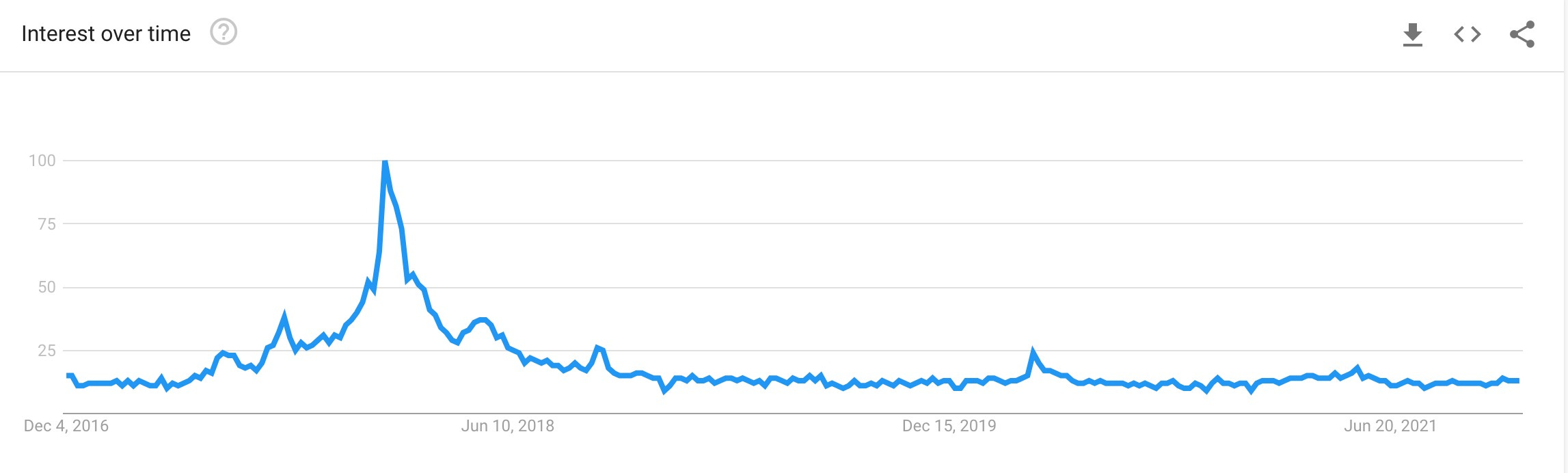
Around 2017 a phenomenon started where startups would issue ‘Initial Coin Offerings’ as a blockchain based way to raise capital, even if their product had nothing to do with blockchain. The google search history for ICOs tells the story:

My hypothesis is that DAOs are 2021’s ICOs; a flash in the pan that we’ll look back on only when the next blockchain craze comes around.

One hypothetical examples of DAOs was specific to D2C meat, which you know is a topic I’m here for – here’s how the author described it:

Going to a high-end butcher and buying your meat piecemeal might run you anywhere from $10/lb for ground to $30-40/lb for top cuts.

It’s much more financially manageable to buy a fraction of a cow from a ranch directly. That might cut your costs by 50-75%. But most people can’t eat a whole cow. So you team up with some friends and buy one together.

Let’s say you can buy a cow for $3,000. That’ll yield you around 450 lbs of meat, so you’re paying an average $6.66 per pound for everything from ground to filet.

You probably don’t need a whole cow at once though, so let’s say you buy ⅓ of one. So your cost is $1,000.

But instead of buying one directly, you buy a membership to the new CowDAO. CowDAO is a DAO focused on making high quality meat more accessible to all its members. Membership comes in the form of an NFT, which is initially priced at 0.07 ETH with a supply of 1,000. Pretty typical for a new NFT drop.

Your membership entitles you to lifetime discounts on the finest quality meat sourced from around the country, and eventually, free meat. Here’s how CowDAO does it.

(You can read the full piece here including the how’s, though I recommend popping some Tylenol first.)

Let’s dissect the CowDAO idea. So a lot of people want non-commodity meat but don’t necessarily want to purchase a whole or half carcass? Yes and amen.

But you don’t need a DAO to solve that problem as CrowdCow, ButcherBox, and Barn2Door are proving because…

…it’s not a technology problem, it’s a business model problem.

DAOs are tech for the sake of tech.

And so far, so is blockchain.

Buzz about blockchain seemed to really pick up around 2016. The ag industry speculated that blockchain would finally enable traceability in food value chains.

But traceability isn’t a technology problem, its a market problem.

Who wants traceability and who is willing to pay for it? Five years later and in most markets, its still unclear.

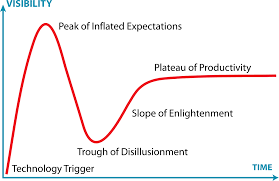
Remember the hype cycle for emerging technologies:

So where are we in the blockchain hype cycle? It’s hard to say. I *do* think blockchain will find its footing, eventually. Why & when will it happen? No idea, except that it it’s likely to be when blockchain is the right solution for a customer problem, and the technology fits the business context. Not a second before then.

Yet given enough time, anything can happen. QR codes were invented in 1994 and hey, it only took 26 years and a global pandemic for that technology to hit it’s stride.

My caveat to all the above is that not only am I by no means an expert, I did just purchase a couple of blockchain books to read over the holidays. So I reserve the right to change my mind. And let’s just assume that because I’ve now taken such a public & negative view on DAOs, that they might actually become a real thing. 🙂

Share


Get past editions of Prime Future in one place:

Get Prime Future PDF!

Categories
Animal AgTech Leadership

Prime Future 70: Why I’m wary of too much certainty 🙅🏻‍♀️


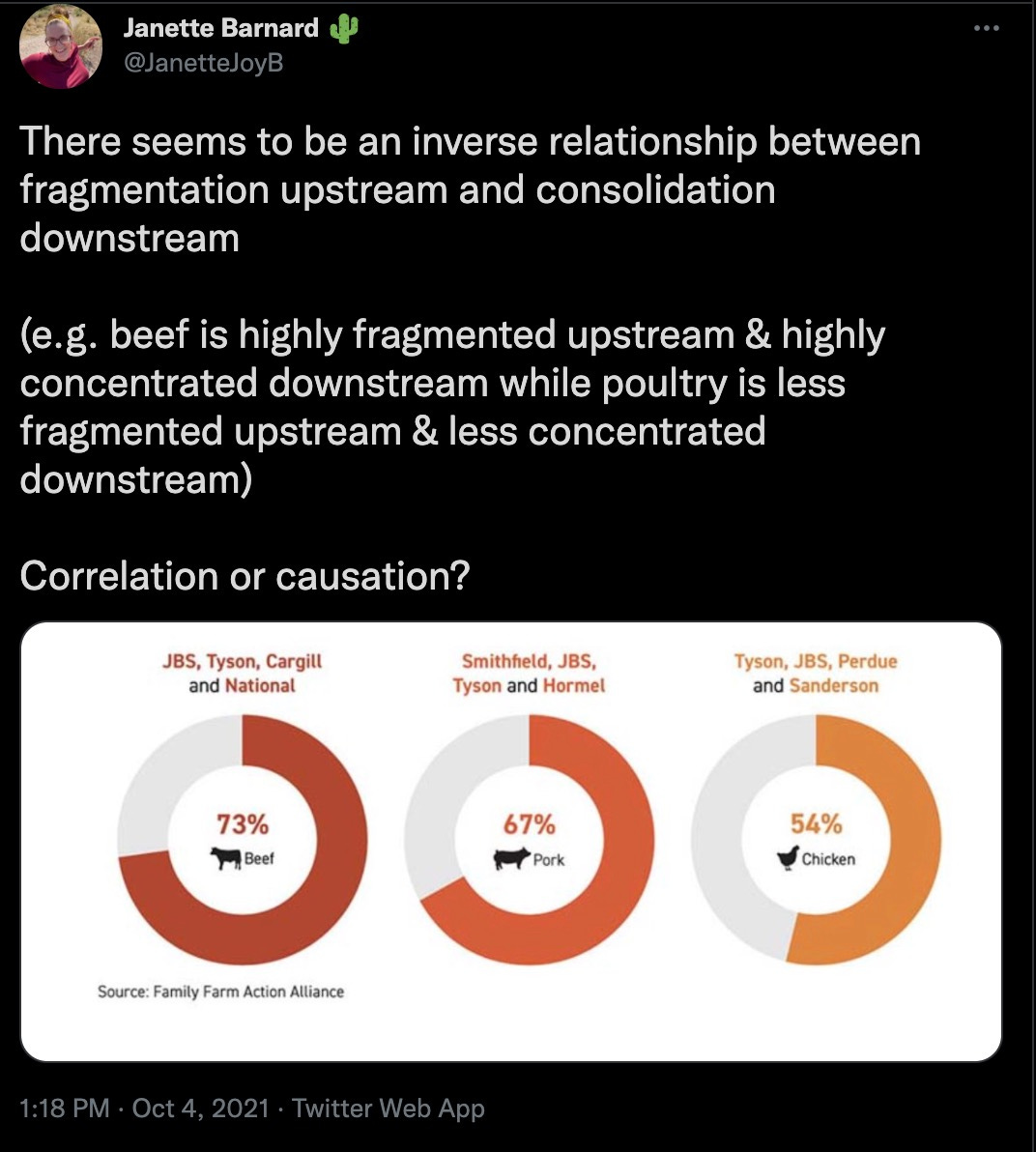
Is beef more concentrated at the packer level because the animals are heavier? More valuable? Or because there’s more’s variation in sourcing? Variation in plant size? Or maybe it’s this:

The answer to why the fragmentation/concentration conundrum exists doesn’t seem to be super obvious, but clearly it’s super complex. Happened-over-time things like packer concentration don’t take place in a vacuum. So simple solutions like the top x processors shouldn’t have more than y% capacity don’t take into account the competing dynamics that led to the current state.

And yet, there is *a lot* of certainty floating around about the topic without much (any?) tolerance for nuance.

But ag isn’t alone in having limited capacity for nuance. (Look, if I was the Debate Commissioner at every presidential debate before a candidate articulated their own position, they would have to summarize the other side’s policy position and say 1 positive thing about it, sans sarcasm.)

There’s another prickly conversation where we need nuance – climate change. I wish people didn’t point to an individual weather events as evidence of climate change. As climate researchers say, it’s not the individual events that are concerning, it is the trends in the data over time – the frequency and severity of extreme weather events. Which means there’s some level of variation that is normal.

Floods, hurricanes, tornados, droughts, heat waves – these are not new events. They were not created by climate change. So pointing at individual weather events as evidence of climate change is either disingenuous or intellectual laziness. Why not highlight more clearly weather events & trends that are within normal variation, versus what’s outside that normal variation?

Another nuance that’s really important is around the distinction of who’s driving change in the industry: consumers or food companies. From Climate + Ag: what gets measured gets monetized (link):

Who’s leading who in climate + ag?

“Consumer wants drive value chain decisions.”

I’ll start by pushing back on the narrative that protein value chains are driven by consumers, on climate or any other topic. Consumers….those nebulous creatures of food commerce who somehow sound like the unknowable inhabitants of an alternative universe when we refer to them. Two flaws with the Consumers-R-In-Control narrative:

  1. Consumers are not a monolith. Segments of consumers want certain attributes, sub-segments are willing to pay for those attributes. Variation among consumers is no less nuanced than variation among farming systems. Mis-identifying what consumers want and what they will pay for x is as fatal of a flaw as over-estimating how many consumers will pay for x.
  2. Although staggeringly critical to the system, consumers are not everyone’s customers. Consumers don’t transform supply chains or recalibrate industry norms. Food companies do. Food companies are where the power lies. Brand owners make decisions about how to market meat & milk to their customer: retail consumers. Food companies make decisions about how to market meat & milk, and then where needed those same companies use their scale and influence to set product specs & requirements as they procure raw materials or finished product from a certain set of suppliers. No one is talking about the fried chicken wars of Mar Jac vs Wayne Farms chicken, they’re talking about KFC vs Chick Fil A. The two directional power of influence lies with brand holders across foodservice and retail. Leading brands lead consumers by positioning xyz about their brand that is better than competitors. Food brands tap into consumer trends, but they lead consumer segments with differentiated products. Sometimes those changes are then adopted by other food brands & their supply chains. The massive shift in NAE (no antibiotics ever) production in US poultry is my go to example for this dynamic – when 1-2 major food companies said we will buy NAE chicken, then NAE chicken is what suppliers learned to produce, at scale. So then more food co’s buy NAE chicken. It’s a cycle that starts with a food brand, moving vertically in that supply chain and then expanding horizontally as more food brands (and their supply chains) adopt whatever the thing is.

We oversimplify the value chain when we attribute all influence to consumers, and we underweight the actual centers of leverage.

This week McDonald’s announced their net zero emissions by 2050 commitment. That’s a big deal – we are talking about a legacy, conservative, brand conscious company not some fly by night, here-today-gone-tomorrow brand. This is one of the largest buyers of beef, lettuce, tomatos, pork, potatos, strawberries, etc on the face of the planet. When companies like that start jumping in, it bends the arc towards action – it’s a sign that we’re past the niche-y early adopters and moving right to the middle of the bell shaped curve.

Some interesting context on the McDonald’s announcement from Meatingplace:

Efforts underway since 2018 have resulted in an 8.5% reduction in the absolute emissions of the company’s restaurants and offices and a 5.9% decrease in supply chain emissions intensity measured against a 2015 baseline, McDonald’s reported.

Although the most recent announcement does not specify where in the supply chain the fast-food company will look for its emissions reductions, in an earlier post on its website, the company said, “In collaboration with franchisees, suppliers and producers, McDonald’s will prioritize action on the largest segments of our carbon footprint: beef production, restaurant energy usage and sourcing, packaging and waste. These segments combined, account for approximately 64 percent of McDonald’s global emissions.”

Food companies have leverage, consumers do not.

Another source of leverage is capital. Right now there is an enormous amount of capital (we could put a period there) flowing into climate tech & solutions. More than $33.9 BILLION in venture capital investment has gone into climate tech….in 2021 alone.

Venture capital doesn’t automatically lead to good outcomes and solutions, but it increases the odds of good outcomes when its put behind good founders and good visions and great products. I recently heard someone say “venture capital subsidizes risk taking at scale”.

It’s safe to say that investment in a category tends to be a leading indicator of tech/innovation.

In 2015 Bill Gates founded Breakthrough Energy, a billion dollar fund to “support the innovations that will lead the world to net-zero emissions.” In 2021 Chris Sacca raised an $800M fund to invest in climate tech, with 2 objectives: 1) lower emissions to net zero, 2) get carbon out of the air.

Two interesting quotes on Lowercarbon Capital’s website:

  • “Give or take, we’ll need to suck at least a trillion tons of CO2 out of the sky between now and 2100.”
  • “Fixing the planet is just good business. Shame and guilt won’t get us there, markets will.”

A few previous comments that are germane to this conversation for livestock:

The extreme positions on either end of the sustainability spectrum will not create actionable, consumer-satisfying, carbon-reducing, market-growing solutions. But nuance…that’s how we find the productive middle ground. Nuance acknowledges that one size does not fit all – what works in geographies that get 40+ inches of annual rain fall won’t necessarily work in areas that get <15 inches. Systematic management changes like transitioning from continuous grazing to intensive rotational grazing are complex, as is anything related to managing the biology of plants or animals.

Regardless of the abundant unknowns about how things will evolve, this whole “climate thing” is not a topic where producers can look away and hope it will disappear. This is a mega trend. There will be winners and losers – my hypothesis is that the difference will be those who collaborate and find workable solutions…or don’t. This is a mega trend to engage, to lead by looking for the ‘and’ solutions…the places of overlap between what’s good for climate related metrics AND for cattle AND for successful cattle operators AND for food companies AND consumers. This is a place to ask questions like, what if? What needs to be true? What opportunities will be created in this mega trend?

Maybe nuance isn’t realistic though – not even because of the formats in which we consume information (140 characters doesn’t leave much room for nuance), but because the human brain can only absorb so much information about so many topics in the midst of living our lives. So sweeping statements and catchy slogans leave us with soundbite driven opinions – and which soundbites we latch onto depends on who we’re listening to.

Anyway, I guess my philosophical point this fine Tuesday is that topics like packer consolidation and climate change are wildly complex with no simple answers, and I’m wary of too much certainty, of the simplistic answers. Anyone peddling simple answers is likely trying to scare or shame to sell something or get a vote (either side).

I think embracing nuance will serve us all well in these discussions.


ICYMI: why is carbon more likely to be a monetizable mega trend than an emotion driven fad? (link)

<insert corporation name> will not be able to buy 2 units of sustainability to offset 2 units of un-sustainabillity. But, <insert corporation name> will likely be able to buy 2 units of carbon sequestration to offset 2 units of carbon emissions.

As more companies make net-zero commitments around carbon and seek to offset carbon in their supply chains, carbon markets are the likely place to turn. To make this carbon economy go, the entire structure will have to be underpinned by rigorous standards of measurement and verification. Sound methodology and precision processes are the only way for carbon markets to deliver on the promise for participants and their investors, customers, and consumers.

Another concept bubbling up is carbon labeling on food. Only high end, niche brands are pursuing carbon labeling now, but will this become a more widely adopted practice? The concept behind these labels is numerical representation of the carbon involved in production….the (potentially) magical word for livestock producers is “numerical”. To the extent that sound methodology and high integrity math drive carbon labeling, it represents an opportunity for livestock producers to win by numerically capturing the net positive carbon impacts of livestock production.

People way smarter than me can go deeper on carbon markets and carbon labeling. My point is simply this:

Carbon could be the real deal for producers because both B2B carbon markets and consumer facing carbon labeling on food would require data driven approaches to drive an actual functioning net zero carbon economy based on measurements.


I’m interested in all things technology, innovation, and every element of the animal protein value chain. I grew up on a farm in Arizona, spent my early career with Elanco, Cargill, & McDonald’s before moving into the world of early stage Agtech startups.

I’m currently on the Merck Animal Health Ventures team. Prime Future is where I learn out loud. It represents my personal views only, which are subject to change…’strong convictions, loosely held’.

Thanks for being here,

Janette Barnard

Categories
Leadership

Prime Future 68: Bet on the collaborative-ists

There’s a local ranching family that’s been raising cattle on the same land for 7 generations. In that time they have not sold an acre of land, not one. They have withstood droughts, drug cartel activity, wildlife predators, market crashes, high interest rates. You name it, they’ve survived it.

Some years ago they got into a lil spat with the US government over the renewal terms for grazing permits on public land, so the federal government rounded up the family’s cattle that were on public lands and kindly delivered them to the sale barn.

Someone recently summarized the family’s mentality this way, “They are  fiercely independent, they just don’t trust anyone. Then again, that’s probably how they’ve survived and why they’re still ranching.”

This struck me. I have a deep respect for the challenges producers face and the resilience they embody….but I wonder if that fierce independence won’t actually work against producers in a rapidly evolving world where collaboration is rewarded more than independence. (And though this first example is a rancher, every segment of the value chain has players with a similar mentality, a transactional ‘us vs everyone else’ mentality.)

Collaborating raises new questions, new situations, new risks to manage…and new opportunity. If done thoughtfully and effectively, new collaborators can grow the pie (and it’s individual slices) in ways that independent actors cannot.

We live in a world where the art of highly effective collaboration increases the probability of survival.

Let’s start with one of the most successful examples of a systems approach, one that has stood the test of time: McDonald’s. (If you aren’t familiar with the 3 legged stool model, here’s a good primer.)

Each supply category has a limited number of suppliers that are held to very high standards but rewarded with high volumes of business, typically on a cost plus basis. Suppliers do not float in and out of the system frequently, these are not transactional relationships – they are partnerships built for the long term.

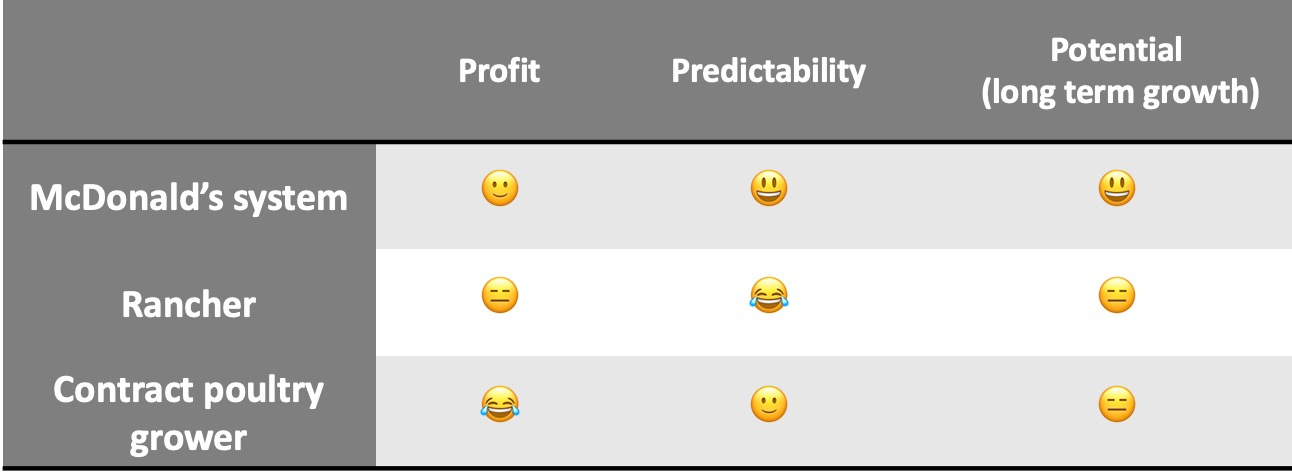
Now contrast the McDonald’s system with two alternative structures that land in different places along the continuum of Transactional to Collaborative, the independent rancher and the contract poultry grower:

  1. Let’s assume the rancher sells weaned calves at the sale barn, the epitome of price taking at the market’s daily whims. The definition of transactional – the buyer is literally whoever is willing to pay the most on any given day.
  2. Let’s assume the contract poultry grower supplies the labor and facilities, then executes the management program prescribed by the poultry integrator. The grower is paid on a $.xx/lb produced with some level of base pay that is set, and the remainder of pay determined by how the contract grower’s live performance stacks up against the flocks that are processed that week (the lottery system).

Regardless of the business (weaned pigs, broilers, or hamburger patties), it seems there are 3 core drivers around engaging in collaborative ecosystems with dedicated partners:

  1. Profit. Maybe its about finding higher value races to the top of the value pyramid, rather than vice versa. Maybe it’s about cost plus arrangements that may not maximize revenue on a given transaction, but could look smart over the long haul and the ups & downs of market cycles.
  2. Predictability. Creating predictable revenue can radically impact business planning and operations. Some would prefer to make $.1/lb day in day out, some would prefer to make $1.00/lb on 1 load knowing they might lose $.90/lb on the next.
  3. Potential (long term growth). What’s the growth potential of the ecosystem? Is this a chance to grow the pie and grow your business accordingly?

Below is a rough analysis of how different systems compare – maybe these are over or under stated, but the big idea is that there are tradeoffs under each model.

🙂=sufficient. 😃=heck yeah. 😑=maybe? 😂=that’s funny.

Of course this doesn’t capture some of the intangible tradeoffs of collaborative partnerships, like losing some degrees of freedom. I think my real point is that there are increasingly more alternative ways to approach business models and these alternatives should be considered.

  1. What is the upside potential? Downside risk?
  2. What are the tradeoffs compared with the risks of the status quo?
  3. Are those tradeoffs bearable compared to the next best alternative?

The answer to those questions will always be situation/people/goal dependent.

And I’m no Pollyana – there are risks with entering partnerships where multiple parties are reliant on one another. The obvious caveat is that not all systems are created equal; not all partners are good partners, not all collaborations are worthy bets. Sometimes the business model isn’t right, sometimes the leadership isn’t right…or any other number of reasons that a system doesn’t work out. One of the most practical pieces of advice came from my friend’s dad: when you create a plan to enter a partnership, create the plan for how you will exit the partnership.

(Those of you much more seasoned than me are probably nodding your head vigorously at that advice since you’ve seen the dangers of not preparing for partnership dissolution in advance. “Expect the best, prepare for the worst” and whatnot.)

A great irony from a producer standpoint is that although it might be easy to reject taking on the risk of entering partnerships, the fewer strategic alliances a producer makes with customers, by definition, the more reliant the producer is on commodity markets where price takers have zero control which introduces…risk. Maybe the real question is around where you want control (price? management freedom?), where you want predictability, and what type of risk you are willing to accept / are more comfortable managing.

I recently saw a list of about 30 aligned beef supply chains in the United States, here’s a snapshot of one. ‘Run our program to help us deliver a better product to our customers and we’ll all win’ is the summary idea. If you read Prime Future you know I think we’ll continue seeing more of these:

The above examples focus on how producers might engage supply chains & customers, but what about managing suppliers? I recently heard of a producer who decided to double down on supplier relationships by choosing one strategic supplier for every major input category. They gave up the transactional, shop-around-for-the-best-price-on-this-transaction in pursuit of the best supply arrangement on the next 1,000 transactions. Another dimension of a collaborative approach.

What does collaboration look like in Agtech?

Now let’s talk about where a collaborative mindset can drive progress in agtech:

  • Among co-founders – its doable to be a solo founder but as someone who hit The Great Wall of Burnout trying this route, I can tell you it is HARD and there is not an ounce of virtue in trying to defy the odds by being a solo founder.
  • Among founders and venture investors – there are huge tradeoffs in choosing to bootstrap a business which typically means slow and steady growth versus raising venture capital and committing to the high growth model. Neither is right or wrong, they are just different models with different paths.
  • Among founders and early customers – That early feedback from first customers – and how founders respond – can set the entire trajectory of an early stage company. Ask any successful tech company and they will tell you about the early customers who made them.
  • Among big companies and startups – each brings something to the table in terms of successfully scaling innovation, figuring out how to get the best of each can unlock magic.
  • Among startups and startups – the punishment for tech forward producers right now is that every single hardware/software product tends to have its own login. What farmer wants to login to multiple systems to manage their business? Zero. But not every company can be THE platform. This will drive partnerships that may not be what every company wants, but will drive customer experience and <drumroll please> grow the pie of tech adoption.

The best summary of those last points came from a recent Future of Ag podcast interview with Jim Ethington, an early employee of Climate Corp who is now CEO of Arable:

“We could have said we can’t afford to give up a piece of this pie and we’re going to go it alone but that’s not the path that moves the industry forward. …we can all be good at our pieces and hey sometimes we compete, most of the time we can collaborate but that’s what moves the industry forward.…being able to put the puzzle pieces together where 1+1 = 3 for the customer.

What if they try to replace us? Come in with the assumption that a) it doesn’t matter because this integration is what the customer wants – start with the customer and work backwards, and they want one integrated system. …and b) when this plays out even at the largest companies in the world…guess what their roadmap is full. ….everybody’s roadmap is packed – don’t flatter yourself they aren’t going to go build your product. And if they do, they were probably going to anyway and your partnership didn’t do anything to accelerate it. I think you have to let go a little bit and go back to the customer problem, growing the pie, making this a better overall technology space….and put aside the natural fears of what risks does this pose to us. The benefits outweigh the risks because those fears usually aren’t as real as you think.”

Does an independence-at-all-cost mentality create the trajectory to thrive in the ag economy of the future?

There’s perseverance in independence which will get you somewhere, but my hypothesis is that moving forward it will be the smart collaborations who channel that same perseverance for the sake of a larger business objective who will win; those who grow the pie in a way that creates long term value for every link in their chain.

…aka the spoils will go to the effective collaborators. The collaborative’ists, if you will.

“If you want to go fast go alone; if you want to go far go together.”


I’m interested in all things technology, innovation, and every element of the animal protein value chain. I grew up on a farm in Arizona, spent my early career with Elanco, Cargill, & McDonald’s before moving into the world of early stage Agtech startups.

I’m currently on the Merck Animal Health Ventures team. Prime Future is where I learn out loud. It represents my personal views only, which are subject to change…’strong convictions, loosely held’.

Thanks for being here,

Janette Barnard

Categories
Animal AgTech Emerging Tech

Prime Future 84: Everything is the enemy of something

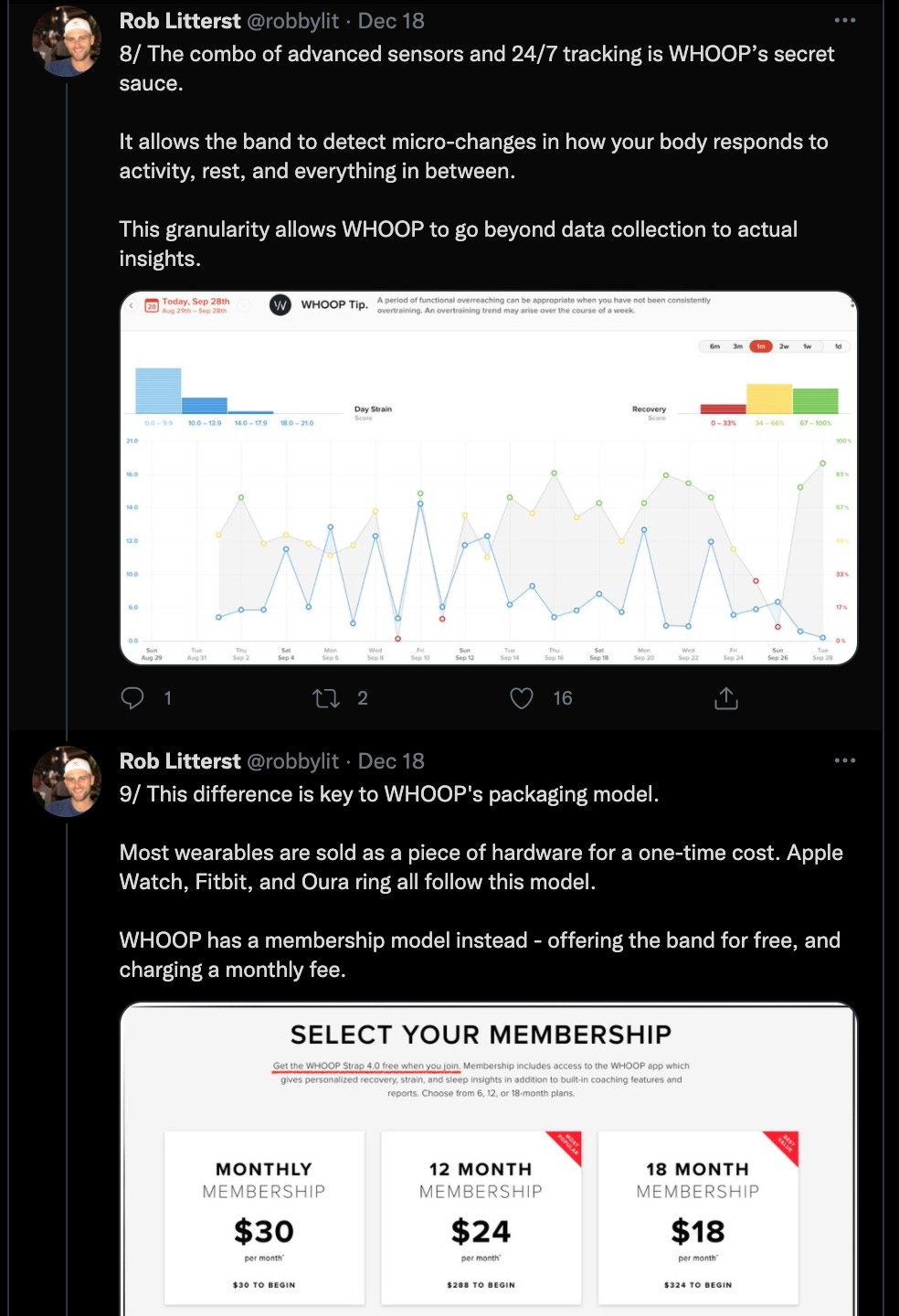
I found the below analysis of the Apple Watch compared with the WHOOP fitness wearable to be a gold mine, with 4 big ideas that tee up 2 paradoxes AgTech companies face.

(1) Specificity can create big markets:

(2) Market clarity impacts everything about the product:

(3) Product-market clarity impacts business model:

(4) Product-market clarity increases value creation:

That’s what a rando outsider sees; here’s what Whoop has to say about themselves:

“Your 24/7 personalized fitness and health coach.”

“WHOOP 4.0 – the latest, most advanced fitness and health wearable available. Monitor your recovery, sleep, training, and health, with personalized recommendations and coaching feedback.”

Let’s go ahead and call WHOOP a really great example of product-market clarity.

(In the tech world we talk all the time about finding product-market fit, but I wonder if product-market clarity makes it easier to find product-market fit. Whether product-market clarity is a leading or lagging indicator to product-market fit is a debate for another day though.)

Now let’s contrast WHOOP with Agtech companies who talk about solving macro, world-saving, how-would-humanity-continue-without-us types of problems. I’ve never once heard a producer lament those problems though; producers don’t typically have a…

  • pressing need to feed the world
  • generic, burning need for analytics
  • acute lack of artificial intelligence or machine learning or blockchains
  • dire need for transparency

And yet that kind of grandiose-but-vague language is all over websites and marketing materials in the ag industry, particularly from agtech startups.

On the other hand, I have heard many a producer talk about the ongoing struggle with questions like:

  • how do I access premium markets?
  • how do I increase predictability of cash flow?
  • how do I reduce medication costs?
  • how do I manage rising labor costs?
  • how do I grow top line revenue? increase margins?
  • how do I manage weather and disease and market risk?
  • how do I accurately manage animal inventory?

Going back to the very first idea from the Apple Watch vs WHOOP analysis, specificity can create big markets. And yet, that leads to the 1st paradox for agtech companies.

The “Everything is the enemy of something” paradox:

the harder you try to have broad appeal by not limiting your product, the harder you make it for target customers to know that your product could be for them. The more you try to appeal to everyone, the less you appeal to anyone.

This paradox shows up as a temptation for tech startups to avoid clearly articulating what their product does for whom, because a prospective customer might have a different use cases.

Then valiantly-struggling-to-get-off-the-ground tech co says HEY NO PROB WE CAN DO ALL THE THINGS. 🤦🏻‍♀️

Counterintuitively, the idea “our product can do anything” is the biggest enemy of traction because it puts the burden on prospective customers to discover how the product can create value for them.

Specificity can unlock big markets. Getting really clear about the use case and value proposition is how you get really clear in talking to your target customers….but only if you use clear words, the 2nd paradox.

The “Clear Words Paradox” is this:

the more you use jargon (tech or otherwise) to build credibility with target customers, the less credibility you have with your target customers because the words mean nothing.

My high school English teacher used to say ‘words mean things’ – laughably simplistic, but true. Words mean things. Getting the message right means getting specific and using market relevant words with clear meanings.

In my experience, producers tend to be an unpretentious population. Not only does pretentious/superfluous/jargon-y language not help a sales process, it usually hurts the sales process by slowing the conversation down…or killing it.

There’s no benefit in using words that don’t have significance or relevance to our target customers, usually serving the only purpose of making us think we sound smart or innovative. 🤭

With those 2 paradoxes in mind, here are 2 questions to ask yourself about product positioning:

  1. Am I providing substantive & specific use cases that allows a producer to see how this product solves a specific problem they might have?
  2. Am I describing the use case in language that is clear?

At first glance, today’s topic is only relevant to those in agtech. But actually my hope is that this gives some helpful language to the innovative producers who engage with agtech startups in the earliest days of beta testing or even early customer discovery. It’s ok, often even really helpful, to tell startups ‘those words mean nothing’ because that’s how they find clarity. I imagine WHOOP struggled through that same process in its early days too!

Everything is the enemy of something.