Categories
Business Model Innovation Genetics

Prime Future 65: 💡3 reasons why dairy is the new beef

First we looked at how the ‘beef on dairy’ genetics strategy will impact cow-calf producers. Spoiler alert: not much, mathematically speaking.

Then we looked at what’s driving this beef on dairy thing from the dairy producers POV. tldr: its complicated.

I’ve been exploring the implications for cattle feeders, packers, and retailers and next week we’ll talk about those. But first I have to share 3 big aha’s that have jumped out as potential beef industry game changers…here we go.

(1) Beef is better, right? …right??

I started this series with an assumption that beef breeds create better beef carcasses than dairy breeds, or dairy x beef crossbreds. (It seems reasonable, doesn’t it?)

But here’s the surprising little secret: Beef x Dairy cross carcasses are as good or better than straight beef carcasses, or ‘natives’ as the people say.

Texas Tech recently published trials looking at how beef-dairy crosses perform in feedyards and in the plant, and my takeaway was that beef-dairy can increase total pounds without sacrificing quality grades, when managed correctly. That’s a big deal. Imagine being able to sell 100 additional pounds of meat per animal with minimal yield impact.

Someone framed it this way: milk production and red meat yield are antagonistic traits and tend to move in opposition directions, while marbling and milk production are complementary traits and tend to go hand in hand.  The beef on dairy genetics jigsaw puzzle allows dairy producers to make decisions that get the best of beef and dairy breeds, to use ‘elite terminally focused genetics’ on the beef side that offset the dairy deficiencies. For example, one variation on a beef on dairy program might be to use Limousine sire genetics (high red meat yield) on Jersey females (high marbling). All breed genetics are not the same, that’s just one example of how the jigsaw puzzle can be put together.

It’s how dairy producers thread the needle to keep the best of dairy genetics so milk production isn’t negatively impacted one ounce (which would be a complete deal breaker for dairies, obvs), while driving towards carcasses that have zero hint of dairy’ness to them and are therefore just as valuable as carcasses from beef genetics.

(2) Consistency is the name of the beef on dairy game

There are 3 elements of consistency that beef on dairy can offer to the beef value chain:

  • Year round continuous supply of calves to the feedyard, and then to the plant.
  • Genetic consistency given how narrow the genetic base of dairy cattle are since AI has been used so widely for so long.
  • Management consistency – while a beef animal could move through 2-3 sale barns between weaning and arriving at the feedyard, beef-dairy crosses are much less likely to go through a sale barn at all. They’re more likely to move in large lots from calf ranch to grow yard to feedyard, or directly from calf ranch to feedyard with consistent management in each phase.

The US beef industry has been wildly successful at increasing consistency of meat so that the consumer experience is what the consumer expects, every time. And yet, there is still a lot of variability in genetics and production systems and feeding and management and, and, and. With 800k+ cow-calf producers and animals changing hands multiple times, high variability is somewhat of a given.

But beef dairy crosses offer the exact opposite of fragmented traditional beef production. This segment offers a hyper consistency of product which can only be net positive for processors, retailers, and consumer eating experience…which is net positive for all players upstream.

(3) Max value capture requires aligned supply chains

Value is only value when it’s recognized by the buyer, in this case the packer. The value chasm is wide between a dairy animal and a beef animal, so the challenge for beef-dairy animals is to get them priced like a native. One producer said it this way, “packers are looking for a reason to price a beef-dairy cross like a dairy animal. You have to get the animals on a grid to get a base price where it should be.”

The beef-dairy value equation is driven by the price the packer is willing to pay; the value of the animal to the packer determines the value of the animal when it first hits the ground. If the packer doesn’t recognize the value of a beef-dairy carcass, then the beef on dairy strategy doesn’t pencil out for the dairy producer.

Capturing full value of the beef-dairy animal requires closely aligned partnerships all the way through the value chain to the packer. Aka aligned supply chains or coordinated supply chains. Prime Future readers who have been around for a while know I have a borderline obsession with how aligned supply chains can create better outcomes for producers and consumers. We’ve talked about them here and here, with this key idea:

“Traceability is meaningless until somebody will pay for it. The industry has thrown around the t word for at least a decade with extremely limited success in finding the right use case & corresponding business case. Like all innovations, until the right business case surfaces it’ll never happen. However, coordinated supply chains likely are the business case that supports traceability particularly when the data flows in both directions so producers get better feedback on how animals perform in the feedyard/plant, and consumers get relevant cues about how the animal was produced.”

But beef on dairy looks like it just miiight be the breakthrough use case to drive supply chain alignment and as a byproduct, traceability.

For dairy producers to maximize the value of beef-dairy crosses, dairy producers have to create supply chain partnerships for the long term where everyone involved is incentivized to ‘stick with it’ in order to create a consistent system, and to mature the whole system over time. (one of my other favorite ideas is playing long term games with long term people – traditional transactional won’t work here!)

Will it be surprising if Dairy Beef aligned supply chains grow and consolidate over time to find the efficiencies of scale without the capital intensity of true vertical integration? Not at all, that’s the nature of the agriculture game.

So there they are, the 3 ideas that make beef-on-dairy shine:

  1. Beef x Dairy cross carcasses are as good or better than straight beef carcasses. (Think of it as having your cake and eating it too, but ya know, beef.)
  2. Beef-dairy crosses hold a consistency advantage over the traditional fragmented beef value chain.
  3. Beef-dairy cross value chains are forcing new partnerships in order to capture full value at the packer level.

Which is all fine and well, until we come back to the math of beef on dairy. If we are really only talking about 5M calves annually, out of 25 million total fed cattle, it raises the question of….so what?

What happens with 5M beef dairy crosses is interesting, but the really fun part will be seeing how the 5M could influence the 20M.

It’s almost like The Innovators Dilemma, but at an industry level. Here’s my short summary of The Innovator’s Dilemma:

“When big companies are disrupted by upstarts, many assume it was because the big co didn’t see what the upstart saw, e.g. Kodak, Blockbuster. But author Dr. Clayton Christenson argues that big companies see the early trends just fine, they just are not positioned, structured, or incentivized to act on early trends. Leaders at established companies have to focus on market share and profitability of today’s largest customers. This is rational behavior. But it also makes it easy for incumbents to miss emerging trends.”

Here’s a recent take on that idea:

“The reason big new things sneak by incumbents is that the next big thing always starts out being dismissed as a “toy.” This is one of the main insights of Clay Christensen’s “disruptive technology” theory. This theory starts with the observation that technologies tend to get better at a faster rate than users’ needs increase. From this simple insight follows all kinds of interesting conclusions about how markets and products change over time. Disruptive technologies are dismissed as toys because when they are first launched they “undershoot” user needs. The first telephone could only carry voices a mile or two. The leading telco of the time, Western Union, passed on acquiring the phone because they didn’t see how it could possibly be useful to businesses and railroads – their primary customers.”

Now read that paragraph again but where it says ‘toy’ insert ‘just beef-dairy crosses which is a tiny fraction of the beef supply, no worries’.

Imagine that cattle feeders and packers and retailers get used to all those benefits mentioned above that are inherent to the beef x dairy value chain. Now use an exceptionally limited amount of imagination to picture those expectations bleeding over into the other 80% of beef, the natives. Not much imagination required, huh?

The unknown is how the beef value chain will respond and how long it will take to catch up & recreate the rapidly accelerating advantages of the beef on dairy value chain. Is this a 30 year dynamic or a 5 year dynamic? TBD.

Perhaps beef on dairy is to beef what ABF chicken was to the US chicken industry 5-7 years ago when it was still a tiny percentage, before the tiny percentage influenced the majority. Without a doubt, there are new emerging trends in pork and poultry…maybe not as clearly emerging as beef on dairy yet, but emerging nonetheless. What are those emerging trends you see?


Get the beef-on-dairy ebook 🐄


Total Addressable Market (TAM) for Beef on Dairy (updated)

  • The US dairy industry has been steady state for a while at 9.4M dairy cows.
  • If the herd turnover rate is closer to 40%, then we need 3.76 million replacement heifers annually.
  • But…..there’s another number here, ‘return to replacement’ which is what % of heifers born intended to be replacements actually go back into the herd. If that number is closer to 80%, then the industry really needs 4.7 million heifers to be born annually.
  • Assuming replacement heifers are created via sexed dairy semen and the remaining calves born annually will be bred to beef genetics for a beef dairy cross calf, that means the upward limit on cross calves is 4.7 million. Let's call it 5 million just for a clean number.
  • And though it ranges, let’s use the number 25 million cattle fed on feedyards annually. So beef on dairy as a percent of total fed cattle looks like it will max out at 20%, at least in the US industry.

Beef on dairy TAM = ~5M beef x dairy calves out of ~25M total fed cattle


I’m interested in all things technology, innovation, and every element of the animal protein value chain. I grew up on a farm in Arizona, spent my early career with Elanco, Cargill, & McDonald’s before moving into the world of early stage Agtech startups.

I’m currently on the Merck Animal Health Ventures team. Prime Future is where I learn out loud. It represents my personal views only, which are subject to change…’strong convictions, loosely held’.

Thanks for being here,

Janette Barnard

Categories
Genetics

Prime Future 64: If dairy is the new beef, what are the dairy drivers?

We kicked off our series on the ‘beef on dairy’ genetics strategy by asking if cow-calf producers face an existential threat as more dairies deploy the strategy.

The math led us to an unequivocal rejection of that hypothesis, but also to the conclusion that if this beef on dairy thing continues to be a thing, it will mean some things to the beef industry.

The discussion raised a lot of great points, including these:

(Pork & poultry friends, stay with us because ultimately this is a discussion about value chains and diverging markets and aligning incentives from producer profitability to customer outcomes.)

Decision points

Let’s look at the series of decision points that a dairy producer navigates that ultimately leads to a Dairy, Beef, or Beef x Dairy calf output.

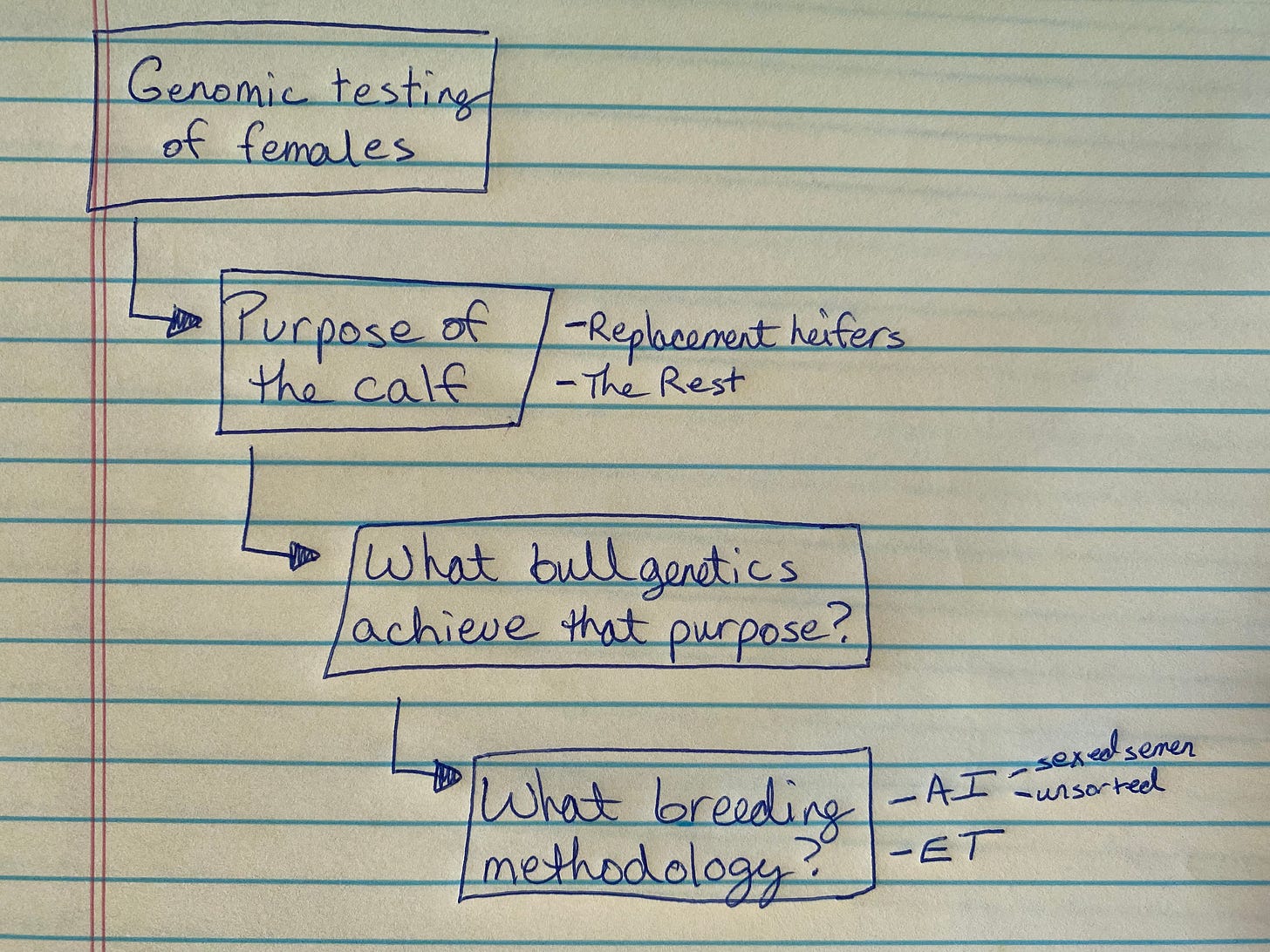
I set out to create a simple decision tree to illustrate the discrete decisions in building a genetics strategy and execution plan. But – shocker – turns out that it’s more complicated than that, way more complicated. So instead here’s a rough sketch of the high level decision flow as I understand it:

AI = artificial insemination. ET = embryo transfer.

Let’s break that down.

What is the genetic potential of this cow/heifer?

Until genomic testing became wide spread, the decision of which bull genetics to use via AI was the primary decision – that was kinda it. Genomic testing flipped the script by unlocking a preliminary decision point about every female. Genomic testing allows the producer to understand the right place in the dairy’s genetic program for each individual heifer/cow based on her genetic potential. This serves as the foundation of the strategy because it sets up the next question….

What is the purpose of the calf?

If genomic testing indicates a heifer/cow is top shelf genetically, the producer will likely make breeding decisions with the objective of getting a replacement heifer from her. If she’s not, then she just needs to produce a non-replacement heifer calf, one of ‘The Rest’. The question ‘what is the purpose of the calf?’ leads us to 3 layers:

  1. Get the cow lactating. This is the obvious purpose of breeding a cow on a dairy farm but I’m calling it out here to keep the main thing the main thing: milk production. All calves share this purpose. But now we can further subdivide to:
  2. Produce Replacement Heifers. This is the long term play, to optimize the herd over time by doubling down on dams that are genetically superior to continue advancing the quality of the herd.
  3. Capture value from ‘The Rest’ of the calves. This is about optimizing short term revenue by optimizing the value of offspring that are not bred specifically for replacement heifers. Let’s say a Holstein calf is worth $60 and a Holstein x Angus calf is worth $175….we can breed a cow for either output but the $115 differential represent real dollars on the table that in a thin margin environment can make really meaningful impact on profitability. (Should we call that Holstein x Angus a ‘Hogus’? A ‘Hangus’? Nah?)

So the genomic testing of the dam dictates the purpose of the offspring which leads to…

What bull genetics achieve the purpose?

The purpose of the calf – Replacement Heifer or The Rest – drives the decision on what bull genetics are required to achieve that purpose. Primo or average dairy sire? Primo or average beef sire? This is the same decision point that dairy producers have been exercising since adopting AI as the path to genetic improvement, decades ago…there are just more options now for breeding methodology.

And that leads us to the mechanics….

What breeding methodology is right?

This decision point bifurcates (<— favorite word in the English language) into:

  1. AI or ET?
  2. If AI, whether to use sexed semen or non sorted semen? Sexed semen is the enabling technology for separating a dairy herd and using replacement heifer

The outcomes of this portfolio of (admittedly oversimplified) decisions delivers ~5 million calves annually into the US that fit into the following 3 buckets:

  1. Dairy calves
  2. Beef x Dairy cross calves
  3. Beef calves

We don’t really know how many calves dairies produce for each bucket today, but we DO know the Dairy bucket is decreasing as the Dairy x Beef bucket increases. Which leads to that 3rd bucket of straight beef calves where the value of the calf converges with breeding technology….

Technology + Market

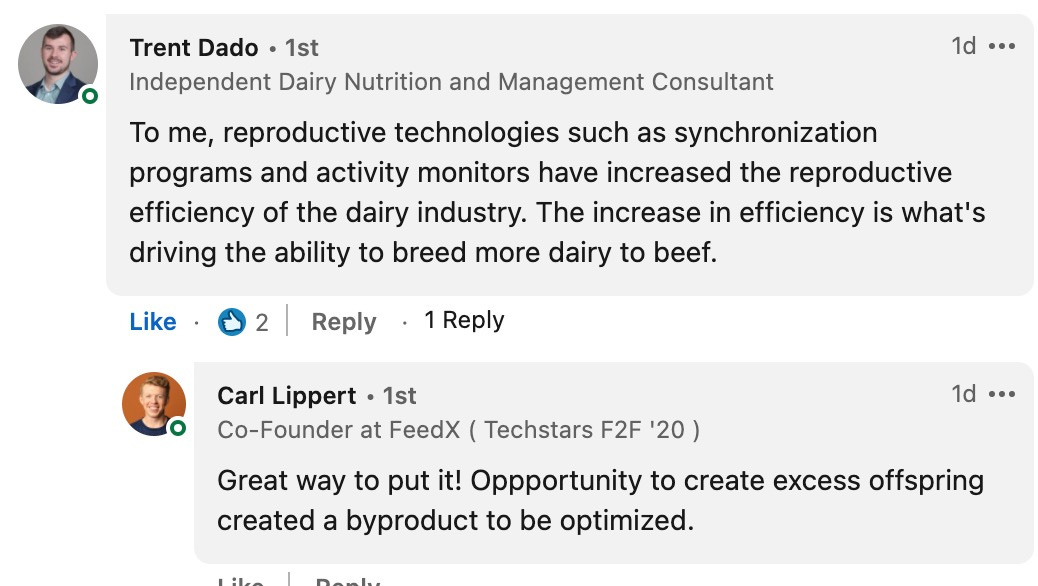
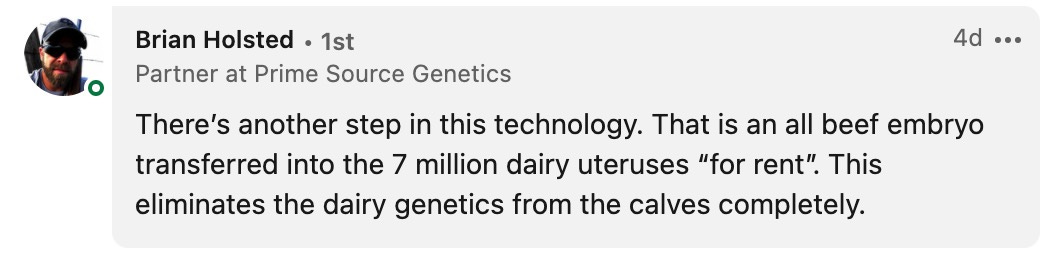
In the comments above from LinkedIn, the idea of 7 million dairy uteruses ‘for rent’ was mentioned. The idea would be that 3M of the 10M dairy cows would be bred for replacement heifers, and the remaining dairy cows would be recipient cows for a beef x beef embryo. That’s the extreme scenario where breeding technology (embryo transfer) and market optimization (produce as many higher value beef calves as possible) intersect.

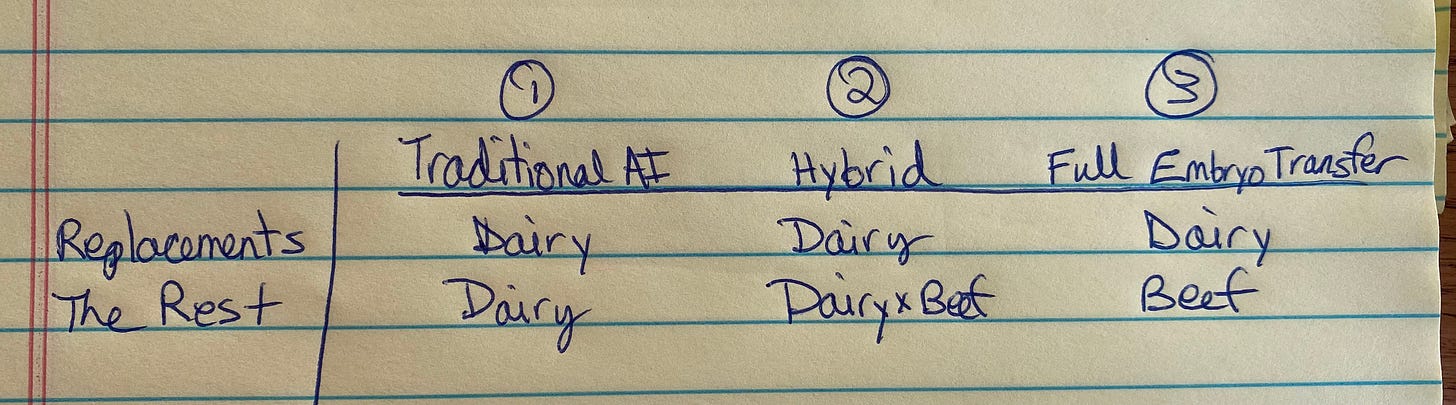
Here’s a visualization of how each breeding methodology & genetics strategy could impact ‘The Rest’ of calves produced by dairies, that extreme scenario is at the far right:

Think about that – what if there was a shift from the left scenario of ~5M straight DAIRY calves (let’s say this was the default scenario until the last decade when beef on dairy began growing) to that far right scenario where there are ~7M straight BEEF calves entering the value chain? 🤯

But while embryo transfer for 100% of the US dairy herd might be technologically possible, is it viable economically? Where is the market meaningfully incentivizing adoption of that type of program?

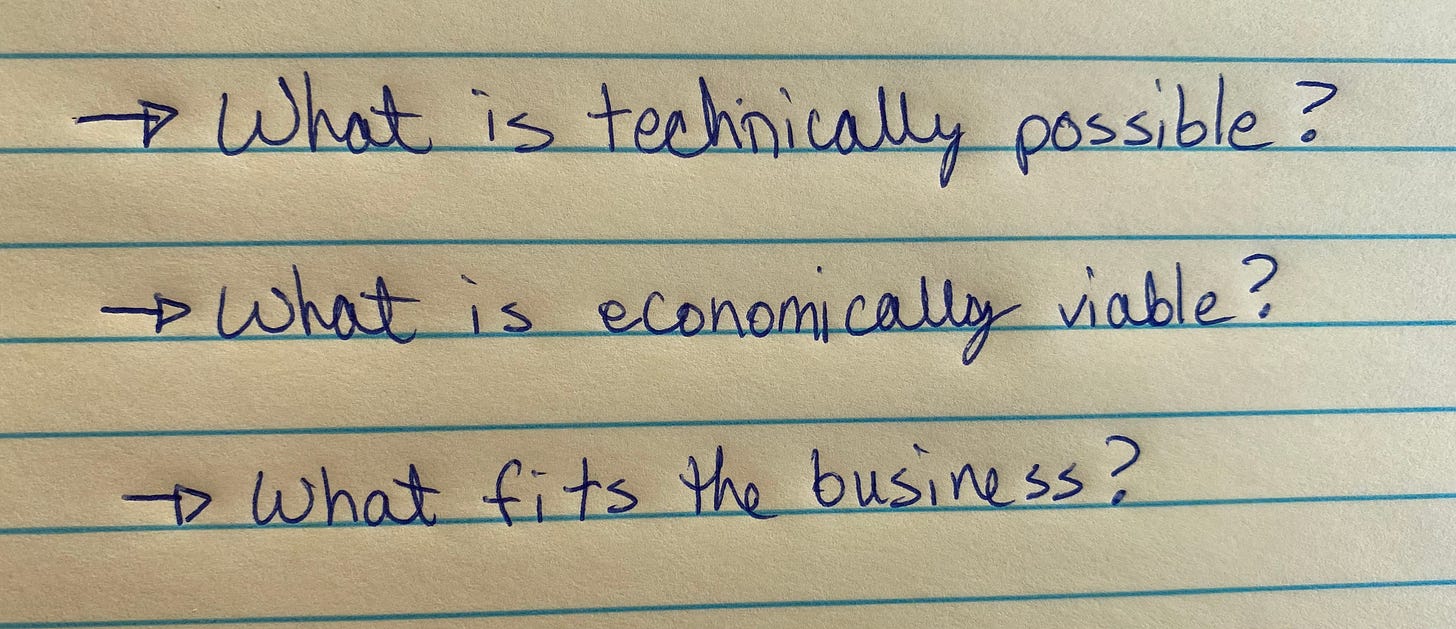
Again this is over simplified, but ultimately the dairy producer is navigating these 3 screens to design their genetics strategy:

‘What fits the business’ can be any operational criteria from cost (cash flow management) to facilities to staffing, etc. that an individual dairy would have. No news flash here but ANY innovation at the farm level has to fit the day in day out operations of the farm.

Compound Genetics

Interest isn’t the only thing that compounds, so does genetic improvement. If the more complex genetic strategies lead to an annual increase of x% more genetic improvement than traditional strategies, then over time that x% improvement will compound. And if the more complex strategies lend themselves to larger dairies who can implement those strategies more cost effectively, how will this impact further consolidation?

Wisdom of the crowd

I hope you are geeking out on this topic as much as I am, it’s fascinating, right?? As I continue digging in, here are questions I’d love to get your perspective on:

  • What decision points are missing above?
  • What are the frameworks that innovative producers are using to make those decisions?
  • How do the decision points for dairy producers vary among different types of dairy farms?
  • How is this trend playing out in other dairy & beef producing regions of the world?

I’m interested in all things technology, innovation, and every element of the animal protein value chain. I grew up on a farm in Arizona, spent my early career with Elanco, Cargill, & McDonald’s before moving into the world of early stage Agtech startups.

I’m currently on the Merck Animal Health Ventures team. Prime Future is where I learn out loud. It represents my personal views only, which are subject to change…’strong convictions, loosely held’.

Thanks for being here,

Janette Barnard

Categories
Animal AgTech Genetics

Prime Future 63: If dairy is the new beef, are cow-calf producers necessary?

Hypothesis: the biggest threat to cow-calf producers is neither packer consolidation nor alternative proteins. The biggest threat to cow-calf producers is dairy producers who are increasingly deploying the 'beef on dairy' genetics strategy which will allow them to own the beef calf market, creating an existential threat for cow-calf producers.

That was my hypothesis when I sat down to write this piece.

Before we get into whether this hypothesis is reasonable or not, here’s a quick review of the beef on dairy strategy:

“In dairy herds, a sustainable breeding strategy could combine usage of sexed semen to generate replacement heifers only, and usage of beef semen on all dams that are not suitable for generating replacements. This results in increased genetic gain in dairy herd, increased value of beef output from the dairy herd, and reduced greenhouse gas emissions from beef.”

(We recently looked into the 3 mega phases of genetics revolution in dairy cattle that led to the beef on dairy trend.)

One more idea before we get to whether cow-calf producers have a future or not, an idea from “Loonshots: How to Nurture the Crazy Ideas That Win Wars, Cure Diseases, and Transform Industries” is that innovation falls in two buckets:

  • P-type innovation which are product innovations, like the invention of the jet engine
  • S-type innovation which are business model innovations, like the idea of an airline that would not use the hub & spoke model and only offer low cost direct flights

The interesting thing about the beef-on-dairy strategy is that the two enabling technologies were P-type innovations: genomics and sexed semen.

But now as producers adopt those products, we’re looking at S-type innovations playing out in real time which is likely to lead to more S-type innovations across beef and dairy value chains.

Back to my hypothesis. Let’s do some napkin math, and use the most extreme assumption that 100% of US dairy producers will apply the beef on dairy strategy to 100% of their herd. (For the purpose of thinking about the potential impacts of a trend, it’s helpful to play it out to the extremes even if highly unlikely.)

Using extreme and very round numbers, here’s some math:

  • There are 10 million dairy cows in the US. Let’s say 30% of those cows are replaced by heifers every year. All 10 million cows need to have a calf, but only 3M of those calves need to be female to be kept as replacement heifers and maintain current production levels (10M * .3 = 3M). Let’s say the remaining 7M calves NOT being kept as replacement heifers flow into the beef value chain (10M – 3M = 7M).
  • If today there are ~5M dairy calves that flow into the beef supply chain already, or ~50% of the 10M dairy calves born annually then it looks like beef-on-dairy only adds 2M additional beef-dairy cross calves per year into the beef value chain (7M – 5M = 2M). However a big caveat is that there is already a reasonable % of the 5M dairy calves that are actually beef-dairy crosses, though there’s no good estimate of what that number is. Regardless…
  • If ~25M beef animals are finished in feedyards annually, and the most dairy can contribute (in pure dairy or beef-dairy crosses) is 7M then that leaves a minimum of 18M calves per year needed from cow-calf producers.

Napkin math shows that my hypothesis that dairy producers pose an existential threat to cow-calf producers is wrong.

Cow-calf producers will continue to be a necessary segment of the beef value chain.

But even if beef-on-dairy does not create an existential threat to cow-calf producers, there will be implications and ripples felt across the beef and dairy industries. This week’s newsletter is the start of a series exploring those implications and ripples.

Here are some questions I’m interested in:

  • How viable is the sustainability hypothesis behind on beef-on-dairy? Cargill is making a bet on beef on dairy as a sustainability play, will others?
  • What are the limiting factors for beef-on-dairy growth?
  • Alternative milk now has ~16% share of the milk market, if beef and dairy become even more enmeshed than they already are, how could change in milk demand impact beef? If the primary link today is ground beef, what happens when the link expands?
  • What does it mean for cattle feeders to have 3 distinct types of potential calves to feed: beef, dairy, beef-dairy crosses? For packers to have those 3 types of fed cattle to process?
  • What are the positive/negative impacts felt through the value chain from an increase in beef on dairy? From dairy producers to feedyards to packers.
  • How will profit drivers be impacted? From live performance metrics to carcass yield and grade. How will management of these metrics change?

If you have insights or opinions on any of those questions, please reach out – I’d love to get your thoughts. Or, if you have other questions to explore about this space.

An important caveat to this conversation is that beef-on-dairy is not new. It was first discussed in the early 2000’s and how slowly increased over time. But it feels like we’re at an inflection point and adoption is accelerating rapidly.

“The future is here, it’s just unevenly distributed.”


I’m interested in all things technology, innovation, and every element of the animal protein value chain. I grew up on a farm in Arizona, spent my early career with Elanco, Cargill, & McDonald’s before moving into the world of early stage startups.

I’m currently on the Merck Animal Health Ventures team. Prime Future is where I learn out loud. It represents my personal views only, which are subject to change…’strong convictions, loosely held’.

Thanks for being here,

Janette Barnard
Categories
Animal AgTech

Prime Future 62: Tech can’t make it rain.

We’ve had 7 inches of rain in the last month, more than the previous 22 months combined. Pastures are green, stock ponds are full, ranchers are elated.

that’s not a pond tho…just some ocean front property in Arizona

It’s been a long time since I lived on the farm and felt the angst of drought up close. For the last several years I’ve lived in the agtech world where it’s all optimization and transformation and precision management of variables.

But all the tech in the world can’t solve the biggest problem that has plagued much of the American West in recent months/years: drought.

Sure, sensors can help farmers optimize irrigation or remotely detect water levels in stock tanks and AI models can better forecast market prices based on weather patterns or facilitate better management of financial risk associated with weather. That is all good and well and high value in the right situations, but it doesn’t solve the Mega Problem in a drought: rain.

Tech can solve a lot of problems, but tech can’t make it rain.

In agriculture, nature usually gets the last word. Talk to any producer who’s been at it for more than a minute and they have a war story or ten of when nature flexed with an untimely drought or flood, heat wave or blizzard, derecho or tornado, and so on the list goes. (On the flip side, most have been on the receiving end of a market that was positively tipped in their direction by nature’s punk behavior in another part of the world but we don’t usually talk about that.)

No newsflash here, but nature is unpredictable and dramatic with a tendency to be wildly inconvenient. Nature never reads a business plan or considers the market or accounts for global supply & demand conditions. Nature just does what nature does – perhaps that’s even a feature not a bug?

Great management practices & smart tech products allow producers to be more prepared for the unexpected or to handle the unexpected more effectively, but they are ultimately powerless to dictate Nature’s whims. Even in ‘controlled environment’ poultry & swine housing, weather can still wreak havoc on performance and/or costs.

Nature is uncontrollable, yet holds enormous control over production outcomes.

So what? I think this reality has to shape our mental models:

  1. That nature is uncontrollable yet holds enormous control over production outcomes, is all the more reason for producers to control the controllable, to optimize the optimizable, to precisely manage the manageable.
  2. That nature is uncontrollable yet holds enormous control over production outcomes means that there is a level of humility required, especially in agtech. Not everything can be solved by a better algorithm. I think sometimes we forget this.

Tech can solve a lot of problems, but tech can’t make it rain.


I’m interested in all things technology, innovation, and every element of the animal protein value chain. I grew up on a farm in Arizona, spent my early career with Elanco, Cargill, & McDonald’s before moving into the world of early stage startups.

I’m currently on the Merck Animal Health Ventures team. Prime Future is where I learn out loud. It represents my personal views only, which are subject to change…’strong convictions, loosely held’.

Thanks for being here,

Janette Barnard
Categories
Business Model Innovation Leadership

Prime Future 61: Egos & incentives

Sometimes in the B2B world it’s easy to assume business decisions are driven solely by an ROI calculation, neatly tied with an Excel bow around a carefully curated formula. Or in the farm world, that every decision is justified by the output of the almighty shirt pocket calculator.

But in the real world, rarely can an ROI be fully captured numerically. Other factors impact decisions, including the psychological factors. I summarize this as Egos & Incentives.

Numerical ROI is necessary, but it’s not sufficient. At the margin, decisions are made based on their impact to our egos and incentives, including decisions about adopting new products, practices or ideas:

  • Incentives: How does this help me achieve what I’m incentivized to achieve, what I want to achieve?
  • Egos: How does this impact my view of myself and my place in the world, aka my ego?

We’re all out here responding to incentives, intentionally or unintentionally, doing the things to get the job, the bonus, the contract, the new customer, the promotion, the upsell, the renewal, the fill in the blank. And no surprise, we all have egos. Every last one of us, even those who say they don’t (perhaps especially those). The advertising industry is built around these fundamental truths of human nature.

And though it can be framed at an individual level, I believe it’s just as true at an organizational level because, of course, organizations are just big groups of individuals, still responding to egos and incentives.

Sarah Nolet & Matthew Pryor, partners in Tenacious Ventures, described this dynamic in the context of agtech adoption quite elegantly:

“The wine industry presents an illustrative example. Wine makers often contract the growing of some or all of their grapes to other growers. This makes sense to get to scale and mitigate risk, but this distributed production method poses serious challenges for managing the cost and quality of wine making. Despite the fact that good tools are available to assess grape quality and yield as harvest approaches, individual growers are not likely to take them up as the ROI for their business is not strong enough. For the wine maker, though, these tools are invaluable: over supply, under supply, and poor grape quality all have major financial implications for winemakers. In other words, though the growers are the users, the real beneficiary is the winemaker. Therefore, until winemakers create incentives, and perhaps even supply the tools directly to the growers, growers are unlikely to adopt and the benefits from far greater visibility of the yield and quality of the coming harvest will remain unrealized.

Another notable characteristic of agtech 1.0 was that as this dynamic played out again and again, agtech companies (and their investors) blamed the farmers! Agtech conferences and industry reports featured claims about “laggards,” pointing fingers at the users for being “traditional” and “resistant to change” in an industry “based on handshakes.” In reality, the problems were with business models and incentive alignment.”

Their example describes the exact dynamic that trips up so many technology creators in livestock. The sentiment from creators goes something like this: ‘We made this widget for producers that is really beneficial to everyone but only kinda to the producer. Also we built our business model so the producer pays for the product and the rest of the value chain gets the value. Also also it’s SO weird how producers aren’t interested in our technology, what laggards🙄.’

The fundamental question to ask about new products is, where does value accrue and where is cost incurred?  If the packer accrues the value but the producer incurs the cost, well….that’s probably not going to go well because incentives are not aligned. The challenge of incentive alignment is why business model innovation can be just as high impact as tech innovation, if not more so.

This dynamic extends from adoption of new products to adoption of new practices. Silver Fern Farms, New Zealand’s largest meat processor, recently announced their planned launch of Net Zero Carbon Beef. The most interesting part of the story was this little line:

“Silver Fern Farms is committed to supporting our farmers to contribute to these goals, through knowledge transfer and market-led incentives"

Did you catch that phrase missing from most announcements around carbon/sustainability/any type of change requested of a supply chain?

Market-led incentives.

I asked Nick Rowe, Innovation Manager at Silver Fern Farms, for some background on the program. Here’s what he said:

“When we derive an in-market premium we will share that value with the supply chain (consumers, customers and farmers) on our path to a regenerative future. Without the incentive, it’s hard to drive change. People won’t change the way they do things unless they are incentivized to do so. We are launching net zero carbon beef that makes sense commercially.”

That is the most effective model to drive behavior change in a supply chain, regardless of the behavior.

All that said, what ARE producer’s incentives? The universal incentives are around generating revenue, increasing pounds or increasing $/lb, maintaining a customer, growing market share, etc but of course every individual producer has unique incentives and is prioritizing those incentives in a unique way. Related: feeding the world is not on anyone’s incentives bingo card, neither is curbing climate change or any other macro good. That’s why those macro problems have to be broken down to specific problems for specific someones, or specific incentives for specific someones.

Which brings us to ego. In agtech where ego can become a road blocker is around decision support tools. IMO these are some of the most challenging products to sell because in order for the product to be high value, it has to support high value decisions. And high value decisions tend to be high risk decisions. And high risk decisions tend to be deeply personal, whether a decision to sell a 1 billion bushels of corn or 10 weaned calves.

ICYMI Prime Future

The 2 most soul crushing words an innovator can hear 😳
You describe a concept for a tech solution to a prospective customer or show them an early version of the product. What’s the worst response you could get? “That’s interesting.” It would be better to have a full cup of lukewarm coffee thrown in your face so at least you know definitively that you need to go back to the whiteboard. An enthusiastic YES or…

Read more

Excerpt from 👆🏼 this piece:

I once asked a feed yard manager if this (when to sell cattle) was a decision where analytics could help drive a more precise & profitable decision. His reply was “probably not, we’re good at this decision.” I asked how they know if they made the optimally timed decision and he replied “well, did we make money?”

And THAT is the fatal trap for any analytics product. If there’s no control to compare against, how does the user know what money has been left on the table? If the opportunity cost is undefined, how does the prospective user determine if an analytics tool makes them any better at making the difficult decisions than the hard earned insights from the school of hard knocks? The burden of proof rests on the innovator.

That excerpt describes the value proposition challenge for decision support tools, but in my experience there are always ego impacts to consider – whether it’s the software tool to help asset managers make better trading decisions or the software tool to help the crop farmer determine the optimal time to irrigate. The ego objections are usually some variations around relevance (does this tool make me or my hard won insights less important in the world?) and skill (how will my team build their hard won insights if they have tools to help them?). (Though the skill objection is like people back in the day worrying that kids will get worse at math if they use a calculator.)

Creators of decision support tools have to take into account the ego considerations in everything from product design to marketing.

Here’s the second part of Nick’s comments that struck me:

“Net zero carbon beef is really an extension of our journey to provide consumers with branded meat they can trust is better for them and ultimately the planet – it was the natural next step. When something is hard and we don’t have all the answers it takes people with a pioneering ethos and a company that is not scared of leading, to take charge and drive change.”

Yes, “we’ve always done it this way” is real and maybe it is more prevalent in ag than other industries – though I’m not entirely convinced that’s true. But the forward thinking, innovating early adopters are also real. And the burden of adoption rests on the creators of new products and the food companies who want to drive new practices to make their value proposition relevant by accounting not just for ROI, but also for egos + incentives.

P.S. If you like thinking about the traps around how businesses or industries structure incentives, then you’ll love this piece from The Hustle.

P.P.S. This:


Welcome to those of you who are new to Prime Future! Many of you found this newsletter through Shane Thomas and his newsletter, Upstream Ag Insights. I highly recommend subscribing to Upstream Ag Insights if you don’t already – he writes on all things agtech on the crop side of the industry with a lens on agribusiness strategy.


I’m interested in all things technology, innovation, and every element of the animal protein value chain. I grew up on a farm in Arizona, spent my early career with Elanco, Cargill, & McDonald’s before moving into the world of early stage startups.

I’m currently on the Merck Animal Health Ventures team. Prime Future is where I learn out loud. It represents my personal views only, which are subject to change…’strong convictions, loosely held’.

Thanks for being here,

Janette Barnard

Categories
D2C Meat

Prime Future 60: Tighten the packer feedback loop

In early 2020 I went down the rabbit hole of exploring what D2C might mean for the meat business. Today I want to revisit some ideas from way back then but with the benefit of a little hindsight after the trend wildly accelerated during the pandemic. This tweet sets the directional stage for the obviousness that D2C is, and will continue to be, a thing for all segments, including meat:

So here’s the quick recap of my no longer provocative hypothesis:

Hypothesis: Direct to Consumer (D2C) business models will be a high growth sales channel for all meat & poultry companies within 5 years.

And to capitalize on the D2C trend, packers must get serious about building capability…soon.

For those who might say this market is still too small for packers to pay attention yet, remember in part 1 we talked about the Innovator’s Dilemma. Quick summary:

“Established companies see the early trends of new markets, they are just not structured or incentivized to act on them. Leaders at established companies must focus on market share and profitability of today’s largest customers & segments….not tomorrow’s.”

Given that D2C is definitively not going to suddenly be the largest sales segment overnight, why should packers focus there?

There are 2 obvious reasons:

  1. If COVID has taught us anything, its that a large segment of consumers are comfortable ordering online and want more ways to secure access to protein.
  2. As more companies seek to build brands and move closer to the consumer in order to increase margin, D2C presents an obvious opportunity.

Now let’s transition to the still relevant & under-appreciated elements around D2C, starting with this:

There’s a less obvious reason for packers to bet on D2C, one that could impact the packer’s ability to serve their entire customer portfolio.

The strategic reason to engage in D2C is to drastically increase visibility into consumer behavior.

To illustrate this point, here’s a case study from the insurance industry.

Back in the day insurance carriers built out the agent distribution system, so products and processes were built for selling through the distribution system. The carriers receive data related to policies sold. Now, many carriers are trying to figure out how to layer digital into the customer experience but its….clunky.

Contrast this with Lemonade, the homeowners insurance startup with a digital first experience for buyers that’s grown from $0 to $100M revenue in 3 years. As a digital first experience, shoppers not only buy their policy online, they also file claims online, most of which are settled with incredible speed.

So what? In its few years in existence, Lemonade has captured data about buyer behavior that provides them better insight to their buyer than the mega companies who have been in existence for decades.

Take <insert 100+ yr old insurance company>. That company captures data about buyers who purchased a policy. That’s it.

Meanwhile Lemonade is able to understand exactly how buyers moved through every inch of the buying process, such as:

  1. What options did they consider? Did they select one before going back to select another?
  2. Which options did the buyer take the most time to select?
  3. How far did the buyer get in the process before dropping out entirely?

And that’s just the tip of the iceberg.

This treasure trove of data informs Lemonade’s understanding of their target customer including buying behavior, which then informs Lemonade’s ability to improve the customer experience through better processes AND better products. The power of a shortened feedback loop.

Now let’s do the meat industry. Packers get point of sale data from retailers that tells them what a customer bought…that’s it. Meanwhile <name your digital first D2C company> understands the buyer’s behavior at a granular level, including which cuts a customer almost bought but didn’t, which cuts a customer bought once but never repeated, etc, etc, etc.

Think about how a packer could build a compelling competitive advantage in terms of marketing and product development not just in their D2C channel, but across retail and foodservice as well. Unlocking the power of a shortened feedback loop could power innovation and growth across the entire customer portfolio.

The packers are now dabbling with their 2 primary options:

  1. Supply a growing D2C platform as a customer
  2. Build their own D2C platform

Packers are approaching this opportunity differently, but it doesn’t take a crystal ball to see that this trend is here to stay.

My curiosity is not in how packers continue engaging this sales channel, but how the sales channel will impact their broader business via shortened feedback loops…and how might those impacts flow upstream to producers.

Here’s the original 3 part series on D2C & what it could mean for packers and producers:

  1. A D2C revolution is on its way
  2. The real reason packers should go all in on D2C
  3. Capturing the D2C Market: Farmers vs Packers

I’m interested in all things technology, innovation, and every element of the animal protein value chain. I grew up on a farm in Arizona, spent my early career with Elanco, Cargill, & McDonald’s before moving into the world of early stage startups.

I’m currently on the Merck Animal Health Ventures team. Prime Future is where I learn out loud. It represents my personal views only, which are subject to change…’strong convictions, loosely held’.

Thanks for being here,

Janette Barnard

Categories
Animal AgTech Genetics

Prime Future 59: Will CRISPR find its legs in livestock?

My interest in science took a nose dive in high school biology when life science seemed contained to owl pellets and dead frogs, which didn’t seem to be the stuff of world changing significance. But reading the new Walter Isaacson book “The Code Breaker” on the people & events that led to the discovery of CRISPR had a much more inspiring effect than Mrs. Rigg’s biology class. Even though the book focuses on the potential uses of CRISPR in humans, my mind has been spinning around the potential uses in livestock.

First, what is CRISPR? It describes a a type of DNA sequences, more specifically:

“CRISPR systems were a way that bacteria acquired immunity to viruses. …found that bacteria with the CRISPR spacer sequences seemed to be immune from infection by a virus that had the same sequence. CRISPR associated enzymes (Cas) enable the system to cut and paste new memories of viruses that attack bacteria. They also create short segments of RNA that can guide a scissors-like enzyme to a dangerous virus and cut up its genetic material. Presto!”

If DNA is kinda there for documentation, RNA is the molecular workhorse, hustling & getting the right messages to the right places. The understanding of how CRISPR segments of DNA give RNA the information to get to work was the foundation that led scientists to ask how CRISPR could be used for gene editing by directing RNA to make good things happen. (or at least that’s my non-scientific understanding)

It doesn’t take much creativity to imagine the many ethical questions around any type of gene editing or the ways RNA could be re-directed for questionable or downright terrible uses. (Interestingly, Isaacson says the US Department of Defense is one of the major funders of CRISPR research, centered around finding ways to prevent its misuse.) But we’ll leave those questions to others, we’re interested in possibilities.

The Isaacson book focuses on human uses for CRISPR, only using the word agriculture once and almost as an afterthought. So, let’s brainstorm how a tiny little biochemical thingamajig could be used to make a potentially big impact in livestock, meat & dairy.

(Heads up: I’m not constraining this list to any nonsensical details like what’s scientifically possible 🙃)

  • Efficiency. The most obvious and least exciting use for CRISPR is to improve efficiency of production metrics like growth rates or feed conversion or carcass yield. Could beef someday have the same feed conversion as chicken, or even fish?
  • Quality improvements. Can gene editing increase meat tenderness in certain cuts? Increase flavor in pork? Eliminate that nagging issue of woody breast in chicken? Could CRISPR unlock the Honeycrisp apple of the meat case?
  • Health management. Imagine if you could eliminate Mastitis in dairy cows, or BRD in beef cattle, or ASF or PRRS in swine, or Coccidiosis in poultry…all of which have massive economic impact around the globe.
  • Methane emissions.  Could CRISPR gene editing somehow (magically?) reduce methane emissions and put that whole issue to pasture?
  • Demand response. Imagine you could use gene editing to get more of what the market is asking for, like more loin per carcass for a higher ratio of high value middle meats in beef & pork. Or let’s throw common sense to the wind – what if you could get more wings per bird? That would look pretty good in times when wings trade at $3/lb and breast meat trades at $1.

Let’s say some of those applications are scientifically possible. The next question is, what applications will be allowed? There are two stakeholder groups that will ultimately determine the future of CRISPR in livestock, and the importance of each simply cannot be overstated.

The only way CRISPR can make a meaningful impact is if both regulators and consumers embrace the technology.

  1. Regulators. What will the regulatory framework for CRISPR gene editing in livestock look like and who will oversee it? How will different countries approach it? For use in humans, scientists think of CRISPR having 3 different uses: to prevent disease, to treat disease, or for enhancements like making your offspring taller, smarter, stronger, etc. (Obviously there are varied opinions among the CRISPR scientific community about using it only for disease prevention & treatment to alleviate human suffering, rather than selecting for certain characteristics because we can.) Another screen, and debated distinction, is whether gene editing will impact only that patient/generation (somatic editing) or if it will impact that patient/generation and all future offspring (germline editing). If similar screens are applied in livestock, the list of possible CRISPR use cases would change.
  2. Consumers. If GMOs in plant breeding signals how CRISPR might be viewed in livestock, then the odds of widespread consumer acceptance of CRISPR editing in livestock are less than my chances of competing in the 2021 Olympics. The staggering advantages of GMO’s in crop production – less resource use per unit of production – have not satisfied the anti-GMO camp enough to offset their concerns of genetic modification. Good science has not been enough for a good outcome.

However, there’s one factor in livestock that isn’t part of the equation for crops, and that is animal welfare. How will the risk/reward equation adjust itself if CRISPR provides ways to reduce animal disease and therefore improve animal well being?

More broadly, what can we learn about what not to do from the GMO plant situation? Could meat companies more effectively market CRISPR enabled results than seed companies marketed GMO enabled yield increases? An ominous sign for any scientific breakthrough is the amount of COVID vaccine disinformation readily consumed via social media, then digested & regurgitated even by smart & logical people. So I don’t know, maybe we just can’t have nice things?

Ultimately societal consensus around how CRISPR should be used in humans is likely to drive the degree of acceptance of CRISPR use in livestock.

The book was particularly interesting in light of the role RNA has played in fighting COVID. Isaacson summarizes the mRNA vaccine technology, “Now scientists had found a way to enlist RNA’s most basic biological function in order to turn our cells into manufacturing plants for the spike protein that would stimulate our immunity to the coronavirus.”

There was also a lot of work done on using CRISPR as a diagnostic tool for COVID, ideally as an at home test with immediate results. Isaacson highlights the belief of some CRISPR scientists who believe the technology will ‘democratize biology for human health’ through personalized diagnostics for in home use:

“The development of home testing kits has a potential impact beyond the fight against COVID: bringing biology into the home, the way that personal computers in the 1970’s brought digital products and services into people’s daily lives and consciousness. Home testing kits could become the platform, operating system, and form factor that will allow us to weave the wonders of molecular biology into our daily lives. Developers and entrepreneurs may someday be able to use CRISPR-based home testing kits as platforms on which to build a variety of biomedical apps: virus detection, disease diagnosis, cancer screening, nutritional analysis, microbiome assessments, and genetic tests.”

Whether or not – or at what time horizon – that happens, if it can happen in human use why can’t it happen in some modified way in livestock?

What’s your hypothesis on where, how, & why CRISPR could be useful in livestock?


I’m interested in all things technology, innovation, and every element of the animal protein value chain. I grew up on a farm in Arizona, spent my early career with Elanco, Cargill, & McDonald’s before moving into the world of early stage startups.

I’m currently on the Merck Animal Health Ventures team. Prime Future is where I learn out loud. It represents my personal views only, which are subject to change…’strong convictions, loosely held’.

Thanks for being here,

Janette Barnard
Categories
Genetics

Prime Future 58: Cattle collision: where the digital revolution meets the genetic revolution

My working hypothesis is that the best way to imagine the future is to better understand the past and what’s led to the present. “What got us Here won’t get us There” is undeniably true. Yet, understanding the how’s & why’s that got us Here might provide nuanced clues about getting There.

With that, let’s take a quick tour through two seemingly disconnected histories to grab the takeaways most relevant to the future of livestock production.

Digital revolution

In The Innovators, author Walter Isaacson walks through the many breakthroughs (both obviously significant and seemingly small) from the 1850’s to today that have led to the digital revolution. Here’s the cliff notes on that progression:

  • The computer. Although the idea for a computing machine was first published in 1837, the 1890 consensus was tabulated in 1 year rather than 8 years by using a primitive computer designed by a fella that later founded a company that would become IBM.
  • Transistor. “The advent of transistors and the subsequent innovations that allowed millions of them to be etched into tiny microchips, meant that the processing power could be nestled inside the nose cone of rocket ships and in computers that sit on your lap.” Discovered in AT&T’s Bell Labs, the transistor allowed the cost and complexity of computers to massively shrink. Pocket radios were the use case that made transistors widely used which dropped the cost further.
  • Microchip. The microchip was an integrated circuit that simplified the computer’s innards down from 10,000 little components with 100,000 hand soldered wires connecting them. Another critical step in increasing power, decreasing complexity & size, and decreasing cost. The military & NASA were the first big customers, using microchips for missiles & rockets until the cost of microchips declined enough for consumer products. The market that was tapped to create high demand – and reliable demand – in order to decrease the cost per microchip? Pocket calculators.
  • Internet. The concept of a decentralized network of connected computers was developed in the 1940’s but ARPA made it happen in the late 1960’s, largely for military and academic institutions – individuals still didn’t have computers until…
  • Personal computer. The Steve Jobs part of the story most of us know – his genius was to make the computer accessible to individuals who wanted to open a box and pull out a machine that could be turned on and immediately usable, instead of the hobbyist computer junkies who wanted to build the computer themselves and were the entire market up to that point.
  • Software. The Bill Gates part of the story you may know also. His genius was realizing that hardware would become a commodity, but software is what unlocks value….he certainly wasn’t wrong about that.
  • World wide web. The development of this protocol unlocked the internet in ways that led to our daily experience online today.
  • Cloud computing (this one isn’t included in the book but IMO is as significant as the others)
10/10 recommend this 👆🏼

What does all of that have to do with cattle genetics? Good question….

Cattle Genetics Revolution

I recently spoke with Jerry Thompson and Matthew Cleveland of Genus ABS who generously shared their insights on the 4 big innovation waves that have hit cattle genetics.

Artificial Insemination & EPD’s

What led to widespread adoption of AI in dairy production? (Side note: livestock and tech have *very* different meanings for the letters AI.)

Quick note on EPD’s: Expected progeny differences are predictions of the genetic transmitting ability of a parent to its offspring and are used to make selection decisions for traits desired in the herd. Expected progeny differences (EPDs) have been applied to improve the genetics of beef cattle for almost four decades.

Here’s how Cleveland & Thompson describe the EPD phenomena:

“The ability to calculate EPD’s drastically accelerated AI adoption. AI has been used since the 60’s and 70’s, but in the 80’s and 90’s EPD’s took off as a function of computing power to implement them. We knew how to do EPD’s before but couldn’t do them at scale because the equations were too big. You could calculate for 5 animals by hand but beyond that it was super difficult. That began changing in the early to mid 80’s drove that when universities started putting together computing clusters which enabled calculation of EPD’s. We’ve known for hundreds of years about selective breeding and looking at animal performance but EPD’s were a huge driver of genetic change.”

AI adoption was accelerated by EPD’s which were accelerated by advancements in computing power.

Genomics

Some brief background on genomics from the good folks in extension:

Recently, genomic testing for beef cattle has evolved to include “high-throughput” testing, meaning that thousands of markers (or single nucleotide polymorphisms, or SNPs) are read from an animal’s DNA. Producers need only to submit a blood, hair, or tissue sample from an animal to the breed association. After collection and submission to the respective breed association, samples are submitted to the genotyping laboratory where several thousand markers are read from the DNA extracted from the samples. The most common genomic test available for cattle reads around 50,000 DNA markers or SNPs using a technology embedded in a small chip called a SNP chip.

Having the ability to read thousands of SNPs is a tremendous advantage for producers because most economically important traits like calving ease, dry matter intake, feed efficiency, hot carcass weight, marbling score, and tenderness are controlled by many genes as opposed to a single gene like hide color or horned status. This means that many modern tests can make predictions about the genetic merit of an animal more precisely and at a younger age than traditional expected progeny difference (EPD).

I asked Cleveland & Thompson, what brought about the rise of genomics in cattle?

“Genomics allows rapid genetic progress and have had a huge impact in dairy. Although we’ve been using genomics for close to 30 years, it was on an extremely limited scale because of limited genomic information and cost. The idea of incorporating genomics in commercial breeding programs was published in 2001, but it was largely theoretical. But in 2008, the price of genotyping went down and the first chip became available (for testing of many traits at once). USDA put together groups to genotype the first 1,400 bulls. This started the process toward low cost genotyping with fast computing power. There was great foresight from USDA.

In dairy, genomics have become ubiquitous not only for selection of sires, but also for ranking of commercial herd and selection of dams. We’ve seen hundreds of dairy bull breeders consolidate because the cost to play has gone up massively. You see the genetics companies building in house programs and proprietary genetics just like the pig industry did. The massive consolidation has been easy because of low number of breeds and common selection criteria, plus breeding decisions made on public indices.”

I hadn’t fully appreciated how genomics completely flipped old time lines for genetic progress on their head, nor the level of precision in decision making that genomics unlocks. In Cleveland’s words, here’s why that matters so much:

“The implications are that the rate of improvement continues to accelerate. Whereas historically you needed 5 years to get proof (of animal performance), now producers can make selection decisions a week after birth. Both in terms of genetics at a specialized breeding company and within your own herd to select which cows to breed. So you immediately know the next generation. As calves are born, you conduct genetic testing, rank the calves, then make your sell or keep decisions. Repeat.”

Earlier decisions, faster decisions, better decisions….which creates an easy ROI in dairy.

Sexed semen —> Beef on Dairy

Here’s an overview of sexed semen – what it is and why it matters – from NIH:

“In dairy farming, there is surplus production of unwanted male calves. Incorporating sexed semen into the breeding program can minimize the number of unwanted male dairy calves and reduce dystocia. Sexed semen can be used to generate herd replacements and additional heifers for herd expansion at a faster rate from within the herd, thereby minimizing biosecurity risks associated with bringing in animals from different herds. Furthermore, the use of sexed semen can increase herd genetic gain compared with use of non-sorted semen. In dairy herds, a sustainable breeding strategy could combine usage of sexed semen to generate replacements only, and usage of beef semen on all dams that are not suitable for generating replacements. This results in increased genetic gain in dairy herd, increased value of beef output from the dairy herd, and reduced greenhouse gas emissions from beef.”

Here’s Thompson & Cleveland’s take on the timing & implications of sexed semen in dairy and the rise of beef on dairy breeding programs:

“The idea of sexed semen was 1st presented around 2003. We launched an alternative tech 5 years ago that has accelerated the use of sexed semen, and beef as a strategy for dairy. It is the most profitable option by driving genetic improvement in replacement heifers while maximizing value by creating high value dairy beef calves. There has been massive adoption of sexed semen in beef while sales of conventional dairy semen decrease rapidly. The advanced producers are using the sexed semen and beef strategy which we expect to become ubiquitous in the next 5 years.”

Ok so there’s a 30,000 foot summary of the 3 recent phases of dairy genetics innovation:

  • Phase 1: AI enabled producers to level up their genetics every time a breeding decision is made.
  • Phase 2: Genomics allow producers to assess an animal’s genetic promise as soon as a calf is on the ground which allows them to make faster & better breed/sell decisions.
  • Phase 3: Sexed semen allows producers to only breed dams with the best genetics for replacement heifers and to breed all other dairy cows with beef genetics for a higher value calf.

Meanwhile <10% of beef producers are using AI, let alone more advanced genetic technologies. What would make AI economically meaningful in North America beef industry?

According to Cleveland & Thompson:

“Adoption of AI in beef is not a value proposition question – the value is there. It is a logistics question and an industry mentality question. Accessing additional labor to AI is one barrier for the 700k+ producers in North America.

The beef industry is a long way from having breeding programs like in pigs and poultry with dam lines for maternal traits and sire lines for terminal generations. If that changed, then we’d potentially see increased AI adoption in beef.

Even though beef AI numbers are still low and not moving significantly, some producers have not had bulls on their property since the 1960’s and are solely using AI.”

Although the two histories certainly overlap, the parallels speak to how innovation comes about. What are the takeaways from the digital & genetic revolution in cattle?

  1. 'The street finds its own use for things' is a phrase Isaacson uses in The Innovators. I love it. It’s the idea that technology is just technology without the right market, business model, pricing model, and context. Computing power for calculating EPD’s in cattle….can we all agree that was not a use case anywhere on the radar of the early creators of computers? The street finds its own use.
  2. The future is here, it’s just not evenly distributed.’ Beef on dairy is being talked about more today, even tho it’s existed as a concept for 20+ years. Pick 10 other technologies that will likely play a big role in the future and they are probably just now in their awkward adolescent years finding their place in the world, from Artificial Intelligence to Machine Learning to blockchain to CRISPR….they’re here, they’re not yet everywhere though.
  3. Collaboration. Whether among institutions (academia, govt, individuals, big companies or startups) or among individuals, all of these innovations evolved through collaboration. As Isaacson says, “The main lesson to draw from the birth of computers is that innovation is usually a group effort, involving collaboration between visionaries and engineers, and that creativity comes from drawing on many sources. Only in storybooks do inventions come like a thunderbolt.”
  4. Execution > ideas. Many people had the idea of the computer (or almost any other invention) but few brought it to life. Execution is where the magic happens – like the mastermind behind getting microchips into personal calculators knowing that would create high demand which would allow them to decrease the cost which would allow them to find more use cases…brilliant.
  5. Most innovation is evolutionary rather than revolutionary. New breakthroughs build on previous breakthroughs. We’re all standing on the shoulders of giants.

I’m interested in all things technology, innovation, and every element of the animal protein value chain. I grew up on a farm in Arizona, spent my early career with Elanco, Cargill, & McDonald’s before moving into the world of early stage startups and venture capital.

I’m currently on the Merck Animal Health Ventures team. Prime Future is where I learn out loud. It represents my personal views only, which are subject to change….strong convictions, loosely held.

Thanks for being here,

Janette Barnard

Categories
Business Model Innovation Meat

Prime Future 57: The packers get Standard Oil’d. Then what?

This is neither political commentary or prediction. This is a look at the hypothetical implications of a hypothetical scenario that has a zero percent chance of happening.


If an oligopoly market is when 4 firms have 50+ percent share, then US beef, pork, and poultry are undeniable oligopolies. These concentrated markets aren’t uncommon though, we run into them from cereal (Kellogg’s, General Mills, Post, and Quaker) to cell phones (Apple, Samsung, Huawei).

But these examples are child’s play compared to the most extreme example of market power: the classic story of Standard Oil. In the 1880’s, John D. Rockefeller realized the oil business was a fantastic business except for the nagging issue of price volatility. So he found a solution to that little problem, by developing an effective monopoly through the Standard Oil trust. A Supreme Court ruling in 1911 forced the trust to split into 34 companies to increase market competition.

The current rally cry of many US producers is that the problem with the cattle business is concentration among the packers. This is not new; tale as old as time. But carry that rally cry out to the most extreme outcome of de-concentrating processing capacity….what does it really solve?

Just for fun, let’s say the DOJ goes full 1911 and ‘Standard Oils’ the meat industry.

Every plant becomes its own company.

The ‘Big 4’ become the ‘Midsize 22’.

Then what? Before we lock into any hypotheses about a re-fragmented meat industry, what was the result of busting the Standard Oil trust?

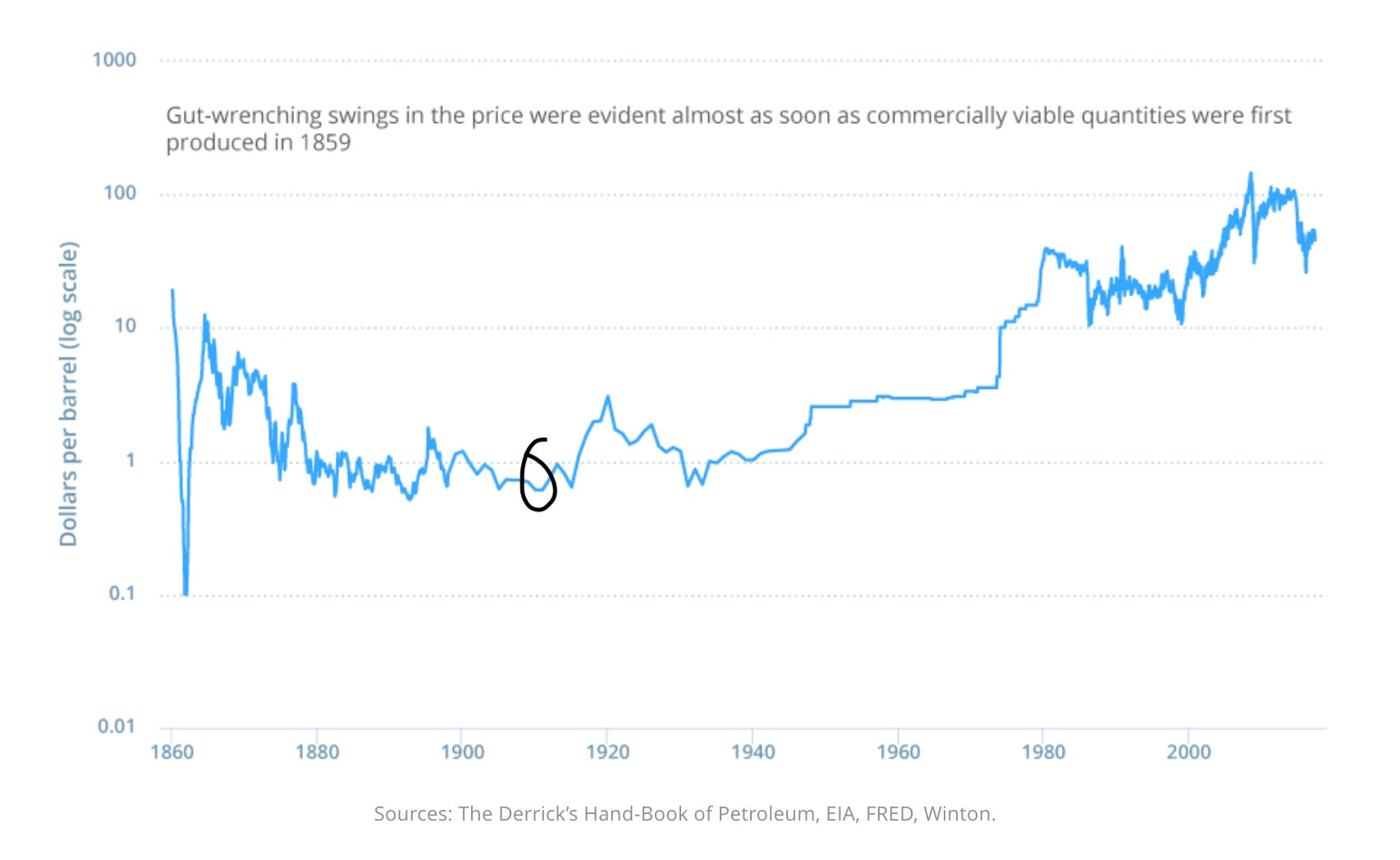
Keep in mind that also around 1911 the rise in automobiles meant gasoline (previously a worthless byproduct) was suddenly worth more than kerosene, and that other regions of the world began producing oil competitively so the entire oil market was shifting as Standard Oil was split. Here’s a snapshot of oil prices before and after:

So the Standard Oil trust was busted and then prices went…up? While there are clearly more factors at play than we’ll dig into here, my takeaway from this chart is that this whole scenario is not as straight forward as anyone would like it to be. There are a lot of factors at play; markets are dynamic and impacted by all the things from pandemics to stimulus programs to weather.

The livestock & meat industry’s common hypothesis is that if the packers were less concentrated, then market power would ‘return’ to feedyards & producers upstream and downstream customers in foodservice/retail. It would ‘free up margin’ by taking away the packer’s pricing power on the buy and sell side. Econ 101.

But is reality as clean as an econ textbook? Are we *certain* that the net effect of increasing packer competition would definitively be positive for the rest of the value chain?

The 2 dimensions I’m interested in are price (purchasing live cattle, selling boxed beef) and innovation (finding new ways to better serve customers & end consumers).

Let’s start with downstream. What would the implications be for further processors, retailers, foodservice, and end consumers?

Price: Packers sell to further processors, distributors, retail and foodservice…segments that also happen to be highly concentrated. Let’s say a national retailer like Walmart who sells ~20% of US retail beef today buys from 1 or 2 companies. Each supplier has multiple plants that service multiple Walmart distribution centers with multiple SKU’s at tailored specs. Plants have become specialized with specific programs or specific customers. The big processors were able to flex reasonably well as COVID shut down foodservice because of diversification of channels across plants – individual plants didn’t have that diversification.

In a Standard Oil trust busted world, is a national retailer now going to work with 10 independent plants that are each independent suppliers? What does that do the retailers ability to keep meat cases full with homogenous supply of fresh meat at spec? Big companies like to deal with big companies that can handle big business. What does that increased friction in the whole process do to the price of meat at retail? On the other hand, what would increased competition among packers do to the price of meat for retailers?

Innovation: A key rationale for minimizing oligopoly or monopoly markets is that competition leads to innovation. Agree, of course. But you know what else leads to innovation? Resources. What is the optimal mix of incentive to innovate and resources to innovate as a function of market power? I don’t know. But low margin businesses without scale don’t tend to be fountains of innovation.

Innovation = Incentive + Resources

Then let’s look upstream. What would the implications be for cow-calf producers and feedyards?

  • Price: Cow-calf producers don’t sell to packers, they sell to sale barns or stockers or feedyards. The feed yard space is way less concentrated than processing but way more concentrated than cow-calf. Say feedyards have more pricing power if packers are split up….does that trickle up to cow-calf producers or does it just mean feedyards are the new margin sinkhole of the beef supply chain?
  • Innovation: Let’s say more of the total value chain margin stays upstream. Maybe that leaves some financial wiggle room to focus on things besides survival So do producers start thinking about things consumers are talking about like carbon footprint? I don’t think so. Not unless the incentive structure changes and packers pay more to feedyards who pay more for calves that are raised a certain way at the cow-calf operation.

A complicating factor is that even if you increase processing competition nationally, it does not necessarily mean you increase competition regionally.

And if packers cannot consolidate processing capacity, would the result be more vertical integration in an attempt to consolidate supply chain control?

An obvious factor that makes meat processing different from cereal is that it’s a capital intensive business so barriers to entry are high, really high. It’s an economies of scale business, so it’s a business that ‘wants’ to be consolidated to chase more economies of scale.

But even if the US government regulated away processor’s ability to consolidate, what would that mean for the US industry’s ability to compete against emerging regions? The world’s largest hog farm was recently built in China for 84,000 sows to produce 2.1 million hogs annually….wouldn’t it stand to reason that the world’s largest processing plant(s) will soon follow?

Would a Standard Oil’ing of meat packing be good for downstream players? Maybe, in the short run. Probably not in the long run.

Would a Standard Oil’ing of meat packing be good for upstream players? Maybe, in the short run.

But what’s not good for downstream players in the long run cannot be good for upstream players in the long run.

Hear me loud & clear that profitability at all stages of the value chain is the #1 foundation of a viable cattle industry. Increasing margin capture throughout the value chain is a good thing, a great thing. But is reducing packer power the panacea that people often describe it as? I may be wrong, but I just don’t think it is.

Maybe looking at impact of competition on pricing power & innovation is the wrong framework….maybe higher margins don’t lead to innovation, maybe innovation leads to higher margins.

Are oligopolies good or bad? Should the big 4 be broken up? Irrelevant questions.

The actionable question is, how do you win when you buy from or sell to an oligopoly marketplace? Control the control-ables and innovate the innovate-able.

At the end of the day, animal protein is a commodity driven business. And what do commodity markets do? They move in cycles. Sometimes tree growers profit, sometimes lumber mills profit. Sometimes the cow-calf producer wins, sometimes the packer wins. Sometimes dairy producers make hand over fist, sometimes processors do. Sometimes oil drillers print money, sometimes refineries do.

‘your margin is our opportunity’

Look at other industries where big companies in one segment of a value chain amassed market share and then stopped innovating. Think IBM in the 80’s. You know what happened when those companies got satisfied with their market share and stopped innovating? Apple. Microsoft. Dell. A resurgence of insurgents jumped in with new innovation that captured market share…and then those ‘new’ tech companies get big and face their own anti-trust scrutiny. It’s almost like everything is a cycle and the cycle is what creates opportunity…

You could easily argue that type of insurgency is what upstarts like Cooks Venture or Shenandoah Valley Organic could be in the US poultry business.

Carl Lippert recently summed this up well in his article The Farm Barbell,

“The future of agriculture is large farms producing commodities and small farms creating value added products.”

That’s true for producers AND for processors.

The only way to stay in a commodity driven business AND get out of the trappings of commodity cycles is to build a competitive moat, to pursue value added markets. That’s also true for producers AND for processors. We’ve talked about this before:

The livestock & poultry industry has spent decades driving cost out of animal production systems to increase profit. And we’ve done it well. Really well. More pounds per animal. Less feed per pound of gain. Least cost feed formulation. Increased efficiency.

And yet, we see record high number of farm bankruptcies, near record low farm income, and volatile train wrecks of milk, live cattle and hog markets the last 6 months. All of which point to revenue challenges in animal agriculture.

Commodity production is an existence governed by a ruthlessly brutal dictator: The Market. It’s time to focus on enabling livestock producers to increase Revenue, to escape the commodity game that’s ruled the industry, to differentiate.

The punchline of Lippert’s article sums up the implications of this whole discussion for startups in animal ag:

“Startups should build penny shaving machines for scaled farms and margin capture machines for small farms.”

Yes.

(For more on the Standard Oil saga, I highly recommend the book Titan by Ron Chernow.)


Livestock Market Transparency is Possible. Here’s how. (link)

On a related note, this piece was written at the height of 2020’s chaos:

Pricing is a hot topic in light of live cattle and boxed beef prices heading in opposite directions, and the same dynamic to a lesser extreme in pork. These pandemic market dynamics highlight the need for improved price discovery and market transparency across the entire meat, poultry, and livestock sector. These are great problems for technology to solve. Here’s why: (link)


Prime Future is a weekly newsletter that allows me to learn out loud. I’m on the Merck Animal Health Ventures team. Prime Future represents my personal views only.


Categories
Leadership

Prime Future 56: A right time for everything, the builder’s version

There is a right time for everything.

There is a time to be born and a time to die.

There is a time to plant and a time to pull up plants. 

There is a time to look for something and a time to stop looking for it.

….

I love the Ecclesiastes framework of life. That everything is seasonal, dynamic, contextual.

I’ve been thinking about how much good advice we have access to…articles, books, podcasts, people. So much advice about what to do and so much of it good, but often conflicting. (E.g. wake up at 3:30 am bc hustle wins but also get 9.2 hours of sleep bc the well rested win. Good advice, but conflicting.)

There’s even more good but conflicting advice offered on building a startup, a product, a career, or…anything.

Perhaps the highest value muscle to build is discernment…knowing when to do, more than what to do.

If I were to rewrite the Ecclesiastes framework for people building & creating, it would look something like this…

There is a right time for everything.

A time to be highly strategic and a time to throw stuff at the wall to see what sticks.

A time to expand optionality and a time to hyper commit.

A time to ignore to the skeptics and a time to listen carefully.

A time to meticulously plan and a time to just👏🏽get👏🏽started👏🏽.

A time to seek outside input and a time to trust your gut.

A time to seek out new people with fresh eyes and a time to sit at the proverbial feet of wise old industry owls.

A time to focus on growth and a time to focus on profitability.

A time to expand your circle and a time to link up with the few & hang on tight.

A time to generously schedule intro calls and a time to ruthlessly guard your calendar.

A time to raise outside capital and a time to bootstrap.

A time to talk to every single sales leads and a time to relentlessly qualify leads.

A time to optimize for short term results and a time to optimize for the long term.

A time to reject process and a time to make smart process your secret weapon.

A time to speak truth to power and a time to be diplomatic.

A time to burn the ships and a time to hedge your bet.

…I could go on, mainly because I write this from a place of choosing incorrectly on all of these, and realizing it only with the benefit of hindsight. I like to think there are ways to build the discernment muscle other than just screwing up but maybe that’s it, that’s how the learning becomes real and practical and personal.

The challenge is that most outside advice comes from a place of survivorship bias, with strong hints of ‘here’s what worked for me so here’s what you should do’. But of course there are a gajillion factors that influence the right step at any given time. Situational context, trajectory, people, capabilities, personalities, resources, starting point, and end game, just to name a few.

I’m increasingly convinced that discernment is one of those intangible super powers that mega effective leaders and builders have cultivated. #goals

P.S. There’s even a time to switch publishing day from Saturday to a weekday. This newsletter is still once a week. What day do you like to receive newsletters?


Wisdom of the crowd

Following last week’s discussion on the tricky dynamics for processors of being competitor focused or customer focused (and what happens when words mismatch reality), ag economist Eric Micheels shared some academic research looking at the same dynamics for beef producers. I hate when academic work gets disconnected from the real world…this is not that. Here are some poignant highlights:

  • “Learning faster than one’s rivals may be the only way to achieve sustained competitive advantage in highly competitive markets, such as beef production.”
  • “As the competitive landscape in agriculture changes from a purely commodity-based sector to one where firms attempt to differentiate their offerings through different production practices, improved channel relationships, or alternative marketing strategies, factors other than size and experience may become increasingly important.”  (say it ain’t so)
  • “Managerial heuristics based on prior experience generated under different environmental conditions might not optimize performance in the current environment.” Translation: the rules of thumb that got you here won’t get you there.
  • “Organizational learning significantly contributes to innovativeness while we also find that greater managerial experience leads to decreased organizational learning.” Translation: sometimes experience is an asset, sometimes it’s a liability.
  • “Those firms who are able to become aware of changing market conditions and are able to develop solutions to meet increasingly stringent consumer and buyer requirements may be better positioned to change with the market and to be successful during the development of new marketing and production channels.” Translation: Tired of being a price taker? Build a moat. (link)

Relevant Reads

(1) For a peek at where the whole ‘carbon thing’ might be evolving with food companies, check out this announcement from Panera: low carbon cool food meals. Love it or hate it – this fits with the conversation about ‘Climate + Ag: what gets measured gets monetized’. Note the idea of what % of your daily recommended carbon footprint should be allocated to each meal. Will that become mainstream’ish?

(2) This article by Shane Thomas of Upstream Ag Insight, ‘Technology Quotients and Resourcefulness: Catalysts for Agribusiness Success’ is fantastic. Here’s a snippet:

In knowledge work you can pull on two main levers to accomplish better outcomes:

  • More effective – be more creative, have a superior tactic or strategy that lead to better outcomes (eg: sales, cost reductions etc)
  • More efficient – accomplish more with less effort (eg: reach more customers with less resources)

In ag we like to talk about working hard and hours worked, but in knowledge work the emphasis should be on outcomes and results; this means the emphasis shouldn’t be on hours worked, but outcomes achieved.

This brings us to resourcefulness as a skillset. Part of being resourceful stems from having a growth mindset.

And then he jumps into the best part, the idea of “Technology Quotient” & implications. (link)


Prime Future is a weekly newsletter that allows me to learn out loud. I’m on the Merck Animal Health Ventures team. Prime Future represents my personal views only.