Categories
Animal AgTech

Prime Future 54: Cyber security risk just got real

What does the JBS ransomware attack mean for companies in meat & livestock?

It seems like the public conversation following the JBS ransomware attack has largely centered around the market implications of packer consolidation yada yada, with little attention to the fact that cyber security risks just punched the meat industry in the face and chances are strong to quite strong that ‘cybersecurity’ will be at the top of the agenda for executive teams and boards of directors for a while. Cyber attacks are in the news all the time and it’s easy to think of it as something for only CIOs of global corporations to grapple with. But this week the nebulous, hypothetical, happens-to-other-companies-not-us risk got very real.

Let me first say that this is *not* my area of expertise nor a topic I’d planned on diving into. And the dynamics around cyber security are wildly complex, I don’t know if the technical jargon or the geopolitics makes my head spin more. But my goal is to use Prime Future to explore the questions that matter to leaders across animal protein…and this one matters.

As a first principle: we operate in a physical world that’s increasingly powered by digital infrastructure. That is not going to change, except to accelerate. Tin foil hats are not the answer, doubling down on risk management is…and if any segment knows about managing risk, it’s agriculture.

Cyber security risks are not going away, for $50B companies or for 500 cow producers.

To put this whole topic in context, I want to share 2 helpful (or at least interesting!) resources that some generous Twitter friends pointed me towards.

The first is a report from the US Department of Homeland Security & USDA on cyber threats in ag, particularly given the rise of precision agriculture.

TLDR: Cyber security risk is industry agnostic. Ag companies are not unique snowflakes, which means mitigation strategies put to work in other industries also work in ag.

‘Most of the information management / cyber threats facing precision agriculture’s embedded and digital tools are consistent with threat vectors in all other connected industries. Malicious actors are also generally the same: data theft, stealing resources, reputation loss, destruction of equipment, or gaining an improper financial advantage over a competitor. Therefore, improper use of USB thumb drives, spear-phishing, and other malicious cyber-attacks, are readily available threat vectors for an attack; and the generally accepted mitigation techniques in other industries are largely sufficient for creating a successful defense-in-depth strategy for precision agriculture. ‘

However the report highlights that players across the ag industry may not be sufficiently equipped because of the rapid digital transition happening:

‘Precision agriculture is unique, however, because it took a highly mechanical labor-intensive industry and connected it online, dramatically increasing the attack space available to threat actors. Due to this, otherwise common threats may have unique and far-reaching consequences on the agricultural industry.’

(On page 20 there are some practical mitigation steps you might be interested in.)

The second great resource is a video of a conversation between Perdue Farms Director of Information Security, and FBI agents from the cyber security division. This conversation happened last month at the CyberAg Symposium…ironic timing, eh?

If you want a healthy dose of paranoia, I highly recommend watching the first 20 minutes. Here were my takeaways:

  1. ‘Cyber hygiene’ is a critical capability for businesses of all sizes. Cyber risk is not specific to the largest oil pipeline on the east coast or the largest global meat company, sometimes small to midsize businesses are the target of hackers precisely because they are less likely to have rigorous security in place, making them easier targets. And cyber hygiene extends to every employee, not just those in IT setting up systems and protocols.
  2. Business email compromise is the most common threat… No surprise there. But these attempts are increasingly low tech, but elegant and harder to detect. Quick story: I know a super tech savvy guy who works for a tech startup and yet found himself on the wrong end of a ‘business email compromise’ only after he’d purchased $2k of gift cards at what he thought was the request of his manager. Cue the paranoia - it can happen to anyone.
  3. …but ransomware is, of course, the mega threat. The monetary loss from reported ransomware attacks was up 225% in 2020 compared to 2019, and the FBI agents in the video speculate that only a small % of attacks are even reported to the FBI.
    • ‘‘Ransomware is when a malicious cyber actor gets into your system and takes it hostage until they are paid. It happens less often than email compromise but can be crippling to an organization.” ….or an industry, or an entire food chain.
    • “Why would hackers attack an agribusiness with ransomware? Ag is a significant target because disruption is a large part of what they’re trying to create. Higher disruption increases the likelihood of the target paying the ransom. Hackers are looking for 3 characteristics in a target: 1) access, 2) vulnerability, 3) impact. Agribusinesses are highly likely to pay ransoms because you can’t have a manufacturing plant(s) down for 5 days while you wait for the FBI to investigate.”

That idea of correlation between impact of the disruption and likelihood of ransom payment makes the meat industry seem particularly at risk. The just in time nature of poultry and swine value chains, increased consolidation, and perishability of fresh meat are all factors that play into the ‘impact of disruption’ equation….it’s high, really high.

And while the biggest companies in this space are rallying all the resources to prepare for the risk, this is a risk for small to midsize businesses as well.

This whole thing kinda reminds me of post-9/11 when everyone was talking about bioterrorism risks in the food system.

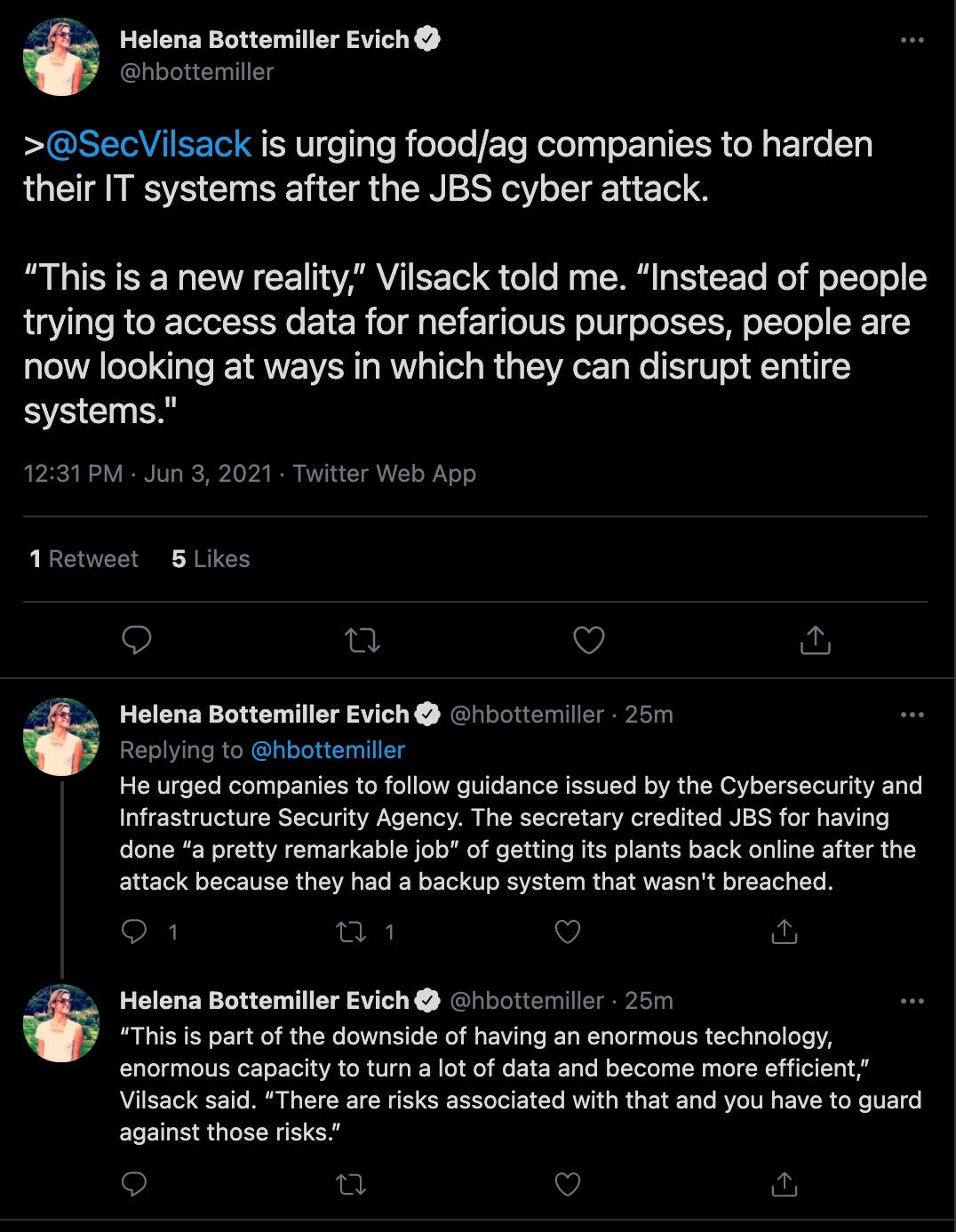
This seems like a reasonable summary of the situation:

A final note on Honeycrisps & meat

Where’s the meat case equivalent of the Honeycrisp apple?‘ took a fun turn this week as folks pointed to multiple Honeycrisps in the dairy case. You may already have some of these in your fridge but let’s look at them in the aggregate for any relevant takeaways for meat & poultry processors.

(1) Fairlife: “We ultra-filter real milk to concentrate the naturally occurring protein and calcium. We do not add additional proteins of any kind. The proteins found in fairlife ultra-filtered milk reflect the natural whey and casein proteins found in milk: 80% casein and 20% whey. These are concentrated through the ultra-filtration process. Our filtration process removes most of the lactose and the remaining lactose is converted by adding lactase enzyme to ensure our products are lactose-free. This combination allows our milk to maintain the creamy and classic taste you love.”

In 2020 Coca Cola purchased the remaining shares of the company and said in the press release, “Value-added dairy products have been growing steadily in the United States, in contrast to the traditional fluid milk category.” 👀

(2) The A2 Milk Company: “The a2 Milk Company works with local U.S. dairy farmers to identify cows that naturally only produce the A2 protein type and process their milk separately, making it possible for those with sensitivities to enjoy 100% real cows’ milk.” The company reported $1.73B in sales last fiscal year.

(3) Maple Hill just launched net zero sugar milk. “Kinderhook, N.Y.-based Maple Hill Creamery says it released the nation’s first zero-sugar organic ultrafiltered milk. The average serving of milk has 12 grams of sugar; Maple Hill’s soft-filtering process skims out the sugar, carbs and lactose from the milk, but retains the farm-fresh taste and nutrition.”

Takeaways:

  • While FairLife and Maple Hill’s net zero sugar milk are a function of how the milk is processed, A2 is a function of genetic decisions.
  • These plays all tap into the macro themes playing out in food (higher protein, lower sugar, health conscious, etc) without sacrificing taste. That seems like the right formula.
  • Product differentiation only works when paired up with a strong marketing capability. The snazzy packaging and branding around FairLife tell a story that that private label gallon of milk or traypack chicken just…don’t. Buying or building a marketing capability is no easy task, especially for organizations that have traditionally prioritized operations above all else….but it’s a critical part of the equation for ‘Honeycrisp’ creators.
  • You don’t often see upstarts in these markets going after the commodity business, upstarts instead look like A2MC or Shenandoah Valley Organic (chicken) going after high value markets. The irony is that in the packing industry, there are new players coming to the game with regional plants expecting to compete with large scale plants on efficiency alone. That is…puzzling. With current margin structures, it might work in the short run but it’s hard to imagine that play working out in the long run when the cattle cycle does what the cattle cycle does.

A final note in this discussion: Cattle Grading

From a beef perspective, one indicator of improved quality in the meat case is the % of cattle that grade prime/choice. That % has steadily increased in recent years. The question is, how much of that is as a result of how cattle are fed and how long cattle are fed, and how much is due to genetics?

The truth is that it’s some of both, though my hypothesis is that a significant portion of that shift is based on what happens in the feed yard.

But in most cases, data about how an animal performs in the feed yard or how they grade in the plant never makes its way upstream to the cow-calf producer making breeding decisions….and if the data doesn’t flow upstream, the incentives don’t flow upstream….which is a key reason that most producers make genetic decisions based on live performance metrics. You might even say that, to the extent the increase in prime/choice cattle is due to genetics, it’s due to the aggregate improvement of cattle genetics not due to specific decisions made by producers. On the one hand, maybe that’s a win despite the lack of market signals….but imagine how progress will accelerate as more supply chains align directly around specific product attributes for specific commercial objectives.

On the other hand, if 70+% of cattle grade prime & choice maybe it’s time to begin further distinguishing the upper end to increase potential value capture?


Prime Future Summary

You can get the first 47 editions of Prime Future in 1 PDF:

Get the summary!


Prime Future is where I learn out loud about the big dynamics around livestock & meat. I’m on the Merck Animal Health Ventures team but this newsletter represents my personal views only.

Categories
Animal AgTech

Prime Future 51: SPACs, a linchpin for AgTech?

Two recent announcements about late stage AgTech companies merging with SPACs piqued my curiosity about what this phenomenon means for the broader ecosystem. Are SPACs a bubble inducing financial fad or the linchpin to drive more innovation in AgTech?

I admit that I started out with the impression that SPAC is just a fun word to say and that SPAC mania is just a manifestation of a hot stock market, maybe even something we’d point at after a bubble busting event as part of the problem.

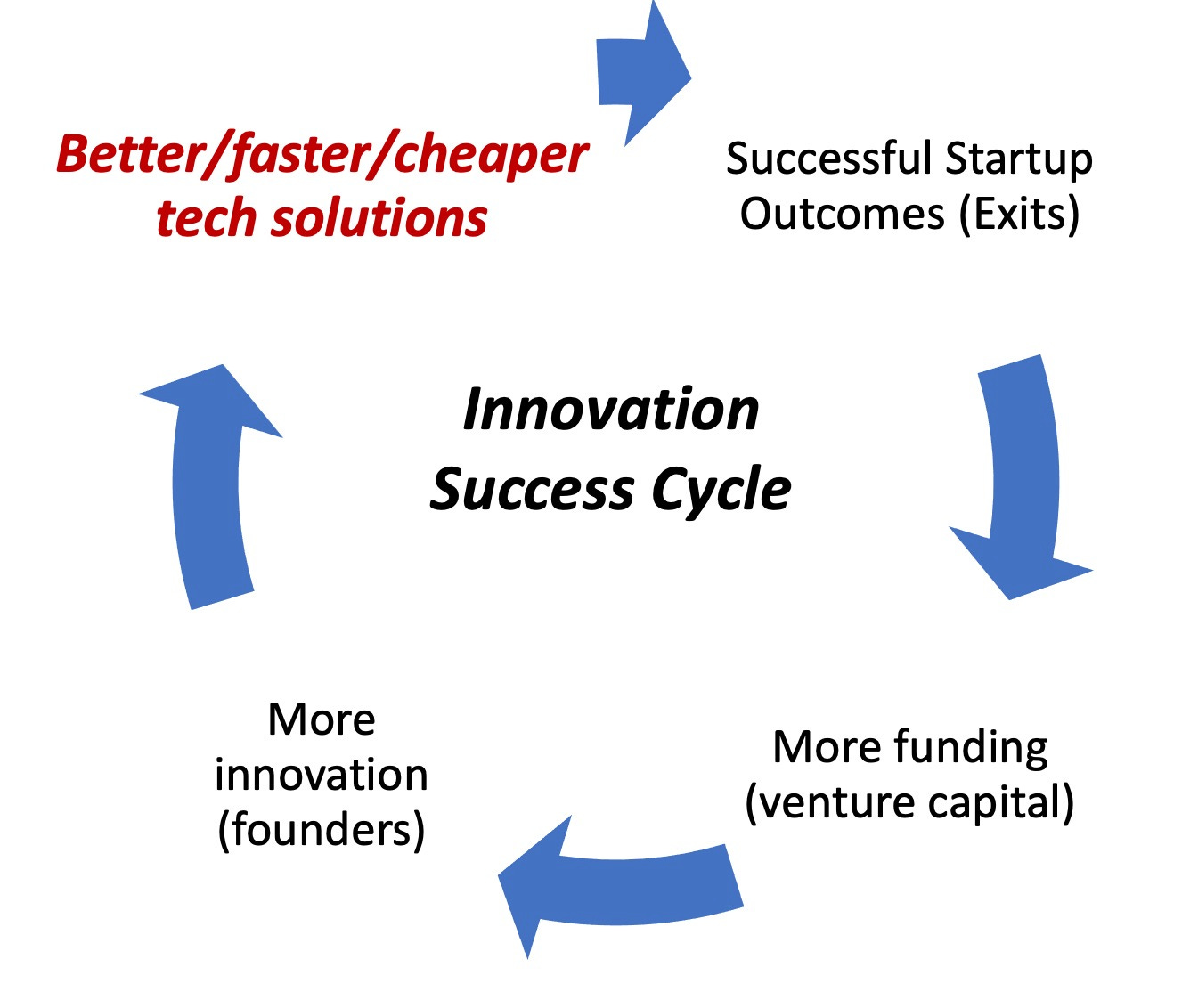
You might be asking, what do SPACs have to do with feed conversion and yield and the day to day of meat & milk production? Zero. Maybe less than zero. But before we dig into SPACs, let’s ground ourselves on the “Innovation Success Cycle” and how the robustness of the Animal AgTech startup ecosystem does impact swine producers and poultry processors and cattle feedyards and errrybody in between:

Most segments can point to a cornerstone acquisition that sparked a frenzy of investment & innovation in a space, on the crop side of AgTech it was Monsanto’s acquisition of Climate Corp, that kicked off a virtuous Innovation Success Cycle. The things that increase the velocity at which that cycle spins, and spits out better/faster/cheaper tech solutions, are relevant for those interested in outcomes for livestock producers.

To learn about SPACs I reached out to some AgTech investors and to Will Bunker, the founder of Match.com turned tech investor who is now involved in a SPAC that went public earlier this year and currently securing a tech company to merge.

Let’s start at the beginning, what is a SPAC?

Investopedia: “A special purpose acquisition company (SPAC) is a company with no commercial operations that is formed strictly to raise capital through an initial public offering for the purpose of acquiring an existing company. Also known as “blank check companies,” SPACs have been around for decades. In recent years, they’ve become more popular, attracting big-name underwriters and investors and raising a record amount of IPO money in 2019 and 2020.”

Start throwing words around like “blank check companies” and (naturally) people tend to get extremely greedy or extremely cautious. What are the checks & balances on SPACs?

Here’s my understanding: the SPAC itself raises $$ in an IPO based on a thesis of finding an operating company to merge with. The thesis can be geographical, vertical specific, size of company, etc. Then the SPAC looks at target companies that fit their thesis criteria, and then strike a merger deal with the target company. The last step might be most important: the PIPE investors reality check the valuation of the target company – this is the brake that keeps the process from running amok.

According to Will, “The big misunderstanding with founders is they act like a SPAC is another round of financing and therefore your negotiating with a counter party when talking with the SPAC, but it doesn’t work that way. A SPAC is a vessel, the counter party are the PIPE (PIPE = private investment in public equity) investors. PIPE investors are the institutional investors that give credibility to the valuation of the company being merged with the SPAC.”

So why now? If SPACs have been around for a while, why was there only 1 in 2019 with $13.6B invested and 248 in 2020 with over $83B invested?

Will explained why SPACs are gaining steam and, in his view, very much here to stay:

“Amazon went public in 1997 with a $480M market cap. Today if a tech company wants to IPO they need to have a $20B+ valuation. The effect of the dot com blow up was that the bar was raised for companies looking to go public, so now there are ~6k fewer public companies than in 2000. The whole ecosystem shrank as businesses were bought and consolidated. We've had 20 years of startups having to wait until they get to $20B+ to go public, which is a hurdle few companies can hit.

So why are more SPACs happening now? It’s a social thing – SPAC used to be a 4 letter word. It’s like the fable of the fox and the grapes – the fox can’t get to the grapes so he finally says he doesn’t want the grapes. Tech companies struggled to get to the scale necessary to go public after the dot com bust, so they finally said ‘well being a public company stinks and I don’t want to do it anyway.’”

“Tech companies convinced themselves they didn't want to go public because they couldn't. Now that’s changing.”

At this point the skeptic is thinking, “why are SPACs popular now? Silly question, look at the stock market over the last 12 months….the answer is obvious.” But Will’s explanation highlights that the timing of SPACs is an entirely separate question from the purpose of SPACs. He specifically said “Founders have to control what they can control which are the things a multiple is multiplied by (e.g. revenue or EBITDA) because you can’t control the market. Will SPACs be abused? Yes, there will be idiots who take companies out that don’t have a business model. But if you are taking a legitimate business that has a business model and is on a growth path, this path is as legit as it gets.”

But what’s the point of SPACs? Why would a startup take this path to public markets instead of an IPO or direct listing, or even staying private longer?

On this Will said:

“Once your company is public then you have currency to buy companies: stock. As a private company making acquisitions with equity, you give so much of your company away so acquisitions are less common. There are 3 things you can do in public markets that you cannot do in private capital markets: borrow without personal guarantee, issue secondary shares to raise capital, make acquisitions with shares.

If you want to build a big company, a SPAC lets you access public markets at a valuation that is a step function below what you had to wait for otherwise. Instead of waiting until $20B valuation to go public, our analysis is that post-merger valuation (Enterprise Value + new cash) should be greater than $500M so that you can get coverage from analysts and the stock price will increase as you execute. You don’t want to be a micro cap, so probably the smallest would be $300M EV + $200M cash.

Valuations come from comps. Founders looking at a SPAC should know who they will be compared to in the public market and work backwards to figure out what you need to do to increase enterprise value. Companies that go public via a SPAC should then be able to be acquisitive, they should become the strategic, and do the consolidating and expanding in their space. If your outcome is build a big co, these tools can help you build a bigger company faster and this is a path to do it. ”

What are the implications of SPACs on the AgTech startup ecosystem?

The partners from Fulcrum Global Capital, an agtech venture firm, put it this way when asked what the implications are for AgTech: “Huge!  With pressure for innovation building across the industry for years and established strategics focused on consolidation, there has been a notable lack of exits within the agtech industry.  SPACS offer an outlet for a subset of companies with the right combination of transformative technology and growth potential.  And obviously, successful market entry by those early SPACS can breed a larger appetite in both the public and private markets, thereby making the entire industry more attractive from a risk capital perspective, which should lead to a more rapid technological development across the entire industry.”

So there it is: If SPACs allow startups to access public capital markets earlier in the company’s life than a traditional IPO, then the company has greater access to capital for growth, like acquisitions.

And more acquisitions and more risk capital in a segment lead to more investment and innovation which leads to better/faster/cheaper solutions for customers.

When asked if SPACS are here to stay, the Fulcrum parters said this, “Obviously, the strong economic climate coupled with a more environmentally-focused current political environment are favorable for the current round of SPACs hitting the markets.  That said, ultimately the answer will likely be based on how the early movers perform on the public markets.  If those companies deliver on the promise they currently hold, the market will likely be receptive in the future.

Will sees the potential impact of SPACs for founders through a very personal lens, “We sold match.com to Barry Diller who then spun it out for $15B and its now trading at a $45B market cap. If this had been a tool when I was a founder, I would have captured so much more of the value of my idea and more of the value would have gone into my pockets than someone else’s.”

And because who doesn’t love a good example of supply & demand at work, Will shared this gem: “SPACs are like penguins – I’m a beautiful penguin and I’m special but no one else can tell the difference. The financial press is saying we’ve never seen so many penguins in our life! But on the flip side there’s such a backlog of companies looking for ‘penguins’ to help them go public that there’s an imbalance.”

Back to our industry of interest, of the 4 AgTech companies who’ve either merged or announced a merger with a SPAC, not one has a footprint in Animal AgTech. But that’s not surprising as there aren’t many (any) late stage startups in this space. As we’ve talked about before, animal agtech lags crop agtech in terms of total investment and venture backed startups which, related, many VC’s attribute to fewer active acquirers on the animal side.

So let’s say that a few animal agtech startups go public via SPACs in the next 3-7 years and that creates more acquirers for animal agtech startups over the subsequent 3-7 years….that’s still, umm, quite a while before any potential impact of SPACs would be felt in the animal agtech ecosystem.

The point is that SPACs could maybe, definitely, possibly be a potential catalyst of innovation in livestock in the long run.

Will it be a linchpin tho? WAY too early to say.


Prime Future Summary

You can get the first 47 editions of Prime Future in 1 PDF here, check it out:

Get the summary!


In his book Effortless, Greg McKeown talks about the idea of “inverting assumptions” to highlight new ways of doing things, solving problems, etc. I’ve been thinking about this exercise as it relates to the deeply held convictions within livestock production and how those assumptions impact all things innovation. So, here’s my question:

What is one assumption that has been generally accepted as true within livestock production & processing, that is not true / no longer true?

Hit that reply button and make your case. 😁 And stay tuned for more on this…


I’m on the Merck Animal Health Ventures team. This newsletter is not representative of anyone’s views but my own. Sometimes it doesn’t even represent my views 🙂

Categories
Animal AgTech

Prime Future 50: Climate + agriculture: what gets measured gets monetized

How do you win when it’s unclear what winning looks like? ICYMI, that’s the question we tackled last week in Climate + agriculture: noise, or mega trend?

“Climate is a mega trend. There will be winners and losers, the difference will be those who collaborate and find workable solutions. This is a mega trend to engage by looking for the ‘and’ solutions…the places of overlap between what’s good for climate related metrics AND for cattle AND for successful cattle operators AND for food companies AND consumers.”

A few readers pointed out that these things tend to be emotion driven and ag typically loses on emotion driven topics. I don’t disagree. We could point to several topics where farmers are squarely on the side of the Science Angels, yet lost the perception battle.

So let’s talk about why carbon *could* be different. Today we look at 3 questions about how livestock fits into the climate trend:

  1. Who is leading who?
  2. Why might carbon be more than just another emotion driven marketing fad?
  3. What’s missing to enable the mega trend to materialize, pragmatically speaking?

Who’s leading who in climate + ag?

“Consumer wants drive value chain decisions.”

I’ll start by pushing back on the narrative that protein value chains are driven by consumers, on climate or any other topic. Consumers….those nebulous creatures of food commerce who somehow sound like the unknowable inhabitants of an alternative universe when we refer to them. Two flaws with the Consumers-R-In-Control narrative:

  1. Consumers are not a monolith. Segments of consumers want certain attributes, sub-segments are willing to pay for those attributes. Variation among consumers is no less nuanced than variation among farming systems. Mis-identifying what consumers want and what they will pay for x is as fatal of a flaw as over-estimating how many consumers will pay for x.
  2. Although staggeringly critical to the system, consumers are not everyone’s customers. Consumers don’t transform supply chains or recalibrate industry norms. Food companies do. Food companies are where the power lies. Brand owners make decisions about how to market meat & milk to their customer: retail consumers. Food companies make decisions about how to market meat & milk, and then where needed those same companies use their scale and influence to set product specs & requirements as they procure raw materials or finished product from a certain set of suppliers. No one is talking about the fried chicken wars of Mar Jac vs Wayne Farms chicken, they’re talking about KFC vs Chick Fil A. The two directional power of influence lies with brand holders across foodservice and retail. Leading brands lead consumers by positioning xyz about their brand that is better than competitors. Food brands tap into consumer trends, but they lead consumer segments with differentiated products. Sometimes those changes are then adopted by other food brands & their supply chains. The massive shift in NAE (no antibiotics ever) production in US poultry is my go to example for this dynamic – when 1-2 major food companies said we will buy NAE chicken, then NAE chicken is what suppliers learned to produce, at scale. So then more food co’s buy NAE chicken. It’s a cycle that starts with a food brand, moving vertically in that supply chain and then expanding horizontally as more food brands (and their supply chains) adopt whatever the thing is.

We oversimplify the value chain when we attribute all influence to consumers, and we underweight the actual centers of leverage.

This distinction is slight but crucial. Increasing general interest in climate friendliness is creating a market opportunity for food brands to sell into consumers who care enough about that trend to pay more for it. Who will be the brands that lead with a climate related message about their supply chain? How will participants in those brands’ supply chains respond? Will the premiums awarded be enough to shift supply chains, or some supply chains, or parts of supply chains?

But there’s another influencing group that should not be overlooked: investors. Someday we’ll read the HBS case study about the BlackRock effect as the $9 trillion asset manager has gone all in on making sustainability investing the same as investing. In general, an increasing amount of capital is marked for ESG investments (environmental, social, governance) and protein companies are beginning to access that capital, like Pilgrim’s recently issued $1B sustainability linked bond, tying the interest rate to Pilgrim’s success in achieving their targets of reducing GHG emissions by 30% by 2030.

Food companies influence their supply chains and consumers. Investors influence food companies.

Why is carbon more likely to be a monetizable mega trend than an emotion driven fad?

<insert corporation name> will not be able to buy 2 units of sustainability to offset 2 units of un-sustainabillity. But, <insert corporation name> will likely be able to buy 2 units of carbon sequestration to offset 2 units of carbon emissions.

As more companies make net-zero commitments around carbon and seek to offset carbon in their supply chains, carbon markets are the likely place to turn. To make this carbon economy go, the entire structure will have to be underpinned by rigorous standards of measurement and verification. Sound methodology and precision processes are the only way for carbon markets to deliver on the promise for participants and their investors, customers, and consumers.

Another concept bubbling up is carbon labeling on food. Only high end, niche brands are pursuing carbon labeling now, but will this become a more widely adopted practice? The concept behind these labels is numerical representation of the carbon involved in production….the (potentially) magical word for livestock producers is “numerical”. To the extent that sound methodology and high integrity math drive carbon labeling, it represents an opportunity for livestock producers to win by numerically capturing the net positive carbon impacts of livestock production.

People way smarter than me can go deeper on carbon markets and carbon labeling. My point is simply this:

Carbon could be the real deal for producers because both B2B carbon markets and consumer facing carbon labeling on food would require data driven approaches to drive an actual functioning net zero carbon economy based on measurements.

What gets measured gets managed, and monetized.

So what’s missing to enable the mega trend to materialize? Consider this framing:

“Big shifts are underway for farmers as the larger food companies, for the first time, are starting to reward them with a piece of the elusive “green premium.” In 2020, firms like Cargill, Anheuser-Busch, General Mills, and Walmart started paying farmers to adopt greener practices.

Cargill said it would shift 10 million acres to regenerative practices, paying farmers for the green shift and offering complimentary training. The move kills two birds with one stone. It lowers food companies’ own supply chain emissions while encouraging them to offer differentiated, sustainably sourced food to their end customers—at a premium, of course.

While always stewards of the land, farmers have faced a continuous squeeze over the decades with the real price of food declining, the price of labor increasing by 40 percent, and the price of agricultural inputs increasing by 15 percent since 2010. These forces allowed little flexibility in farmer margins to bear the cost and risk of switching to greener products and practices. But with food companies increasingly offering premiums and upfront risk capital, farmers are starting to see the calculus differently.

The big question remains: what technologies will unlock the ability for farmers to profitably capture the green premiums?”

Right now, there seem to be more questions than answers to what the enabling technologies will be. How will we measure? How will we verify? How will we transact? Will participation be voluntary or mandatory, and for whom? Are we talking net carbon sequestration or only the differential from year 0 to year 1?

There’s a whole host of entrepreneurs innovating in this space and venture investors backing them. It’s nascent but rapidly evolving.

The only certainty is this proven core technology (link) 😁:

The devil will be in the details – methodology, realities of implementation, new capabilities needed, new partnerships, new data streams, and more. The intriguing aspect is that carbon *could* let producers be on the side of the Science Angels and maybe even win the perception battle.


I’m on the Merck Animal Health Ventures team. This newsletter is not representative of anyone’s views but my own. Sometimes it doesn’t even represent my views 🙂


21 tips for 2021 University Graduates (link)

Graduation season is here, so do the grad in your life a favor and share this article by Shane Thomas, creator of Upstream Ag Insights. A few of my favorites:

1. Ask Questions Don’t let the feeling of looking stupid keep you from asking questions. Many others have the same question and you’ll have more confidence in that answer moving forward.

You don’t know everything. You never will (no matter what your degree says). But you can try. In order to do this, you need to ask questions + listen to those more experienced and with different perspectives. You don’t have to agree with others opinions, but sometimes their perspective is what you need.

2. Learn Broadly (Always Be Capturing – ABC) Being done school doesn’t mean you stop learning. It means learning is just beginning. Learning your area is important, but going beyond ag is beneficial in work & in your personal life. The tools to accomplish this today are infinite. Never stop learning.

7. Expand Your Time Horizons 3 years out seems like a long time, but it’s <10% of your working life. Think 15 or 20 yrs out instead when it comes to things like skill development, career moves or how a technology could impact you.

9. Build a Network Make connections. Introduce yourself to people you find interesting and tell them your ideas. Send messages on social media, request a coffee or a phone call.

14. Be Comfortable in the Grey Area We get taught in black and white. The world is grey.

17. Outcome Over Ego The goal shouldn’t be to be right, but to achieve the best possible outcome. That might mean your ideas don’t get used. Accept it and learn from it.

20. Strong Opinions Loosely Held Having conviction in your beliefs is paramount, but you need to be continuously open to changing times and new information…especially early on in your career. Be confident, but be ready to adapt.

Categories
Animal AgTech

Prime Future 49: Climate + agriculture: noise, or mega trend?

Ask 10 people what sustainability means, get 10 different answers.

Ask 10 people what regenerative agriculture looks like in practice; you’re more likely to hear the equivalent of “you’ll know it when you see it” than a clear set of actionable ideas.

The ambiguity in definitions can make producers feel like engaging on climate/sustainability is the equivalent of the Baylor Bears hearing that they did not score enough home runs to win the 2021 NCAA basketball championship. ¯\_(ツ)_/¯

How do you win when it’s unclear what winning looks like?

Additionally, the climate + ag conversation often has a tone problem. Real or perceived, much of it feels condescending to producers…it reeks of coastal elitism and “you’re doing it wrong, silly”. What reaction do you expect to get when you tell a 5th generation rancher that they aren’t using sustainable grazing practices? That rancher predictably says “what is a better definition of sustainability than raising beef for 100+ years on the same land” then follows it up with “no one is more invested in the long term sustainability of this land than we are, the people who derive our livelihoods from the land”. Shot, chaser.

For starters, let’s please welcome nuance to the table. The extreme positions on either end of the sustainability spectrum will not create actionable, consumer-satisfying, carbon-reducing, market-growing solutions. But nuance…that’s how we find the productive middle ground. Nuance acknowledges that one size does not fit all – what works in geographies that get 40+ inches of annual rain fall won’t necessarily work in areas that get <15 inches. Systematic management changes like transitioning from continuous grazing to intensive rotational grazing are complex, as is anything related to managing the biology of plants or animals.

Nuance also matters in the context of beef’s perceived “market position” around climate change. While methane emissions are a target, cattle have the superpower to up-cycle grasses and support soil health, a key factor in carbon sequestration. Russ Conser of Blue Nest Beef explains that he left a career in venture investing at Shell to launch a cattle business when he realized that “effectively grazing cattle is the other half of the carbon cycle” via carbon sequestration. 🤯

The language, tone, and lack of nuance in sustainability speak sometimes makes the whole topic sound like mere noise…so the volume gets turned down. To turn this mega trend into opportunity, we’ve got to break the language logjam in order to unlock the meaningful ways agriculture can show off its uniquely powerful climate chops.

And this issue matters, right now. A significant amount of capital has been invested into cell based meat with much of the enthusiasm centered around the reduced environmental impact compared with animal grown (?) meat.

As a result, the livestock industry has a time sensitive imperative to demonstrate, dial up, and deliver on the wide ranging net climate benefits that livestock alone can deliver.

So here we go. Where is the opportunity for producers to take steps towards delivering what a carbon-conscious market wants?

“One in five of the world’s 2,000 largest publicly listed companies have now committed to a “net-zero” emissions target to help tackle climate change.”

If you believe:

(1) the undeniable trend is towards food companies (retailers & food service) making net/near zero claims about their supply chains, and

(2) the likely trend is towards more coordinated/aligned/virtually integrated beef supply chains (e.g. the venture between 44 Farms & Walmart)

Then, it is not a difficult leap to assume that in the not too distant future there will be an increasing number of coordinated supply chain initiatives that will incentivize – or select – producers to adopt (or continue) and verify certain production practices. Clearly aligned incentives throughout a supply chain to realize greater commercial outcomes for all (<—key word) participants, and measurable carbon outcomes that make meat attractive even to carbon conscious consumers? Interesting…

In the interim, some companies are learning how to work with their supply chains, e.g. Sysco & Cargill’s program to “invest $5 million to support ranchers in the Southern Great Plains with the implementation of sustainable grazing practices” by “targeting 1 million acres to sequester as much as 360,000 tons of carbon annually.” Some of the practices that the grants will support include rotational grazing, improvements to infrastructure, control of invasive vegetation, or a combination of interventions appropriate for the landowner, wildlife, soil type, and climate. Presumably everyone involved will learn a lot through this project from the how’s to the why’$.

Brief aside on Amazon: One of the company’s core tenants is improving customer experience. A few years in, they began to focus on fulfillment errors as a key metric. Less errors in customer orders meant happier customers. But less errors also meant reduced cost to fulfill the order. Improving the metric had good impact on customer experience AND on company profits.

Applying that to our topic: can what’s good for carbon sequestration be good for the land AND for cattle AND for cattle producers? Or must producers who set out to improve carbon related metrics do so at the expense of their business?

Take intensive rotational grazing – a practice that carbon sequestration enthusiasts love to love, and a practice that many cattle producers generally accept as a way to better manage grass and therefore increase carrying capacity. It’s hard to execute because of the labor and hassle factor, but how can technology change that? How can properly aligned incentives recalibrate the cost/benefit equation? What needs to be true in order to increase adoption of this practice that is widely accepted is beneficial on every outcome??

Anyone grazing livestock effectively is closely managing two inventories: cattle AND grass. What’s good for grass tends to be good for cattle, and the producer. Sustainable grazing enthusiasts want to promote biodiversity and healthy vegetation and reduce water consumption….these sound a lot like things cattle producers want too, right? Perhaps this whole thing is as simple, not easy but simple, as looking at new ways to achieve age old objectives, of finding the overlap in operator objectives and carbon objectives….there’s almost always middle ground to be found.

It takes a healthy dose of humility on all sides when it comes to tackling this topic because there’s still *SO* much unknown…including how to measure carbon sequestration in soil, how to quantify its impacts, and how/when/if carbon markets will pan out.

Regardless of the abundant unknowns about how things will evolve, this whole “climate thing” is not a topic where producers can look away and hope it will disappear. This is a mega trend. There will be winners and losers – my hypothesis is that the difference will be those who collaborate and find workable solutions…or don’t. This is a mega trend to engage, to lead by looking for the ‘and’ solutions…the places of overlap between what’s good for climate related metrics AND for cattle AND for successful cattle operators AND for food companies AND consumers. This is a place to ask questions like, what if? What needs to be true? What opportunities will be created in this mega trend?

Consider this framing on the value of engaging:

Producers will produce what the market signals, and the market signals around this mega trend are dialing up.

Where there’s a market there’s a way.


Heads up – I’m now part of the Merck Animal Health Ventures team. This newsletter is not representative of anyone’s views but my own. Sometimes it doesn’t even represents my views 🙂

Categories
Animal AgTech

Prime Future 48: Nothing new under the sun ☀️

Let’s talk about 2 ideas on innovation by way of the last 150 years in ag. These ideas stood out after reading 3 fascinating books about the early evolution of cattle, grain, and fertilizer. While these ideas aren’t actionable per se, I hope they’ll be food for thought.

To set the stage, here’s a quick recap on the 3 books:

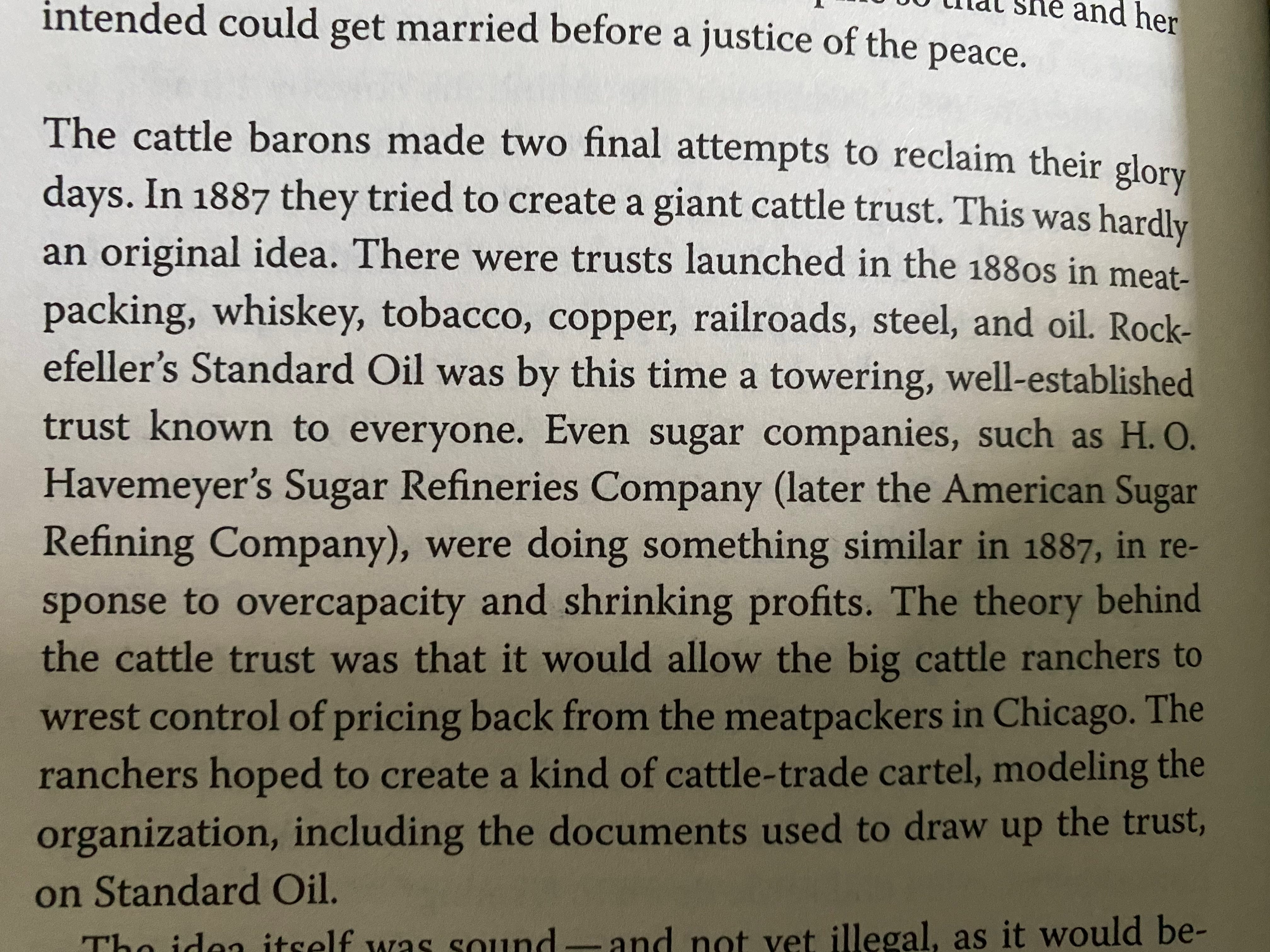
(1) Cattle Kingdom: The Hidden History of the Cowboy West describes the early development of the open range cattle industry in the US and all its many dynamics. The elimination of buffalo that ruled the open range so cattle could be trailed north to markets. The completion of the transcontinental railroad so live cattle could be shipped to urban areas which led to the creation of “cattle towns” and then to the geographic push to Chicago where packing plants were built after refrigerated rail cars were in play to move meat east instead of animals. Gustavus Swift not only pioneered the idea of vertically integration from feeding cattle to processing to distribution directly to wholesalers (and the restaurant that made the steak popular, Delmonico’s), his design for a (dis)assembly plant established the future of the modern packing plant and served as the blueprint for Henry Ford. The author actually argues that Swift’s company initiated a lot of management principles still around. The development of barbed wire was the death knell for the open range, as settlers blocked off their sliver of the world, but proved an invaluable early management tool for ranchers.

(2) The Alchemy of Air: A Jewish Genius, a Doomed Tycoon, and the Scientific Discovery That Fed the World but Fueled the Rise of Hitler tells the story of how South American reserves of bat guano increased yields for European farmers until supply began running low. Experts claimed the population was soon going to outstrip the planet’s ability to produce food….until a German scientist created a mechanism to convert nitrogen from the air into nitrogen that could be applied to fields, prompting a massive boost in food production and saving millions of lives.

(3) Merchants of Grain: The Power and Profits of the Five Giant Companies at the Center of the World’s Food Supply walks through the driving forces of the international grain trade since the late 1800’s and the companies that survived the geopolitical turmoil, economic chaos, and rapid advances in everything from transportation to harvesting (move over wheat, now corn is on the move) to markets, both new segments and new financial instruments to trade. (FYI this one is not as reader friendly. Michael Lewis should make this his next project.)

Those 3 threads together perfectly demonstrate how mega trends in technology collided with industry specific mega trends to radically accelerate each space from where it was originally, to where it evolved.

Thus, two takeaways on innovation:

(1) Context matters: innovation is only & always a bridge FROM some current state TO some future state.

(2) Timing mattersinnovation only & always happens when emerging mega trends converge, both technology trends and industry trends.

Case and point:

Always bet on the megatrends” sounds like great advice for….everybody? Including producers and players up and down the meat & poultry value chain.

So shifting to the current Current State, what are the mega trends playing out in livestock & meat, and in tech?

Industry mega trends include:

  • Buzz about traceability
  • Sustainability – economic, environmental, animal welfare
  • Need for automation
  • Transparency at all layers
  • Rising land prices, volatile commodity prices

Meanwhile, current tech mega trends include:

  • Ubiquitous cloud computing
  • Drastic increase in sensor capability / decrease in cost
  • Massive investment in alt proteins
  • Focus on data privacy & data security
  • Solving rural Internet access gaps (thanks Elon)

Which of these industry & tech mega trends converge, and how they converge, will determine the next future state of livestock & meat. 

This whole idea of “innovation is contextual” matters for a few reasons, especially in a livestock production context:

  1. The funny thing about innovation is that for us much as, yes, it is creating the future at some time horizon….it never gets the chance to take off unless it’s rooted in the realities of the current state, both operational AND value proposition realities. There’s also the added complexity of many value propositions that fluctuate with commodity cycles. Look at precision farming – tech that gets adopted at $6/bu corn does not always get adopted at $3/bu.
  2. Innovation is only innovative for a little while. The goal posts move. (No one inherently gets this better than farmers…what gets a premium today is mainstream tomorrow.) Synthetic fertilizer was truly game changing and life saving in 1920, today’s innovations are replacing synthetic fertilizers with biologics. From/To.
  3. Timing is not everything, but it’s a really big thing. Look at online grocery, which grew from 3% in 2019 to 10% in 2020, a massive inflection point even though variations of grocery e-commerce has been a thing since the late 1990’s. The graveyard of failed online grocery startups is not small…but ask any of those founders and they would likely tell you that technology was not their challenge. Their challenges were consumer behavior and (lack of) retailer motivation, that they couldn’t stay afloat long enough for the consumer trends to catch up with the tech capability. Startups launching 20 years ago in that space never had a chance, yet companies started in the last few years were perfectly poised to ride that sweet COVID rocket ship. Timing matters.

All that to say, context and timing drove innovation 150 years ago just like they do today. Context and timing are often (usually?) the difference between success and failure (an already fine line for most startups).

Innovation is only & always a bridge FROM some current state TO some future state, and it only & always happens when emerging mega trends converge.

And sure, maybe what happened 150 years ago isn’t directly relevant today…..then again, many of today’s industry dynamics were hard at work way back when. There is nothing new under the sun.

Exhibit A of nothing new under the sun:


Heads up – I’m now part of the Merck Animal Health Ventures team. This newsletter is in no way representative of anyone’s views but my own. Sometimes it doesn’t even represents my views 🙂

Categories
Animal AgTech

Prime Future 47: Waves of change

Friends – Today I’m excited to share (1) some news, and (2) some thoughts on the Farmers Business Network announcement about their acquisition & entry into animal health/nutrition distribution. Here we go….


(1) The next 90 years

The pandemic brought an unanticipated but surprisingly great temporary move home to help care for my elderly grandparents. In addition to daily domino games to bookend Zoom calls, I got to hear all the stories and perspectives on life and agriculture from their 70+ years of farming. Some favorite quotes:

  • “Kid, the thing about opportunity is its always there when you look for it. You just gotta find the right window where it’s the right thing for you and the right timing. And ya gotta stay in the game, ya gotta just stay in the game.”
  • “People say farming is harder now. When was it ever easy? It has been challenging for as long as people have farmed.”
  • “Don’t do what the coffee shop boys do. They’re playing it safe, doing what everybody else is doing, going broke when everybody else goes broke.”

One interesting thing about living with old people is getting a fascinating glimpse into depression era food habits & attitudes. The juxtaposition is that at 89 years old, my granddad considers one dimension of success that his family has consistently had meat on the table. But when they want a comfort food kinda meal (the throwback to childhood kinda meal), it’s inevitably a low meat/heavy starch situation:

  • Cornbread and milk
  • Tomatos and gravy
  • Black eyed peas
  • Potatos fried in lard

Most of those food preferences reflect depression era resources in rural Oklahoma:

  • A garden
  • Milk from a dairy cow (the more fortunate families)
  • Slaughtering a pig once, maybe twice a year and canning the meat. Any additional pigs were sold for income. Turns out they slaughtered the pigs around 340-350 lbs to maximize for lard. 🥴
  • Some chickens to eat, because obviously chickens are cheaper to raise than pigs. And beef wasn’t on anyone’s plate in their rural community….way, way out of economic reach.

(Fun fact: I always knew black eyed peas’ center of gravity of popularity was in Oklahoma but my granddad recently explained that as FDR dealt with the simultaneous effects of the dust bowl and the Great Depression ravaging the rural economy and leaving families in abject poverty, one solution to both conserve top soil AND put food on tables was a program to incentivize planting black eyed peas.)

Now contrast all of that with today.

Meat is the center of the meal for most people, most of the time, in developed countries. Meat & poultry is one of the first ways an economy trades up as incomes increase. Meatless meals are generally a bougie political statement, not an economic consequence. So why does my generation not think twice about having ready access to meat when my grandparents still view it with a hint of amazement?

(1) The general rise in prosperity across America. In the mid 1930’s, ~45% of Americans lived in poverty. In 2021, ~9% of Americans live in poverty. Without a doubt, sheer purchasing power has recalibrated most Americans expectations and views on food choices and meat in particular which transformed demand.

(2) The lengthy list of innovations over the last 90 years that have transformed the supply of animal protein, enabling increased production and decreased cost, such as:

  1. Widespread adoption of refrigerated freight, allowing for more efficient geographical allocation of production & processing.
  2. Antibiotics to treat sick animals, vaccines to prevent and other medicines to manage disease.
  3. Genetic advancements and decades of genetic selection to make more/better/faster meat.
  4. Specialized production and economies of scale in livestock production & processing.
  5. Facilities – for pork and poultry, innovation around the engineering and management of housing to create the optimal temp, humidity, air flow for growth.
  6. Steam flaked corn in feed yards so cattle could process the feedstuff more efficiently.
  7. Corn yields went from 50 to 250 bushels/acre…and we discovered the power of protein found in soybeans (read the image below, an excerpt from Merchants of Grain)

Most of the trends above that drove the massive growth in animal protein throughout the last 90 years were a function of the relentless focus on efficiency, on reduced cost per pound of meat/poultry produced.  I recently mentioned the idea that if “all business is bundling and unbundling”, it seems our corollary is “all agriculture is commodity scaling and differentiating”. In recent years, the pendulum has started the slow swing from commodity scaling back towards commodity + a whole host of of differentiation opportunities.

It’s the messiness of the pendulum swinging process that creates opportunity for new businesses, new business models, and/or new markets. And by messy, I obviously mean deliciously exciting.

If you’re a regular Prime Future reader, you know I’m bullish on how technology can enable livestock & poultry producers who are in pursuit of either commodity scaling and/or differentiating. This intersection of meat/livestock and tech is about enabling more profitable production, increased sustainability, and ultimately increased end customer delight….all of which will enable the next era of livestock & poultry growth over the next 90 years.

All of that is why I'm excited to share that I'm joining the Merck Animal Health Ventures team! I’ll be working with an organization that is actively betting on digital tech’s role in livestock & poultry production. Please reach out if we should connect.


Grab the Prime Future ebook (link)

Prime Future will also be changing, likely moving from weekly to monthly. While my goal will be the same, to highlight emerging trends across animal protein and opportunities for innovation, stay tuned for specifics. Thanks for being here.

In the meantime, you can access all editions of Prime Future published so far!

Get the ebook!


(2) Farmers Business Network – another aggregator on the scene?

We’ve talked about Telus Agriculture as the mark of Animal Agriculture 2.0 but as of this week, we add Farmers Business Network to the mix…and now it’s a party over here in animal agtech😁

Background: FBN has raised $571M since its founding in 2014. The company describes itself as “an independent ag tech platform and farmer-to-farmer network. FBN has set out to redefine value and convenience for farmers by helping reduce the cost of production and maximize the value of their crops.”

Charles Baron, co-founder and VP of Livestock told Successful Farming:

“What’s important to FBN is to help farmers maximize profit potential across the breadth of the farm. For many of our members, livestock is just as important as crop production. Well over half of our 24,000 members have livestock. We want to be able to support and help them in the exact same platform.”

Prairie Livestock Supply adds to the FBN portfolio:

  • Prairie Livestock Supply: A leading pharmaceuticals supplier for swine, beef, dairy, and poultry.
  • ProPig and ProCattle: A feed and nutrition services provider.

The acquisition adds a team of 40 professionals, including veterinarians, animal health sales specialists, and nutritionists with expertise in swine, beef, dairy, and poultry. FBN members in select states can now also access clinical veterinary services for beef cattle, swine, and dairy through a partnership with Southwest Veterinary Services, a new offering made possible by the acquisition.

FBN’s multispecies livestock platform now provides farmers with an array of transparently priced, high-ROI products and services.

The FBN Pharmacy has a full line of animal health pharmaceuticals and supplies from branded and generic manufacturers, which gives producers control to choose the products that best fit their operation. Animal health products are supported by a team of veterinarians and shipped direct to the farm in 41 states and counting.

FBN’s broad and growing feed portfolio includes transparently-priced dry feed, liquid supplements, lick tubs, and nutritional services for beef cattle, swine, and poultry — available in select states. Bulk and bag feed is delivered direct to the farm with 0% interest financing available to those who qualify.

FBN Finance and FBN Insurance are available to producers for financing inputs and purchasing livestock insurance.

Lastly, through its partner, Southwest Veterinary Services, FBN members will be able to access full clinical veterinary service capabilities for dairy, swine operations, and beef cattle, as well as access to autogenous vaccines.

As I think about FBN’s strategic advantages in moving into this space, they include:

  1. Farmer network – bringing new offerings to existing customers (of both FBN and Prairie Livestock Supply) as a way to keep customer acquisition costs low could be a huge advantage.
  2. Learnings – FBN has sought to restructure the input sector including both the sales and distribution model. As they seek to apply those learnings to restructure how inputs are sold and distributed to livestock producers, how well will these learnings translate? Give them a minute to play around with this acquisition and get some direct experience in the livestock space…
  3. Dry powder – they’ve raised a lot of money and investors appear to be pro-FBN which should translate to relatively easy access to capital, aka the ability to do more acquisitions and invest heavily in this space.

The whole animal tech ecosystem benefits from more serious players, with multiple strategics and/or mid-market companies that can acquire and aggregate tech offerings. FBN seems to be positioning itself as one of those players, and is in a position to at least give their crop input playback a good run in livestock.

Will it add a huge hook in the story for FBN if/when they IPO? Presumably.

Will it work? TBD.

So much here is TBD except for the fact that a big player innovating around distribution to dairy, cattle, independent hog producers should mean more innovation will come to that space, like it has in crop input distribution.


Here’s the page on the “soybean miracle” from the book Merchants of Grain:

…so interesting, right??

Categories
Animal AgTech

Prime Future 46: How cattle feeders are making innovation real

“You’ve built a Tesla for a market that needs a Ford. A used Ford. Without doors.”

That’s the flavor of feedback that innovators need to hear as early as possible. That’s the kind of feedback that can either point to hardware/software product changes that need to be made OR point creators to a different market, to a different pricing model, or to (really) finding product-market fit, where a product creates measurable ROI for a specific set of customers.

And it’s the kind of feedback that applicants to the Beef Alliance Startup Challenge are getting. The last several months I’ve been working with some forward looking leaders in the cattle feeding segment on an initiative that began when they started asking, how do we drive meaningful innovation to cattle feeding?

The bulk of the event hasn’t even happened yet but below are a few observations on what I’ve seen so far and some thoughts for participants from both sides of the table.

(Quick recap on the model: The Beef Alliance selected 10 finalist companies (listed below) to present directly to CEO’s, vets, and nutritionists at major cattle feeding co’s in a pitch competition. Last week, that same audience screened 30+ applicants. Direct feedback was shared with all the startups, even those who weren’t selected. The winning company will get to run a pilot with one of the cattle feeders. )

(1) Why I like the model:

  • Creates direct alignment of future paying customers with those who are in various stages of developing solutions.
  • For founders, this means early access to prospective customers to get early feedback to either accelerate development or prevent costly mistakes that might not have been discovered until much later.
  • For cattle feeders, this means early influence to engage and shape what’s coming down the pipeline. Hopefully this means cattle feeders get solutions sooner that work better than they would have otherwise.
  • The practicality of it all. Applying the pragmatic lens of how a hardware solution has to withstand weather elements, dust, etc of cattle pens, or how traceability software has to be both user friendly AND have a clear value proposition.

(2) Encouragement to cattle feeders (or any producer engaging with startups):

  • Remember that innovation is messy. Calibrate your expectations. I’m not saying don’t have high expectations….have the highest of standards but make sure they are development stage appropriate for the company. Maybe that means you only engage with companies that have hit certain milestones, cool – that’s good clarity to have.
  • Be fair. This is a low margin business and any new product has to have a compelling value proposition. But you have to split that value appropriately with tech providers, or new tech will not flow to the segment.
  • The trick is finding solutions for known problems like BRD which could make an immediate impact, versus finding solutions to the problems we don’t recognize because they are as familiar and as accepted as breathing air. How do you keep one foot in both worlds, of innovation that solves for today’s business and innovation that will enable you to operate better in 5-10+ years?

(3) Encouragement to founders:

  • All feedback is a gift…but look for trends. Hear the hard feedback, but go verify if that feedback is consistent or just an n of 1 that should be noted but not acted upon.
  • Paint your big vision but be radically transparent about where you are in the journey. What do you know today, what do you not know yet, what is your plan for getting answers to the outstanding questions. No one wins when expectations are mismanaged.
  • Sometimes you need to change how you tell the story, sometimes you need to change the story itself. It’s your job to investigate why the pitch isn’t resonating.
  • Fundraising is not validation, cold hard cash money from customers is validation.
  • The Industry (in any industry) is not your market. An industry does not pay for your product, a customer does. Solving a problem for a specific set of customers who capture value, who are willing to pay for that value captured…that’s your market. Dialing this in tight early on allows you to get traction to expand your target market later.

Ten startups tackling cattle feeding

Ok, this list of finalist companies is legit. These solutions are relevant, creative but practical, and have potential for big impact:

  • Resilient Biotics – using data analytics to design microbiome-based therapeutics.
  • BlockTrust – blockchain-based livestock supply chain transparency platform.
  • Cattler – software solution that integrates operational and production data into a mobile management platform.
  • Pix Force – an AI-based system to assess the quantity of feed left in bunks.
  • Bezoar Laboratories – developing a novel patented probiotic that reduces methane in ruminants while reducing food-borne pathogens and increasing feed-efficiency.
  • IsoMark – breath biomarker technology for early infection detection in cattle.
  • Precision Livestock Technologies – uses machine vision and AI to collect feedyard data, including feedbunk management, cattle health, and performance.
  • Deken Technology – developing a solution that will use sensors and machine learning for cattle health monitoring, including early detection of BRD.
  • Ripe Technology – blockchain network to enhance transparency across the beef supply chain.
  • ProAgni – antibiotic replacements that have potential to increase animal performance and reduce methane emissions.

It will be fun to see this initiative evolve and especially the ultimate outcomes.

Pork and poultry leaders….👀


Grab the Prime Future ebook (link)

Like what you’re reading? Get all 47 editions of Prime Future to date in one PDF.

Get the ebook!


Categories
Animal AgTech

Prime Future 45: What must be true for grass fed beef to scale?

Two recent conversations have me thinking about grass fed beef and specifically, what needs to be true for grass fed to become a meaningful segment in the US?

Some industry folks might already be rolling their eyes at the question, thinking of how inconsistent the grass fed eating experience is, how much more resource intensive it is than grain fed, why it cannot happen at scale in the US, etc.

But, where there’s a market there’s a way. My favorite example, why did the US poultry industry so rapidly flip 50-60% of production to No Antibiotics Ever? Because companies like Chick Fil A, with significant buying power, said this is what we want. So the industry had incentive and urgency to figure out how to make it work. Actually that’s wrong….it wasn’t that “the industry” had incentive, it was that Chick Fil A suppliers had the incentive to start figuring out how to make that paradigm of production work. And then the learnings spread among producers as the marketing claims spread among food companies.

Perhaps we are nearing a similar market signal in the beef market, albeit at a much lower volume than the poultry example, that there is demand for US produced grass fed beef. In a recent conversation Mike Salguero, CEO of ButcherBox, shared their aspiration to source grass fed beef from the US, but in the absence of a scaled grass fed beef sector, ButcherBox sources from Australia & New Zealand. Not an uncommon story in grass fed beef.

(Note – I am not here for a debate on the superiority of grass fed or grain fed. Call me an opportunist but I’m on the side of markets, of producing to high value markets or high volatility markets, whichever you fancy. I’m on the side of asking what needs to be true in order for this new idea to work. And when I cut into a Ribeye, I’m on the side of great marbling.)

So why has grass fed beef not scaled in the US? Well, grass finishing requires more land and time and all the resources per animal, which is why it costs more per pound of meat.

The more important question is, what needs to be true in order for grass fed beef to be viable at scale in the United States? Let me know your thoughts, here are my hypotheses:

  1. Grass fed animals need to finish, to be market ready, in a comparable amount of time with grain fed animals.
  2. Grass fed animals need to have a comparable resource footprint as grain finished animals.
  3. The eating experience of grass fed beef must be consistently good.

Basically none of these things are true today. Today. Under current paradigms and capabilities and available tools.

By no means do I make light of the gap between current state and what’s outlined above, but the next critical question is, how do we make those things true? What are the innovation dials that can be turned?

  • Genetics. Cattle genetics in the US have been optimized for grain finished animals. If genetic selections were made with grass finishing in mind, how could that change the cost structure of grass fed meat in 5 years? 10 years?
  • Nutrition. This is pure speculation, but as we learn more about the gut microbiome and the soil microbiome and the plant microbiome….will it turn out that all of those elements be tied together to improve nutrition for cattle finished on grass? Or, at a minimum, how does any one of those elements impact cattle nutrition?
  • Cattle Management. Any cattle feeder can tell you the feed to gain ratio for any given pen, it’s a key metric that is easily tracked and measured. Not so for finishing cattle on grass! The metrics that enable effective management are not available to graziers, which makes precision management much more challenging. More on this in a moment.
  • Pasture Management. Just as row crop farmers are beginning to manage fields in granular units as a result of precision farming tools, how can a 20,000 acre rancher in Montana reasonably & more profitably manage pastures at a more granular level than by the section (640 acres)?

TECHNOLOGY

Allan Nation, the author of Land, Livestock & Life: A Grazier’s Guide to Finance says that graziers must manage 3 inventories: cattle, grass, capital.

My hypothesis is that we could be on the cusp of tech enabling a transformation in how each of those 3 are managed. Examples include:

  • Software to manage herds and pastures (aka feed inventory)
  • Hardware like smart tags or smart scales to monitor animal behavior, even grass feed intake to enable better management of cattle and pastures.
  • Virtual fencing to enable rotational grazing and true precision pasture management. Frank Wooten, CEO of Vence (virtual fencing startup), joined me to talk use cases & value proposition around virtual fencing in a podcast.
  • Mike Salguero of ButcherBox also pointed out that one of the issues they’ve identified as a barrier to producers finishing cattle on grass is that most operating loans for producers are for 12 months – grass fed producers need longer. Are there fintech plays that can line up the right capital structures here?

I’m bullish on some combination of these technologies enabling a new view on what’s possible as it relates to grass fed beef….or whatever other production systems for which there is a market.

Two related strategy ideas:

(1) INFINITE GAMES

In The Infinite Game by Simon Sinek, the big idea is that a basketball game or other sporting event has a defined end point – whoever has the highest score at the end of the pre-determined time period, wins. The other team loses. Game over. But business is an infinite game. Sure there’s reporting at the end of a quarter or the year, but the game goes on. The game goes on as long as the business can keep playing, can stay in the game.

I say that because there isn’t a grass fed vs grain fed finite game. Not to get existential, but the infinite game is about producing high quality beef that meets customer preferences and willingness to pay….whether that means finishing cattle on grass, grain, or kombucha. Where there’s a market there’s a way.

(2) ALL BUSINESS IS….

A friend of mine loves the phrase “riches in the niches”. It sounds funny, but you can find examples in any industry, including agriculture.

Another friend can’t get enough of low margin, high volume businesses. He’d take a commodity market play any day over a premium market.

Which one is right? Both, obviously.

Which makes me think….if it’s true that “all business is bundling & unbundling”, maybe the adaptation to that idea is that all agriculture is scaling & differentiating. There’s a premium in a low volume niche until it begins to happen at scale and the premiums are competed & commoditized away, and then the premiums are found in a new niche. And so the cycle goes, infinitely.

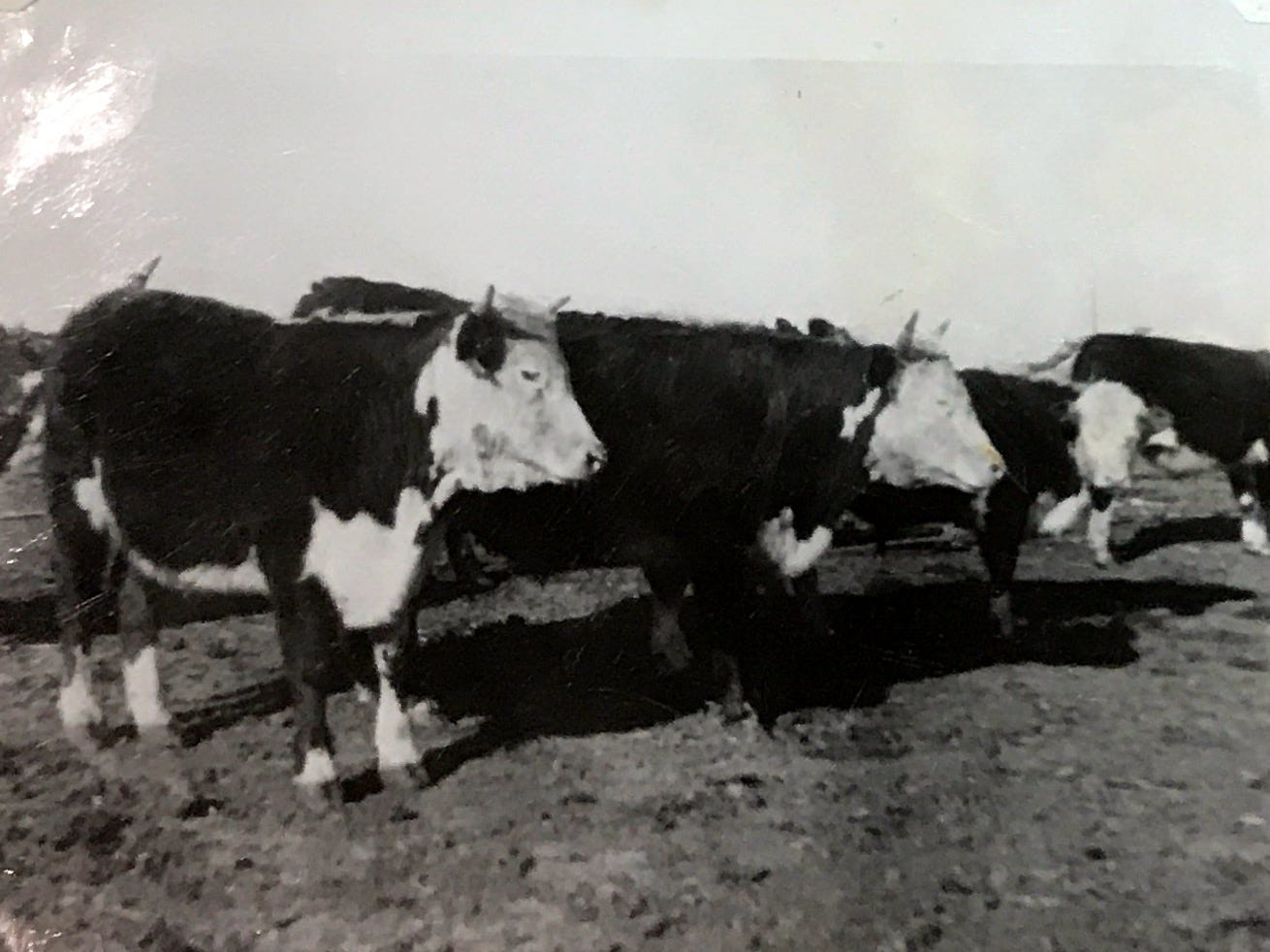
Some steers my great-grandfather fed out in the 1930’s

New Future of Agriculture Podcast Episode!

Check out the podcast episode with Frank Wooten, CEO of Vence, a virtual fencing company about their technology and why it could impact the cattle industry in multiple ways. (LINK)

While you’re at it, I highly recommend signing up for the new weekly newsletter published by Tim Hammerich, host of the Future of Agriculture podcast. (LINK)


Volume 1 of Prime Future is now available in an ebook

My hope is for this PDF to be a valuable go-to resource on all things animal agriculture & innovation. Let me know what you think!

Download the ebook!

Categories
Animal AgTech Business Model Innovation Leadership

Prime Future 44: How to Decide

I was recently making a big decision between two good options, which led me to Annie Duke’s book How to Decide. Duke is a professional poker player turned behavioral decision scientist. One of the most profound ideas from the book is that of evaluating the outcomes of a decision separately from the decision making. Duke points out that we tend evaluate the quality of a decision based on its outcome: good outcome = good decision, bad outcome = bad decision.

But that correlation does not always hold. Sometimes a well informed decision results in terrible outcomes. Sometimes a rash, impulsive decision results in fantastic outcomes. Duke’s thesis is that we can only improve our decision making process when we separate the decision from the outcome, ideally leading to more decisions with better outcomes.

In the first chapter of Netflix founder Reed Hasting’s book No Rules Rules, Reed tells about sitting across from the management of then $6B Blockbuster and proposing they acquire Netflix for $50M. Blockbuster passed.

It is tempting to hear that story and lol at Blockbuster for not making the acquisition. How could they not have seen that their industry was changing? How could they have been so shortsighted to think brick & mortar was the future? How could they have underestimated Reed & his team, or the future of streaming?

With the benefit of hindsight, we know of course that Blockbuster is no longer and Netflix is currently valued at $241B.

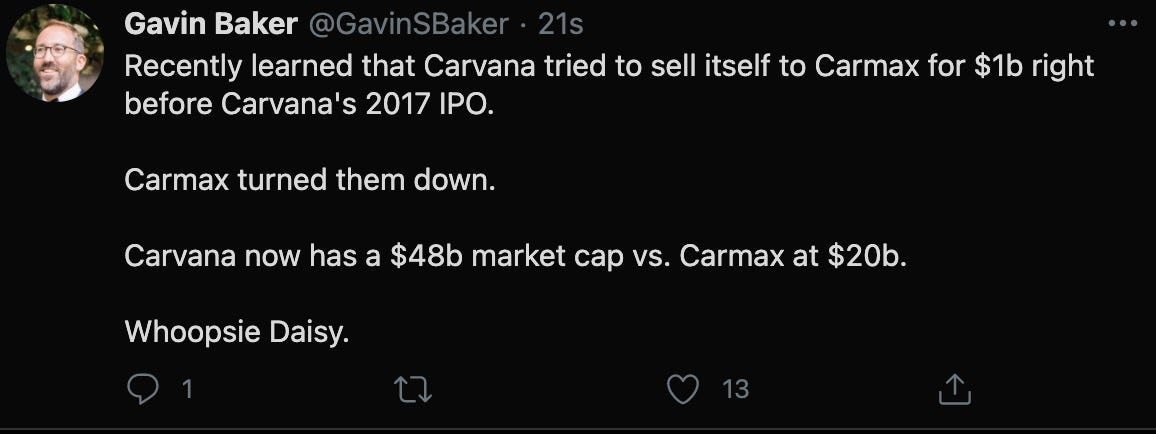
But, did Blockbuster make the wrong decision? Did Carmax make the wrong decision?

Here’s why this is all connected: in a tech obsessed world, particularly in winner-take-all markets (which are fewer than we think, but that’s for another time), the pressure is immense to not be Blockbuster, to not be left behind, to not be the one that didn’t embrace the future. Outsiders love to point out how agriculture is the “least digitized sector” and assume this is because farmers are slow to embrace tech products. Are farmers simply tech averse as outsiders assume….or are farmers making rational risk/benefit decisions that are appropriate for their business context?

Because the truth is, not all tech or innovation decisions lead to good outcomes. Not all innovation is the next big thing. Not every upstart is the next Netflix. Some of it is simply the Segway, cool tech that never finds its use case so it remains a niche product for tech nerds. Some of it is….dare I say….smoke and mirrors. On the super rare occasion, it even turns out to be outright fraud like Theranos (highly recommend the book Bad Blood).

For business leaders, the decision making process is the controllable, the improvable. In all things, including deciding what innovation or tech or tech companies to bet on (whatever the nature of the bet) or what industry trend to capitalize on.

Have you ever noticed that the decisions that led to really bad or really good outcomes are the ones that get all the attention? But, how many exceptionally wise decisions have been made to pass on a product/company that turned out to be the correct decision, that are never known outside of those sitting in the conference room?

Those stories don’t make it on the front page of the Wall Street Journal or into an HBR case study but I expect we could learn a lot if they did.

Here’s how I think hindsight leads us to assess the decisions to bet on a tech company or pass on it, based on the outcomes of how impactive the innovation turned out to be:

Here’s the thing – with the benefit of hindsight we can point to poignant examples of decision outcomes that fit into every category in the above matrix, except for examples of the Unsung Hero. Good defense never gets the same hype as good offense, even though you need both to win.

I could be convinced otherwise, but I think this framework holds true for more than just tech. I think it applies to any new industry trend and decisions made about how to leverage the trend, or not. And again, these decisions get evaluated from the outside based on outcomes.

But there are SO many factors that effect outcomes of early stage companies & early stage technology, from the tech itself, to product design, to go-to-market strategy, to funding sources, to the macro-environment, to industry specific tailwinds or headwinds, to the leadership team, to the pricing model, and on and on and on. Which means, there are SO many factors that affect the outcomes of decisions around early stage tech companies & products. So the decision making process is the controllable.

The relevant question for decision makers of any kind, is how do you make more Obvious Genius & Unsung Hero decisions? I would suggest the following:

  • Make more small bets.
  • Do your due diligence (seriously, reading the book Bad Blood will give you motivation for this).
  • Create a rigorous – and iterative – decision process that you refine as you learn each time. Document your thought process before the decision is made so you can evaluate it in hindsight – most of us are terrible at remembering what we knew or did not know at the time of a decision.
  • Reject all or nothing thinking. Find ways to experiment on a small scale before making go-big-or-go-home type decisions.

My bias is that much of the risk to early stage companies can be mitigated when founders engage early and often in customer discovery, but engaging in that process can also be a way for future customers/partners to de-risk. The challenge for founders is finding the right prospective customers/partners who are willing to engage in the messy, iterative process of innovation. Not everyone wants to see how that sausage gets made.

Right now there are a lot of innovations being thrown at the meat & poultry value chain. With the benefit of hindsight what will be said about bets on…cultured meat? Plant automation? Regenerative ag? Carbon markets? Traceability? eCommerce & brand building? Individual animal management? 3D bio-printing meat? CRISPR?

Time will tell.

How do you improve your decision making process?

On a side note, I usually find that even when I sit down to write for execs at big companies, there are corollary applications for founders of startups and for producers. And vice versa. I hope this was true in today’s content.


Grab the Prime Future ebook (link)

Like what you’re reading? Get all 47 editions of Prime Future to date in one PDF.

Get the ebook!

Categories
Animal AgTech

Prime Future 43: The food & ag labor problem, fixable?

What is one of the most talked about issues across food & agriculture, yet simultaneously wildly under-innovated and under-invested?

Labor.

This issue got a lot of attention in 2020 because of the pandemic but let’s be honest, labor has long been a major issue in agriculture. It’s a top-of-mind & keeps-me-up-at-night issue for both producers and processors of all shapes and sizes & across most geographies, whether you have 10 employees on a farm, 100 employees in a feedyard, or 1000 employees in a packing plant.

On twitter this week, a producer mentioned their plans to scale the farming operation and multiple producers replied with “how are you going to find the labor to make this happen?”

Labor issues range in severity from minor headache to actual constraint on business growth to deciding factor on where to build a new plant.

Before we dig into this topic, keep in mind that we’ve all talked about the expected increase in robotics & automation in processing plants as a solution to some labor challenges. But even with the rise of robotics, smart barns, IoT, etc, for the far foreseeable future there will be significant labor involved in every step of food production and processing.

Optimizing human capital will continue to be an area of opportunity to create outsized impact.

One nuance is that “agriculture” is not a monolith. The seasonal labor needs of a chili farmer in southern Arizona are different than the year round needs of a Tyson plant in Holcomb, KS  which are different still than a grower with 10 chicken houses in northern Georgia.  The labor market of a specific geography has its own dynamics and market forces. Different size businesses have different dynamics and constraints. Different segments have different skill needs.  So saying you have a solution for “agriculture” tells us nothing about who you’re really solving for or what dimension of The Labor Issue you are solving.

Some other nuances that make this such a vexing topic for food & ag:

  • Amount of labor needed – farming and food manufacturing require a lot of human capital.
  • Localized markets
  • Specialized skills
  • Seasonality (some segments)
  • Hard work….really, really hard work.
  • Regulatory environments
  • Ag isn’t a widget production business so people need both good process and good judgement…tricky.

So do we need agriculture specific tech solutions? Yes. You can find several pages on Google search of industry agnostic software solutions for back office processes like payroll. But those solutions don’t address the unsolved challenges vexing food & ag leaders, that are much more complex than running payroll. The real problems are things like:

Safety. Farm work can be inherently dangerous. Manufacturing plant work is inherently dangerous.  In college I lost a friend to a farm accident and a friend to a feedmill accident. We’re talking real human life here. How do we use technology to improve safety and reduce the incidence of injury? How can tech help companies like Cargill that are hyper-focused on safety to further operationalize their safety principles? Or help other companies dial up their focus on improving safety metrics?

Cost. How do we reduce the labor $$ per unit of production? Or how do we turn labor $$ into increased revenue?

Labor availability & workforce managementThese 2 issues can be sliced a lot of different ways here are some of the buckets that create the most challenges:

  • Recruiting – how do you find enough candidates? How do you get the great ones to join your organization?
  • Training – how do you onboard a new employee as quickly and effectively as possible? How do we give employees the opportunity to level up their game and grow in their current role or into a new role? How do we help supervisors & managers be better at supervising & managing?
  • Retaining – the cost of turnover varies, but we all know it’s high. How do we keep (good) employees satisfied & engaged so they stay longer?
  • Rewarding – how do we align individual incentives with business outcomes? I know of a large corn grower that set a bushels per acre goal one year and said that if the goal was met, all employees would get a trip to Hawaii. This pulled everyone in the same direction and not surprisingly, the goal was met.  This might not be feasible for everyone but there are about a trillion and one ways to structure rewards. The main idea is to align incentives for metrics that lead to meaningful business outcomes.

These are all threads that could be pulled and the specific implications within farming and processing contexts, but a lot of ink has been spilled on these topics in general by people much smarter than me so let’s shift to potential solutions.

An interesting tech company that just raised $300M to expand from oil & gas to construction is Workrise, a “workforce management solution for the skilled trades. We make it easier for workers to find work and for companies to find in-demand workers.” Does a company like that move into ag? Presumably. Would/could they account for the nuances in ag mentioned above? TBD.

Here are some AgTech companies that are working on different elements of The Labor Challenge:

  • Ganaz is “the workforce management platform built for deskless workers in agriculture and food manufacturing. We develop tools to help employers recruit, retain, communicate, onboard, train and pay their workforce.”
  • Summit Smart Farms – helps swine producers by “addressing your biggest challenges in labor and technology so you can equip your team.”
  • AgButler is  “a mobile application designed to help users overcome the challenges of agricultural workforce shortages by creating a network of experienced ag laborers made accessible in real-time. Similar to “ride-sharing” technology, our system allows farmers, ranchers and/or agribusinesses to connect with available laborers filtered by location, ratings, work experience and availability. All done within a secure payment structure organized in the app.”
  • DairyKind and Heavy Connect provide targeted worker training solutions.

From an investor perspective, Connie Bowen with AgLaunch describes it this way:

When we talk about pain points in agriculture, there is no pain more acutely felt by all people in the agrifood system than labor.

  • Just care about money? Labor is almost always the largest factor in a farm operation’s bottom line – people are expensive.
  • Just care about health? Lack of technical solutions for specialty crops is a huge factor preventing conversion from row crop to fresh fruit & veg.
  • Just care about ethics? What’s more important than humane [working] conditions and living wages?
  • Just want to invest in a company with a sticky product? Invest in something that does the job and/or enables the farmer and their staff to do the job. Successful past examples include but are not limited to: the steam-powered then diesel tractor [horses/oxen get tired and eat and poop and die], the combine, the cotton gin, effective chemical pesticides.

Labor is a multidimensional problem that is universally felt across food & agriculture. In writing this piece and thinking about it more, my new hypothesis is that labor tech solutions could very well be the most “venture back-able” type of AgTech.

I’d love to know what other companies are tackling this space, just reply to this email if you know any.


Tired of Kodak & BlockBuster as examples of The Innovator’s Dilemma? Here’s one from 1878 courtesy of railroads:

In 1878 Swift (the meat co) hired engineer Andrew Chase to design a refrigerated rail car. Chase’s design proved to be a practical solution, providing temperature-controlled carriage of dressed meats. This allowed Swift to ship their products across the United States.

Swift’s attempts to sell Chase’s design to major railroads were rebuffed, as the companies feared that they would jeopardize their considerable investments in stock cars, animal pens, and feedlots if refrigerated meat transport gained wide acceptance.

In response, Swift financed the initial production run on his own, then — when the American roads refused his business — he contracted with the GTR, a railroad that derived little income from transporting live cattle.

In 1880 the Peninsular Car Company delivered the first of these units to Swift, and the Swift Refrigerator Line was created. Within a year, the Line’s roster had risen to nearly 200 units, and Swift was transporting an average of 3,000 carcasses a week. Competing firms….quickly followed suit.

The punchline? The General American Transportation Corporation would assume ownership of the line in 1930.

The moral for big companies? Innovate early or you pay for it later.


Grab the Prime Future ebook (link)

Like what you’re reading? Get all 47 editions of Prime Future to date in one PDF.

Get the ebook