How do you win when it’s unclear what winning looks like? ICYMI, that’s the question we tackled last week in Climate + agriculture: noise, or mega trend?
“Climate is a mega trend. There will be winners and losers, the difference will be those who collaborate and find workable solutions. This is a mega trend to engage by looking for the ‘and’ solutions…the places of overlap between what’s good for climate related metrics AND for cattle AND for successful cattle operators AND for food companies AND consumers.”
A few readers pointed out that these things tend to be emotion driven and ag typically loses on emotion driven topics. I don’t disagree. We could point to several topics where farmers are squarely on the side of the Science Angels, yet lost the perception battle.
So let’s talk about why carbon *could* be different. Today we look at 3 questions about how livestock fits into the climate trend:
- Who is leading who?
- Why might carbon be more than just another emotion driven marketing fad?
- What’s missing to enable the mega trend to materialize, pragmatically speaking?
Who’s leading who in climate + ag?
“Consumer wants drive value chain decisions.”
I’ll start by pushing back on the narrative that protein value chains are driven by consumers, on climate or any other topic. Consumers….those nebulous creatures of food commerce who somehow sound like the unknowable inhabitants of an alternative universe when we refer to them. Two flaws with the Consumers-R-In-Control narrative:
- Consumers are not a monolith. Segments of consumers want certain attributes, sub-segments are willing to pay for those attributes. Variation among consumers is no less nuanced than variation among farming systems. Mis-identifying what consumers want and what they will pay for x is as fatal of a flaw as over-estimating how many consumers will pay for x.
- Although staggeringly critical to the system, consumers are not everyone’s customers. Consumers don’t transform supply chains or recalibrate industry norms. Food companies do. Food companies are where the power lies. Brand owners make decisions about how to market meat & milk to their customer: retail consumers. Food companies make decisions about how to market meat & milk, and then where needed those same companies use their scale and influence to set product specs & requirements as they procure raw materials or finished product from a certain set of suppliers. No one is talking about the fried chicken wars of Mar Jac vs Wayne Farms chicken, they’re talking about KFC vs Chick Fil A. The two directional power of influence lies with brand holders across foodservice and retail.
Leading brands lead consumers by positioning xyz about their brand that is better than competitors.Food brandstap intoconsumer trends, but theyleadconsumer segments with differentiated products. Sometimes those changes are then adopted by other food brands & their supply chains. The massive shift in NAE (no antibiotics ever) production in US poultry is my go to example for this dynamic – when 1-2 major food companies said we will buy NAE chicken, then NAE chicken is what suppliers learned to produce, at scale. So then more food co’s buy NAE chicken. It’s a cycle that starts with a food brand, moving vertically in that supply chain and then expanding horizontally as more food brands (and their supply chains) adopt whatever the thing is.
We oversimplify the value chain when we attribute all influence to consumers, and we underweight the actual centers of leverage.
This distinction is slight but crucial. Increasing general interest in climate friendliness is creating a market opportunity for food brands to sell into consumers who care enough about that trend to pay more for it. Who will be the brands that lead with a climate related message about their supply chain? How will participants in those brands’ supply chains respond? Will the premiums awarded be enough to shift supply chains, or some supply chains, or parts of supply chains?
But there’s another influencing group that should not be overlooked: investors. Someday we’ll read the HBS case study about the BlackRock effect as the $9 trillion asset manager has gone all in on making sustainability investing the same as investing. In general, an increasing amount of capital is marked for ESG investments (environmental, social, governance) and protein companies are beginning to access that capital, like Pilgrim’s recently issued $1B sustainability linked bond, tying the interest rate to Pilgrim’s success in achieving their targets of reducing GHG emissions by 30% by 2030.
Food companies influence their supply chains and consumers. Investors influence food companies.
Why is carbon more likely to be a monetizable mega trend than an emotion driven fad?
<insert corporation name> will not be able to buy 2 units of sustainability to offset 2 units of un-sustainabillity. But, <insert corporation name> will likely be able to buy 2 units of carbon sequestration to offset 2 units of carbon emissions.
As more companies make net-zero commitments around carbon and seek to offset carbon in their supply chains, carbon markets are the likely place to turn. To make this carbon economy go, the entire structure will have to be underpinned by rigorous standards of measurement and verification. Sound methodology and precision processes are the only way for carbon markets to deliver on the promise for participants and their investors, customers, and consumers.
Another concept bubbling up is carbon labeling on food. Only high end, niche brands are pursuing carbon labeling now, but will this become a more widely adopted practice? The concept behind these labels is numerical representation of the carbon involved in production….the (potentially) magical word for livestock producers is “numerical”. To the extent that sound methodology and high integrity math drive carbon labeling, it represents an opportunity for livestock producers to win by numerically capturing the net positive carbon impacts of livestock production.
People way smarter than me can go deeper on carbon markets and carbon labeling. My point is simply this:
Carbon could be the real deal for producers because both B2B carbon markets and consumer facing carbon labeling on food would require data driven approaches to drive an actual functioning net zero carbon economy based on measurements.
What gets measured gets managed, and monetized.
So what’s missing to enable the mega trend to materialize? Consider this framing:
“Big shifts are underway for farmers as the larger food companies, for the first time, are starting to reward them with a piece of the elusive “green premium.” In 2020, firms like Cargill, Anheuser-Busch, General Mills, and Walmart started paying farmers to adopt greener practices.
Cargill said it would shift 10 million acres to regenerative practices, paying farmers for the green shift and offering complimentary training. The move kills two birds with one stone. It lowers food companies’ own supply chain emissions while encouraging them to offer differentiated, sustainably sourced food to their end customers—at a premium, of course.
While always stewards of the land, farmers have faced a continuous squeeze over the decades with the real price of food declining, the price of labor increasing by 40 percent, and the price of agricultural inputs increasing by 15 percent since 2010. These forces allowed little flexibility in farmer margins to bear the cost and risk of switching to greener products and practices. But with food companies increasingly offering premiums and upfront risk capital, farmers are starting to see the calculus differently.
The big question remains: what technologies will unlock the ability for farmers to profitably capture the green premiums?”
Right now, there seem to be more questions than answers to what the enabling technologies will be. How will we measure? How will we verify? How will we transact? Will participation be voluntary or mandatory, and for whom? Are we talking net carbon sequestration or only the differential from year 0 to year 1?
There’s a whole host of entrepreneurs innovating in this space and venture investors backing them. It’s nascent but rapidly evolving.
The only certainty is this proven core technology (link) 😁:
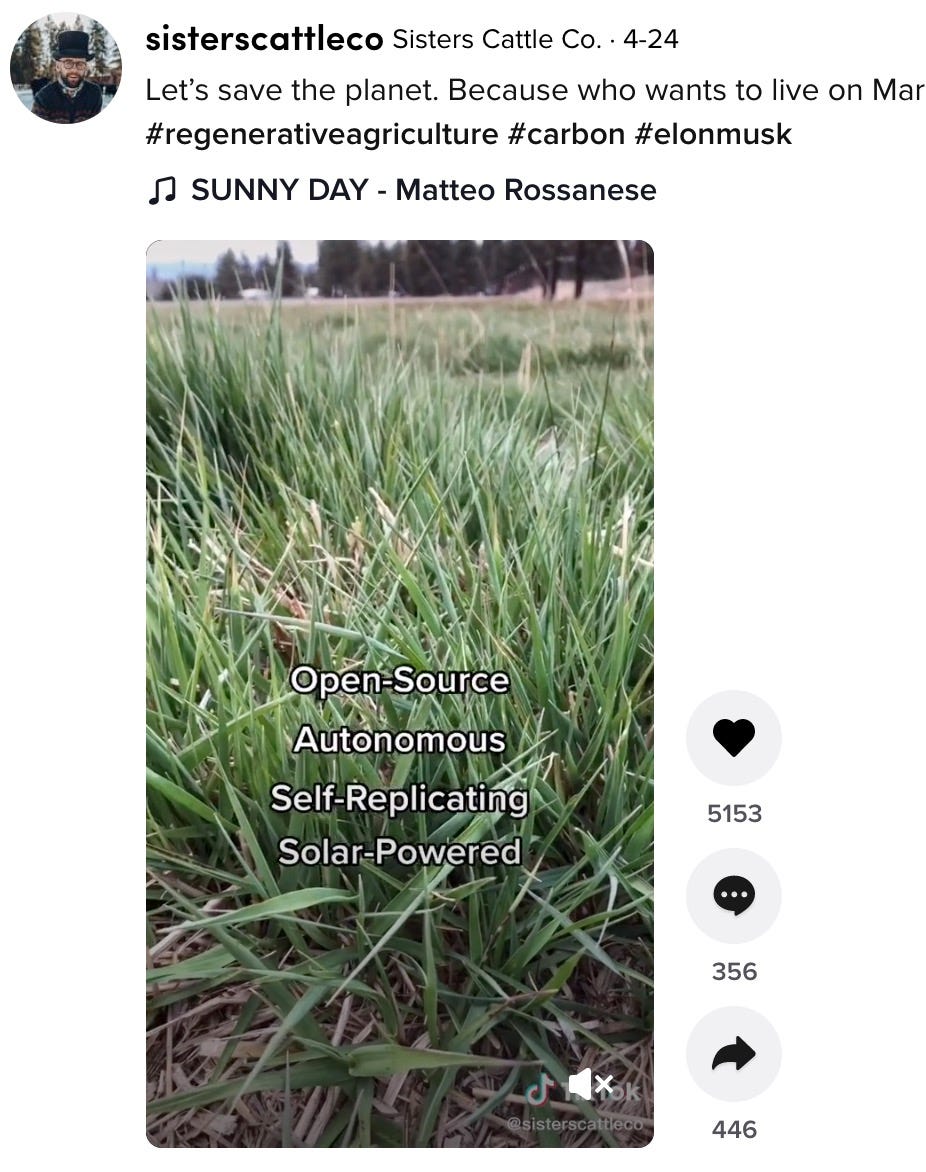
The devil will be in the details – methodology, realities of implementation, new capabilities needed, new partnerships, new data streams, and more. The intriguing aspect is that carbon *could* let producers be on the side of the Science Angels and maybe even win the perception battle.
I’m on the Merck Animal Health Ventures team. This newsletter is not representative of anyone’s views but my own. Sometimes it doesn’t even represent my views 🙂
21 tips for 2021 University Graduates (link)
Graduation season is here, so do the grad in your life a favor and share this article by Shane Thomas, creator of Upstream Ag Insights. A few of my favorites:
1. Ask Questions Don’t let the feeling of looking stupid keep you from asking questions. Many others have the same question and you’ll have more confidence in that answer moving forward.
You don’t know everything. You never will (no matter what your degree says). But you can try. In order to do this, you need to ask questions + listen to those more experienced and with different perspectives. You don’t have to agree with others opinions, but sometimes their perspective is what you need.
2. Learn Broadly (Always Be Capturing – ABC) Being done school doesn’t mean you stop learning. It means learning is just beginning. Learning your area is important, but going beyond ag is beneficial in work & in your personal life. The tools to accomplish this today are infinite. Never stop learning.
7. Expand Your Time Horizons 3 years out seems like a long time, but it’s <10% of your working life. Think 15 or 20 yrs out instead when it comes to things like skill development, career moves or how a technology could impact you.
9. Build a Network Make connections. Introduce yourself to people you find interesting and tell them your ideas. Send messages on social media, request a coffee or a phone call.
14. Be Comfortable in the Grey Area We get taught in black and white. The world is grey.
17. Outcome Over Ego The goal shouldn’t be to be right, but to achieve the best possible outcome. That might mean your ideas don’t get used. Accept it and learn from it.
20. Strong Opinions Loosely Held Having conviction in your beliefs is paramount, but you need to be continuously open to changing times and new information…especially early on in your career. Be confident, but be ready to adapt.