Categories
AgTech Animal AgTech Venture Capital

Prime Future 102: What if Cargill, Tyson & Pilgrims were venture-backed companies?

Imagine an alternate universe where William Cargill, Sam Walton, John Tyson, Bo Pilgrim, and JR Simplot had access to venture capital in their early days.

  1. Could venture capital have improved the outcomes of their companies?
  2. Let’s assume these companies wouldn’t have ended up any bigger than they did, but could they have shaved 50-100 years off the time from start to empire status?
  3. Would those founders have taken venture capital if it had been available?

Venture capital is a tool for faster growth. But it comes with a time clock – industry standard is a 10 year time horizon for a fund.

But these companies are generational giants. William Cargill started the earliest seed of Cargill in 1865…that’s a minute ago. They grew the old fashioned way – by creating value at the right time for the right market(s). I’d love to have insight into their capital structure during mega growth phases but let’s assume that growth was financed by some debt and mostly revenues since venture capital didn’t even become a thing until the 60’s-70’s and even then was limited to high tech businesses.

Today we explore scenarios where venture capital either wasn’t needed or wasn’t a fit, and how survivor bias might influence our views on both.

Speaking of bootstrapping and overnight successes built over years decades, I recently interviewed Scott Sexton (CEO of Dairy.com which is now EverAg) for the Future of Agriculture podcast. Scott has been on my list of go to smart people ever since I was launching The Poultry Exchange. We downed a lot of coffee talking about strategies and tactics to get to liquidity in digital marketplaces since that was how Dairy.com started years before.

Dairy.com emerged from the ashes of the dot com bust backed by several large US dairy processors. Those dairy processors needed a better way to trade dairy products like cream to keep supply & demand in balance which is tricky when you have a perishable product and multiple components.

Because processors were invested in Dairy.com they drove volume into the trading platform, and because there was volume in the trading platform from suppliers then buyers showed up. This early path to liquidity was critical and it’s a topic for another day, but the lack of liquidity is what kills most marketplaces.

The marketplace was effectively what we’d call today their wedge product. It got them in the room, in the market, in the customer’s office. Then they started expanding, incremental step by incremental step.

They were facilitating the trade but then the customer needed to physically haul dairy products and there was a whole suite of challenges making that a nightmare. So Dairy.com moved into digitize hauling.

And once you’ve traded product and hauled product, someone needs to get paid for that product….which had its own suite of clunky paper based products. So Dairy.com moved in to digitize payments.

They’ve just repeated this process for 20 years, going deeper within the vertical while expanding their footprint wider across the value chain and shifting their identity from ‘marketplace company’ to ‘company that powers supply chains’. The company recently began that shift from ‘go deeper in dairy‘ to ‘go wider across ag’ by moving into other verticals.

Until the relatively recent private equity acquisition, Dairy.com grew in a capital constrained way, with steady growth.

So flip the script on their business. Could a venture backed Dairy.com have had a similar outcome in 1/4 the time? Or had a bigger outcome in the same time frame?

I’m still forming my hypothesis here but I think there’s something interesting, something durable about high ambition companies that grow slowly. I’m not talking about lifestyle businesses (and I don’t use that description pejoratively), I’m talking about companies that have high ambition for high growth but do it without relying on copious amounts of venture capital.

Maybe high ambition companies that grow slowly over time have the most staying power.

Venture capital is flashy. It’s big numbers and hockey stick growth curves (up and to the right, always!) and IPO’s and buzzy exits. Or at least, that’s what you read about.

What you don’t see press releases about are the companies that drowned in too much cash by attempting to grow faster than the foundation of the company could handle, or before their market was ready. The graveyard of these companies is grande.

Venture capital is a financial tool for growth, but it’s not always the right tool for the job.

Given the venture fund model and venture timelines, does VC add risk to the investee? In many situations, yes. Or as one founder put it recently, “VC’s have many bets in their portfolio, I have one and it’s this company. My outcomes are binary.”

Alternatively, does slower growth increase staying power of a company?

Depends on the market. The customer. The product. The company. The competition.

Another scenario: Hickory Nut Gap is a growing regional meat company selling into Whole Foods and other retail and foodservice outlets. This is a high ambition farm to label operation that has grown rapidly but is in a low margin category, where traditional growth capital sources aren’t quite a fit and yet some form of growth capital is needed to fuel the founder’s ambitions for the business.

I wonder about the alternative financing models that are needed but not readily available for these types of businesses, capital that is:

  • more risk tolerant than private equity
  • more patient than venture capital
  • less expensive than equity
  • more flexible than most debt

Is that a thing? Can that be a thing?

In agriculture, capital can’t remove all the bottlenecks to growth because often the bottleneck to growth is the reality of natural rhythms of live plants and animals who exist in complex biological ecosystems and producers operating in increasingly volatile financial environments.

The risk to this whole conversation is looking only at the winners, and failing to recognize Survivorship Bias.

Shane Parrish of The Knowledge Project describes it this way:

“Survivorship bias is a common logical error that distorts our understanding of the world. It happens when we assume that success tells the whole story and when we don’t adequately consider past failures.

There are thousands, even tens of thousands of failures for every big success in the world. But stories of failure are not as sexy as stories of triumph, so they rarely get covered and shared. As we consume one story of success after another, we forget the base rates and overestimate the odds of real success.”

This is incredibly true in the world of venture capital. But by definition it must also be true in the eras in which Cargill, Tyson, Walmart, Simplot, etc were forged.

So what’s the takeaway?

I think the moral of the story is that great businesses get built under every financing structure possible, in any market condition, in any vertical. There’s no absolute better or worse capital source, there’s only better or worse for this business at this time.

Would William & Sam & John & Bo & JR have taken venture capital? Impossible to say obviously (and we can have a whole other debate about whether their business models were venture friendly) but I wonder if the benefits of bootstrapping a high ambition business isn’t its own kind of super power.

What a time to be alive 😉

What company that is a small to midsize business today do you think will be a big business in 20-50 years?

Categories
AgTech Animal AgTech

Prime Future 98: maybe Market Conditions are the real innovation arbiters

That is the headline from a recent Wall Street Journal article that goes on to describe an emerging dynamic in this fertilizer-market-gone-wild moment:

This summary highlights two questions that matter when it comes to adoption of anything in ag – whether new technology, new production practices, new marketing strategies. New anything. Let’s call this The New Thing, for simplicity.

The first hurdle is to ShOw Me tHe PrOoF.

Show me the science, the evidence that this has worked elsewhere in a predictable and repeatable way. Producers need highly convicting reasons to believe this New Thing is highly likely to deliver the same results in my operation as it did in the evidence you bring. When you get one shot a year, there’s little room for error.

Assuming the ShOw Me tHe PrOoF hurdle has been cleared, another relevant question is:

Under what market conditions does adoption of The New Thing make the most sense?

And the complexity lies in the fact that ‘market conditions’ does not simply mean the conditions of a single market. Market conditions refers to the equilibrium of both input costs and commodity prices.

  • Grain farmers make decisions based on input costs like fertilizer and corn prices.
  • Cow-calf producers make decisions based on hay prices and drought conditions and calf prices.
  • Feedyards make decisions based on feed prices and feeder cattle prices and live cattle prices.
  • Farrow to finish hog producers make decisions based on feed prices and hog prices.
  • Poultry integrators make decisions based on feed prices and wholesale chicken (meat) prices.

The point is that the unique combination of market factors at any given time can influence adoption in 2 ways:

  1. Increasing or decreasing ROI of The New Thing.
  2. Increasing or decreasing the risk of trying The New Thing, real or perceived.

I don’t want to hurt anybody’s feelings but….innovators cannot bend markets to their will. Market conditions are not a controllable, even for highly convicted startup founders creating their own Steve Jobs’ style reality distortion field.

But innovators can be prepared for the market conditions that might create incentives for producers to become more open to trying out The New Thing.

And innovators can think through whether adoption will ONLY occur under certain market conditions (yikes if true) OR if certain market conditions simply give producers a reason to give The New Thing a shot, at which point The New Thing can prove itself in order to become The Status Quo Thing.

Here’s a great quote from the WSJ article, by a farmer currently using Pivot Bio products:

The fertilizer & biologicals situation is interesting because if – under the current combo of fertilizer and grain prices – producers who would not have otherwise had a reason to take on the initial risk (real or perceived) of biologics in lieu of fertilizers now have such a reason, and if biologics prove themselves in yield, then this specific set of market conditions could turn out to be an inflection point for biologics adoption.

The best case scenario is when certain market conditions create a compelling reason to try, and then The New Thing delivers a compelling reason to keep doing the thing even when market conditions normalize.

Of course the flip side is that market conditions can create massive headwinds for The New Thing, in which case for innovators and startups it’s all about staying alive long enough to have the chance at flying in alternative market conditions.

So maybe the takeaway is simply to put your head down and build solutions to real problems, be aware of what market conditions might create a tailwind, and ignore the market chaos while being ready to seize the moment when some ideal combo of market conditions happens.

Sometimes innovation adoption is determined by markets in the form of premiums, discounts, or market access. Sometimes by regulations. But maybe, just maybe:

Market Conditions are the real innovation arbiters.

One last caveat from the classic book Crossing the Chasm on the real challenge of moving beyond innovator customers & early adopter customers to mainstream adoption: everything we’ve discussed here is likely only true for the majority of prospective customers. In the fertilizer vs biologics example, the early adopter farmers were already piloting the use of biologics for other reasons before the market conditions created the opportunity for the rest to consider.

So perhaps the more accurate statement is that Market Conditions are the real ag innovation arbiters for the majority of New Thing adopters.

The unending complexity in ag is what makes it fun…what a time to be alive 🙂

Categories
AgTech Animal AgTech

Prime Future 93: Un-manured money in animal agtech

Last week was the Animal Agtech Innovation Summit held on the front end of the World Agritech Innovation Summit, which is largely focused on non-livestock agtech.

With a livestock lens, here are 7 takeaways:

(1) Many things in life fall into a normal bell curve distribution…startups do not.

There are a lot of really uninteresting startups and a few really really interesting startups. Since animal agtech companies are largely still super early stage, the dimensions that divide the un and the interesting are pretty basic: problem being solved, product, business model, team, vision, etc.

There are the many startups that are just noise (so.much.noise). And there are the few fantastic startups that could radically improve the livestock, meat & dairy business.

But….

(2) ….the same is also true of investors. There is a lot of money investing in ag, that doesn’t know ag…especially animal ag.

Venture investing is risky. Venture investing in a nuanced space without respecting the nuances is really risky.

According to AgFunder’s newly released Agrifoodtech Investment Report, venture capital into ‘agrifood’ increased 85% from $27.8 billion in 2020 to $51.7 billion in 2021. AgFunder further divides into upstream investment (farm to processing), which grew from $15.8 billion in 2020 to $18.9 billion in 2021. AgFunder does not segment the Upstream category into crop vs livestock solutions but I expect livestock funding follows a similar growth trend, albeit smaller than the crop category.

On the one hand, this growth in capital is fantastic news for the category. More capital = more innovation.

Except, a lot of the money is being managed by folks in their standard VC Patagonia vest who’ve never been on a farm or had their boots covered in cow/pig/chicken 💩💩💩 or heard first hand all the dynamics that livestock producers are navigating. That’s a problem.

Some might be tempted to call this dumb money, but let's call this 'un-manured money'.

The cynical view is that too much un-manured money means the wrong companies get backed, and the market gets oversaturated with zombie startups that won’t generate venture returns because they won’t create real producer value.

If investors then start to believe they can’t win in the category, then future capital might not flow into the category and it will go to ClimateTech or FinTech or some other hot category.

And if early adopter producers have negative experiences, then the target market grows skeptical. (Ask any mid-large row crop farmer what it was like 2014-2019 when they were getting daily calls from inside sales reps from the 10th farm management software company.)

And yet, the optimistic view is that regardless of the capital source, more venture capital means more companies get backed and more innovation flows to livestock, milk & meat, and even if only a small fraction of companies that get backed are solving legitimate problems and could have a shot at creating meaningful impact, well there’s still a shot at meaningful impact. So the net result is positive for the industry.

(3) There’s a lot of dogma in agtech investing.

Traceability, regenerative, etc. Which of these will prove to be actual market opportunities and which will turn out to be overhyped & untested investor assumptions? TBD.

But I get really nervous that folks have lost the plot when people stand on a conference stage and say with a straight face that consumers want to pay more for food.

Are some consumers willing & able to pay more for food produced with specific attributes & claims of production practices? Absolutely.

Are all consumers willing & able to pay more for food? Absolutely not. And to assume so is to be embarrassingly out of touch with the reality of the majority of humans on the planet.

(4) Start with the customer and their problem and work back.

Start with the customer and their problem and work back.

Start with the customer and their problem and work back.

Early stage animal agtech companies that have this kind of mantra on repeat will be the winners…the rest will struggle.

One of Amazon’s disciplines is that at the start of product development for any new product, the team writes a press release as if the product were being released today. The press release has to frame the product in terms of benefits to the customer. That press release is aggressively iterated until the product vision is clear.

There are a lot of early stage agtech companies that could benefit from this exercise.

(Related: no one cares about your technology for the sake of technology that sounds cool…I’m looking at you, blockchain.)

(5) The myth of the hoodie wearing 20 year old wunderkind founder is not the rule in broader venture, and it’s really not the rule in ag.

“Mark Zuckerberg launched Facebook at the age of 19, but this is the exception rather than the rule when it comes to successful founders. Most successful founders in the United States have tended to be over 40 years old when launching their company. As of 2018, the average age of the top 0.1 percent of startups in term of growth was 45 years.”

Given the complexities of livestock, the most effective animal agtech founders are those that either know the problem they’re solving because they’ve worked directly in it, or because they’ve invested the time to know the problem as well as their customers do. That’s when magic happens.

(6) The number of livestock & dairy focused startups feels significantly higher than it was even 2-3 years ago.

But the number of startups working on solutions for meat processors seems flat. I think MeatTech might be the 3rd wave of innovation after agtech and animal agtech.

(7) Animal agtech is still so, so, so early.

The Animal Agtech event is actually only a few years old and although it’s growing, it has less than half the attendees compared with the longer running World Agritech event. The evolution of the two events mirrors the two distinct waves of innovation in that agtech innovation for crops is about 7-10 years ahead of animal agtech in terms of funding, maturity, scale, impact.

Almost by definition, the majority of tech companies working in livestock are early stage companies.

There aren’t venture-backed animal agtech companies that have IPO’d, who’s quarterly earnings can be analyzed. There’s no rumor mill about which animal agtech companies are about to IPO. Unlike their counterparts in broader agtech that are raising Series F & Series G funding rounds, the most mature of animal agtech companies are still at the beginning of the alphabet. The category is just early.

That earliness shows up in the still relatively small number of companies, and especially  in the smaller still number of companies that have reached product-market fit. A producer who looked at the category today might be skeptical since many animal agtech companies are still in their Wilderness years. And yet, I think that’s how the broader agtech category felt circa 2012.

If the pattern holds, then by 2032 the animal agtech landscape will look completely different from today, in the best of ways.

No news flash here: I’m bullish on the category and excited to see high-impact animal agtech companies grow in the next decade.

What a time to be alive 😉

Categories
Animal AgTech Business Model Innovation

Prime Future 88: The infinite game plays on

You probably know the now infamous quote: “There are only two ways to make money in business: one is to bundle; the other is to unbundle.”

Bundling vs unbundling is an example of two extremes in a market. But my hypothesis is that the insight isn’t about those 2 specific extremes, the insight is that every market has its own extremes from which the pendulum swings.

Let’s talk about 3 livestock & meat industry pendulums that miiiight be on the verge of gaining momentum. Who knows how much they’ll actually move, but it’s at least worth exploring out of curiosity.

(1) Farms moved from integrated to specialized, or from closed loop systems to open loop systems. Now there’s a movement back towards farming systems that integrate crops & livestock.

Before synthetic fertilizer was available, the fertilizer options were livestock manure or importing bat guano from South America. Then along came the Haber-Bosch process, an invention that converted atmospheric nitrogen into ammonia for fertilizer. This was a lynchpin in the evolution of the modern ag industry as it meant farms no longer ‘needed’ livestock manure in a closed loop system. It allowed farmers to sever the natural link between crops and livestock farming, allowing farms to specialize in crop OR livestock production. This was an incredible move towards efficiency.

Now there’s a movement to pull the pendulum closer to closed loop systems, to get the best of both worlds.

Even a few years ago, even in ‘sustainability’ circles, the idea of grazing cattle behind crops was quasi-heretical. Today the idea is not at all heretical.

How seriously the pendulum is swinging, to what degree, and at what pace are all still TBD.

The two extremes in farming are integrated systems or specialized systems. 

(2) Processing was geographically concentrated near population centers, then moved to be near the cattle. Now a segment of consumers want local production and processing.

Packing plants were originally located near population centers, like 1800’s originally. Live cattle were driven to the plants because live cattle traveled better than meat did. The development of the refrigerated rail allowed the pendulum to swing, leading to packing plants being located near the cattle, and cattle were increasingly located near grain. Ever since, meat has done the majority of the traveling.

Now some segments of the meat industry are rethinking that paradigm. Increased regional packing capacity is being constructed today in response to this dynamic…how the business model evolves to make these plants work is still a bit tbd, but regardless, capital is following this pendulum swing.

The two extremes in packing are large scale/centralized/high throughput and small-mid size/decentralized. Can this pendulum move meaningfully?

(3) Specialization in red meat value chains led to an effective separation between the livestock industry and the meat industry. More people are trying to re-converge the two.

The livestock, dairy, and meat business used to be synonymous. Then those segments each specialized. So today it’s not uncommon to find producers who don’t understand the nuance of the meat business. Neither is it uncommon to find folks in the meat business who do not appreciate the complexity of live production.

The two extremes are distinct livestock & meat industries, or an animal protein industry.

The complexity of nonstop recalibration

What makes the ag industry fun is its complexity. The examples above are just a few of the many pendulums that are continually & simultaneously recalibrating all while consumer behavior collides with producer economics, record packer profits, and the rise of soil health as the center of all the things.

This whole ag industry thing is not just as simple as bundling and unbundling as in other sectors, this is the complexity of a multi-player game with many moving parts, each simultaneously sending signals upstream and downstream.

We tend to think of these big pendulum swings as Either/Or, when reality is more of an And.

Speaking of pendulums with momentum, take the example of rapidly changing layer housing systems. On one extreme are super-efficient-and-great-for-low-cost-production-cage-systems and on the other end is cage free production, aka what the market is signaling it wants:

“Without much fuss and even less public attention, the nation’s egg producers are in the midst of a multibillion-dollar shift to cage-free eggs that is dramatically changing the lives of millions of hens in response to new laws and demands from restaurant chains.

In a decade, the percentage of hens in cage-free housing has soared from 4% in 2010 to 28% in 2020, and that figure is expected to more than double to about 70% in the next four years.

The egg industry also initially sought national standards that would allow larger cages but ultimately relented, said J. T. Dean, president of Iowa-based Versova, a leading egg producer.

The key, said Dean, was getting long-term commitments for guaranteed buyers of eggs at a higher price and then finding financing that would work for his company.

Jayson Lusk, who heads the Agricultural Economics Department at Purdue University, found that after a mandatory shift on Jan. 1 to cage-free in California, the price of a dozen eggs in the state jumped by 72 cents — or 103% — over the average U.S. price, although the gap could shrink as the market adapts.”

Where there’s a market there’s a way.

The invisible hand, and whatnot.

A few ideas from Simon Sinek’s book The Infinite Game bring this all together:

“Sinek explains that finite games (e.g. chess and football) are played for the purpose of ending play consistent with static rules. There are set rules, and every game has a beginning, middle and end, and a final winner is distinctly recognizable. Infinite games (e.g. business and politics) are played for the purpose of continuing play rather than to win. Sinek claims that leaders who embrace an infinite mindset, aligned with infinite play, will build stronger, more innovative, inspiring, resilient organizations.

Sinek argues that business fits all the characteristics of an infinite game, notably that: there may be known as well as unknown players; new players can join at any time; each player has their own strategy; there is no set of fixed rules (though law may operate as semi-fixed rules); and there is no beginning or end. Further drawing on Carse’s work, Sinek extends the distinction between end states in finite games to claim that business, when viewed through an infinite mindset, do not have winners and losers, but rather players who simply drop out when they run out of the will, the desire, and/or the resources to continue play.

The protein industry is by definition an infinite game. Individual businesses within the game are only infinite to the extent they continually earn the right to keep playing.

The pendulums swing but the infinite game plays on.

Categories
Animal AgTech

Prime Future 87: Precision livestock management, so what?

Have you ever taken a work out class at Orange Theory Fitness? I’m a recent convert, mostly because of this:

The scoreboard inside Orange Theory Fitness gyms

That front & center, color coded, real time scoreboard. There are big screens at the front of the gym with everyone’s names in a block that changes color as your heart rate increases, relative to your resting heart. The color zones are based on your current heart rate as a % of your maximum heart rate, and it progresses from gray to blue to green to orange to red. The data is pulled from the heart rate monitor you wear during the workout.

So wherever I am in the gym, I can look up and quickly see how I’m performing in my workout…and how my performance compares to others in the class.

Orange Theory says that to maximize calorie burning, you should get at least 12 “Splat Points” per workout. A splat point is added for every 1 minute your heart rate is 84% and above your maximum heart rate. Each individual’s progress towards splat points is also displayed on the big screen.

This gives me a a real time quantifiable, measurable, trackable goal while I’m in the moment and can still dial up my effort to change the outcome of the workout.

After the workout, I open the OTF app to see how this workout compared to prior workouts. The app gives me a visual record of progress, of momentum. Which is wickedly motivating.

Before wearable fitness trackers, you only had documentation about whether the workout occurred, or what happened during the workout, if you wrote it down yourself. People just worked out for the sake of working out. <shudders>

That same shift, the same unlocking, is happening with the rise of precision livestock management. Let’s talk about what that means & why it matters.

There are three defining dimensions to precision agriculture technology, whether livestock or crops:

  1. Shrinking the unit of management. In crops, it is about going from field to acre, or acre to plant/tree. In livestock, it’s about going from herd to animal, or swine barn to pen, or poultry house to zone.
  2. Timing of the measurement. Real time data capture, or close to it.
  3. Actionable. What is the ‘splat points’ equivalent? The thing that gives the user something to GO DO differently, based on the data captured. Without a thing to GO DO differently, 1& 2 don’t matter and the whole concept falls down. There is near zero value created if the data cannot be actioned.

…and precision livestock management applies those 3 dimensions in a framework to optimize relevant inputs (animals, feed, grass, etc) and outputs (livestock, meat, milk). A critical caveat here is that ‘optimization’ is unique to each producer’s objectives and what they are optimizing for.

Contrast a future state with high value creating precision tools with the historical norm, in which livestock managers have had the most relevant data available at closeout with metrics like feed conversion, ADG, or profit/loss.

Quick timeout for 2 definition refreshers:

(1) Lagging indicators vs leading indicators. Lagging indicators tell us what happened in the past. Leading indicators tell us what’s happening now. And effective leading indicators predict outcomes.

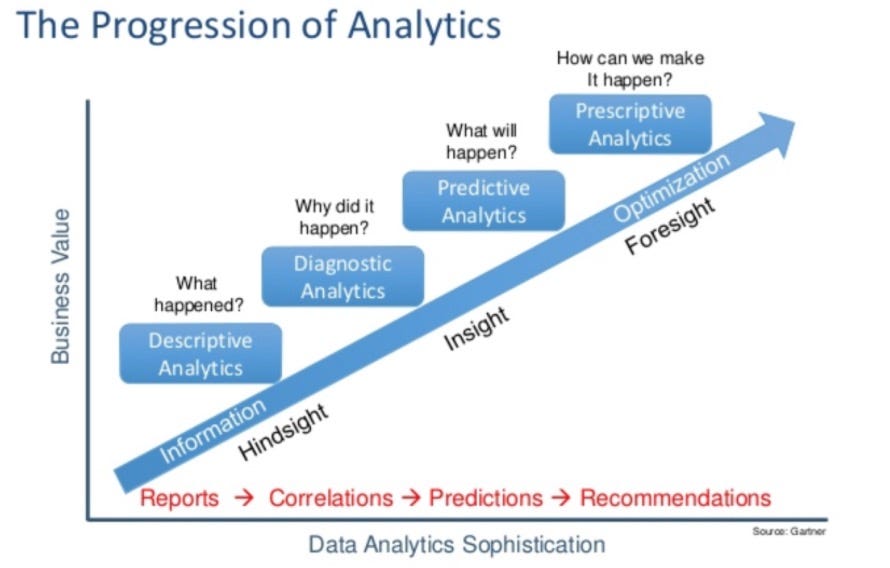
(2) You’ve probably seen this a hundred times, as it’s a common framework to think about the progression of analytics in terms of both business value & degree of difficulty:

So, closeout data is both a lagging indicator and an example of descriptive analytics, the lowest value version of analytics. Closeout data can only tell us what happened – not why it happened or what’s likely to happen next, in time to course correct. 😕

In the absence of real time data around leading indicators, we rely on the combination of lagging indicators and qualitative evaluations. Like when a poultry vet walks into a poultry house and looks at litter conditions as an indication of bird health which is an indicator of how the flock will perform at close out.

But the promise of IoT is that with connected sensors, we can have real time data that enables more effective leading indicators of performance & outcomes.

It’s almost like there are 4 elements to make that promise of IoT hold up:

  1. What relevant data is captured?
  2. How is the data presented? (Think of the OTF scoreboard!)
  3. How does the ‘scoreboard’ change behavior?
  4. What is the value created by the change?

5 Considerations for livestock owners & managers

(1) Behavior change. Because precision livestock tools only create value when they drive a specific decision or set of decisions, these tools should change how we manage and/or what we manage. Full stop.

(And the more specific precision livestock products get about what they solve, the easier it is for decision makers to decide how to deploy the technology. Everything is the enemy of Something.)

(2) Scorecards motivate people. Humans like to see results, evidence of progress. It’s why every single management system in the world talks about the importance of keeping some sort of scorecard in front of people, whether it’s Andy Grove’s OKR system or Franklin Covey’s 4 disciplines of execution. Data turned into leading indicators turned into compelling scorecards can align work to be done & drive progress.

(3) New ways to get it right...or wrong. Incentivize the wrong metrics and you could end up with suboptimal results. Which potential metrics are simply ‘interesting’ and which potential metrics can move the needle on the most important outcomes? Getting really clear about vanity metrics vs useful metrics will be more important than ever.

(4) Linking leading indicators with lagging indicators. Find the leading indicators with Actual Predictive Value of lagging indicators. Not to mention that one segment’s lagging indicators at closeout, might be leading indicators as the product (livestock or meat) moves through the value chain.

(5) Find the right role for qualitative evaluation. I love the idea of human + machines, or qualitative + quantitative, or marrying what the data says and what the well trained human eye detects. Real time data doesn’t mean you don’t need people to manage livestock, obviously. But it should mean that you can allocate those human resources in higher value ways.

Long time Prime Future readers know that I am not interested in tech for the sake of interesting tech – it is always and only about value creation.

We are in the early early days of precision livestock management and aligning the right tech around the right business problems to create compelling value. I’m bullish on animal protein in the long run, and on precision livestock technologies as an enabler of that long run.

“The future is here, it’s just not evenly distributed.”

Share


To catch up on almost 2 years of Prime Future content, here are two available downloads:

Prime Future editions 0 – 81

Get the ebook with editions 0 – 81 🚀

Beef x Dairy: What does this emerging trend mean for the beef industry?

Get the beef-on-dairy ebook 🐄

Categories
Animal AgTech

Prime Future 85: Minimum viable management isn’t enough

If we’re gonna do this topic then we have to follow the story all the way to the end. Are you in?

Last week an exceptionally forward thinking rancher said in a sustainability discussion that the lowest hanging fruit to level up the US cattle herd is for every calf to get an eartag. Not an EID, an old school humble visual tag.

That simple step, and marrying the calf’s number with the cow’s number, allows producers to get a handle on each cow’s productivity and performance which allows them to manage their herd more precisely.

That simple step is the first baby step in shifting from managing at a herd level to an individual cow level. It is cattle 101, something the good & great (even mediocre) producers have been doing for decades.

Yet, you’re telling me there’s a meaningful chunk of the US cattle industry that is not even tagging their calves?

The idea that tagging calves represents a meaningful way for a meaningful chunk of producers to level up is….alarming. And it should be alarming for the mediocre/good/great producers. If tagging calves is the bar, the bar is…low.

In a time where hyper-innovative producers are deploying advanced genetics strategies, intensive rotational grazing, or non-traditional marketing agreements, over on the other end of the spectrum putting a mere visual tag in every calf’s ear can be considered a proxy for minimum viable management.

Suboptimal cattle production isn’t just an innocuous segment that has no effect on the rest. Poorly managed cattle are a drag on the whole system. And the impacts of the drag are worsening as the industry looks to address the big challenges.

This begs a few questions.

What is good management? It starts with a business approach, not a lifestyle mentality, which means things like:

  1. Sound financial management.
  2. Strong resource management – capital, land/soil, water, grass, livestock.
  3. Clear KPI’s to manage and optimize.
  4. Pursuit of excellence – however you measure it for yourself and your business.

“If a man is called to be a street sweeper, he should sweep streets even as Michelangelo painted, or Beethoven composed music, or Shakespeare wrote poetry. He should sweep streets so well that all the hosts of heaven and earth will pause to say, ‘Here lived a great street sweeper who did his job well. ‘” – MLK

There are many excellence-oriented producers.

There are also many existence-oriented producers. (Synonyms in this context: mediocre, ordinary, status quo maintainers, hobbyists.)

And the gap between the two is widening. Imagine that at the extreme edge of excellence-oriented producers are those pushing boundaries in all areas or maybe even hounding feedyards and packers for individual animal data on how cattle perform in the feedyard and on the rail so the producer can use that data to iterate on genetics and produce a more premium end product. And on the opposite end of the extreme edge of existence-oriented producers are those still operating at a brand level (herd level), largely raising cattle the same way cattle were raised back in the day: low cost, low touch, no tech.

The easy thing to do would be to assume that large operations are better managed than small operations. In the United States, ~10% of cattle producers own 100+ cows, yet this segment owns ~56% of total beef cows. The average is ~43 cows, which means the average of the ~44% of cows is actually much lower than 43.

But herd size isn’t necessarily a good predictor. We have talked previously about an alternative mental model to think about quality of an enterprise than simply scale:

“Big business can be good, small business can be bad. Vice versa. Size is not the indicator of success and it’s definitely not the goal.

My hypothesis is that scale is a lagging indicator; velocity of business model innovation is the leading indicator of success.

I think the successful producers (or packers or xyz business) who will thrive come-what-may are the ones who don’t think of their business based solely in terms of the output (corn, soy, weaned calves, whatever), but rather view their business as a business model that is is in continual refinement. They constantly ask what’s the process that most effectively generates the output. They think in systems that can optimized.

It seems that the really successful producers are the ones that have a vision of where they are going and how they will get there. There’s no doing it this way because that’s how we’ve done it, there’s no growth for the sake of the growth. There is only relentless learning and improvement.

The great producers realize that they aren’t selling just a commodity output, they are selling their business model.”

Some portion of those <50 head operations are incredibly well managed operations that consistently send high quality cattle into the value chain.

And, some of those small herds exist for the fun of it, or so that someone’s ego is flattered by the status symbol of owning cattle, or so that a landowner qualifies for an ag exemption, reducing their property taxes by assessing the productive value of the land rather than the market value of land.

But again, excellence oriented producers come in all herd sizes. The distinction is in their objective and their management framework.

Take a producer with a lifelong goal to improve their business and steward their resources and pass on a viable cattle business to the next generation like the producer on Twitter who said he was going to start writing an annual report about his family’s cattle business for the benefit of both current and future shareholders, presumably his children. Then take the producer who really just wants an excuse to wear a cowboy hat, or a way to reduce their property tax burden, or does this because it’s all they know and they raise cattle the way their grandparents did.

The two are not the same.

As one cattle producer puts it, “it isn’t hard to be above average in this business.”

In the past, it’s been kinda easy for the excellent producers to ignore the existence producers, the below average producers. But as the industry leans in to address big problems (which happens to create opportunity for those at the front edge), the existence-oriented producers are creating a drag that could become an existential threat to the entire industry.

Which raises the next set of questions:

How do we level up the industry by bringing up the bottom x%?

How do you get producers to shift from existence to excellence?

How do you help those producers to level up or get out?

Maybe you don’t, maybe it is what it is.

Or, maybe you lobby USDA to pay them not to produce, or to produce something different. (Yes of course it’s a terrible idea but don’t act shocked – we’ve had crazier agricultural policies in this country.) Or, maybe you lobby to refine the ag exemption in the tax code (though sometimes its better not to poke the bear).

Changing behavior in a value chain often comes down to regulations 🥴 or market incentives, aka premiums & discounts.

As the aligned supply chain trend continues to grow and the variance increases from one aligned supply chain to the next as far as what farm/ranch level practices are incentivized, that could present an opportunity to incentivize these producers to level up…but only if they have a profit motive. Even then, there’s a high cost of coordination with small producers. Perhaps there’s a need for an aggregator platform to connect small producers with aligned supply chains.

Alternatively, as more innovative producers shift cattle into aligned supply chains, then more of the commodity value chain will be composed of cattle from existence-oriented operations. That doesn’t seem to be a good thing either, does it?

Look clearly I don’t know the answer, I’m just spitballing. And clearly it’s a complex problem.

What I do know is that as the industry looks to address the big problems like methane footprint, it’s going to take excellence across the entire value chain to be successful.

Anyone not striving for excellence is a drag on the beef industry.

Minimum viable management isn’t enough.

This extreme level of variance in production is largely only a cattle industry dynamic. Two questions:

  1. If different than above, how would you define minimum viable management in beef?
  2. What’s the proxy for minimum viable management in dairy? Swine?
Categories
Animal AgTech Leadership

Prime Future 70: Why I’m wary of too much certainty 🙅🏻‍♀️


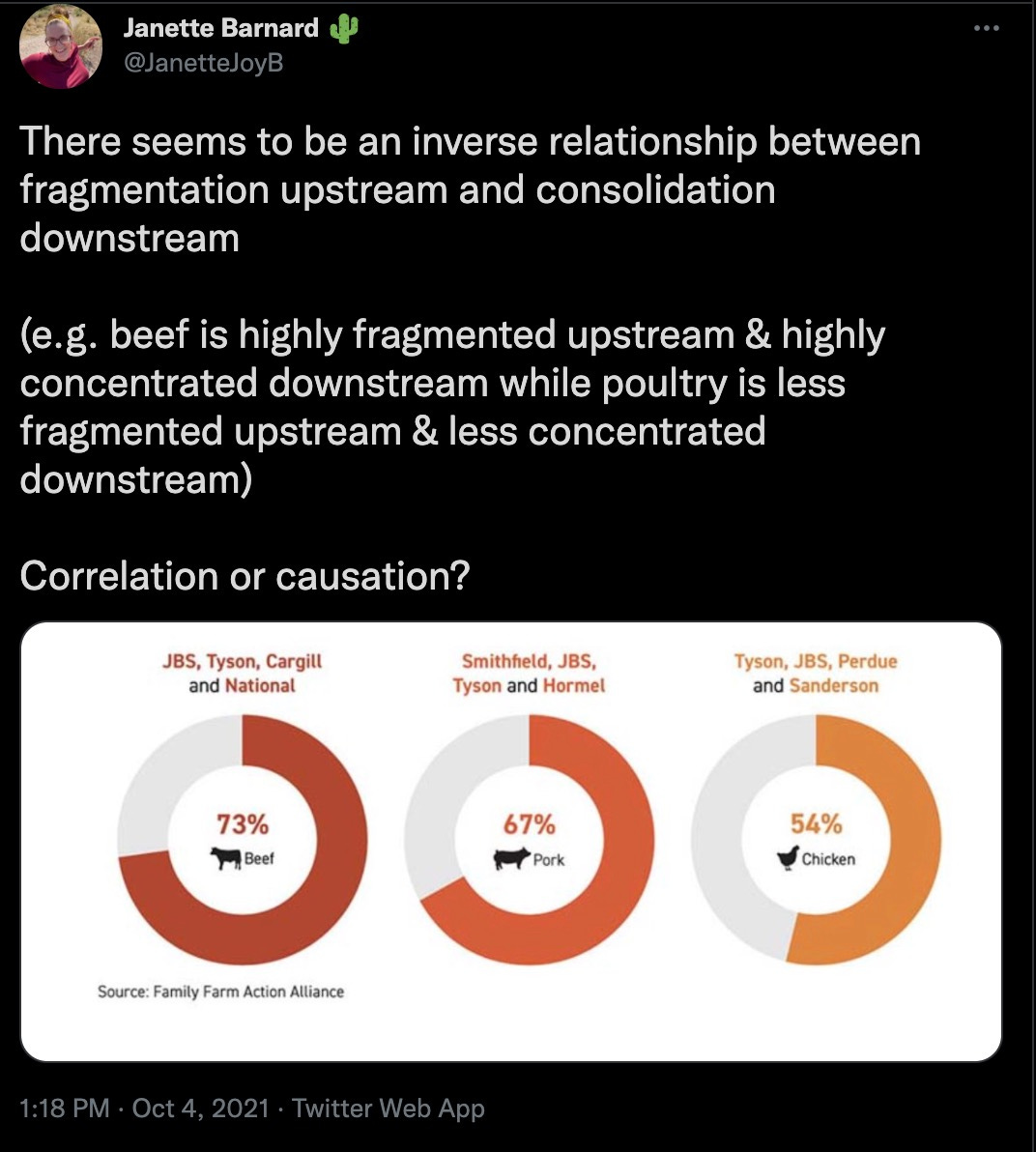
Is beef more concentrated at the packer level because the animals are heavier? More valuable? Or because there’s more’s variation in sourcing? Variation in plant size? Or maybe it’s this:

The answer to why the fragmentation/concentration conundrum exists doesn’t seem to be super obvious, but clearly it’s super complex. Happened-over-time things like packer concentration don’t take place in a vacuum. So simple solutions like the top x processors shouldn’t have more than y% capacity don’t take into account the competing dynamics that led to the current state.

And yet, there is *a lot* of certainty floating around about the topic without much (any?) tolerance for nuance.

But ag isn’t alone in having limited capacity for nuance. (Look, if I was the Debate Commissioner at every presidential debate before a candidate articulated their own position, they would have to summarize the other side’s policy position and say 1 positive thing about it, sans sarcasm.)

There’s another prickly conversation where we need nuance – climate change. I wish people didn’t point to an individual weather events as evidence of climate change. As climate researchers say, it’s not the individual events that are concerning, it is the trends in the data over time – the frequency and severity of extreme weather events. Which means there’s some level of variation that is normal.

Floods, hurricanes, tornados, droughts, heat waves – these are not new events. They were not created by climate change. So pointing at individual weather events as evidence of climate change is either disingenuous or intellectual laziness. Why not highlight more clearly weather events & trends that are within normal variation, versus what’s outside that normal variation?

Another nuance that’s really important is around the distinction of who’s driving change in the industry: consumers or food companies. From Climate + Ag: what gets measured gets monetized (link):

Who’s leading who in climate + ag?

“Consumer wants drive value chain decisions.”

I’ll start by pushing back on the narrative that protein value chains are driven by consumers, on climate or any other topic. Consumers….those nebulous creatures of food commerce who somehow sound like the unknowable inhabitants of an alternative universe when we refer to them. Two flaws with the Consumers-R-In-Control narrative:

  1. Consumers are not a monolith. Segments of consumers want certain attributes, sub-segments are willing to pay for those attributes. Variation among consumers is no less nuanced than variation among farming systems. Mis-identifying what consumers want and what they will pay for x is as fatal of a flaw as over-estimating how many consumers will pay for x.
  2. Although staggeringly critical to the system, consumers are not everyone’s customers. Consumers don’t transform supply chains or recalibrate industry norms. Food companies do. Food companies are where the power lies. Brand owners make decisions about how to market meat & milk to their customer: retail consumers. Food companies make decisions about how to market meat & milk, and then where needed those same companies use their scale and influence to set product specs & requirements as they procure raw materials or finished product from a certain set of suppliers. No one is talking about the fried chicken wars of Mar Jac vs Wayne Farms chicken, they’re talking about KFC vs Chick Fil A. The two directional power of influence lies with brand holders across foodservice and retail. Leading brands lead consumers by positioning xyz about their brand that is better than competitors. Food brands tap into consumer trends, but they lead consumer segments with differentiated products. Sometimes those changes are then adopted by other food brands & their supply chains. The massive shift in NAE (no antibiotics ever) production in US poultry is my go to example for this dynamic – when 1-2 major food companies said we will buy NAE chicken, then NAE chicken is what suppliers learned to produce, at scale. So then more food co’s buy NAE chicken. It’s a cycle that starts with a food brand, moving vertically in that supply chain and then expanding horizontally as more food brands (and their supply chains) adopt whatever the thing is.

We oversimplify the value chain when we attribute all influence to consumers, and we underweight the actual centers of leverage.

This week McDonald’s announced their net zero emissions by 2050 commitment. That’s a big deal – we are talking about a legacy, conservative, brand conscious company not some fly by night, here-today-gone-tomorrow brand. This is one of the largest buyers of beef, lettuce, tomatos, pork, potatos, strawberries, etc on the face of the planet. When companies like that start jumping in, it bends the arc towards action – it’s a sign that we’re past the niche-y early adopters and moving right to the middle of the bell shaped curve.

Some interesting context on the McDonald’s announcement from Meatingplace:

Efforts underway since 2018 have resulted in an 8.5% reduction in the absolute emissions of the company’s restaurants and offices and a 5.9% decrease in supply chain emissions intensity measured against a 2015 baseline, McDonald’s reported.

Although the most recent announcement does not specify where in the supply chain the fast-food company will look for its emissions reductions, in an earlier post on its website, the company said, “In collaboration with franchisees, suppliers and producers, McDonald’s will prioritize action on the largest segments of our carbon footprint: beef production, restaurant energy usage and sourcing, packaging and waste. These segments combined, account for approximately 64 percent of McDonald’s global emissions.”

Food companies have leverage, consumers do not.

Another source of leverage is capital. Right now there is an enormous amount of capital (we could put a period there) flowing into climate tech & solutions. More than $33.9 BILLION in venture capital investment has gone into climate tech….in 2021 alone.

Venture capital doesn’t automatically lead to good outcomes and solutions, but it increases the odds of good outcomes when its put behind good founders and good visions and great products. I recently heard someone say “venture capital subsidizes risk taking at scale”.

It’s safe to say that investment in a category tends to be a leading indicator of tech/innovation.

In 2015 Bill Gates founded Breakthrough Energy, a billion dollar fund to “support the innovations that will lead the world to net-zero emissions.” In 2021 Chris Sacca raised an $800M fund to invest in climate tech, with 2 objectives: 1) lower emissions to net zero, 2) get carbon out of the air.

Two interesting quotes on Lowercarbon Capital’s website:

  • “Give or take, we’ll need to suck at least a trillion tons of CO2 out of the sky between now and 2100.”
  • “Fixing the planet is just good business. Shame and guilt won’t get us there, markets will.”

A few previous comments that are germane to this conversation for livestock:

The extreme positions on either end of the sustainability spectrum will not create actionable, consumer-satisfying, carbon-reducing, market-growing solutions. But nuance…that’s how we find the productive middle ground. Nuance acknowledges that one size does not fit all – what works in geographies that get 40+ inches of annual rain fall won’t necessarily work in areas that get <15 inches. Systematic management changes like transitioning from continuous grazing to intensive rotational grazing are complex, as is anything related to managing the biology of plants or animals.

Regardless of the abundant unknowns about how things will evolve, this whole “climate thing” is not a topic where producers can look away and hope it will disappear. This is a mega trend. There will be winners and losers – my hypothesis is that the difference will be those who collaborate and find workable solutions…or don’t. This is a mega trend to engage, to lead by looking for the ‘and’ solutions…the places of overlap between what’s good for climate related metrics AND for cattle AND for successful cattle operators AND for food companies AND consumers. This is a place to ask questions like, what if? What needs to be true? What opportunities will be created in this mega trend?

Maybe nuance isn’t realistic though – not even because of the formats in which we consume information (140 characters doesn’t leave much room for nuance), but because the human brain can only absorb so much information about so many topics in the midst of living our lives. So sweeping statements and catchy slogans leave us with soundbite driven opinions – and which soundbites we latch onto depends on who we’re listening to.

Anyway, I guess my philosophical point this fine Tuesday is that topics like packer consolidation and climate change are wildly complex with no simple answers, and I’m wary of too much certainty, of the simplistic answers. Anyone peddling simple answers is likely trying to scare or shame to sell something or get a vote (either side).

I think embracing nuance will serve us all well in these discussions.


ICYMI: why is carbon more likely to be a monetizable mega trend than an emotion driven fad? (link)

<insert corporation name> will not be able to buy 2 units of sustainability to offset 2 units of un-sustainabillity. But, <insert corporation name> will likely be able to buy 2 units of carbon sequestration to offset 2 units of carbon emissions.

As more companies make net-zero commitments around carbon and seek to offset carbon in their supply chains, carbon markets are the likely place to turn. To make this carbon economy go, the entire structure will have to be underpinned by rigorous standards of measurement and verification. Sound methodology and precision processes are the only way for carbon markets to deliver on the promise for participants and their investors, customers, and consumers.

Another concept bubbling up is carbon labeling on food. Only high end, niche brands are pursuing carbon labeling now, but will this become a more widely adopted practice? The concept behind these labels is numerical representation of the carbon involved in production….the (potentially) magical word for livestock producers is “numerical”. To the extent that sound methodology and high integrity math drive carbon labeling, it represents an opportunity for livestock producers to win by numerically capturing the net positive carbon impacts of livestock production.

People way smarter than me can go deeper on carbon markets and carbon labeling. My point is simply this:

Carbon could be the real deal for producers because both B2B carbon markets and consumer facing carbon labeling on food would require data driven approaches to drive an actual functioning net zero carbon economy based on measurements.


I’m interested in all things technology, innovation, and every element of the animal protein value chain. I grew up on a farm in Arizona, spent my early career with Elanco, Cargill, & McDonald’s before moving into the world of early stage Agtech startups.

I’m currently on the Merck Animal Health Ventures team. Prime Future is where I learn out loud. It represents my personal views only, which are subject to change…’strong convictions, loosely held’.

Thanks for being here,

Janette Barnard

Categories
Animal AgTech Genetics

Prime Future 63: If dairy is the new beef, are cow-calf producers necessary?

Hypothesis: the biggest threat to cow-calf producers is neither packer consolidation nor alternative proteins. The biggest threat to cow-calf producers is dairy producers who are increasingly deploying the 'beef on dairy' genetics strategy which will allow them to own the beef calf market, creating an existential threat for cow-calf producers.

That was my hypothesis when I sat down to write this piece.

Before we get into whether this hypothesis is reasonable or not, here’s a quick review of the beef on dairy strategy:

“In dairy herds, a sustainable breeding strategy could combine usage of sexed semen to generate replacement heifers only, and usage of beef semen on all dams that are not suitable for generating replacements. This results in increased genetic gain in dairy herd, increased value of beef output from the dairy herd, and reduced greenhouse gas emissions from beef.”

(We recently looked into the 3 mega phases of genetics revolution in dairy cattle that led to the beef on dairy trend.)

One more idea before we get to whether cow-calf producers have a future or not, an idea from “Loonshots: How to Nurture the Crazy Ideas That Win Wars, Cure Diseases, and Transform Industries” is that innovation falls in two buckets:

  • P-type innovation which are product innovations, like the invention of the jet engine
  • S-type innovation which are business model innovations, like the idea of an airline that would not use the hub & spoke model and only offer low cost direct flights

The interesting thing about the beef-on-dairy strategy is that the two enabling technologies were P-type innovations: genomics and sexed semen.

But now as producers adopt those products, we’re looking at S-type innovations playing out in real time which is likely to lead to more S-type innovations across beef and dairy value chains.

Back to my hypothesis. Let’s do some napkin math, and use the most extreme assumption that 100% of US dairy producers will apply the beef on dairy strategy to 100% of their herd. (For the purpose of thinking about the potential impacts of a trend, it’s helpful to play it out to the extremes even if highly unlikely.)

Using extreme and very round numbers, here’s some math:

  • There are 10 million dairy cows in the US. Let’s say 30% of those cows are replaced by heifers every year. All 10 million cows need to have a calf, but only 3M of those calves need to be female to be kept as replacement heifers and maintain current production levels (10M * .3 = 3M). Let’s say the remaining 7M calves NOT being kept as replacement heifers flow into the beef value chain (10M – 3M = 7M).
  • If today there are ~5M dairy calves that flow into the beef supply chain already, or ~50% of the 10M dairy calves born annually then it looks like beef-on-dairy only adds 2M additional beef-dairy cross calves per year into the beef value chain (7M – 5M = 2M). However a big caveat is that there is already a reasonable % of the 5M dairy calves that are actually beef-dairy crosses, though there’s no good estimate of what that number is. Regardless…
  • If ~25M beef animals are finished in feedyards annually, and the most dairy can contribute (in pure dairy or beef-dairy crosses) is 7M then that leaves a minimum of 18M calves per year needed from cow-calf producers.

Napkin math shows that my hypothesis that dairy producers pose an existential threat to cow-calf producers is wrong.

Cow-calf producers will continue to be a necessary segment of the beef value chain.

But even if beef-on-dairy does not create an existential threat to cow-calf producers, there will be implications and ripples felt across the beef and dairy industries. This week’s newsletter is the start of a series exploring those implications and ripples.

Here are some questions I’m interested in:

  • How viable is the sustainability hypothesis behind on beef-on-dairy? Cargill is making a bet on beef on dairy as a sustainability play, will others?
  • What are the limiting factors for beef-on-dairy growth?
  • Alternative milk now has ~16% share of the milk market, if beef and dairy become even more enmeshed than they already are, how could change in milk demand impact beef? If the primary link today is ground beef, what happens when the link expands?
  • What does it mean for cattle feeders to have 3 distinct types of potential calves to feed: beef, dairy, beef-dairy crosses? For packers to have those 3 types of fed cattle to process?
  • What are the positive/negative impacts felt through the value chain from an increase in beef on dairy? From dairy producers to feedyards to packers.
  • How will profit drivers be impacted? From live performance metrics to carcass yield and grade. How will management of these metrics change?

If you have insights or opinions on any of those questions, please reach out – I’d love to get your thoughts. Or, if you have other questions to explore about this space.

An important caveat to this conversation is that beef-on-dairy is not new. It was first discussed in the early 2000’s and how slowly increased over time. But it feels like we’re at an inflection point and adoption is accelerating rapidly.

“The future is here, it’s just unevenly distributed.”


I’m interested in all things technology, innovation, and every element of the animal protein value chain. I grew up on a farm in Arizona, spent my early career with Elanco, Cargill, & McDonald’s before moving into the world of early stage startups.

I’m currently on the Merck Animal Health Ventures team. Prime Future is where I learn out loud. It represents my personal views only, which are subject to change…’strong convictions, loosely held’.

Thanks for being here,

Janette Barnard

Categories
Animal AgTech

Prime Future 62: Tech can’t make it rain.

We’ve had 7 inches of rain in the last month, more than the previous 22 months combined. Pastures are green, stock ponds are full, ranchers are elated.

that’s not a pond tho…just some ocean front property in Arizona

It’s been a long time since I lived on the farm and felt the angst of drought up close. For the last several years I’ve lived in the agtech world where it’s all optimization and transformation and precision management of variables.

But all the tech in the world can’t solve the biggest problem that has plagued much of the American West in recent months/years: drought.

Sure, sensors can help farmers optimize irrigation or remotely detect water levels in stock tanks and AI models can better forecast market prices based on weather patterns or facilitate better management of financial risk associated with weather. That is all good and well and high value in the right situations, but it doesn’t solve the Mega Problem in a drought: rain.

Tech can solve a lot of problems, but tech can’t make it rain.

In agriculture, nature usually gets the last word. Talk to any producer who’s been at it for more than a minute and they have a war story or ten of when nature flexed with an untimely drought or flood, heat wave or blizzard, derecho or tornado, and so on the list goes. (On the flip side, most have been on the receiving end of a market that was positively tipped in their direction by nature’s punk behavior in another part of the world but we don’t usually talk about that.)

No newsflash here, but nature is unpredictable and dramatic with a tendency to be wildly inconvenient. Nature never reads a business plan or considers the market or accounts for global supply & demand conditions. Nature just does what nature does – perhaps that’s even a feature not a bug?

Great management practices & smart tech products allow producers to be more prepared for the unexpected or to handle the unexpected more effectively, but they are ultimately powerless to dictate Nature’s whims. Even in ‘controlled environment’ poultry & swine housing, weather can still wreak havoc on performance and/or costs.

Nature is uncontrollable, yet holds enormous control over production outcomes.

So what? I think this reality has to shape our mental models:

  1. That nature is uncontrollable yet holds enormous control over production outcomes, is all the more reason for producers to control the controllable, to optimize the optimizable, to precisely manage the manageable.
  2. That nature is uncontrollable yet holds enormous control over production outcomes means that there is a level of humility required, especially in agtech. Not everything can be solved by a better algorithm. I think sometimes we forget this.

Tech can solve a lot of problems, but tech can’t make it rain.


I’m interested in all things technology, innovation, and every element of the animal protein value chain. I grew up on a farm in Arizona, spent my early career with Elanco, Cargill, & McDonald’s before moving into the world of early stage startups.

I’m currently on the Merck Animal Health Ventures team. Prime Future is where I learn out loud. It represents my personal views only, which are subject to change…’strong convictions, loosely held’.

Thanks for being here,

Janette Barnard

Categories
Animal AgTech Genetics

Prime Future 59: Will CRISPR find its legs in livestock?

My interest in science took a nose dive in high school biology when life science seemed contained to owl pellets and dead frogs, which didn’t seem to be the stuff of world changing significance. But reading the new Walter Isaacson book “The Code Breaker” on the people & events that led to the discovery of CRISPR had a much more inspiring effect than Mrs. Rigg’s biology class. Even though the book focuses on the potential uses of CRISPR in humans, my mind has been spinning around the potential uses in livestock.

First, what is CRISPR? It describes a a type of DNA sequences, more specifically:

“CRISPR systems were a way that bacteria acquired immunity to viruses. …found that bacteria with the CRISPR spacer sequences seemed to be immune from infection by a virus that had the same sequence. CRISPR associated enzymes (Cas) enable the system to cut and paste new memories of viruses that attack bacteria. They also create short segments of RNA that can guide a scissors-like enzyme to a dangerous virus and cut up its genetic material. Presto!”

If DNA is kinda there for documentation, RNA is the molecular workhorse, hustling & getting the right messages to the right places. The understanding of how CRISPR segments of DNA give RNA the information to get to work was the foundation that led scientists to ask how CRISPR could be used for gene editing by directing RNA to make good things happen. (or at least that’s my non-scientific understanding)

It doesn’t take much creativity to imagine the many ethical questions around any type of gene editing or the ways RNA could be re-directed for questionable or downright terrible uses. (Interestingly, Isaacson says the US Department of Defense is one of the major funders of CRISPR research, centered around finding ways to prevent its misuse.) But we’ll leave those questions to others, we’re interested in possibilities.

The Isaacson book focuses on human uses for CRISPR, only using the word agriculture once and almost as an afterthought. So, let’s brainstorm how a tiny little biochemical thingamajig could be used to make a potentially big impact in livestock, meat & dairy.

(Heads up: I’m not constraining this list to any nonsensical details like what’s scientifically possible 🙃)

  • Efficiency. The most obvious and least exciting use for CRISPR is to improve efficiency of production metrics like growth rates or feed conversion or carcass yield. Could beef someday have the same feed conversion as chicken, or even fish?
  • Quality improvements. Can gene editing increase meat tenderness in certain cuts? Increase flavor in pork? Eliminate that nagging issue of woody breast in chicken? Could CRISPR unlock the Honeycrisp apple of the meat case?
  • Health management. Imagine if you could eliminate Mastitis in dairy cows, or BRD in beef cattle, or ASF or PRRS in swine, or Coccidiosis in poultry…all of which have massive economic impact around the globe.
  • Methane emissions.  Could CRISPR gene editing somehow (magically?) reduce methane emissions and put that whole issue to pasture?
  • Demand response. Imagine you could use gene editing to get more of what the market is asking for, like more loin per carcass for a higher ratio of high value middle meats in beef & pork. Or let’s throw common sense to the wind – what if you could get more wings per bird? That would look pretty good in times when wings trade at $3/lb and breast meat trades at $1.

Let’s say some of those applications are scientifically possible. The next question is, what applications will be allowed? There are two stakeholder groups that will ultimately determine the future of CRISPR in livestock, and the importance of each simply cannot be overstated.

The only way CRISPR can make a meaningful impact is if both regulators and consumers embrace the technology.

  1. Regulators. What will the regulatory framework for CRISPR gene editing in livestock look like and who will oversee it? How will different countries approach it? For use in humans, scientists think of CRISPR having 3 different uses: to prevent disease, to treat disease, or for enhancements like making your offspring taller, smarter, stronger, etc. (Obviously there are varied opinions among the CRISPR scientific community about using it only for disease prevention & treatment to alleviate human suffering, rather than selecting for certain characteristics because we can.) Another screen, and debated distinction, is whether gene editing will impact only that patient/generation (somatic editing) or if it will impact that patient/generation and all future offspring (germline editing). If similar screens are applied in livestock, the list of possible CRISPR use cases would change.
  2. Consumers. If GMOs in plant breeding signals how CRISPR might be viewed in livestock, then the odds of widespread consumer acceptance of CRISPR editing in livestock are less than my chances of competing in the 2021 Olympics. The staggering advantages of GMO’s in crop production – less resource use per unit of production – have not satisfied the anti-GMO camp enough to offset their concerns of genetic modification. Good science has not been enough for a good outcome.

However, there’s one factor in livestock that isn’t part of the equation for crops, and that is animal welfare. How will the risk/reward equation adjust itself if CRISPR provides ways to reduce animal disease and therefore improve animal well being?

More broadly, what can we learn about what not to do from the GMO plant situation? Could meat companies more effectively market CRISPR enabled results than seed companies marketed GMO enabled yield increases? An ominous sign for any scientific breakthrough is the amount of COVID vaccine disinformation readily consumed via social media, then digested & regurgitated even by smart & logical people. So I don’t know, maybe we just can’t have nice things?

Ultimately societal consensus around how CRISPR should be used in humans is likely to drive the degree of acceptance of CRISPR use in livestock.

The book was particularly interesting in light of the role RNA has played in fighting COVID. Isaacson summarizes the mRNA vaccine technology, “Now scientists had found a way to enlist RNA’s most basic biological function in order to turn our cells into manufacturing plants for the spike protein that would stimulate our immunity to the coronavirus.”

There was also a lot of work done on using CRISPR as a diagnostic tool for COVID, ideally as an at home test with immediate results. Isaacson highlights the belief of some CRISPR scientists who believe the technology will ‘democratize biology for human health’ through personalized diagnostics for in home use:

“The development of home testing kits has a potential impact beyond the fight against COVID: bringing biology into the home, the way that personal computers in the 1970’s brought digital products and services into people’s daily lives and consciousness. Home testing kits could become the platform, operating system, and form factor that will allow us to weave the wonders of molecular biology into our daily lives. Developers and entrepreneurs may someday be able to use CRISPR-based home testing kits as platforms on which to build a variety of biomedical apps: virus detection, disease diagnosis, cancer screening, nutritional analysis, microbiome assessments, and genetic tests.”

Whether or not – or at what time horizon – that happens, if it can happen in human use why can’t it happen in some modified way in livestock?

What’s your hypothesis on where, how, & why CRISPR could be useful in livestock?


I’m interested in all things technology, innovation, and every element of the animal protein value chain. I grew up on a farm in Arizona, spent my early career with Elanco, Cargill, & McDonald’s before moving into the world of early stage startups.

I’m currently on the Merck Animal Health Ventures team. Prime Future is where I learn out loud. It represents my personal views only, which are subject to change…’strong convictions, loosely held’.

Thanks for being here,

Janette Barnard