Categories
Emerging Tech Funding Venture Capital

Prime Future 137: It’s time to call it, farm mgmt software was a wash.

Riddle me this: What do you call a category of companies that raised a ton of venture capital and, a decade later, had not one sustainable business to show for it?

There are a few categories that are in the process of playing out as we speak, including plant-based meat, cell-based meat, and indoor farming. But each of those is still too early to call for sure, they are still playing out. Maybe they’ll fit the above description when the chapter closes, or maybe they’ll be raging successes. TBD.

But there’s another category that is 10+ years old, and a post-mortem is timely because, well, it’s basically commercially corpse-like.

The category is farm management software, the row crop genre.

Most would call farm management software companies Agtech 1.0. It was the wave that initially put agtech on the map, kicked off by Monsanto’s billion-dollar acquisition of Climate Corp in 2013.

Most companies in this category were started between 2005 and 2010. There were a bunch of these early companies that didn’t make it beyond Series A, sometimes attributed to the fact that they didn’t understand farmers or they didn’t get that not all farms operate the same or that a farmer growing corn & soy in Illinois is not the same as a diversified farm in Missouri is not the same as a vegetable farmer in Yuma, Arizona. But let’s ignore the majority of companies here.

Using back-of-the-envelope math on only the handful of companies that broke through and made it to an IPO or major acquisition, the final players alone raised over $400 million in venture capital.

And their acquirers (and in one case, public market investors) paid close to $2 billion in total, plus or minus $200 million.

So where are they now?

In general, they are running on fumes, are afterthoughts within their organizations, or have been divested entirely.

$400+ million in venture capital, ~$2 billion in acquisitions, and the row crop farm management category has not one sustainable business to show for it.

The major crop input companies acquired these farm management companies to jumpstart their own digital capabilities. By all accounts, these software products were intended to be functional, sustainable profit centers – able to stand on their own two feet like a real grown-up business.

For the most part, the idea behind the acquisition was to turn the data from farm management software into higher-value products like analytics or insurance (Climate Corp’s original thesis). But if the data isn’t good (clean), then the analytics are worthless. So then the common path was to downgrade the push for revenue to instead use free access to software as an incentive to switch to that company’s seed and chem products from their core portfolio.

I wonder if part of the issue was that farmers had been trained to expect access to farm management software at low to no cost by venture-subsidized businesses that were in all-out pursuit of growth.

The corollary is how Uber & Lyft used to be cheaper than a taxi, by far. Being cheaper and more convenient made it a no-brainer. Then Uber & Lyft went public and now what used to be a $15 ride is a $30 ride because it’s not venture subsidized and these companies have to stand on their own two feet. But that new (real) price for a rideshare is close to what a taxi costs and, especially at an airport,  it can be easier to grab a taxi than hunt for your Uber driver, the needle in a carstack. All of which changes the long term market for rideshare…just like farm mgmt software?

My hypothesis is that founders of Agtech 1.0 companies, and investors, had the hypothesis that farm management was a winner-take-all market. If you believe that only 1 or 2 players will dominate a market, then it is logical to invest aggressively in growth in order to be one of those winners.

But few markets are really winner-take-all.

In an industry such as farming where the potential user base is so diverse, their needs are so diverse, their business structure and profit margins are so diverse…the pie is so varied that it would be difficult for any one company to take the entire market, simply from a capability standpoint.

Perhaps the question that the agtech world should be asking itself, a decade+ in, is how to measure the success of a venture category. There are a few ways you could think about it:

  1. How much venture capital was raised? Everyone knows this isn’t a long term measure of value, but it does indicate something. Or sometimes it indicates something. But let’s agree it’s an insufficient metric at best and a vanity metric at worst.
  2. How many exits did the category have / how healthy were those exits? This is a much better indicator than #1, and it is certainly an indicator of success for founders and investors. But it’s like calling the game-winner at halftime.
  3. How commercially viable is the business over the long run? This is the only measure I know that reflects commercial reality; how much value is created for farmer customers and captured by the acquirers. Unless the test of time and commercial value is passed, then it was all just financial engineering and/or short term wins.
If we agree that #3 is the real measure, and after a decade of post-acquisition signals from the category, I think we have enough data points to say that in the end, this category was…a wash.

The caveat is that there are some niche examples of variations on farm management software where the above does not apply, often where the company has dialed in on a value proposition that is not simply storing & visualizing basic farm data but building higher value propositions. And some of those companies were not juiced in a big way by venture capital, they tended to grow more slowly over time. But overall, TBD on these.

So, what do we learn from agtech 1.0?

About pricing new products, and how people don’t tend to value what they don’t pay for.

About user experience and automating data entry.

About value creation….and that there has to be enough of it!

About how digital products matter strategically for incumbents, and that checking a box is not a strategy.

I also think there are lessons about aligning financing and business expectations with long-term customer interests. Agtech 1.0 created the opportunity, or revealed the opportunity, for sector-focused investors to have an edge over generalist VC’s simply by understanding the business of agriculture and its nuances.

While it’s time to call Agtech 1.0 a wash, I don’t think we can call it a bust.

It attracted capital and talent to a previously overlooked space. And even though you can’t point to individual significant long-term successes in this category, we can safely assume the learnings that founders, investors, strategics, and farmers had through this process has informed how Agtech 2.0, 3.0, 4.0…25.0 will play out.

How would you rate Agtech 1.0?

Oh and the whole thing of not knowing exactly how things will play out, isn’t that really a feature of creating and building the new, not a bug?

What a time to be alive 😉


Did you miss early editions of Prime Future?

Access an ebook with editions 1 through 81 here: Prime Future PDF

Get the ebook!

Categories
Artificial Intelligence Emerging Tech

Prime Future 130: Merry ChatGPT Christmas

Last week OpenAI beta launched ChatGPT, an AI-generated chat feature. Maybe that sounds simple or uninspiring, but once you interact with ChatGPT, you realize this is something new (and slightly addicting).

This leaves you with the impression of “wow, this is actually going to be A Thing, probably A Big Thing.”

If you haven’t dived into ChatGPT yet, my goal today is to give you a sense of what it is and begin considering the So What & Now What.

Let’s start with an example of a relatively basic question:

Not bad. Let’s get more subjective:

Interesting. We can also ask for something more creative:

I mean, I too, don’t care because I love bacon too much.

My favorite is the trick question:

Good to know. And then there’s this lol tweet by Anand Sanwal @asanwal:

“Most company culture principles are basically this level of drivel #chatGPT did this in 2 seconds You’re welcome”
Image

Tech Twitter has run amok with people sharing ChatGPT responses. I love seeing other’s chat examples, but 10/10 recommend just creating an account and playing around with the tool. It’s hard to appreciate the magic of it until you experience it firsthand.

Until then, here’s how I would describe the obvious benefits:

  • the immediacy – all of the above responses were generated in <2 seconds
  • the layout & logic – the tool can structure an essay well or lay out an argument logically
  • the creativity – this is what amazes me most

But there are limitations. For starters, how you phrase a prompt determines if you get a mediocre non-answer or something almost helpful:

But, uhhhh one other clear limitation is that the current version of the ChatGPT model doesn’t ‘know’ anything post-2021. <clears throat👆🏼>

The good news is that ChatGPT seems to know its limitations:

But, of course, there are limitations….all technology has some limitations, but also this has only been live for like 10 days! So let’s assume it’s going to get much better, soon.

By the end of day 5 after ChatGPT launched, it had 1 million users. It’s amazing to think about how much training data the models are getting as people go nuts testing the boundaries of ChatGPT’s capabilities.

Ok fine, cool tech…so what?

In my mind the big So What questions are:

  • How will individuals incorporate ChatGPT capabilities into their workflows?
  • How will companies incorporate ChatGPT into internal processes? Into customer-facing processes? Into tech products?
  • Specific to livestock, meat & dairy, what opportunities will ChatGPT create? For food brands to engage with consumers? For producers buying inputs or selling commodities? For processors engaging suppliers, labor, or customers?

Many people way smarter than I am have been speculating on the So What, and the POV’s are all over the place, ranging from this:

To this:

If you talk to people about the potential of artificial intelligence, almost everybody brings up the same thing: the fear of replacement. For most people, this manifests as a dread certainty that AI will ultimately make their skills obsolete. To put it bluntly, we think the fear, and the guilt, are probably mostly unwarranted. What we’ve seen so far about how generative AI works suggests that it’ll largely behave like the productivity-enhancing, labor-saving tools of past waves of innovation. 

AI doesn’t take over jobs, it takes over tasks.

If AI causes mass unemployment among the general populace, it will be the first time in history that any technology has ever done that. Industrial machinery, computer-controlled machine tools, software applications, and industrial robots all caused panics about human obsolescence, and nothing of the kind ever came to pass; pretty much everyone who wants a job still has a job.

The principle of comparative advantage says that whether the jobs of the future pay better or worse than the jobs of today depends to some degree on whether AI’s skill set is very similar to humans, or complementary and different. If AI simply does things differently than humans do, then the complementarity will make humans more valuable and will raise wages. We think that the work that generative AI does will basically be “autocomplete for everything”.

I would just suggest this: whether your first reaction to hearing about this technology is fear or excitement says more about you than it does the technology.

ChatGPT reminds me of the saying “the street finds the use” for new technology. I’m curious to see what those uses are, what the business models are around this technology, and how quickly (or not) large language models like ChatGPT are commoditized.

While nobody yet knows exactly what the impact will be, it seems safe (and a massive understatement) to say this capability will have Some impact on Some people in Some ways.

Oh and luckily this rolled out just in time to liven things up if family holiday time gets boring. Merry ChatGPTChristmas, ya know? 😉

Categories
Animal AgTech Emerging Tech Transportation

Prime Future 125: the✨magic✨in solving invisible problems

Amazon launched AWS in 2006; Microsoft launched Azure in 2010. The cloud is old news.

We’ve digitized all the things; the digital west has been won. ✅

Yet there are large pockets of huge companies in gigantic industries that still operate on notepads and <gasp> fax machines.

Today we look at one of those not-small pockets within the ag industry and one company’s quest to simplify the ecosystem and create outsized impact.

It is a story about a seemingly invisible problem with a seemingly simple solution….until you dig below the surface.

It’s one of my favorite kinds of tech stories, where real magic gets made for customers by solving the ignored, invisible, and/or ‘boring’ problems. The ones that Silicon Valley is unlikely to find and, even if they did, unlikely to find interesting. The problems that customers don’t even realize they have until a better way is presented, like a fish unaware of the water around them.

This is a sponsored deep dive by M2X Group, the transportation management system for livestock and agriculture, and today we’re digging into the dynamics around the oft-ignored livestock transportation ecosystem & the problems M2X is tackling.

Let’s get a move on…so to speak.


Prime Future Sponsored Deep Dives explore the dynamics around a specific company, the problems they are solving and the world they are creating. As always, here are my personal commitments to Prime Future readers:

  1. I will only deep dive into companies I find intellectually interesting and relevant to the Prime Future audience.
  2. I won’t shill. My goal is for Prime Future readers to always expect, and receive, practical candor and intellectual honesty.
  3. Sponsored Deep Dives will be few and far between.

How the transportation ecosystem works

In the US cattle value chain, a calf can easily be shipped 3+ times before it is processed by the packer. Whether a weaned calf shipped from an auction barn to a stocker, or to a feedyard or to the packer, cattle can rack up a lot of miles over their lifetime.

For napkin math, let’s say the ~25 million head of beef cattle finished in feedyards every year travel 150 miles over their lifetime, a super conservative estimate but that would mean 3,750,000,000 bovine miles! Of course, these are assembled into truck loads so there are fewer actual miles driven but the point is – there’s a lot of cattle moving up and down the road.

Which means someone has to coordinate that movement. There’s a someone at the buying organization, say at the feedyard, who is coordinating transportation with a carrier, who’s going to arrange the truck and trucker to pick up the cattle from a seller, say a stocker.

In that coordination there are times for pick up and delivery, there is a price, and there is some sort of contract locking in prices and approximate times.

And today, the vast majority of that coordination happens via phone and a notepad and fax machine. CAN YOU EVEN?

So there’s administrative staff on all sides involved in the process (buyer, seller, carrier). And a lot of room for human error. And a lot of paper shuffling.

You see where this is headed, don’t you?

M2X provides a Transportation Management System. Their software platform digitizes the processes around coordinating livestock transportation and allows all the players involved to visualize one source of truth for all things related to managing livestock transportation: prices, arrivals, etc.

Some reasons that’s interesting…

(1)You can’t run an algorithm on a legal pad.

Optimization follows digitization.

As M2X customers transfer their workflows related to transportation onto the software platform, the next step is for M2X to work with the customer to start optimizing transportation. In New Zealand, M2X’s home country, this means identifying the most efficient routes to pick up animals in order to fill the truck on its way to the processor. For example, Silver Fern Farms has 14 processing plants, 90+ buyers, 14,000 suppliers, and works with over 160 trucking companies. M2X helps them optimize farm-to-plant flows, meaning that for the same amount of animals delivered to the plants, Silver Fern Farms is removing 1,000,000 kilometers from their network.

At current fuel prices that impact shows up quickly in the financials. Energy cost savings aside, the optimized farm-to-plant flows means animals are on trucks for 14% less time. All of this means 11% reduction in emissions per animal. Check, check, check.

In New Zealand, a big part of the issue is trucks picking up animals from farms in less than truckload lots so those improvements are created both by optimizing which truck is selected for animal pick up, and what route the truck takes in their multiple stops.

But these optimizations are only possible because the workflows have been moved to the software where better data is captured, and then optimizations can be layered on top.

In the US the sale barn often serves as the point of aggregation for cattle, so most truckloads are full truckloads already. But even in the US, route optimization still suggests the shortest, fastest, and safest route for a loaded truck which reduces energy costs, animal time in the truck, GHG emissions, etc.

And there’s another optimization superpower, and that’s to reduce truck congestion at plants. If you have spent much time around meat processing plants, you know this can be a massive issue in 100* summer heat but even more so for dairy processors where time is <literally> money.

I love these examples where what’s good for the income statement is good for animal welfare is good for GHG emissions. Magic.

One reason I'm so bullish on the future impact of tech in animal ag is that there's still so much happening on legal pads or the producer's pocket notebook, and as those workflows are digitized, it will create opportunities to optimize decision-making and outcomes.

For example, Caviness Beef Packers began working with M2X to streamline their transportation-related activities. They set out to pick up some efficiencies but as Regan Caviness put it, “we realized just how inefficient we had been once we had a better way to do the work. We’ve gotten way, way more accurate in everything from scheduling pickup through to billing, but especially in calculating freight costs for each truckload. Now we have an accurate headcount, accurate mileage, accurate owner data (name and address), and the freight costs are calculated in the software rather than across Google Maps tabs and paper.”

Regan also pointed out that every M2X customer will think about their flows differently, from livestock pick-up and scheduling all the way to billing. Working with software that was flexible to fit their business processes, instead of the other way around, made a big difference in the outcome and being able to easily digitize processes.

Because that is the step 1 that enables all subsequent, higher-value steps.

Optimization follows digitization.

(2) There are 4 timely tailwinds propelling M2X’s journey:

  1. Many companies have a weird dynamic where they cannot bill a customer until they have the invoice from the carrier for shipping costs. Take a grain merchant who’s selling feed ingredients to a feedyard or dairy. If the processes surrounding the carrier are managed via fax machine, you can imagine it can take many days or even weeks to settle costs with the carrier which delays when the grain merchant can invoice the feedyard or dairy. That was all fine and well when interest rates were low and money was cheap. But it’s a whole new world now, with high-interest rates where every incremental day of receivables outstanding costs real money.

Think of it this way – if I’m borrowing money at 8% interest for my operating line of credit, and I cannot invoice a customer for 14 days because I’m waiting for an invoice from the carrier to know the precise shipping costs, there is a quantifiable cost to those 14 days. By simplifying the system for all parties, M2X software allows companies to reduce their Days Receivables Outstanding by shortening the time to invoice customers. Like all numbers in high-volume businesses where small differences can make a big impact, except this impact is amplified in a high-interest-rate environment.

  1. We all know, it’s still a tight labor market. So freeing up administrative staff to focus on higher priority tasks than shuffling papers can be a huge win. Not to mention, many folks in these roles have been in these roles for years, sometimes decades. So there’s an element of succession planning and capturing process knowledge to transfer to the next person that’s also relevant.
  2. Almost anything in livestock that creates an increase in efficiency, creates a corresponding improvement in sustainability. It’s math. But that dynamic becomes very real when you’re talking about the carbon footprint of thousands of diesel trucks running up and down the highway moving millions of cattle. There is real, tangible, low-hanging sustainability fruit to optimizing transportation routing and planning. As companies get closer to their self-declared deadlines for reducing Scope 3 emissions, these types of improvement opportunities have to be attractive.
  3. As consumers, Amazon & others have conditioned us to expect visibility into where a package is until it arrives at our doorstep. That expectation for visibility is mostly a curiosity for our collective neuroses but for a company buying or selling a truckload of livestock, the expectation for visibility is a critical business need.

One of the primary benefits of digitizing allll the processes around transportation is that it creates real-time visibility for everyone involved. That visibility isn’t nice to have, it’s a need to havebut you can’t have one digital ecosystem with one source of truth when the whole process is managed on legal pads and fax machines.

(3) Why now?

Usually, this question is asked in the context of why the market or tech is at a point of readiness, but in this case, the question is more of, why hasn’t this been done before?

Coordinating shipping for livestock is, umm, not exactly the sexiest thing. Nor is it visible to those who aren’t working in it day in and day out. It’s one of those pockets of the industry that you only know how terrible it is if you’ve directly interacted with it. And you only have an appreciation for how to solve the problem if you’ve directly interacted with it.

Yes, there are plenty of Transportation Management Systems (TMS) out in the world, servicing manufacturers of all types who are bringing in one kind of widget and sending out other widgets. And those TMS work great for companies who bring goods in and out of their facilities in standard boxes. But they fall short for everyone in the value chain dealing with live animals, meat, even grain and fertilizer.

As we know, agricultural supply chains can be s-u-p-e-r complex which both creates the need for a purpose-built system for agriculture and makes it costly to build such a system.

(4) In the spirit of learning out loud, here are my takeaways as I’ve learned about M2X and the category they play in:

  • Some of the most interesting businesses in agtech are simply competing with a notepad and pen. You can’t earn the right to fix the supply chain or any other lofty aspiration until you solve a one thing for a one customer, ideally a repeatable thing for a repeatable customer. Then layer in more value for that existing customer base.
  • The role of sector knowledge in ag can be a mega differentiator, both in the product you design and in the customer experience. A CRM is a CRM whether you’re storing a customer name and notes about your interactions for a cattle feeder or a battery smelter or shoe stores, a TMS is not a TMS. The M2X team is from the industry so they have an understanding of the many nuances that a generalist TMS just can’t have.
  • High-growth bootstrapped businesses are fascinating because they are outside the norm. M2X has funded most of its growth from revenues rather than venture capital, so their validation has been in the form of paying customers….the strongest possible validation signal.
  • Substantial businesses can be built off what seem like niche spaces. Every livestock category navigates the same challenges around transportation management, as do players in grain and feed and fertilizer. The problem is repeatable with many adjacent markets within agriculture. 🤌🏼

Look, farming on Mars, chickens with 4 wings, steers that yield 80% ribeye, and self-processing pigs are all interesting moonshots for agtech to tackle.

But in the meantime, there’s so much value to be created in improving workflows and laying the foundation to optimize business operations and outcomes, like M2X is doing in the transportation space.

Categories
Business Model Innovation Emerging Tech

Prime Future 123: baling wire fix or a hack for muggles?

Did y’all know that all incoming freshmen at Purdue University used to be required to take two semesters of computer programming, regardless of their major?

In the 1980's 🤯

I’m a millennial, the first generation that started learning to type in kindergarten. I’ve lived my entire life on the assumption that as a whole my generation was the most tech-savvy, compared with generations prior. And now I learn that before I was even born there were universities requiring students to take computer science classes, the topic I most regret not studying as an undergrad student?!

Why on earth isn’t there a computer science requirement for all majors at all universities today?
On Twitter someone wrote:
“my advice to anyone who wants to learn to code because they feel like their white collar field isn’t going to get them to where they want: don’t become a software engineer, become an accountant/lawyer/actuary/policy analyst/economist that can also code you’ll kill”
Image

I love this point of having a skill set PLUS the ability to code. It’s like being someone with domain knowledge, who can also communicate, e.g. an engineer/vet/nutritionist who can speak well. It’s the combo that is their superpower.

But I was an idiot when I was 19 years old and never considered taking computer science, either not realizing the massive impact tech would make on the ag industry during my lifetime or not realizing someone like me could be part of it. Maybe both.

There’s a bit of a juxtaposition here in that while coding skills are more valuable than ever, especially as a secondary skill set, there are more alternatives for those of us muggles who couldn’t write a line of code if our lives depended on it: no-code software tools.

Today we’re looking at how no-code software tools could impact the ag industry, specifically how they could be helpful for innovators – either in startups or established companies.

The good news is that this category seems to have moved past its peak in the hype cycle and is now settling in to find its place in the world. Adoption is still early though, with a sense of “the future is here it’s just not evenly distributed”.

Gartner says that by 2024 that 65% of app development be low code or no code. 2024 is umm, right around the corner. (Note: no-code is for us completely non-technical muggles while low-code is for developers.)

Gartner also suggests that by 2030 no-code & low-code will be a $187B market. As a comparison, Gartner projects the global SaaS market will be $381B by 2030. That’s a lot of no-code runway.

So what kind of capabilities can you find in no-code tools? For starters…

Best tools to get started in No-Code: > Create a form with @TallyForms > Create a database with @airtable > Create a web app with @softr_io > Create a mobile app with @AdaloHQ > Create automations with @zapier

I see 2 obvious scenarios where no-code could create high value in ag innovation:

1. Established companies with limited to no development capability internally.

Every big co now has teams of data scientists and programmers on staff, and that’s starting to push down market to mid-market companies. No-code tools seem like a way for mid-market companies to dip their toes in the water with early capabilities. A Peco Foods (chicken) or a Creekstone (beef) just aren’t going to have the same capacity or capability in this area as a Tyson Foods. But no-code tools could minimize the gap.

Perhaps most interestingly is how these no-code products could either be put to work internally to drive operational efficiency or externally to drive new customer value.

Maybe software products developed using no-code tools will be fully sufficient on their own, or maybe they serve the purpose of running an experiment that proves the larger investment in full infrastructure is worthwhile.

(btw LMK any specific examples in livestock, meat or dairy – I’d love to learn more.)

2. Non-technical founders launching startups.

The entire promise of no-code tools is that non-technical people can build and launch products faster/easer/cheaper.

This means that Non-technical people can build an MVP for a product idea to test the concept in a low-risk way before seeking out a technical co-founder and/or raising capital. Think of the months or even years that this could save, let alone units of sanity.

A friend of mine is a farm kid from the Central Valley of California. A few years ago, with no software development skills to her name, she identifies the challenges for almond growers associated with a limited ability to forecast production each year. She comes up with an idea on how to solve the problem, but in order to even test her concept, she first has to spend a few (really hard) months learning the basics of how to write software. Then do the painstakingly hard work of putting rudimentary skills to work to get to an early version of a product to test with customers, in order to recruit a co-founder and then investors.

I brought up no-code tools on Twitter, and Megan chimed in about how it might have impacted the early start of her company, Bountiful:

There are always tradeoffs though, so would Megan have made progress faster if she’d been able to cobble together no-code tools to come up with an MVP of her yield forecast software that she could take to almond growers and investors? Maybe/probably, but what would she have missed out on compared to the longer/harder road she had to take in learning to code?

Of course, counterfactuals are impossible to know.

No code is definitely something but it is not everything. There are limitations and watch-outs to no-code tools like navigating cybersecurity concerns, limitations to functionality, and knowing when to start building actual software infrastructure to scale a product.

Is no code a hack for us non-technical muggles to get to v 1 of a software product or just the software equivalent of a duct tape and baling wire situation?

Idk but I wanna find out firsthand. Because sometimes duct tape & baling wire fixes are lifesavers.

For non-technical founders whose childhood best friends aren’t wunderkind developers, there are basically 3 options to build & launch a software product:

  1. Take time to learn to code. Ooph.
  2. Find a technical co-founder. But this is like saying “get married by Christmas”…it doesn’t work that way, and most shotgun marriages don’t end well.
  3. Hire a software development shop to build a product. Software shops love non-technical founders because we stink at assessing their pricing, capabilities and timelines. Yes, I did this, and no, I do not recommend. 😑

In general, I think non-technical aspiring founders are going to find some magic in running small experiments on early software product versions created using no-code tools. While it’s not a perfect answer to the non-technical founder’s dilemma above, these tools can at least give you a running start compared with the other options.

I love when technology democratizes stuff.My favorite thing about digital marketplaces is how they democratize individual markets, whether real estate, or farmland, or livestock markets. (ok maybe i just love democracy in general)

And no-code tools have the potential to sort of democratize coding, in the right instances.

As a non-coder who believes tech can unlock mega value, I’m here for it – this is something I’m going to be digging into for myself in the coming months.

But I still wish my university had required this Ag Econ major to take computer science classes. I’m thinking they would have been slightly more relevant to my career than that Italian art history elective I had to take.

Anyway, let’s add this discussion to the list of ways in which higher education has lost the plot, and revisit that another day…

Categories
Artificial Intelligence Emerging Tech

Prime Future 118: The other AI.

There’s a weird dynamic in the current housing market in Tucson, Arizona. Almost all listings fall into the following categories:

  1. on the market less than 21 days, or
  2. on market greater than 100 days.

It turns out that the vast majority of houses in category 2 are listed by Opendoor, the iBuyer real estate company that IPO’d in 2020 via a SPAC. The company did $8 billion in revenue in 2021, albeit with negative $.5 billion EBITDA.

The idea of Opendoor houses being on the market for so long makes zero sense to me, in light of the core capability that underpins the entire business model: Artificial Intelligence.

The entire premise behind Opendoor is that the company can reasonably forecast future market prices. Reasonable confidence in a forecasted future resale price allows them to back into a purchase price today so they can buy a house quickly, do some minor renovations if necessary, then put the house back on the market and quickly capture a profit.

Set aside the forecasting algorithms that are the backbone of the Opendoor model, the company should have some variation of dynamic pricing to adjust prices for active listings in a way that reflects the current, and forecasted, market conditions.

But that’s not what’s happening with Opendoor listings, at least in Tucson. These houses are sitting on the market, getting stale, in a slowing market.

In 2021 Zillow shut down its ibuying business in a blaze of glory, admitting that it “could not predict market prices with sufficient accuracy to support the business model and the amount of capital at risk in inventory.”

I’ve seen similar concerns about used car dealer Carvana, the Opendoor of the car category and another AI-first business.

All of this jumped out at me as I was reading The AI-First Company: How to compete and win with Artificial Intelligence. (Ok fine I’m generously skimming it bc hello 😵‍💫)

The big takeaway from the book, and observation of companies like Opendoor, is that being an AI-first company creates enormous competitive advantage, or has the potential to do so, but is really hard to execute well.

Today we look at what artificial intelligence might mean for companies in the business of producing & processing livestock, meat & dairy or the companies who provide services to producers & processors.

Some key concepts from the AI-First Company:

“The first wave was tools that brought physical leverage, think rope traps and spears. The second wave brought intellectual leverage in the form of the printing press, calculators, computers.

The third wave is artificial intelligence tools that provide decision-making leverage. These tools are affording us an entirely new form of intelligence that gathers, processes, and communicates information to make better decisions. We’re learning better and faster as we see these decisions play out.”

“When we change what we use to learn, we can change how fast we learn.”

That might be my favorite point, and quote, from the whole book. The entire purpose of using AI is to learn more/faster/better in order to drive better decisions and outcomes. Full stop.

“Data Learning Effects are the automatic compounding of information.”

Data Learning Effects are where competitive advantage is created, in the automated, systematized process of accelerating learning from data.

“AI-First companies put AI to work, prioritizing it within real budgets and time constraints.”

“AI-First companies make short-term trade-offs to build intelligence in order to gain a long-term advantage over their competitors.”

Ok so this is great and all, but how does an established company become an AI-accelerated company?

“The steps to building a data learning effect with intelligent machines are:

(1) capturing a critical mass of data,

(2) developing capabilities to process that data into information, and

(3) feeding that information into a computer that runs calculations over data to learn something new.”

The author also translates that into English:

“Get lots of data, process it into something useful in terms of making a decision, and create a system that automatically generates more useful data.”

You can think of those 3 steps as the Data –> Decisions value chain.

Just like a Cattle–>Beef value chain of cow-calf to stocker to backgrounder to feedyard to packer, or a Hog–>Pork value chain of farrow to wean to finish to packer.

“The value of each part of the chain depends on the other parts of the chain, e.g. commodity data requires a high degree of processing and augmentation by the network to turn into a valuable asset whereas differentiated data requires less processing and augmentation to turn into a valuable asset.”

That statement also holds true for Cattle–>Beef and Hog–>Pork value chains, doesn’t it?!

Some ‘so whats’ for established companies in livestock, meat, and dairy, and their service providers:

(1) Be on the lookout for the AI-First business model, the emerging competitor in your category. Every category will have them, some already do.

(2) Sometimes what’s marketed as Artificial Intelligence is just a smart person with a laptop and mad Excel skills. Beware of the difference between AI-first and AI-as-window-dressings.

(3) A key distinction is whether a company is building an AI capability to drive its own operations and a company building an AI capability to drive its offering to customers.

Two contrasting examples:

AI-first: Opendoor. AI is central to their business model. If their AI capabilities do not meet the task, the entire business model falls apart.

AI-friendly: John Deere. AI is an addition to their business, or maybe it’s a core capability for a secondary part of their business, their software business. But if John Deere’s AI capabilities are not up to the task, less than 10% of the company’s revenue is at risk. They’re still going to manufacture and sell incredibly high-quality farm equipment.

(4) Each of the 3 steps is challenging: capturing more data, processing the data, and systematizing. Different categories within livestock, meat and dairy have bottlenecks in different places; some segments still lack sufficient data capture, while some segments simply lack the automation to consistently process that data into decision-making horsepower, while still other segments have all the building blocks without the necessary changes in management styles to harness AI.

(5) It is really hard to successfully launch and scale an AI-First company, but I think it might be harder to transition from a non-AI company to an AI-Friendly company, because it’s not just the mechanics of creating the system to get decision-making tools, its retooling how you make decisions.

Shifting to be an AI-accelerated company requires retooling how you manage, or at least what you manage to. It requires rethinking SOP’s, in some cases. It requires rethinking culture, hiring, and training. It requires building entirely new capabilities. It requires time and trial and error, all of which require a massive philosophical leadership commitment to doing business differently.

(6) “The future is here, it’s just not evenly distributed.”

That familiar phrase applies to this whole conversation because there are companies investing now AND capturing the benefits of AI to drive better decisions, improved operations, improved customer relationships, etc.

I can think of companies across every single category within livestock, meat & dairy that are poised to win as AI evolves. They are the companies hiring data scientists and software programmers right alongside hog buyers, corn buyers, meat sales teams, or any of the other standard roles involved in the business of producing and processing.

Side note: if I were an ambitious 20-something just starting my career, I wouldn’t even entertain the idea of working for a company that doesn’t have at least 1 data scientist on staff. It’s a proxy for how forward-thinking the company is, IMO.

(7) Warren Buffett only invests in businesses with an “economic moat”, which is a business’s ability to maintain competitive advantages over its competitors in order to protect its long-term profits and market share.

Moats are valuable precisely because they are difficult to replicate, which is wildly true here.

What might seem odd is that we started with how AI-First models are not living up to the hype, then dove right into why there’s reason to be hype-ish about AI and its potential impact in the industry. That’s because this is one of those areas with a lot of potential, a lot of promise….but we have to be realistic about the challenges to realizing the potential. Not everyone is gonna win in this game.

Will Opendoor or Carvana be able to survive long enough to improve their algorithms? I have no idea.

Does the outcome of these early AI-first business models change the fact that AI-First models are likely to emerge in every industry, with increasing efficacy, in the next 5-10 years? Nope.

Lastly, I assumed that I didn’t need to offer the caveat that adopting AI does not replace the need for humans, but if your knickers are in a bunch after reading this….well, welcome to 2022, my friend. It’s hard to imagine a world in which the power of data and Artificial Intelligence decreases in the future, especially as we get better at capturing data, building systems to automate Data Learning Effects, and building processes and business models to leverage those Data Learning Effects.

There’s no going back. And the odds are good that while some are trying to decide whether or not they like the idea of Artificial Intelligence, their competitors are building their moat, brick by brick.

Artificial Insemination (AI) has massively accelerated the genetic improvement in livestock, and now it seems likely that Artificial Intelligence (AI) will provide the next acceleration, in the form of decision-making improvement.

The other AI.

What a time to be alive😉

Categories
Emerging Tech

Prime Future 83: Just a heart transplant, or a catalyst?

Today’s word is xenotransplantation, ‘the transplant into a human of an organ from a nonhuman animal’.

This week a pig heart was transplanted into a human, the first (so far) successful xenotransplantation of its kind. Somewhat downplayed in the media coverage was the role of CRISPR in making this transplant possible:

Xenotransplantation has seen significant advances in recent years with the advent of CRISPR–Cas9 genome editing, which made it easier to create pig organs that are less likely to be attacked by human immune systems. The latest transplant, performed at the University of Maryland Medical Center (UMMC), used organs from pigs with ten genetic modifications.

To make the pig heart used in the transplant, the company knocked out three pig genes that trigger attacks from the human immune system, and added six human genes that help the body to accept the organ. A final modification aims to prevent the heart from responding to growth hormones, ensuring that organs from the 400-kilogram animals remain human-sized.

…the future of xenotransplantation probably includes tailoring the modifications to suit particular organs and recipients.

Another report said “Researchers reported in 2015 that they had used Crispr, a new gene-editing technology, to inactivate pig viruses that otherwise might infect humans transplanted with pig organs.”

Can we just geek out for a moment about how wild this all is? Not just for novelty’s sake, but because….

…if gene editing can turn off/down genes to ‘inactivate viruses’, why can’t ASF & PRRS be edited away in commercial swine herds? (Research that is already underway.)

…if gene editing can modulate growth hormones, why can’t Average Daily Gain and Feed:Gain metrics be drastically improved in new and novel ways?

…if gene editing can alter how an animal organ interacts with human biology, why can’t gene editing enable meat & milk to play a bigger role in ‘food as medicine’ for humans?

I previously went down the CRISPR path, considering how gene editing could hit livestock:

In The Code Breaker: Jennifer Doudna, Gene Editing, and the Future of the Human Race the author focuses on human uses for CRISPR, only using the word agriculture once and almost as an afterthought. So, let’s brainstorm how a tiny little biochemical thingamajig could be used to make a potentially big impact in livestock, meat & dairy.

(Heads up: I’m not constraining this list to any nonsensical details like what’s scientifically possible 🙃)

  • Efficiency. The most obvious and least exciting use for CRISPR is to improve efficiency of production metrics like growth rates or feed conversion or carcass yield. Could beef someday have the same feed conversion as chicken, or even fish?
  • Quality improvements. Can gene editing increase meat tenderness in certain cuts? Increase flavor in pork? Eliminate that nagging issue of woody breast in chicken? Could CRISPR unlock the Honeycrisp apple of the meat case?
  • Health management. Imagine if you could eliminate Mastitis in dairy cows, or BRD in beef cattle, or ASF or PRRS in swine, or Coccidiosis in poultry…all of which have massive economic impact around the globe.
  • Methane emissions.  Could CRISPR gene editing somehow (magically?) reduce methane emissions and put that whole issue to pasture?
  • Demand response. Imagine you could use gene editing to get more of what the market is asking for, like more loin per carcass for a higher ratio of high value middle meats in beef & pork. Or let’s throw common sense to the wind – what if you could get more wings per bird? That would look pretty good in times when wings trade at $3/lb and breast meat trades at $1.

To be fair, this week’s development has no direct impact on livestock production or the milk & meat biz. Zero. It has far more implications for the field of medicine.

Yet there could be game changing indirect benefits, since the animal-organs-for-human-transplant use case for CRISPR gene editing will force regulators to put some guardrails in place. It will also nudge the general public towards an implicit verdict on CRISPR gene editing in animals.

The beauty of the pig heart transplant is that it accelerates the broader CRISPR+livestock conversation, starting with an initial use case that is almost inarguably good for humanity.

I previously described the risks this way:

The only way CRISPR can make a meaningful impact is if both regulators and consumers embrace the technology.

  • Regulators. What will the regulatory framework for CRISPR gene editing in livestock look like and who will oversee it? How will different countries approach it? For use in humans, scientists think of CRISPR having 3 different uses: to prevent disease, to treat disease, or for enhancements like making your offspring taller, smarter, stronger, etc. (Obviously there are varied opinions among the CRISPR scientific community about using it only for disease prevention & treatment to alleviate human suffering, rather than selecting for certain characteristics because we can.) Another screen, and debated distinction, is whether gene editing will impact only that patient/generation (somatic editing) or if it will impact that patient/generation and all future offspring (germline editing). If similar screens are applied in livestock, the list of possible CRISPR use cases would change.
  • Consumers. If GMOs in plant breeding signals how CRISPR might be viewed in livestock, then the odds of widespread consumer acceptance of CRISPR editing in livestock are less than my chances of competing in the 2021 Olympics. The staggering advantages of GMO’s in crop production – less resource use per unit of production – have not satisfied the anti-GMO camp enough to offset their concerns of genetic modification. Good science has not been enough for a good outcome.

However, there’s one factor in livestock that isn’t part of the equation for crops, and that is animal welfare. How will the risk/reward equation adjust itself if CRISPR provides ways to reduce animal disease and therefore improve animal well being?

I have to believe that the xenotransplantation use case for CRISPR will create momentum for additional CRISPR use cases that directly benefit commercial livestock producers and the broader meat industry.

So, was this heart transplant just a transplant? Or, was it a catalyst for all the ways CRISPR could change not just how we think about livestock genetics but nutrition, health, management, and more?

My hypothesis is that history will call this a catalyst for more….how much more, and on what time horizon, remain TBD.

What a time to be alive!


Beef-on-Dairy ebook available!

This ebook summarizes the Prime Future beef-on-dairy series when we looked at everything from what this trend really is, why it’s emerging so rapidly and what it really means for the industry. Here ya go:

Get the ebook!

Categories
Blockchain Emerging Tech

Prime Future 79: Blockchain…all dressed up but where to go?

Technology only has a fighting chance in agriculture when it definitively improves producer outcomes🤑 and/or consumer outcomes😃. Tech for the sake of tech is a road to nowhere.

Moreover, I get reeally skeptical when seemingly overnight cult-like obsessions form, as has happened in the second half of 2021 in the tech world with DAOs.

Unpopular opinion: DAOs are just blockchains all dressed up & looking for something to do on a Friday night.

What’s a DAO? Decentralized Autonomous Organizations. (Oh that wasn’t self-explanatory? Weird…)

Constitution DAO is probably the most public example, recently formed to purchase a copy of the US Constitution that was going up for auction. The group raised ~$40M which wasn’t quite enough to snag the prize, so the DAO was dissolved.

One definition of a DAO is, “a group organized around a mission that coordinates through a shared set of rules enforced on a blockchain.” Hmmm. Here’s another perspective:

“Formal definitions are a good place to start when things are new, but there does not seem to be one for DAO—even though many attempts have been made. DAOs are a new type of organization and to understand the key characteristics of a DAO, it is helpful to review some blockchain fundamentals. A programmable blockchain, like Ethereum, enables applications to run on a decentralized trust system—removing our need to rely on any single actor as an intermediary of trust. Another way of looking at it, is that blockchains convert computing power into trust. Everyone is keeping an eye on everyone else, so that we can all keep performing economic activity on the network.

In truly decentralized systems, no one needs permission to join in on this action. The underlying consensus algorithm is publicly accessible. This means that anyone can become a network participant and help verify the behavior of other participants. This is the key innovation we have all gravitated towards in the crypto space. A DAO is an ecosystem with loose operational borders that comprise coordination tools.

The public blockchain act as a cozy blanket of trust that applications can be built on.”

Decentralized ownership? Loose operational borders? Ummm….who’s gonna tell the tech bros this that they invented co-ops? Bravo.

Sure, these co-ops are on a blockchain, but the underlying concept is not new. And co-ops are fraught with traps, that’s why ag history is littered with failed co-ops.

Organizing humans around objectives is not a technology problem, it’s a human problem.

(Though there have also been some wildly successful co-ops in ag & I’m keen to understand why that is – if you have insights into why organizations like Land O’Lakes, Fonterra, Tilamook, Cabot Cheese, etc have worked so well, please reach out.)

If co-ops are fraught with management & organizational risk (which they are), imagine further decentralizing decision making and planning. 😵‍💫 I recently read about a real estate DAO that would allow all members (anyone can join a DAO, that’s a key feature) to put forward potential real estate deals and then all members would vote on which deals the DAO would execute. YIKES. Wisdom of the crowd is a great concept only when the crowd is wise on a given topic.

This isn’t blockchain’s first run at insanity. Remember ICOs?

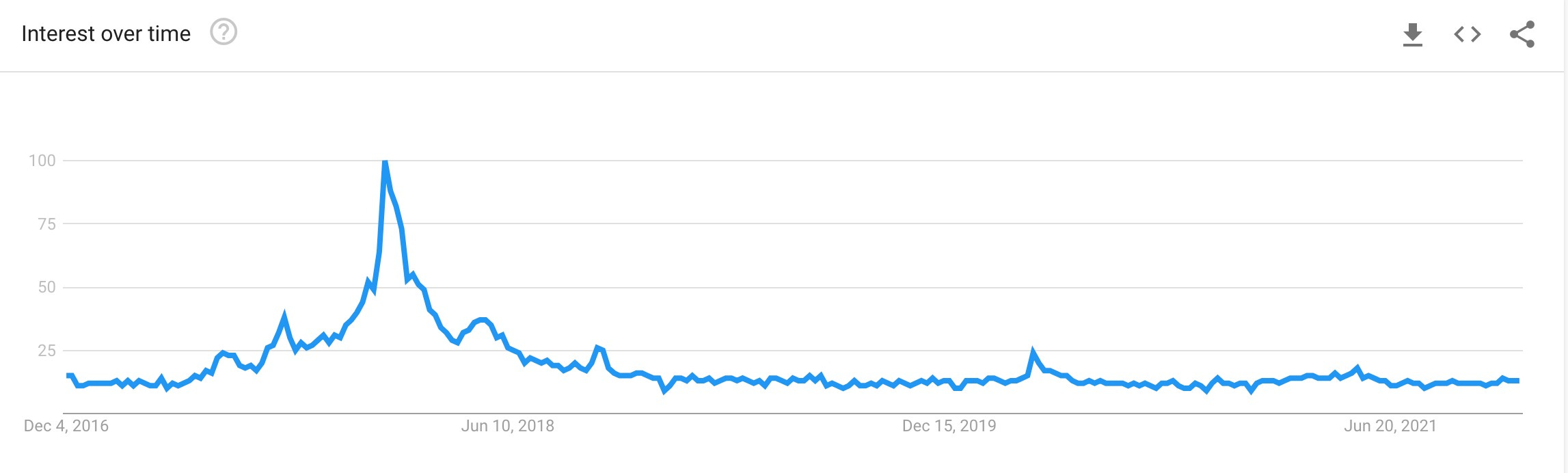
Around 2017 a phenomenon started where startups would issue ‘Initial Coin Offerings’ as a blockchain based way to raise capital, even if their product had nothing to do with blockchain. The google search history for ICOs tells the story:

My hypothesis is that DAOs are 2021’s ICOs; a flash in the pan that we’ll look back on only when the next blockchain craze comes around.

One hypothetical examples of DAOs was specific to D2C meat, which you know is a topic I’m here for – here’s how the author described it:

Going to a high-end butcher and buying your meat piecemeal might run you anywhere from $10/lb for ground to $30-40/lb for top cuts.

It’s much more financially manageable to buy a fraction of a cow from a ranch directly. That might cut your costs by 50-75%. But most people can’t eat a whole cow. So you team up with some friends and buy one together.

Let’s say you can buy a cow for $3,000. That’ll yield you around 450 lbs of meat, so you’re paying an average $6.66 per pound for everything from ground to filet.

You probably don’t need a whole cow at once though, so let’s say you buy ⅓ of one. So your cost is $1,000.

But instead of buying one directly, you buy a membership to the new CowDAO. CowDAO is a DAO focused on making high quality meat more accessible to all its members. Membership comes in the form of an NFT, which is initially priced at 0.07 ETH with a supply of 1,000. Pretty typical for a new NFT drop.

Your membership entitles you to lifetime discounts on the finest quality meat sourced from around the country, and eventually, free meat. Here’s how CowDAO does it.

(You can read the full piece here including the how’s, though I recommend popping some Tylenol first.)

Let’s dissect the CowDAO idea. So a lot of people want non-commodity meat but don’t necessarily want to purchase a whole or half carcass? Yes and amen.

But you don’t need a DAO to solve that problem as CrowdCow, ButcherBox, and Barn2Door are proving because…

…it’s not a technology problem, it’s a business model problem.

DAOs are tech for the sake of tech.

And so far, so is blockchain.

Buzz about blockchain seemed to really pick up around 2016. The ag industry speculated that blockchain would finally enable traceability in food value chains.

But traceability isn’t a technology problem, its a market problem.

Who wants traceability and who is willing to pay for it? Five years later and in most markets, its still unclear.

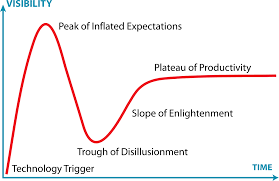
Remember the hype cycle for emerging technologies:

So where are we in the blockchain hype cycle? It’s hard to say. I *do* think blockchain will find its footing, eventually. Why & when will it happen? No idea, except that it it’s likely to be when blockchain is the right solution for a customer problem, and the technology fits the business context. Not a second before then.

Yet given enough time, anything can happen. QR codes were invented in 1994 and hey, it only took 26 years and a global pandemic for that technology to hit it’s stride.

My caveat to all the above is that not only am I by no means an expert, I did just purchase a couple of blockchain books to read over the holidays. So I reserve the right to change my mind. And let’s just assume that because I’ve now taken such a public & negative view on DAOs, that they might actually become a real thing. 🙂

Share


Get past editions of Prime Future in one place:

Get Prime Future PDF!

Categories
Emerging Tech

Prime Future 76: Meat the metaverse

Facebook recently announced the company is changing its name to Meta, a head nod to their bet on the ‘metaverse’. The Internet had a lot of jokes about it, including:

But jokes aside, if the 7th most valuable company in the world (~$943B) is changing their name to bet on a single idea, then that idea is probably worth being aware of. Whether they are correct or not is an entirely different discussion. (Some say it’s a PR stunt to distract from the bad press Facebook has received lately, but I don’t think you change the corporation’s name and stock ticker symbol just to change the news cycle…Meta believes the metaverse will be a big thing.)

The metaverse may seem like a topic outside Prime Future scope. I like to dig into trends happening in livestock & meat & milk production but this is not even clearly a thing, let alone one impacting the animal protein world. And yet…

There is a general trajectory in tech that new tech usually hits consumer use first, then trickles to B2B uses over time. What’s happening today in the consumer world can give clues about what’s coming to the B2B world in say, 3-10 years.

And the world of gaming is often the ‘canary in the coal mine’ for consumer facing tech. What’s happening today in gaming can give clues about what’s coming to the consumer world of tech in say, 3-10 years. And many in the gaming world argue that the metaverse, or some early variation of it, is here.

So while on the one hand I could not care less what’s happening in gaming (my idea of gaming is re-reading the Ron Chernow biography on Alexander Hamilton), it does kinda give some clues about what tech is headed to the broader consumer world and then to the B2B world. And tech trends for the B2B world puts us squarely in the domain of what matters in livestock, meat, & milk value chains…so here we are.

What is the metaverse?

Before you write off the metaverse as something from & for SciFi nerds only, here are some descriptions of the metaverse:

  • The metaverse is a complex topic to describe, even for experts, but roughly speaking it’s a world where people work, shop, play, and do everything else they normally do IRL—just in digital form. Zuckerberg describes it as “the next chapter of the internet.”
  • The metaverse, which is a future vision of the internet that is a persistent shared digital space (and probably includes AR or VR tools).
  • Metaverse is not about a digital representation of the physical world, its about an entirely digital space.

Here’s the official party line from Meta:

Meta builds technologies that help people connect, find communities, and grow businesses. When Facebook launched in 2004, it changed the way people connect. Apps like Messenger, Instagram and WhatsApp further empowered billions around the world. Now, Meta is moving beyond 2D screens toward immersive experiences like augmented and virtual reality to help build the next evolution in social technology.

Notice the word immersive. Immersion into the digital world is a pillar of the metaverse.

This is an oversimplifying, but the metaverse is largely about new ways to do what we already do online. Which is to say, the metaverse will provide more digitally immersive ways to connect and socialize and work. Perhaps with new tools (like VR glasses), for sure with better graphical interfaces, likely with new digital infrastructure to facilitate it all. But generally, the idea of the metaverse seems more evolutionary than revolutionary, at least from a user perspective.

(Scroll down to skip to the ‘so what’)

Another metaverse pillar is decentralization, as in decentralization of the ownership of the platforms, from Not Boring:

“To understand why (decentralization matters), it’s useful to think about the Metaverse as a virtual version of the real world, a place in which people work, play, shop, and socialize as avatar versions of themselves, or many, depending on the context. Just like we buy outfits for our physical bodies and just like gamers buy skins in Fortnite, everyone will buy outfits for their avatars. Just like people want to buy nice homes and decorate them to reflect their personal taste, we’ll buy and decorate virtual spaces. And on and on.  We will spend real time and real money in virtual worlds.

If the Metaverse operated like the internet does today, though, we wouldn’t actually own any of those things. They’d be tied to whichever platform we bought or earned them in. Platform changes its mind, lose the items or see their value deflated. Leave the platform, lose the items.”

How do you allow people to maintain ownership of digital assets as they move through the metaverse? Decentralized ownership of the platforms is part of the answer, but also this is where cryptocurrency enters the metaverse conversation – but that’s for another day. The Journal said this:

For the metaverse to take off, we’ll need upgrades to existing computer systems and technology, tech executives say, including more raw computing power and higher-quality graphics as well as a universal framework that allows users to move seamlessly from one part of the metaverse to another. Also essential will be programming tools simple enough to allow anyone to create their own virtual realms and experiences, not just skilled developers.

Consider that many of us have just spent 18 months on 3+ hours of video calls every day. Zoom is great, but also, doesn’t there have to be a better way than ‘virtual coffees’? The metaverse just might unlock that…or at least try to do so.

Back to the idea of gaming as the canary in the coal mine for new tech, there are already some big companies working solely in this space of immersive digital experiences. Ask the 16-20 year old in your life about the company Discord, which started as a place for gamers to find each other and chat but morphed into being for “anyone who could use a place to talk with their friends and communities.” That includes companies using Discord for non-Zoom, more digitally immersed team meetings. Oh and Discord has 250m+ users and is supposedly generating several hundred million dollars in revenue – it’s a real thing (some) people use today, not just the idea of a future thing.

Ok with all of that background, the real question will be, how and when and WHY will people use the metaverse? It’s hard to say because it’s early innings still, maybe the game hasn’t even started. 🤷🏻‍♀️

If consumers get comfortable with the metaverse, what will that mean for consumer expectations?

…of how they buy meat & milk? What will consumers expect from the buying experience, but also the products themselves?

Think about this generationally. Millenials are the first digitally native generation – we learned to type in kindergarten and had social media accounts in high school. We grew up with SimFarm and Oregon Trail and that weird ski game where the bear ran out to eat the skier. Millenials grew up way more immersed in the digital world than Gen X’ers, and so there’s always been a different set of expectations about the world, that there should be an online element for all things.

Gen Z’ers though, they make Millenials look like we’re back here using a rotary phone. Their expectations about digital experiences are vastly higher. They experience life with their peers via Snapchat and TikTok. They are way more immersed than Millenials, so have different expectations. And so on and so on.

As technology changes, our experience changes, and our expectations.

Imagine if Starbucks or Chick Fil A didn’t have a website in 2011, or a mobile app in 2021. If the metaverse becomes a thing, then let’s assume that in 2031 brands will have to have a metaverse presence.

Even if not all consumers engage in the metaverse, just as not all consumers use a restaurant’s app, the brands will have to be there because that's where their customer base is leading them.

Expect to see the tech forward food brands & retailers at the bleeding edge of this trend.

How will the metaverse impact input companies, and meat & milk processors?

I don’t really know but I think it largely centers around how people work. Just as consumer expectations for brands evolves, people’s expectations for workplaces evolve to continue expecting more/better digital tools. So…

The first metaverse native generation will have expectations about how work works in the metaverse.

Because oh by the way….

“Last week, Facebook rebranded to Meta, and outlined its vision for the budding metaverse. This week, Microsoft announced its own entry into the metaverse — and its early vision sounds a lot like Meta’s. Both companies are all-in on:

(1) VR headsets

(2) Digital avatars: Microsoft Teams is adding 3D avatars and using AI to listen to a user’s voice and animate their avatar, while Zuck revealed Meta’s Codec Avatars that closely mimic users’ appearance

(3) Virtual workspaces: Both companies revealed virtual whiteboards and other collaborative settings that position the metaverse as a place to get work done

Each company has distinct advantages to fulfilling its metaverse dreams.”

So maybe the metaverse will simultaneously find a fit with consumer and business use cases early on?

For livestock producers, there could be opportunity in the contrast.

Perhaps as more of life becomes more digital, it has the potential to make the physical world more engaging as a contrast. Why do people like to go to pumpkin patches in the fall and Christmas tree farms in December? (besides the Insta worthy pics, obviously) It’s because there’s something appealing in the contrast with being on a computer all week, even in today’s version of the digital world. And if that is an accurate hypothesis, then a further dive into the digital world with the metaverse will mean a stronger contrast between the digital and the physical world. How will farmers capitalize on that? Will we see more ‘Fair Oaks Farms’ equivalents? (If you don’t know Fair Oaks, it’s like livestock Disneyland. Agritourism is way too lame of a word to describe what they flawlessly execute.)

And in that same vein, could the metaverse somehow be a catalyst for more farmer D2C sales? Like Barn2Door but in the metaverse??

If the metaverse materializes, what will *not* change?

Engaging with brands, buying decisions, ordering, etc may all happen digitally – maybe even in the metaverse eventually – but you know what can never be digital? Food consumption and food production.

Food production will continue to be augmented with technology but the growing of the food and the shipping of the food and the processing of the food? That all happens in the physical world. People can’t eat digital food or live in digital houses. Agriculture will always be the anchor of the physical world.

The Journal also said this:

Concerns over privacy and security will need to be addressed as well. And then there’s the matter of the metaverse’s potential pitfalls, including the possibility that people will find the virtual realm so compelling that they neglect their real-world needs.

“There’s a potential to preferring it to traditional life,” Rachel Kowert, an Ontario, Canada-based psychologist who has studied the mental health of gamers, says of the metaverse, adding that the risks are higher for children. “Their primary learning about how to behave and engage with the world is through their peers and social interaction,” she says. “It’s a critical component of how we learn to be people.”

…but, doesn’t that sound like what people have been saying for 10 years about social media?? There is nothing new under the sun.

The question for the animal protein industry will be:

How do you continue bridging the physical & digital worlds to be relevant in both by meeting customers where they are?

What a time to be alive!


Get the first 50 editions of Prime Future in 1 ebook

Get the ebook!

Categories
Animal AgTech Emerging Tech

Prime Future 84: Everything is the enemy of something

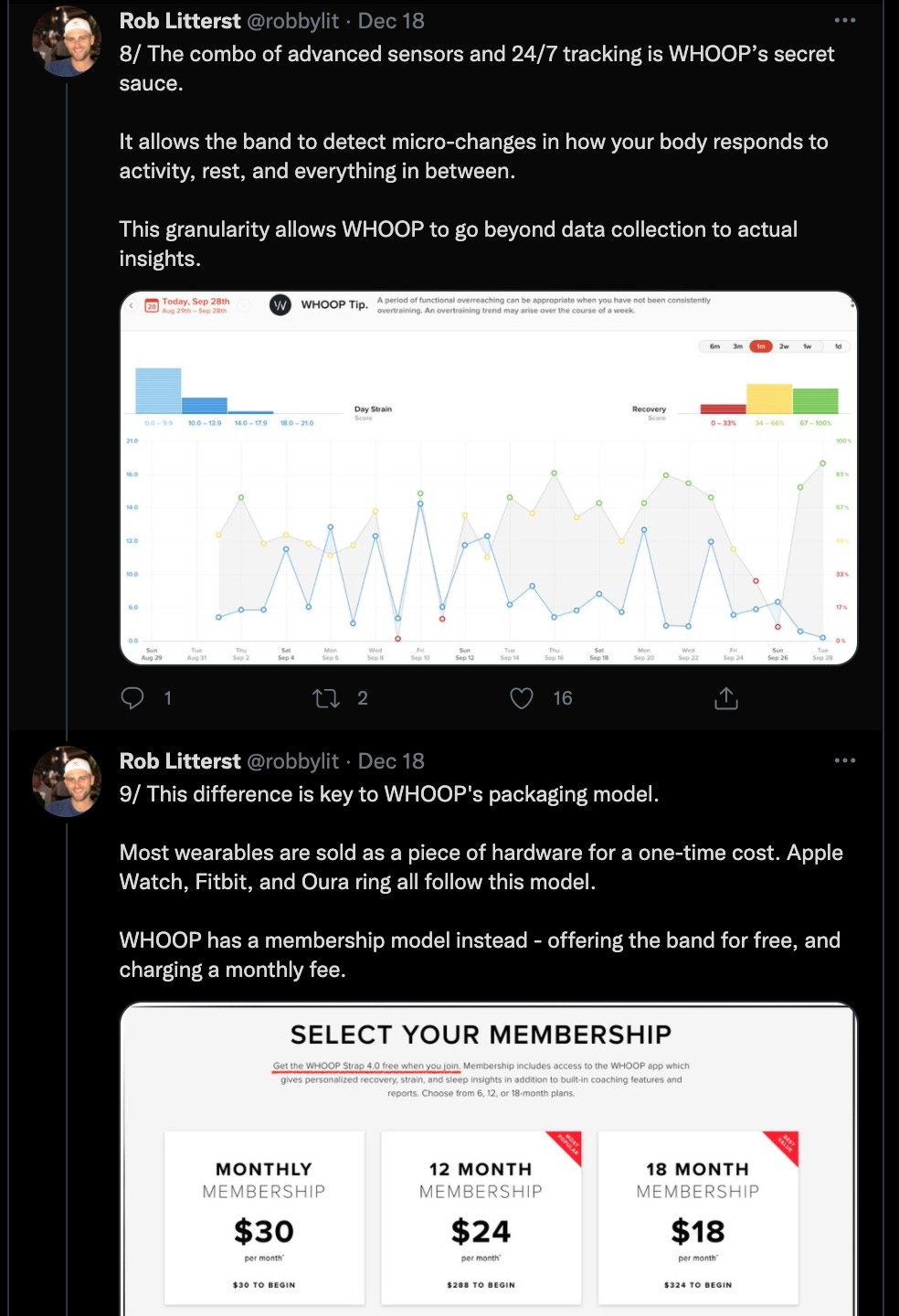
I found the below analysis of the Apple Watch compared with the WHOOP fitness wearable to be a gold mine, with 4 big ideas that tee up 2 paradoxes AgTech companies face.

(1) Specificity can create big markets:

(2) Market clarity impacts everything about the product:

(3) Product-market clarity impacts business model:

(4) Product-market clarity increases value creation:

That’s what a rando outsider sees; here’s what Whoop has to say about themselves:

“Your 24/7 personalized fitness and health coach.”

“WHOOP 4.0 – the latest, most advanced fitness and health wearable available. Monitor your recovery, sleep, training, and health, with personalized recommendations and coaching feedback.”

Let’s go ahead and call WHOOP a really great example of product-market clarity.

(In the tech world we talk all the time about finding product-market fit, but I wonder if product-market clarity makes it easier to find product-market fit. Whether product-market clarity is a leading or lagging indicator to product-market fit is a debate for another day though.)

Now let’s contrast WHOOP with Agtech companies who talk about solving macro, world-saving, how-would-humanity-continue-without-us types of problems. I’ve never once heard a producer lament those problems though; producers don’t typically have a…

  • pressing need to feed the world
  • generic, burning need for analytics
  • acute lack of artificial intelligence or machine learning or blockchains
  • dire need for transparency

And yet that kind of grandiose-but-vague language is all over websites and marketing materials in the ag industry, particularly from agtech startups.

On the other hand, I have heard many a producer talk about the ongoing struggle with questions like:

  • how do I access premium markets?
  • how do I increase predictability of cash flow?
  • how do I reduce medication costs?
  • how do I manage rising labor costs?
  • how do I grow top line revenue? increase margins?
  • how do I manage weather and disease and market risk?
  • how do I accurately manage animal inventory?

Going back to the very first idea from the Apple Watch vs WHOOP analysis, specificity can create big markets. And yet, that leads to the 1st paradox for agtech companies.

The “Everything is the enemy of something” paradox:

the harder you try to have broad appeal by not limiting your product, the harder you make it for target customers to know that your product could be for them. The more you try to appeal to everyone, the less you appeal to anyone.

This paradox shows up as a temptation for tech startups to avoid clearly articulating what their product does for whom, because a prospective customer might have a different use cases.

Then valiantly-struggling-to-get-off-the-ground tech co says HEY NO PROB WE CAN DO ALL THE THINGS. 🤦🏻‍♀️

Counterintuitively, the idea “our product can do anything” is the biggest enemy of traction because it puts the burden on prospective customers to discover how the product can create value for them.

Specificity can unlock big markets. Getting really clear about the use case and value proposition is how you get really clear in talking to your target customers….but only if you use clear words, the 2nd paradox.

The “Clear Words Paradox” is this:

the more you use jargon (tech or otherwise) to build credibility with target customers, the less credibility you have with your target customers because the words mean nothing.

My high school English teacher used to say ‘words mean things’ – laughably simplistic, but true. Words mean things. Getting the message right means getting specific and using market relevant words with clear meanings.

In my experience, producers tend to be an unpretentious population. Not only does pretentious/superfluous/jargon-y language not help a sales process, it usually hurts the sales process by slowing the conversation down…or killing it.

There’s no benefit in using words that don’t have significance or relevance to our target customers, usually serving the only purpose of making us think we sound smart or innovative. 🤭

With those 2 paradoxes in mind, here are 2 questions to ask yourself about product positioning:

  1. Am I providing substantive & specific use cases that allows a producer to see how this product solves a specific problem they might have?
  2. Am I describing the use case in language that is clear?

At first glance, today’s topic is only relevant to those in agtech. But actually my hope is that this gives some helpful language to the innovative producers who engage with agtech startups in the earliest days of beta testing or even early customer discovery. It’s ok, often even really helpful, to tell startups ‘those words mean nothing’ because that’s how they find clarity. I imagine WHOOP struggled through that same process in its early days too!

Everything is the enemy of something.