Categories
AgTech Business Model Innovation

Prime Future 78: The gate’s closing on 2021

With the gate rapidly swinging shut on 2021, here’s a look at the 5 most popular Prime Future editions this year:

(5) Egos & Incentives

Sometimes in the B2B world it’s easy to assume business decisions are driven solely by an ROI calculation, neatly tied with an Excel bow around a carefully curated formula. Or in the farm world, that every decision is justified by the output of the almighty shirt pocket calculator.

But in the real world, rarely can an ROI be fully captured numerically. Other factors impact decisions, including the psychological factors. I summarize this as Egos & Incentives.

Numerical ROI is necessary, but it’s not sufficient. At the margin, decisions are made based on their impact to our egos and incentives, including decisions about adopting new products, practices or ideas:

  • Incentives: How does this help me achieve what I’m incentivized to achieve, what I want to achieve?
  • Egos: How does this impact my view of myself and my place in the world, aka my ego?

We’re all out here responding to incentives, intentionally or unintentionally, doing the things to get the job, the bonus, the contract, the new customer, the promotion, the upsell, the renewal, the fill in the blank. And no surprise, we all have egos. Every last one of us, even those who say they don’t (perhaps especially those). The advertising industry is built around these fundamental truths of human nature.

And though it can be framed at an individual level, I believe it’s just as true at an organizational level because, of course, organizations are just big groups of individuals, still responding to egos and incentives.

The fundamental question to ask about new products is, where does value accrue and where is cost incurred?  If the packer accrues the value but the producer incurs the cost, well….that’s probably not going to go well because incentives are not aligned. The challenge of incentive alignment is why business model innovation can be just as high impact as tech innovation, if not more so.

Read more


(4) 💡3 reasons why dairy is the new beef

I started this series with an assumption that beef breeds create better beef carcasses than dairy breeds, or dairy x beef crossbreds. But here’s the surprising little secret: Beef x Dairy cross carcasses are as good or better than straight beef carcasses, or ‘natives’ as the people say.

The beef on dairy genetics jigsaw puzzle allows dairy producers to make decisions that get the best of beef and dairy breeds, to use ‘elite terminally focused genetics’ on the beef side that offset the dairy deficiencies.

Consistency is the name of the beef on dairy game. There are 3 elements of consistency that beef on dairy can offer to the beef value chain:

  • Year round continuous supply of calves to the feedyard, and then to the plant.
  • Genetic consistency given how narrow the genetic base of dairy cattle are since AI has been used so widely for so long.
  • Management consistency – while a beef animal could move through 2-3 sale barns between weaning and arriving at the feedyard, beef-dairy crosses are much less likely to go through a sale barn at all. They’re more likely to move in large lots from calf ranch to grow yard to feedyard, or directly from calf ranch to feedyard with consistent management in each phase.

Value is only value when it’s recognized by the buyer, in this case the packer. The value chasm is wide between a dairy animal and a beef animal, so the challenge for beef-dairy animals is to get them priced like a native. One producer said it this way, “packers are looking for a reason to price a beef-dairy cross like a dairy animal. You have to get the animals on a grid to get a base price where it should be.”

Capturing full value of the beef-dairy animal requires closely aligned partnerships all the way through the value chain to the packer. Aka aligned supply chains or coordinated supply chains.

Will it be surprising if Dairy Beef aligned supply chains grow and consolidate over time to find the efficiencies of scale without the capital intensity of true vertical integration? Not at all, that’s the nature of the agriculture game.

So, the 3 ideas that make beef-on-dairy shine:

  1. Beef x Dairy cross carcasses are as good or better than straight beef carcasses. (Think of it as having your cake and eating it too, but ya know, beef.)
  2. Beef-dairy crosses hold a consistency advantage over the traditional fragmented beef value chain.
  3. Beef-dairy cross value chains are forcing new partnerships in order to capture full value at the packer level.

Which is all fine and well, until we come back to the math of beef on dairy. If we are really only talking about 5M calves annually, out of 25 million total fed cattle, it raises the question of….so what?

What happens with 5M beef dairy crosses is interesting, but the really fun part will be seeing how the 5M could influence the 20M.

Read more


(3) Where’s the honeycrisp of the meat case?

I love wandering the aisles of a boujee grocery store. HEB, Whole Foods, Wegman’s…here for them all. Naturally a highlight is walking the produce aisle, letting your eyes take in the color explosion and the magic of plant genetic creativity brought to life: fizzy grapes, plucots, strawberries with more shelf life, sweet peppers with more flavor. Or, the crown jewel of the entire produce aisle: the Honeycrisp apple….pure magic. (I’m honestly not convinced they aren’t laced with something highly addictive.)

While plant based burgers aren’t my thing, objectively the product itself has completely transformed – and continues improving – as a result of innovation and R&D investment. Pat Brown, CEO of Impossible Foods, has been vocal about his strategy: bring about a world without livestock for meat by offering a plant based meat product to the world that meets consumer’s objectives on taste, cost, and nutrition so they do not have to make a values based tradeoff.

Which is a smart strategy! It’s the Tesla strategy. It’s ‘product first’ which inherently means high investment in product development.

Now let’s go to the retail fresh meat case where things have remained unchanged for, um, a while. That steak or pork chop or chicken breast is basically the same as it has been for the last 30 years. Why is that?

Most genetic progress in livestock centers around live performance, not end product outcomes.

We talk about genetics in terms of live performance metrics: Feed conversion. Growth rates. Calving ease. Hatchability. None of these are attributes you can see at the meat case.

Improved live performance is producer language, not meat case language.

We all know the amazing genetic progress over the last 50 years across livestock. Drastically improved feed conversions and growth rates have led to much lower production costs per pound of meat/poultry/milk. Great for producer, beneficial for consumer. I’m not taking anything away from the economic or environmental impact of that live progress….but I am saying, maybe it’s not enough?

Like it or not, we live in a what-have-you-done-for-me-lately world….so where are the product development innovations in meat that are noticeable to the consumer?

Where’s the meat case equivalent of the Honeycrisp apple?

Read more


(2) Lunatic farmers & velocity 🚀

The owner of a dairy was lamenting the rise of mega dairy systems and the risks they pose to small dairies like hers. How many cows does her dairy milk?

7,000

It’s a laughable story except that this dairy farmer & her family have grown the herd from a few hundred to several thousand over the course of their career. They’ve struggled and strived, taken risk after risk to get where they are. And yet in their minds, they still identify as small, scrappy, insurgent producers trying to survive.

There’s a special irony in the tendency among farmers to want to be bigger than neighboring operations. Sometimes bigger is better, sometimes smaller is better. But farm size is not the sole indicator of success and it definitely should not be the sole goal.

My hypothesis is that scale is a lagging indicator; velocity of business model innovation is the leading indicator of success.

The more commoditized the business, the stronger the pull to scale to reduce cost per unit.  The more value oriented the business, the stronger the pull to create incrementally more value per unit. There’s no clever analysis in those statements – those are natural forces that are a function of capitalism and a mature agriculture industry.

I think the successful producers (or packers or xyz business) who will thrive come-what-may are the ones who don’t think of their business based solely in terms of the output (corn, soy, weaned calves, whatever), but rather view their business as a business model that is is in continual refinement. They constantly ask what’s the process that most effectively generates the output. They think in systems that can optimized.

It seems that the really successful producers are the ones that have a vision of where they are going and how they will get there. There’s no doing it this way because that’s how we’ve done it, there’s no growth for the sake of the growth. There is only relentless learning and improvement.

The great producers realize that they aren’t selling just a commodity output, they are selling their business model.

Size is not the determinant of success. It’s about business discipline, management, relationships, processes, team, leadership, ambition. Successful producers have a vision for the future that they rally the team around, there’s an ever evolving plan for increasing revenue per unit produced or decreasing cost per unit produced, or both.

I recently asked a really large operator how they grew their business over the last 20 years from something not at all uncommon to something truly extraordinary. Did they have access to capital that others didn’t have? Some other advantage not available to similar producers? “I don’t think so, I think we just do things in a different way than most people are interested in doing. We do a lot of things that aren’t uncommon for most growing businesses, they are just uncommon for production ag businesses. We have a yearning for learning.”

Let’s call a spade a spade – capital is abundant and cheap in 2021, as it has been the last several years. Ideas are a dime a dozen. It’s everything else that separates the aggressive producers from the rest.

I’ve referenced Allen Nation’s book before, but germane to this conversation is a chapter on how farmers approach innovation with insights pulled from a 1962 book “Diffusion of Innovation” that studied extension efforts to get farmers to switch from open pollinated to hybrid corn post WW2.

“The innovative farmer is seen by his farm neighbors as a lunatic farmer. And a lunatic is not seen as a role model. As a result, what the innovator does on his/her farm is literally invisible to the neighbors. This is true even if the innovation is producing visible wealth. The normal reaction to unconventional success is the old it-might-work-there-but-not-here syndrome. The sad truth is that the vast majority of farmers prefer to fail conventionally rather than to succeed unconventionally. It is very, very difficult to be more innovative than the community in which you live.

Here’s the really germane part: “No farmer referenced what a farmer smaller in acreage than themselves was doing as applicable or worthy of study. Everyone preferred to learn from someone larger than themselves.” Isn’t that fascinating?

I’ve recently observed some markers that lunatic farmers seem to have that indicate high velocity of business model innovation:

  • They ask questions. A lot of questions. They find smart people to ask questions. They find smart people in non-traditional places to ask questions.
  • They read. Not just industry magazines, they look outside.
  • They have a sense that what they are saying sounds half crazy, dare I say they know it might make them sound like a lunatic farmer.
  • They surround themselves with high quality people, high quality teammates.
  • They have a system they are building/running, a flywheel they are looking to spin faster.
  • They have some insight that most of their peers don’t, some belief that isn’t widely held.
  • They know new practices & ideas take time to implement correctly, so they allow margin (time, energy, $) to experiment.

Read more


(1) The packers get Standard Oil’d. Then what?

If an oligopoly market is when 4 firms have 50+ percent share, then US beef, pork, and poultry are undeniable oligopolies. These concentrated markets aren’t uncommon though, we run into them from cereal (Kellogg’s, General Mills, Post, and Quaker) to cell phones (Apple, Samsung, Huawei).

But these examples are child’s play compared to the most extreme example of market power: the classic story of Standard Oil. In the 1880’s, John D. Rockefeller realized the oil business was a fantastic business except for the nagging issue of price volatility. So he found a solution to that little problem, by developing an effective monopoly through the Standard Oil trust. A Supreme Court ruling in 1911 forced the trust to split into 34 companies to increase market competition.

The current rally cry of many US producers is that the problem with the cattle business is concentration among the packers. This is not new; tale as old as time. But carry that rally cry out to the most extreme outcome of de-concentrating processing capacity….what does it really solve?

Just for fun, let’s say the DOJ goes full 1911 and ‘Standard Oils’ the meat industry.

Every plant becomes its own company.

The ‘Big 4’ become the ‘Midsize 22’.

Then what? Before we lock into any hypotheses about a re-fragmented meat industry, what was the result of busting the Standard Oil trust?

Would a Standard Oil’ing of meat packing be good for downstream players? Maybe, in the short run. Probably not in the long run.

Would a Standard Oil’ing of meat packing be good for upstream players? Maybe, in the short run.

But what’s not good for downstream players in the long run cannot be good for upstream players in the long run.

Hear me loud & clear that profitability at all stages of the value chain is the #1 foundation of a viable cattle industry. Increasing margin capture throughout the value chain is a good thing, a great thing. But is reducing packer power the panacea that people often describe it as? I may be wrong, but I just don’t think it is.

Maybe looking at impact of competition on pricing power & innovation is the wrong framework….maybe higher margins don’t lead to innovation, maybe innovation leads to higher margins.

Read more


Categories
Business Model Innovation Supply Chain

Prime Future 71: Love Me Tenders: a supply chain story

“There does not seem to be any relief on the horizon.”

Supply chain: the red headed step child of business school disciplines; the silent function that just effortlessly does its thing; the heartbeat keeping blood (stuff) moving through the body (economy) without a second thought required.

Or at least that’s how it seemed until we started seeing signs like “due to supply chain shortages, we are out of guacamole and Ford F-250’s.”

Supply chains are in the spotlight now, as they have been since toilet paper-gate began in March 2020.

As we kick off this series on how supply chain disruptions & dynamics are impacting meat & poultry and how this could play out in the future, today we’ll look at 2 macro concepts, what’s happening in milk hauling, and a chicken tender supply situation.

Supply Chain Inception

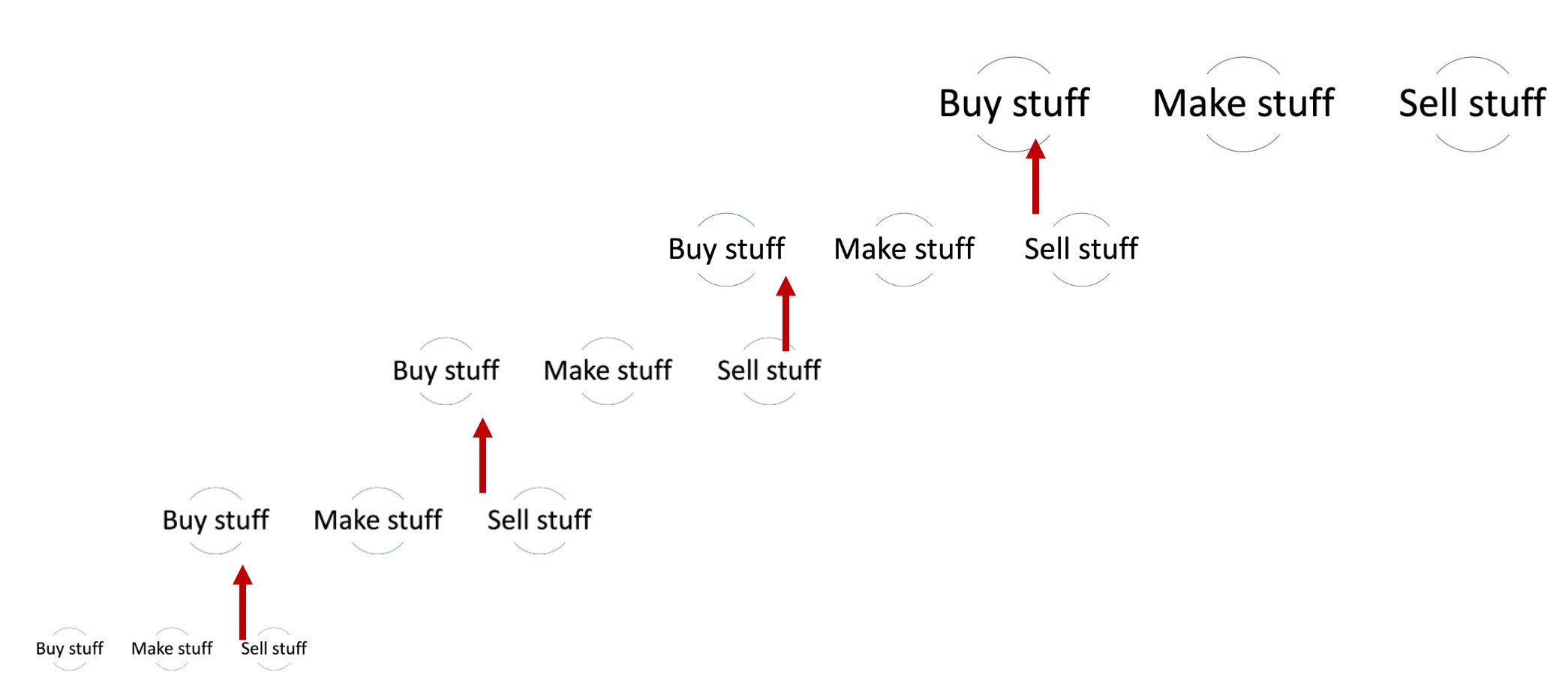
Every company buys stuff to make stuff to sell stuff, which is a simplified version of Wikipedia’s definition of a supply chain as “a system of organizations, people, activities, information, and resources involved in supplying a product or service to a customer.”

So we start with Company A’s supply chain, who buys inputs from Company B who buys inputs from Company C and so on and so on. Suppliers are dependent on their suppliers to provide inputs; customers are dependent on supply chains to function. The layers keep pulling back like some sort of supply chain inception:

Supply Chain Inception

Sometimes the supply chain inception is called The Global Supply Chain, a generic term being thrown around a lot right now that may or may not be relevant. No one cares about THE supply chain, they care about disruptions to MY supply chain.

In theory vertical integration solves some of this, but not entirely. More on that in a moment…

Supply Chain Chaos: The Bullwhip Effect +

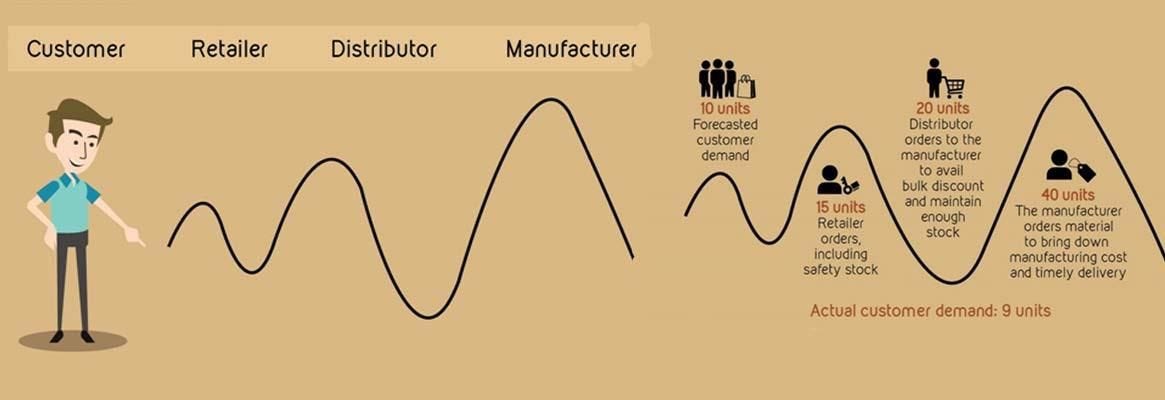
“The bullwhip effect is a supply chain phenomenon describing how small fluctuations in demand at the retail level can cause progressively larger fluctuations in demand at the wholesale, distributor, manufacturer and raw material supplier levels. The effect is named after the physics involved in cracking a whip.”

The big idea is that with a small demand increase, the further upstream you go the bigger the impact.

For a lot of companies, the 2020 demand increase didn’t start until a little ways into the pandemic, maybe even after the first stimulus check. But for meat companies it was immediate in March as the ~50% of total meat sold through foodservice shuttered and shifted to retail, where grocery store shoppers stocked up for what felt at the time like the looming apocalypse, emptying the meat case day after day after day.

Simultaneously, getting enough employees to run the plant went from challenging to existentially difficult. I cannot remember a single livestock or meat industry conference that didn’t discuss labor as a critical issue – labor as a challenge is not at all new….what’s new is the severity of the issue.

As we know the 2020 Bullwhip effect created huge and harmful waves upstream to livestock producers, especially as it was compounded with a supply constraint and labor shortage. We basically had supply and demand shocks competing with one another, compounded by labor shortage. I picture the hypothetical equation looks something like this:

It’s not hard to imagine this wild combination of competing & simultaneous dynamics will go in supply chain textbooks as the COVID effect…and the effects continue playing out. Truthfully, we don’t actually know how it ‘ends’.

While this isn’t the place to hypothesize on labor impacting policies or the root origins of the labor shortage, the fact is that in the United States there are 5 million fewer people in the workplace today than in April 2020. That labor shortage is felt in two key ways:

(1) Labor to transport goods. If trucking is a “job of last resort” in a time where people don’t need to resort to their last and worst option, well….here we are. Truckers are required in order to move product from Point A to Point B at every transaction, and some in between. The red arrows are red because those are now high risk potential bottlenecks:

(2) Labor to do the making. If you don’t have labor in the manufacturing plant, you won’t have anything to transport. The red boxes are red because those are also high risk potential bottlenecks:

Plants have struggled to keep the fabrication floor staffed up, often at the expense of further processing capacity which means selling more bone in hams rather than higher value boneless hams, as one example. The Daily Livestock Report provided this commentary on the recently increased volatility of the pork cutout in the US:

“While one can point to a number of factors driving this day to day volatility, we think a major issue has been the widening spread between bone- in and boneless items. The wide spread reflects the impact that limited labor has had on the ability of packers to run boning and trimming lines, be this for hams, loins or other products.”

….and that’s nothing compared to the situation in the UK. According to Bloomberg:

“U.K. farms have begun the daunting task of destroying pigs as worker shortages leave 120,000 animals with nowhere to go, meaning livestock could end up as pet food instead of pork. A worker crunch — driven by Brexit and the pandemic — has seen processors cut slaughter rates by as much as 25% since early August.”

People tend to, uh, get grumpy when impacted by shortages, delays, price hikes, or (more likely) some combo of all 3 effects caused by supply chain bottlenecks. Managers & owners want to maximize profit, which they can’t do without being sufficiently staffed. Buyers want predictability of price and availability, which they don’t get on non-existent or delayed goods. Sellers want commissions, which they don’t get on product unavailable to sell.

How is the driver shortage impacting milk hauling?

Hill Pratt, Managing Director of the Transportation Business Unit for Dairy.com provided these astute observations:

The driver shortage has become the limiting factor in getting dairy loads moved.  Since June of this year, short-notice and weekend loads have become difficult (and at times, impossible) to cover and spot hauling rates have shot up to the highest levels we have ever recorded.

Covid has impacted many haulers and some haulers report large numbers of parked trucks due to lack of drivers. Hauling companies have added pay and (especially) benefits to attract drivers and are working hard to accommodate driver lifestyle preferences.  Many dairy haulers feel that drivers are simply not available—at any pay level—in their market areas.  Owners of smaller and medium-sized hauling companies are often back to driving trucks on a fulltime basis and see no way to replace drivers who leave.

Nearly all hauler input costs—drivers, equipment, parts, tires, insurance and fuel—have spiked in the last couple of years.  To avoid maintenance headaches, hauling companies had begun replacing trucks earlier, but with delivery on new trucks ordered today delayed until 2023, hauling companies are forced to keep old trucks in service longer—driving up maintenance costs and downtime (given the shortage of replacement parts).”

On how this situation might evolve in the future, Hill said this:

“There does not seem to be any relief on the horizon.  If anything, the capacity crunch that hit the industry this summer may become worse as milk production increases this winter (if it follows typical seasonal patterns.)

Whereas plant processing capacity has historically been the limiting factor (which has caused instances of “dumped milk”), the industry faces the prospect of dairy hauling shortfalls causing milk (and milk components) to build up beyond the capacity to store them.  This may force dairy companies to cease production, dump milk products and/or miss/delay orders.”

Ouch.

Love Me Tenders

To continue pulling this thread, let’s take the POV of the head poultry buyer at a fictitious fast food chain, Love Me Tenders. This chain has 10 distribution centers and 2,000+ stores across the country where they sell air fried chicken tenders (and accept only cryptocurrency as payments, but that’s a topic for another day).

The buyer’s responsibility is to manage 3 variables while procuring chicken tenders:

  • Quality – everything coming into the DC & the stores must meet company specs.
  • Availability – the product HAS to be there or else the company can’t make the stuff to sell the stuff to the people who pay the money.
  • Price – responsibly managing COGS.

(There’s a whole discussion to be had about how different procurement organizations think about the prioritization of these 3 variables relative to their business model. For today let’s assume that our buyer ranks them in the order above.)

So our buyer calls their 3-5 strategic suppliers. Our buyer has negotiated long term agreements with suppliers in order to manage the 3 priorities above but hey, its 2020-2021 and its the wild west out here…hard to say how well suppliers will be able to fulfill their commitments on time. Because these are large poultry integrators, each of our buyer’s suppliers will source product from 2-4 different processing plants within the company but because our buyer only buys the tender, each of those processing plants has to balance their other customers who buy the rest of the bird.

Two truths about the poultry supply chain (pictured here):

  1. Things have to move. For meat & milk supply chains to work, trucking capacity is an existential necessity at multiple points. Every arrow above represents the movement of one physical thing from one step in the supply chain to the next (eggs, chicks, feed, birds, meat). Until localized bullet trains for birds get built, this trucking thing is a big deal.
  2. Things have to move on time. Every step in a supply chain with live animals has its own ‘turkey timer’ so to speak. Chicks have to come out of the hatchery once they hatch and they have to go to a farm, they can’t hang out in the chick trays at the hatchery. Placement numbers in a broiler house are calculated based on density targets by the end of the flock, so birds have to leave the farm at a certain time which means they have to be processed within a very tight window. And once the birds are processed, fresh meat has to move or else it has to be frozen which is a value destroyer. Everything has to happen on time in order for the supply chain to work.

Ford pickups and John Deere tractors can be parked while manufacturers wait on chips to arrive from Taiwan before being shipped to customers in Iowa, but live animals (or milk) can’t be parked in the side lot for days or weeks.

The buyer at Love Me Tenders is reliant on so many supply chain elements to go right, the vast majority being out of the buyer’s control. Which should mean the buyer is signaling to management that we probbbbably need to create some additional back ups for our additional back up plans that were busted to bits over the last 18 months.

The idea of supply chain resilience is everywhere, “the capacity of a supply chain to persist, adapt, or transform in the face of change.” But supply chain leaders will tell you that being prepared for any contingency has always been a core objective, tho perhaps the degree of ‘change’ to be prepared for is increasing in scope/severity.

We’ll continue exploring the complexity around supply chains & the current chaos over the next few weeks but needless to say, there are no easy answers for the Love Me Tenders of the world…or anyone else in meat, poultry & milk supply chains.

Share

Categories
Business Model Innovation Genetics

Prime Future 67: When does beef x dairy show up at the meat case?

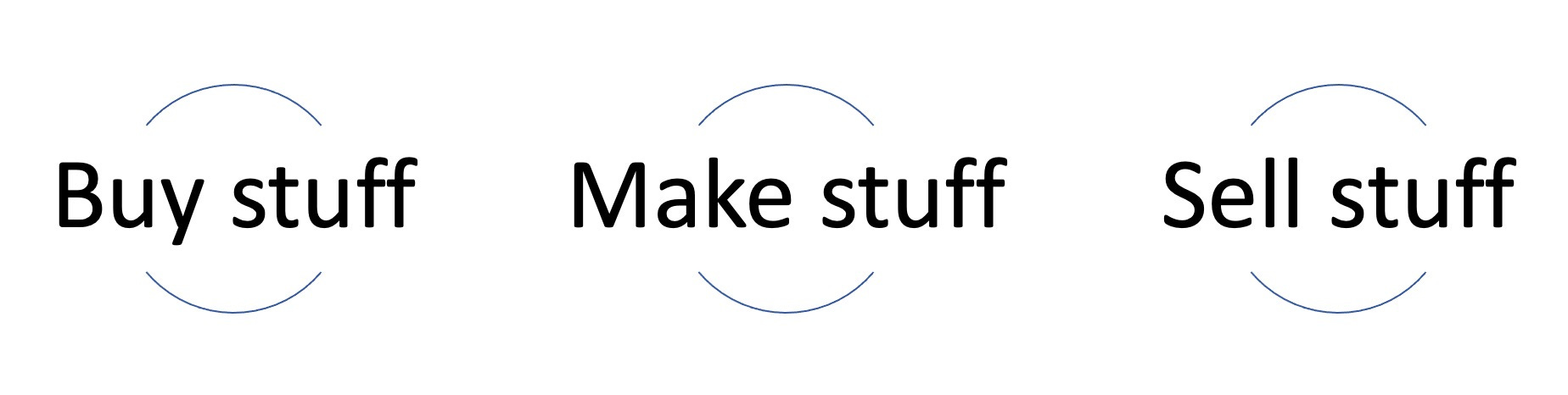
Every company on the face of the planet (and someday on Mars) does 3 things:

  1. buys stuff to
  2. make stuff to
  3. sell stuff

Using that oversimplified framework, in our last stop in this series let’s look at the downstream implications of ‘beef on dairy’ for cattle feeders, packers, and retailers.

Keep in mind, we’re talking about a max of ~5 million out of ~25 million fed cattle per year in the US.

Feeders gonna feed.

Success in cattle feeding is based on a 3 variable equation:

  1. Quantity & price of lbs out the door (selling cattle right)
  2. Minus the quantity & price of lbs in the door (buying cattle right)
  3. Minus the cost of lbs added at the feedyard (feeding & managing cattle right)

Those 3 levers make feedyards the segment in the beef value chain with the most flexibility. That flexibility makes cattle feeding a reeeeally dynamic business allowing feeders to shift strategy with trends in the market, the cattle cycle, or grain prices. It’s also what makes cattle feeding really hard.

When it comes to feeding native cattle (beef), dairy, or beef x dairy crosses, cattle feeders find what works as they triangulate risk profile on the buy, feeding & management, and relationships/proximity to plants that process certain types of cattle. There are both the management & nutrition elements of feeding different or new-to-you types of cattle that can take some time in learning how to adjust lever #3 above, cost of gain. But just as important are levers #1 and #2 which are driven by the relationships and partnerships and arrangements that surround a cattle feeder’s strategy as it relates to how they buy and how they sell cattle. All 3 levers have some degree of learning curve when it comes to beefxdairy, though waaay less than a beef cattle feeder jumping into feeding dairy cattle.

My hypothesis is that because large dairies are leading the way with ‘beef on dairy’, the animals tend to move as large lots under negotiated agreements rather than moving as smaller lots through sale barns. The result is increased visibility to production history, and decreased risk….not a bad combo for a cattle feeder.

One opportunity for cattle feeders is if these large dairy systems look to maintain ownership of cattle through the supply chain to capture more value all the way to the packer, will that create more low risk custom feeding opportunities. If the balance of feedyard owned cattle vs custom feeding cattle for others tends to cycle with the broader cattle cycle and feed price fluctuations, could this increase the amount of predictable custom fed business? Maybe, maybe not.

~5 million dairy calves have been part of the beef value chain for decades. All ‘beef on dairy’ does is create an opportunity to level up, to get the best of beef and dairy genetics for performance in a feedyard and in the plant. Shifting from 280 days in a feedyard for Holsteins to <180 days in a feedyard for Hogus cattle is, um, a big deal.

One aside: For the segment of dairy cows that are bred to a beef bull using AI, the math doesn’t (yet) make sense to use sexed semen so 50% of those offspring will be heifers. Heifers are typically considered less profitable for a feedyard than steers. If/when it becomes economical to use sexed semen for all calves from a dairy that are headed into the beef value chain, there will be another inflection point. The view on heifers is another example of the difference in beef goals vs (traditional) dairy goals, since heifers are significantly more valuable to the dairy producer.

Packers gonna pack…but at what price?

We talked about the BIG idea of beef on dairy value chains to accelerate aligned supply chains in beef since they are absolutely critical to maximizing the value of beef x dairy carcasses. Beef on dairy value chains *have* to have a direct relationship with the packer. This partnership mentality, from producer to calf ranch to feedyard to packer, is essential to ensuring beef-dairy cattle are priced according to the value of the carcass, with its beef characteristics.

But as long as the ‘right’ genetics have been selected to drive desirable carcass traits the packers are looking for, then these animals should be priced like their native peers. If the dairy’ness has been offset by the terminal beef genetics, then once the animal arrives at the packing plant there *should* be no subsequent difference in process or how that beef is sold. It’s just beef by the time the carcass is disassembled and prepared for the meat case at retail.

Which leads us to….

Retailers gonna…cringe a bit.

To the extent beef x dairy meat went into mainstream channels & programs at the packer, then they show up in the meat case just like meat from any native (beef) animal. Zero impact there.

The real question is, will retail brands be built around beef on dairy?

Here are the reasons FOR beef x dairy focused brands:

  1. Consistency in supply, consistency in product given the tight dairy gene pool. The consumer will get the same experience every.single.time. That seems brand’able.
  2. Transparency into supply given the ‘aligned supply chain’ nature of this beast that is required. Want to know how this animal was raised, where it’s been, how it was fed? We gotchu.
  3. Sustainability. Let’s say for illustrative purposes (don’t @ me) that each cow uses 1 unit of environment per year. The beef cow produces 1 unit of food supply per year with a calf. So we can loosely say that beef = 1:1 output to input ratio. But wait a sec, here comes the dairy cow who also uses 1 unit of environment per year but she produces 1 unit of food supply per year through milk production PLUS 1 unit of food supply with a high value beef x dairy calf. Dairy = 2:1 output to input ratio. The dairy cow is the super star when you frame it that way.

It’s a made-for-the-meat-case story.

But there’s a catch: The calf ranch.

Regardless of how well cared for the calves are, kept out of the elements, given appropriate feed and water and nutrition…brand new baby calves in hutches isn’t something thats likely to play well in a social media world that runs on sound bites & spin rather than nuance. Until there’s an alternative to the current calf rearing link in the supply chain, there’s likely to be limited retailer / brand appetite for marketing beef x dairy crosses in a direct way.

And yet, given how great the value proposition is for a fully aligned beef x dairy supply chain from dairy to meat case, I have to believe that someone is going to find a meat case friendly solution for calf rearing.

And when that happens? Game on.

Summary

We’ve covered a lot of ground in this 5 part series – I have learned so much from all the people who’ve shared their insights along the way. My takeaway from the series is that beef on dairy isn’t everything, but it is definitively something:

the 3 ideas that make beef-on-dairy punch above its weight class:

  1. Beef x Dairy cross carcasses are as good or better than straight beef carcasses. (Think of it as having your cake and eating it too, but ya know, beef.)
  2. Beef-dairy crosses hold a consistency advantage over the traditional fragmented beef value chain.
  3. Beef-dairy cross value chains are forcing new partnerships in order to capture full value at the packer level.

Which is all fine and well, until we come back to the math of beef on dairy. If we are really only talking about 5M calves annually, out of 25 million total fed cattle, it raises the question of….so what?

What happens with 5M beef dairy crosses is interesting, but the really fun part will be seeing how the 5M could influence the 20M.

Imagine that cattle feeders and packers and retailers get used to all those benefits mentioned above that are inherent to the beef x dairy value chain. Now use the exceptionally limited amount of imagination to picture those expectations bleeding over into the other 80% of beef, the natives. Not much imagination required, huh?

The unknown is how the beef value chain will respond and how long it will take to catch up & recreate the rapidly accelerating advantages of the beef on dairy value chain. Is this a 30 year dynamic or a 5 year dynamic? TBD.


ICYM the rest of the series

The first 4 of this 5 part series on how the ‘beef on dairy’ genetics strategy could impact the beef & dairy industry in the United States:

(1)  How the ‘beef on dairy’ genetics strategy will impact cow-calf producersSpoiler alert: not much, mathematically speaking.

(2) What’s driving this beef on dairy thing from the dairy producers POVtldr: its complicated.

(3) 💡 3 reasons why dairy is the new beefIt’s not about the 5M, it’s about how the 5M influence the remaining 20M fed cattle.

(4) If dairy is the new beef, where do the alts fit? A look at how alternative milk and meat market share might impact milk and meat prices now that the two are even more interdependent.

GET THE BEEF-ON-DAIRY EBOOK 🐄


I’m interested in all things technology, innovation, and every element of the animal protein value chain. I grew up on a farm in Arizona, spent my early career with Elanco, Cargill, & McDonald’s before moving into the world of early stage Agtech startups.

I’m currently on the Merck Animal Health Ventures team. Prime Future is where I learn out loud. It represents my personal views only, which are subject to change…’strong convictions, loosely held’.

Thanks for being here,

Janette Barnard

Categories
Business Model Innovation Genetics

Prime Future 66: If dairy is the new beef, where do the alts fit?

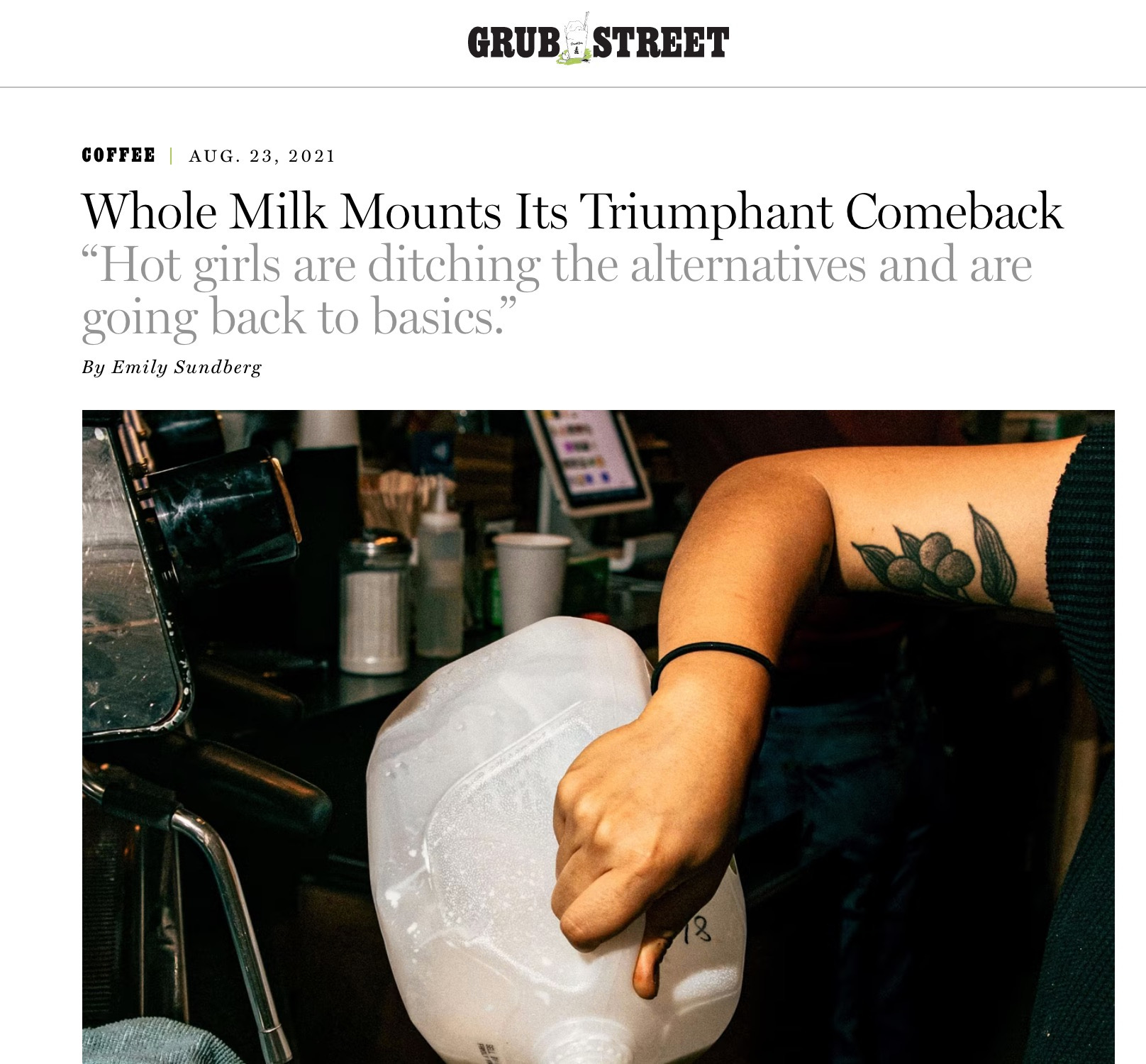
Move over hippies and hipsters, man buns and punk rock. The new counter culture move is….drinking milk?

“I traveled around Europe this summer. I drank icy frappes on the beaches of Greece and stirred foamy café au lait at the bistros of Paris. I was in a simpler, more sensible world, one without an alt mylk or nondairy creamer in sight. The real international delight, I realized, is pouring whole, full-dairy milk into your coffee; it is perhaps the most civilized activity in which a person can partake.”

….her answer edged on spiritual fulfillment. “There’s this quest for absolution in the foods we eat,” she said. “I think consumers were fed this lie by what I call the Goop Industrial Complex that if you cut dairy from your diet you will have more energy, clearer skin, and you will never ever fart ever again. But the case against dairy ignores many of the complexities of our food system, and I think people are starting to realize that.”

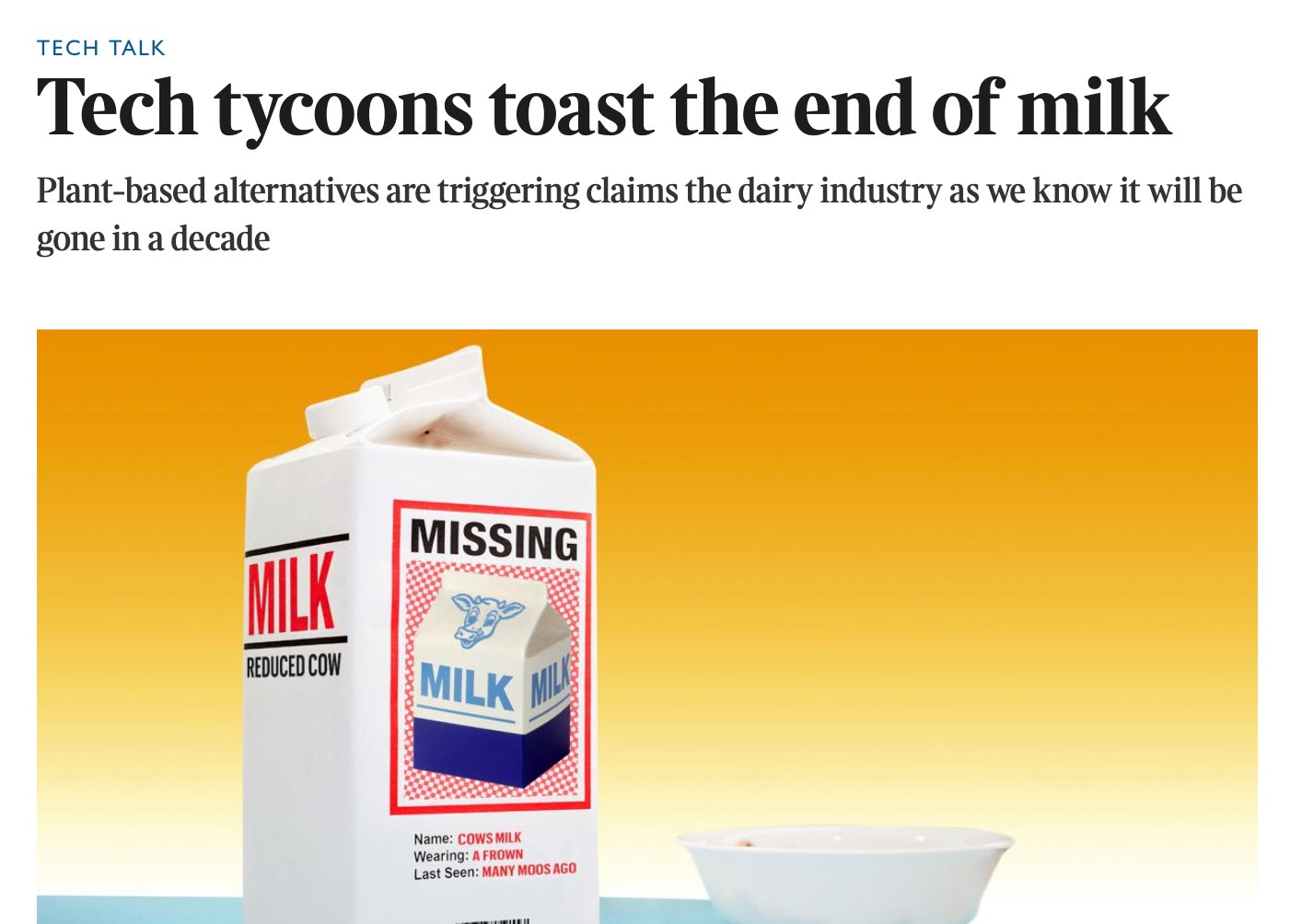
Now set that against this other recent headline:

When I hear people talking about the ultimate demise of animal protein as we know it, I assume it’s either an alternative protein investor who has capital on the line, or someone who wants to be seen as a forward thinker, even in the industry. It sounds more futurist to describe a future without plant fed animal protein than it is to say “I think there’s a market for plant based or cell cultured protein but not necessarily at the expense of plant fed protein.” It sounds more contrarian to say “livestock production will end in 10 years” than it is to say here are the markets where alternative protein is likely to take share but here’s where it’s unlikely to gain traction.

There’s little reward for a nuanced position in most conversations right now though…

Consider this quote by Jeff Bezos:

“I very frequently get the question: “What’s going to change in the next 10 years?” That’s a very interesting question.

I almost never get the question: “What’s not going to change in the next 10 years?” And I submit to you that that second question is actually the more important of the two.

You can build a business strategy around the things that are stable in time. In our retail business, we know that customers want low prices, and I know that’s going to be true 10 years from now. They want fast delivery; they want vast selection. It’s impossible to imagine a future 10 years from now where a customer comes up and says, “Jeff I love Amazon, I just wish the prices were a little higher.” Or, “I love Amazon, I just wish you’d deliver a little slower.” Impossible.

So we know the energy we put into these things today will still be paying off dividends for our customers 10 years from now. When you have something that you know is true, even over the long term, you can afford to put a lot of energy into it.”

How great is that?

That framing is likely to generate the richness of a whole lotta nuance, the tension of simultaneously asking what will change and what will remain the same. And when it comes to the impact of alternative proteins in milk or meat, it’s largely TBD.

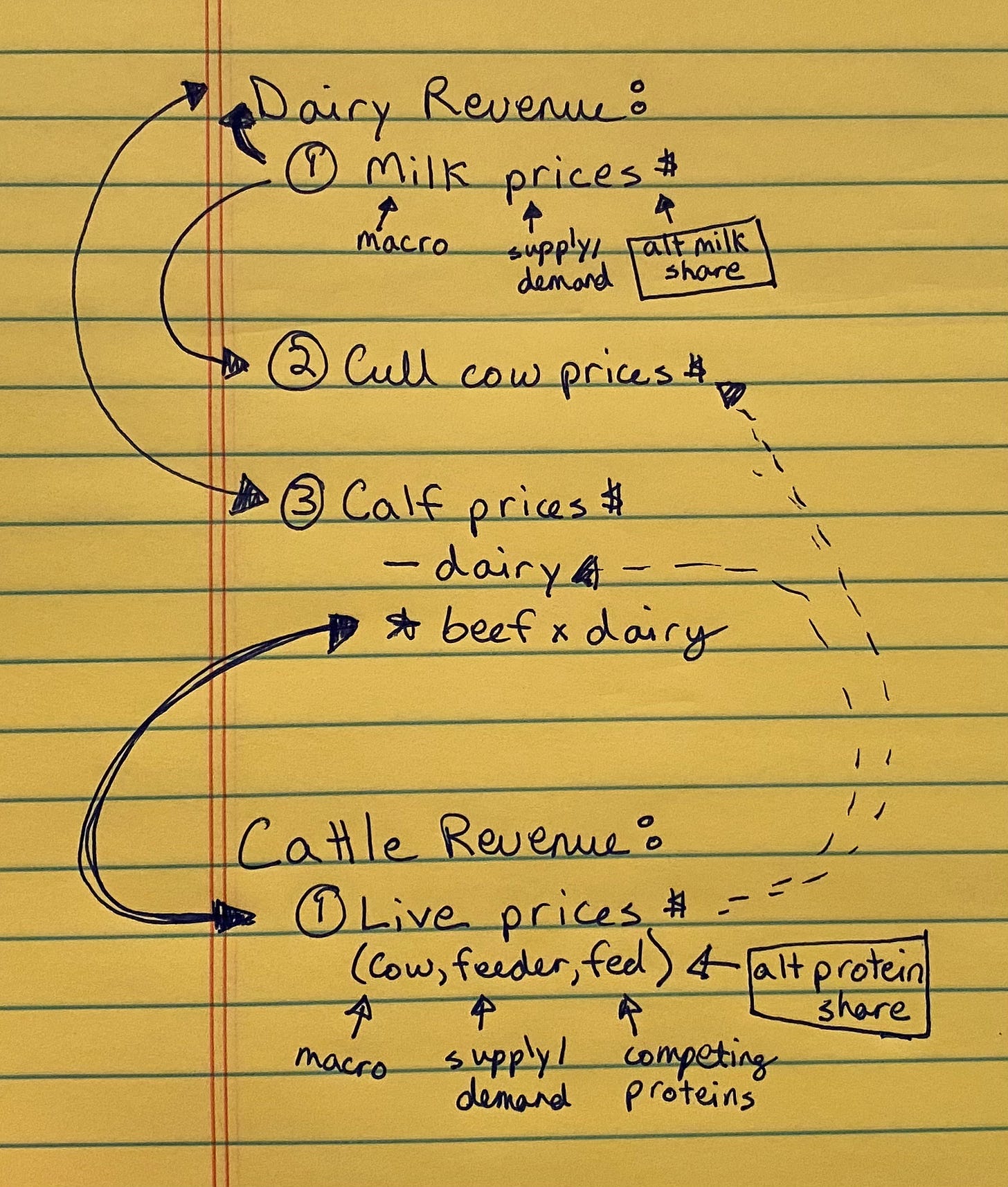
How do alternative milks & alternative meats fit with our ‘beef on dairy’ series?

Kinda like this:

This is obviously a wildly oversimplified drawing of wildly complex markets. Pricing for beef, pork, chicken, eggs, and milk have always been dynamic. These are competitive, commodity driven markets with so many interdependencies with macro factors and grain markets and processing capacity and export markets, and, and.

Alternative milks have captured up to 16% market share, depending on who you ask. Does that impact dairy milk prices? You betcha. Now what happens if something similar happens in meat over the next 3-10 years, will it impact meat prices? You betcha. I put a square around both of them above because they are x factors moving forwards, unknownslet’s ignore those who speak with certainty about the future (in either direction) and assume the impact will fall somewhere between ‘zero’ and ‘destruction’.

Market share for alternative milk has been a driver of milk prices, and market share for alternative meat could become a driver of meat prices…but what if market share for alternative milk becomes an indirect driver of meat prices and market share of alternative meat becomes an indirect driver of milk prices. 🤯

What is the increasing link between beef and dairy? The increasing supply of beef-dairy crosses flowing from dairy producers into the beef value chain.

I suppose the potential mega trend is that protein markets could get even messier with more x factors:

  • What happens to beef prices when a rancher generates more revenue selling carbon credits than selling weaned calves?
  • What happens to infrastructure heavy industries with super high asset specificity when the fickleness of consumer fads bears down in unpredictable ways?
  • What happens to dairy profitability when plant based ground chicken gets traction?
  • What happens to the broader animal protein industry when the ethanol mandate disappears? increases?
  • What happens to cattle feeder profitability when plant based milk loses market share?

I think I’m with Bezos:

It’s important to ask what will change in 10 years; it’s critical to ask what will stay the same.

Kick this to the nuanced thinkers in your network to see what they’d add to this discussion:


ICYM the ‘beef on dairy’ series so far

  1. If dairy is the new beef, are cow-calf producers necessary? (link)
  2. If dairy is the new beef, what are the dairy drivers? (link)
  3. 💡3 reasons why dairy is the new beef (link)

GET THE BEEF-ON-DAIRY EBOOK 🐄


I’m interested in all things technology, innovation, and every link in the animal protein value chain. I grew up on a farm in Arizona, spent my early career with Elanco, Cargill, & McDonald’s before moving into the world of early stage Agtech startups.

I’m currently on the Merck Animal Health Ventures team. Prime Future is where I learn out loud. It represents my personal views only, which are subject to change…’strong convictions, loosely held’.

Thanks for being here,

Janette Barnard

Categories
Business Model Innovation Genetics

Prime Future 65: 💡3 reasons why dairy is the new beef

First we looked at how the ‘beef on dairy’ genetics strategy will impact cow-calf producersSpoiler alert: not much, mathematically speaking.

Then we looked at what’s driving this beef on dairy thing from the dairy producers POVtldr: its complicated.

I’ve been exploring the implications for cattle feeders, packers, and retailers and next week we’ll talk about those. But first I have to share 3 big aha’s that have jumped out as potential beef industry game changers…here we go.

(1) Beef is better, right? …right??

I started this series with an assumption that beef breeds create better beef carcasses than dairy breeds, or dairy x beef crossbreds. (It seems reasonable, doesn’t it?)

But here’s the surprising little secret: Beef x Dairy cross carcasses are as good or better than straight beef carcasses, or ‘natives’ as the people say.

Texas Tech recently published trials looking at how beef-dairy crosses perform in feedyards and in the plant, and my takeaway was that beef-dairy can increase total pounds without sacrificing quality grades, when managed correctly. That’s a big deal. Imagine being able to sell 100 additional pounds of meat per animal with minimal yield impact.

Someone framed it this way: milk production and red meat yield are antagonistic traits and tend to move in opposition directions, while marbling and milk production are complementary traits and tend to go hand in hand.  The beef on dairy genetics jigsaw puzzle allows dairy producers to make decisions that get the best of beef and dairy breeds, to use ‘elite terminally focused genetics’ on the beef side that offset the dairy deficiencies. For example, one variation on a beef on dairy program might be to use Limousine sire genetics (high red meat yield) on Jersey females (high marbling). All breed genetics are not the same, that’s just one example of how the jigsaw puzzle can be put together.

It’s how dairy producers thread the needle to keep the best of dairy genetics so milk production isn’t negatively impacted one ounce (which would be a complete deal breaker for dairies, obvs), while driving towards carcasses that have zero hint of dairy’ness to them and are therefore just as valuable as carcasses from beef genetics.

(2) Consistency is the name of the beef on dairy game

There are 3 elements of consistency that beef on dairy can offer to the beef value chain:

  • Year round continuous supply of calves to the feedyard, and then to the plant.
  • Genetic consistency given how narrow the genetic base of dairy cattle are since AI has been used so widely for so long.
  • Management consistency – while a beef animal could move through 2-3 sale barns between weaning and arriving at the feedyard, beef-dairy crosses are much less likely to go through a sale barn at all. They’re more likely to move in large lots from calf ranch to grow yard to feedyard, or directly from calf ranch to feedyard with consistent management in each phase.

The US beef industry has been wildly successful at increasing consistency of meat so that the consumer experience is what the consumer expects, every time. And yet, there is still a lot of variability in genetics and production systems and feeding and management and, and, and. With 800k+ cow-calf producers and animals changing hands multiple times, high variability is somewhat of a given.

But beef dairy crosses offer the exact opposite of fragmented traditional beef production. This segment offers a hyper consistency of product which can only be net positive for processors, retailers, and consumer eating experience…which is net positive for all players upstream.

(3) Max value capture requires aligned supply chains

Value is only value when it’s recognized by the buyer, in this case the packer. The value chasm is wide between a dairy animal and a beef animal, so the challenge for beef-dairy animals is to get them priced like a native. One producer said it this way, “packers are looking for a reason to price a beef-dairy cross like a dairy animal. You have to get the animals on a grid to get a base price where it should be.”

The beef-dairy value equation is driven by the price the packer is willing to pay; the value of the animal to the packer determines the value of the animal when it first hits the ground. If the packer doesn’t recognize the value of a beef-dairy carcass, then the beef on dairy strategy doesn’t pencil out for the dairy producer.

Capturing full value of the beef-dairy animal requires closely aligned partnerships all the way through the value chain to the packer. Aka aligned supply chains or coordinated supply chains. Prime Future readers who have been around for a while know I have a borderline obsession with how aligned supply chains can create better outcomes for producers and consumers. We’ve talked about them here and here, with this key idea:

“Traceability is meaningless until somebody will pay for it. The industry has thrown around the t word for at least a decade with extremely limited success in finding the right use case & corresponding business case. Like all innovations, until the right business case surfaces it’ll never happen. However, coordinated supply chains likely are the business case that supports traceability particularly when the data flows in both directions so producers get better feedback on how animals perform in the feedyard/plant, and consumers get relevant cues about how the animal was produced.”

But beef on dairy looks like it just miiight be the breakthrough use case to drive supply chain alignment and as a byproduct, traceability.

For dairy producers to maximize the value of beef-dairy crosses, dairy producers have to create supply chain partnerships for the long term where everyone involved is incentivized to ‘stick with it’ in order to create a consistent system, and to mature the whole system over time. (one of my other favorite ideas is playing long term games with long term people – traditional transactional won’t work here!)

Will it be surprising if Dairy Beef aligned supply chains grow and consolidate over time to find the efficiencies of scale without the capital intensity of true vertical integration? Not at all, that’s the nature of the agriculture game.

So there they are, the 3 ideas that make beef-on-dairy shine:

  1. Beef x Dairy cross carcasses are as good or better than straight beef carcasses. (Think of it as having your cake and eating it too, but ya know, beef.)
  2. Beef-dairy crosses hold a consistency advantage over the traditional fragmented beef value chain.
  3. Beef-dairy cross value chains are forcing new partnerships in order to capture full value at the packer level.

Which is all fine and well, until we come back to the math of beef on dairy. If we are really only talking about 5M calves annually, out of 25 million total fed cattle, it raises the question of….so what?

What happens with 5M beef dairy crosses is interesting, but the really fun part will be seeing how the 5M could influence the 20M.

It’s almost like The Innovators Dilemma, but at an industry level. Here’s my short summary of The Innovator’s Dilemma:

“When big companies are disrupted by upstarts, many assume it was because the big co didn’t see what the upstart saw, e.g. Kodak, Blockbuster. But author Dr. Clayton Christenson argues that big companies see the early trends just fine, they just are not positioned, structured, or incentivized to act on early trends. Leaders at established companies have to focus on market share and profitability of today’s largest customers. This is rational behavior. But it also makes it easy for incumbents to miss emerging trends.”

Here’s a recent take on that idea:

“The reason big new things sneak by incumbents is that the next big thing always starts out being dismissed as a “toy.” This is one of the main insights of Clay Christensen’s “disruptive technology” theory. This theory starts with the observation that technologies tend to get better at a faster rate than users’ needs increase. From this simple insight follows all kinds of interesting conclusions about how markets and products change over time. Disruptive technologies are dismissed as toys because when they are first launched they “undershoot” user needs. The first telephone could only carry voices a mile or two. The leading telco of the time, Western Union, passed on acquiring the phone because they didn’t see how it could possibly be useful to businesses and railroads – their primary customers.”

Now read that paragraph again but where it says ‘toy’ insert ‘just beef-dairy crosses which is a tiny fraction of the beef supply, no worries’.

Imagine that cattle feeders and packers and retailers get used to all those benefits mentioned above that are inherent to the beef x dairy value chain. Now use an exceptionally limited amount of imagination to picture those expectations bleeding over into the other 80% of beef, the natives. Not much imagination required, huh?

The unknown is how the beef value chain will respond and how long it will take to catch up & recreate the rapidly accelerating advantages of the beef on dairy value chain. Is this a 30 year dynamic or a 5 year dynamic? TBD.

Perhaps beef on dairy is to beef what ABF chicken was to the US chicken industry 5-7 years ago when it was still a tiny percentage, before the tiny percentage influenced the majority. Without a doubt, there are new emerging trends in pork and poultry…maybe not as clearly emerging as beef on dairy yet, but emerging nonetheless. What are those emerging trends you see?


Get the beef-on-dairy ebook 🐄


Total Addressable Market (TAM) for Beef on Dairy (updated)

  • The US dairy industry has been steady state for a while at 9.4M dairy cows.
  • If the herd turnover rate is closer to 40%, then we need 3.76 million replacement heifers annually.
  • But…..there’s another number here, ‘return to replacement’ which is what % of heifers born intended to be replacements actually go back into the herd. If that number is closer to 80%, then the industry really needs 4.7 million heifers to be born annually.
  • Assuming replacement heifers are created via sexed dairy semen and the remaining calves born annually will be bred to beef genetics for a beef dairy cross calf, that means the upward limit on cross calves is 4.7 million. Let's call it 5 million just for a clean number.
  • And though it ranges, let’s use the number 25 million cattle fed on feedyards annually. So beef on dairy as a percent of total fed cattle looks like it will max out at 20%, at least in the US industry.

Beef on dairy TAM = ~5M beef x dairy calves out of ~25M total fed cattle


I’m interested in all things technology, innovation, and every element of the animal protein value chain. I grew up on a farm in Arizona, spent my early career with Elanco, Cargill, & McDonald’s before moving into the world of early stage Agtech startups.

I’m currently on the Merck Animal Health Ventures team. Prime Future is where I learn out loud. It represents my personal views only, which are subject to change…’strong convictions, loosely held’.

Thanks for being here,

Janette Barnard

Categories
Business Model Innovation Leadership

Prime Future 61: Egos & incentives

Sometimes in the B2B world it’s easy to assume business decisions are driven solely by an ROI calculation, neatly tied with an Excel bow around a carefully curated formula. Or in the farm world, that every decision is justified by the output of the almighty shirt pocket calculator.

But in the real world, rarely can an ROI be fully captured numerically. Other factors impact decisions, including the psychological factors. I summarize this as Egos & Incentives.

Numerical ROI is necessary, but it’s not sufficient. At the margin, decisions are made based on their impact to our egos and incentives, including decisions about adopting new products, practices or ideas:

  • Incentives: How does this help me achieve what I’m incentivized to achieve, what I want to achieve?
  • Egos: How does this impact my view of myself and my place in the world, aka my ego?

We’re all out here responding to incentives, intentionally or unintentionally, doing the things to get the job, the bonus, the contract, the new customer, the promotion, the upsell, the renewal, the fill in the blank. And no surprise, we all have egos. Every last one of us, even those who say they don’t (perhaps especially those). The advertising industry is built around these fundamental truths of human nature.

And though it can be framed at an individual level, I believe it’s just as true at an organizational level because, of course, organizations are just big groups of individuals, still responding to egos and incentives.

Sarah Nolet & Matthew Pryor, partners in Tenacious Ventures, described this dynamic in the context of agtech adoption quite elegantly:

“The wine industry presents an illustrative example. Wine makers often contract the growing of some or all of their grapes to other growers. This makes sense to get to scale and mitigate risk, but this distributed production method poses serious challenges for managing the cost and quality of wine making. Despite the fact that good tools are available to assess grape quality and yield as harvest approaches, individual growers are not likely to take them up as the ROI for their business is not strong enough. For the wine maker, though, these tools are invaluable: over supply, under supply, and poor grape quality all have major financial implications for winemakers. In other words, though the growers are the users, the real beneficiary is the winemaker. Therefore, until winemakers create incentives, and perhaps even supply the tools directly to the growers, growers are unlikely to adopt and the benefits from far greater visibility of the yield and quality of the coming harvest will remain unrealized.

Another notable characteristic of agtech 1.0 was that as this dynamic played out again and again, agtech companies (and their investors) blamed the farmers! Agtech conferences and industry reports featured claims about “laggards,” pointing fingers at the users for being “traditional” and “resistant to change” in an industry “based on handshakes.” In reality, the problems were with business models and incentive alignment.”

Their example describes the exact dynamic that trips up so many technology creators in livestock. The sentiment from creators goes something like this: ‘We made this widget for producers that is really beneficial to everyone but only kinda to the producer. Also we built our business model so the producer pays for the product and the rest of the value chain gets the value. Also also it’s SO weird how producers aren’t interested in our technology, what laggards🙄.’

The fundamental question to ask about new products is, where does value accrue and where is cost incurred?  If the packer accrues the value but the producer incurs the cost, well….that’s probably not going to go well because incentives are not aligned. The challenge of incentive alignment is why business model innovation can be just as high impact as tech innovation, if not more so.

This dynamic extends from adoption of new products to adoption of new practices. Silver Fern Farms, New Zealand’s largest meat processor, recently announced their planned launch of Net Zero Carbon Beef. The most interesting part of the story was this little line:

“Silver Fern Farms is committed to supporting our farmers to contribute to these goals, through knowledge transfer and market-led incentives"

Did you catch that phrase missing from most announcements around carbon/sustainability/any type of change requested of a supply chain?

Market-led incentives.

I asked Nick Rowe, Innovation Manager at Silver Fern Farms, for some background on the program. Here’s what he said:

“When we derive an in-market premium we will share that value with the supply chain (consumers, customers and farmers) on our path to a regenerative future. Without the incentive, it’s hard to drive change. People won’t change the way they do things unless they are incentivized to do so. We are launching net zero carbon beef that makes sense commercially.”

That is the most effective model to drive behavior change in a supply chain, regardless of the behavior.

All that said, what ARE producer’s incentives? The universal incentives are around generating revenue, increasing pounds or increasing $/lb, maintaining a customer, growing market share, etc but of course every individual producer has unique incentives and is prioritizing those incentives in a unique way. Related: feeding the world is not on anyone’s incentives bingo card, neither is curbing climate change or any other macro good. That’s why those macro problems have to be broken down to specific problems for specific someones, or specific incentives for specific someones.

Which brings us to ego. In agtech where ego can become a road blocker is around decision support tools. IMO these are some of the most challenging products to sell because in order for the product to be high value, it has to support high value decisions. And high value decisions tend to be high risk decisions. And high risk decisions tend to be deeply personal, whether a decision to sell a 1 billion bushels of corn or 10 weaned calves.

ICYMI Prime Future

The 2 most soul crushing words an innovator can hear 😳
You describe a concept for a tech solution to a prospective customer or show them an early version of the product. What’s the worst response you could get? “That’s interesting.” It would be better to have a full cup of lukewarm coffee thrown in your face so at least you know definitively that you need to go back to the whiteboard. An enthusiastic YES or…

Read more

Excerpt from 👆🏼 this piece:

I once asked a feed yard manager if this (when to sell cattle) was a decision where analytics could help drive a more precise & profitable decision. His reply was “probably not, we’re good at this decision.” I asked how they know if they made the optimally timed decision and he replied “well, did we make money?”

And THAT is the fatal trap for any analytics product. If there’s no control to compare against, how does the user know what money has been left on the table? If the opportunity cost is undefined, how does the prospective user determine if an analytics tool makes them any better at making the difficult decisions than the hard earned insights from the school of hard knocks? The burden of proof rests on the innovator.

That excerpt describes the value proposition challenge for decision support tools, but in my experience there are always ego impacts to consider – whether it’s the software tool to help asset managers make better trading decisions or the software tool to help the crop farmer determine the optimal time to irrigate. The ego objections are usually some variations around relevance (does this tool make me or my hard won insights less important in the world?) and skill (how will my team build their hard won insights if they have tools to help them?). (Though the skill objection is like people back in the day worrying that kids will get worse at math if they use a calculator.)

Creators of decision support tools have to take into account the ego considerations in everything from product design to marketing.

Here’s the second part of Nick’s comments that struck me:

“Net zero carbon beef is really an extension of our journey to provide consumers with branded meat they can trust is better for them and ultimately the planet – it was the natural next step. When something is hard and we don’t have all the answers it takes people with a pioneering ethos and a company that is not scared of leading, to take charge and drive change.”

Yes, “we’ve always done it this way” is real and maybe it is more prevalent in ag than other industries – though I’m not entirely convinced that’s true. But the forward thinking, innovating early adopters are also real. And the burden of adoption rests on the creators of new products and the food companies who want to drive new practices to make their value proposition relevant by accounting not just for ROI, but also for egos + incentives.

P.S. If you like thinking about the traps around how businesses or industries structure incentives, then you’ll love this piece from The Hustle.

P.P.S. This:


Welcome to those of you who are new to Prime Future! Many of you found this newsletter through Shane Thomas and his newsletter, Upstream Ag Insights. I highly recommend subscribing to Upstream Ag Insights if you don’t already – he writes on all things agtech on the crop side of the industry with a lens on agribusiness strategy.


I’m interested in all things technology, innovation, and every element of the animal protein value chain. I grew up on a farm in Arizona, spent my early career with Elanco, Cargill, & McDonald’s before moving into the world of early stage startups.

I’m currently on the Merck Animal Health Ventures team. Prime Future is where I learn out loud. It represents my personal views only, which are subject to change…’strong convictions, loosely held’.

Thanks for being here,

Janette Barnard


Categories
Business Model Innovation Meat

Prime Future 57: The packers get Standard Oil’d. Then what?

This is neither political commentary or prediction. This is a look at the hypothetical implications of a hypothetical scenario that has a zero percent chance of happening.


If an oligopoly market is when 4 firms have 50+ percent share, then US beef, pork, and poultry are undeniable oligopolies. These concentrated markets aren’t uncommon though, we run into them from cereal (Kellogg’s, General Mills, Post, and Quaker) to cell phones (Apple, Samsung, Huawei).

But these examples are child’s play compared to the most extreme example of market power: the classic story of Standard Oil. In the 1880’s, John D. Rockefeller realized the oil business was a fantastic business except for the nagging issue of price volatility. So he found a solution to that little problem, by developing an effective monopoly through the Standard Oil trust. A Supreme Court ruling in 1911 forced the trust to split into 34 companies to increase market competition.

The current rally cry of many US producers is that the problem with the cattle business is concentration among the packers. This is not new; tale as old as time. But carry that rally cry out to the most extreme outcome of de-concentrating processing capacity….what does it really solve?

Just for fun, let’s say the DOJ goes full 1911 and ‘Standard Oils’ the meat industry.

Every plant becomes its own company.

The ‘Big 4’ become the ‘Midsize 22’.

Then what? Before we lock into any hypotheses about a re-fragmented meat industry, what was the result of busting the Standard Oil trust?

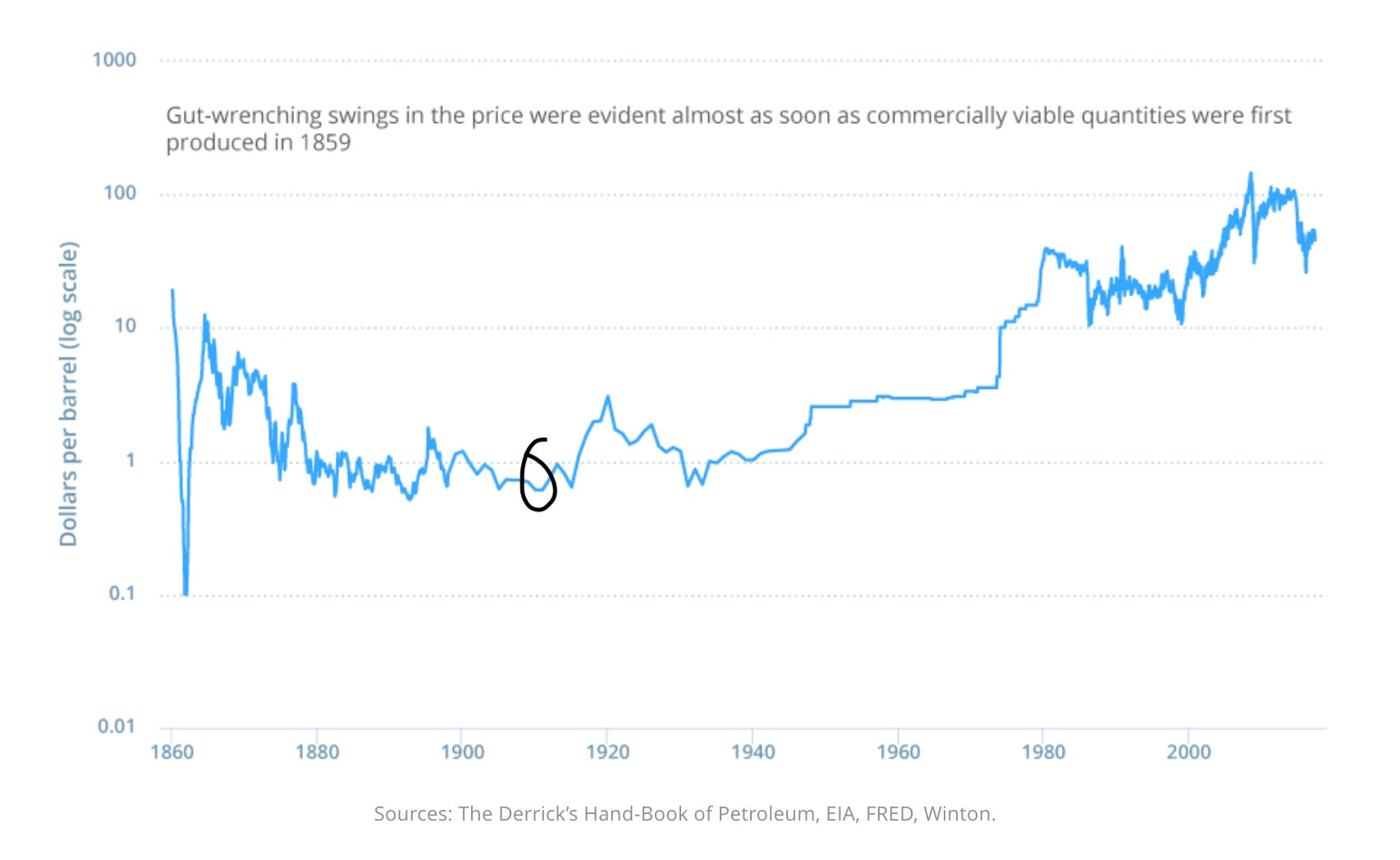
Keep in mind that also around 1911 the rise in automobiles meant gasoline (previously a worthless byproduct) was suddenly worth more than kerosene, and that other regions of the world began producing oil competitively so the entire oil market was shifting as Standard Oil was split. Here’s a snapshot of oil prices before and after:

So the Standard Oil trust was busted and then prices went…up? While there are clearly more factors at play than we’ll dig into here, my takeaway from this chart is that this whole scenario is not as straight forward as anyone would like it to be. There are a lot of factors at play; markets are dynamic and impacted by all the things from pandemics to stimulus programs to weather.

The livestock & meat industry’s common hypothesis is that if the packers were less concentrated, then market power would ‘return’ to feedyards & producers upstream and downstream customers in foodservice/retail. It would ‘free up margin’ by taking away the packer’s pricing power on the buy and sell side. Econ 101.

But is reality as clean as an econ textbook? Are we *certain* that the net effect of increasing packer competition would definitively be positive for the rest of the value chain?

The 2 dimensions I’m interested in are price (purchasing live cattle, selling boxed beef) and innovation (finding new ways to better serve customers & end consumers).

Let’s start with downstream. What would the implications be for further processors, retailers, foodservice, and end consumers?

Price: Packers sell to further processors, distributors, retail and foodservice…segments that also happen to be highly concentrated. Let’s say a national retailer like Walmart who sells ~20% of US retail beef today buys from 1 or 2 companies. Each supplier has multiple plants that service multiple Walmart distribution centers with multiple SKU’s at tailored specs. Plants have become specialized with specific programs or specific customers. The big processors were able to flex reasonably well as COVID shut down foodservice because of diversification of channels across plants – individual plants didn’t have that diversification.

In a Standard Oil trust busted world, is a national retailer now going to work with 10 independent plants that are each independent suppliers? What does that do the retailers ability to keep meat cases full with homogenous supply of fresh meat at spec? Big companies like to deal with big companies that can handle big business. What does that increased friction in the whole process do to the price of meat at retail? On the other hand, what would increased competition among packers do to the price of meat for retailers?

Innovation: A key rationale for minimizing oligopoly or monopoly markets is that competition leads to innovation. Agree, of course. But you know what else leads to innovation? Resources. What is the optimal mix of incentive to innovate and resources to innovate as a function of market power? I don’t know. But low margin businesses without scale don’t tend to be fountains of innovation.

Innovation = Incentive + Resources

Then let’s look upstream. What would the implications be for cow-calf producers and feedyards?

  • Price: Cow-calf producers don’t sell to packers, they sell to sale barns or stockers or feedyards. The feed yard space is way less concentrated than processing but way more concentrated than cow-calf. Say feedyards have more pricing power if packers are split up….does that trickle up to cow-calf producers or does it just mean feedyards are the new margin sinkhole of the beef supply chain?
  • Innovation: Let’s say more of the total value chain margin stays upstream. Maybe that leaves some financial wiggle room to focus on things besides survival So do producers start thinking about things consumers are talking about like carbon footprint? I don’t think so. Not unless the incentive structure changes and packers pay more to feedyards who pay more for calves that are raised a certain way at the cow-calf operation.

A complicating factor is that even if you increase processing competition nationally, it does not necessarily mean you increase competition regionally.

And if packers cannot consolidate processing capacity, would the result be more vertical integration in an attempt to consolidate supply chain control?

An obvious factor that makes meat processing different from cereal is that it’s a capital intensive business so barriers to entry are high, really high. It’s an economies of scale business, so it’s a business that ‘wants’ to be consolidated to chase more economies of scale.

But even if the US government regulated away processor’s ability to consolidate, what would that mean for the US industry’s ability to compete against emerging regions? The world’s largest hog farm was recently built in China for 84,000 sows to produce 2.1 million hogs annually….wouldn’t it stand to reason that the world’s largest processing plant(s) will soon follow?

Would a Standard Oil’ing of meat packing be good for downstream players? Maybe, in the short run. Probably not in the long run.

Would a Standard Oil’ing of meat packing be good for upstream players? Maybe, in the short run.

But what’s not good for downstream players in the long run cannot be good for upstream players in the long run.

Hear me loud & clear that profitability at all stages of the value chain is the #1 foundation of a viable cattle industry. Increasing margin capture throughout the value chain is a good thing, a great thing. But is reducing packer power the panacea that people often describe it as? I may be wrong, but I just don’t think it is.

Maybe looking at impact of competition on pricing power & innovation is the wrong framework….maybe higher margins don’t lead to innovation, maybe innovation leads to higher margins.

Are oligopolies good or bad? Should the big 4 be broken up? Irrelevant questions.

The actionable question is, how do you win when you buy from or sell to an oligopoly marketplace? Control the control-ables and innovate the innovate-able.

At the end of the day, animal protein is a commodity driven business. And what do commodity markets do? They move in cycles. Sometimes tree growers profit, sometimes lumber mills profit. Sometimes the cow-calf producer wins, sometimes the packer wins. Sometimes dairy producers make hand over fist, sometimes processors do. Sometimes oil drillers print money, sometimes refineries do.

‘your margin is our opportunity’

Look at other industries where big companies in one segment of a value chain amassed market share and then stopped innovating. Think IBM in the 80’s. You know what happened when those companies got satisfied with their market share and stopped innovating? Apple. Microsoft. Dell. A resurgence of insurgents jumped in with new innovation that captured market share…and then those ‘new’ tech companies get big and face their own anti-trust scrutiny. It’s almost like everything is a cycle and the cycle is what creates opportunity…

You could easily argue that type of insurgency is what upstarts like Cooks Venture or Shenandoah Valley Organic could be in the US poultry business.

Carl Lippert recently summed this up well in his article The Farm Barbell,

“The future of agriculture is large farms producing commodities and small farms creating value added products.”

That’s true for producers AND for processors.

The only way to stay in a commodity driven business AND get out of the trappings of commodity cycles is to build a competitive moat, to pursue value added markets. That’s also true for producers AND for processors. We’ve talked about this before:

The livestock & poultry industry has spent decades driving cost out of animal production systems to increase profit. And we’ve done it well. Really well. More pounds per animal. Less feed per pound of gain. Least cost feed formulation. Increased efficiency.

And yet, we see record high number of farm bankruptcies, near record low farm income, and volatile train wrecks of milk, live cattle and hog markets the last 6 months. All of which point to revenue challenges in animal agriculture.

Commodity production is an existence governed by a ruthlessly brutal dictator: The Market. It’s time to focus on enabling livestock producers to increase Revenue, to escape the commodity game that’s ruled the industry, to differentiate.

The punchline of Lippert’s article sums up the implications of this whole discussion for startups in animal ag:

“Startups should build penny shaving machines for scaled farms and margin capture machines for small farms.”

Yes.

(For more on the Standard Oil saga, I highly recommend the book Titan by Ron Chernow.)


Livestock Market Transparency is Possible. Here’s how. (link)

On a related note, this piece was written at the height of 2020’s chaos:

Pricing is a hot topic in light of live cattle and boxed beef prices heading in opposite directions, and the same dynamic to a lesser extreme in pork. These pandemic market dynamics highlight the need for improved price discovery and market transparency across the entire meat, poultry, and livestock sector. These are great problems for technology to solve. Here’s why: (link)


Prime Future is a weekly newsletter that allows me to learn out loud. I’m on the Merck Animal Health Ventures team. Prime Future represents my personal views only.


Categories
Business Model Innovation Meat

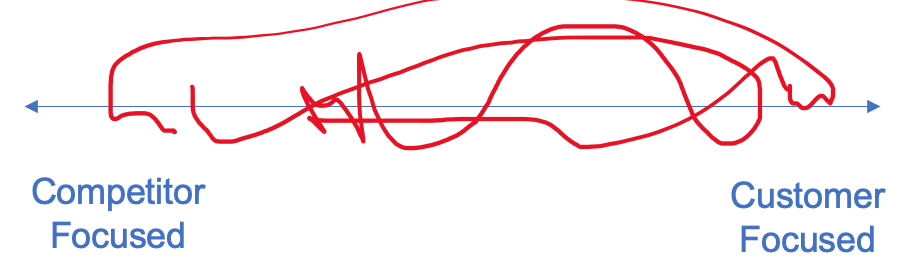
Prime Future 55: Two masters: customer or competitor focused?

“The US meat industry has been able to focus on high volume low complexity production, but Europe is different. There is more complexity built in with more SKUs and smaller volume runs in factories. This is because of fundamental differences in how Americans shop and eat, and how Europeans do. Food culture is entirely different between the two. While American consumers have an expectation for homogeneity and in many cases are happy to find the same offering at every retailer, that is not an acceptable retail model in Europe. There are a variety of food cultures within Europe that retailers are serving, and further processors like OSI must reflect this.”

– Nicole Johnson-Hoffman, OSI Managing Director – Europe Further Processing & Chief Sustainability Officer

Nicole spent much of her career in the North America meat business and is now with OSI Europe. I reached out to ask about her learnings around the differences & similarities between the two regions. Keep that quote in mind as we dive into today’s topic…


Walk into the office of almost any packer or integrator (in North America) and you’ll see a poster on the wall about the company’s values. Almost always it includes something along the lines of “customer focus”.

Walk into almost any management meeting at those same companies and you’re likely to hear a discussion centered around benchmarking the company’s performance relative to competitors. Especially in poultry, where the blue book reigns supreme (if you know you know).

So which is it, is the company focused on customers or competitors?

More importantly, can a business effectively focus on both?

The book Invent and Wander led me down the rabbit hole of 20+ years of Jeff Bezos’  annual letter to shareholders. First of all, the consistency of philosophy from 1997 to 2020 is uncanny. The manifestation of the philosophy has expanded over time, but the elements of the vision have remained consistent. Granted, Amazon had the same CEO over that time while most companies see more frequent leadership changes. But what other large, or high growth, company has stayed committed to the same principles over 20+ years? The whats have changed, the hows have remained the same…and its hard to argue with the results.

One of the single most consistent theme from 20 years of Bezos’ writing is the idea of focusing on the customer more than the competitor.

Which made me wonder what application that idea has across livestock, meat & dairy.

I want to acknowledge the obvious rebuttal to this train of thought which sounds something like “but Amazon was not playing in a highly competitive commodity market like most livestock & poultry producers & processors.”

Except the entire Amazon business model was built around lower prices and better selection than competitors. They of course started with books – the same books offered in any other book store. Aren’t the hallmarks of a commodity market 1) competing on the dimension of price, and 2) an undifferentiated product? So the argument could be made that Amazon actually proved its model in a pseudo commodity market.

Of course ‘customer focus’ doesn’t mean that happenings at Walmart or Jet.com or Costco or Facebook Marketplace weren’t of interest to Amazon leadership. But did every management meeting center around a comparison to competitors for the week prior? I’m guessing not…

There’s a difference in aligning the management of your business around how competitors are performing, versus being informed and appropriately calibrated to the context you operate in. Let’s call the latter being ‘competitor aware’. That’s basic blocking and tackling of running a business. The question is where do you focus. The definition of focus is literally ‘the center of interest or activity.’

Competitor-focus looks like management by industry benchmarking and incremental advances within an existing model.
Customer-focus looks like continual progress: new products, new markets, new business lines, new business models.

It makes intuitive sense; we tend to go where we focus, as individuals, as organizations, and as industries. That’s why I find Nicole’s insights above so terribly fascinating. There’s this entire industry orientation that factors in. Nicole also pointed out:

“The European market is complicated in different ways than North America. The great joy of the meat industry is that it’s a system. You can’t work one part of the system in isolation, you have to work the whole system to accomplish big goals. People with intellectual curiosity gravitate to the meat industry because there are no simple answers.”

The meat industry on both sides of the pond are led by smart people running complex systems (companies) that make money. And within North America’s high throughput & efficiency driven business there are customer led companies just as (I assume) within Europe’s customer led business there are competitor focused companies.

Two big ideas:

(1) In reality, there’s probably a continuum from competitor focused to customer focused. Not only are organizations moving along the continuum at any given point of time, teams within the org are doing so. And leaders at all levels are pushing/pulling in one direction or the other. And some customers are dragging suppliers to their end of the continuum while that one competitor with 10% lower COGS is dragging the supplier to the competitor end of the continuum. It’s messy & dynamic & always in flux.

(Look for this graphic in a best selling business book near you, probably)

And its difficult! A packing plant manager in the US put it this way, “I think about it as trying to serve two masters. Which is actually impossible to do but meat companies have to try.”

(2) The strategic choice of where to focus is central to the whole system, the whole business model.

Because it’s not just about business model. Or management style. It’s also about culture. My takeaway from the book on Amazon is how Bezos drove that customer focus principle throughout the organization. In order to be part of the culture it had to become a discipline, to be an idea that consistently led to results it had to be consistently actionable.

So what does customer focus look like?

  • Really understanding customer priorities & aligning internal priorities accordingly.
  • Incentivizing people on outcomes that impact customers, not incentivizing results relative to competitors.
  • Understanding the customer’s business holistically. If every company can be split into 3 parts (Make, Buy, Sell), do you just know the function you interact with or do you understand how all 3 work together and the levers that move the entire business?
  • Continually getting ‘clean water’, talking with customers to understand current experience rather than relying on old assumptions. Asking questions….sometimes when you know the answer, sometimes when you don’t. This is NOT asking the customer what they want; customers don’t (usually) know what they want….but they (usually) know what problems they want solved.
  • The capability to test new concepts, gather feedback from customers, iterate. Repeat.

While I was at Texas A&M, Southwest CEO Gary Kelly spoke on campus and someone asked him if he was worried about moves being made by Southwest’s competitors. He replied, “Have you seen these clowns? If we can’t beat them we deserve to lose. We’re focused on making customers happy.” (Regardless of how much of that was bravado, as a frequent flier I found it pretty funny.)

Although IMO one path tends to be more compelling than the other, maybe it doesn’t matter whether you are competitor focused or customer focused, as long as it works for your company in your market context. Maybe the real trap is to believe you are customer focused but actually be competitor focused….or the deadly option, internal focused.

Share this with a colleague or 4 to spark some healthy debate 🙃


Wisdom of the Crowd

From last week:

AI became standard in US swine breeding in the early 90’s. It had been around for decades prior but not widely used. What changed? Why did it suddenly become standard practice?

Shamus Brown shared this fascinating article and some comments on the dynamics around why pig production was scaling up so rapidly in the 90’s, “product quality and consistency were key to scale, and you needed consistent genetics through a consistent program (management) to get there.” There are some takeaways about tech adoption here, stay tuned…

Question for this week:

What will be the long term implications of genomics?

Hit reply to this email or click the bubble at the top of this to leave a comment.


Context

The Morning Brew speculated that inflation and increased meat prices might even impact the virtually unchangeable $5 rotisserie chicken at Costco. That’s saying something – that $5 chicken has been part of the core grocery strategy for years and has historically remained unchanged even when chicken prices skyrocket. It’s centrality to the strategy is also why Costco is now in the chicken business. (link)

Speaking of Costco, check out Rhishi Pethe’s interview with an executive from Pinduoduo. ‘Pinduoduo is an e-commerce retailer in China which focuses on agricultural products, and has shown a mind-boggling growth trajectory. PDD describes itself as “Costco meets Disney.”’ (link)

This WSJ article is interesting not just because of the emerging category of tech startups working to identify the sex of chickens in ovo, but because the framing via the headline “A technology race to stop the mass killing of baby chicks” is…something. (link)

Jayson Lusk highlighted 9 dynamics that could impact pork supply chains in coming years. Prime Future has highlighted some of these, and this is a great summary list. Numbers 4, 6, 8, and 9 are my bets for high impact. (link)


Prime Future is where I learn out loud about the big dynamics around livestock & meat. I’m on the Merck Animal Health Ventures team but this newsletter represents my personal views only.


Categories
Animal AgTech Business Model Innovation Leadership

Prime Future 44: How to Decide

I was recently making a big decision between two good options, which led me to Annie Duke’s book How to Decide. Duke is a professional poker player turned behavioral decision scientist. One of the most profound ideas from the book is that of evaluating the outcomes of a decision separately from the decision making. Duke points out that we tend evaluate the quality of a decision based on its outcome: good outcome = good decision, bad outcome = bad decision.

But that correlation does not always hold. Sometimes a well informed decision results in terrible outcomes. Sometimes a rash, impulsive decision results in fantastic outcomes. Duke’s thesis is that we can only improve our decision making process when we separate the decision from the outcome, ideally leading to more decisions with better outcomes.

In the first chapter of Netflix founder Reed Hasting’s book No Rules Rules, Reed tells about sitting across from the management of then $6B Blockbuster and proposing they acquire Netflix for $50M. Blockbuster passed.

It is tempting to hear that story and lol at Blockbuster for not making the acquisition. How could they not have seen that their industry was changing? How could they have been so shortsighted to think brick & mortar was the future? How could they have underestimated Reed & his team, or the future of streaming?

With the benefit of hindsight, we know of course that Blockbuster is no longer and Netflix is currently valued at $241B.

But, did Blockbuster make the wrong decision? Did Carmax make the wrong decision?

Here’s why this is all connected: in a tech obsessed world, particularly in winner-take-all markets (which are fewer than we think, but that’s for another time), the pressure is immense to not be Blockbuster, to not be left behind, to not be the one that didn’t embrace the future. Outsiders love to point out how agriculture is the “least digitized sector” and assume this is because farmers are slow to embrace tech products. Are farmers simply tech averse as outsiders assume….or are farmers making rational risk/benefit decisions that are appropriate for their business context?

Because the truth is, not all tech or innovation decisions lead to good outcomes. Not all innovation is the next big thing. Not every upstart is the next Netflix. Some of it is simply the Segway, cool tech that never finds its use case so it remains a niche product for tech nerds. Some of it is….dare I say….smoke and mirrors. On the super rare occasion, it even turns out to be outright fraud like Theranos (highly recommend the book Bad Blood).

For business leaders, the decision making process is the controllable, the improvable. In all things, including deciding what innovation or tech or tech companies to bet on (whatever the nature of the bet) or what industry trend to capitalize on.

Have you ever noticed that the decisions that led to really bad or really good outcomes are the ones that get all the attention? But, how many exceptionally wise decisions have been made to pass on a product/company that turned out to be the correct decision, that are never known outside of those sitting in the conference room?

Those stories don’t make it on the front page of the Wall Street Journal or into an HBR case study but I expect we could learn a lot if they did.

Here’s how I think hindsight leads us to assess the decisions to bet on a tech company or pass on it, based on the outcomes of how impactive the innovation turned out to be:

Here’s the thing – with the benefit of hindsight we can point to poignant examples of decision outcomes that fit into every category in the above matrix, except for examples of the Unsung Hero. Good defense never gets the same hype as good offense, even though you need both to win.

I could be convinced otherwise, but I think this framework holds true for more than just tech. I think it applies to any new industry trend and decisions made about how to leverage the trend, or not. And again, these decisions get evaluated from the outside based on outcomes.

But there are SO many factors that effect outcomes of early stage companies & early stage technology, from the tech itself, to product design, to go-to-market strategy, to funding sources, to the macro-environment, to industry specific tailwinds or headwinds, to the leadership team, to the pricing model, and on and on and on. Which means, there are SO many factors that affect the outcomes of decisions around early stage tech companies & products. So the decision making process is the controllable.

The relevant question for decision makers of any kind, is how do you make more Obvious Genius & Unsung Hero decisions? I would suggest the following:

  • Make more small bets.
  • Do your due diligence (seriously, reading the book Bad Blood will give you motivation for this).
  • Create a rigorous – and iterative – decision process that you refine as you learn each time. Document your thought process before the decision is made so you can evaluate it in hindsight – most of us are terrible at remembering what we knew or did not know at the time of a decision.
  • Reject all or nothing thinking. Find ways to experiment on a small scale before making go-big-or-go-home type decisions.

My bias is that much of the risk to early stage companies can be mitigated when founders engage early and often in customer discovery, but engaging in that process can also be a way for future customers/partners to de-risk. The challenge for founders is finding the right prospective customers/partners who are willing to engage in the messy, iterative process of innovation. Not everyone wants to see how that sausage gets made.

Right now there are a lot of innovations being thrown at the meat & poultry value chain. With the benefit of hindsight what will be said about bets on…cultured meat? Plant automation? Regenerative ag? Carbon markets? Traceability? eCommerce & brand building? Individual animal management? 3D bio-printing meat? CRISPR?

Time will tell.

How do you improve your decision making process?

On a side note, I usually find that even when I sit down to write for execs at big companies, there are corollary applications for founders of startups and for producers. And vice versa. I hope this was true in today’s content.


Grab the Prime Future ebook (link)

Like what you’re reading? Get all 47 editions of Prime Future to date in one PDF.

Get the ebook!

Categories
Business Model Innovation

Prime Future 41: What if GroceryTech is the key to the future of meat?

Prime Future 41: What if GroceryTech is the key to the future of meat?

In 2018, Amazon quietly began piloting a new store format, Amazon Go. The premise was this: a shopper walks into the store, scans their Amazon Go app to be allowed through the turnstile, selects items off store shelves, and then walks out of the store. Seconds later, the shopper receives an email with receipt. That’s it.

The shopper just walks out.

How? According to The Verge, “Amazon Go stores use overhead cameras and computer vision technology to track both shoppers and items throughout the store. That way, the system can identify when a specific person has picked something off the shelf and placed it in their cart, and even when they decided to put something back.”

Two announcements by Amazon should catch the attention of primary and further processors:

  1. Amazon is now expanding the use of the technology into a larger grocery format at their new Go Grocery store in Seattle.
  2. More importantly, Amazon is now licensing the technology to other retailers. And branding the technology, cleverly, as Just Walk Out.

According to the Wall Street Journal, “Amazon hopes the grocery store will serve as a showcase for its technology as it seeks to sell its system to other businesses. The company has recently been in talks with potential partners and is targeting retail options including convenience stores and shops in airports and sports arenas, according to people familiar with the matter. Amazon has discussed multiple revenue models, including a fixed licensing fee or a revenue-sharing agreement, one of the people said.”

How could this impact the meat case, and the value chain of case ready plants and primary processing plants?

Three reasons this creates an inflection point in the retail value chain:

  1. Puts the consumer experience on the consumer’s termsIt lets them talk with a store employee when they want to do so, not because they have to in order to make the purchase. As consumers – all of us – continue down the path of customization options to buy when we want, how we want, and what we want, this is a big step in that direction for food retail. And on a related note, I expect this to dial up consumer expectations for the retail experience. How long will it be before checking out with an actual cashier will feel like stepping into 1950?
  2.  Frees up labor to increase service level / create opportunities for a new consumer experience at the meat case. How will retailers reassign labor and take advantage of a way to improve the experience as consumers shop for one of their biggest ticket items in a grocery store? How will packers equip retail partners to do this well?
  3. Enables a data driven supply chain. Not just in theory, but in practice. Today, the only data that packers receive from their retail customers is sales data – SKU, volume, price. Imagine a world in which retailers are able to send packers not only data about shopper decisions, but about the shopper’s behaviors during the decision making process. e.g. the average amount of time a consumer spent looking at one item vs another, which 2 items a shopper picked up before selecting one, how many times consumers picked up one packaging type vs another, and how all of this correlates with actual purchases. Imagine all the ways an increasingly granular view into shopper behavior during decision making could drive relevant data upstream to packers to drive everything from packaging decisions to new product development.

A parallel example is Lemonade Insurance vs Every-100-Plus-Year-Old-Insurance. Insurance companies are set up to sell policies through a distribution network of agents, so the data that flows back to insurance companies only comes from shoppers who submit information to get a policy, or actually buy a policy. All the micro-behaviors in the middle of that buying process are lost because there is no mechanism to capture data for traditional insurance companies.

But that’s not true for Lemonade Insurance, a startup with a buying experience that is digital first. Because Lemonade engineered an online buying process, they are capturing an enormous amount of data about micro-behaviors in the buying process such as, at what point do most shoppers drop out of the buying process. That’s incredibly valuable information to inform either product development OR engineering of the buying process itself. 

I see Just Walk Out as a technology that will enable retailers and their packer suppliers to move from making blindfolded decisions with sales data only, to being able to operate like Lemonade Insurance with an eye opening new level of data granularity to drive better consumer outcomes – either in the product itself or how its sold. 

Note: I wrote all of the above in January 2020. So after 12 tumultuous months, my take on the above hypothesis:

It didn’t happen.

Amazon didn’t expand the use of their “Just Walk Out” product….or at least it hasn’t made its way to Safeway in rural southern Arizona. But in a world relentlessly pursuing reduced human contact during in person transactions, why haven’t we seen this technology roll out either across Whole Foods stores or more broadly across other retailers? If ever there was a perfect moment and an external environment driving the rapid adoption of a tech product, a global pandemic seems like a pretty great reason to ridiculously accelerate adoption of this type of technology. Yet it doesn’t seem to have happened.

So, did Amazon table the roll out of this technology in order to focus all resources on their core business and keeping up with pandemic demand?

Or, did Amazon’s prospective customers (HEB, Wegman’s, Publix, etc) table their interest in the technology in order to simply focus on keeping shelves stocked amidst pandemic demand? What organization has the bandwidth to completely upend their customer facing operations in the middle of all that?

Or, perhaps the economics of this technology don’t actually make sense in the grocery business.

My hypothesis is that the lack of adoption of Just Walk Out is due to resourcing & timing for both Amazon and their prospective customers, and that over the next few years we will start seeing this tech in more grocery stores. If that’s right, this highlights the importance of adoption costs for tech products, aka the costs (money or perhaps as important, time) of implementing the product. Adoption costs are a corollary of switching costs but it’s more about going from status quo to Something New as opposed to going from Product A to Product B. Adoption costs matter for any tech product, whether the customer is a hog farmer in the Midwest, a cattle rancher in Montana, or a national food retailer.


Prime Future Volume 1

From genetics to fintech to gut microbiomes to the meat case, we’ve covered <a lot> of ground since the beginning of Prime Future.

To make it easy to access all in one place, I’ve compiled all Prime Future content into an ebook, Prime Future Volume 1: Trends, Innovations & Tech across Livestock, Poultry & Meat.

Get the Prime Future eBook