Categories
Animal AgTech

Prime Future 146: Closing Loops

This is a mish-mash of follow-ups to previous newsletter editions, including some great feedback from some of you which I always appreciate.

(1) The overlap between FTX and funny business in cattle feeding (link)

NPR did a podcast series on the $244 million Tyson Foods / Easterday saga of 265,000 ‘ghost’ cattle that existed only on paper. Ooph, it was a doozy and well worth the listen.

My big takeaways from the way NPR told the story were that ‘trust but verify’ isn’t just a nifty saying, but also the reminder that in most situations like this, the person doesn’t set out to blow up their business/life, it happens over time as need and opportunity collide.

At the risk of stating the obvious, both the FTX saga and the Tyson/Easterday saga point to the rationale for better governance & systems that reduce the opportunity for bad behavior in the first place.

(2) 1975 should call the pork people (link)

The feedback on this one was fun because it generally fell into 3 camps:

  • Multiple producers reached out to highlight that there are already pockets of high-quality pork production in the US, like Berkshire programs or brands out of Clemens Foods Group, for example. And yet, they also readily admit there’s still an industry-level quality gap that the pork industry has not solved while the beef industry now has a super high percentage of carcasses that grade very high quality.
  • There have been prior attempts in the US to implement quality grading, including recent attempts. But the pushback from packers is that the increased complexity of plant logistics are not worth the benefit. While it makes sense that anything that hampers throughput is met with skepticism, this pushback strikes me as over-weighting the short-term costs against the long-term rewards of being able to grow the fresh pork pie, so to speak. Fresh pork has as big of an adoption problem as farm management software, and it seems like it’s going to take a new approach to the business model or branding or something (and probably something big) to solve it.
  • Fresh pork as a meh kinda product is a US issue, not European for example, as evidenced by products like Iberico pork which “comes from the distinctive Black Iberian Pig. Native to areas of Portugal and central and southern Spain, the pigs’ diet of acorns and elements of the natural forests in these areas impacts the meat directly, giving it a nutty, evocative flavour. Black Iberian Pigs – also known as ‘Pata Negra’ – are bred to contain a higher fat content than many other pigs. That means that the pork they produce has a delightful tenderness that is sure to impress foodies.” While this is a great example, it’s clearly a specialty item and not the everyday version of pork that middle-class meat eaters are putting on the table.

(3) Lunatic farmers (link)

I love finding comments in the wild that support an idea. When we talk about lunatic farmers doing things that look absurd to the coffee shop boys until suddenly they look brilliant, here’s a great example of that dynamic in action:

(4) It’s time to call it: farm mgmt software was a wash. (link)

Shane Thomas and Rhishi Pethe built on my analysis with their own comments that furthered the conversation.

In Upstream Ag Insights Shane framed his analysis around network effects (or lack there of):

The first thing to consider is what underpins a “winner-take-all” market? The answer: Network effects.

Network effects are the incremental benefit gained by an existing user for each new user that joins the network. Every additional user to the telephone creates a stronger network effect. Same with Facebook or any social media.

The assumption in the farm management software space was that as more acres were gained on a platform, that would mean more data accrued leading to a deeper understanding of that customer and therefore deeper value delivery to the farmer which would mean more data for the organization to add value to other farmers which would increase switching costs of the farmer and make it difficult for any other farm management software player to break into the market. Farmers in theory would derive so much decision making value they would gladly play $5, $7 or $10/ac to access this. A winner-take-all scenario.

Because of these assumptions the emphasis became customer acquisition. Hundreds of million (billions in total) poured into pulling customers onto the software.

What’s important to note is that in order for a network effect to take off there needs to be utility for the user and ideally a tight feedback loop. Think of Google. Everytime you search on their platform you derive utility, almost immediately. And Google has a tight feedback loop surrounding time spent on the page, what you clicked on etc. ultimately enhancing their offering and making them better which means you keep going back to Google. The externalities influencing the system are close to none and there are only so many parameters that can influence the outcome.

Now if we think about this from a farming perspective, we get the opposite. The first issue is that the farmer has an arduous onboarding process and not only doesn’t derive immediate benefit, they might not derive any benefit for months, or years. This stems from data challenges and disparate connectivity issues.

Rhishi Pethe, who writes Software is Feeding the World, put it this way:

Janette is spot on in her analysis of a flawed market being a winner-take-all market. The faulty winner-take-all assumption was compounded by a few other factors. When Monsanto acquired The Climate Corporation, the assumptions on productivity improvement through analytics were in the range of 15-20 bushels per acre, when the prices of corn and soy were some of the highest prices in the history of commodity markets.

Even as late as 2017, it was common to talk about improvements in profitability of $ 100 per acre, based on farm management software analytics. It created an overhang on farm management software companies like The Climate Corporation (full disclosure – I worked there from 2017 to 2020), and Granular. There was a belief about creating a data flywheel to continue to drive more value and in turn bring in more data from commodity row crop farmers and drive even more value. The reality was a bit different.

I want to highlight my conclusion once again because some folks seemed to skip that part😉

So, what do we learn from agtech 1.0?

About pricing new products, and how people don’t tend to value what they don’t pay for.

About user experience and automating data entry.

About value creation….and that there has to be enough of it!

About how digital products matter strategically for incumbents, and that checking a box is not a strategy.

I also think there are lessons about aligning financing and business expectations with long-term customer interests. Agtech 1.0 created the opportunity, or revealed the opportunity, for sector-focused investors to have an edge over generalist VC’s simply by understanding the business of agriculture and its nuances.

While it’s time to call Agtech 1.0 a wash, I don’t think we can call it a bust.

It attracted capital and talent to a previously overlooked space. And even though you can’t point to individual significant long-term successes in this category, we can safely assume the learnings that founders, investors, strategics, and farmers had through this process has informed how Agtech 2.0, 3.0, 4.0…25.0 will play out.

Oh and the whole thing of not knowing exactly how things will play out, isn’t that really a feature of creating and building the new, not a bug?

What a time to be alive 😉

Categories
AgTech Animal AgTech Developing economies Markets

Prime Future 145: What would Norman say?

Ugh. That was my reaction when my book club chose a book about life in a Mumbai slum called, ironically, behind the beautiful forevers.

We normally read historical non-fiction narratives like The Splendid and The Vile, Endurance, and The Warburgs. Books that have that great combo of inspiration and interesting information. Not books that make me want to cringe at the bitter reality of people sharing the planet at the exact same time I am and yet our lives could not possibly be more opposite.

I just finished this book and am left with a simultaneous sense of relief (thank goodness the book is over and I can go back to my bubble) and lingering dread at the weight of a book like this that kinda seeps into your soul and gets stuck. It’s the reminder of real human suffering because someone put a name and the specifics of a story to a statistic, to the million ways that poverty slices at human dignity, as the struggle to meet the most basic needs of survival leads to the horrors of corruption, parents forced to choose between awful and terrible options to keep their kids fed, etc.

Ugh, indeed.

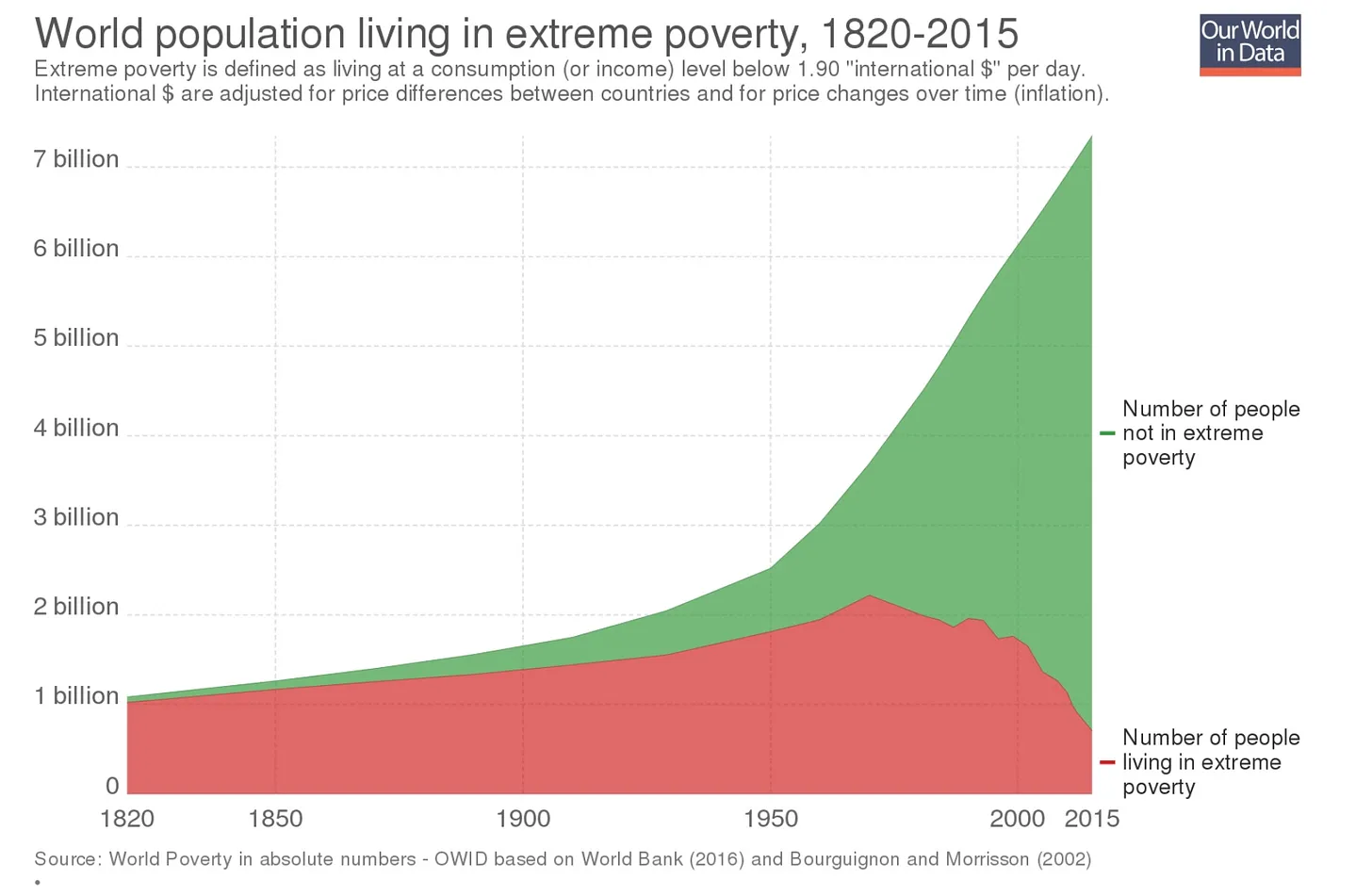
And yet, contrary to popular assumption there’s so much reason to celebrate progress and to be optimistic; there are fewer people in extreme poverty today than ever before, both in absolute numbers and as a percentage of the total population.

This outdated mental model from ‘our world in data’ stands out:

“Two centuries ago the majority of the world population was extremely poor. Back then it was widely believed that widespread poverty was inevitable. But this turned out to be wrong. Economic growth is possible and poverty can decline.”

Clearly, the reasons behind the positive story in this chart are multi-factorial, but industrialization and continued innovation have played a major role in reducing the number of people on the planet in poverty, including agricultural innovations. (After all economic development in developing economies is, by definition, agricultural development.)

That inflection in 1950 is interesting, while I don’t what caused it, I wonder…

…what if the real promise of agtech is to be the next inflection point to elevate more people from extreme poverty?

This whole topic converges with Prime Future’ish topics when you set it next to:

  1. The seemingly unending discussion <waves hands> about reducing the GHG footprint of livestock.
  2. The discussion about whether animal agtech is venture viable.

If we want to reduce the global GHG footprint of livestock, meat & dairy, then emerging markets have to be the focal point for interventions and innovations.

A lot of capital is being plowed into reducing methane emissions in livestock but largely for regions with livestock production systems that are already highly efficient, especially in comparison to their counterparts in developing economies. Not only are many of those solutions only nominally interesting in terms of value creation for producers (and tbd for consumers), many are also only nominally interesting in terms of the job those interventions would be hired to do which is to reduce the global GHG footprint of livestock.

I recently heard Frank Mitloehner from UC Davis say that ~80% of the global livestock GHG footprint comes from developing economies.

So focusing on reducing the GHG footprint of the beef industry in the US or the dairy industry in New Zealand is just playing around the edges of the global problem, at best. Mathematically, it just doesn’t matter much.

If reducing the global GHG footprint is the goal, then the biggest impact is far and away to be made by enabling emerging economies to shift from smallholder agriculture to commercial-scale agriculture to become, by definition, more efficient in the business of producing meat, milk and eggs, and simultaneously lower the GHG intensity.

As an example, as more innovations unlock value in India’s dairy industry, will they still have 200 million dairy producers milking 300 million dairy cows & water buffalo in 20 years? In 10 years? Maybe it becomes 100M producers milking 80M cows as they increase output with less animals – that’s the history of the US beef and dairy industries, as well as other highly efficient markets. Better economically & environmentally.

(The CLEAR Institute did a great write-up on this phenomenon and why efficiency has to be part of the GHG conversation.)

All of this unlocks the basic economic idea of specialization – those who are good at the business of producing milk produce more milk and those who are not good at it go find something else they are good at that contributes to the economy.

But obviously, the challenges that developing economies face are incredibly complex; if these were simple problems they’d be solved by now. I don’t mean to sound reductive, and in no way am I suggesting that agtech is, will be, or ever could be The Answer for developing economies…but ag innovation can be a piece of the puzzle.

And we know this is possible because we’ve seen it happen before.

Exhibit A: Norman Borlaug’s work on dwarf wheat. (If you haven’t read his biography, you’re missing out – incredible story of the ridiculously high impact potential of ag innovation.)

The question is which agtech solutions can be as high impact as dwarf wheat?

Changing agricultural economies requires things we take for granted in places like Ireland, Canada, or France….things like access to capital, access to efficient markets, access to buyers with high-value processing capacity, strong risk management tools, etc. Those sound like problems agtech can at least play a part in solving, don’t they?

(Tho of course, you need things like natural resources, roads, access to water, electrification, political peace, reliable governments, strong property laws, etc – none of which agtech can solve.)

Oh, and VC’s want venture returns to justify continued agtech investment? And agtech founders want to create real value for the world?

It’s not gonna happen with marketplaces in the US. Replacing relatively efficient analog marketplaces with digital marketplaces does not create much value here, it’s incremental at best.

But mention marketplaces to Mark Kahn from VC firm Omnivore that invests in agtech companies in India and he’ll tell you marketplaces can change entire sectors by giving buyers and sellers a cost-effective means to connect and transact.

In emerging markets that are mega fragmented and low yielding, agtech innovations can be legit game-changing. And not just marketplaces, all the things we throw in the agtech bucket.

What if the real promise of agtech is that the combination of existing & emerging tech with existing & emerging business models can actually change economic trajectory?

We can keep funding agtech that tweaks around the edges of production in developed economies, or we can direct technology and solutions to the places where they can create the largest delta, the most change between current state and future state.

Clearly this isn’t a new idea tho, I’m late to the party – there’s a lot of startups and investors who are way ahead in this idea of far greater potential for emerging agtech in emerging markets.

Maybe I’m having an agtech crisis of belief, or maybe I’m just tired of talking about first-world problems like how to make the really efficient thing marginally more efficient.

Either way, maybe emerging markets really are the path forward for agtech to make its dent in the universe.

Not for the sake of cool tech but for the sake of progress that actually enables human flourishing. At the end of the day, isn’t that what it’s all about?

I think Norman would have said so.

Categories
Animal AgTech Innovation

Prime Future 144: Goliath’s big fat feet.

It’s the most chaotic time of the year in the US for college basketball fans, with the NCAA tournament in full swing. Aka March Madness.

The thing about March Madness is that, because it’s a one-and-done tournament, your team having a high seed is great but also nerve-wracking. Because on any given day of the tournament, some pesky David can slay Goliath and dash an entire year of hopes and dreams.

I’m a devoted Arizona basketball fan, so I speak from way too much experience on this, including our own inglorious Goliath-style loss in the first round of the tourney this year. 🙄

The very next night #1 seed Purdue experienced the same fate when a school I’d never heard of just owned this OG basketball program.

Pure magic for David, complete devastation for Goliath.

There are a lot of ways to measure the gap between David and Goliath, but coaches’ salaries are a decent indicator in this case.

Purdue’s coach makes a cool $3.85 million salary, with bonuses for post-season wins.

The tiny no-name school that beat them?

Their coach makes $22,990. TWENTY-TWO THOUSAND DOLLARS. This guy could have made more money this year as the Walmart greeter. (tho, of course, he did just punch his ticket to greener pastures)

Amidst all the David & Goliath’ing in basketball this weekend, I’ve also been reflecting on the complete and utter chaos of the Silicon Valley Bank situation that unfolded last week and into the weekend.

The crux of the matter (as I understand it) was poor risk management, specifically mismanagement of duration risk as SVB bought long-term treasuries. It was all fine and well until interest rates rose and the value of the bond portfolio decreased. This paragraph from the WSJ nails it:

There are a handful of startups that raised capital in the past few years and set out to disrupt SVB, to become the new default banking choice for startups and VC’s.

But these startups gunning for SVB had zero to do with why SVB failed.

SVB failed because of unforced errors.

For as much as we love a story of David defeating Goliath, I wonder if more often than not in business, incumbent Goliaths fail because of their own unforced errors.

Maybe Goliaths are more apt to stumble on their big fat giant feet than they are to be slayed by David’s slingshot, especially in agriculture.

The backdrop to all of the above is the Animal Agtech Summit & World Agritech last week.

Both events were filled with fledgling enterprises trying to bring their insight to life in enough time to stay alive, some with the hope of proving their value enough to be acquired by an industry incumbent but many with the hope of disrupting incumbents, of being the David to fell Goliath.

But the thing about giants is that they have at least some degree of staying power; that is their superpower.

I look around animal ag at the incumbents in all the major segments (animal health, animal nutrition, equipment, packers, etc) and I think they are far more likely to die of unforced errors than by David's disruptive slingshot.

For starters, despite 15+ years of really great stuff in agtech, I can’t point to a single major incumbent in any segment of agriculture that failed because they were disrupted. Not one.

One could argue that this says more about how incumbents have responded to innovation, or about the oligopoly structure of many segments. One could also argue it reflects the type of innovation emerging in agtech. One could also argue the past is not a predictor of the future, and it’s only a matter of time until this happens.

Maybe this is a purely philosophical question, or maybe it’s a good time to look out for big fat giant feet. Or maybe it warrants the question, who is most likely to be the Netflix to the Blockbuster of ag? (Though I’ve also read variations of that story that indicate it too was far more of an unforced error situation than the version we tend to think of.)

Categories
Animal AgTech

Prime Future 143: What if it doesn’t work?

97% of why I work out at Orange Theory Fitness is their tech system: a connected heart rate monitor that feeds into a leaderboard at the front of the studio on a scoreboard that shows everyone’s heart rate at any point in time throughout the class.

And I *love* the system. I am not one of those psychos who actually enjoy working out, so I distract myself by doing mental math the entire workout about my heart rate, calories burned, number of reps, whatever. (I mean, tell me you’re a nerd without telling me you’re a nerd…)

But y’all, when I’m working hard and that connected heart rate monitor does not recognize my clearly elevated heart rate? I feel an irrational anger BECAUSE WHY WORK OUT IF YOU AREN’T GETTING CREDIT FOR IT 💀

The reason I hate it so much when the tech does not work properly is that I love it so much when it does work properly.

Now back to livestock.

There’s this weird but common objection to <insert any new hardware/software product> that any tech salesperson has heard:

“Sure, this could solve my problem but what if I become reliant on it and then it doesn’t work?”

To be clear, that eye roll is not about the expectation that hardware/software has to work. Of course it does, full stop. The eye roll is about the idea that we’d rather struggle with an existing way of doing business in order to not be reliant on technology….

I am 1000% dependent on my iPhone and sometimes the battery dies and it is devastating. But it’s still better than life without my iPhone, ya know?

If the “i don’t wanna be reliant on this tech product” pops into your head as a tech buyer/user/customer, here are 4 ideas to consider:
  1. If you don’t want to buy the technology, that’s cool. But you can find a better reason to justify your decision than the circular logic of “sure I can’t find enough people to do x and that technology could help me with x but then I won’t have as many people who know how to do x”. Bro, aren’t you saying that you already don’t have enough people to do x?
  2. Consider what threshold for reliability would make it worth trying. Get specific and be clear in your mind (and if you want, with the tech co). What threshold would make it worth piloting? Fully implementing? What threshold makes it better than the current state?
  3. Identify the broader concerns that might be behind this objection. Maybe there’s something bigger that justifies not adopting the tech, but a lot of times this one tends to be more of a front for hesitation to change. Which is a human thing.
  4. Design a backup plan for what you’ll do if you adopt the new tech and there comes a day when it doesn’t work quite right. Ironically, a backup plan usually looks something like your status quo today without the technology. In my workout example, my plan B is relying on my Apple watch instead of the OTF heart rate monitor, and plan C is going waaaay old school and just working out without any wearable device like it’s 1923. The horror.
If you are selling a new technology, it’s only a matter of time until you encounter this objection. 3 ideas for navigating it:
  1. Make your product so relevant that it changes the game; make it so good that it IS wildly noticeable when it doesn’t work. Make it so that customers are furious when it doesn’t work because it makes their life so good when it does.
  2. Ask open-ended questions to diagnose and understand the fear/concern behind the stated fear/concern. “And if that happens, what consequences would you see? How would those consequences be felt? How does that compare to the current consequences of x problem? What are the consequences of not taking action to solve x problem you are currently experiencing?”
  3. I hate to state the completely obvious but I’m going to….sell a product that works. Customers don’t care what kind of redundancy you have to build in or what hard things you have to solve to make sure it works, they care that it works. Especially in livestock & dairy where continuity and consistency are foundational to good performance, or in packing plants where minutes of a shuttered line cost thousands of dollars. And if I get up at 4 am for a 5 am workout, I don’t really care what it takes to make the tech work but I expect my heart rate monitor to document said workout 99.9999% of the time, ya know?

But of course there are more & bigger objections to tech adoption than that.

The thing I love about the adoption of technology, and all the commercial dynamics around it in ag, is that it’s this deliciously messy intersection of human psychology and business decisions.

Today’s newsletter was intended to be just that one brief idea related to tech adoption & objections, but then someone sent me an article by consulting giant McKinsey, “Agtech: Breaking down the farmer adopting dilemma.” Much of it is a summary of the obvious, but it includes a few things that kinda can’t be said too often.

Before we get to those, check out this paragraph:

Despite start-up and investment interest in farm-management software solutions, cost is a major barrier for farmers, with 47 percent of respondents citing it as a top concern. In fact, 50 percent of farmers globally are unwilling to pay for these solutions at all—this may be because input manufacturers, distributors, and equipment companies have historically offered deep discounts or no-charge subscriptions to comprehensive digital platforms, leaving farmers to question the ROI of newer offerings.

Remember in the conversation around farm management software and the idea that agtech 1.0 was a wash when we talked about how agribusinesses have trained customers to expect free stuff?! Me too.

Anyway, the McKinsey article did speak to some of the bigger dynamics impaction adoption of hardware & software products in the livestock, meat & dairy space:

A clearer value proposition that focuses on ROI will likely encourage more adoption—30 percent of farmers cited an unclear ROI as a top barrier to adoption and, based on their responses, the minimum-expected ROI to consider adoption is 3:1. This suggests that the current solutions’ impacts aren’t easily measurable.

Agtech companies are presently trying to move away from one-time purchases and flat-fee annual renewals of software or solutions and focus more on business-model adaptation and exploration. They are also shifting toward monetizing solutions with combinations of hardware, software, services, and analytical innovations to enhance the financial viability of their businesses.

Usage-based models (for example, $/per acre, $/per module/per acre) are by far the most common pricing models, with prices as low as $1 an acre to as high as $60 an acre. Despite the attractiveness of these models to agtech players, even products in the lower per-acre price range have struggled to scale.

Demonstrating the ROI of agtech solutions to farmers is challenging. Productivity gains (such as yield increase and yield stability) are confounded by a host of variables that affects overall performance. For example, external factors (including extreme weather events) often mask any improvements, especially where farmers are only testing the solutions on select areas of land.

Models with fewer up-front expenditures for hardware, such as leasing or renting, and scalable pricing structures (for instance, per acre, module, or sensor) are expected to be the easiest models with which to grow adoption. This may be particularly relevant in the upcoming years where 31 percent of farmers are projecting lower profits than in years before.”

The fact that the biggest barrier to adoption of tech products, generally speaking, is unclear ROI seems like another data point supporting our discussion last week about the tiny number of companies in animal ag that are actually scalable.

That 3:1 ROI thing? Table 👏 stakes👏.

Maybe we should stop talking about adoption problems, which puts the onus on the customer, and talk instead about value problems, which rightfully puts the onus on tech companies.

What’s the most common objection you experience as a customer of technology, or hear as a seller of technology?

Categories
Animal AgTech Venture Capital

Prime Future 142: Is animal agtech venture viable?

When I started writing this newsletter in 2020, if you had asked me what I’d be doing in 2023, I would have told you I’d likely be raising a venture fund solely to invest in animal agtech and meat tech. My thesis was this:

  1. Animal agtech lags behind the crop side of agtech in maturity, in # of deals, in size of deals, in adoption, in all of it.
  2. Animal agriculture is roughly equal in market value to row crops and therefore an equally large opportunity from a startup/venture perspective.
  3. Animal ag faces unique challenges & opportunities from growing consumer demand and increasing consumer expectations.
  4. Animal ag / meat / dairy is a category overlooked by most VC’s and so there’s huge opportunity in going all in on this space.

Spoiler alert: I’m not raising a fund to invest in an animal ag thesis, and have no plans to do so. And in a 180* turn, I actually believe raising a venture fund solely to focus on animal ag would be a mistake.

Not only that, a nagging question has been in the back of my mind recently:

Is animal agtech even venture viable?

If we’re going to have this conversation, two quick ground rules:

  1. Read all the way to the end because this is a nuanced discussion, and know that I know I’m only scratching the surface here.
  2. Remember that this newsletter is about learning out loud, which includes asking uncomfortable questions.

Let’s jump in.

What’s generally true of a venture-backable business?

  1. It has the potential to return the investor’s entire fund upon exit. This means things like having a large TAM (total addressable market), including line of sight to large adjacent markets.
  2. It has a lever(s) that allows them to scale in an exponential’ish way. Think of cloud-based software where the marginal cost to add one more user is nominal, or online banks that can scale product delivery and customer experience through tech rather than more humans, or a business with network effects that can lower customer acquisition costs.

Are those things true in animal ag? It depends.

It depends on the individual segment of livestock, meat, and dairy that you’re talking about…and the geography.

For example, selling a SaaS product to poultry integrators in the US is very much an enterprise sales process, whereas selling to individual poultry farmers in Thailand might be much more of an SMB process. Or selling into 10k+ dairies in the US versus selling to the typical dairy producer in India who has 2 animals. I’ve been thinking recently about the tradeoffs between market size (bigger is better!) and concentration among customers (sometimes bigger is better, sometimes bigger is just costlier to sell & serve and creates risk from a lack of customer diversification). More on that another day.

It depends on what problem the startup is trying to solve, and more importantly on the startup’s solution.

A solution that looks and feels more like a consulting business is not a good candidate for venture capital but a business that looks and feels more like a pure SaaS play could be.

It depends on how many adjacent markets a startup can reasonably expect to move into.

Well, reasonably isn’t a good word here…replace reasonably with aggressively optimistically. Rightfully so, founders and VC’s have to suspend disbelief long enough to consider the best case scenario if everything goes right (before preparing for the inverse).

The challenge here is that founders love to think that once they prove out their solution in their home country then global domination is within reach, but given the diversity of production systems and industry structures around the world, it’s rarely true that startups can scale their solution globally within their species of focus. It’s all the more rare that a solution in livestock can move from one species to another – the home run solution in dairy is unlikely to be fit for purpose in poultry, for example.

And to that point, it also depends on how easy or hard it is to scale the startup’s solution.

Let’s play devil’s advocate though, and lay out both the bull and the bear case for venture capital in animal agtech.

The bull case centers around macro dynamics like growing demand for animal protein, increasing emphasis on sustainability, bifurcation of consumer preferences, etc.

An industry in growth mode attracts innovation and investment, full stop.

The bear case that animal agtech is NOT venture backable?

(1) No billion dollar exits. Animal ag has not seen its equivalent of a Climate Corp (billion dollar acquisition), or FBN or Indigo who are likely to IPO.

The easy rebuttal to #1 is that just because it hasn’t happened, doesn’t mean it won’t happen. The 2nd easiest rebuttal is there aren’t that many more big wins in crop tech than livestock so it’s not like livestock is super far behind.

(2) No dedicated funds. Sometimes its difficult to tell if something doesn’t exist because the right person hasn’t made it happen yet, or if something doesn’t exist because others have considered it and decided it’s not a good investment. The notion of an animal agtech fund feels like more of the latter.  If it were going to happen, it feels like the time would have been in the cheap capital frenzy of the last few years.

So let’s just say animal agtech is not a good fit for venture capital in the long run; then what?

How does new innovation get funding in the absence of venture capital?

(1) More customer-backed companies. Except this often means companies need a short time from inception to value businesses (rather than multi-year development before commercialization), which either means lighter touch R&D plays (and more software than hardware or deep tech, or at least more engineer-founded companies) or more startups that find interim revenue that may not be scalable (e.g. consulting revenue) to fund the development of their larger vision.

(2) Strategic investors.

(3) Family offices, particularly family offices who's capital was/is primarily generated through livestock, meat & dairy.

I like family offices because they can often move quickly to make investment decisions and where there’s an industry link, they can quickly get high conviction about a startup’s problem & solution.

The challenge for family offices is the time required to drive deal flow and manage investments for what is likely a fraction of the portfolio. I suppose you could make a case then for pooling funds amongst multiple family offices and hiring a general partner to manage the investment pipeline and portfolio. I suppose you would then have to call it a fund, and if they are investing in venture then you’d call it a venture fund. <face palm>

(4) Rely on independently wealthy entrepreneurs to enter the space. Yuck, yuck, yuck. This would mean that a lot of great would-be companies would never see the light of day.

Or, maybe being a non-venture viable category just means that tech comes to livestock later in the lifecycle of any specific tech, once cost of goods have dropped and (effective) off the shelf technology is available that reduces the time from inception to a viable product.

I recently read that the number of venture funds fell by roughly half from ~2008 to ~2010 as the financial crisis drove a lot of new venture funds out. The economic chaos of COVID, inflation, and a new high interest rate environment are very different from the financial crisis and yet macro economic factors have a huge impact on venture capital. If LP’s can get higher return with lower risk elsewhere as they can today, they are likely to commit less to the next venture fund than they might have committed to the last venture fund.

We’re seeing now how interest rate environment plays a big role in venture capital markets: in how much capital is available, in fund size, in how risk tolerant GP’s are, in valuations, etc etc etc.

All that to say, if ever there were going to be a venture fund focused solely on animal agtech, the time to raise that fund was probably between 2019 and 2022.

But even if an entire fund centered on animal agtech doesn't make sense, there will continue to be some businesses within livestock/meat/dairy that are a fit for venture capital and will make sense as investments in a broader agtech portfolio, or SaaS portfolio, or deep tech portfolio, or climate portfolio.

This highlights the distinction between a specific category as the foundation of the fund’s thesis (e.g. animal agtech) versus as part of a broader portfolio, like 30% animal agtech investments as part of a broader agtech portfolio.

Success in venture funds is all about portfolio construction – the venture model accounts for the fact that most companies will not return any capital and the meaningful returns come from the very small percentage of companies with successful exits.

Individual fund returns are generally not publicly available but industry-wide, the vast majority of venture returns accrue to a tiny number of venture firms & funds, just like the vast majority of returns to funds are accrued by a tiny number of companies.

A few years ago I was convinced that animal agtech startups represented <20% of most agtech funds’ investments because there was less venture capital available.

Now I’m convinced there are fewer venture backed animal agtech companies, and less venture capital invested in the category, because there are fewer venture backable animal agtech startups.

Chicken or the egg? Maybe it doesn’t matter which came first, as long as there are paths forward for innovation in both.

(Btw I 100% assume since I’ve lent public voice to my 180* turn, that someday soon someone will launch a livestock-focused fund, and over the next decade, they will crush it.)

Categories
Animal AgTech Business Model Innovation

Prime Future 133: new year who dis

With the start of a new year, I’ve been thinking about what we’re doing here, and how I want to evolve Prime Future in 2023.

While my why has not changed since the beginning:

  • learn out loud
  • find my like-minded industry people

I have increased clarity on what I’m not about:

  • I am not here to ‘fix a broken food system’. Food supply chains largely held in one of modern society’s wildest black swan events (COVID). I haaaate the sound bite-ness of this overused line but it’s true for the most part: animal protein is abundant, affordable, and nutritious. So let’s not act like we need to start from zero, k?
  • Alternatively, I am not here to defend the status quo. What got us here won't get us there. I loathe the term agvocate, but I think I loathe the idea behind it even more – it’s an inherently defensive posture that does nothing to move the needle. Some things are going to have to change about how animal protein is produced and marketed, and that’s great…early adopters will find/create opportunity.
  • I do not think carbon credits will create more revenue for ranchers than beef. An astute friend of mine recently made this observation: in an industry that is really good at creating value from its byproducts, I can’t even name one example where a byproduct of a commodity became more valuable than the primary commodity itself. (Open to counter examples here!)

And increased clarity about what I am about:

  • I’m bullish on the future of animal protein. And the future likely looks very different from the past.
  • What are the macro-trends across livestock, meat & dairy? And what are the micro-implications of those macro-trends?
  • Looking at the world from a cross-species, cross-value chain perspective. I want to understand at a practical level and big picture.
  • Keeping the main things the main things: the twin pillars of producer viability and end customer satisfaction. Everything in the middle of the value chain sorts itself out of the twin pillars are sound.
  • Data is the answer to many many questions but only when technology fits a production context – durability, connectivity, time, usability, cost, etc – and the value proposition is right.

I’m here <gestures vaguely> because what interests me is innovation that creates real value, especially business model innovation, whether that innovation is tech-enabled, or not.

With that backdrop, here are my three intentions for this year with Prime Future:

  1. Keep two lenses active:
    • What’s likely to change in the next 10 years?
    • What’s likely not to change in the next 10 years?
  2. Go to the source. Ask the questions. Talk with really smart people and then do my own analysis; draw my own conclusions.
  3. Get global. My little US bubble is tiny, there’s a whole world of livestock production systems and creative innovations out there to learn from. This year I want Prime Future to get way more global.

Some questions I want to explore this year:

  • What can beef and dairy learn from pork, poultry, and aqua? Vice versa?
  • What can the US learn from New Zealand, Sadia Arabia, etc? Vice versa?
  • What can livestock learn from the crop side of the industry?
  • What can livestock learn from energy or other unrelated industries?
  • How is the animal nutrition world changing?

And finally, process over outcomes.

The last few years have been a journey in realizing that I control my day-to-day choices much more than I control outcomes. When you say something like “process over outcomes” people tend to get jumpy and think of bureaucratic organizations, but I mean “process over outcomes” as an individual.

An example is investing. I could set the goal to have a portfolio of x by the end of the year, but the stock market could drop 50% in Q4 and leave me with a seemingly bad outcome for the year. Or, I can focus on my process by setting a goal to invest x% of my monthly income in the stock market or real estate. In the short run, I have much more control over my personal process than outcomes. Over time, that discipline should pay off.

So here’s how I’m thinking about Prime Future processes:

  1. Continue publishing weekly.
  2. Start conducting 1 interview per month with an operator who has either started and/or grown a business over a period of time.  (open to ideas!)
  3. Start writing 1-2 sponsored deep dives per quarter about interesting companies that communicate something about the future of the industry. (open to ideas!) Examples from last year include The Magic in Solving Invisible Problems and Rising from the Averages: A Cattle Story.
  4. Stop writing my first draft on Friday/Saturday. I keep a running list of potential ideas which I narrow down to a topic I want to write about on Friday afternoon or Saturday morning. This leaves me with only the weekend to edit before publishing Monday morning. I want to stop this.
  5. Start writing the first draft on Monday afternoon, so I have an entire week for the hardest, and highest ROI, part of the writing process: editing.

I hope you are kicking off a fantastic 2023! What a time to be alive 🙂

What would you like to see more, or less, of in 2023 Prime Future?

Categories
AgTech Animal AgTech Venture Capital

Prime Future 128: The overlap between FTX and funny business in cattle feeding

The FTX implosion is a train wreck and I 👏🏽can👏🏽not👏🏽 look away. It’s shocking because of the scale of the implosion and the depth of the chaos, and this is just the early hazy days of the aftermath.

But we can learn from anything, right? This one is instructive far beyond the crypto world, all the way into the livestock world.

If you aren’t familiar with the FTX story, this and this give a good overview.

“FTX failed after its founder and former CEO, Sam Bankman-Fried, and his lieutenants used customer assets to make bets in Bankman-Fried’s trading firm, Alameda Research.

Launched by Bankman-Fried when he was just 28, FTX became one of the largest crypto exchanges in just three years with a valuation of $32 billion. Bankman-Fried used aggressive marketing, including a Super Bowl ad campaign, and the purchase of naming rights to the home of the Miami Heat basketball team.

FTX and FTX.US crashed due to a lack of liquidity and mismanagement of funds, followed by a large volume of withdrawals from rattled investors. The value of FTX’s native token, FTT, plummeted last week, taking other coins down with it including Ethereum and Bitcoin.”

What’s the parallel to livestock?

When funny business happens in livestock, it’s likely to happen in the cattle feeding business. In the vertically integrated swine & poultry or in dairy where animals do not frequently change hands, there just isn’t much room for shysters to maneuver. So cattle feeding seems to attract them all…in the US anyway.

Of course, the funny business is rare; by and large the cattle feeding industry is professionalized and well-managed. Importantly, the bad actors are a thorn in the side of the 99.99% of good actors.

But do a quick scan on the google and you’ll find plenty of headlines about, umm, ‘mismanagement’ in cattle feeding from the last few years including some big companies on the receiving end of that bad behavior. (To be fair the Big One was $240M not $32B like FTX so that’s something?)

My hypothesis is that the root causes that allow bad actors in cattle feeding echo the root causes that undid FTX.

This is oversimplifying, but there are (at least) two layers of blame in the FTX story:

  1. An entrepreneur carried away by greed, incompetence, and/or hubris.
  2. Investors allowed an entrepreneur to operate with woefully insufficient governance.

There are a lot of advantages of youth, but it’s hardly surprising that a 30-year-old founder of a company valued at $32 billion maaaaay have been tempted to buy into his own hype.

It’s also hardly surprising that a 30-year-old did not have the experience to build a complex financial company with the appropriate guardrails or to know/admit that he needed to hire a management team that could build guardrails into the business, or even to know/admit that he could benefit from a board of directors with the expertise to advise on such matters.

The generous explanation of the situation is youthful hubris and incompetence; the less generous explanation is unbridled greed and negligence. Reality is probably somewhere in the middle, as it usually is.

So, uh yeah, looking out for red flags of those traits in business partners seems like a reasonable rule of thumb.

But nobody looks for shysters to do business with; any sane person runs from the red flags around character.

So the real FTX takeaways are around the governance processes that counterparties put in place with any partnership or investment, whether a cattle-feeding customer, an angel investor in a super-early-stage startup, an established company building a partnership, or a venture fund investing in a growth company.

The practical FTX takeaways are around 3 layers of governance:

(1) Conduct thorough diligence.

I 10/10 recommend the book Bad Blood about Theranos and the company’s journey raising hundreds of billions of dollars to build & scale their technology that could run hundreds of tests from a single drop of blood, only to have the house of cards fall spectacularly. It’s basically a story about inept due diligence.

The author describes how an executive from one of the pharmacy chains that was exploring a partnership with Theranos raised concerns when Theranos management would not allow them to see inside the lab as part of due diligence before signing a major commercial partnership. The exec was saying ‘hey this doesn’t pass the smell test’ but the FOMO train was already running away internally and the exec’s concerns were dismissed.

That story speaks to the value of having multiple perspectives evaluate a potential counterparty.

Another diligence lesson from Theranos was that every new investor that came in assumed that the big-name investors that were already invested wouldn’t have invested without having conducted diligence. This happened in funding round after funding round, going back to the original pre-seed investor by a high-ish profile VC whose daughter was childhood best friends with Elizabeth Holmes….

That speaks to the value of doing your own homework, not looking at anyone else’s paper for the answers to the test because even smart people get it wrong or have different objectives than you do.

Theranos, and now FTX, are these gross extremes of why the most basic diligence – just asking the simple questions – shouldn’t be skipped. Even in the frenzy of a bull market, even in the frenzy of venture hype…even in the frenzy to lock in that cattle supply.

(2) Process controls in place.

CME Group CEO Terry Duffy had harsh commentary on the business model of FTX and the lack of risk management and process controls. Duffy pointed out, “you don’t have to accept anything as innovation that puts risk management in the back seat and that’s exactly what was going on.”

First, not everything needs to be innovated on. Sometimes incumbents are just slow to change and sometimes incumbents are the way they are for really really good reason.

Second, at a minimum, good governance includes understanding the internal processes and process controls that a company has in place.

(3) Board oversight that, ya know, actually oversees.

The myth of entrepreneurship is this idea of “not answering to anybody”…that’s not a thing. For starters, every business answers to customers. Second, every business with outside investors answers to a board…the well-managed businesses anyway.

Founders can stack the board with their drinking buddies, or they can run the business like a grown-up and assemble a board with people who 1) understand what fiduciary duty means, and 2) actually contribute to the management team running the company. IMO the best founders know how to leverage their board’s expertise for the benefit of the company….they don’t see the board as a negative or even neutral but as a positive, as a resource.

But cattle feeders are not venture-backed startups with boards, especially when they are family-run or independent operations, so maybe that piece of governance doesn’t translate very well for our parallel.

If you read much at all about fraud / funny business in cattle feeding, much of it stems from the fact that by eyeballing a pen of cattle you cannot tell whether those cattle have only your lien on them, or someone else’s also, or who owns them…or the absence/presence of “ghost cattle”.

While technology can solve a big piece of the cattle provenance puzzle, technology alone cannot prevent funny business in cattle feeding or any other type of partnership/investment.

The lack of good governance leaves the door open for bad actors to act badly in any partnership or investment.

I suppose the caveat is that the purpose of verifying robust governance is about reducing the likelihood of funny business even though the Enrons of the world prove the risk may not go to zero. (Btw the WSJ podcast series Bad Bets on how Enron unfolded is 🔥.)

One more thing – I hate these dumpster fires. Easterday, Nikola, Theranos, WeWork, FTX. Sure they make for entertaining podcasts but just like the shysters in the cattle feeding business are bad for the good operators, the knucklehead founders are bad for the good innovators.

But they do serve as cautionary tales.

What are your takeaways from the FTX fiasco?

For those interested in the venture capital side of things, this article is quite relevant:

An exchange? That’s not an unknown business model. Frankfurt exchange has been running for over 4 centuries. We know how this works. We know how brokerage works. When Matt Levine writes about how this is insane, he doesn’t need to, like, study up on esoteric secrets of cryptography. Whether you’re trading baseball cards or stocks or currencies or crypto, a margin loan is a margin loan and a fee is a fee.

What they (investors) should have known however are the basic red flags – does this $25 Billion company, going on a trillion by all accounts, have an actual accountant? Is there an actual management team in place? Do they have, like, a back office? Do they know how many employees they have? Do they engage professional services like lawyers to figure out how to construct the corporate structure maze? Do they routinely lend hundreds of millions of dollars to the CEO?

Sure Temasek didn’t get a Board seat, but did they know there was no Board at all? Or how exactly Alameda and FTX were intertwined, if not all the other 130 entities? It seems sensible to ask these things, even if you’re only risking 0.09% of your capital.

These are hardly deep detailed insane questions you skip in order to close the deal faster.

This isn’t Enron, where you had extremely smart folk hide beautifully constructed fictions in their publicly released financial statements. This is Dumb Enron, where someone “trust me bro”-ed their way to a $32 Billion valuation. 

First, focus on the basics: if you’re looking at a large financial company where there is no HR team, no accountant and no Board, try not to write multi hundred million dollar cheques. If the founder is regularly taking out absolute mountains of cash from the company to buy properties, donate to charity or blow it on burning a bit of capital for seemingly silly deals, that feels like bad governance.

Second, don’t fall in love more than necessary: Try to internalise the following: “human ability is normally distributed but the outcomes are power law distributed”. What this means is that just because someone builds a company that produces extraordinary outcomes, 10000x the average, doesn’t mean that they were 10000x as capable. Achievements are created from multiplicative outcomes of many different variables. So if you’re investing in a “10x founder” it doesn’t mean that they themselves are 10x the capability of everyone else, but what it means is that their advantage, combined with everyone else’s advantage, can get you to a 10000x outcome.

Which means the adulation we pour on top of some folks creates its own gravitational field, and makes others susceptible to falling in love.

The most difficult task is to not let someone else control your decision making for you, which is what you give up. If your job is to get seduced by the right narrative by the right-seeming person, guess what you’ll get seduced by anyone who can tell a compelling narrative.

Do NOT make decisions thinking surely someone else has done their part. As the names get bigger, a new investor thinks “hey, surely Sequoia and Temasek and all these big guys would have done their diligence, this makes me comfortable”, which just isn’t true.

FTX isn’t an example of crazy overextension, like WeWork, or outright fraud, like Theranos, but sheer unadulterated incompetence and hubris. The first two are understandable mistakes to overlook because investors are in the risk taking business, and are not detectives. The third is a failure of seeing things right in front of one’s eyes.

FOMO is real and investors are not at all immune, even professional VCs. In many ways, the venture capital model makes complete sense: in order to get outsized returns you take outsized risks which is why investors in venture capital funds (or angel investors in early-stage companies) should recognize that any one investment is likely to go to zero, but the goal is that the portfolio is constructed in a way that any one investment could return the fund.

But then I read stuff like this

“So weird that we ended up with fast, bolt, pipe, bird, ftx et al in the past few years. No idea how that happened
Image
Image
Image

…I can only hope a partner at one of the most storied venture funds did not actually say this. Instead of investing out of high conviction in a thesis and betting on companies with the potential to generate real value for all shareholders, the play is to follow the hype and just sell the asset at a higher price to someone else who bought into the hype before the hype dies???

That is hardly inspiring, or even respectable.

But FOMO is also the most likely explanation for all of the money that has simultaneously flocked to alternative meat startups or indoor ag startups or pick your other flavor-of-the-year venture-backed categories.

There has to be a better way to fund the future. What is it?

Categories
Animal AgTech Emerging Tech Transportation

Prime Future 125: the✨magic✨in solving invisible problems

Amazon launched AWS in 2006; Microsoft launched Azure in 2010. The cloud is old news.

We’ve digitized all the things; the digital west has been won. ✅

Yet there are large pockets of huge companies in gigantic industries that still operate on notepads and <gasp> fax machines.

Today we look at one of those not-small pockets within the ag industry and one company’s quest to simplify the ecosystem and create outsized impact.

It is a story about a seemingly invisible problem with a seemingly simple solution….until you dig below the surface.

It’s one of my favorite kinds of tech stories, where real magic gets made for customers by solving the ignored, invisible, and/or ‘boring’ problems. The ones that Silicon Valley is unlikely to find and, even if they did, unlikely to find interesting. The problems that customers don’t even realize they have until a better way is presented, like a fish unaware of the water around them.

This is a sponsored deep dive by M2X Group, the transportation management system for livestock and agriculture, and today we’re digging into the dynamics around the oft-ignored livestock transportation ecosystem & the problems M2X is tackling.

Let’s get a move on…so to speak.


Prime Future Sponsored Deep Dives explore the dynamics around a specific company, the problems they are solving and the world they are creating. As always, here are my personal commitments to Prime Future readers:

  1. I will only deep dive into companies I find intellectually interesting and relevant to the Prime Future audience.
  2. I won’t shill. My goal is for Prime Future readers to always expect, and receive, practical candor and intellectual honesty.
  3. Sponsored Deep Dives will be few and far between.

How the transportation ecosystem works

In the US cattle value chain, a calf can easily be shipped 3+ times before it is processed by the packer. Whether a weaned calf shipped from an auction barn to a stocker, or to a feedyard or to the packer, cattle can rack up a lot of miles over their lifetime.

For napkin math, let’s say the ~25 million head of beef cattle finished in feedyards every year travel 150 miles over their lifetime, a super conservative estimate but that would mean 3,750,000,000 bovine miles! Of course, these are assembled into truck loads so there are fewer actual miles driven but the point is – there’s a lot of cattle moving up and down the road.

Which means someone has to coordinate that movement. There’s a someone at the buying organization, say at the feedyard, who is coordinating transportation with a carrier, who’s going to arrange the truck and trucker to pick up the cattle from a seller, say a stocker.

In that coordination there are times for pick up and delivery, there is a price, and there is some sort of contract locking in prices and approximate times.

And today, the vast majority of that coordination happens via phone and a notepad and fax machine. CAN YOU EVEN?

So there’s administrative staff on all sides involved in the process (buyer, seller, carrier). And a lot of room for human error. And a lot of paper shuffling.

You see where this is headed, don’t you?

M2X provides a Transportation Management System. Their software platform digitizes the processes around coordinating livestock transportation and allows all the players involved to visualize one source of truth for all things related to managing livestock transportation: prices, arrivals, etc.

Some reasons that’s interesting…

(1)You can’t run an algorithm on a legal pad.

Optimization follows digitization.

As M2X customers transfer their workflows related to transportation onto the software platform, the next step is for M2X to work with the customer to start optimizing transportation. In New Zealand, M2X’s home country, this means identifying the most efficient routes to pick up animals in order to fill the truck on its way to the processor. For example, Silver Fern Farms has 14 processing plants, 90+ buyers, 14,000 suppliers, and works with over 160 trucking companies. M2X helps them optimize farm-to-plant flows, meaning that for the same amount of animals delivered to the plants, Silver Fern Farms is removing 1,000,000 kilometers from their network.

At current fuel prices that impact shows up quickly in the financials. Energy cost savings aside, the optimized farm-to-plant flows means animals are on trucks for 14% less time. All of this means 11% reduction in emissions per animal. Check, check, check.

In New Zealand, a big part of the issue is trucks picking up animals from farms in less than truckload lots so those improvements are created both by optimizing which truck is selected for animal pick up, and what route the truck takes in their multiple stops.

But these optimizations are only possible because the workflows have been moved to the software where better data is captured, and then optimizations can be layered on top.

In the US the sale barn often serves as the point of aggregation for cattle, so most truckloads are full truckloads already. But even in the US, route optimization still suggests the shortest, fastest, and safest route for a loaded truck which reduces energy costs, animal time in the truck, GHG emissions, etc.

And there’s another optimization superpower, and that’s to reduce truck congestion at plants. If you have spent much time around meat processing plants, you know this can be a massive issue in 100* summer heat but even more so for dairy processors where time is <literally> money.

I love these examples where what’s good for the income statement is good for animal welfare is good for GHG emissions. Magic.

One reason I'm so bullish on the future impact of tech in animal ag is that there's still so much happening on legal pads or the producer's pocket notebook, and as those workflows are digitized, it will create opportunities to optimize decision-making and outcomes.

For example, Caviness Beef Packers began working with M2X to streamline their transportation-related activities. They set out to pick up some efficiencies but as Regan Caviness put it, “we realized just how inefficient we had been once we had a better way to do the work. We’ve gotten way, way more accurate in everything from scheduling pickup through to billing, but especially in calculating freight costs for each truckload. Now we have an accurate headcount, accurate mileage, accurate owner data (name and address), and the freight costs are calculated in the software rather than across Google Maps tabs and paper.”

Regan also pointed out that every M2X customer will think about their flows differently, from livestock pick-up and scheduling all the way to billing. Working with software that was flexible to fit their business processes, instead of the other way around, made a big difference in the outcome and being able to easily digitize processes.

Because that is the step 1 that enables all subsequent, higher-value steps.

Optimization follows digitization.

(2) There are 4 timely tailwinds propelling M2X’s journey:

  1. Many companies have a weird dynamic where they cannot bill a customer until they have the invoice from the carrier for shipping costs. Take a grain merchant who’s selling feed ingredients to a feedyard or dairy. If the processes surrounding the carrier are managed via fax machine, you can imagine it can take many days or even weeks to settle costs with the carrier which delays when the grain merchant can invoice the feedyard or dairy. That was all fine and well when interest rates were low and money was cheap. But it’s a whole new world now, with high-interest rates where every incremental day of receivables outstanding costs real money.

Think of it this way – if I’m borrowing money at 8% interest for my operating line of credit, and I cannot invoice a customer for 14 days because I’m waiting for an invoice from the carrier to know the precise shipping costs, there is a quantifiable cost to those 14 days. By simplifying the system for all parties, M2X software allows companies to reduce their Days Receivables Outstanding by shortening the time to invoice customers. Like all numbers in high-volume businesses where small differences can make a big impact, except this impact is amplified in a high-interest-rate environment.

  1. We all know, it’s still a tight labor market. So freeing up administrative staff to focus on higher priority tasks than shuffling papers can be a huge win. Not to mention, many folks in these roles have been in these roles for years, sometimes decades. So there’s an element of succession planning and capturing process knowledge to transfer to the next person that’s also relevant.
  2. Almost anything in livestock that creates an increase in efficiency, creates a corresponding improvement in sustainability. It’s math. But that dynamic becomes very real when you’re talking about the carbon footprint of thousands of diesel trucks running up and down the highway moving millions of cattle. There is real, tangible, low-hanging sustainability fruit to optimizing transportation routing and planning. As companies get closer to their self-declared deadlines for reducing Scope 3 emissions, these types of improvement opportunities have to be attractive.
  3. As consumers, Amazon & others have conditioned us to expect visibility into where a package is until it arrives at our doorstep. That expectation for visibility is mostly a curiosity for our collective neuroses but for a company buying or selling a truckload of livestock, the expectation for visibility is a critical business need.

One of the primary benefits of digitizing allll the processes around transportation is that it creates real-time visibility for everyone involved. That visibility isn’t nice to have, it’s a need to havebut you can’t have one digital ecosystem with one source of truth when the whole process is managed on legal pads and fax machines.

(3) Why now?

Usually, this question is asked in the context of why the market or tech is at a point of readiness, but in this case, the question is more of, why hasn’t this been done before?

Coordinating shipping for livestock is, umm, not exactly the sexiest thing. Nor is it visible to those who aren’t working in it day in and day out. It’s one of those pockets of the industry that you only know how terrible it is if you’ve directly interacted with it. And you only have an appreciation for how to solve the problem if you’ve directly interacted with it.

Yes, there are plenty of Transportation Management Systems (TMS) out in the world, servicing manufacturers of all types who are bringing in one kind of widget and sending out other widgets. And those TMS work great for companies who bring goods in and out of their facilities in standard boxes. But they fall short for everyone in the value chain dealing with live animals, meat, even grain and fertilizer.

As we know, agricultural supply chains can be s-u-p-e-r complex which both creates the need for a purpose-built system for agriculture and makes it costly to build such a system.

(4) In the spirit of learning out loud, here are my takeaways as I’ve learned about M2X and the category they play in:

  • Some of the most interesting businesses in agtech are simply competing with a notepad and pen. You can’t earn the right to fix the supply chain or any other lofty aspiration until you solve a one thing for a one customer, ideally a repeatable thing for a repeatable customer. Then layer in more value for that existing customer base.
  • The role of sector knowledge in ag can be a mega differentiator, both in the product you design and in the customer experience. A CRM is a CRM whether you’re storing a customer name and notes about your interactions for a cattle feeder or a battery smelter or shoe stores, a TMS is not a TMS. The M2X team is from the industry so they have an understanding of the many nuances that a generalist TMS just can’t have.
  • High-growth bootstrapped businesses are fascinating because they are outside the norm. M2X has funded most of its growth from revenues rather than venture capital, so their validation has been in the form of paying customers….the strongest possible validation signal.
  • Substantial businesses can be built off what seem like niche spaces. Every livestock category navigates the same challenges around transportation management, as do players in grain and feed and fertilizer. The problem is repeatable with many adjacent markets within agriculture. 🤌🏼

Look, farming on Mars, chickens with 4 wings, steers that yield 80% ribeye, and self-processing pigs are all interesting moonshots for agtech to tackle.

But in the meantime, there’s so much value to be created in improving workflows and laying the foundation to optimize business operations and outcomes, like M2X is doing in the transportation space.

Categories
AgTech Animal AgTech

Prime Future 113: The boogeyman of first mover advantage

Netflix launched their streaming service in 2007 and has 220.7 million subscribers.

Disney+ launched late 2019 and now has 221 million subscribers.

Hmm, seems like Disney could be to Netflix what….

  • Facebook was to MySpace or Friendster, both early versions of social media.
  • DoorDash was to Webvan, the grocery delivery company that raised a boat load of venture capital, IPO’d, & went out of business in the dot com bust.
  • Walmart was to Piggly Wiggly, inventor of the modern supermarket format.

The idea of first mover advantage gets all the love, but I’m increasingly convinced of the power of second mover advantage.

My favorite example of second mover advantage in agtech is AgVend, who were second movers to Farmers Business Network’s first move in bringing ag retail online.

Farmers Business Network, a farmer-to-farmer network and e-commerce platform, was founded in 2014. My understanding at the time was that they were setting out to create transparency in the ag inputs market in two ways, 1) by capturing actual price data from farmers in exchange for access to other farmers’ input price data, and 2) by creating a direct to farmer model that cut out the traditional ag retailer by bringing the transaction of purchasing inputs to the FBN marketplace.

They’ve since raised $929 million in venture funding and expanded into several verticals. But in 2018, FBN had only raised $194 million in venture funding and was still squarely in the business of disrupting the traditional ag retail model.

The story goes that the CEO of FBN stood up in a room full of ag retailers and said, “you think I’m the boogeyman? I’m worse than the boogeyman.”

That quote sounds like a badly written line from the movie The Social Network, but more importantly that was the backdrop against which Alexander Reichart, CEO of AgVend, and his cofounder began to map their plans as the second mover in this still emerging category of ag retail e-commerce.

I recently caught up with Alexander and asked, how do you think about the role of second mover advantage in the AgVend story? Here are some insights he shared:

“When starting AgVend, we knew there was a missing link in the basic digital infrastructure around commerce, communications, payments, and research about products. We looked at other models in the markets, mostly compared to FBN. But the premise we disagreed on was that they came in and said there’s no reason this should be a 3 step model, we can go direct to grower and we can cut out the retailer. After working with the retailers and listening to growers, and understanding the fundamentals of logistics in the industry, we decided there’s a real need for the retailer. Its not efficient and there’s a lot of fat, but we didn’t say let’s throw the baby out with the bath water and cut out the retailer.

We realized the Amazon for ag would serve only a very small segment of transactional customers so the ag retailer is who you need to be empowered. Second mover advantage was super helpful to learn from their model and created a foil; Amol (FBN CEO) rattled the cage for retailers which prompted retailers to look for other options."

Another interesting thing about AgVend is that a couple of years into the company’s life, they pivoted from a modified marketplace to a platform for retailers, allowing retailers to white label the software so their customers can access their own grower portal. They describe this as building “the technology that keeps the most innovative ag retailers, distributors, and suppliers connected to their customers.”

Where the FBN model was about disrupting ag retailers with technology that cut off the retailer-grower relationship, the AgVend model was about helping ag retailers access technology to enhance the retailer-grower relationship.

I also asked Alexander, how do you think about business model innovation?

“Listen to your customers, build a good business, and then scale. If you just shut up and listen, people will tell you. If you don’t go in there thinking you know better and you don’t go in undervaluing the person you’re speaking with, they’ll tell you what the problems are.

Since we can build anything, as far as software, the hardest part of the job is figuring out what we should build. There’s always a shiny new opportunity, and we think ‘let’s go chase it’. But then we ask the question, why are we uniquely positioned to win in that market? If we can’t answer that question, then we look to find the best players to partner with and build really strong collaborations.”

My hypothesis is that not only was FBN actually good for AgVend, but the formation of AgVend was likely good for FBN. In April 2022 articles were published that FBN would be filing to IPO soon, so obviously they’ve found ways to make their model work.

The truth is that very few markets are really winner-take-all markets.

So its not surprising that multiple models can work, especially in a market as large as North American ag retail.

There seem to be two primary benefits to second mover advantage:

  1. Second mover gets to learn from the first mover – both the right moves of what’s worked and wrong moves of what hasn’t worked or doesn’t seem likely to work long term.
  2. First mover gets the benefit to the newly created category of a second mover - competition can grow the pie of the category and the perception that the category has staying power.

To add a bit more nuance to this discussion, here’s a recent thread by @jmatthewpryor:

Is there really a First Mover advantage? Are you in a Moat or Minefield market? 🧵👇
Image

Matthew goes on to explain his hypothesis about the context of market structure:

So maybe first mover isn’t always best, but neither is being the second mover always best. Sounds about right!

In the spirit of learning out loud, I will reluctantly share a story about my naivete and why this whole discussion lives rent free in my mind…

One of the first companies I wanted to start but chickened out on was in 2015, I heard friends talk about wanting to buy part of a beef but they didn’t have the freezer space to buy a whole or half carcass. So what if we could build a model where you would ship meat directly to the customer on some sort of predictable schedule? And hey, people are talking about local so what if it was locally sourced beef?

I was already questioning the viability of the business model I had in mind and then I saw that some company called CrowdCow had raised several million dollars. They were using all the same words I was. THIS WAS IT, THEY HAD BEAT ME TO THE PUNCH AND WON THE GAME.

I share this because when I first got into agtech ~2015, I thought that once you saw announcements about a company raising venture capital that that was it – the category had been won. The game was over. LOL & cringe, of course that couldn’t be further from the truth.

Obviously that joke is on 2015 Janette who didn’t move forward on that venture because if the D2C market is still in its early days today, it was embryonic way back then. And probably the best thing for the category would have been multiple companies getting funded, with second and third and fourth movers innovating to find profitable business models that could scale. Live and learn 🙂

What’s your view on second mover advantage vs first mover?

Any good examples? I’d love to hear them!

Categories
AgTech Animal AgTech Venture Capital

Prime Future 110: Rising from the averages: a cattle story

“If the cattle industry is to survive, it must adapt to new customer demands and scientific knowledge to create a better product. The industry’s real challenge is to produce a constant product of high quality. Today with fewer than half of cattle grading Choice, we are not producing the kind of product the consumer wants.”

Cattle feeding pioneer WD Farr penned those words in the mid-20th century. I think he’d be delighted to know that today more than 90 percent of cattle grade Choice or Prime. How did the switch flip?

WD Farr saw that one of the limiting factors for the beef industry was inconsistency in the eating experience for the consumer. There was no standardized grading system so packers had no mechanism to incentivize cattle feeders and reward them for high-quality, market-ready cattle. He noted:

“The beef industry works on averages. The poor, inefficient animals in every herd drag down the good animals. I do not believe any industry can exist on averages for a long period of time.”

So WD and other cattle feeders rallied the industry to support the formation of a national carcass grading system and decades later, we consider the inconsistency problem solved.

Some cattle feeders had a vision, rallied the industry, and put the systems and incentives in place to fix the problem.

Now a generation of cattle feeders see a new set of unsolved problems on the horizon, including reducing greenhouse gas emissions and managing natural resources.

Today we explore the key issues these cattle feeders are seeking innovative solutions to, by exploring why these issues have risen in priority and why they are not simple problems to solve.

First, some background. The Beef Alliance is the group of cattle feeders leading the charge. Its mission is to “support & guide innovation, drive industry-leading research, and engage strategically with industry stakeholders to preserve and enhance the U.S. cattle feeding segment.” And they’re dialing up those efforts with the upcoming Beef Alliance Startup Challenge, specifically to connect innovators who are solving these gnarly problems with prospective customers and decision-makers, cattle feeders. But more on that later.

Oh, and these new problems are in addition to the ongoing search for tools to improve animal welfare and health, operational efficiency, animal nutrition, and production efficiency that will be high priority forevermore.

There are 5 considerations as we think about that list of problems.

  1. Why has figuring out the GHG emissions question become an urgent issue for cattle feeders?
  2. High quality + reasonable price + _____ = customer expectations
  3. Why is GHG emissions an incredibly challenging problem to solve?
  4. In the absence of direct mitigation tactics, can indirect improvements get the job done?
  5. AND solutions

Let’s take them one by one. <cracks knuckles>


This week’s newsletter is a Sponsored Deep Dive with the Beef Alliance. Here’s my commitment to Prime Future readers as I incorporate occasional Sponsored Deep Dives.


(1) Why have GHG emissions become an urgent issue for cattle feeders?

Because reducing GHG emissions is important to their customers. Because packers, retailers & foodservice companies are making boardroom commitments, including:

  • Tyson: Achieve net zero greenhouse gas emissions across global operations and supply chain by 2050.
  • JBS USA: Achieve net-zero GHG emissions by 2040.
  • Cargill: Achieve a 30% GHG intensity reduction across North American beef supply chain by 2030 (measured on a per pound of product basis from a 2017 baseline).
  • Walmart: Zero emission by 2040.
  • McDonalds: Net zero emissions by 2050.

Keep in mind the perspective of Greg Bethard of High Plains Ponderosa Dairy, “We very much believe if we can produce milk and beef at a lower carbon footprint then we’ll have markets available to us that others will not. And that means opportunity. Whether or not you agree politically isn’t the issue, if our consumers want food produced in a certain way and we can do it profitably, then we’d be silly not to do it.”

Some quick level setting…

The 3 main greenhouse gasses are: (1) Carbon dioxide, (2) Nitrous oxide, and (3) Methane – largely from manure and enteric emissions. AgNext explains further:

  • Direct greenhouse gases from livestock total 3.8% of U.S. man-made emissions.
  • Enteric methane accounts for 30% of U.S. methane emissions.

(2) High quality + reasonable price +  _____ = customer expectations

Meat consumers have become accustomed to a consistent experience every time they hit the meat case at their grocery store of choice. That has become table stakes.

And strong demand even at record meat prices has shown just how important animal protein is.  While everyone’s sense of pricing is skewed at the moment, safe to say that all things being equal, people prefer to pay less than more…sorry to state the obvious.

But increasingly there are other expectations besides price and quality. Whether it’s animal welfare or lower emissions or how the animal was finished, there seem to be increasing expectations around what’s available at the meat case. This isn’t new, but it seems to be dialing up and more segments with stronger conviction are doing the dialing….which could/should mean more opportunities for hyper-niche marketing to meet those demands.

But ultimately, it’s an AND expectation of high quality + reasonable price + <insert attribute here>.

(3) Why is GHG emissions reduction an incredibly challenging problem to solve?

This entire space is nascent, it’s what I call an ‘assumptions on assumptions’ situation. In the absence of agreed-upon rules of engagement or when is the baseline year or even baseline measurement methodology or any of the other key assumptions, we end up with assumptions on assumptions which is….tenuous.

There are science and technology questions like having reliable tools to measure at reasonable cost, and then there are the alignment questions of what a win looks like.

And then assuming a GHG emissions win, there’s the ultimate alignment question of how the spoils are divided across the value chain.

These are neither easy scientific questions nor are they easy coordination questions.

It will take time. It will take investment. It will take focus. It will take patience.

It will take trial and error.

(4) In the absence of direct mitigation tactics, can indirect improvements get the job done?

We think in terms of financial fixed costs, and the magic that happens when you increase volume and spread those fixed costs out across more units of production. The fixed cost per unit decreases.

But the same concept applies to natural resource use & impact. Where the equation is ‘natural resource usage / total pounds of beef produced per animal’ then the fixed natural resource costs are diluted across more pounds.

It’s also funny because when we think about incremental improvements in any given year, they often sound like not much. But when you put them in the arc of history, consistent incremental improvements can be wickedly high impact. The Beef Alliance points out, “Between 1961 and 2018, the U.S. beef industry has reduced emissions per pound of beef by more than 40% while actually producing more than 60% more beef per animal.”

The best case scenario is for cow-calf producers and cattle feedyards to have a wide array of tools available to them, those that will directly decrease GHG emissions and those that create an indirect decrease of GHG emissions by improving efficiency.

(5) We need ‘AND’ solutions.

When the energy in the diet is lost to methane emissions, it’s costly for the producer AND it’s negative for the environment. So it stands to reason that solutions that reduce methane emissions *could* be good for the producer AND good for the environment.

If increasing soil organic matter by 1% increases the water holding capacity by 3.7%, then it stands to reason that for producers pumping increasingly expensive water to irrigate, that increasing soil organic matter could be good for environmental objectives AND good for the bottom line.

My point here is that sustainability objectives do not automatically imply a financial tradeoff must be made, where in order to satisfy sustainability objectives the producer will have to be worse off financially. I’m not operating with blind optimism and I recognize there could be those situations, but I think its a reasonable expectation that many solutions will be good for the producer and for the environment.

We need to hunt these ‘AND’ solutions down like the golden tickets they could be….and that’s what the Beef Alliance is doing.

This is a space where nuance is critical.

What about the nuance around the fact that for the methane emissions conscience consumer, grain-finished cattle are better than grass-finished cattle. This is such a narrative violation. It’s a contrast with the surface-level assumptions about beef production, and it’s just one example of how a sustainability objective could turn tolerance of efficiency-creating practices into an open-armed embrace of those efficiencies.

I think good things happen when the right people connect. And by good things, I mean better solutions on shorter timelines. It takes a long time to build a startup, typically 7-10 years. And a large reason for that is the early wilderness years when founders are wrapping their arms around the problem and the market and looking for people to share feedback and insights that could save a founder years spent chasing a misguided solution or sub-optimal early market.

Imagine if you could cut the wilderness years phase of a startup down by 20% or 50% just by getting them in the right rooms with the right people to have the right conversations. For industry, that could mean solving million-dollar problems years earlier than otherwise. That dual benefit is ultimately the objective the cattle feeders have in mind here.

“The Beef Alliance Startup Challenge provided a great opportunity for Resilient to connect directly with industry leaders. It’s fantastic to see the biggest players not only supporting new innovation but also designing a conduit for startups like Resilient to interact directly with the end customer. It’s clear the Beef Alliance hopes to create an innovation ecosystem to bring forth new technologies that can address critical challenges in the beef industry.  Winning the award served as critical validation for Resilient’s microbiome products and technology, which helps attract outside investors and adjacent industry players that want to support upstream innovation in the food supply chain.”

– Chris Belnap, founder of Resilient Biotics, winner of the 2021 Startup Challenge

If you are a founder working on cattle problems, throw your hat in the ring by applying here:

Beef Alliance Startup Challenge

It seems that progressive producers are jumping in to create opportunities out of their customer’s unmet needs as it relates to GHG emissions. These producers that are engaging are playing the long game with an optimistic view, rather than being defensive.

This brings us to one last WD Farr quote that is as true today as it was in the 1990s:

"During the next decade, those who are not willing to be optimistic and forward thinking will be lost in the dust of what promises to be the greatest century the world has ever seen."

What a time to be alive 😉