Categories
AgTech Animal AgTech Developing economies Markets

Prime Future 145: What would Norman say?

Ugh. That was my reaction when my book club chose a book about life in a Mumbai slum called, ironically, behind the beautiful forevers.

We normally read historical non-fiction narratives like The Splendid and The Vile, Endurance, and The Warburgs. Books that have that great combo of inspiration and interesting information. Not books that make me want to cringe at the bitter reality of people sharing the planet at the exact same time I am and yet our lives could not possibly be more opposite.

I just finished this book and am left with a simultaneous sense of relief (thank goodness the book is over and I can go back to my bubble) and lingering dread at the weight of a book like this that kinda seeps into your soul and gets stuck. It’s the reminder of real human suffering because someone put a name and the specifics of a story to a statistic, to the million ways that poverty slices at human dignity, as the struggle to meet the most basic needs of survival leads to the horrors of corruption, parents forced to choose between awful and terrible options to keep their kids fed, etc.

Ugh, indeed.

And yet, contrary to popular assumption there’s so much reason to celebrate progress and to be optimistic; there are fewer people in extreme poverty today than ever before, both in absolute numbers and as a percentage of the total population.
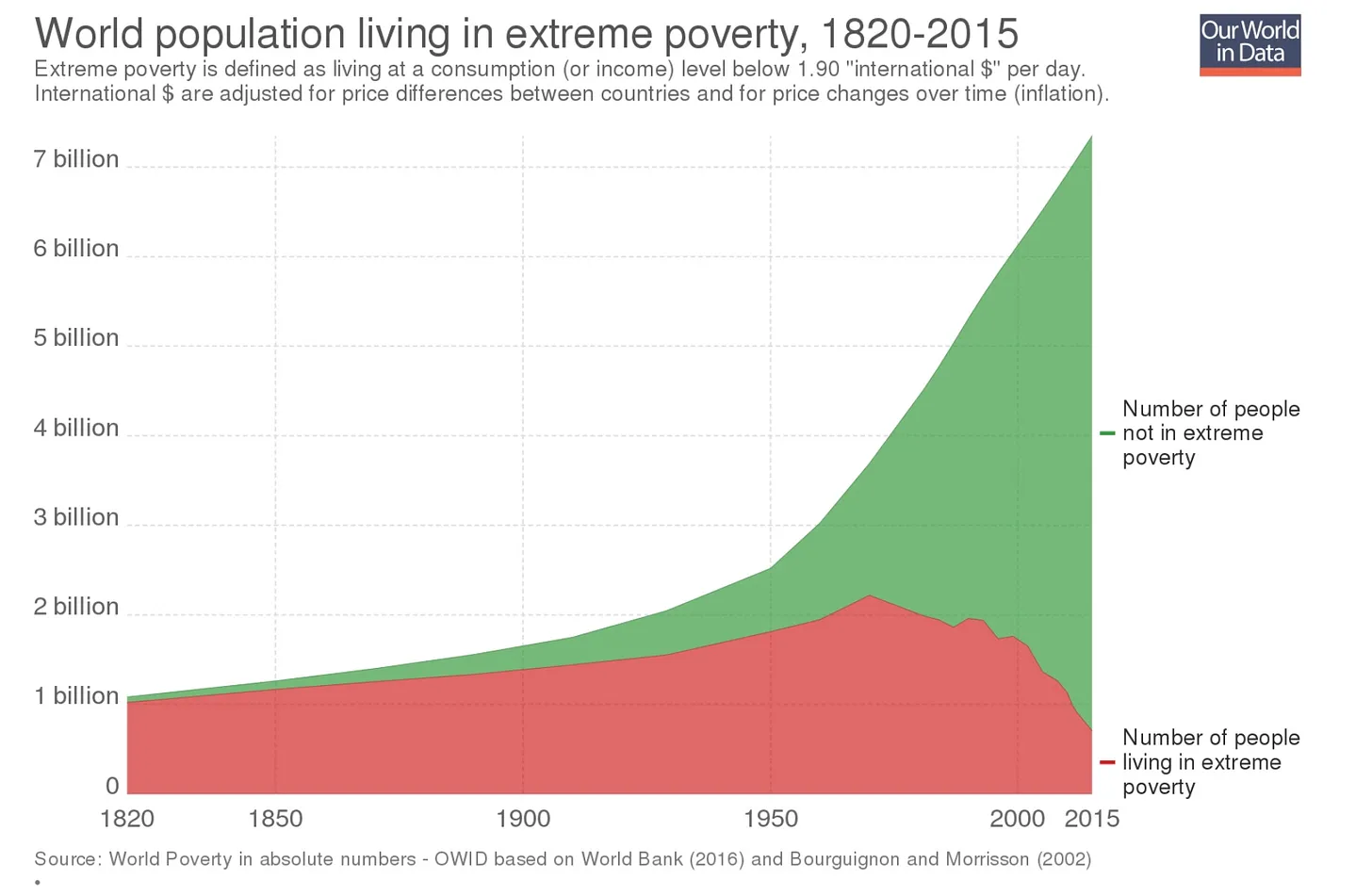
This outdated mental model from ‘our world in data’ stands out:

“Two centuries ago the majority of the world population was extremely poor. Back then it was widely believed that widespread poverty was inevitable. But this turned out to be wrong. Economic growth is possible and poverty can decline.”

Clearly, the reasons behind the positive story in this chart are multi-factorial, but industrialization and continued innovation have played a major role in reducing the number of people on the planet in poverty, including agricultural innovations. (After all economic development in developing economies is, by definition, agricultural development.)

That inflection in 1950 is interesting, while I don’t what caused it, I wonder…

…what if the real promise of agtech is to be the next inflection point to elevate more people from extreme poverty?

This whole topic converges with Prime Future’ish topics when you set it next to:

  1. The seemingly unending discussion <waves hands> about reducing the GHG footprint of livestock.
  2. The discussion about whether animal agtech is venture viable.

If we want to reduce the global GHG footprint of livestock, meat & dairy, then emerging markets have to be the focal point for interventions and innovations.

A lot of capital is being plowed into reducing methane emissions in livestock but largely for regions with livestock production systems that are already highly efficient, especially in comparison to their counterparts in developing economies. Not only are many of those solutions only nominally interesting in terms of value creation for producers (and tbd for consumers), many are also only nominally interesting in terms of the job those interventions would be hired to do which is to reduce the global GHG footprint of livestock.

I recently heard Frank Mitloehner from UC Davis say that ~80% of the global livestock GHG footprint comes from developing economies.

So focusing on reducing the GHG footprint of the beef industry in the US or the dairy industry in New Zealand is just playing around the edges of the global problem, at best. Mathematically, it just doesn’t matter much.

If reducing the global GHG footprint is the goal, then the biggest impact is far and away to be made by enabling emerging economies to shift from smallholder agriculture to commercial-scale agriculture to become, by definition, more efficient in the business of producing meat, milk and eggs, and simultaneously lower the GHG intensity.

As an example, as more innovations unlock value in India’s dairy industry, will they still have 200 million dairy producers milking 300 million dairy cows & water buffalo in 20 years? In 10 years? Maybe it becomes 100M producers milking 80M cows as they increase output with less animals – that’s the history of the US beef and dairy industries, as well as other highly efficient markets. Better economically & environmentally.

(The CLEAR Institute did a great write-up on this phenomenon and why efficiency has to be part of the GHG conversation.)

All of this unlocks the basic economic idea of specialization – those who are good at the business of producing milk produce more milk and those who are not good at it go find something else they are good at that contributes to the economy.

But obviously, the challenges that developing economies face are incredibly complex; if these were simple problems they’d be solved by now. I don’t mean to sound reductive, and in no way am I suggesting that agtech is, will be, or ever could be The Answer for developing economies…but ag innovation can be a piece of the puzzle.

And we know this is possible because we’ve seen it happen before.

Exhibit A: Norman Borlaug’s work on dwarf wheat. (If you haven’t read his biography, you’re missing out – incredible story of the ridiculously high impact potential of ag innovation.)

The question is which agtech solutions can be as high impact as dwarf wheat?

Changing agricultural economies requires things we take for granted in places like Ireland, Canada, or France….things like access to capital, access to efficient markets, access to buyers with high-value processing capacity, strong risk management tools, etc. Those sound like problems agtech can at least play a part in solving, don’t they?

(Tho of course, you need things like natural resources, roads, access to water, electrification, political peace, reliable governments, strong property laws, etc – none of which agtech can solve.)

Oh, and VC’s want venture returns to justify continued agtech investment? And agtech founders want to create real value for the world?

It’s not gonna happen with marketplaces in the US. Replacing relatively efficient analog marketplaces with digital marketplaces does not create much value here, it’s incremental at best.

But mention marketplaces to Mark Kahn from VC firm Omnivore that invests in agtech companies in India and he’ll tell you marketplaces can change entire sectors by giving buyers and sellers a cost-effective means to connect and transact.

In emerging markets that are mega fragmented and low yielding, agtech innovations can be legit game-changing. And not just marketplaces, all the things we throw in the agtech bucket.

What if the real promise of agtech is that the combination of existing & emerging tech with existing & emerging business models can actually change economic trajectory?

We can keep funding agtech that tweaks around the edges of production in developed economies, or we can direct technology and solutions to the places where they can create the largest delta, the most change between current state and future state.

Clearly this isn’t a new idea tho, I’m late to the party – there’s a lot of startups and investors who are way ahead in this idea of far greater potential for emerging agtech in emerging markets.

Maybe I’m having an agtech crisis of belief, or maybe I’m just tired of talking about first-world problems like how to make the really efficient thing marginally more efficient.

Either way, maybe emerging markets really are the path forward for agtech to make its dent in the universe.

Not for the sake of cool tech but for the sake of progress that actually enables human flourishing. At the end of the day, isn’t that what it’s all about?

I think Norman would have said so.

Categories
AgTech Artificial Intelligence Genetics

Prime Future 141: 7 acres —> 1 takeaway

The hosts of my favorite podcast, Acquired, talk about the idea that actual tech enablement always shows up in a company’s P&L, whether in the form of decreased cost structure or increased revenue. If it doesn’t show up in the P&L, the business isn’t truly tech-enabled. A lot of non-native tech companies want to be tech companies; few have the financials to prove it.

Set that idea aside for just a moment.

I recently had the privilege to tour Bayer’s new plant breeding facility outside Tucson. They describe the facility as enabling the transition from selecting genetics to designing genetics, which Bayer calls precision plant breeding.

Photo from Bayer’s website

The facility is 7 acres under greenhouse glass, replacing the need for 20,000 acres of farm ground. And because 365 days of the year make up the growing season, they get 3-4 entire crop cycles per year rather than 1. The facility is automated from start to finish, including full traceability for every seed that is planted into a germination tray all the way to seeds that are shipped out to be planted in field trials.

Not to mention, every seed is ‘chipped’, meaning a tiny sliver of the kernel is sliced off in order to run genomics testing so that selection decisions can be made from the combination of phenotype and genotype data.

The combination of these capabilities allows them to capture more data, apply high-powered analytics, and make better and faster decisions.

The name of the plant genetics game is speed, balanced against accuracy, so you can imagine how these capabilities complement one another. Bayer describes the net impact as moving 15x faster, realizing 4x genetic gain, and accelerating the genetic cycle by 30%, which has a compounding effect.

One of the presenters explained that achieving those 15x, 4x, and 30% outcomes is possible because of the emergence & convergence of multiple technologies simultaneously: greenhouse robotics & automation, plant genotyping, machine learning, massive cloud computing capacity, etc.

A very short time ago, the idea of capturing thousands of data points on every seed planted would have been completely unwieldy, let alone to do predictive analytics with that scale of data.

My takeaway is that this facility Bayer has assembled is not unique because of any individual technology but because of an incredibly rich tech stack.

It's not any one technology that is unlocking their genetic acceleration; it's the portfolio of technologies and how that portfolio has been assembled.

This is instructive for companies up and down the animal protein value chain…or any other value chain, tbh.

While a technology here or a technology there can create real value, competitive advantage is carved out both by assembling a tech stack, or a portfolio of tech solutions, that fits the company’s strategy.

You might even say that adopting a single technology solution is a way to create short-term competitive advantage, while assembling a strategic tech stack is a way to create long-term competitive advantage.

As I walked through the facility with trays of corn plants at various stages of development moving on tracks overhead from one part of the greenhouse to the next, I kept thinking how difficult it would be to replicate what Bayer has created and, perhaps more importantly, to replicate how they are using it.

That’s a competitive advantage; that’s a real moat…in this case, the moat is around their innovation engine. That seems likely to cast an even longer-term moat shadow.

Circling back to the idea from the Acquired podcast. While the Bayer presenters didn’t speak to this specifically, my hypothesis is that Bayer will see the impact of this precision breeding capability show up in the P&L primarily in the form of increased revenue as they launch more products of higher value. I think the Acquired podcast hosts would say that business is transitioning to become a truly tech-enabled business.

This is an extreme example, of course. Not every dairy or feedyard or poultry integrator is going to be able to make an investment like this, for starters, because those businesses do not have the same margin structure as an R&D-driven crop input company.

But the principle holds:

Short-term competitive advantage can be created by adopting individual technologies; long-term competitive advantage is created by assembling a portfolio of technologies that unlock a company’s business model strategy.

What a time to be alive😉


Categories
AgTech Animal AgTech Venture Capital

Prime Future 128: The overlap between FTX and funny business in cattle feeding

The FTX implosion is a train wreck and I 👏🏽can👏🏽not👏🏽 look away. It’s shocking because of the scale of the implosion and the depth of the chaos, and this is just the early hazy days of the aftermath.

But we can learn from anything, right? This one is instructive far beyond the crypto world, all the way into the livestock world.

If you aren’t familiar with the FTX story, this and this give a good overview.

“FTX failed after its founder and former CEO, Sam Bankman-Fried, and his lieutenants used customer assets to make bets in Bankman-Fried’s trading firm, Alameda Research.

Launched by Bankman-Fried when he was just 28, FTX became one of the largest crypto exchanges in just three years with a valuation of $32 billion. Bankman-Fried used aggressive marketing, including a Super Bowl ad campaign, and the purchase of naming rights to the home of the Miami Heat basketball team.

FTX and FTX.US crashed due to a lack of liquidity and mismanagement of funds, followed by a large volume of withdrawals from rattled investors. The value of FTX’s native token, FTT, plummeted last week, taking other coins down with it including Ethereum and Bitcoin.”

What’s the parallel to livestock?

When funny business happens in livestock, it’s likely to happen in the cattle feeding business. In the vertically integrated swine & poultry or in dairy where animals do not frequently change hands, there just isn’t much room for shysters to maneuver. So cattle feeding seems to attract them all…in the US anyway.

Of course, the funny business is rare; by and large the cattle feeding industry is professionalized and well-managed. Importantly, the bad actors are a thorn in the side of the 99.99% of good actors.

But do a quick scan on the google and you’ll find plenty of headlines about, umm, ‘mismanagement’ in cattle feeding from the last few years including some big companies on the receiving end of that bad behavior. (To be fair the Big One was $240M not $32B like FTX so that’s something?)

My hypothesis is that the root causes that allow bad actors in cattle feeding echo the root causes that undid FTX.

This is oversimplifying, but there are (at least) two layers of blame in the FTX story:

  1. An entrepreneur carried away by greed, incompetence, and/or hubris.
  2. Investors allowed an entrepreneur to operate with woefully insufficient governance.

There are a lot of advantages of youth, but it’s hardly surprising that a 30-year-old founder of a company valued at $32 billion maaaaay have been tempted to buy into his own hype.

It’s also hardly surprising that a 30-year-old did not have the experience to build a complex financial company with the appropriate guardrails or to know/admit that he needed to hire a management team that could build guardrails into the business, or even to know/admit that he could benefit from a board of directors with the expertise to advise on such matters.

The generous explanation of the situation is youthful hubris and incompetence; the less generous explanation is unbridled greed and negligence. Reality is probably somewhere in the middle, as it usually is.

So, uh yeah, looking out for red flags of those traits in business partners seems like a reasonable rule of thumb.

But nobody looks for shysters to do business with; any sane person runs from the red flags around character.

So the real FTX takeaways are around the governance processes that counterparties put in place with any partnership or investment, whether a cattle-feeding customer, an angel investor in a super-early-stage startup, an established company building a partnership, or a venture fund investing in a growth company.

The practical FTX takeaways are around 3 layers of governance:

(1) Conduct thorough diligence.

I 10/10 recommend the book Bad Blood about Theranos and the company’s journey raising hundreds of billions of dollars to build & scale their technology that could run hundreds of tests from a single drop of blood, only to have the house of cards fall spectacularly. It’s basically a story about inept due diligence.

The author describes how an executive from one of the pharmacy chains that was exploring a partnership with Theranos raised concerns when Theranos management would not allow them to see inside the lab as part of due diligence before signing a major commercial partnership. The exec was saying ‘hey this doesn’t pass the smell test’ but the FOMO train was already running away internally and the exec’s concerns were dismissed.

That story speaks to the value of having multiple perspectives evaluate a potential counterparty.

Another diligence lesson from Theranos was that every new investor that came in assumed that the big-name investors that were already invested wouldn’t have invested without having conducted diligence. This happened in funding round after funding round, going back to the original pre-seed investor by a high-ish profile VC whose daughter was childhood best friends with Elizabeth Holmes….

That speaks to the value of doing your own homework, not looking at anyone else’s paper for the answers to the test because even smart people get it wrong or have different objectives than you do.

Theranos, and now FTX, are these gross extremes of why the most basic diligence – just asking the simple questions – shouldn’t be skipped. Even in the frenzy of a bull market, even in the frenzy of venture hype…even in the frenzy to lock in that cattle supply.

(2) Process controls in place.

CME Group CEO Terry Duffy had harsh commentary on the business model of FTX and the lack of risk management and process controls. Duffy pointed out, “you don’t have to accept anything as innovation that puts risk management in the back seat and that’s exactly what was going on.”

First, not everything needs to be innovated on. Sometimes incumbents are just slow to change and sometimes incumbents are the way they are for really really good reason.

Second, at a minimum, good governance includes understanding the internal processes and process controls that a company has in place.

(3) Board oversight that, ya know, actually oversees.

The myth of entrepreneurship is this idea of “not answering to anybody”…that’s not a thing. For starters, every business answers to customers. Second, every business with outside investors answers to a board…the well-managed businesses anyway.

Founders can stack the board with their drinking buddies, or they can run the business like a grown-up and assemble a board with people who 1) understand what fiduciary duty means, and 2) actually contribute to the management team running the company. IMO the best founders know how to leverage their board’s expertise for the benefit of the company….they don’t see the board as a negative or even neutral but as a positive, as a resource.

But cattle feeders are not venture-backed startups with boards, especially when they are family-run or independent operations, so maybe that piece of governance doesn’t translate very well for our parallel.

If you read much at all about fraud / funny business in cattle feeding, much of it stems from the fact that by eyeballing a pen of cattle you cannot tell whether those cattle have only your lien on them, or someone else’s also, or who owns them…or the absence/presence of “ghost cattle”.

While technology can solve a big piece of the cattle provenance puzzle, technology alone cannot prevent funny business in cattle feeding or any other type of partnership/investment.

The lack of good governance leaves the door open for bad actors to act badly in any partnership or investment.

I suppose the caveat is that the purpose of verifying robust governance is about reducing the likelihood of funny business even though the Enrons of the world prove the risk may not go to zero. (Btw the WSJ podcast series Bad Bets on how Enron unfolded is 🔥.)

One more thing – I hate these dumpster fires. Easterday, Nikola, Theranos, WeWork, FTX. Sure they make for entertaining podcasts but just like the shysters in the cattle feeding business are bad for the good operators, the knucklehead founders are bad for the good innovators.

But they do serve as cautionary tales.

What are your takeaways from the FTX fiasco?

For those interested in the venture capital side of things, this article is quite relevant:

An exchange? That’s not an unknown business model. Frankfurt exchange has been running for over 4 centuries. We know how this works. We know how brokerage works. When Matt Levine writes about how this is insane, he doesn’t need to, like, study up on esoteric secrets of cryptography. Whether you’re trading baseball cards or stocks or currencies or crypto, a margin loan is a margin loan and a fee is a fee.

What they (investors) should have known however are the basic red flags – does this $25 Billion company, going on a trillion by all accounts, have an actual accountant? Is there an actual management team in place? Do they have, like, a back office? Do they know how many employees they have? Do they engage professional services like lawyers to figure out how to construct the corporate structure maze? Do they routinely lend hundreds of millions of dollars to the CEO?

Sure Temasek didn’t get a Board seat, but did they know there was no Board at all? Or how exactly Alameda and FTX were intertwined, if not all the other 130 entities? It seems sensible to ask these things, even if you’re only risking 0.09% of your capital.

These are hardly deep detailed insane questions you skip in order to close the deal faster.

This isn’t Enron, where you had extremely smart folk hide beautifully constructed fictions in their publicly released financial statements. This is Dumb Enron, where someone “trust me bro”-ed their way to a $32 Billion valuation. 

First, focus on the basics: if you’re looking at a large financial company where there is no HR team, no accountant and no Board, try not to write multi hundred million dollar cheques. If the founder is regularly taking out absolute mountains of cash from the company to buy properties, donate to charity or blow it on burning a bit of capital for seemingly silly deals, that feels like bad governance.

Second, don’t fall in love more than necessary: Try to internalise the following: “human ability is normally distributed but the outcomes are power law distributed”. What this means is that just because someone builds a company that produces extraordinary outcomes, 10000x the average, doesn’t mean that they were 10000x as capable. Achievements are created from multiplicative outcomes of many different variables. So if you’re investing in a “10x founder” it doesn’t mean that they themselves are 10x the capability of everyone else, but what it means is that their advantage, combined with everyone else’s advantage, can get you to a 10000x outcome.

Which means the adulation we pour on top of some folks creates its own gravitational field, and makes others susceptible to falling in love.

The most difficult task is to not let someone else control your decision making for you, which is what you give up. If your job is to get seduced by the right narrative by the right-seeming person, guess what you’ll get seduced by anyone who can tell a compelling narrative.

Do NOT make decisions thinking surely someone else has done their part. As the names get bigger, a new investor thinks “hey, surely Sequoia and Temasek and all these big guys would have done their diligence, this makes me comfortable”, which just isn’t true.

FTX isn’t an example of crazy overextension, like WeWork, or outright fraud, like Theranos, but sheer unadulterated incompetence and hubris. The first two are understandable mistakes to overlook because investors are in the risk taking business, and are not detectives. The third is a failure of seeing things right in front of one’s eyes.

FOMO is real and investors are not at all immune, even professional VCs. In many ways, the venture capital model makes complete sense: in order to get outsized returns you take outsized risks which is why investors in venture capital funds (or angel investors in early-stage companies) should recognize that any one investment is likely to go to zero, but the goal is that the portfolio is constructed in a way that any one investment could return the fund.

But then I read stuff like this

“So weird that we ended up with fast, bolt, pipe, bird, ftx et al in the past few years. No idea how that happened
Image
Image
Image

…I can only hope a partner at one of the most storied venture funds did not actually say this. Instead of investing out of high conviction in a thesis and betting on companies with the potential to generate real value for all shareholders, the play is to follow the hype and just sell the asset at a higher price to someone else who bought into the hype before the hype dies???

That is hardly inspiring, or even respectable.

But FOMO is also the most likely explanation for all of the money that has simultaneously flocked to alternative meat startups or indoor ag startups or pick your other flavor-of-the-year venture-backed categories.

There has to be a better way to fund the future. What is it?

Categories
AgTech Animal Health Venture Capital

Prime Future 122: Not all heroes wear capes.

I’m increasingly convinced that in a world of blowhards who overpromise and underdeliver, to underpromise and overdeliver is a superpower.

Not only is it a superpower, it’s one that compounds and proves its power over time and relationships and results.

Let me start by saying I used to think the opposite was true. Despite this being one of the oft-repeated pieces of advice early in my career when I was a brand new baby sales rep, when I transitioned from animal health sales to startup founder I temporarily left that advice behind as too old school and short sighted….

I thought that painting a big picture of what’s possible (even when my intuition told me it was probably impossible) showed ambition to do big things which could then unlock resources to actually make big things happen. Financial projections up and to the right, further and faster.

Now I tend to think over-ambition just looks naive.

(I hope I can attribute that to the increasing pragmatism that comes with experience, and not cynicism creeping in🤞🏽)

It’s not that the effective under-promiser over-deliverers play small.

It’s that they can separate the future from the present, and they can distinguish between their aspirations and their realities. And they don’t shy from those gaps.

Under-promiser over-deliverers can tell the difference between a base-case scenario, a best-case scenario, and an “only in our wildest dreams” scenario.

Under-promiser over-deliverers still have a compelling vision, especially under-promisers who raise venture capital. The venture game is, by definition, one of big risks and big rewards so a big reward has to be possible.

Under-promisers still sell a big vision with plenty of ambition, but they capture the nuance of what it will take to make the vision a reality.

It’s hard not to be energized by a person/team/company with genuine enthusiasm and commitment to solve big problems. Maybe this whole under-deliver vs over-deliver idea is just all contextual. Know your audience. Know when to paint the grandiose vision and when to manage the reality of what it will take to get there.

Maybe it's all about managing expectations.

There are at least 4 stakeholder groups whose expectations have to be managed well in the pursuit of doing something new and hard and unpredictable:

(1) Early customers.

While it seems obvious that you’re playing with fire as an early-stage company to overpromise and underdeliver, it’s not at all uncommon for agtech startups to create unmet expectations with early customers. Get the right early customers and they have a lot of grace for glitches in an early product, they do NOT usually have a lot of grace for a big gap between reality and the sales pitch.

(2) The team.

The earlier stage the company is, the more the team needs reasons to believe we are on the right track. Whether that is in the form of product development milestones or commercial milestones is irrelevant (for this convo), the main thing is managing the team’s expectations to maintain morale and commitment. Working 75 hours a week is fine as long as there’s progress being made and a light at the end of the tunnel that it will pay off at some point.

Once your team loses faith in your misguided expectations, trust quickly erodes and suddenly a founder finds themselves scrambling to recruit new talent….which of course slows the company’s progress further.

(3) Yourself, as a founder.

This might be the most important of the 4. Being a founder is really hard, mentally and emotionally. A huge part of avoiding burnout is managing your own expectations so that when something takes an extra 6-18 months, you have a frame of reference to handle it. (Have I mentioned how I learned this the really, really hard way??)

(4) Investors.

“There’s more fiction written in Microsoft Excel than Microsoft Word”

I recently heard someone say that and it’s been living rent-free in my head ever since. It’s funny bc its so so so true, isn’t it?

Anyway, I’ve been thinking about this whole idea lately in the context of startup founders, but maybe it applies to…everyone?

“IMHO…. The best sales people under promise and over deliver. The best investors under promise and over deliver. The best founders under promise and over deliver. The best <at anything> under promise and over deliver. 👆🏼Incredibly underrated super power”

Not all heroes wear capes, but maybe they all have the superpower of consistently underpromising & overdelivering. #goals

Categories
AgTech Animal AgTech

Prime Future 113: The boogeyman of first mover advantage

Netflix launched their streaming service in 2007 and has 220.7 million subscribers.

Disney+ launched late 2019 and now has 221 million subscribers.

Hmm, seems like Disney could be to Netflix what….

  • Facebook was to MySpace or Friendster, both early versions of social media.
  • DoorDash was to Webvan, the grocery delivery company that raised a boat load of venture capital, IPO’d, & went out of business in the dot com bust.
  • Walmart was to Piggly Wiggly, inventor of the modern supermarket format.

The idea of first mover advantage gets all the love, but I’m increasingly convinced of the power of second mover advantage.

My favorite example of second mover advantage in agtech is AgVend, who were second movers to Farmers Business Network’s first move in bringing ag retail online.

Farmers Business Network, a farmer-to-farmer network and e-commerce platform, was founded in 2014. My understanding at the time was that they were setting out to create transparency in the ag inputs market in two ways, 1) by capturing actual price data from farmers in exchange for access to other farmers’ input price data, and 2) by creating a direct to farmer model that cut out the traditional ag retailer by bringing the transaction of purchasing inputs to the FBN marketplace.

They’ve since raised $929 million in venture funding and expanded into several verticals. But in 2018, FBN had only raised $194 million in venture funding and was still squarely in the business of disrupting the traditional ag retail model.

The story goes that the CEO of FBN stood up in a room full of ag retailers and said, “you think I’m the boogeyman? I’m worse than the boogeyman.”

That quote sounds like a badly written line from the movie The Social Network, but more importantly that was the backdrop against which Alexander Reichart, CEO of AgVend, and his cofounder began to map their plans as the second mover in this still emerging category of ag retail e-commerce.

I recently caught up with Alexander and asked, how do you think about the role of second mover advantage in the AgVend story? Here are some insights he shared:

“When starting AgVend, we knew there was a missing link in the basic digital infrastructure around commerce, communications, payments, and research about products. We looked at other models in the markets, mostly compared to FBN. But the premise we disagreed on was that they came in and said there’s no reason this should be a 3 step model, we can go direct to grower and we can cut out the retailer. After working with the retailers and listening to growers, and understanding the fundamentals of logistics in the industry, we decided there’s a real need for the retailer. Its not efficient and there’s a lot of fat, but we didn’t say let’s throw the baby out with the bath water and cut out the retailer.

We realized the Amazon for ag would serve only a very small segment of transactional customers so the ag retailer is who you need to be empowered. Second mover advantage was super helpful to learn from their model and created a foil; Amol (FBN CEO) rattled the cage for retailers which prompted retailers to look for other options."

Another interesting thing about AgVend is that a couple of years into the company’s life, they pivoted from a modified marketplace to a platform for retailers, allowing retailers to white label the software so their customers can access their own grower portal. They describe this as building “the technology that keeps the most innovative ag retailers, distributors, and suppliers connected to their customers.”

Where the FBN model was about disrupting ag retailers with technology that cut off the retailer-grower relationship, the AgVend model was about helping ag retailers access technology to enhance the retailer-grower relationship.

I also asked Alexander, how do you think about business model innovation?

“Listen to your customers, build a good business, and then scale. If you just shut up and listen, people will tell you. If you don’t go in there thinking you know better and you don’t go in undervaluing the person you’re speaking with, they’ll tell you what the problems are.

Since we can build anything, as far as software, the hardest part of the job is figuring out what we should build. There’s always a shiny new opportunity, and we think ‘let’s go chase it’. But then we ask the question, why are we uniquely positioned to win in that market? If we can’t answer that question, then we look to find the best players to partner with and build really strong collaborations.”

My hypothesis is that not only was FBN actually good for AgVend, but the formation of AgVend was likely good for FBN. In April 2022 articles were published that FBN would be filing to IPO soon, so obviously they’ve found ways to make their model work.

The truth is that very few markets are really winner-take-all markets.

So its not surprising that multiple models can work, especially in a market as large as North American ag retail.

There seem to be two primary benefits to second mover advantage:

  1. Second mover gets to learn from the first mover – both the right moves of what’s worked and wrong moves of what hasn’t worked or doesn’t seem likely to work long term.
  2. First mover gets the benefit to the newly created category of a second mover - competition can grow the pie of the category and the perception that the category has staying power.

To add a bit more nuance to this discussion, here’s a recent thread by @jmatthewpryor:

Is there really a First Mover advantage? Are you in a Moat or Minefield market? 🧵👇
Image

Matthew goes on to explain his hypothesis about the context of market structure:

So maybe first mover isn’t always best, but neither is being the second mover always best. Sounds about right!

In the spirit of learning out loud, I will reluctantly share a story about my naivete and why this whole discussion lives rent free in my mind…

One of the first companies I wanted to start but chickened out on was in 2015, I heard friends talk about wanting to buy part of a beef but they didn’t have the freezer space to buy a whole or half carcass. So what if we could build a model where you would ship meat directly to the customer on some sort of predictable schedule? And hey, people are talking about local so what if it was locally sourced beef?

I was already questioning the viability of the business model I had in mind and then I saw that some company called CrowdCow had raised several million dollars. They were using all the same words I was. THIS WAS IT, THEY HAD BEAT ME TO THE PUNCH AND WON THE GAME.

I share this because when I first got into agtech ~2015, I thought that once you saw announcements about a company raising venture capital that that was it – the category had been won. The game was over. LOL & cringe, of course that couldn’t be further from the truth.

Obviously that joke is on 2015 Janette who didn’t move forward on that venture because if the D2C market is still in its early days today, it was embryonic way back then. And probably the best thing for the category would have been multiple companies getting funded, with second and third and fourth movers innovating to find profitable business models that could scale. Live and learn 🙂

What’s your view on second mover advantage vs first mover?

Any good examples? I’d love to hear them!

Categories
AgTech Animal AgTech Venture Capital

Prime Future 110: Rising from the averages: a cattle story

“If the cattle industry is to survive, it must adapt to new customer demands and scientific knowledge to create a better product. The industry’s real challenge is to produce a constant product of high quality. Today with fewer than half of cattle grading Choice, we are not producing the kind of product the consumer wants.”

Cattle feeding pioneer WD Farr penned those words in the mid-20th century. I think he’d be delighted to know that today more than 90 percent of cattle grade Choice or Prime. How did the switch flip?

WD Farr saw that one of the limiting factors for the beef industry was inconsistency in the eating experience for the consumer. There was no standardized grading system so packers had no mechanism to incentivize cattle feeders and reward them for high-quality, market-ready cattle. He noted:

“The beef industry works on averages. The poor, inefficient animals in every herd drag down the good animals. I do not believe any industry can exist on averages for a long period of time.”

So WD and other cattle feeders rallied the industry to support the formation of a national carcass grading system and decades later, we consider the inconsistency problem solved.

Some cattle feeders had a vision, rallied the industry, and put the systems and incentives in place to fix the problem.

Now a generation of cattle feeders see a new set of unsolved problems on the horizon, including reducing greenhouse gas emissions and managing natural resources.

Today we explore the key issues these cattle feeders are seeking innovative solutions to, by exploring why these issues have risen in priority and why they are not simple problems to solve.

First, some background. The Beef Alliance is the group of cattle feeders leading the charge. Its mission is to “support & guide innovation, drive industry-leading research, and engage strategically with industry stakeholders to preserve and enhance the U.S. cattle feeding segment.” And they’re dialing up those efforts with the upcoming Beef Alliance Startup Challenge, specifically to connect innovators who are solving these gnarly problems with prospective customers and decision-makers, cattle feeders. But more on that later.

Oh, and these new problems are in addition to the ongoing search for tools to improve animal welfare and health, operational efficiency, animal nutrition, and production efficiency that will be high priority forevermore.

There are 5 considerations as we think about that list of problems.

  1. Why has figuring out the GHG emissions question become an urgent issue for cattle feeders?
  2. High quality + reasonable price + _____ = customer expectations
  3. Why is GHG emissions an incredibly challenging problem to solve?
  4. In the absence of direct mitigation tactics, can indirect improvements get the job done?
  5. AND solutions

Let’s take them one by one. <cracks knuckles>


This week’s newsletter is a Sponsored Deep Dive with the Beef Alliance. Here’s my commitment to Prime Future readers as I incorporate occasional Sponsored Deep Dives.


(1) Why have GHG emissions become an urgent issue for cattle feeders?

Because reducing GHG emissions is important to their customers. Because packers, retailers & foodservice companies are making boardroom commitments, including:

  • Tyson: Achieve net zero greenhouse gas emissions across global operations and supply chain by 2050.
  • JBS USA: Achieve net-zero GHG emissions by 2040.
  • Cargill: Achieve a 30% GHG intensity reduction across North American beef supply chain by 2030 (measured on a per pound of product basis from a 2017 baseline).
  • Walmart: Zero emission by 2040.
  • McDonalds: Net zero emissions by 2050.

Keep in mind the perspective of Greg Bethard of High Plains Ponderosa Dairy, “We very much believe if we can produce milk and beef at a lower carbon footprint then we’ll have markets available to us that others will not. And that means opportunity. Whether or not you agree politically isn’t the issue, if our consumers want food produced in a certain way and we can do it profitably, then we’d be silly not to do it.”

Some quick level setting…

The 3 main greenhouse gasses are: (1) Carbon dioxide, (2) Nitrous oxide, and (3) Methane – largely from manure and enteric emissions. AgNext explains further:

  • Direct greenhouse gases from livestock total 3.8% of U.S. man-made emissions.
  • Enteric methane accounts for 30% of U.S. methane emissions.

(2) High quality + reasonable price +  _____ = customer expectations

Meat consumers have become accustomed to a consistent experience every time they hit the meat case at their grocery store of choice. That has become table stakes.

And strong demand even at record meat prices has shown just how important animal protein is.  While everyone’s sense of pricing is skewed at the moment, safe to say that all things being equal, people prefer to pay less than more…sorry to state the obvious.

But increasingly there are other expectations besides price and quality. Whether it’s animal welfare or lower emissions or how the animal was finished, there seem to be increasing expectations around what’s available at the meat case. This isn’t new, but it seems to be dialing up and more segments with stronger conviction are doing the dialing….which could/should mean more opportunities for hyper-niche marketing to meet those demands.

But ultimately, it’s an AND expectation of high quality + reasonable price + <insert attribute here>.

(3) Why is GHG emissions reduction an incredibly challenging problem to solve?

This entire space is nascent, it’s what I call an ‘assumptions on assumptions’ situation. In the absence of agreed-upon rules of engagement or when is the baseline year or even baseline measurement methodology or any of the other key assumptions, we end up with assumptions on assumptions which is….tenuous.

There are science and technology questions like having reliable tools to measure at reasonable cost, and then there are the alignment questions of what a win looks like.

And then assuming a GHG emissions win, there’s the ultimate alignment question of how the spoils are divided across the value chain.

These are neither easy scientific questions nor are they easy coordination questions.

It will take time. It will take investment. It will take focus. It will take patience.

It will take trial and error.

(4) In the absence of direct mitigation tactics, can indirect improvements get the job done?

We think in terms of financial fixed costs, and the magic that happens when you increase volume and spread those fixed costs out across more units of production. The fixed cost per unit decreases.

But the same concept applies to natural resource use & impact. Where the equation is ‘natural resource usage / total pounds of beef produced per animal’ then the fixed natural resource costs are diluted across more pounds.

It’s also funny because when we think about incremental improvements in any given year, they often sound like not much. But when you put them in the arc of history, consistent incremental improvements can be wickedly high impact. The Beef Alliance points out, “Between 1961 and 2018, the U.S. beef industry has reduced emissions per pound of beef by more than 40% while actually producing more than 60% more beef per animal.”

The best case scenario is for cow-calf producers and cattle feedyards to have a wide array of tools available to them, those that will directly decrease GHG emissions and those that create an indirect decrease of GHG emissions by improving efficiency.

(5) We need ‘AND’ solutions.

When the energy in the diet is lost to methane emissions, it’s costly for the producer AND it’s negative for the environment. So it stands to reason that solutions that reduce methane emissions *could* be good for the producer AND good for the environment.

If increasing soil organic matter by 1% increases the water holding capacity by 3.7%, then it stands to reason that for producers pumping increasingly expensive water to irrigate, that increasing soil organic matter could be good for environmental objectives AND good for the bottom line.

My point here is that sustainability objectives do not automatically imply a financial tradeoff must be made, where in order to satisfy sustainability objectives the producer will have to be worse off financially. I’m not operating with blind optimism and I recognize there could be those situations, but I think its a reasonable expectation that many solutions will be good for the producer and for the environment.

We need to hunt these ‘AND’ solutions down like the golden tickets they could be….and that’s what the Beef Alliance is doing.

This is a space where nuance is critical.

What about the nuance around the fact that for the methane emissions conscience consumer, grain-finished cattle are better than grass-finished cattle. This is such a narrative violation. It’s a contrast with the surface-level assumptions about beef production, and it’s just one example of how a sustainability objective could turn tolerance of efficiency-creating practices into an open-armed embrace of those efficiencies.

I think good things happen when the right people connect. And by good things, I mean better solutions on shorter timelines. It takes a long time to build a startup, typically 7-10 years. And a large reason for that is the early wilderness years when founders are wrapping their arms around the problem and the market and looking for people to share feedback and insights that could save a founder years spent chasing a misguided solution or sub-optimal early market.

Imagine if you could cut the wilderness years phase of a startup down by 20% or 50% just by getting them in the right rooms with the right people to have the right conversations. For industry, that could mean solving million-dollar problems years earlier than otherwise. That dual benefit is ultimately the objective the cattle feeders have in mind here.

“The Beef Alliance Startup Challenge provided a great opportunity for Resilient to connect directly with industry leaders. It’s fantastic to see the biggest players not only supporting new innovation but also designing a conduit for startups like Resilient to interact directly with the end customer. It’s clear the Beef Alliance hopes to create an innovation ecosystem to bring forth new technologies that can address critical challenges in the beef industry.  Winning the award served as critical validation for Resilient’s microbiome products and technology, which helps attract outside investors and adjacent industry players that want to support upstream innovation in the food supply chain.”

– Chris Belnap, founder of Resilient Biotics, winner of the 2021 Startup Challenge

If you are a founder working on cattle problems, throw your hat in the ring by applying here:

Beef Alliance Startup Challenge

It seems that progressive producers are jumping in to create opportunities out of their customer’s unmet needs as it relates to GHG emissions. These producers that are engaging are playing the long game with an optimistic view, rather than being defensive.

This brings us to one last WD Farr quote that is as true today as it was in the 1990s:

"During the next decade, those who are not willing to be optimistic and forward thinking will be lost in the dust of what promises to be the greatest century the world has ever seen."

What a time to be alive 😉

Categories
AgTech Animal AgTech Venture Capital

Prime Future 102: What if Cargill, Tyson & Pilgrims were venture-backed companies?

Imagine an alternate universe where William Cargill, Sam Walton, John Tyson, Bo Pilgrim, and JR Simplot had access to venture capital in their early days.

  1. Could venture capital have improved the outcomes of their companies?
  2. Let’s assume these companies wouldn’t have ended up any bigger than they did, but could they have shaved 50-100 years off the time from start to empire status?
  3. Would those founders have taken venture capital if it had been available?

Venture capital is a tool for faster growth. But it comes with a time clock – industry standard is a 10 year time horizon for a fund.

But these companies are generational giants. William Cargill started the earliest seed of Cargill in 1865…that’s a minute ago. They grew the old fashioned way – by creating value at the right time for the right market(s). I’d love to have insight into their capital structure during mega growth phases but let’s assume that growth was financed by some debt and mostly revenues since venture capital didn’t even become a thing until the 60’s-70’s and even then was limited to high tech businesses.

Today we explore scenarios where venture capital either wasn’t needed or wasn’t a fit, and how survivor bias might influence our views on both.

Speaking of bootstrapping and overnight successes built over years decades, I recently interviewed Scott Sexton (CEO of Dairy.com which is now EverAg) for the Future of Agriculture podcast. Scott has been on my list of go to smart people ever since I was launching The Poultry Exchange. We downed a lot of coffee talking about strategies and tactics to get to liquidity in digital marketplaces since that was how Dairy.com started years before.

Dairy.com emerged from the ashes of the dot com bust backed by several large US dairy processors. Those dairy processors needed a better way to trade dairy products like cream to keep supply & demand in balance which is tricky when you have a perishable product and multiple components.

Because processors were invested in Dairy.com they drove volume into the trading platform, and because there was volume in the trading platform from suppliers then buyers showed up. This early path to liquidity was critical and it’s a topic for another day, but the lack of liquidity is what kills most marketplaces.

The marketplace was effectively what we’d call today their wedge product. It got them in the room, in the market, in the customer’s office. Then they started expanding, incremental step by incremental step.

They were facilitating the trade but then the customer needed to physically haul dairy products and there was a whole suite of challenges making that a nightmare. So Dairy.com moved into digitize hauling.

And once you’ve traded product and hauled product, someone needs to get paid for that product….which had its own suite of clunky paper based products. So Dairy.com moved in to digitize payments.

They’ve just repeated this process for 20 years, going deeper within the vertical while expanding their footprint wider across the value chain and shifting their identity from ‘marketplace company’ to ‘company that powers supply chains’. The company recently began that shift from ‘go deeper in dairy‘ to ‘go wider across ag’ by moving into other verticals.

Until the relatively recent private equity acquisition, Dairy.com grew in a capital constrained way, with steady growth.

So flip the script on their business. Could a venture backed Dairy.com have had a similar outcome in 1/4 the time? Or had a bigger outcome in the same time frame?

I’m still forming my hypothesis here but I think there’s something interesting, something durable about high ambition companies that grow slowly. I’m not talking about lifestyle businesses (and I don’t use that description pejoratively), I’m talking about companies that have high ambition for high growth but do it without relying on copious amounts of venture capital.

Maybe high ambition companies that grow slowly over time have the most staying power.

Venture capital is flashy. It’s big numbers and hockey stick growth curves (up and to the right, always!) and IPO’s and buzzy exits. Or at least, that’s what you read about.

What you don’t see press releases about are the companies that drowned in too much cash by attempting to grow faster than the foundation of the company could handle, or before their market was ready. The graveyard of these companies is grande.

Venture capital is a financial tool for growth, but it’s not always the right tool for the job.

Given the venture fund model and venture timelines, does VC add risk to the investee? In many situations, yes. Or as one founder put it recently, “VC’s have many bets in their portfolio, I have one and it’s this company. My outcomes are binary.”

Alternatively, does slower growth increase staying power of a company?

Depends on the market. The customer. The product. The company. The competition.

Another scenario: Hickory Nut Gap is a growing regional meat company selling into Whole Foods and other retail and foodservice outlets. This is a high ambition farm to label operation that has grown rapidly but is in a low margin category, where traditional growth capital sources aren’t quite a fit and yet some form of growth capital is needed to fuel the founder’s ambitions for the business.

I wonder about the alternative financing models that are needed but not readily available for these types of businesses, capital that is:

  • more risk tolerant than private equity
  • more patient than venture capital
  • less expensive than equity
  • more flexible than most debt

Is that a thing? Can that be a thing?

In agriculture, capital can’t remove all the bottlenecks to growth because often the bottleneck to growth is the reality of natural rhythms of live plants and animals who exist in complex biological ecosystems and producers operating in increasingly volatile financial environments.

The risk to this whole conversation is looking only at the winners, and failing to recognize Survivorship Bias.

Shane Parrish of The Knowledge Project describes it this way:

“Survivorship bias is a common logical error that distorts our understanding of the world. It happens when we assume that success tells the whole story and when we don’t adequately consider past failures.

There are thousands, even tens of thousands of failures for every big success in the world. But stories of failure are not as sexy as stories of triumph, so they rarely get covered and shared. As we consume one story of success after another, we forget the base rates and overestimate the odds of real success.”

This is incredibly true in the world of venture capital. But by definition it must also be true in the eras in which Cargill, Tyson, Walmart, Simplot, etc were forged.

So what’s the takeaway?

I think the moral of the story is that great businesses get built under every financing structure possible, in any market condition, in any vertical. There’s no absolute better or worse capital source, there’s only better or worse for this business at this time.

Would William & Sam & John & Bo & JR have taken venture capital? Impossible to say obviously (and we can have a whole other debate about whether their business models were venture friendly) but I wonder if the benefits of bootstrapping a high ambition business isn’t its own kind of super power.

What a time to be alive 😉

What company that is a small to midsize business today do you think will be a big business in 20-50 years?

Categories
AgTech Animal AgTech

Prime Future 98: maybe Market Conditions are the real innovation arbiters

That is the headline from a recent Wall Street Journal article that goes on to describe an emerging dynamic in this fertilizer-market-gone-wild moment:

This summary highlights two questions that matter when it comes to adoption of anything in ag – whether new technology, new production practices, new marketing strategies. New anything. Let’s call this The New Thing, for simplicity.

The first hurdle is to ShOw Me tHe PrOoF.

Show me the science, the evidence that this has worked elsewhere in a predictable and repeatable way. Producers need highly convicting reasons to believe this New Thing is highly likely to deliver the same results in my operation as it did in the evidence you bring. When you get one shot a year, there’s little room for error.

Assuming the ShOw Me tHe PrOoF hurdle has been cleared, another relevant question is:

Under what market conditions does adoption of The New Thing make the most sense?

And the complexity lies in the fact that ‘market conditions’ does not simply mean the conditions of a single market. Market conditions refers to the equilibrium of both input costs and commodity prices.

  • Grain farmers make decisions based on input costs like fertilizer and corn prices.
  • Cow-calf producers make decisions based on hay prices and drought conditions and calf prices.
  • Feedyards make decisions based on feed prices and feeder cattle prices and live cattle prices.
  • Farrow to finish hog producers make decisions based on feed prices and hog prices.
  • Poultry integrators make decisions based on feed prices and wholesale chicken (meat) prices.

The point is that the unique combination of market factors at any given time can influence adoption in 2 ways:

  1. Increasing or decreasing ROI of The New Thing.
  2. Increasing or decreasing the risk of trying The New Thing, real or perceived.

I don’t want to hurt anybody’s feelings but….innovators cannot bend markets to their will. Market conditions are not a controllable, even for highly convicted startup founders creating their own Steve Jobs’ style reality distortion field.

But innovators can be prepared for the market conditions that might create incentives for producers to become more open to trying out The New Thing.

And innovators can think through whether adoption will ONLY occur under certain market conditions (yikes if true) OR if certain market conditions simply give producers a reason to give The New Thing a shot, at which point The New Thing can prove itself in order to become The Status Quo Thing.

Here’s a great quote from the WSJ article, by a farmer currently using Pivot Bio products:

The fertilizer & biologicals situation is interesting because if – under the current combo of fertilizer and grain prices – producers who would not have otherwise had a reason to take on the initial risk (real or perceived) of biologics in lieu of fertilizers now have such a reason, and if biologics prove themselves in yield, then this specific set of market conditions could turn out to be an inflection point for biologics adoption.

The best case scenario is when certain market conditions create a compelling reason to try, and then The New Thing delivers a compelling reason to keep doing the thing even when market conditions normalize.

Of course the flip side is that market conditions can create massive headwinds for The New Thing, in which case for innovators and startups it’s all about staying alive long enough to have the chance at flying in alternative market conditions.

So maybe the takeaway is simply to put your head down and build solutions to real problems, be aware of what market conditions might create a tailwind, and ignore the market chaos while being ready to seize the moment when some ideal combo of market conditions happens.

Sometimes innovation adoption is determined by markets in the form of premiums, discounts, or market access. Sometimes by regulations. But maybe, just maybe:

Market Conditions are the real innovation arbiters.

One last caveat from the classic book Crossing the Chasm on the real challenge of moving beyond innovator customers & early adopter customers to mainstream adoption: everything we’ve discussed here is likely only true for the majority of prospective customers. In the fertilizer vs biologics example, the early adopter farmers were already piloting the use of biologics for other reasons before the market conditions created the opportunity for the rest to consider.

So perhaps the more accurate statement is that Market Conditions are the real ag innovation arbiters for the majority of New Thing adopters.

The unending complexity in ag is what makes it fun…what a time to be alive 🙂

Categories
AgTech Animal AgTech

Prime Future 93: Un-manured money in animal agtech

Last week was the Animal Agtech Innovation Summit held on the front end of the World Agritech Innovation Summit, which is largely focused on non-livestock agtech.

With a livestock lens, here are 7 takeaways:

(1) Many things in life fall into a normal bell curve distribution…startups do not.

There are a lot of really uninteresting startups and a few really really interesting startups. Since animal agtech companies are largely still super early stage, the dimensions that divide the un and the interesting are pretty basic: problem being solved, product, business model, team, vision, etc.

There are the many startups that are just noise (so.much.noise). And there are the few fantastic startups that could radically improve the livestock, meat & dairy business.

But….

(2) ….the same is also true of investors. There is a lot of money investing in ag, that doesn’t know ag…especially animal ag.

Venture investing is risky. Venture investing in a nuanced space without respecting the nuances is really risky.

According to AgFunder’s newly released Agrifoodtech Investment Report, venture capital into ‘agrifood’ increased 85% from $27.8 billion in 2020 to $51.7 billion in 2021. AgFunder further divides into upstream investment (farm to processing), which grew from $15.8 billion in 2020 to $18.9 billion in 2021. AgFunder does not segment the Upstream category into crop vs livestock solutions but I expect livestock funding follows a similar growth trend, albeit smaller than the crop category.

On the one hand, this growth in capital is fantastic news for the category. More capital = more innovation.

Except, a lot of the money is being managed by folks in their standard VC Patagonia vest who’ve never been on a farm or had their boots covered in cow/pig/chicken 💩💩💩 or heard first hand all the dynamics that livestock producers are navigating. That’s a problem.

Some might be tempted to call this dumb money, but let's call this 'un-manured money'.

The cynical view is that too much un-manured money means the wrong companies get backed, and the market gets oversaturated with zombie startups that won’t generate venture returns because they won’t create real producer value.

If investors then start to believe they can’t win in the category, then future capital might not flow into the category and it will go to ClimateTech or FinTech or some other hot category.

And if early adopter producers have negative experiences, then the target market grows skeptical. (Ask any mid-large row crop farmer what it was like 2014-2019 when they were getting daily calls from inside sales reps from the 10th farm management software company.)

And yet, the optimistic view is that regardless of the capital source, more venture capital means more companies get backed and more innovation flows to livestock, milk & meat, and even if only a small fraction of companies that get backed are solving legitimate problems and could have a shot at creating meaningful impact, well there’s still a shot at meaningful impact. So the net result is positive for the industry.

(3) There’s a lot of dogma in agtech investing.

Traceability, regenerative, etc. Which of these will prove to be actual market opportunities and which will turn out to be overhyped & untested investor assumptions? TBD.

But I get really nervous that folks have lost the plot when people stand on a conference stage and say with a straight face that consumers want to pay more for food.

Are some consumers willing & able to pay more for food produced with specific attributes & claims of production practices? Absolutely.

Are all consumers willing & able to pay more for food? Absolutely not. And to assume so is to be embarrassingly out of touch with the reality of the majority of humans on the planet.

(4) Start with the customer and their problem and work back.

Start with the customer and their problem and work back.

Start with the customer and their problem and work back.

Early stage animal agtech companies that have this kind of mantra on repeat will be the winners…the rest will struggle.

One of Amazon’s disciplines is that at the start of product development for any new product, the team writes a press release as if the product were being released today. The press release has to frame the product in terms of benefits to the customer. That press release is aggressively iterated until the product vision is clear.

There are a lot of early stage agtech companies that could benefit from this exercise.

(Related: no one cares about your technology for the sake of technology that sounds cool…I’m looking at you, blockchain.)

(5) The myth of the hoodie wearing 20 year old wunderkind founder is not the rule in broader venture, and it’s really not the rule in ag.

“Mark Zuckerberg launched Facebook at the age of 19, but this is the exception rather than the rule when it comes to successful founders. Most successful founders in the United States have tended to be over 40 years old when launching their company. As of 2018, the average age of the top 0.1 percent of startups in term of growth was 45 years.”

Given the complexities of livestock, the most effective animal agtech founders are those that either know the problem they’re solving because they’ve worked directly in it, or because they’ve invested the time to know the problem as well as their customers do. That’s when magic happens.

(6) The number of livestock & dairy focused startups feels significantly higher than it was even 2-3 years ago.

But the number of startups working on solutions for meat processors seems flat. I think MeatTech might be the 3rd wave of innovation after agtech and animal agtech.

(7) Animal agtech is still so, so, so early.

The Animal Agtech event is actually only a few years old and although it’s growing, it has less than half the attendees compared with the longer running World Agritech event. The evolution of the two events mirrors the two distinct waves of innovation in that agtech innovation for crops is about 7-10 years ahead of animal agtech in terms of funding, maturity, scale, impact.

Almost by definition, the majority of tech companies working in livestock are early stage companies.

There aren’t venture-backed animal agtech companies that have IPO’d, who’s quarterly earnings can be analyzed. There’s no rumor mill about which animal agtech companies are about to IPO. Unlike their counterparts in broader agtech that are raising Series F & Series G funding rounds, the most mature of animal agtech companies are still at the beginning of the alphabet. The category is just early.

That earliness shows up in the still relatively small number of companies, and especially  in the smaller still number of companies that have reached product-market fit. A producer who looked at the category today might be skeptical since many animal agtech companies are still in their Wilderness years. And yet, I think that’s how the broader agtech category felt circa 2012.

If the pattern holds, then by 2032 the animal agtech landscape will look completely different from today, in the best of ways.

No news flash here: I’m bullish on the category and excited to see high-impact animal agtech companies grow in the next decade.

What a time to be alive 😉

Categories
AgTech Alternative Meat

Prime Future 92: RIP plant-based meat mania

I am often asked about my view on alternative meats and the threat they pose to old fashioned, plant-fed meat. I’ve stayed away from that question, for the most part because I’m just more interested in plant-fed meat.

First, it’s important to separate “alternative meat” into 3 distinct buckets: plant-based, fermented, cell-based.

Today we are looking at the plant-based meat category. Spoiler alert: I find the plant-based meat category bland and uninspiring. And honestly, I think we can reasonably lay plant-based meat mania to rest in peace in the history books, right alongside 1990’s emu farming mania in the US.

Some background on VC’s appetite for the category:

“Plant-based meat, egg, and dairy companies received $2.1 billion in investments in 2020 — the most capital raised in any single year in the industry’s history and more than three times the $667 million raised in 2019. Plant-based meat, egg, and dairy companies have raised $4.4 billion in investments in the past decade (2010–2020). Almost half, or $2.1 billion, was raised in 2020 alone. This included Impossible Foods’ record $700 million funding haul.”

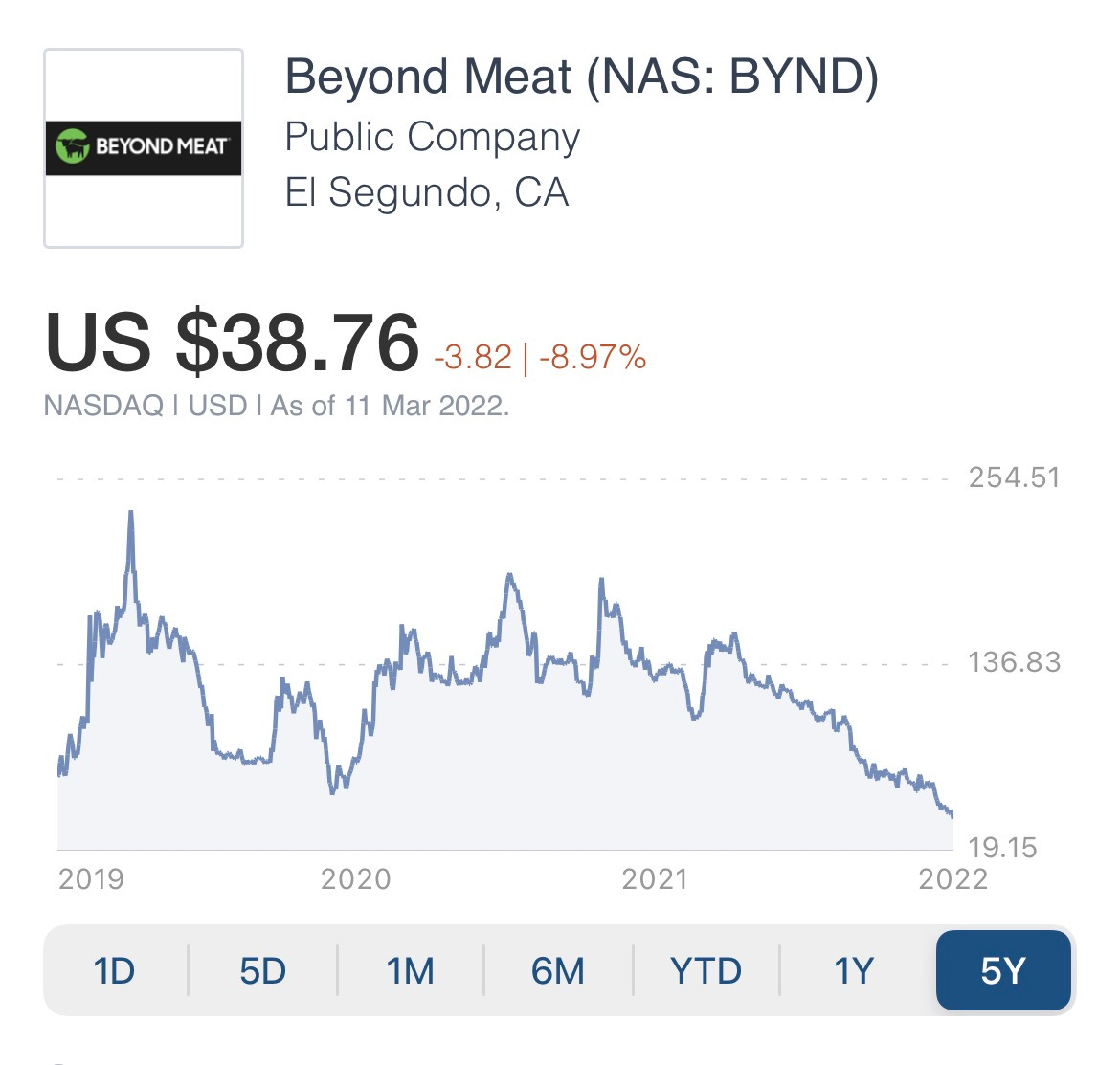
In addition to Impossible Foods, the other elephant in the plant-based room is Beyond Meat, which has sent investors on a roller coaster since their 2019 IPO.

Here’s the category update, according to the Wall Street Journal:

“Beyond shares peaked above $234 in mid-2019 after the company’s initial public offering at a price of $25 earlier that year. Shares have fallen since then as meat alternative makers have dealt with pandemic-related challenges and uncertainty around the products’ growth prospects. Beyond’s stock has fallen about 71% in the past 12 months.

Maple Leaf Foods Inc, a Canadian meat company that in 2017 acquired plant-based food maker Lightlife Foods, this week said that an internal company analysis showed that after years of rapid growth, the category had stalled.

“All major brands and products across the category are experiencing similar challenges, which largely seems to be driven by consumers’ experience in terms of taste, price, degree of processing and ease of preparation, said Curtis Frank, Maple Leaf’s president.”

Womp, womp…

Now layer on 3 dynamics about plant-based meat mania….

(1) Timing – conditions over the last 24 months were all that plant-based meat companies could have hoped for, but it wasn’t enough.

Beyond Meat when public in 2019, then record levels of venture capital flowed into the category in 2020. This was during a time when total money flowing into the venture capital class was exploding, and public markets were frothy.

And, it was at a time when plant-fed meat began selling at record prices in the meat case over the last two years, at times even being unavailable.

And yet, the plant-based meat category appears to have stalled.

(2) Competition is fierce and growing, which will continue pressuring (already negative) margins.

Plant based meat is an increasingly crowded market, including private label brands intent on competing on price, driving down margins of the whole category. If I’m a retail sales exec for a meat packer, I’m looking at this dynamic and thinking ‘welcome to the real world, kids!’

Like with any emerging trend, what matters is not the absolute size of the plant-based category relative to plant-fed meat….what matters is the growth rate.

But if the growth rate is slowing, and more emerging brands are popping up then suddenly the category is crowded and competing on price and suddenly the whole category is much less interesting to investors.

This picture is from the meat case in Safeway. Notice the seeming price differential. In reality, the plant-based burgers are $.749/oz while the prime chuck burgers are $.519/lb. But ignore the price differential, the visual quality cues here are striking, right?

You have to really want plant-based meat to pick up the one on the right; you have to have a compelling why behind that purchase….don’t you?

Especially in a time when plant-fed meat quality is high. As in ~90%-of-US-cattle-grading-choice-or-prime kinda high. That’s really high.

(3) Plant-based meat: it’s still just a veggie burger.

We’ve talked before about the 2 things venture capital has funded for plant-based meat companies are product development and marketing.

The plant-based meat category was not invented by Beyond Meat or Impossible Foods, but it was dressed up & juiced up by venture capital.

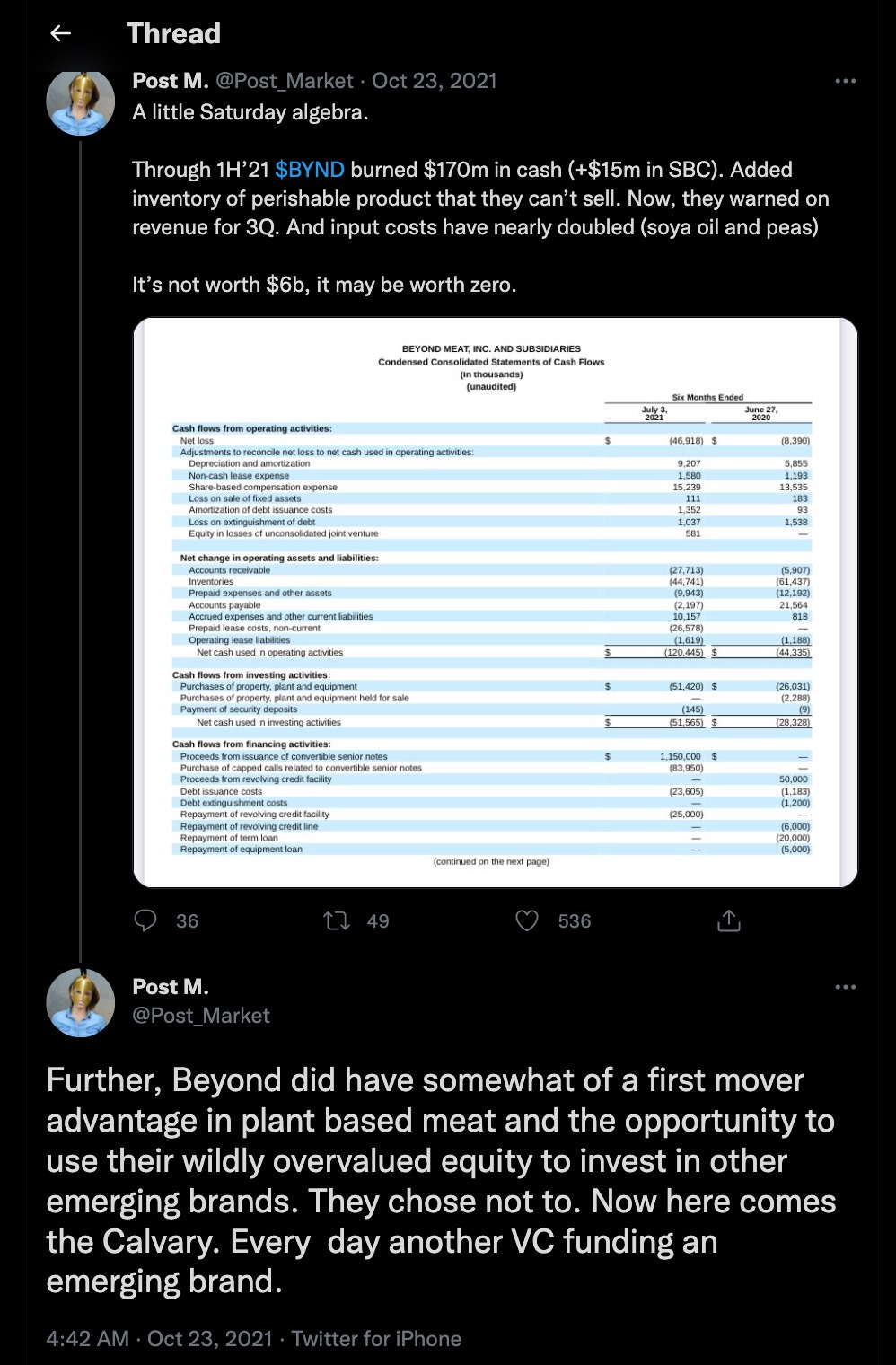
What I find most interesting about Beyond’s latest quarter results is that while total revenue was only down 1.2% YoY, retail sales were down 19.5%. Foodservice is the sales channel where Beyond is moving more product YoY. But my hypothesis is that much of the foodservice lift is from QSR chains like Burger King and White Castle trying to get a PR lift.

But the canary in the coal mine is McDonalds, and the test they are running with the oh-so-cleverly named McPlant burger. For 3 reasons:

  1. Menu board space is precious. Items have to earn their spot.
  2. Menu board space is all the more precious now, since the menu has been pared down to simplify operations and decrease wait times amidst labor shortages.
  3. Amidst a pared down menu board, sales have increased. Correlation or causation is hard to say, but it does seem reasonable to think that the hurdle to add something to the menu has been raised.

If McDonalds rolls out plant based burgers on a broad scale beyond the current trial, then my view might change.

Ok that’s a lot of negativity in one article….oops. But now let’s talk about the most important aspect: taste.

I’ve done the obligatory tasting of an Impossible burger and it tasted 97% like mushy cardboard.

But let’s say 90% of my reaction was influenced by my bias towards plant-fed meat. So let’s say the burger actually only tasted 7% like mushy cardboard. Is there really a massively growing market of repeat buyers for something that has even a hint of  a mushy cardboard eating experience? Especially in a time when meat quality is at all time highs.

But actually the obvious risk to my entire analysis is that I’m operating out of a complete bias towards plant-fed meat and it’s cultural, nutritional, environmental, societal, and experiential superiority over plant-based meat. I’m unabashedly bullish on animal protein. So perhaps this entire analysis will be proven laughably wrong over time…

One reason I do not anticipate that to be the case though, is The Lindy Effect:

“the Lindy effect proposes the longer a period something has survived to exist or be used in the present, it is also likely to have a longer remaining life expectancy. Longevity implies a resistance to change, obsolescence or competition and greater odds of continued existence into the future.”

I can’t think of a better example of The Lindy Effect than meat. Humans have been eating meat for a long, long time…that won’t change with marketing splash.

Where are my plant-based bulls?

I’ve lined out the (really) bear case about the plant-based meat category and why the sizzle will fizzle out and the category will continue to be a fixture in the meat case, albeit a shrinking fixture.

And yet, many many folks see the bull case for plant-based. That’s who I want to hear from – if you are a plant-based bull, tell me more about why that is.

What do you see that makes you optimistic the category’s growth rate will return to pre-2021 levels and sustain or even accelerate?