Categories
AgTech

Prime Future 91: Red meat & venture capital don’t go together

Riddle me this: why are there multiple venture-backed poultry production companies, but zero venture-backed pork, beef, or dairy production companies?

Kicking that around raises questions about potential disruption in meat and livestock.

Venture + Poultry

According to Crunchbase, Shenandoah Valley Organic (Farmer Focus brand) has raised $24.2 million in venture capital to “revolutionize the industry by creating sustainable, innovative partnerships between SVO and family farms. These partnerships allow farmers to retain ownership and grow profitability while also providing traceable, organic meat.”

Meanwhile Cooks Venture just closed $50M in debt financing, after raising ~$75M in venture capital to fund “building an alternative to America’s meat industry, to deliver great food from independent, regional farms. Our core values include a commitment to true transparency, and prioritizing the health of the land and the well being of our workers.”

And then there’s Pasturebird, a pastured poultry + poultry tech company, which was acquired by Perdue Farms early in the company’s growth, but otherwise would likely have gone down the venture-backed path.

So that’s (almost) 3 venture backed production companies in poultry.

Yet we haven’t seen a single venture backed production company in beef, pork or dairy. Why?

Two potential reasons:

  1. The venture model is inherently more compatible with poultry production than the other proteins. We will not see venture backed production companies in beef, dairy, or pork.
  2. The other proteins have not yet found the right production model that is compatible with the venture model. We will see venture backed production companies in beef, dairy, and pork….it just hasn’t happened yet.

Note that I am specifically raising the question about companies actually producing beef, pork, or dairy. Currently the venture backed companies in beef, pork, and dairy fall into the overly broad categories of (1) solutions & tools for producers, or (2) meat & milk alternatives.

The caveat to this discussion is that venture capital is simply a financing tool – one of many. It’s not better or worse than debt financing or bootstrapping a business. It’s the right tool only when it’s the right scenario.

Also, keep in mind that venture capital is one of the highest risk asset classes. Really high risk only makes sense when there is potential for really big rewards. Venture capital is the most effective when it is funding companies that are:

  1. High growth
  2. Low CapEx

Said differently, venture capital most effectively fuels asset-light, high-growth companies. That’s why VC’s love to love software companies.

As a reference, consider three comparisons of asset intensive vs asset light business models:

  • Hotels: Marriott (asset-intensive with ownership of individual hotel properties) with Airbnb (asset-light with regular people renting out their homes)
  • Rental Cars: Hertz (asset-intensive with ownership of cars) with Getaround (asset-light with regular people renting out their cars)
  • Education: brick & mortar universities (asset-intensive with campuses) with BloomTech (asset-light with online only delivery)

Venture capital loves asset-light, high-growth companies. And it’s hard to imagine a more directly opposite business model than that of livestock production.

Production requires livestock inventory, land, and facilities. I think we can all agree that red meat & milk production is an incredibly asset intensive business. So….asset-intensive, (generally) low-growth. Probably not a fit for venture.

Not to mention, read meat & milk producing livestock naturally tie up cash for longer periods than poultry. In the Future of Ag podcast episode, Paul Grieve from Pasturebird talked about when they were starting the company that he would put the cost of purchasing chicks on his credit card and by the time the credit card payment was due, he had income from selling the birds for meat. That’s not really an option for red meat or milk production.

It’s why Bo Pilgrim & John Tyson were able to scale up their vertically integrated poultry model so quickly in the 60’s and 70’s, yet not only did beef never vertically integrate, what integration did exist has been undone as the packers sold off cattle feeding.

But back to our two options. Is the venture model just not a fit for red meat & milk production, or have we just not seen the venture back-able business model yet?

The most reasonable answer is that a venture backed beef/pork/dairy company isn’t a viable thing for the same as the reason that vertically integrated cattle production isn’t a thing – the asset-intensive nature of the business.

However the techno-optimist in me thinks that there is some future business model that will leverage technology and aligned supply chains in an asset light, scalable way that will benefit livestock producers, and packers, and consumers.

What is the future business model for livestock production that is asset-light, high-growth, and compatible with venture capital? I don’t know. But the most interesting companies are the ones that make previously held assumptions about what won’t work, look obvious in hindsight that it will.

This topic gets all the more relevant if let’s say, oh idk, the plant-based meat category fizzles and sends investors on a search for ways to disrupt animal protein from within. But more on that next week…

For you:

Let’s say you had $15 million to start a business to produce pork, beef or milk.

There are no other constraints but the business has to produce one of those 3.

What would the business model be?

Categories
AgTech

Prime Future 89: How could pastured poultry scale?

The US chicken industry processes ~9 billion birds each year.

I can’t find good data on what percentage of that is pasture raised, but my guess is <.001%. Why is pasture raised poultry a negligible piece of the industry?

Because mainstream chicken is raised in amazingly efficient systems, where costs are managed to the fraction of a cent and live performance metrics like feed conversion are managed to the hundredth of a pound. Amazingly efficient systems = amazingly affordable protein.

Meanwhile pasture raised poultry is land intensive, labor intensive, and therefore cost outlandish for most people. It’s the very definition of a niche category.

So, why waste time talking about a tiny sliver of the industry when the day in day out poultry is produced by large scale vertically integrated companies?

Because we are here 👏🏼for 👏🏼the 👏🏼 script 👏🏼flips.

Pasturebird is working to break down the barriers that make pasture raised poultry impractical at scale; they’re using technology to flip the script.

Paul Greive, founder of Pasturebird, joined the Future of Ag podcast for an interview about the dynamics that led to the creation, early growth, and acquisition of the company.

Click the image to listen to the episode

Pasturebird has two elements that make their business interesting:

  1. Proprietary technology to decrease production costs.
  2. Consumer facing chicken brand.

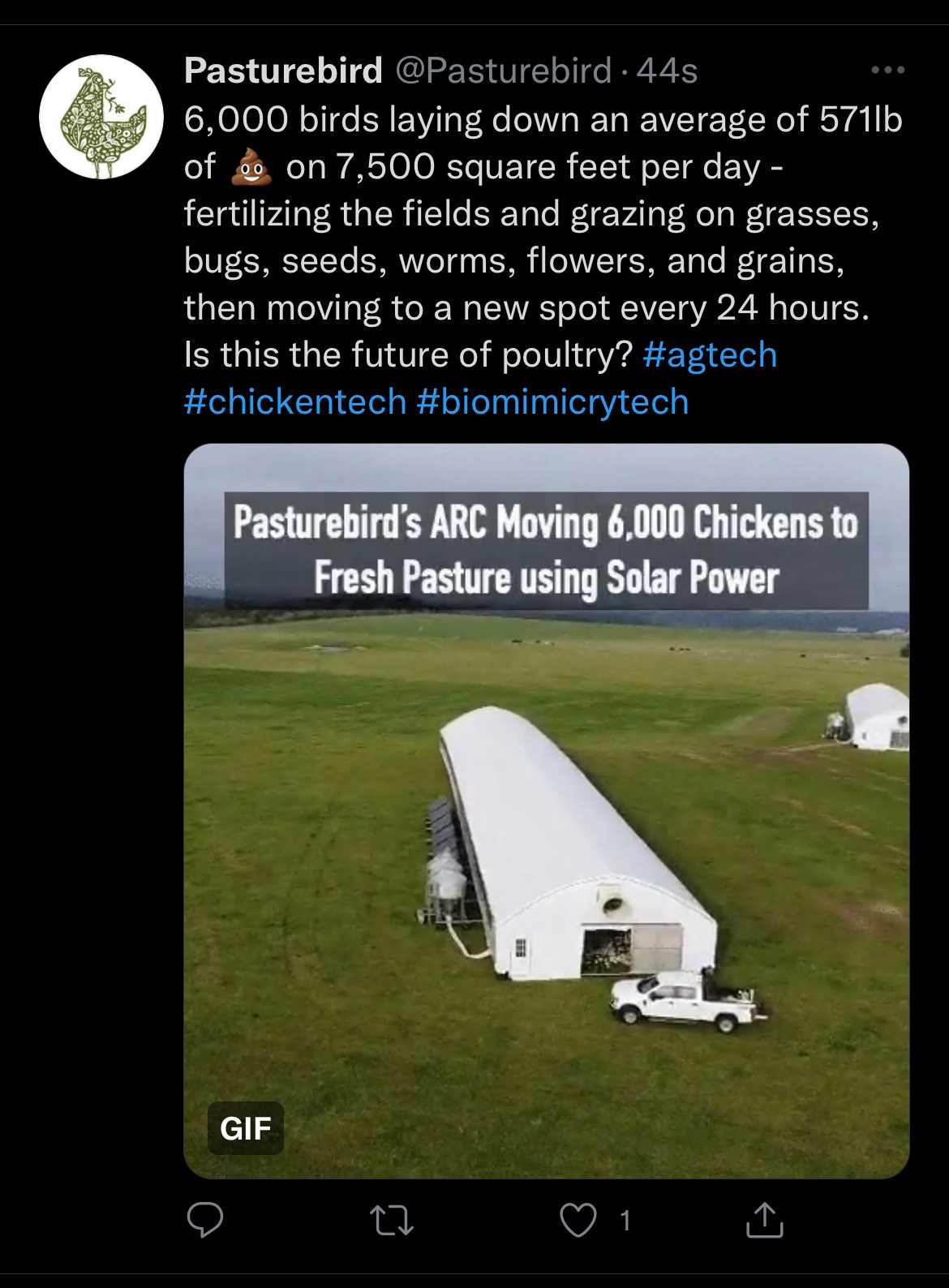
Paul describes their proprietary technology as an “automated range coop, a solar powered 6000 bird structure that’s 150 feet by 50 feet with independent drive motors that actually drives the system to fresh pasture each day.” The technology was designed to reduce the extremely high labor costs associated with pasture raised poultry.

Pasturebird was acquired by Perdue Farms, a company that bets on brand and markets on production attributes.

Paul covered a ton of interesting ground in the interview, but here are 5 takeaways from Paul’s insights:

(1) Impact demands scale. “We wanted to take the best from conventional ag and the best from small scale pastured poultry. Our whole mission as a company is to make nutrient dense pasture poultry more accessible and affordable. In order to scale pasture poultry, we need to take the labor out and start to get some of the efficiencies as conventional production.” Do you hear the AND at the center of their thesis? Thats a pragmatism that’s often missing from folks on the niche end of the industry.

(2) Low cost, and… “For 30-40 years people asked the big companies for cheap chicken, and they’ve delivered. People are now starting to ask for something different and companies are trying to figure out how to do that. Now people are saying it’s not just about a good price, it’s also nutrients, etc.”

(3) Nutrient based pricing? “We’ve relied on attribute based marketing in meat for 30 years. Now there’s an opportunity to shift to outcome based marketing. There’s a big opening in the market to go deeper with data and analytics and lab results than ever before.” Imagine a world where instead of looking at a price per pound of chicken sticker, you were looking at a price per unit of protein, omega 3’s, Vitamin E, etc. Crazy, right? 🤯 Maybe not.

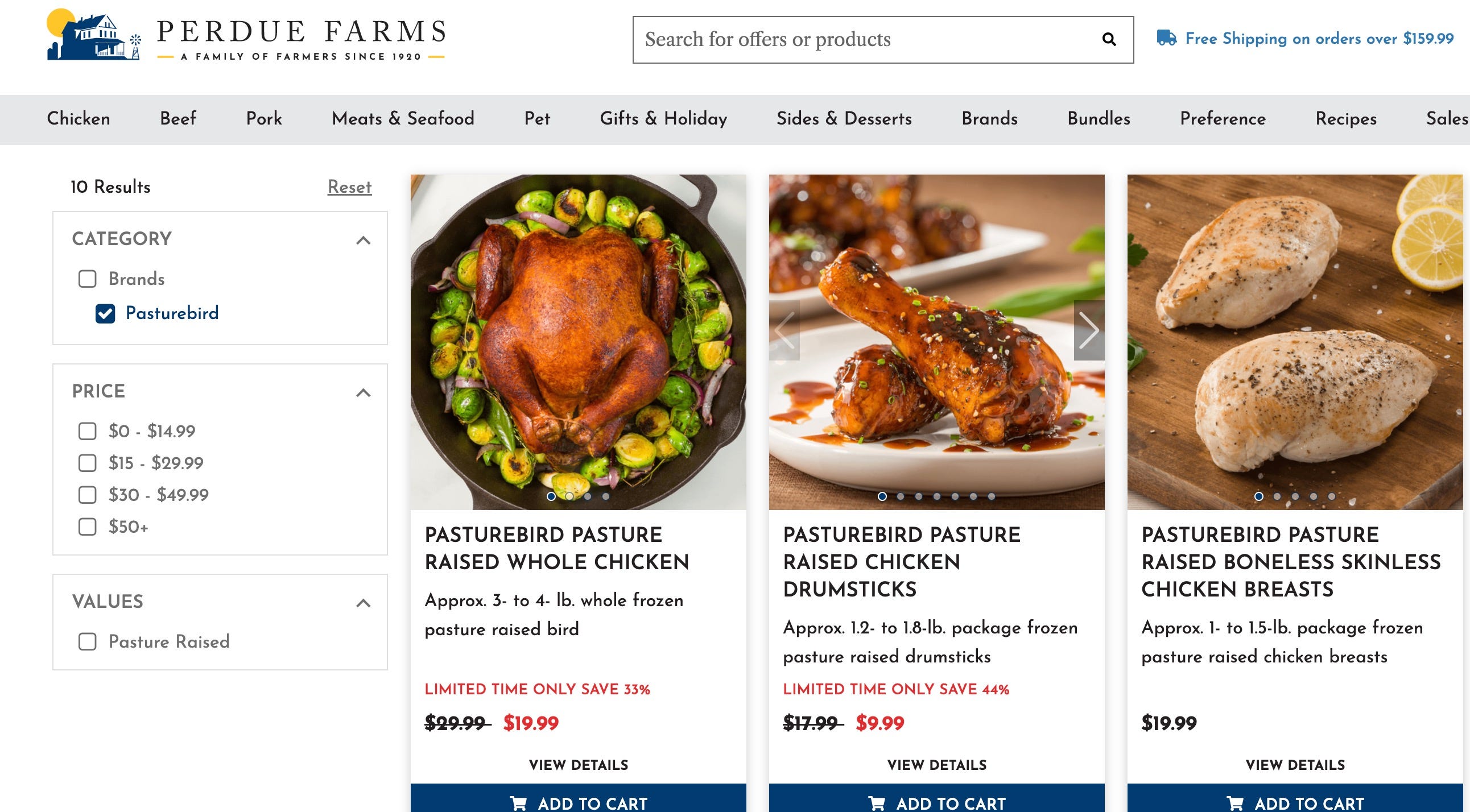
(4) Omnichannel expectations. Pasturebird customers can purchase chicken direct from Pasturebird, via CrowdCow, or via Perdue Farms’ ecommerce site. Paul points out in the episode that it’s not about exclusivity to any single D2C channel, customers rightly expect to be able to purchase their brands anywhere shoppers in that target market might be. Omnichannel = convenience.

(5) Most importantly, make the niche less of a niche. “Electric vehicles will become cheaper when they reach scale. I don’t know if that will be our story but I think we can get competitive. If we can get within 10-20% of the ‘Walmart baseline’ then we can be competitive. We have to get away from the current 3x price to have impact though.

It’s easy to write pasture raised poultry off as a hyper-niche segment but remember the central idea of the Innovator’s Dilemma is that incumbents run the risk of missing emerging trends because emerging trends begin on a minuscule scale - by definition.

Emerging trends grow gradually then suddenly.

My favorite business strategy podcast is Acquired. In each episode they deep dive into a different company’s strategy, particularly acquisitions (obvs), followed by an analysis based on Hamilton Helmer’s 7 powers. The 7 powers are:

  • Scale economies
  • Network economies
  • Counter positioning
  • Switching costs
  • Branding
  • Cornered resource
  • Process power

From that framework, Pasturebird seems to leverage the following powers:

  • Counter positioning. The ~899,999,990,000 chicken processed in the US each year are raised in wildly efficient systems of stationary indoor housing and every few flocks, chicken litter is moved from inside the house to on the field. Pasturebird said hey what if we can do the opposite.
  • Scale. In a niche where small is the default, Pasturebird built the business around the assumption that scale is necessary.
  • Cornered resource. Pasturebird does not currently sell their proprietary technology, they use it for their own poultry production. Given what a critical role the technology plays in the business model, this gives Pasturebird a competitive advantage in its category by having this cornered technology resource.

Many thanks to Tim Hammerich for sharing the Future of Agriculture podcast mic for this episode, and to Paul for his insights.


If you are new to Prime Future, welcome!

To catch up on almost 2 years of Prime Future content, here are two available downloads:

Prime Future editions 0 – 81

Get the ebook with editions 0 – 81 🚀

Beef x Dairy: What does this emerging trend mean for the beef industry?

Get the beef-on-dairy ebook 🐄


I’m interested in all things technology, innovation, and value creation for every link in the animal protein value chain. I’m on the Merck Animal Health Ventures team where we invest in early stage technology companies who are creating value for livestock producers.

Prime Future is where I learn out loud. It represents my personal views only, which are subject to change…’strong convictions, loosely held’.

Thanks for being here,

Janette Barnard

Categories
AgTech

Prime Future 80: Can farmer facing agtech startups IPO?

Two late stage Agtech companies have each raised ~$1B in venture capital but they haven’t IPO’d yet. There were 4 agtech SPACs this year, but there have not been as many good old fashioned IPOs. Since the Agtech era was kickstarted by the 2013 Monsanto acquisition of Climate Corp, there haven’t been any notable agtech IPOs to point to as success signals.

Why?

Set aside all the obvious financial hurdles of what it takes to be IPO ready. For startups who sell directly to farmers, my hypothesis is that there are also tricky customer dynamics to navigate in the transition from privately held company with undisclosed financials to publicly traded company with fully disclosed financials.

If this sounds like an overstatement then maybe you missed how Farmers Edge was excoriated by #agtwitter after their IPO, with farmers relentlessly mocking the company’s financial results.

(Aside: check out Upstream Ag Insights analysis on the Farmers Edge IPO)

But it makes sense that farmers would experience a disconnect in the financials of an agtech company compared with their own approach to accessing capital.

Could two financing models possibly be more juxtaposed than the VC backed, growth now profit (hopefully) later tech startup model and the typical traditional debt financing model for most farms? I doubt it. Technology companies often IPO while showing big losses in the pursuit of growth as long as unit economics make sense; while farmers who operate at persistent losses go bankrupt.

Completely different financing models for completely different business models in completely different markets.

While farmers are generally not impressed with venture capital hype, there doesn’t seem to be much of a customer perception win for farmer facing agtech companies who go public. Let’s take 2 extreme possible outcomes of an IPO:

(1) The company IPO’s and their financials reveal that the company is operating with high EBITDAWait, high EBITDA? That must mean the company is taking advantage of producers. Who are we, a bunch of suckers? Riot.

(2) The company’s financials reveal that the company is operating at huge lossesHuge losses? This isn’t even a real business? Riot.

What if the only acceptable and respectable option in the eyes of a farmer customer base is to be profitable but ya know, not too profitable.

Impress investors at the risk of disenfranchising your farmer customer base, and vice versa.

Rock. Hard place.

So, are late stage agtech startups delaying IPOs and staying private longer because they are concerned about what farmer customers will think of their financials, or because they are concerned about what The Street (public investors) will think of their financials?

Assuming these late stage agtech companies are substantive businesses, the number of mature non-ag startups that have IPO’d in the last 2-4 years with high revenue yet operating at huge losses (e.g. Uber, Lyft, Airbnb, Lemonade, etc etc etc) seems to negate the idea that mature agtech startups are delaying IPOs because of lack of public investor appetite.

I readily admit that this hypothesis that farmer facing agtech startups are delaying IPOs because of farmer perception concerns may be wrong. I’d love to hear your counterarguments, here are my own:

(1) Each of those non-ag companies mentioned above (Uber, etc) had raised significantly more capital in private markets than these agtech companies have, their total addressable markets (TAM) were larger, and presumably they went public at much higher revenue than what these agtech companies will when they IPO. So it’s not apples to apples. Maybe it’s not even fair to apply the label ‘late stage agtech companies’, maybe in the grand scheme of things they are just mid stage and have a long way to go & grow in private markets. Perhaps.

(2) Many companies upstream and downstream from farmers have been public for years or decades and seen tremendous growth. Maybe that means the hypothesis is wrong, or that even if the hypothesis is correct and farmer customers won’t like seeing the financials of a venture backed company gone public, that it doesn’t matter whether the company is privately held or publicly traded because we humans (including farmers) are just one news cycle away from something else to get worked up about. Perhaps.

(3) Did Farmers Edge experience a negative commercial impact after the IPO? If not, then the noise about it all was just noise and my hypothesis is incorrect. Perhaps.

(4) The burdens of being a public company are so much higher than being privately held, why would anyone IPO before they have to?? Perhaps.

What I find really interesting are the agtech founders able to thread the needle of operating in a ‘VC light model’, where they find ‘patient’ venture capital that allows them to build a company that reflects their farmer customers values and sets them up for long term success, not flash in the pan hype of the venture treadmill but rather build for the long term, one brick at a time. A ‘fit the financing to the business’ approach rather than ‘fit the business to the business to the financing’ approach.

That takes discipline, especially in a market like we’re in now. And just to contradict my own hypothesis, maybe accessing private capital further into the company’s life allows late stage startups to do that. Perhaps.

For how long will late-stage agtech companies continue raising capital in private markets and avoid the inevitable scrutiny of publicly traded companies? TBD.

Categories
AgTech Business Model Innovation

Prime Future 78: The gate’s closing on 2021

With the gate rapidly swinging shut on 2021, here’s a look at the 5 most popular Prime Future editions this year:

(5) Egos & Incentives

Sometimes in the B2B world it’s easy to assume business decisions are driven solely by an ROI calculation, neatly tied with an Excel bow around a carefully curated formula. Or in the farm world, that every decision is justified by the output of the almighty shirt pocket calculator.

But in the real world, rarely can an ROI be fully captured numerically. Other factors impact decisions, including the psychological factors. I summarize this as Egos & Incentives.

Numerical ROI is necessary, but it’s not sufficient. At the margin, decisions are made based on their impact to our egos and incentives, including decisions about adopting new products, practices or ideas:

  • Incentives: How does this help me achieve what I’m incentivized to achieve, what I want to achieve?
  • Egos: How does this impact my view of myself and my place in the world, aka my ego?

We’re all out here responding to incentives, intentionally or unintentionally, doing the things to get the job, the bonus, the contract, the new customer, the promotion, the upsell, the renewal, the fill in the blank. And no surprise, we all have egos. Every last one of us, even those who say they don’t (perhaps especially those). The advertising industry is built around these fundamental truths of human nature.

And though it can be framed at an individual level, I believe it’s just as true at an organizational level because, of course, organizations are just big groups of individuals, still responding to egos and incentives.

The fundamental question to ask about new products is, where does value accrue and where is cost incurred?  If the packer accrues the value but the producer incurs the cost, well….that’s probably not going to go well because incentives are not aligned. The challenge of incentive alignment is why business model innovation can be just as high impact as tech innovation, if not more so.

Read more


(4) 💡3 reasons why dairy is the new beef

I started this series with an assumption that beef breeds create better beef carcasses than dairy breeds, or dairy x beef crossbreds. But here’s the surprising little secret: Beef x Dairy cross carcasses are as good or better than straight beef carcasses, or ‘natives’ as the people say.

The beef on dairy genetics jigsaw puzzle allows dairy producers to make decisions that get the best of beef and dairy breeds, to use ‘elite terminally focused genetics’ on the beef side that offset the dairy deficiencies.

Consistency is the name of the beef on dairy game. There are 3 elements of consistency that beef on dairy can offer to the beef value chain:

  • Year round continuous supply of calves to the feedyard, and then to the plant.
  • Genetic consistency given how narrow the genetic base of dairy cattle are since AI has been used so widely for so long.
  • Management consistency – while a beef animal could move through 2-3 sale barns between weaning and arriving at the feedyard, beef-dairy crosses are much less likely to go through a sale barn at all. They’re more likely to move in large lots from calf ranch to grow yard to feedyard, or directly from calf ranch to feedyard with consistent management in each phase.

Value is only value when it’s recognized by the buyer, in this case the packer. The value chasm is wide between a dairy animal and a beef animal, so the challenge for beef-dairy animals is to get them priced like a native. One producer said it this way, “packers are looking for a reason to price a beef-dairy cross like a dairy animal. You have to get the animals on a grid to get a base price where it should be.”

Capturing full value of the beef-dairy animal requires closely aligned partnerships all the way through the value chain to the packer. Aka aligned supply chains or coordinated supply chains.

Will it be surprising if Dairy Beef aligned supply chains grow and consolidate over time to find the efficiencies of scale without the capital intensity of true vertical integration? Not at all, that’s the nature of the agriculture game.

So, the 3 ideas that make beef-on-dairy shine:

  1. Beef x Dairy cross carcasses are as good or better than straight beef carcasses. (Think of it as having your cake and eating it too, but ya know, beef.)
  2. Beef-dairy crosses hold a consistency advantage over the traditional fragmented beef value chain.
  3. Beef-dairy cross value chains are forcing new partnerships in order to capture full value at the packer level.

Which is all fine and well, until we come back to the math of beef on dairy. If we are really only talking about 5M calves annually, out of 25 million total fed cattle, it raises the question of….so what?

What happens with 5M beef dairy crosses is interesting, but the really fun part will be seeing how the 5M could influence the 20M.

Read more


(3) Where’s the honeycrisp of the meat case?

I love wandering the aisles of a boujee grocery store. HEB, Whole Foods, Wegman’s…here for them all. Naturally a highlight is walking the produce aisle, letting your eyes take in the color explosion and the magic of plant genetic creativity brought to life: fizzy grapes, plucots, strawberries with more shelf life, sweet peppers with more flavor. Or, the crown jewel of the entire produce aisle: the Honeycrisp apple….pure magic. (I’m honestly not convinced they aren’t laced with something highly addictive.)

While plant based burgers aren’t my thing, objectively the product itself has completely transformed – and continues improving – as a result of innovation and R&D investment. Pat Brown, CEO of Impossible Foods, has been vocal about his strategy: bring about a world without livestock for meat by offering a plant based meat product to the world that meets consumer’s objectives on taste, cost, and nutrition so they do not have to make a values based tradeoff.

Which is a smart strategy! It’s the Tesla strategy. It’s ‘product first’ which inherently means high investment in product development.

Now let’s go to the retail fresh meat case where things have remained unchanged for, um, a while. That steak or pork chop or chicken breast is basically the same as it has been for the last 30 years. Why is that?

Most genetic progress in livestock centers around live performance, not end product outcomes.

We talk about genetics in terms of live performance metrics: Feed conversion. Growth rates. Calving ease. Hatchability. None of these are attributes you can see at the meat case.

Improved live performance is producer language, not meat case language.

We all know the amazing genetic progress over the last 50 years across livestock. Drastically improved feed conversions and growth rates have led to much lower production costs per pound of meat/poultry/milk. Great for producer, beneficial for consumer. I’m not taking anything away from the economic or environmental impact of that live progress….but I am saying, maybe it’s not enough?

Like it or not, we live in a what-have-you-done-for-me-lately world….so where are the product development innovations in meat that are noticeable to the consumer?

Where’s the meat case equivalent of the Honeycrisp apple?

Read more


(2) Lunatic farmers & velocity 🚀

The owner of a dairy was lamenting the rise of mega dairy systems and the risks they pose to small dairies like hers. How many cows does her dairy milk?

7,000

It’s a laughable story except that this dairy farmer & her family have grown the herd from a few hundred to several thousand over the course of their career. They’ve struggled and strived, taken risk after risk to get where they are. And yet in their minds, they still identify as small, scrappy, insurgent producers trying to survive.

There’s a special irony in the tendency among farmers to want to be bigger than neighboring operations. Sometimes bigger is better, sometimes smaller is better. But farm size is not the sole indicator of success and it definitely should not be the sole goal.

My hypothesis is that scale is a lagging indicator; velocity of business model innovation is the leading indicator of success.

The more commoditized the business, the stronger the pull to scale to reduce cost per unit.  The more value oriented the business, the stronger the pull to create incrementally more value per unit. There’s no clever analysis in those statements – those are natural forces that are a function of capitalism and a mature agriculture industry.

I think the successful producers (or packers or xyz business) who will thrive come-what-may are the ones who don’t think of their business based solely in terms of the output (corn, soy, weaned calves, whatever), but rather view their business as a business model that is is in continual refinement. They constantly ask what’s the process that most effectively generates the output. They think in systems that can optimized.

It seems that the really successful producers are the ones that have a vision of where they are going and how they will get there. There’s no doing it this way because that’s how we’ve done it, there’s no growth for the sake of the growth. There is only relentless learning and improvement.

The great producers realize that they aren’t selling just a commodity output, they are selling their business model.

Size is not the determinant of success. It’s about business discipline, management, relationships, processes, team, leadership, ambition. Successful producers have a vision for the future that they rally the team around, there’s an ever evolving plan for increasing revenue per unit produced or decreasing cost per unit produced, or both.

I recently asked a really large operator how they grew their business over the last 20 years from something not at all uncommon to something truly extraordinary. Did they have access to capital that others didn’t have? Some other advantage not available to similar producers? “I don’t think so, I think we just do things in a different way than most people are interested in doing. We do a lot of things that aren’t uncommon for most growing businesses, they are just uncommon for production ag businesses. We have a yearning for learning.”

Let’s call a spade a spade – capital is abundant and cheap in 2021, as it has been the last several years. Ideas are a dime a dozen. It’s everything else that separates the aggressive producers from the rest.

I’ve referenced Allen Nation’s book before, but germane to this conversation is a chapter on how farmers approach innovation with insights pulled from a 1962 book “Diffusion of Innovation” that studied extension efforts to get farmers to switch from open pollinated to hybrid corn post WW2.

“The innovative farmer is seen by his farm neighbors as a lunatic farmer. And a lunatic is not seen as a role model. As a result, what the innovator does on his/her farm is literally invisible to the neighbors. This is true even if the innovation is producing visible wealth. The normal reaction to unconventional success is the old it-might-work-there-but-not-here syndrome. The sad truth is that the vast majority of farmers prefer to fail conventionally rather than to succeed unconventionally. It is very, very difficult to be more innovative than the community in which you live.

Here’s the really germane part: “No farmer referenced what a farmer smaller in acreage than themselves was doing as applicable or worthy of study. Everyone preferred to learn from someone larger than themselves.” Isn’t that fascinating?

I’ve recently observed some markers that lunatic farmers seem to have that indicate high velocity of business model innovation:

  • They ask questions. A lot of questions. They find smart people to ask questions. They find smart people in non-traditional places to ask questions.
  • They read. Not just industry magazines, they look outside.
  • They have a sense that what they are saying sounds half crazy, dare I say they know it might make them sound like a lunatic farmer.
  • They surround themselves with high quality people, high quality teammates.
  • They have a system they are building/running, a flywheel they are looking to spin faster.
  • They have some insight that most of their peers don’t, some belief that isn’t widely held.
  • They know new practices & ideas take time to implement correctly, so they allow margin (time, energy, $) to experiment.

Read more


(1) The packers get Standard Oil’d. Then what?

If an oligopoly market is when 4 firms have 50+ percent share, then US beef, pork, and poultry are undeniable oligopolies. These concentrated markets aren’t uncommon though, we run into them from cereal (Kellogg’s, General Mills, Post, and Quaker) to cell phones (Apple, Samsung, Huawei).

But these examples are child’s play compared to the most extreme example of market power: the classic story of Standard Oil. In the 1880’s, John D. Rockefeller realized the oil business was a fantastic business except for the nagging issue of price volatility. So he found a solution to that little problem, by developing an effective monopoly through the Standard Oil trust. A Supreme Court ruling in 1911 forced the trust to split into 34 companies to increase market competition.

The current rally cry of many US producers is that the problem with the cattle business is concentration among the packers. This is not new; tale as old as time. But carry that rally cry out to the most extreme outcome of de-concentrating processing capacity….what does it really solve?

Just for fun, let’s say the DOJ goes full 1911 and ‘Standard Oils’ the meat industry.

Every plant becomes its own company.

The ‘Big 4’ become the ‘Midsize 22’.

Then what? Before we lock into any hypotheses about a re-fragmented meat industry, what was the result of busting the Standard Oil trust?

Would a Standard Oil’ing of meat packing be good for downstream players? Maybe, in the short run. Probably not in the long run.

Would a Standard Oil’ing of meat packing be good for upstream players? Maybe, in the short run.

But what’s not good for downstream players in the long run cannot be good for upstream players in the long run.

Hear me loud & clear that profitability at all stages of the value chain is the #1 foundation of a viable cattle industry. Increasing margin capture throughout the value chain is a good thing, a great thing. But is reducing packer power the panacea that people often describe it as? I may be wrong, but I just don’t think it is.

Maybe looking at impact of competition on pricing power & innovation is the wrong framework….maybe higher margins don’t lead to innovation, maybe innovation leads to higher margins.

Read more