Categories
AgTech Animal AgTech Developing economies Markets

Prime Future 145: What would Norman say?

Ugh. That was my reaction when my book club chose a book about life in a Mumbai slum called, ironically, behind the beautiful forevers.

We normally read historical non-fiction narratives like The Splendid and The Vile, Endurance, and The Warburgs. Books that have that great combo of inspiration and interesting information. Not books that make me want to cringe at the bitter reality of people sharing the planet at the exact same time I am and yet our lives could not possibly be more opposite.

I just finished this book and am left with a simultaneous sense of relief (thank goodness the book is over and I can go back to my bubble) and lingering dread at the weight of a book like this that kinda seeps into your soul and gets stuck. It’s the reminder of real human suffering because someone put a name and the specifics of a story to a statistic, to the million ways that poverty slices at human dignity, as the struggle to meet the most basic needs of survival leads to the horrors of corruption, parents forced to choose between awful and terrible options to keep their kids fed, etc.

Ugh, indeed.

And yet, contrary to popular assumption there’s so much reason to celebrate progress and to be optimistic; there are fewer people in extreme poverty today than ever before, both in absolute numbers and as a percentage of the total population.
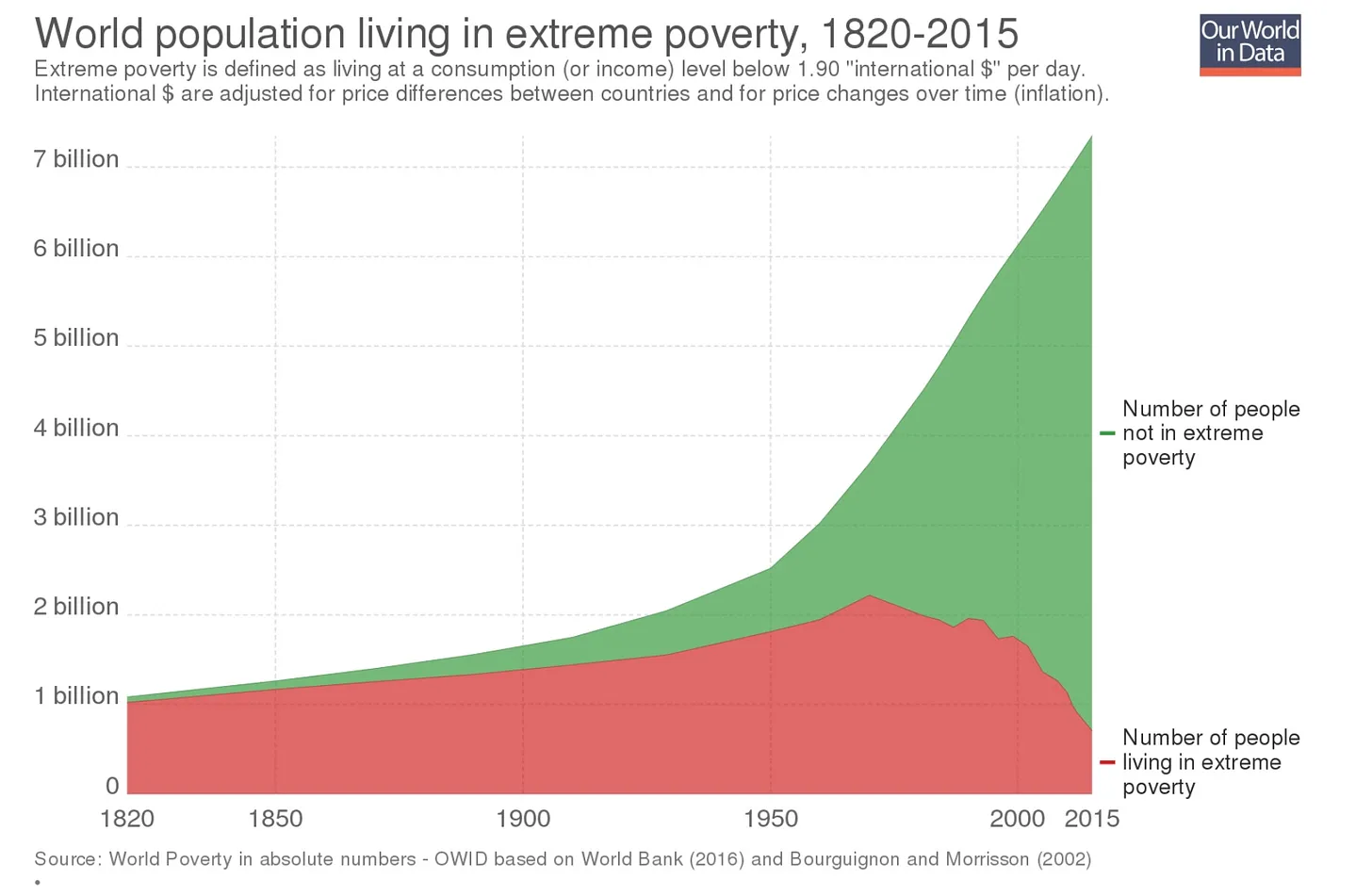
This outdated mental model from ‘our world in data’ stands out:

“Two centuries ago the majority of the world population was extremely poor. Back then it was widely believed that widespread poverty was inevitable. But this turned out to be wrong. Economic growth is possible and poverty can decline.”

Clearly, the reasons behind the positive story in this chart are multi-factorial, but industrialization and continued innovation have played a major role in reducing the number of people on the planet in poverty, including agricultural innovations. (After all economic development in developing economies is, by definition, agricultural development.)

That inflection in 1950 is interesting, while I don’t what caused it, I wonder…

…what if the real promise of agtech is to be the next inflection point to elevate more people from extreme poverty?

This whole topic converges with Prime Future’ish topics when you set it next to:

  1. The seemingly unending discussion <waves hands> about reducing the GHG footprint of livestock.
  2. The discussion about whether animal agtech is venture viable.

If we want to reduce the global GHG footprint of livestock, meat & dairy, then emerging markets have to be the focal point for interventions and innovations.

A lot of capital is being plowed into reducing methane emissions in livestock but largely for regions with livestock production systems that are already highly efficient, especially in comparison to their counterparts in developing economies. Not only are many of those solutions only nominally interesting in terms of value creation for producers (and tbd for consumers), many are also only nominally interesting in terms of the job those interventions would be hired to do which is to reduce the global GHG footprint of livestock.

I recently heard Frank Mitloehner from UC Davis say that ~80% of the global livestock GHG footprint comes from developing economies.

So focusing on reducing the GHG footprint of the beef industry in the US or the dairy industry in New Zealand is just playing around the edges of the global problem, at best. Mathematically, it just doesn’t matter much.

If reducing the global GHG footprint is the goal, then the biggest impact is far and away to be made by enabling emerging economies to shift from smallholder agriculture to commercial-scale agriculture to become, by definition, more efficient in the business of producing meat, milk and eggs, and simultaneously lower the GHG intensity.

As an example, as more innovations unlock value in India’s dairy industry, will they still have 200 million dairy producers milking 300 million dairy cows & water buffalo in 20 years? In 10 years? Maybe it becomes 100M producers milking 80M cows as they increase output with less animals – that’s the history of the US beef and dairy industries, as well as other highly efficient markets. Better economically & environmentally.

(The CLEAR Institute did a great write-up on this phenomenon and why efficiency has to be part of the GHG conversation.)

All of this unlocks the basic economic idea of specialization – those who are good at the business of producing milk produce more milk and those who are not good at it go find something else they are good at that contributes to the economy.

But obviously, the challenges that developing economies face are incredibly complex; if these were simple problems they’d be solved by now. I don’t mean to sound reductive, and in no way am I suggesting that agtech is, will be, or ever could be The Answer for developing economies…but ag innovation can be a piece of the puzzle.

And we know this is possible because we’ve seen it happen before.

Exhibit A: Norman Borlaug’s work on dwarf wheat. (If you haven’t read his biography, you’re missing out – incredible story of the ridiculously high impact potential of ag innovation.)

The question is which agtech solutions can be as high impact as dwarf wheat?

Changing agricultural economies requires things we take for granted in places like Ireland, Canada, or France….things like access to capital, access to efficient markets, access to buyers with high-value processing capacity, strong risk management tools, etc. Those sound like problems agtech can at least play a part in solving, don’t they?

(Tho of course, you need things like natural resources, roads, access to water, electrification, political peace, reliable governments, strong property laws, etc – none of which agtech can solve.)

Oh, and VC’s want venture returns to justify continued agtech investment? And agtech founders want to create real value for the world?

It’s not gonna happen with marketplaces in the US. Replacing relatively efficient analog marketplaces with digital marketplaces does not create much value here, it’s incremental at best.

But mention marketplaces to Mark Kahn from VC firm Omnivore that invests in agtech companies in India and he’ll tell you marketplaces can change entire sectors by giving buyers and sellers a cost-effective means to connect and transact.

In emerging markets that are mega fragmented and low yielding, agtech innovations can be legit game-changing. And not just marketplaces, all the things we throw in the agtech bucket.

What if the real promise of agtech is that the combination of existing & emerging tech with existing & emerging business models can actually change economic trajectory?

We can keep funding agtech that tweaks around the edges of production in developed economies, or we can direct technology and solutions to the places where they can create the largest delta, the most change between current state and future state.

Clearly this isn’t a new idea tho, I’m late to the party – there’s a lot of startups and investors who are way ahead in this idea of far greater potential for emerging agtech in emerging markets.

Maybe I’m having an agtech crisis of belief, or maybe I’m just tired of talking about first-world problems like how to make the really efficient thing marginally more efficient.

Either way, maybe emerging markets really are the path forward for agtech to make its dent in the universe.

Not for the sake of cool tech but for the sake of progress that actually enables human flourishing. At the end of the day, isn’t that what it’s all about?

I think Norman would have said so.

Categories
Markets

Prime Future 111: Is that premium for actual quality, or just peace of mind?

There’s a West Wing episode where the new hired gun campaign manager for President Bartlet is asked how the campaign is going to sell an unpopular new policy. The campaign manager replies that they just need to do it “the same way PT Barnum sold a truck load of white salmon; by sticking labels on that say ‘guaranteed not to go pink in the can’.”

I just spent the weekend with friends who are parents of young children. Although my friends (and family for that matter) don’t quite know what I do, they know I love all things livestock, meat & dairy so naturally, they had some meat & dairy related commentary.

The first topic was the friend who gave a thorough category review of frozen chicken nuggets with a piercing analysis concluding that Tyson’s all-white meat dino-shaped nuggets reign supreme among parents and children. Apparently, this is sacred ground and substitute products have no place. Hats off to you, Tyson Foods – if my friend gets a dino nugget tattoo I will be zero percent surprised.

The second topic was the friend who recently did a massive amount of research on baby formula because of the formula availability crisis. She went all the way down the rabbit hole trying to identify the very best option on the market. She asked if I knew of a specific type of dairy farm in Europe that is widely recognized by Internet experts as the superior source for ingredients in infant formula.

The questions behind the question were, “does this certification that I’m paying extra for mean that I’m buying formula that really is the highest possible quality for my child? Am I paying for actual quality or is someone just trying to make me feel good or feel like I’m buying high quality?”

I obviously had no idea. I’d never heard of that certification but when I looked it up, it sounded like it was certifying practices that exist on most dairies and/or would have little to no bearing on the quality of milk output. (I didn’t say that to her though – my assumption is that if people want to pay for something that has real or perceived value, that’s the beauty of the free market.)

But the other friend in the conversation started peeling the layers, and asking more questions about common marketing phrases around meat and dairy including the differences in pasture-raised and cage-free eggs.

We were casually kicking these things around (and yes I was trying super hard not to go into full Nerd Mode) when one of them said, “look I don’t know what happens on the farm and I don’t mind whatever it is, I just want to know if something is worth paying extra for or not.”

She then made the analogy that in Arizona, school districts can go through the 3rd party accreditation and audit process to receive an “A+” label. It’s a thorough and resource-intensive process, and often school districts right up the road from a formally certified A+ school can be doing the same right things but the neighboring school didn’t go through the expense and hassle to get the stamp of approval. The same quality of "product", but one has a stamp of approval and one does not.

This conversation with bright and curious customers of meat and dairy got me thinking about what might be true of marketing in the meat and dairy case:

Value is in the eye of the beholder. And yet, consumers are at the mercy of what they are told….by brands, by influencers, by media.

You know I don’t think the answer is to “educate consumers” or make farm experts out of every person who walks in a grocery store, that’s an absurd objective that sets everyone up for frustration and failure. No one wants to hear us ag people when we activate Nerd Mode!

And yet, when an information vacuum exists, someone fills it. Most consumers are not stupid, but neither do they have the context to be subject matter experts with well-developed BS radars.

So how do we solve for the consumer’s desire for quality, or for a specific attribute, without dumping 160 years of research on them at once?

Ultimately the responsibility falls on brand managers who are marketing a product via a brand, aka monetizing a specific set of features and benefits to a specific set of potential customers.

That’s where the whole suite of decisions are made that send signals downstream to consumers about what to care about, and upstream to producers about what to produce. But sometimes marketing fails.

The 2 most grievous marketing failures being:

  1. Where there is a quality difference and the consumer doesn’t know about it (and the producer doesn’t get paid for it). A marketing failure of UNDER marketing.
  2. Where there is NOT a quality difference but the consumer is told there is a quality difference, and expected to pay more. A marketing failure of OVER marketing.

To use the West Wing / PT Barnum analogy, maybe white salmon really is better or maybe we’re just slapping a label on something and calling it better. Smart consumers wanna know the difference.

What do your people say about how they choose meat and dairy products to buy?

Oh, and 10/10 recommend this backdrop for contemplating the complexities of the modern food system:

Categories
Markets Meat

Prime Future 104: Oil based insights from ga$ price$

This April headline caught my eye:

Although it’s a bit dated now since oil prices are back up, the article is still relevant as it answers the question by looking at the structure and complexity of the value chain.

Prime Futurists when someone mentions value chain complexity

“Oil prices have tumbled almost 20% from a multiyear peak in March, but the prices American drivers are paying at the pump are still hovering around record levels.

The difference between the costs of oil and gasoline has attracted attention from politicians, some of whom have accused oil companies of price gouging, as U.S. inflation soars.

Oil prices have in fact been falling more quickly than gasoline prices. Oil was at $100.60 a barrel Tuesday, down about 19% from an almost 14-year peak in early March, while a gallon of regular gas averaged about $4.098 on Tuesday, only about 5.4% lower than the all-time record in March.

But the system that turns oil into gas in the U.S. is big, complex and not controlled by any one company. Thousands of companies drill for oil. Dozens refine that oil into fuel. And tens of thousands of largely independent gasoline stations sell that fuel to customers.”

Of course this is all interesting because holy ga$ price$ 😵‍💫, but mainly because of its parallels to price chaos across protein value chains over the last couple of years with both live animal prices and meat and milk prices.

Maybe there are some oil based insights that are relevant for livestock?

To explore that, let’s start by comparing the structure of oil with a protein value chain – let’s use beef. Full disclosure we are going to hunt for insights by oversimplifying things; you’ve been warned.

The article explains the gasoline value chain like this:

  • ~9,000 companies drilling for oil
  • 129 companies refining the oil
  • ~130,000 (mostly independent) gas stations selling gasoline

Contrast that with the beef value chain:

  • ~900,000 cow-calf producers selling calves
  • ~300,000 stockers selling feeder cattle
  • ~26,000 feedyards finishing cattle
  • ~80% of cattle processed by 4 packers selling meat into export, foodservice & retail channels
  • ~63,000 grocery stores who sell to meat eaters (but a way smaller # of chains, obvs)

Even though the commodity’s characteristics obviously impact value chain structures, it’s not actually that relevant to our ‘so what’ today. But here are a few similarities and differences in oil/live cattle and gasoline/meat:

With that context, now to the good part!

“When gas station owners buy more expensive fuel, they typically wait two to four days to start substantially raising pump prices because they are reluctant to lead the market in price increases. When oil prices decline, gas station owners also tend to follow more slowly, with pump prices floating down “like pigeon feathers,”….”

Implicit in this paragraph is the idea that these independently owned gas stations do not have the ability to systematically manage price risk other than the timing of changing retail prices which is in a wickedly competitive market since there’s a gas station or 10 on every corner. They are exposed to market risk both in how they buy and how they sell.

But if live cattle is oil & meat is gasoline, we run into a narrative violation.

Many would say that live cattle prices are low and meat prices are high because of concentration among the packers. But in the oil & gas scenario, refining is also fairly concentrated yet gas prices remain high because of fragmentation at gas retail. Wait…concentration or fragmentation can cause market funkiness?!

Whether gasoline or feeder cattle, buying or selling a commodity inherently includes price risk. As a seller, the more you identify as a price taker the more price risk you are exposed to. Duh.

But larger organizations tend to have the capability to better manage risk, from the sophistication and know how to create risk management *strategies* to the systems that help execute risk management *tactics*. It tends to be the smaller players that absorb the price uncertainty because they tend to have less resources and capability and so are less likely to manage risk.

(Obviously there are outliers – I see you.)

The ‘so what’ is that regardless of what commodity you are in the business of producing/processing, at the extremes there are 3 options:

  1. Swim in the sea of commodity price risk. Ride the wave of profit in, and the wave of loss out, expecting the waves to be favorable over the long run.
  2. Get really really good at managing price risk from strategies and tactics to systems and discipline.
  3. Channel your inner fairlife milk / Eggland’s Best eggs / Snake River Farms beef to get as far out of commodity markets as you can by positioning yourself in non-commodity markets. Or at least in markets that are less commodity-ish.

None of those are right or wrong. Empires have been built from all 3 options….and empires have been lost from all 3.

None of those 3 are necessarily exclusive – many successful businesses have built the even more impressive capability of knowing when and how to use all 3. Meta.

I have a regular debate with a friend about whether it’s better to be in a low margin high volume business or in a lower volume higher margin business. Of course it comes down to two assumptions:

(1) this is a ‘different strokes for different folks’ kind of question which includes personal preferences and capabilities and resources.

(2) the key to make low margin high volume work is to lower volatility and lessen the impact of cyclicality – however you make that happen. Whether it’s through flexing capacity, a financial hedge, long term supply agreements, some other strategy, or the systematic combination of multiple strategies.

My aha from comparing meat and oil is that lessening the impact of market cyclicality is basically the business of production – wherever you are in the value chain, whatever value chain you are in.

I come back to this topic somewhat frequently for a few reasons:

  1. Because sometimes people who work around agriculture but not in production fail to appreciate what it’s like to operate in a commodity market. Spoiler alert: it’s hard.
  2. I love talking to super successful producers because they inevitably have simultaneous strong conviction and hard won humility about this topic because they have built a systematic approach to managing market risk – whether it’s being fully exposed to the market to capture the upside of the good years by having enough equity to ride out the bad years, or whether it’s creating brands to get out of the commodity category, or laser focusing on having the lowest cost of production.

Who knows what gas prices will do over the next 2 years. But if we’re going to pay out the nose we’re at least gonna try to learn something from it, amirite? Especially if it’s true that oil and cattle have more in common than the Permian Basin. 😉

What aha’s does the oil:cattle and gasoline:meat analogy bring to your mind?