Categories
Leadership

Prime Future 75: Nobody knows how the future of work will work.

There is no such thing as “The Cattle Market”. There is a price for live cattle futures contracts, or this week’s average price of bred heifers at the local sale barn, or the average price of feeder calves at Oklahoma City in the fall. We could go on and on with specific sub-markets across regions and categories, none of which are “The Cattle Market”. Markets are local and specific…also true for labor.

“The Labor Market” isn’t a real thing.

Labor markets are local; yet simultaneously, in a world of more remote work and increased flexibility, the market for talent is global.

It’s all relative to any individual’s next best alternative.

Yes, we’re talking labor today. The challenges, the chaos, & the principles to get from here to there….whatever ‘there’ ends up looking like knowing that none of us can see much more than faint outlines of the future of work.

But we’re going to use the word talent instead of labor because this whole thing is about people; the trick is how to get the best people to take your job and keep it. That’s not a new problem, but it has been exacerbated in the last 18 months as ‘The Great Resignation’ has unfolded, with droves of people leaving bad jobs, crummy bosses, and uncompelling companies behind. No one really knows where this massive realignment leads or what the workplace of the future looks like but things are uncertain and the stakes are high.

Caveat: The activities involved in turning livestock into meat & milk are physical; they happen in the real world not the virtual one. You can’t have a WFH pen rider, a remote based employee on the deboning line in a plant, or a Zoom based truck driver transporting pigs from farm to plant. The worlds of front line physical work and office based ‘information economy’ work seem to be moving further apart (for better or worse), yet many of the challenges facing company leadership for both types have a lot of crossover, especially the monumental challenges of recruiting & retaining talent.

How to recruit and retain talent today is a tricky question with zero easy answers. But leaning into the trickiness and wrestling with it is a great place to start.

The thing about The Great Resignation is that most people are going somewhere; they are just leaving one company to go play on someone else’s team. So the question is, are people running to your company or away from it?

Today’s conversation is not about unemployment policy, federal vaccine rules, inflation, or any of the other factors outside a business owner/leader’s control. Those things are what they are. The worthwhile conversations are about how we navigate this new world and its many complexities, focusing on the controllable levers.

Humility: are you looking in the mirror?

When people leave your organization, what’s the conversation in the management meeting? If it centers around ‘people these days’ or ‘those <insert generation> don’t know how to work’ or lamenting government policies or anything else outside of the people in the room, well….the next few years may not go well for you. I believe there will be long term implications of choices being made now, of postures being taken. To be clear, I’m not necessarily talking about company policies, I’m literally just talking about management attitudes. I’m betting my $$ on the management teams who’s conversations sound like this:

  • “We haven’t done it before, but what if we….”
  • “We need to learn more about how to structure it, but could we….”
  • “We’d need to experiment a bit, but perhaps we could work with people to….”
  • “What’s 1 thing we can learn from their departure?”

Winning in a chaotic talent market is not about having all the answers, it’s being willing to wrestle new questions.

And that takes humility. Sometimes a lot of it.

I like the way my friend Jim Bishop, founder of Conjunction Leadership, describes it:

At the core, the entire “Covid experience” enabled people to understand the value of their time. Now suddenly individuals were able to understand the opportunity cost of giving up their time.  While working at home, they realized that an extra hour could be invested into what was most important to them. Almost in unison, employees across the globe are using this moment in time to assert what is important to them and with a “labor shortage” as wind in their sails, taking it upon themselves to create the life that they’ve wanted all along.

However, most ill-prepared organizations are caught flat-footed and stand to lose talent during this time.  Organizational leaders that have stubbornly dismissed The Great Resignation as something dreamed up by “entitled employees who’ve gotten spoiled during the last 24 months” will certainly lose.  They will numerically lose numbers of employees as well as physically losing the hearts and engagement of those who simply feel too trapped to leave.  Simply put, they’ve got to stop believing that they own the employee’s time for a set number of hours per day – an archaic mindset and belief rooted in the industrial revolution when employees “clocked in” for their jobs and today results in the unhealthy practice of presentee-ism.

Jim’s comments are right in line with the takeaway from a recent WSJ article, “How a side hustle can boost your job performance”:

Organizations want exclusive rights to their employees, but perhaps that idea of ownership is misplaced,” says Dr. Sessions. He believes that if companies restrict moonlighting, they risk losing employees. “People need to choose their own path outside of their day jobs,” Dr. Sessions says. “For some, that means pursuing career development, personal fulfillment or just engaging with new and interesting people in a side hustle—all of which can elevate their moods and be beneficial to their regular jobs.”

What are some of the upsides of this massive realignment?

It seems like all the headlines focus on the downsides of The Great Resignation, but every cloud has a silver lining…

  • In a world of options, people who show up every day are showing up because they choose to be there. When people in my orbit complain about a role/company for months on end, I’m asking them when they are going to do something about it…especially right now. The upside of people having so many options today is that if people are showing up its because they want to show up. (Ok its that or they couldn’t get a job elsewhere but let’s assume you didn’t hire many of those in the first place😬)
  • Will there be new perspective gained & other benefits from office folks pitching in on the front lines? From fast food to grocery stores to factories, there have been several examples over the last 18 months of management & office staff being called to the front lines. I have to believe that getting a fresh perspective could have huge impacts on how these business operate at the front lines, whether Trader Joe’s having all office hands on deck to staff cash registers or KFC sending the office troops to stores to cook chicken.
  • Opportunities in rural areas. I love that WFH means people can do big city work from small town places. I don’t want to risk sounding like a bad country song writer here, but I love this point.
  • Incentive to tap non-traditional talent pools. I think the two most wildly underutilized & widely available talent pools in general are stay at home moms who are college educated with great work experience but want part time / flexible hours, and the recently retired who have great experience & want to contribute somewhere without full time stress.
  • I recently heard on a podcast that companies who go back to in the office full time will probably lose 1/3 of their people, and companies who go fully remote will probably lose 1/3 of their people. Which means we’re likely to end up in the hybrid model as the dominant work model, and there’s so much we don’t have solved for that model. We really don’t know yet how the future of work will work so this is an opportunity to re-evaluate assumptions. We’ve been swimming in the same work assumptions since the 1920’s and we haven’t really had a good reason to hold up the assumptions to examine them. Now we have to do so. What’s true about how we work that is critical vs what’s true about how we work that is just what we’re used to? Time, place, people, scope, terms, processes….it's all up for a revamp…

…just how ‘up for a revamp’ are old assumptions? The Hustle put it this way in a recent article aptly titled, “To reinvent work, we have to destroy the clock:

The pandemic has accelerated conversations about remote work, hybrid scheduling, and 4-day workweeks (an idea that has been trotted out since at least the 1970s and never stuck). But some scholars propose a more radical alternative to time-based work: destroying the clock altogether and just getting stuff done.

That means working when we’re at our best, and around our family and health priorities, instead of from 9 to 5, or 8 to 6, or longer to try to impress our boss.

When someone asks us how many hours we work every week, we should all have the same answer: I don’t know.

That same article describes the Best Buy experiment with a concept called Results Only Work Environment, which rested on 2 key concepts: autonomy and accountability. On that experiment:

Many employees didn’t work less — some reported working more — but they felt in control. They skipped out of the office for the occasional afternoon matinee, took conference calls while hunting, and picked up their kids from school.

This is the hard part about results-based work:

  • It comes unnaturally to executives and managers, given their contributions (how much does delegation and leadership really count for?) are difficult to gauge.
  • They also have the most to learn and the most to give up as they grant greater autonomy to employees.

That’s really what time-based work schedules have been taking away from us: our freedom.

By losing the structure of time and focusing on the results, we can get freedom back. Freedom to take care of children or elderly parents. Freedom to exercise. Freedom to start a new hobby. Even the freedom to do our best work.

But even in a new world, some old principles still apply.

Here are some favorite mental models around retaining talent – if you’ve experienced these in the wild then you know why they matter:

  1. Always be recruiting. I’m not talking externally, I’m talking internally. Just like the lowest cost customer to acquire is the one you keep, the lowest cost top talent to acquire is the one you keep.
  2. A players recruit A players, B players recruit C players. In remote based teams this dynamic is multiplied.
  3. Good managers help their people get where they wanna go inside the company, great managers help their people get where they wanna go inside or outside the company.
Ok those are some ideas for employers.

A big idea for employees:

McKinsey estimates that 75% of companies in the S&P 500 will fall out by 2027.

75%! That is staggering. And it means that it's wildly risky for any employee to assume their employer will exist in the future.

The industry is the new company. Here’s what I mean by that – you and I both know people who see their network (the career relevant, meaningful set of relationships) as existing within the confines of the organization. That’s not only myopic, it’s toxic for your career (and for company culture, but that’s a separate discussion). Meaningful networks don’t exist just within the confines of a company; the real relationships are the ones that span companies and time. Your real network is the list of people you call when your role gets cut, your company gets acquired, you’re looking for talent, or you’re looking for feedback on a business idea. Cultivate that list with generosity. It’s a big world of opportunity and options and really smart people doing really great work on really cool stuff.

A final note for us all

According to Axios, “more than half of frontline grocery store employees have plans to leave their jobs due to pandemic-induced burnout. The pandemic revealed how much we rely on low-wage, frontline workers, but it also exposed the ugly ways in which these essential workers are treated by employers and consumers alike.”

…a good reminder that simply being kind can be a competitive advantage.

What a time to be alive!

Categories
Animal AgTech Leadership

Prime Future 70: Why I’m wary of too much certainty 🙅🏻‍♀️


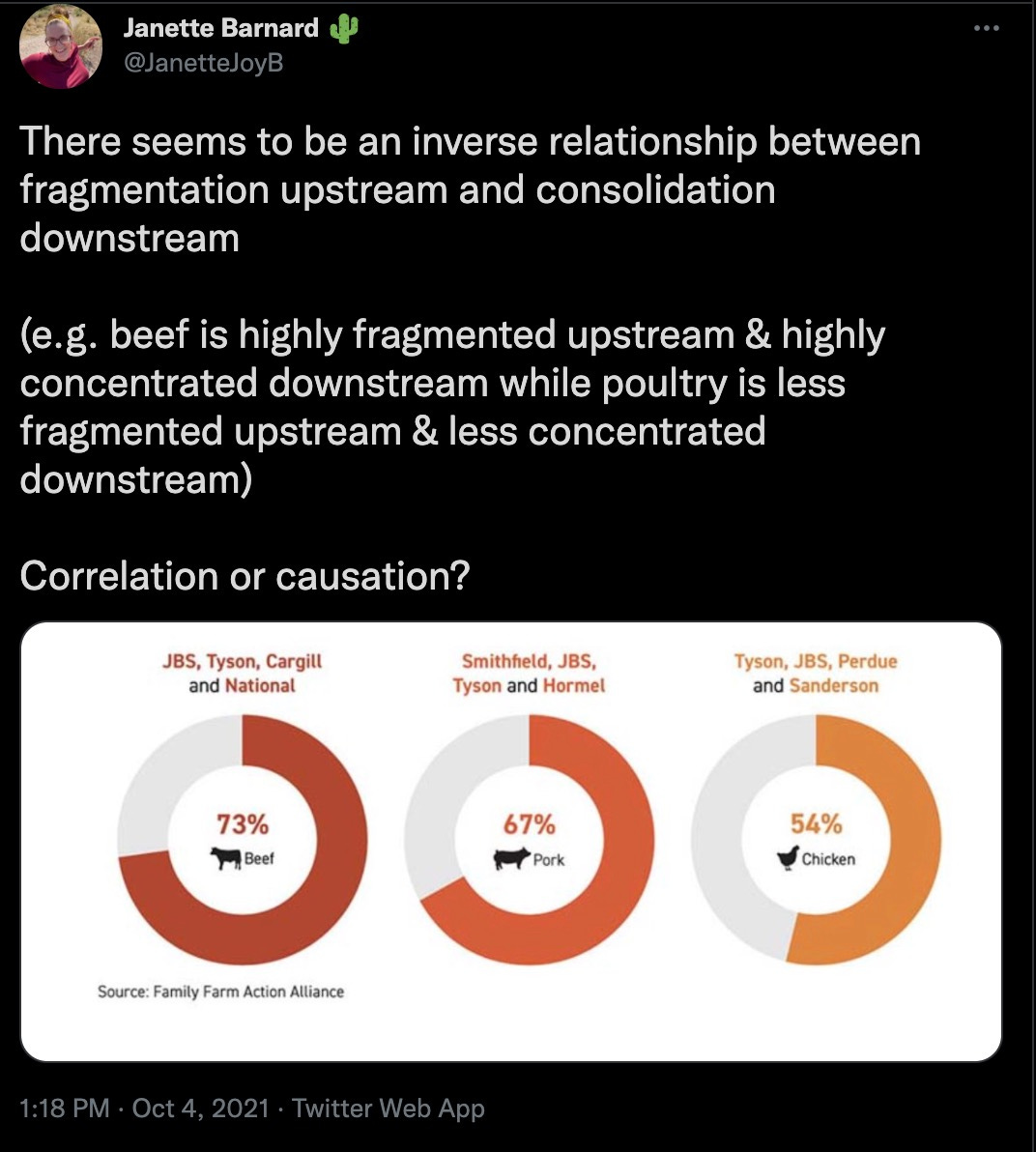
Is beef more concentrated at the packer level because the animals are heavier? More valuable? Or because there’s more’s variation in sourcing? Variation in plant size? Or maybe it’s this:

The answer to why the fragmentation/concentration conundrum exists doesn’t seem to be super obvious, but clearly it’s super complex. Happened-over-time things like packer concentration don’t take place in a vacuum. So simple solutions like the top x processors shouldn’t have more than y% capacity don’t take into account the competing dynamics that led to the current state.

And yet, there is *a lot* of certainty floating around about the topic without much (any?) tolerance for nuance.

But ag isn’t alone in having limited capacity for nuance. (Look, if I was the Debate Commissioner at every presidential debate before a candidate articulated their own position, they would have to summarize the other side’s policy position and say 1 positive thing about it, sans sarcasm.)

There’s another prickly conversation where we need nuance – climate change. I wish people didn’t point to an individual weather events as evidence of climate change. As climate researchers say, it’s not the individual events that are concerning, it is the trends in the data over time – the frequency and severity of extreme weather events. Which means there’s some level of variation that is normal.

Floods, hurricanes, tornados, droughts, heat waves – these are not new events. They were not created by climate change. So pointing at individual weather events as evidence of climate change is either disingenuous or intellectual laziness. Why not highlight more clearly weather events & trends that are within normal variation, versus what’s outside that normal variation?

Another nuance that’s really important is around the distinction of who’s driving change in the industry: consumers or food companies. From Climate + Ag: what gets measured gets monetized (link):

Who’s leading who in climate + ag?

“Consumer wants drive value chain decisions.”

I’ll start by pushing back on the narrative that protein value chains are driven by consumers, on climate or any other topic. Consumers….those nebulous creatures of food commerce who somehow sound like the unknowable inhabitants of an alternative universe when we refer to them. Two flaws with the Consumers-R-In-Control narrative:

  1. Consumers are not a monolith. Segments of consumers want certain attributes, sub-segments are willing to pay for those attributes. Variation among consumers is no less nuanced than variation among farming systems. Mis-identifying what consumers want and what they will pay for x is as fatal of a flaw as over-estimating how many consumers will pay for x.
  2. Although staggeringly critical to the system, consumers are not everyone’s customers. Consumers don’t transform supply chains or recalibrate industry norms. Food companies do. Food companies are where the power lies. Brand owners make decisions about how to market meat & milk to their customer: retail consumers. Food companies make decisions about how to market meat & milk, and then where needed those same companies use their scale and influence to set product specs & requirements as they procure raw materials or finished product from a certain set of suppliers. No one is talking about the fried chicken wars of Mar Jac vs Wayne Farms chicken, they’re talking about KFC vs Chick Fil A. The two directional power of influence lies with brand holders across foodservice and retail. Leading brands lead consumers by positioning xyz about their brand that is better than competitors. Food brands tap into consumer trends, but they lead consumer segments with differentiated products. Sometimes those changes are then adopted by other food brands & their supply chains. The massive shift in NAE (no antibiotics ever) production in US poultry is my go to example for this dynamic – when 1-2 major food companies said we will buy NAE chicken, then NAE chicken is what suppliers learned to produce, at scale. So then more food co’s buy NAE chicken. It’s a cycle that starts with a food brand, moving vertically in that supply chain and then expanding horizontally as more food brands (and their supply chains) adopt whatever the thing is.

We oversimplify the value chain when we attribute all influence to consumers, and we underweight the actual centers of leverage.

This week McDonald’s announced their net zero emissions by 2050 commitment. That’s a big deal – we are talking about a legacy, conservative, brand conscious company not some fly by night, here-today-gone-tomorrow brand. This is one of the largest buyers of beef, lettuce, tomatos, pork, potatos, strawberries, etc on the face of the planet. When companies like that start jumping in, it bends the arc towards action – it’s a sign that we’re past the niche-y early adopters and moving right to the middle of the bell shaped curve.

Some interesting context on the McDonald’s announcement from Meatingplace:

Efforts underway since 2018 have resulted in an 8.5% reduction in the absolute emissions of the company’s restaurants and offices and a 5.9% decrease in supply chain emissions intensity measured against a 2015 baseline, McDonald’s reported.

Although the most recent announcement does not specify where in the supply chain the fast-food company will look for its emissions reductions, in an earlier post on its website, the company said, “In collaboration with franchisees, suppliers and producers, McDonald’s will prioritize action on the largest segments of our carbon footprint: beef production, restaurant energy usage and sourcing, packaging and waste. These segments combined, account for approximately 64 percent of McDonald’s global emissions.”

Food companies have leverage, consumers do not.

Another source of leverage is capital. Right now there is an enormous amount of capital (we could put a period there) flowing into climate tech & solutions. More than $33.9 BILLION in venture capital investment has gone into climate tech….in 2021 alone.

Venture capital doesn’t automatically lead to good outcomes and solutions, but it increases the odds of good outcomes when its put behind good founders and good visions and great products. I recently heard someone say “venture capital subsidizes risk taking at scale”.

It’s safe to say that investment in a category tends to be a leading indicator of tech/innovation.

In 2015 Bill Gates founded Breakthrough Energy, a billion dollar fund to “support the innovations that will lead the world to net-zero emissions.” In 2021 Chris Sacca raised an $800M fund to invest in climate tech, with 2 objectives: 1) lower emissions to net zero, 2) get carbon out of the air.

Two interesting quotes on Lowercarbon Capital’s website:

  • “Give or take, we’ll need to suck at least a trillion tons of CO2 out of the sky between now and 2100.”
  • “Fixing the planet is just good business. Shame and guilt won’t get us there, markets will.”

A few previous comments that are germane to this conversation for livestock:

The extreme positions on either end of the sustainability spectrum will not create actionable, consumer-satisfying, carbon-reducing, market-growing solutions. But nuance…that’s how we find the productive middle ground. Nuance acknowledges that one size does not fit all – what works in geographies that get 40+ inches of annual rain fall won’t necessarily work in areas that get <15 inches. Systematic management changes like transitioning from continuous grazing to intensive rotational grazing are complex, as is anything related to managing the biology of plants or animals.

Regardless of the abundant unknowns about how things will evolve, this whole “climate thing” is not a topic where producers can look away and hope it will disappear. This is a mega trend. There will be winners and losers – my hypothesis is that the difference will be those who collaborate and find workable solutions…or don’t. This is a mega trend to engage, to lead by looking for the ‘and’ solutions…the places of overlap between what’s good for climate related metrics AND for cattle AND for successful cattle operators AND for food companies AND consumers. This is a place to ask questions like, what if? What needs to be true? What opportunities will be created in this mega trend?

Maybe nuance isn’t realistic though – not even because of the formats in which we consume information (140 characters doesn’t leave much room for nuance), but because the human brain can only absorb so much information about so many topics in the midst of living our lives. So sweeping statements and catchy slogans leave us with soundbite driven opinions – and which soundbites we latch onto depends on who we’re listening to.

Anyway, I guess my philosophical point this fine Tuesday is that topics like packer consolidation and climate change are wildly complex with no simple answers, and I’m wary of too much certainty, of the simplistic answers. Anyone peddling simple answers is likely trying to scare or shame to sell something or get a vote (either side).

I think embracing nuance will serve us all well in these discussions.


ICYMI: why is carbon more likely to be a monetizable mega trend than an emotion driven fad? (link)

<insert corporation name> will not be able to buy 2 units of sustainability to offset 2 units of un-sustainabillity. But, <insert corporation name> will likely be able to buy 2 units of carbon sequestration to offset 2 units of carbon emissions.

As more companies make net-zero commitments around carbon and seek to offset carbon in their supply chains, carbon markets are the likely place to turn. To make this carbon economy go, the entire structure will have to be underpinned by rigorous standards of measurement and verification. Sound methodology and precision processes are the only way for carbon markets to deliver on the promise for participants and their investors, customers, and consumers.

Another concept bubbling up is carbon labeling on food. Only high end, niche brands are pursuing carbon labeling now, but will this become a more widely adopted practice? The concept behind these labels is numerical representation of the carbon involved in production….the (potentially) magical word for livestock producers is “numerical”. To the extent that sound methodology and high integrity math drive carbon labeling, it represents an opportunity for livestock producers to win by numerically capturing the net positive carbon impacts of livestock production.

People way smarter than me can go deeper on carbon markets and carbon labeling. My point is simply this:

Carbon could be the real deal for producers because both B2B carbon markets and consumer facing carbon labeling on food would require data driven approaches to drive an actual functioning net zero carbon economy based on measurements.


I’m interested in all things technology, innovation, and every element of the animal protein value chain. I grew up on a farm in Arizona, spent my early career with Elanco, Cargill, & McDonald’s before moving into the world of early stage Agtech startups.

I’m currently on the Merck Animal Health Ventures team. Prime Future is where I learn out loud. It represents my personal views only, which are subject to change…’strong convictions, loosely held’.

Thanks for being here,

Janette Barnard

Categories
Leadership

Prime Future 69: Lunatic farmers & velocity 🚀

The owner of a dairy was lamenting the rise of mega dairy systems and the risks they pose to small dairies like hers. How many cows does her dairy milk?

7,000

It’s a laughable story except that this dairy farmer & her family have grown the herd from a few hundred to several thousand over the course of their career. They’ve struggled and strived, taken risk after risk to get where they are. And yet in their minds, they still identify as small, scrappy, insurgent producers trying to survive.

There’s a dynamic that plays out across the ecosystem of food production where size matters. To everyone. A lot. There’s an awareness (obsession?) about the size of suppliers, customers, processors, neighboring operations:

  • Big retailers want to deal with big food brands, not small insurgents. There are tangible costs to dealing with more suppliers, smaller suppliers, inexperienced suppliers with unproven track records, etc.
  • Some consumers want to buy food produced on a ‘small family farm’, whatever that means. (Why does ‘family’ have to imply a modest sized business? And who decides what size is the right size? And don’t *all* small business to either evolve, grow, or die? I digress…)
  • Some (most?) producers would like to sell livestock to small(er) processors who have less pricing power than processors in an oligopoly have. (What if the packers got Standard Oil’d?)
  • Many producers fantasize about having more acres, or head of cattle, or poultry & hog barns.

There’s a special irony in the tendency among farmers to want to be bigger than neighboring operations. It’s almost a tendency to criticize the operators who run more acres or head than they do. (But is it criticism or envy? Sometimes the two look eerily similar.) It’s like a Russian nesting doll situation where the 700 acre farmer judges the 2,000 acre farmer who criticizes the 15,000 acre farmer as too big. I’ve heard this lament from midsize farmers a few times recently and it raises some questions…How many acres is too big? How much profit per acre is too much? How much revenue per year is deemed over the top? These sound like questions that supporters of alternative economic structures would ask, not those who enjoy the benefits of a capitalistic economy….

The primary counter to the notion that small business > big is the idea of available resources. Who is in a position to commit more resources to ensuring appropriate nutrition – the backyard poultry farmer or the large integrator? Who is in a position to invest in technology that reduces deboning costs in the plant – the custom processor killing 50 head/day or the large plant killing 5,000 head/day?

The primary counter to the notion big business > small is, well, we just know this isn’t always true, right?

Big business can be good, small business can be bad. Vice versa. Some small businesses are amazing employers, some are terrible. Some small businesses are terrible suppliers, some big businesses are amazing customers. Vice versa.

I’m less intrigued by the external voices extolling or incriminating business size. I’m more intrigued by the view of producers, and what causes some producers to maintain status quo and some to find a model that allows them to scale.

Sometimes bigger is better, sometimes smaller is better…size is not the indicator of success and it’s definitely not the goal.

A recent Reddit thread on personal finance included a comment by a couple making $500,000/year who un-ironically identified themselves as a middle class family with middle class money concerns. It’s a similar dynamic with the large producer who still has the mentality of scrappy insurgent, maybe (likely?) that mentality is what helped them get where they are – what helped them do things their peers weren’t doing, to get different outcomes than ‘average’ producers.

Can we just admit that the obsession with farm business size is….kinda odd? Or at a minimum, it’s not very helpful.

My hypothesis is that scale is a lagging indicator; velocity of business model innovation is the leading indicator of success.

The more commoditized the business, the stronger the pull to scale to reduce cost per unit.  The more value oriented the business, the stronger the pull to create incrementally more value per unit. There’s no clever analysis in those statements – those are natural forces that are a function of capitalism and a mature agriculture industry.

I think the successful producers (or packers or xyz business) who will thrive come-what-may are the ones who don’t think of their business based solely in terms of the output (corn, soy, weaned calves, whatever), but rather view their business as a business model that is is in continual refinement. They constantly ask what’s the process that most effectively generates the output. They think in systems that can optimized.

(This is a great article on the founders of Premium Standard Farms, the ‘inventors’ of the mega farm / consolidation model in pig production and the mental models they put to work…some worked, some didn’t. Btw I’m still waiting for a good book about this phenomenon in poultry – can somebody write that plz? 🙂)

It seems that the really successful producers are the ones that have a vision of where they are going and how they will get there. There's no doing it this way because that's how we've done it, there's no growth for the sake of the growth. There is only relentless learning and improvement.

The great producers realize that they aren’t selling just a commodity output, they are selling their business model.

Size is not the determinant of success. It’s about business discipline, management, relationships, processes, team, leadership, ambition. Successful producers have a vision for the future that they rally the team around, there’s an ever evolving plan for increasing revenue per unit produced or decreasing cost per unit produced, or both.

I recently asked a really large operator how they grew their business over the last 20 years from something not at all uncommon to something truly extraordinary. Did they have access to capital that others didn’t have? Some other advantage not available to similar producers? “I don’t think so, I think we just do things in a different way than most people are interested in doing. We do a lot of things that aren’t uncommon for most growing businesses, they are just uncommon for production ag businesses. We have a yearning for learning. ”

Let’s call a spade a spade – capital is abundant and cheap in 2021, as it has been the last several years. Ideas are a dime a dozen. It’s everything else that separates the aggressive producers from the rest. (The rebuttal I’m expecting is what about the market, the weather, etc etc etc…..luck and timing play huge roles in ag, I’ll never downplay that. But there’s more to this phenomenon than that.)

I’ve referenced Allen Nation’s book before, but germane to this conversation is a chapter on how farmers approach innovation with insights pulled from a 1962 book “Diffusion of Innovation” that studied extension efforts to get farmers to switch from open pollinated to hybrid corn post WW2.

“The innovative farmer is seen by his farm neighbors as a lunatic farmer. And a lunatic is not seen as a role model. As a result, what the innovator does on his/her farm is literally invisible to the neighbors. This is true even if the innovation is producing visible wealth. The normal reaction to unconventional success is the old it-might-work-there-but-not-here syndrome. The sad truth is that the vast majority of farmers prefer to fail conventionally rather than to succeed unconventionally. It is very, very difficult to be more innovative than the community in which you live.

Here’s the really germane part: “No farmer referenced what a farmer smaller in acreage than themselves was doing as applicable or worthy of study. Everyone preferred to learn from someone larger than themselves.” Isn’t that fascinating?

There’s irony in that if you’ve made it this far, then there’s a huge chance that you are in the groups referenced in this last quote from Allen Nation:

“The innovators and the early adopters form approximately 15% of the total farming community. Interestingly this percentage is almost exactly the same as the number of farmers who earn an upper class income from agriculture.”

I’ve recently observed some markers that lunatic farmers seem to have that indicate high velocity of business model innovation:

  • They ask questions. A lot of questions. They find smart people to ask questions. They find smart people in non-traditional places to ask questions.
  • They read. Not just industry magazines, they look outside.
  • They have a sense that what they are saying sounds half crazy, dare I say they know it might make them sound like a lunatic farmer.
  • They surround themselves with high quality people, high quality teammates.
  • They have a system they are building/running, a flywheel they are looking to spin faster.
  • They have some insight that most of their peers don’t, some belief that isn’t widely held.
  • They know new practices & ideas take time to implement correctly, so they allow margin (time, energy, $) to experiment.

I’ll wrap up today with a tweet:

Share


I’m interested in all things technology, innovation, and every element of the animal protein value chain. I grew up on a farm in Arizona, spent my early career with Elanco, Cargill, & McDonald’s before moving into the world of early stage Agtech startups.

I’m currently on the Merck Animal Health Ventures team. Prime Future is where I learn out loud. It represents my personal views only, which are subject to change…’strong convictions, loosely held’.

Thanks for being here,

Janette Barnard

Categories
Leadership

Prime Future 68: Bet on the collaborative-ists

There’s a local ranching family that’s been raising cattle on the same land for 7 generations. In that time they have not sold an acre of land, not one. They have withstood droughts, drug cartel activity, wildlife predators, market crashes, high interest rates. You name it, they’ve survived it.

Some years ago they got into a lil spat with the US government over the renewal terms for grazing permits on public land, so the federal government rounded up the family’s cattle that were on public lands and kindly delivered them to the sale barn.

Someone recently summarized the family’s mentality this way, “They are  fiercely independent, they just don’t trust anyone. Then again, that’s probably how they’ve survived and why they’re still ranching.”

This struck me. I have a deep respect for the challenges producers face and the resilience they embody….but I wonder if that fierce independence won’t actually work against producers in a rapidly evolving world where collaboration is rewarded more than independence. (And though this first example is a rancher, every segment of the value chain has players with a similar mentality, a transactional ‘us vs everyone else’ mentality.)

Collaborating raises new questions, new situations, new risks to manage…and new opportunity. If done thoughtfully and effectively, new collaborators can grow the pie (and it’s individual slices) in ways that independent actors cannot.

We live in a world where the art of highly effective collaboration increases the probability of survival.

Let’s start with one of the most successful examples of a systems approach, one that has stood the test of time: McDonald’s. (If you aren’t familiar with the 3 legged stool model, here’s a good primer.)

Each supply category has a limited number of suppliers that are held to very high standards but rewarded with high volumes of business, typically on a cost plus basis. Suppliers do not float in and out of the system frequently, these are not transactional relationships – they are partnerships built for the long term.

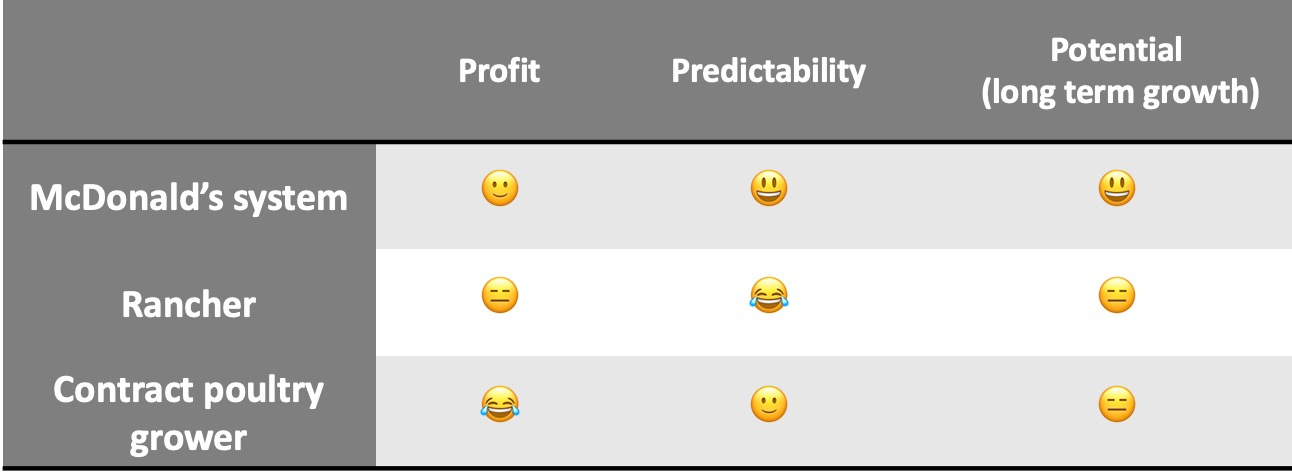
Now contrast the McDonald’s system with two alternative structures that land in different places along the continuum of Transactional to Collaborative, the independent rancher and the contract poultry grower:

  1. Let’s assume the rancher sells weaned calves at the sale barn, the epitome of price taking at the market’s daily whims. The definition of transactional – the buyer is literally whoever is willing to pay the most on any given day.
  2. Let’s assume the contract poultry grower supplies the labor and facilities, then executes the management program prescribed by the poultry integrator. The grower is paid on a $.xx/lb produced with some level of base pay that is set, and the remainder of pay determined by how the contract grower’s live performance stacks up against the flocks that are processed that week (the lottery system).

Regardless of the business (weaned pigs, broilers, or hamburger patties), it seems there are 3 core drivers around engaging in collaborative ecosystems with dedicated partners:

  1. Profit. Maybe its about finding higher value races to the top of the value pyramid, rather than vice versa. Maybe it’s about cost plus arrangements that may not maximize revenue on a given transaction, but could look smart over the long haul and the ups & downs of market cycles.
  2. Predictability. Creating predictable revenue can radically impact business planning and operations. Some would prefer to make $.1/lb day in day out, some would prefer to make $1.00/lb on 1 load knowing they might lose $.90/lb on the next.
  3. Potential (long term growth). What’s the growth potential of the ecosystem? Is this a chance to grow the pie and grow your business accordingly?

Below is a rough analysis of how different systems compare – maybe these are over or under stated, but the big idea is that there are tradeoffs under each model.

🙂=sufficient. 😃=heck yeah. 😑=maybe? 😂=that’s funny.

Of course this doesn’t capture some of the intangible tradeoffs of collaborative partnerships, like losing some degrees of freedom. I think my real point is that there are increasingly more alternative ways to approach business models and these alternatives should be considered.

  1. What is the upside potential? Downside risk?
  2. What are the tradeoffs compared with the risks of the status quo?
  3. Are those tradeoffs bearable compared to the next best alternative?

The answer to those questions will always be situation/people/goal dependent.

And I’m no Pollyana – there are risks with entering partnerships where multiple parties are reliant on one another. The obvious caveat is that not all systems are created equal; not all partners are good partners, not all collaborations are worthy bets. Sometimes the business model isn’t right, sometimes the leadership isn’t right…or any other number of reasons that a system doesn’t work out. One of the most practical pieces of advice came from my friend’s dad: when you create a plan to enter a partnership, create the plan for how you will exit the partnership.

(Those of you much more seasoned than me are probably nodding your head vigorously at that advice since you’ve seen the dangers of not preparing for partnership dissolution in advance. “Expect the best, prepare for the worst” and whatnot.)

A great irony from a producer standpoint is that although it might be easy to reject taking on the risk of entering partnerships, the fewer strategic alliances a producer makes with customers, by definition, the more reliant the producer is on commodity markets where price takers have zero control which introduces…risk. Maybe the real question is around where you want control (price? management freedom?), where you want predictability, and what type of risk you are willing to accept / are more comfortable managing.

I recently saw a list of about 30 aligned beef supply chains in the United States, here’s a snapshot of one. ‘Run our program to help us deliver a better product to our customers and we’ll all win’ is the summary idea. If you read Prime Future you know I think we’ll continue seeing more of these:

The above examples focus on how producers might engage supply chains & customers, but what about managing suppliers? I recently heard of a producer who decided to double down on supplier relationships by choosing one strategic supplier for every major input category. They gave up the transactional, shop-around-for-the-best-price-on-this-transaction in pursuit of the best supply arrangement on the next 1,000 transactions. Another dimension of a collaborative approach.

What does collaboration look like in Agtech?

Now let’s talk about where a collaborative mindset can drive progress in agtech:

  • Among co-founders – its doable to be a solo founder but as someone who hit The Great Wall of Burnout trying this route, I can tell you it is HARD and there is not an ounce of virtue in trying to defy the odds by being a solo founder.
  • Among founders and venture investors – there are huge tradeoffs in choosing to bootstrap a business which typically means slow and steady growth versus raising venture capital and committing to the high growth model. Neither is right or wrong, they are just different models with different paths.
  • Among founders and early customers – That early feedback from first customers – and how founders respond – can set the entire trajectory of an early stage company. Ask any successful tech company and they will tell you about the early customers who made them.
  • Among big companies and startups – each brings something to the table in terms of successfully scaling innovation, figuring out how to get the best of each can unlock magic.
  • Among startups and startups – the punishment for tech forward producers right now is that every single hardware/software product tends to have its own login. What farmer wants to login to multiple systems to manage their business? Zero. But not every company can be THE platform. This will drive partnerships that may not be what every company wants, but will drive customer experience and <drumroll please> grow the pie of tech adoption.

The best summary of those last points came from a recent Future of Ag podcast interview with Jim Ethington, an early employee of Climate Corp who is now CEO of Arable:

“We could have said we can’t afford to give up a piece of this pie and we’re going to go it alone but that’s not the path that moves the industry forward. …we can all be good at our pieces and hey sometimes we compete, most of the time we can collaborate but that’s what moves the industry forward.…being able to put the puzzle pieces together where 1+1 = 3 for the customer.

What if they try to replace us? Come in with the assumption that a) it doesn’t matter because this integration is what the customer wants – start with the customer and work backwards, and they want one integrated system. …and b) when this plays out even at the largest companies in the world…guess what their roadmap is full. ….everybody’s roadmap is packed – don’t flatter yourself they aren’t going to go build your product. And if they do, they were probably going to anyway and your partnership didn’t do anything to accelerate it. I think you have to let go a little bit and go back to the customer problem, growing the pie, making this a better overall technology space….and put aside the natural fears of what risks does this pose to us. The benefits outweigh the risks because those fears usually aren’t as real as you think.”

Does an independence-at-all-cost mentality create the trajectory to thrive in the ag economy of the future?

There’s perseverance in independence which will get you somewhere, but my hypothesis is that moving forward it will be the smart collaborations who channel that same perseverance for the sake of a larger business objective who will win; those who grow the pie in a way that creates long term value for every link in their chain.

…aka the spoils will go to the effective collaborators. The collaborative’ists, if you will.

“If you want to go fast go alone; if you want to go far go together.”


I’m interested in all things technology, innovation, and every element of the animal protein value chain. I grew up on a farm in Arizona, spent my early career with Elanco, Cargill, & McDonald’s before moving into the world of early stage Agtech startups.

I’m currently on the Merck Animal Health Ventures team. Prime Future is where I learn out loud. It represents my personal views only, which are subject to change…’strong convictions, loosely held’.

Thanks for being here,

Janette Barnard

Categories
Business Model Innovation Leadership

Prime Future 61: Egos & incentives

Sometimes in the B2B world it’s easy to assume business decisions are driven solely by an ROI calculation, neatly tied with an Excel bow around a carefully curated formula. Or in the farm world, that every decision is justified by the output of the almighty shirt pocket calculator.

But in the real world, rarely can an ROI be fully captured numerically. Other factors impact decisions, including the psychological factors. I summarize this as Egos & Incentives.

Numerical ROI is necessary, but it’s not sufficient. At the margin, decisions are made based on their impact to our egos and incentives, including decisions about adopting new products, practices or ideas:

  • Incentives: How does this help me achieve what I’m incentivized to achieve, what I want to achieve?
  • Egos: How does this impact my view of myself and my place in the world, aka my ego?

We’re all out here responding to incentives, intentionally or unintentionally, doing the things to get the job, the bonus, the contract, the new customer, the promotion, the upsell, the renewal, the fill in the blank. And no surprise, we all have egos. Every last one of us, even those who say they don’t (perhaps especially those). The advertising industry is built around these fundamental truths of human nature.

And though it can be framed at an individual level, I believe it’s just as true at an organizational level because, of course, organizations are just big groups of individuals, still responding to egos and incentives.

Sarah Nolet & Matthew Pryor, partners in Tenacious Ventures, described this dynamic in the context of agtech adoption quite elegantly:

“The wine industry presents an illustrative example. Wine makers often contract the growing of some or all of their grapes to other growers. This makes sense to get to scale and mitigate risk, but this distributed production method poses serious challenges for managing the cost and quality of wine making. Despite the fact that good tools are available to assess grape quality and yield as harvest approaches, individual growers are not likely to take them up as the ROI for their business is not strong enough. For the wine maker, though, these tools are invaluable: over supply, under supply, and poor grape quality all have major financial implications for winemakers. In other words, though the growers are the users, the real beneficiary is the winemaker. Therefore, until winemakers create incentives, and perhaps even supply the tools directly to the growers, growers are unlikely to adopt and the benefits from far greater visibility of the yield and quality of the coming harvest will remain unrealized.

Another notable characteristic of agtech 1.0 was that as this dynamic played out again and again, agtech companies (and their investors) blamed the farmers! Agtech conferences and industry reports featured claims about “laggards,” pointing fingers at the users for being “traditional” and “resistant to change” in an industry “based on handshakes.” In reality, the problems were with business models and incentive alignment.”

Their example describes the exact dynamic that trips up so many technology creators in livestock. The sentiment from creators goes something like this: ‘We made this widget for producers that is really beneficial to everyone but only kinda to the producer. Also we built our business model so the producer pays for the product and the rest of the value chain gets the value. Also also it’s SO weird how producers aren’t interested in our technology, what laggards🙄.’

The fundamental question to ask about new products is, where does value accrue and where is cost incurred?  If the packer accrues the value but the producer incurs the cost, well….that’s probably not going to go well because incentives are not aligned. The challenge of incentive alignment is why business model innovation can be just as high impact as tech innovation, if not more so.

This dynamic extends from adoption of new products to adoption of new practices. Silver Fern Farms, New Zealand’s largest meat processor, recently announced their planned launch of Net Zero Carbon Beef. The most interesting part of the story was this little line:

“Silver Fern Farms is committed to supporting our farmers to contribute to these goals, through knowledge transfer and market-led incentives"

Did you catch that phrase missing from most announcements around carbon/sustainability/any type of change requested of a supply chain?

Market-led incentives.

I asked Nick Rowe, Innovation Manager at Silver Fern Farms, for some background on the program. Here’s what he said:

“When we derive an in-market premium we will share that value with the supply chain (consumers, customers and farmers) on our path to a regenerative future. Without the incentive, it’s hard to drive change. People won’t change the way they do things unless they are incentivized to do so. We are launching net zero carbon beef that makes sense commercially.”

That is the most effective model to drive behavior change in a supply chain, regardless of the behavior.

All that said, what ARE producer’s incentives? The universal incentives are around generating revenue, increasing pounds or increasing $/lb, maintaining a customer, growing market share, etc but of course every individual producer has unique incentives and is prioritizing those incentives in a unique way. Related: feeding the world is not on anyone’s incentives bingo card, neither is curbing climate change or any other macro good. That’s why those macro problems have to be broken down to specific problems for specific someones, or specific incentives for specific someones.

Which brings us to ego. In agtech where ego can become a road blocker is around decision support tools. IMO these are some of the most challenging products to sell because in order for the product to be high value, it has to support high value decisions. And high value decisions tend to be high risk decisions. And high risk decisions tend to be deeply personal, whether a decision to sell a 1 billion bushels of corn or 10 weaned calves.

ICYMI Prime Future

The 2 most soul crushing words an innovator can hear 😳
You describe a concept for a tech solution to a prospective customer or show them an early version of the product. What’s the worst response you could get? “That’s interesting.” It would be better to have a full cup of lukewarm coffee thrown in your face so at least you know definitively that you need to go back to the whiteboard. An enthusiastic YES or…

Read more

Excerpt from 👆🏼 this piece:

I once asked a feed yard manager if this (when to sell cattle) was a decision where analytics could help drive a more precise & profitable decision. His reply was “probably not, we’re good at this decision.” I asked how they know if they made the optimally timed decision and he replied “well, did we make money?”

And THAT is the fatal trap for any analytics product. If there’s no control to compare against, how does the user know what money has been left on the table? If the opportunity cost is undefined, how does the prospective user determine if an analytics tool makes them any better at making the difficult decisions than the hard earned insights from the school of hard knocks? The burden of proof rests on the innovator.

That excerpt describes the value proposition challenge for decision support tools, but in my experience there are always ego impacts to consider – whether it’s the software tool to help asset managers make better trading decisions or the software tool to help the crop farmer determine the optimal time to irrigate. The ego objections are usually some variations around relevance (does this tool make me or my hard won insights less important in the world?) and skill (how will my team build their hard won insights if they have tools to help them?). (Though the skill objection is like people back in the day worrying that kids will get worse at math if they use a calculator.)

Creators of decision support tools have to take into account the ego considerations in everything from product design to marketing.

Here’s the second part of Nick’s comments that struck me:

“Net zero carbon beef is really an extension of our journey to provide consumers with branded meat they can trust is better for them and ultimately the planet – it was the natural next step. When something is hard and we don’t have all the answers it takes people with a pioneering ethos and a company that is not scared of leading, to take charge and drive change.”

Yes, “we’ve always done it this way” is real and maybe it is more prevalent in ag than other industries – though I’m not entirely convinced that’s true. But the forward thinking, innovating early adopters are also real. And the burden of adoption rests on the creators of new products and the food companies who want to drive new practices to make their value proposition relevant by accounting not just for ROI, but also for egos + incentives.

P.S. If you like thinking about the traps around how businesses or industries structure incentives, then you’ll love this piece from The Hustle.

P.P.S. This:


Welcome to those of you who are new to Prime Future! Many of you found this newsletter through Shane Thomas and his newsletter, Upstream Ag Insights. I highly recommend subscribing to Upstream Ag Insights if you don’t already – he writes on all things agtech on the crop side of the industry with a lens on agribusiness strategy.


I’m interested in all things technology, innovation, and every element of the animal protein value chain. I grew up on a farm in Arizona, spent my early career with Elanco, Cargill, & McDonald’s before moving into the world of early stage startups.

I’m currently on the Merck Animal Health Ventures team. Prime Future is where I learn out loud. It represents my personal views only, which are subject to change…’strong convictions, loosely held’.

Thanks for being here,

Janette Barnard


Categories
Leadership

Prime Future 56: A right time for everything, the builder’s version

There is a right time for everything.

There is a time to be born and a time to die.

There is a time to plant and a time to pull up plants. 

There is a time to look for something and a time to stop looking for it.

….

I love the Ecclesiastes framework of life. That everything is seasonal, dynamic, contextual.

I’ve been thinking about how much good advice we have access to…articles, books, podcasts, people. So much advice about what to do and so much of it good, but often conflicting. (E.g. wake up at 3:30 am bc hustle wins but also get 9.2 hours of sleep bc the well rested win. Good advice, but conflicting.)

There’s even more good but conflicting advice offered on building a startup, a product, a career, or…anything.

Perhaps the highest value muscle to build is discernment…knowing when to do, more than what to do.

If I were to rewrite the Ecclesiastes framework for people building & creating, it would look something like this…

There is a right time for everything.

A time to be highly strategic and a time to throw stuff at the wall to see what sticks.

A time to expand optionality and a time to hyper commit.

A time to ignore to the skeptics and a time to listen carefully.

A time to meticulously plan and a time to just👏🏽get👏🏽started👏🏽.

A time to seek outside input and a time to trust your gut.

A time to seek out new people with fresh eyes and a time to sit at the proverbial feet of wise old industry owls.

A time to focus on growth and a time to focus on profitability.

A time to expand your circle and a time to link up with the few & hang on tight.

A time to generously schedule intro calls and a time to ruthlessly guard your calendar.

A time to raise outside capital and a time to bootstrap.

A time to talk to every single sales leads and a time to relentlessly qualify leads.

A time to optimize for short term results and a time to optimize for the long term.

A time to reject process and a time to make smart process your secret weapon.

A time to speak truth to power and a time to be diplomatic.

A time to burn the ships and a time to hedge your bet.

…I could go on, mainly because I write this from a place of choosing incorrectly on all of these, and realizing it only with the benefit of hindsight. I like to think there are ways to build the discernment muscle other than just screwing up but maybe that’s it, that’s how the learning becomes real and practical and personal.

The challenge is that most outside advice comes from a place of survivorship bias, with strong hints of ‘here’s what worked for me so here’s what you should do’. But of course there are a gajillion factors that influence the right step at any given time. Situational context, trajectory, people, capabilities, personalities, resources, starting point, and end game, just to name a few.

I’m increasingly convinced that discernment is one of those intangible super powers that mega effective leaders and builders have cultivated. #goals

P.S. There’s even a time to switch publishing day from Saturday to a weekday. This newsletter is still once a week. What day do you like to receive newsletters?


Wisdom of the crowd

Following last week’s discussion on the tricky dynamics for processors of being competitor focused or customer focused (and what happens when words mismatch reality), ag economist Eric Micheels shared some academic research looking at the same dynamics for beef producers. I hate when academic work gets disconnected from the real world…this is not that. Here are some poignant highlights:

  • “Learning faster than one’s rivals may be the only way to achieve sustained competitive advantage in highly competitive markets, such as beef production.”
  • “As the competitive landscape in agriculture changes from a purely commodity-based sector to one where firms attempt to differentiate their offerings through different production practices, improved channel relationships, or alternative marketing strategies, factors other than size and experience may become increasingly important.”  (say it ain’t so)
  • “Managerial heuristics based on prior experience generated under different environmental conditions might not optimize performance in the current environment.” Translation: the rules of thumb that got you here won’t get you there.
  • “Organizational learning significantly contributes to innovativeness while we also find that greater managerial experience leads to decreased organizational learning.” Translation: sometimes experience is an asset, sometimes it’s a liability.
  • “Those firms who are able to become aware of changing market conditions and are able to develop solutions to meet increasingly stringent consumer and buyer requirements may be better positioned to change with the market and to be successful during the development of new marketing and production channels.” Translation: Tired of being a price taker? Build a moat. (link)

Relevant Reads

(1) For a peek at where the whole ‘carbon thing’ might be evolving with food companies, check out this announcement from Panera: low carbon cool food meals. Love it or hate it – this fits with the conversation about ‘Climate + Ag: what gets measured gets monetized’. Note the idea of what % of your daily recommended carbon footprint should be allocated to each meal. Will that become mainstream’ish?

(2) This article by Shane Thomas of Upstream Ag Insight, ‘Technology Quotients and Resourcefulness: Catalysts for Agribusiness Success’ is fantastic. Here’s a snippet:

In knowledge work you can pull on two main levers to accomplish better outcomes:

  • More effective – be more creative, have a superior tactic or strategy that lead to better outcomes (eg: sales, cost reductions etc)
  • More efficient – accomplish more with less effort (eg: reach more customers with less resources)

In ag we like to talk about working hard and hours worked, but in knowledge work the emphasis should be on outcomes and results; this means the emphasis shouldn’t be on hours worked, but outcomes achieved.

This brings us to resourcefulness as a skillset. Part of being resourceful stems from having a growth mindset.

And then he jumps into the best part, the idea of “Technology Quotient” & implications. (link)


Prime Future is a weekly newsletter that allows me to learn out loud. I’m on the Merck Animal Health Ventures team. Prime Future represents my personal views only.

Categories
Animal AgTech Business Model Innovation Leadership

Prime Future 44: How to Decide

I was recently making a big decision between two good options, which led me to Annie Duke’s book How to Decide. Duke is a professional poker player turned behavioral decision scientist. One of the most profound ideas from the book is that of evaluating the outcomes of a decision separately from the decision making. Duke points out that we tend evaluate the quality of a decision based on its outcome: good outcome = good decision, bad outcome = bad decision.

But that correlation does not always hold. Sometimes a well informed decision results in terrible outcomes. Sometimes a rash, impulsive decision results in fantastic outcomes. Duke’s thesis is that we can only improve our decision making process when we separate the decision from the outcome, ideally leading to more decisions with better outcomes.

In the first chapter of Netflix founder Reed Hasting’s book No Rules Rules, Reed tells about sitting across from the management of then $6B Blockbuster and proposing they acquire Netflix for $50M. Blockbuster passed.

It is tempting to hear that story and lol at Blockbuster for not making the acquisition. How could they not have seen that their industry was changing? How could they have been so shortsighted to think brick & mortar was the future? How could they have underestimated Reed & his team, or the future of streaming?

With the benefit of hindsight, we know of course that Blockbuster is no longer and Netflix is currently valued at $241B.

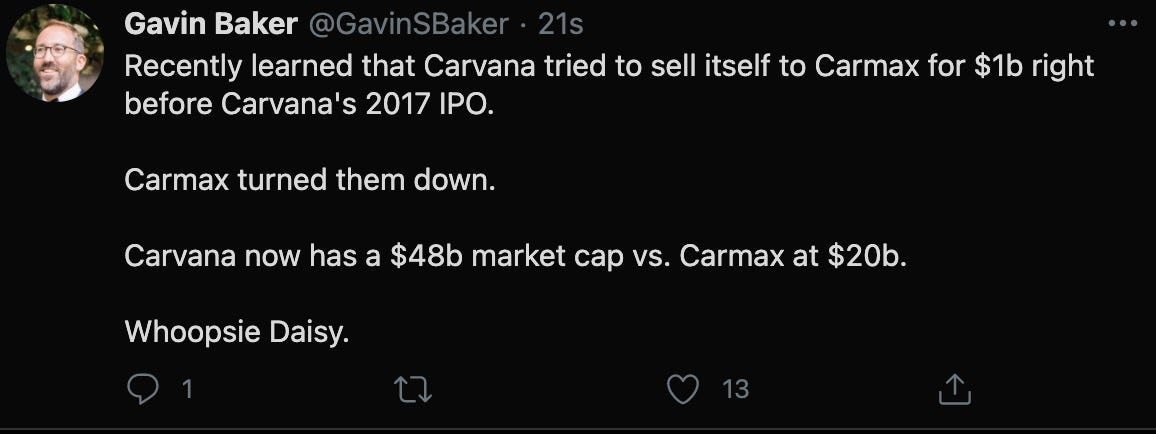
But, did Blockbuster make the wrong decision? Did Carmax make the wrong decision?

Here’s why this is all connected: in a tech obsessed world, particularly in winner-take-all markets (which are fewer than we think, but that’s for another time), the pressure is immense to not be Blockbuster, to not be left behind, to not be the one that didn’t embrace the future. Outsiders love to point out how agriculture is the “least digitized sector” and assume this is because farmers are slow to embrace tech products. Are farmers simply tech averse as outsiders assume….or are farmers making rational risk/benefit decisions that are appropriate for their business context?

Because the truth is, not all tech or innovation decisions lead to good outcomes. Not all innovation is the next big thing. Not every upstart is the next Netflix. Some of it is simply the Segway, cool tech that never finds its use case so it remains a niche product for tech nerds. Some of it is….dare I say….smoke and mirrors. On the super rare occasion, it even turns out to be outright fraud like Theranos (highly recommend the book Bad Blood).

For business leaders, the decision making process is the controllable, the improvable. In all things, including deciding what innovation or tech or tech companies to bet on (whatever the nature of the bet) or what industry trend to capitalize on.

Have you ever noticed that the decisions that led to really bad or really good outcomes are the ones that get all the attention? But, how many exceptionally wise decisions have been made to pass on a product/company that turned out to be the correct decision, that are never known outside of those sitting in the conference room?

Those stories don’t make it on the front page of the Wall Street Journal or into an HBR case study but I expect we could learn a lot if they did.

Here’s how I think hindsight leads us to assess the decisions to bet on a tech company or pass on it, based on the outcomes of how impactive the innovation turned out to be:

Here’s the thing – with the benefit of hindsight we can point to poignant examples of decision outcomes that fit into every category in the above matrix, except for examples of the Unsung Hero. Good defense never gets the same hype as good offense, even though you need both to win.

I could be convinced otherwise, but I think this framework holds true for more than just tech. I think it applies to any new industry trend and decisions made about how to leverage the trend, or not. And again, these decisions get evaluated from the outside based on outcomes.

But there are SO many factors that effect outcomes of early stage companies & early stage technology, from the tech itself, to product design, to go-to-market strategy, to funding sources, to the macro-environment, to industry specific tailwinds or headwinds, to the leadership team, to the pricing model, and on and on and on. Which means, there are SO many factors that affect the outcomes of decisions around early stage tech companies & products. So the decision making process is the controllable.

The relevant question for decision makers of any kind, is how do you make more Obvious Genius & Unsung Hero decisions? I would suggest the following:

  • Make more small bets.
  • Do your due diligence (seriously, reading the book Bad Blood will give you motivation for this).
  • Create a rigorous – and iterative – decision process that you refine as you learn each time. Document your thought process before the decision is made so you can evaluate it in hindsight – most of us are terrible at remembering what we knew or did not know at the time of a decision.
  • Reject all or nothing thinking. Find ways to experiment on a small scale before making go-big-or-go-home type decisions.

My bias is that much of the risk to early stage companies can be mitigated when founders engage early and often in customer discovery, but engaging in that process can also be a way for future customers/partners to de-risk. The challenge for founders is finding the right prospective customers/partners who are willing to engage in the messy, iterative process of innovation. Not everyone wants to see how that sausage gets made.

Right now there are a lot of innovations being thrown at the meat & poultry value chain. With the benefit of hindsight what will be said about bets on…cultured meat? Plant automation? Regenerative ag? Carbon markets? Traceability? eCommerce & brand building? Individual animal management? 3D bio-printing meat? CRISPR?

Time will tell.

How do you improve your decision making process?

On a side note, I usually find that even when I sit down to write for execs at big companies, there are corollary applications for founders of startups and for producers. And vice versa. I hope this was true in today’s content.


Grab the Prime Future ebook (link)

Like what you’re reading? Get all 47 editions of Prime Future to date in one PDF.

Get the ebook!

Categories
Leadership

Prime Future 42: Doomed from the start: how bias distorts

Prime Future 42: Doomed from the start: how bias distorts

A few years ago I set out to tackle the problem of wildly opaque price discovery in poultry, focusing on the $120 billion US chicken market and the ~40% of chicken priced & traded in the spot market. I talked with executives and sales leaders up and down the chicken industry and received widespread affirmation that yes, of course everyone would like a more transparent market with more accurate price discovery and yes, of course, current price discovery is broken. I interpreted the vigorously nodding heads as sufficient evidence I was on the right track so I raised capital, recruited a team, and built out a product. It was then that I realized that when my prospective customers said “yes, of course I’d like to see a more transparent market with more accurate price discovery” what they actually meant was “yes, of course I’d like better transparency into the rest of the market but not at the risk of giving others better transparency into our pricing”.

With the benefit of hindsight, I see every cringe-worthy mistake I made in the earliest steps of that company, in the core assumptions that laid the foundation for everything else.

There are a lot of reasons new companies die and new products fail, but I'm increasingly convinced that the art & science of customer discovery & validation can be de-risking superpowers to new products & new ventures.

Luckily, these are skills that can absolutely be learned and cultivated. Let’s start with definitions:

  • Customer discovery is the process of identifying the core hypotheses wrapped up in a new product, whether about the problem being solved, the target market, the value proposition or any other core element.
  • Customer validation is the process of testing to prove or disprove those hypotheses. (Let’s use the generous definition of product to mean any new product from a hardware or software tech product to an innovative business model.)

Customer discovery & validation can make the difference between success and failure for early stage companies. It can determine the trajectory of a new product for corporates. It can unlock an insight for a new market for a producer or packer. Whether implicitly or explicitly, a thousand decisions about the product itself and the market will be determined by the outcomes of customer discovery & validation. Think of this as the foundation that entire products/ventures are built upon. (That’s why it’s so risky to outsource this process.)

Sometimes the best products are created by those who know the problem & market from firsthand experience, sometimes the best products are created by those who approach the problem with fresh eyes from the outside. Since we can point to examples of each, I’d suggest that (aside from the role of luck & timing & uncontrollables) the 2 best predictors of a product creator’s success are:

  1. Curiosity & humility. These 2 usually go together. Curiosity leads to asking new questions in new ways to get new insights which lead to new ways to solve old problems. Humility spurs curiosity.
  2. Self awareness to resist cognitive biases. More on this in a moment.

Here are some common traps of customer discovery:

  • Strong convictions, loosely held. I observed one startup lose several years building a product the market said it did not want. Despite the market’s continual feedback that the founders’ core hypotheses were inaccurate, the founders resisted updating their mental models which, naturally, had negative implications on everything from product design to sales. Having “strong convictions, loosely held” allows you to move faster and positively impact the trajectory of a product’s adoption. Update your mental models, listen to the market.
  • And yet, the market can’t evaluate what the market doesn’t know. What will you pay for this, how will you use it, when will you use it? People aren’t great at projecting their future behavior so they usually don’t know the answer to hypothetical questions when you’re still in the product concept stage. We all know the Henry Ford saying that if he’d asked people what they wanted, they would have said faster horses. Bill Gates, Steve Jobs, Jeff Bezos, & Elon Musk would presumably all agree with that sentiment. When it comes to product concepts, customers are better at describing what they don’t want than knowing what they do want; insights from the “don’t wants” usually make highly effective constraints for product design. For example, a smart barn product for poultry has to withstand xyz environmental conditions, function without cell signal, and cover x sq feet. Those constraints create a great sandbox to play in.
  • Sometimes its hard for “nice” people to be brutally honest. Nobody wants to say “that’s a dumb idea & here’s why” so instead they say “well, that’s interesting.” The best way to discern whether someone is merely being polite or if they really want a solution like you are describing, is to get cold, hard pre-orders. Someone saying they might purchase something is a very different thing from issuing a purchase order or swiping a credit card. There is an enormous time cost to not recognizing a proverbial pat on the head for what it is.
  • N of 1. Just because 1 prospective customer says something, doesn’t mean there’s a meaningful market that shares that view. Look for trends, not individual data points.

All of these traps lead us directly to the wonderful world of cognitive biases:

“A cognitive bias is a systematic error in thinking that occurs when people are processing and interpreting information in the world around them and affects the decisions and judgments that they make.” — VeryWellMind

Cognitive biases impact us all on the daily, but they can have an outsized impact on the customer discovery process and a new product’s subsequent trajectory. If a business/product is built on a tenuous foundation, the house of cards will fall. Either for the person testing their hypotheses OR for the person responding, here are some practical ways cognitive biases can hijack the customer discovery process:

  1. Confirmation bias leads us to hear what we want to hear and disregard information that disproves our hypotheses. “The reaction to disconfirming evidence by strengthening one’s previous beliefs.” Yiiikes.
  2. Endowment bias is “the tendency for people to demand much more to give up an object than they would be willing to pay to acquire it.”
  3. Anchoring bias is “where an individual depends too heavily on an initial piece of information offered to make subsequent judgments during decision making.” This is why the n of 1 problem is a dangerous trap.
  4. Selection bias is “the bias introduced by the selection of individuals, groups or data for analysis in such a way that proper randomization is not achieved, thereby ensuring that the sample obtained is not representative of the population intended to be analyzed.” Who you go test hypotheses with matters as much as how you test them.
  5. Framing effect is “drawing different conclusions from the same information, depending on how that information is presented.”

The list goes on, but these are the cognitive biases I can link directly with my mistakes in customer discovery from the poultry scenario.

So you know why customer discovery & validation matter and you know the traps to avoid, but what are the elements of a good process?

  1. Articulate your core hypotheses about your product, the problem it solves, the market it serves, and the value proposition. PSA: this is harder to do than it sounds but it serves as an incredibly valuable forcing function to clarify.
  2. Design an experiment to prove/disprove those hypotheses.
  3. Execute the experiments.
  4. Synthesize insights and update your assumptions where necessary.

An experiment could be anything from a conversation/interview with someone in the target market to running a paid Facebook ad campaign to test demand for a product concept. Most often, a conversation is the best place to start as a way to get “clean water”. As you think about structuring a process to conduct conversations that will allow you to test core hypotheses, a few things to consider:

  • Who you talk to. You know you need to talk to more than 1 person, but what about talking to people across a range of functional roles within a company? A range of seniority levels? A range of company sizes? It’s amazing what kind of insights that 5-10 targeted, well structured conversations can yield.
  • How you structure the conversation & frame questions to maximize insight yield. This is the trickiest part, IMO. Remember you are trying to get CLEAN water, not influenced water. There is art & science here, but the quality of the question impacts the quality of the responses. Open ended questions should be the default with only an occasional but highly targeted closed ended question. Planning ahead can help you move from generic open ended questions to incredibly high value questions. Consider a few examples, which one is likely to yield more rich intel?
    1. “Do you try to reduce labor costs?” or “What are the top 3 ways you’ve tried to reduce labor costs in the last 3 years and what did you learn from those efforts?”
    2. “Is it important to increase calving rates?” or “How does increasing calving rates fit into your top 3 priorities for the business this year?”
    3. “How much does x cost annually?” or “What % of your budget does this problem represent today and what is a reasonable target in the future?”
  • How you interpret what you heard. Did you prove or disprove your hypotheses…really?

The principles around customer discovery & validation can be game changers in almost any commercial context from an early stage venture launching software for hog farmers to publicly traded animal health companies launching feed additives to a top 5 poultry integrator offering new products to foodservice customers.

What are your tips for running great customer discovery & validation processes?


Now Available! Prime Future Volume 1 (link)

Get the first 42 editions of Prime Future in a single PDF….95 easy-to-read pages about trends impacting animal agriculture across the entire value chain from production to processing. This was fun to put together & made me all the more excited about the opportunities in this space.

Get the ebook!

Categories
Leadership

The perfect end to a year? Life Retreat.

Hopefully you are sliding into holiday mode and the most troublesome thing on your mind is nailing the ratio of rosemary:thyme:garlic for the prime rib. Me too.

Today I’m deviating from our normal topics to share one of my favorite end of the year traditions: a Life Retreat. It’s one of the highest life ROI ways to invest a few days, carving out time to step away from daily life to distill my learnings from the year ending and gear up for the year ahead. It’s my best chance to recalibrate day to day life with long term objectives, to pressure test the trajectory I’m on with the trajectory I want to be on.

In my experience, the real keys to crafting a high impact Life Retreat are:

  • take 2-3 days – any thing less doesn’t allow you to completely separate from day to day life
  • a relaxing setting, for me it’s a mountain range somewhere
  • really good food + abundant charcuterie
  • a comfortable house with a good view from the porch (3 cheers for AirBnb)
  • the perfect mix of hiking to clear the mind & reflect, and down time to journal or whiteboard or whatever seems like the best way to mind map
  • identify in advance the big questions/topics you want to mentally wrestle down

Earlier this month I went on my 2020 Life Retreat so I thought I’d share 5 of my big learnings from this year:

  1. Play long term games with long term people. Build relationships like they are the only thing that matters. Because they are the only thing that matters.
  2. Hit send.Put the idea in the world. Let publishing be a forcing function for action, whether publishing means hitting send on a newsletter, a tweet, or an email to a target customer. Even when you’re a little nervous to do so, or, maybe especially when you’re a little nervous to do so.
  3. Process disciplineI can’t control outcomes. I can, however, control the design and execution of my process. Am I executing on the things that increase the probability of the outcomes I want to see? Am I doing it consistently? Am I refining the process as I go?
  4. Curiosity & humility are pre-requisites for making an impact. In early stage ventures / new products, curiosity is what leads to uncovering what others missed. And humility is what lets people successfully follow where their curiosity leads, whether by asking that critical question or updating an outdated mental model.
  5. I am responsible for what I focus on. 2020 usually felt like the whole world was burning down, but look at history….when isn’t that the case? I deactivated my Facebook account and disabled push notifications for news but still had to daily & actively manage how much 2020-ness I fed my mind. Regardless of the crazy happening out in the world, I have to stay focused on what matters to me and my work. This lesson was poignant in 2020.

It’s been a doozy of a year for everyone, including those in the meat & livestock industry, from growers navigating volatile markets to processors navigating the overnight loss of the entire foodservice channel, and every other extreme that 2020 indiscriminately served up, including human loss.

But now is a time to celebrate every inch of progress made this year….especially this year. Maybe the biggest industry win this year was that despite the calls for a “more resilient food supply chain”, I think we saw that the food supply chain *IS* resilient. Plenty of room for improvement? Always. But the system held. And yet, the chaos created by COVID-19 will definitively shape the industry for decades to come, whether it’s the acceleration of remote work, digitization of supply chains, the drive towards de-commoditization, or any of the others we could list.

Here’s to capturing every single personal and professional learning that this year served up and heading into 2021 ready to win. I hope you have a great holiday season!

Janette

Processing…
Success! You're on the list.