Categories
Animal AgTech Business Model Innovation

Prime Future 133: new year who dis

With the start of a new year, I’ve been thinking about what we’re doing here, and how I want to evolve Prime Future in 2023.

While my why has not changed since the beginning:

  • learn out loud
  • find my like-minded industry people

I have increased clarity on what I’m not about:

  • I am not here to ‘fix a broken food system’. Food supply chains largely held in one of modern society’s wildest black swan events (COVID). I haaaate the sound bite-ness of this overused line but it’s true for the most part: animal protein is abundant, affordable, and nutritious. So let’s not act like we need to start from zero, k?
  • Alternatively, I am not here to defend the status quo. What got us here won't get us there. I loathe the term agvocate, but I think I loathe the idea behind it even more – it’s an inherently defensive posture that does nothing to move the needle. Some things are going to have to change about how animal protein is produced and marketed, and that’s great…early adopters will find/create opportunity.
  • I do not think carbon credits will create more revenue for ranchers than beef. An astute friend of mine recently made this observation: in an industry that is really good at creating value from its byproducts, I can’t even name one example where a byproduct of a commodity became more valuable than the primary commodity itself. (Open to counter examples here!)

And increased clarity about what I am about:

  • I’m bullish on the future of animal protein. And the future likely looks very different from the past.
  • What are the macro-trends across livestock, meat & dairy? And what are the micro-implications of those macro-trends?
  • Looking at the world from a cross-species, cross-value chain perspective. I want to understand at a practical level and big picture.
  • Keeping the main things the main things: the twin pillars of producer viability and end customer satisfaction. Everything in the middle of the value chain sorts itself out of the twin pillars are sound.
  • Data is the answer to many many questions but only when technology fits a production context – durability, connectivity, time, usability, cost, etc – and the value proposition is right.

I’m here <gestures vaguely> because what interests me is innovation that creates real value, especially business model innovation, whether that innovation is tech-enabled, or not.

With that backdrop, here are my three intentions for this year with Prime Future:

  1. Keep two lenses active:
    • What’s likely to change in the next 10 years?
    • What’s likely not to change in the next 10 years?
  2. Go to the source. Ask the questions. Talk with really smart people and then do my own analysis; draw my own conclusions.
  3. Get global. My little US bubble is tiny, there’s a whole world of livestock production systems and creative innovations out there to learn from. This year I want Prime Future to get way more global.

Some questions I want to explore this year:

  • What can beef and dairy learn from pork, poultry, and aqua? Vice versa?
  • What can the US learn from New Zealand, Sadia Arabia, etc? Vice versa?
  • What can livestock learn from the crop side of the industry?
  • What can livestock learn from energy or other unrelated industries?
  • How is the animal nutrition world changing?

And finally, process over outcomes.

The last few years have been a journey in realizing that I control my day-to-day choices much more than I control outcomes. When you say something like “process over outcomes” people tend to get jumpy and think of bureaucratic organizations, but I mean “process over outcomes” as an individual.

An example is investing. I could set the goal to have a portfolio of x by the end of the year, but the stock market could drop 50% in Q4 and leave me with a seemingly bad outcome for the year. Or, I can focus on my process by setting a goal to invest x% of my monthly income in the stock market or real estate. In the short run, I have much more control over my personal process than outcomes. Over time, that discipline should pay off.

So here’s how I’m thinking about Prime Future processes:

  1. Continue publishing weekly.
  2. Start conducting 1 interview per month with an operator who has either started and/or grown a business over a period of time.  (open to ideas!)
  3. Start writing 1-2 sponsored deep dives per quarter about interesting companies that communicate something about the future of the industry. (open to ideas!) Examples from last year include The Magic in Solving Invisible Problems and Rising from the Averages: A Cattle Story.
  4. Stop writing my first draft on Friday/Saturday. I keep a running list of potential ideas which I narrow down to a topic I want to write about on Friday afternoon or Saturday morning. This leaves me with only the weekend to edit before publishing Monday morning. I want to stop this.
  5. Start writing the first draft on Monday afternoon, so I have an entire week for the hardest, and highest ROI, part of the writing process: editing.

I hope you are kicking off a fantastic 2023! What a time to be alive 🙂

What would you like to see more, or less, of in 2023 Prime Future?

Categories
Business Model Innovation

Prime Future 131: Why haven’t other proteins been Eggland’s Best-ed?

The most tragically underrated animal protein? Eggs.

Which is weird because eggs are seemingly a magical food from a nutrition standpoint.

My fitness journey led me to the egg case this year…a lot. Per capita consumption in the US is ~294 eggs. I start almost every day with three eggs, so I’ve got a run rate ~4x per capita consumption. lol

I’m ok with it though because eggs also have that price per gram of protein superpower, even with record-high prices right now in the US because of bird flu.

If possible, perhaps the retail egg case is even more interesting than the egg itself. And that’s our actual topic today.

I recently spent a weirdly long time looking at the egg case in a couple of different grocery stores; here are my takeaways:

(1) There is (finally) a tiny space for ready-to-eat products, aka egg snacks.

If the past 10 years were when the meat snack category stepped up its game in a big way, and it did, it’s only in the last few years that the egg snack category has become a real thing. Here for it.

One of my favorite egg-producing companies is a family-owned business with 8 million hens. Sure, 8 million is a large number, but it’s nothing compared to the largest producer in the US who has ~47 million hens…you might even call 8 million small, relatively speaking.

This raises some questions about all the ‘small family farms’ branding in the Whole Foods egg case; what is a small family farm? What’s the definition of small…of family…of farm? Who decides?

(3) Ten years ago the largest claims on a carton seemed to be about antibiotic use, now it’s primarily about housing systems.

Which has led to a confusing free-range vs. cage-free vs. outdoor-access debacle. Please let there not be a test.

And at $12.49 per dozen, like, what even is this?

Wait, are these eggs meant to be gifts? WHAT IS HAPPENING

(4) For the non-Whole Foods shopper, eggs are a commodity.

Almost 30% of the hens in the US are now in cage-free housing. The shift towards specialized housing has been relatively rapid. While the obvious question is, at what percent specialized housing do eggs produced in those environments stop generating a premium, in the egg case today it’s not uncommon to see a mismatch between pricing and housing systems declared on the carton.

As Whole Foods goes so goes the industry? ….and so goes the premium as the new thing becomes commoditized.

So maybe the better question is, what will the next marketing dimension of differentiation be? Genetics? Technology?

(4) The most fascinating innovation in the entire shell egg category turned 30 years old this year:

the creation of the Eggland's Best brand and, more importantly, the business model.

Here’s how the company website describes the origin story:

“In 1992, we set out to create a better egg. Egg consumption was in decline. Consumers were concerned about cholesterol, and fresh, quality eggs were hard to come by. So we asked ourselves how we could deliver the freshest, best-tasting, most-nutritious egg possible and make it accessible for everyone.”

What’s notable is that in 1992 there was little effort being put into branding eggs (and Whole Foods was still a <10 store twinkle in the founders’ eyes) so the creation of a brand in and of itself was a novel idea.

Interestingly the dimension that EB differentiated on was neither medication (like in the early 2000’s) or housing (like the 2010’s – now) but on feed formulation.

EB leveraged the 1990’s cultural focus on human health with a message about the link between animal feed and egg nutrition characteristics.

From their website:

“As the saying goes: “you are what you eat.” We understood that to create a better egg, it would have to be better from the start. Through rigorous research and careful sourcing, we formulated our own unique patented feed to give all of our hens a wholesome, all-vegetarian diet. This nutritionally superior diet means Eggland’s Best hens lay naturally superior eggs.”

More novel still was the use of a franchising business model in animal agriculture.

Eggland’s Best did not and does not own any hens; they work with producers who meet their specs, comply with their production standards and license the use of the brand.

A pre-cursor to Airbnb and Uber, Eggland’s Best was a super early asset-light business model: the most well-known egg brand by a company that owned no chickens, no chicken houses, and no farms.

I can point to only a few examples of the Eggland’s Best business model working successfully in the other proteins, why is that? I want to explore that question in 2023, so I welcome your insights & hypotheses.

Two disclaimers to wrap around this conversation:

  1. Where there’s a market, there’s a way. If people are willing to pay for bougie blue eggs and the producer’s economics work, then by all means somebody raise bougie blue eggs. There should be a premium option in every category.
  2. Once again, production systems are complex ecosystems. Pulling the ‘more space per bird’ lever can increase metrics like mortality but “more space, higher mortality” doesn’t look great on an egg carton, ya know? I say that not in a “we need to educate consumers” kind of way (barf) but in a “such is the world we live in, and egg producers have to make the hard decisions of balancing current consumer trends against future consumer trends against production realities and cost constraints when making huge capital outlays.” Maybe that balancing act is even a feature of the modern ag economy, not a bug? Either way, it’s a reality.

Anyway, happy holidays. Maybe Santa will leave $12.49/dozen eggs in your stocking🤞🏼

Question: how does retail shell egg marketing look different in other countries?

Categories
Business Model Innovation Emerging Tech

Prime Future 123: baling wire fix or a hack for muggles?

Did y’all know that all incoming freshmen at Purdue University used to be required to take two semesters of computer programming, regardless of their major?

In the 1980's 🤯

I’m a millennial, the first generation that started learning to type in kindergarten. I’ve lived my entire life on the assumption that as a whole my generation was the most tech-savvy, compared with generations prior. And now I learn that before I was even born there were universities requiring students to take computer science classes, the topic I most regret not studying as an undergrad student?!

Why on earth isn’t there a computer science requirement for all majors at all universities today?
On Twitter someone wrote:
“my advice to anyone who wants to learn to code because they feel like their white collar field isn’t going to get them to where they want: don’t become a software engineer, become an accountant/lawyer/actuary/policy analyst/economist that can also code you’ll kill”
Image

I love this point of having a skill set PLUS the ability to code. It’s like being someone with domain knowledge, who can also communicate, e.g. an engineer/vet/nutritionist who can speak well. It’s the combo that is their superpower.

But I was an idiot when I was 19 years old and never considered taking computer science, either not realizing the massive impact tech would make on the ag industry during my lifetime or not realizing someone like me could be part of it. Maybe both.

There’s a bit of a juxtaposition here in that while coding skills are more valuable than ever, especially as a secondary skill set, there are more alternatives for those of us muggles who couldn’t write a line of code if our lives depended on it: no-code software tools.

Today we’re looking at how no-code software tools could impact the ag industry, specifically how they could be helpful for innovators – either in startups or established companies.

The good news is that this category seems to have moved past its peak in the hype cycle and is now settling in to find its place in the world. Adoption is still early though, with a sense of “the future is here it’s just not evenly distributed”.

Gartner says that by 2024 that 65% of app development be low code or no code. 2024 is umm, right around the corner. (Note: no-code is for us completely non-technical muggles while low-code is for developers.)

Gartner also suggests that by 2030 no-code & low-code will be a $187B market. As a comparison, Gartner projects the global SaaS market will be $381B by 2030. That’s a lot of no-code runway.

So what kind of capabilities can you find in no-code tools? For starters…

Best tools to get started in No-Code: > Create a form with @TallyForms > Create a database with @airtable > Create a web app with @softr_io > Create a mobile app with @AdaloHQ > Create automations with @zapier

I see 2 obvious scenarios where no-code could create high value in ag innovation:

1. Established companies with limited to no development capability internally.

Every big co now has teams of data scientists and programmers on staff, and that’s starting to push down market to mid-market companies. No-code tools seem like a way for mid-market companies to dip their toes in the water with early capabilities. A Peco Foods (chicken) or a Creekstone (beef) just aren’t going to have the same capacity or capability in this area as a Tyson Foods. But no-code tools could minimize the gap.

Perhaps most interestingly is how these no-code products could either be put to work internally to drive operational efficiency or externally to drive new customer value.

Maybe software products developed using no-code tools will be fully sufficient on their own, or maybe they serve the purpose of running an experiment that proves the larger investment in full infrastructure is worthwhile.

(btw LMK any specific examples in livestock, meat or dairy – I’d love to learn more.)

2. Non-technical founders launching startups.

The entire promise of no-code tools is that non-technical people can build and launch products faster/easer/cheaper.

This means that Non-technical people can build an MVP for a product idea to test the concept in a low-risk way before seeking out a technical co-founder and/or raising capital. Think of the months or even years that this could save, let alone units of sanity.

A friend of mine is a farm kid from the Central Valley of California. A few years ago, with no software development skills to her name, she identifies the challenges for almond growers associated with a limited ability to forecast production each year. She comes up with an idea on how to solve the problem, but in order to even test her concept, she first has to spend a few (really hard) months learning the basics of how to write software. Then do the painstakingly hard work of putting rudimentary skills to work to get to an early version of a product to test with customers, in order to recruit a co-founder and then investors.

I brought up no-code tools on Twitter, and Megan chimed in about how it might have impacted the early start of her company, Bountiful:

There are always tradeoffs though, so would Megan have made progress faster if she’d been able to cobble together no-code tools to come up with an MVP of her yield forecast software that she could take to almond growers and investors? Maybe/probably, but what would she have missed out on compared to the longer/harder road she had to take in learning to code?

Of course, counterfactuals are impossible to know.

No code is definitely something but it is not everything. There are limitations and watch-outs to no-code tools like navigating cybersecurity concerns, limitations to functionality, and knowing when to start building actual software infrastructure to scale a product.

Is no code a hack for us non-technical muggles to get to v 1 of a software product or just the software equivalent of a duct tape and baling wire situation?

Idk but I wanna find out firsthand. Because sometimes duct tape & baling wire fixes are lifesavers.

For non-technical founders whose childhood best friends aren’t wunderkind developers, there are basically 3 options to build & launch a software product:

  1. Take time to learn to code. Ooph.
  2. Find a technical co-founder. But this is like saying “get married by Christmas”…it doesn’t work that way, and most shotgun marriages don’t end well.
  3. Hire a software development shop to build a product. Software shops love non-technical founders because we stink at assessing their pricing, capabilities and timelines. Yes, I did this, and no, I do not recommend. 😑

In general, I think non-technical aspiring founders are going to find some magic in running small experiments on early software product versions created using no-code tools. While it’s not a perfect answer to the non-technical founder’s dilemma above, these tools can at least give you a running start compared with the other options.

I love when technology democratizes stuff.My favorite thing about digital marketplaces is how they democratize individual markets, whether real estate, or farmland, or livestock markets. (ok maybe i just love democracy in general)

And no-code tools have the potential to sort of democratize coding, in the right instances.

As a non-coder who believes tech can unlock mega value, I’m here for it – this is something I’m going to be digging into for myself in the coming months.

But I still wish my university had required this Ag Econ major to take computer science classes. I’m thinking they would have been slightly more relevant to my career than that Italian art history elective I had to take.

Anyway, let’s add this discussion to the list of ways in which higher education has lost the plot, and revisit that another day…

Categories
Business Model Innovation

Prime Future 121: From the (business) graveyard 💀

I’m in the midst of a move and travel so this newsletter is a bit off the cuff. Bear with me 🙂


Taco Bell has been testing a subscription service: $10/month for 1 taco every day.

Set aside concerns for subscribers health and the egregious assault on tacos that is Taco Bell, the idea of Tacos-as-a-Service is kinda interesting.

Tacos-as-a-Service is further proof that recurring revenue models are no longer confined to the tech industry.

Salesforce pioneered Software-as-a-Service (SaaS) by jumping on the cloud based software trend in its early days. Recurring revenue is now the preferred pricing model for software companies and their investors, but it’s a model that has spread to other types of business from hardware to….tacos.

Recurring revenue pricing models are awesome. They create more predictable revenue, which helps companies plan and scale more predictably than a business model built around one-off transactions. Subscription models mean decreased customer acquisition costs (CAC) which increases the value of that revenue from a company valuation standpoint. And subscription models are great for customers, as would be capital expenses get moved to the income statement. Anything-as-a-Service models also allow for more flexibility from a customer standpoint.

We’ve talked before about how recurring revenue is no longer just for software companies, as all sorts of companies look to build a subscription offering.

But the greatest cautionary tale for the risks of subscription models is now clawing its way out of the (business) graveyard so it’s worth talking about.

Exhibit A: MoviePass

Ever heard of MoviePass? The company started in 2011, in theory to help movie theaters fill otherwise unused seats. This was about the same time Uber, Lyft, and Airbnb were also starting with similar concepts in different categories, all designed to match up unused capacity with additional demand.

MoviePass was a subscription model for moviegoers. Instead of paying $15 each time you want to see a movie, you paid <$20 per month and could see unlimited movies per month. In the years right before the company filed bankruptcy (shocker), the price was ~$7 per month.

As a broke business school student, this was awesome. But of course, it was less awesome for shareholders in MoviePass as it turned out that the model wasn’t sustainable.

The company was subsidizing its customers as MoviePass still had to pay the theater full price for any seat taken by a MoviePass customer. And it turned out that while some customers only went to 1 or 2 movies per month, some customers went to a lot of movies which destroyed the profitability of MoviePass.

After filing bankruptcy, it seemed MoviePass had died until I recently got a message from beyond the grave, an email to previous MoviePass subscribers about the relaunch of the company.

Lets state the obvious: the underlying economics of a subscription offering has to be sustainable.

Duh.

The founder of MoviePass re-acquired the company in bankruptcy court and she is relaunching with a modified business model designed to more specifically match un-utilized capacity in movie theaters to movie goers’ demand, e.g. fill more seats during the less popular show times, and with other parameters around the subscription to maintain profitability.

The MoviePass wikipedia page reads like a horror story of venture-subsidized market growth that never found its own footing.

But with movie theaters struggling in a post-COVID world, maybe a precision version of the MoviePass model will work?

Weird story, valid lesson: building out profitable subscription models isn’t as easy as it looks.

Now let’s talk about a subscription business that should exist but doesn’t…yet. (I have a list of businesses I’m gonna start when I’m tired of agtech and this is one of them.)

The background

I usually go to Jiffy Lube to get the oil changed in my car because it’s less bad than other options.

Jiffy Lube was basically the McDonald’s of oil change:

“In 1979, we created the first drive-through service bay to make oil changes quicker for our customers. We also introduced the first window sticker to help remind you when to get your next oil change. Jiffy Lube also developed a nationwide database, giving you the freedom to visit any Jiffy Lube location with the peace of mind that your service records will travel with you.”

But while Jiffy Lube may have brought some innovation to oil changes, the experience is still terrible.

The problem

Oil changes are inevitably terrible for 3 main reasons:

  1. The customer experience is trash.
  2. The waiting area is inevitably tiny and gross and smells like dirty old man sweat.
  3. Servicemen are either condescending to female customers, or they are shysters to female customers. Or both.

….which is why getting an oil change is one of those chores I put off doing, then hold my nose (almost literally) while doing it.

Oh and if this doesn’t resonate with you, ask your wife/daughter/female friends – chances are very high they get this.

The solution

IMO this market needs an alternative that is built around customer experience as the competitive advantage, where getting an oil change isn’t the worst part of oil change weekends.

The basic concept has two elements:

(1) An oil change franchise that tailors the customer experience to women.

Practically speaking that means:

  • Clean waiting area.
  • Clean play area for kids.
  • Drinkable coffee.
  • Clean restrooms (don’t think a billion-dollar business can be built around clean restrooms? I refer you to Buc-ee’s as exhibit A, but more on that another time.)
  • Actual customer service. Look I’m not even saying you need Chick-Fil-A level customer service (though what customer doesn’t want that) but the bar is low: no condescending service dudes doing either of the things women know to expect when rolling into any kind of car place, either (1) mansplaining things like the fact that the oil needs changing (yeah I know bro), or (2) unnecessarily upselling additional services.

I’m not saying that getting an oil change has to be as luxurious as a spa day, but I believe there is a not small market of American humans willing to pay for a significantly less bad customer experience than current options in the market.

(2) In a world that values recurring revenue above all other revenue, routine oil changes seem like a business that is ripe for a subscription model. Structurally, we’re talking about a service that is needed on a recurring basis at relatively predictable intervals, making it a textbook example of a product wanting to be subscription-based.

Oil change franchises and movie tickets may not be directly relevant for innovators in livestock, meat and dairy but there are 2 relevant concepts here:

(1) There are still shockingly large underserved ‘niches’ in most markets.

Whether it’s female car owners or Hispanic shoppers in the US, as the pork industry has realized is a significantly underserved market and has taken great strides towards product innovation tailored to that specific segment, there are huge ‘niche’ markets that remain underserved…aka remain an opportunity.

(2) Recurring revenue models can build customer loyalty and increase lifetime customer value….but only if they’re sustainable.

Technology offerings are where subscriptions largely are found today selling into producers and processors, or on the other end of the value chain, D2C meat subscriptions. I don’t know how production or processing could operate a B2B recurring revenue model for a physical product in a way that doesn’t end up like version 1 of MoviePass with unsustainable underlying economics. Can subscription pricing models work at an enterprise level for non-software products? I have to think someone will figure that out eventually.

What’s a non-obvious but highly effective subscription service you’ve seen?

Categories
Business Model Innovation Leadership

Prime Future 112: Growth: DNA trait or decision point?

Sanderson Farms began as a humble farm supply store in 1947 while Wayne Farms traces back to a feed milling operation started in 1895. I wonder what the founders of these businesses would have said their ambition was for these companies, way back when? You probably saw the recent announcement about the newly merged Wayne-Sanderson Farms, now the 3rd largest poultry producer in the US.

On the one hand, it’s hard to imagine that the early founders of what are now the biggest companies in the space set out to become what they became.

On the other hand, growth orientation is a DNA trait. Or is it?

We recently talked about the Business Model Canvas and the 9 building blocks around business model innovation. It’s a great framework, but I think there is a 10th building block that’s missing: ambition.

The last several years I’ve had one foot in ag where economies of scale continue to drive consolidation, and one foot in tech where startups create a vision to someday become a billion-dollar company to raise venture capital.

In both worlds, sometimes it seems like growth is the answer…no matter the question.

Why is it that some organizations hit the ground running towards scale either by leveraging the business with debt or by selling portions of the business as equity, while other businesses rock along for decades or generations without taking risk?

I think much of it has to do with ambition. The ambition level of the founder, investors, board, and/or leadership team. When I spoke with Greg Bethard, CEO of High Plains Ponderosa Dairy, I asked him how he thinks about growth. Here’s what he said:

“Growth is not for everybody. We have embraced growth; as a business our ownership has decided we want to grow. We’re all in it to get a good ROI, and I look at this as if we want to attract partners to invest in our business so we have capital to grow then we need to deliver a good ROI.

If you aren’t growing it gets harder to deliver a good return because your equity levels get higher. Its really hard to get a great ROI if you own a lot of your business and have very little debt. But if you are growing all the time and fairly highly leveraged then you can get a good ROI.

Now that comes with risk, obviously the higher the risk you should get a better return. Every partnership has to decide how much risk they are willing to accept, how leveraged are we willing to be, and you have to find the happy spot where everyone is comfortable.”

Greg mentioned a book that he and his board read as they began scaling the business, No Man’s Land: Where growing companies fail.

“No Man’s Land is that period when a company is too big to be small and too small to be big.”

The author describes No Man’s Land as the awkward teenage phase for a company. The majority of the book is about how to move through No Man’s Land effectively, but the author points out that companies have a decision point of whether to move into & through No Man’s Land.

Not every company is going to make it out, not every company should even try.

I think this has applications for both ag producers and tech founders. In a venture world that celebrates growth at all costs and an ag industry that assumes economies of scale are always the best path to profit, there’s the sometimes ignored idea that not every company can scale and/or not every company should scale.

There are two questions:

  1. Do you want to grow the business? That’s a personal preference question.
  2. If so, should you grow the business? That’s a financial & business model question.

And these questions are only relevant when the founder is more interested in working on the business rather than working in the business. If the founder would rather drive tractor than find new customers, or rather work cattle than recruit talent, or rather write lines of code than think about how to reduce CAC….then maybe growth isn’t the path.

But where growth is the intentionally chosen path, No Man’s Land lays out 4 traps that entrepreneurs run into and ideas for getting past those traps. Here are my takeaways:

Trap #1: Market misalignment

  • Market misalignment is “when a gap opens between the promises made to customers and the operations required to satisfy them.”
  • Careful consideration has to be made about which promises to extend to which customers. Chasing any customer may be fine in the early days, but it will wreck a business trying to scale.
  • The correct decisions here will keep you growing through No Man’s Land, while the wrong ones will kill you. Deciding which promises to make to which customers is strategic planning in its essence.
  • Scale the system for value delivery by breaking it down step by step to make it repeatable, and profitably.

Trap #2: Companies in No Man’s Land risk outgrowing their money.

  • Undercapitalization is not a cause of death, it is a symptom of being perceived as too risky to raise capital.
  • What most entrepreneurs fail to realize is that the growth itself generates the need for capital. Look around and you’ll find many rapid-growth firms that are rolling in profits, yet have no cash on hand. Even when a business is and remains profitable, growth requires infusions of capital, for the very reason that growth eats up cash flow.”
  • Equity investors need confidence in the upside potential, while lenders need confidence that the downside risk is managed. Choose wisely which path to take.

Trap #3: Companies in No Man’s Land usually outgrow existing management.

  • To make it through No Man’s Land, companies have to make the switch from hiring cheap labor to hiring someone trained as an expert to do the thing. This usually means hiring someone who learned how to do the thing on someone else’s dime and can immediately step in to begin executing.

Trap #4: Companies in No Man’s Land often outgrow their model.

  • You have to know how your company will make money as you scale, how will you be more profitable at higher volumes? Do the math. Let the math provide another important indicator of whether this business should be scaled up.
  • “Distribution channels – the mechanism to identify and acquire a new customer – are often by far the most expensive components of the business model, costing even more than delivering the value proposition.”
  • “Is your business viable at greater and greater scale, or do you risk growing yourself out of business? Are the fruits of growth work taking the risk of making infrastructure investments up front?”
  • As a machine for making money and creating value, how does it work now and how will it work at scale?

“If an entrepreneur doesn’t find a way to get through No Man’s Land, the company goes back to being small or goes under.”

I appreciated Greg’s recommendation because the book gives a helpful framework for thinking about the predictable risks of growth, but perhaps the most helpful are the questions about when and why to make the intentional decision to grow, or not grow. To grow and scale towards becoming an Industry Giant, or to refine and improve to be a Small Giant. Neither better or worse, just different objectives based on the business and individuals. Neither has the corner of the market on high ambition.

It’s only in the last couple of years that I’ve even entertained the idea that maybe growth is not the only measure of success, or the absolute measure of ambition. Books like Built to Sell: Creating a Business That Can Thrive Without You or Small Giants: Companies that Choose to Be Great instead of Big offer alternatives to the idea that scale = success.

There are other measures of success, including balancing financial objectives with impact objectives or with lifestyle design.

One of my favorite things about spending time with producers of all stripes is that you know when you’re in the presence of excellence. You know when you’re talking with a cattle feeder who is completely dialed in and optimizing every aspect of their business, or a seedstock producer who is proving out a new business model, or a poultry company that is rethinking what ‘best in class’ even means. Sometimes those are the big companies and sometimes those are the companies that you just know will overtake the big guys someday in some way in at least some markets, because they’re just better.

So maybe excellence is the real ambition flex.

Categories
Business Model Innovation

Prime Future 108: 9 blocks, limitless combinations

There are only 4 sustainable business models in tech: • ads • selling hardware • selling software/services to consumers • selling software/services to businesses If your favorite tech startup isn’t making money in one of these ways then it isn’t making money, period.

Set aside whether or not this is oversimplified, how would it read if it were about business models in production agriculture?

Today we are building on the idea that lunatic farmers have a high velocity of business model innovation, by looking at some specific examples from a wickedly impressive lunatic farmer, and 1 helpful framework.

Greg Bethard, CEO of High Plains Ponderosa Dairy, recently joined me in a wide-ranging conversation from how he thinks about growth and risk management, to his atypical path to managing a progressive dairy business, to some of the special projects he and his team are excited about. I highly recommend the entire interview, but here are a few particularly interesting pieces of their high velocity dairy business model.

(1) High Plains Ponderosa has partnered with Shell in a methane digester project to turn cow manure into renewable natural gas. This is turning *literal* waste into a new revenue stream while massively improving the GHG emissions profile of the business; instead of that manure emitting methane from lagoons as a liability, it is now an asset generating useful energy. For the magic of mentality, consider Greg’s words:

“We very much believe if we can produce milk and beef at a lower carbon footprint then we’ll have markets available to us that others will not. And that means opportunity. Whether or not you agree politically isn’t the issue, if our consumers want food produced in a certain way and we can do it profitably, then we'd be silly not to do it. We’re trying to find the spot where we can lower our carbon footprint in a way that is profitable for the business and lowers our cost or increases our revenue.”

Whether or not you agree politically isn’t the issue, if our consumers want food produced in a certain way and we can do it profitably, then we’d be silly not to do it. – Greg Bethard 🔥

(2) High Plains Ponderosa has aggressively built out their beef on dairy program, using dairy genetics on their highest quality females to produce replacement heifers and then using beef genetics on the remainder of the herd to produce calves that will perform better in the beef value chain. As Greg said:

“This is about creating a quality stream of high-quality beef that grades really well. What’s different from traditional beef is that we know everything that’s happened to the animal every day of its life, from the time it was conceived until it was harvested. We can tell the story and we can control production practices. Calving in traditional beef production is seasonal but we have the same number of calves born every day, year-round.”

This is a move towards increasing value by expanding the business’s market access:

“I’m not after premiums for these programs, I’m after market access. In today’s ag market, it’s about getting consistent high-quality product so customers want our product. You can’t just build a dairy and hope someone buys your milk, or raise calves and hope someone wants to buy them.”

(3) Greg believes in the superpower of low-cost production and has put people, technology, and systems in place to achieve that goal. Greg expanded on this:

“Dairy is a manufacturing industry. You have to keep your plant full and your factory full and run at capacity. The big diluter is fixed cost for fixed costs like labor and equipment, so you have to get more product out the door to get costs lower. Not getting low-cost by being the cheapest, but rather by getting reasonable productivity in the cows and keeping parlors full.”

‘Low cost is better than high cost’ may seem as generic of a statement as ‘buy low sell high’ at first glance. But, to Greg’s point, there are two flavors of low cost:

  1. Low input cost. The objective of the low input cost approach is to minimize expenses. Find the cheapest feedstuffs formulated into the cheapest per ton cost, keep labor expenses low, and avoid new technology that requires a cash outlay. There’s no equation to solve, this is simply about keeping expenses as low as possible, even at the detriment of performance.
  2. Low cost of production. The objective of the low-cost production approach is to minimize cost of goods sold. In the case of a dairy, that’s the cost to produce each pound of milk. The equation here is cost of goods = (fixed costs + variable costs) / total production. The producer in single-minded pursuit of low-cost production doesn’t mind increasing expenses when it results in increased yield and/or quality in a way that ultimately either reduces costs or increases revenue.

The words ‘low input cost’ and ‘low cost of production’ may be similar but the philosophies are clearly miles apart, and the business models are miles apart.

So what do we really mean when we say, business model? I like this definition: “A business model describes how an organization creates, delivers, and captures value.”

It’s the whole enchilada. It’s not just the sum of the pieces, it’s how the pieces work together; how the system functions to take dollars invested and spit out more dollars.

The Business Model Canvas is a good framework with 9 building blocks that add up to a business model:

  1. Value Propositions
  2. Customer Segments
  3. Channels
  4. Customer Relationships
  5. Revenue Streams
  6. Key Resources
  7. Key Activities
  8. Key Partnerships
  9. Cost Structure

One reason I love business model innovation is that there’s a ‘sky’s the limit‘ feel to it.

Those 9 blocks can be individually changed, or be combined in new ways….there are so many dimensions along which to innovate, a seemingly limitless set of potential combos. Like giving 10 people the exact same Legos and each person being able to build something unique, and uniquely valuable.

So why do so many business models in production ag not only look the same as one another but the same as their ancestors? Ahh, that’s for another day.

But do you see Greg’s ideas in those building blocks?

  • The methane digester project with Shell is both an example of #5 adding a new revenue stream, and #8 key partnerships.
  • The beef-on-dairy program is an example of drastically dialing up the value proposition of calves not needed for replacement heifers, so #1.
  • And the disciplined approach to low-cost production is obviously #9 in action.

All that to say, my conversation with Greg further reinforced this:

“My hypothesis is that scale is a lagging indicator; velocity of business model innovation is the leading indicator of success.

It seems that the really successful producers are the ones that have a vision of where they are going and how they will get there. There’s no doing it this way because that’s how we’ve done it, there’s no growth for the sake of the growth. There is only relentless learning and improvement. They constantly ask what’s the process that most effectively generates the output. They think in systems that can optimized.

The great producers realize that they aren't selling just a commodity output, they are selling their business model."

Oh, and this discussion so far has just been in thinking about production business models, not about the business models for those who sell products & services TO producers which might also be on the brink of innovation. One recent example is a Swedish company that sells a feed additive to reduce methane that partnered not just with producers, but with all value chain participants (through to the retailer) around a product that can be marketed to meat shoppers who care about low methane emissions.

Is that a scalable model? Depends. If the retailer wants an exclusive product, then the scalability of the model depends on the growth of the retailer. But tbd.

However this is the first example I can think of meat case marketing what’s IN meat, rather than what’s NOT in meat….so that’s definitely intriguing.

What a time to be alive😉

Question for you: who & what are the business model innovations in your space?

Categories
Business Model Innovation

Prime Future 101: The boring key that unlocks super powers? Distribution 🗝

This Business Breakdown podcast episode about John Deere is worth the listen for anyone who…well, it’s worth it for anyone. Farmer & investor Matt Coutts talks about Deere’s transition to a technology company, from product strategy to commercial strategy.

An interesting product note is that Deere now has more software engineers than other engineers. 👀

On the commercial front, Deere has publicly stated a goal to transition to 10% recurring revenue. (Here’s what Sarah Nolet and Upstream Ag Insight’s Shane Thomas had to say about this.)

But relevant to our discussion today, Coutts highlighted Deere’s advantage not just in product but also in distribution of both farm equipment and technology.

The distribution model in farm equipment is to sell through a dealer network. Dealers take the capital intensive inventory, build the relationship to sell directly to farmers, and also service equipment. Deere has relationships with dealers who have relationships with farmers. Coutts says one Deere advantage is having a larger dealer network than their competitors which means farmers might only be 50 miles from a Deere dealership instead of 150 miles. This especially matters when it comes to needing timely repairs in season.

And specifically from a technology perspective, Deere has more tractors in field than competitors so that base of existing tractors is the target market for technology.

Sounds pretty flywheel’ish, doesn’t it?

Deere obviously built the brand on product quality. But we all know that the best product doesn’t necessarily win. Often it’s the company with the best distribution that wins.

Truth be told, Deere having the advantage in both product and distribution is downright impressive.

My nieces here would say nothing dance parties like a Deere 😉

Today we dig into the whats and hows of distribution & why distribution can be the innovation lever to unlock super powers.

This is a discussion that is central to developing new business models, whether the product is physical, digital, or service-based.

What does distribution mean, really?

Distribution is sometimes reduced to the delivery of the physical product, but there are three relevant functions tied (in varying degrees) to distribution:

  1. Customer acquisition & demand creation.
  2. Physical movement & delivery of a product or service.
  3. Customer relationship to support anything post-sale.

Sometimes when people say distribution they mean all 3 elements. Sometimes they just mean 2, or 1 & 2 only, or 2 & 3 only. Often it’s a catch all term for the go to market plan.

(And sometimes the 3 are tied closely together, sometimes they are independent of one another, depending on the product, market, etc.)

Scale is often considered THE distribution advantage. There are so many examples of this from John Deere, to Standard Oil’s grip on the railroads as the method of elbowing out competitors (legality aside) to be the dominant oil player across the US, to the packers whose diversification across sales channels and geographies allowed them to better weather the overnight slow down of foodservice sales in 2020.

But innovation in distribution can be what disrupts the incumbents, or at least allows upstarts to compete with incumbents. A few examples:

  • Before Sam Walton got a hold of the retail & grocery business, the model was for manufacturers to ship product directly to stores. Sam flipped the model on its head by scaling up the distribution center as the inventory buffer between manufacturers and stores, increasing SKUs while lowering costs.
  • Author Ryan Holiday writes books and newsletters, including a monthly email with book recommendations. I buy at least 1 book every month from his recommendations and not once has he led me astray. So in a contrarian move with horrible luck of timing, Ryan opened a physical book store in March 2020. A physical book store in an Amazon world, that’s crazy! And yet, Ryan has thousands of subscribers on his monthly book recommendation email so instead of linking each book title to Amazon, he links it to his own shop’s website. Immediate distribution reach beyond the 4 walls of his book store in little ol’ Bastrop, Texas. Beautiful.
  • Bill Gates is a billionaire because of his early insight that licensing software was the better business than hardware which was on a path to commoditization. Microsoft was the first software company to reach $1B in revenues because of a licensing agreement with IBM in which every PC sold included Microsoft software. Even now in a cloud based world, the vast majority of Microsoft revenue is from licensing software.
  • Digital only banks like Chime or insurance companies like Hippo. In the very first edition of Prime Future, I wrote this about digital first insurer Lemonade:

Distribution can be the glue to a new business model…

I recently talked with the CEO of Walden Local Meat out of New England, Philip Giampietro. Here are the basics of Walden Local’s business model:

  • Walden Local is an ‘animal share’ with a membership model. Join the club and get a % of an animal(s) on a monthly basis. The key here is balancing the entire carcass across members, both grinds and middle meats.
  • Source livestock directly from local farms (how define local) and local processors. Since local processing capacity is a bottleneck for businesses like this, balancing the timing of market ready livestock with processing availability with demand from customers is critical.
  • The kicker? Walden manages their own logistics. Walden owned vans & trucks pick up meat at the processing plants and deliver meat to members.

Walden’s distribution strategy is core to their business model. Presumably owning the fleet and managing the logistics of delivery is not the cheapest way to do things, not by a long shot. But here’s why they do it:

  • Typical delivery services have 2% damaged deliveries. If you’re trying to replace the trip to the grocery store, the right product has to be delivered at the right time. Controlling logistics, including last mile delivery, allows Walden to have <.2% damaged deliveries. This keeps customers happy which keeps customers out of the meat case at their local grocery store.
  • The delivery fleet doubles as rolling bill boards through target neighborhoods.
  • If you’re selling a product on a local ethos, then having a rando FedEx or UPS truck deliver your product feels a bit disconnected. So having a Walden Local vehicle deliver your order by a Walden Local employee feels on brand.

We can debate the scalability of their model. But for Walden Local, their distribution model impacts how they get new customers, how they get product to customers, and how they support customers.

The Walden example raises the question, what metric(s) are we optimizing via distribution?

  1. Cost
  2. Time/speed
  3. Customer experience (control for quality/precision of customer experience, build customer connection, etc)

This reminds me of the product triangle we’ve all seen. You can pick 2 of the following 3 variables: price, speed, quality. But you can’t have all 3.

I’ve always thought of the application of this triangle in regards to the product/service itself, but what if it also applies to distribution models.

When it comes to rethinking old school assumptions about distribution for new business models, this article by the maestro Marc Andreesen outlines a decision tree. Most of the questions in the decision tree are kinda obvious as a function of your product and target customer/market:

  • Product:
    • Physical product (perishable? Liquid? 4 legged? In a bin? In a bag?) vs services vs software
  • Target customer:
    • Who is our target customer? What’s true about them? How do we reach them? Profitably?

But the non-obvious questions are around business model:

  • What role does distribution play in our business model?
  • How do different distribution options impact the business model’s ability to produce?
  • How does pulling on the distribution lever impact other levers like total addressable market (TAM), lead gen, NPS, operational efficiency, supplier relationships, etc?

Distribution is an interesting lever to innovate around because it is so central to the customer experience and the e-n-t-i-r-e business model.

Distribution is the unsexy, boring lever at the center of a lot of companies & industries that can have huge impact when that lever is applied differently.

Distribution innovation can be the secret key to unlock flywheel superpowers.

One last thing. There’s an interesting phenomenon playing out for companies who’s primary customer acquisition channel is paid digital ads. In the early days of social media, you could build a brand & a business faster/cheaper online by putting ads on Facebook and Google. Now paid online ads are a super competitive channel and the cost per ad / cost per new customer has skyrocketed. Some estimate that startups spend as much as $.40 of every $1 of venture capital on digital advertising. That is going to be an increasingly challenging model of customer acquisition if we are in fact at the beginning of a market downturn where capital – whether debt or equity – is more expensive.

What will the next distribution innovation wave be?

What a time to be alive😉

My caveat to all of this is that distribution is not a topic I’ve spent much time thinking about as an isolated concept.

Categories
Business Model Innovation Meat

Prime Future 99: Learnings from a rotisserie fueled flywheel

The only things certain in life are death, taxes, and the $4.99 Costco rotisserie chicken.

Inflation in the US hit 8.5% in March 2022, the highest since 1981. Food prices up, gas prices up, energy prices up.

But the Costco rotisserie chicken? $4.99 for evaaaah.

This is similar to the Costco founder’s now infamous conviction around the $1.50 hot dog. When new’ish CEO Craig Jelinek went to former CEO and Costco founder, Jim Sinegal, complaining that the hot dog price needed to increase because the company was losing money on it, the founder replied, “If you raise the <expletive> hot dog, I will kill you. Figure it out.”

To figure it out, aka manage costs, this behemoth retailer built their own hot dog factory to supply the more than 100 million hot dogs sold per year. They also moved upstream into the chicken business, building out an entire poultry complex just to supply their need for  more than 85 million rotisserie chickens per year.

Even amidst the highest inflation in 40 years, Costco still hasn’t raised prices on these two items. That is conviction.

That is conviction about a proven tactic in service of a larger strategy, one part of a system. The tendency of a Costco shopper is to do large infrequent trips so the rotisserie chicken is a bet on getting people in the door more often and when folks are in the door….well, you know how it goes at Costco. That $2-3 loss on the rotisserie chicken is more than made up for when the shopper walks out with a $100+ basket of other items.

This reminds me of the Amazon flywheel, a mega theme of the book ‘Amazon Unbound’. Bezos’ core conviction was that customers want lower prices and more selection, and that those two expectations would not change over time. So the Amazon flywheel goes like this:

  • Offer low prices to get customers.
  • Having customers allows Amazon to bring on more sellers.
  • More sellers provide more selection which brings more customers.
  • More customers brings more revenue which Amazon can invest into systems to lower prices.

And the flywheel spins faster and faster. (Sure Amazon sales dropped 3% this last quarter but let’s assume thats a blip as the pandemic impact winds down.)

Aside: I’ve read multiple books about Amazon the last couple of years because they are one of the most fascinating companies to study. I get it that not everyone loves Amazon, I’m working on finding other companies to use as examples though 😉

Jim Collins developed the flywheel concept in Good to Great:

Picture a huge, heavy flywheel—a massive metal disk mounted horizontally on an axle, about 30 feet in diameter, 2 feet thick, and weighing about 5,000 pounds. Now imagine that your task is to get the flywheel rotating on the axle as fast and long as possible. Pushing with great effort, you get the flywheel to inch forward, moving almost imperceptibly at first. You keep pushing and, after two or three hours of persistent effort, you get the flywheel to complete one entire turn. You keep pushing, and the flywheel begins to move a bit faster, and with continued great effort, you move it around a second rotation. You keep pushing in a consistent direction. Three turns … four … five … six … the flywheel builds up speed … seven … eight … you keep pushing … nine … ten … it builds momentum … eleven … twelve … moving faster with each turn … twenty … thirty … fifty … a hundred.

Then, at some point—breakthrough! The momentum of the thing kicks in in your favor, hurling the flywheel forward, turn after turn … whoosh! … its own heavy weight working for you. You’re pushing no harder than during the first rotation, but the flywheel goes faster and faster. Each turn of the flywheel builds upon work done earlier, compounding your investment of effort. A thousand times faster, then ten thousand, then a hundred thousand. The huge heavy disk flies forward, with almost unstoppable momentum. 

All of this leads me to 3 takeaways:

(1) Enduring principles anchor dynamic systems.

It’s easy to look at these retail B2C businesses as something different than the B2B companies we find in production or processing. But every business is a system. Every business buys stuff to make stuff to sell stuff.

In production agriculture, the output is largely a commodity. But whether the output is commodity or differentiated, the system of how the output is produced matters as much as the output itself. The how determines the what.

Enduring principles about what will not change, like the conviction of both Costco & Amazon founders that consumers prefer lower prices. That’s why business model innovation gets so interesting.

So, what’s not going to change in livestock, meat & dairy?

  • We’re talking about living creatures in complex biological systems. We understand more about the biology than ever before but there’s still a lot we don’t know. And even what is understood can’t always be controlled. There’s genetics, nutrition, health, the role of weather in feed & health & mgmt, etc.
  • Price matters. Which means efficiency matters, which generally means scale matters.
  • Quality matters. The obvious dimension of quality is product quality that impacts the eating experience. What is changing is the definition of quality, not just what the customers buys but how it was produced….and many definitions of quality means many high quality sub-markets.

Love it or hate it, price a-n-d quality are what consumers expect.

(2) Dynamic systems spin flywheels.

An old school example of a flywheel was when JR Simplot started feeding potato waste to cattle. Eventually his company invented frozen french fries which increased demand for potatoes so there were more potatoes grown, and more available potato waste for cattle feed. Not just a flywheel, an upcycling flywheel…<chef’s kiss>

A newer example is beef x dairy. Dairy adopts the use of genomics to identify high potential heifers, uses sexed semen to breed for replacement heifers, uses beef genetics for the rest of the herd. The beef x dairy calves are worth more when they hit the ground, and that value carries through to packer. Meanwhile the herd’s genetics improve faster, so all offspring are higher quality, so the dairy herd performs better and the beef x dairy offspring perform better….let that flywheel rolllll.

Dynamic systems spin flywheels creating outcomes like reduced costs, less waste, higher yield, higher value, lower risk, etc….whatever the system was optimized for, the flywheel will accelerate.

(3) Flywheels keep flying.

Each turn of the flywheel builds upon work done earlier, compounding your investment of effort. A thousand times faster, then ten thousand, then a hundred thousand. The huge heavy disk flies forward, with almost unstoppable momentum. 

What is 1 flywheel in livestock, meat & dairy that you see?

Categories
Animal AgTech Business Model Innovation

Prime Future 88: The infinite game plays on

You probably know the now infamous quote: “There are only two ways to make money in business: one is to bundle; the other is to unbundle.”

Bundling vs unbundling is an example of two extremes in a market. But my hypothesis is that the insight isn’t about those 2 specific extremes, the insight is that every market has its own extremes from which the pendulum swings.

Let’s talk about 3 livestock & meat industry pendulums that miiiight be on the verge of gaining momentum. Who knows how much they’ll actually move, but it’s at least worth exploring out of curiosity.

(1) Farms moved from integrated to specialized, or from closed loop systems to open loop systems. Now there’s a movement back towards farming systems that integrate crops & livestock.

Before synthetic fertilizer was available, the fertilizer options were livestock manure or importing bat guano from South America. Then along came the Haber-Bosch process, an invention that converted atmospheric nitrogen into ammonia for fertilizer. This was a lynchpin in the evolution of the modern ag industry as it meant farms no longer ‘needed’ livestock manure in a closed loop system. It allowed farmers to sever the natural link between crops and livestock farming, allowing farms to specialize in crop OR livestock production. This was an incredible move towards efficiency.

Now there’s a movement to pull the pendulum closer to closed loop systems, to get the best of both worlds.

Even a few years ago, even in ‘sustainability’ circles, the idea of grazing cattle behind crops was quasi-heretical. Today the idea is not at all heretical.

How seriously the pendulum is swinging, to what degree, and at what pace are all still TBD.

The two extremes in farming are integrated systems or specialized systems. 

(2) Processing was geographically concentrated near population centers, then moved to be near the cattle. Now a segment of consumers want local production and processing.

Packing plants were originally located near population centers, like 1800’s originally. Live cattle were driven to the plants because live cattle traveled better than meat did. The development of the refrigerated rail allowed the pendulum to swing, leading to packing plants being located near the cattle, and cattle were increasingly located near grain. Ever since, meat has done the majority of the traveling.

Now some segments of the meat industry are rethinking that paradigm. Increased regional packing capacity is being constructed today in response to this dynamic…how the business model evolves to make these plants work is still a bit tbd, but regardless, capital is following this pendulum swing.

The two extremes in packing are large scale/centralized/high throughput and small-mid size/decentralized. Can this pendulum move meaningfully?

(3) Specialization in red meat value chains led to an effective separation between the livestock industry and the meat industry. More people are trying to re-converge the two.

The livestock, dairy, and meat business used to be synonymous. Then those segments each specialized. So today it’s not uncommon to find producers who don’t understand the nuance of the meat business. Neither is it uncommon to find folks in the meat business who do not appreciate the complexity of live production.

The two extremes are distinct livestock & meat industries, or an animal protein industry.

The complexity of nonstop recalibration

What makes the ag industry fun is its complexity. The examples above are just a few of the many pendulums that are continually & simultaneously recalibrating all while consumer behavior collides with producer economics, record packer profits, and the rise of soil health as the center of all the things.

This whole ag industry thing is not just as simple as bundling and unbundling as in other sectors, this is the complexity of a multi-player game with many moving parts, each simultaneously sending signals upstream and downstream.

We tend to think of these big pendulum swings as Either/Or, when reality is more of an And.

Speaking of pendulums with momentum, take the example of rapidly changing layer housing systems. On one extreme are super-efficient-and-great-for-low-cost-production-cage-systems and on the other end is cage free production, aka what the market is signaling it wants:

“Without much fuss and even less public attention, the nation’s egg producers are in the midst of a multibillion-dollar shift to cage-free eggs that is dramatically changing the lives of millions of hens in response to new laws and demands from restaurant chains.

In a decade, the percentage of hens in cage-free housing has soared from 4% in 2010 to 28% in 2020, and that figure is expected to more than double to about 70% in the next four years.

The egg industry also initially sought national standards that would allow larger cages but ultimately relented, said J. T. Dean, president of Iowa-based Versova, a leading egg producer.

The key, said Dean, was getting long-term commitments for guaranteed buyers of eggs at a higher price and then finding financing that would work for his company.

Jayson Lusk, who heads the Agricultural Economics Department at Purdue University, found that after a mandatory shift on Jan. 1 to cage-free in California, the price of a dozen eggs in the state jumped by 72 cents — or 103% — over the average U.S. price, although the gap could shrink as the market adapts.”

Where there’s a market there’s a way.

The invisible hand, and whatnot.

A few ideas from Simon Sinek’s book The Infinite Game bring this all together:

“Sinek explains that finite games (e.g. chess and football) are played for the purpose of ending play consistent with static rules. There are set rules, and every game has a beginning, middle and end, and a final winner is distinctly recognizable. Infinite games (e.g. business and politics) are played for the purpose of continuing play rather than to win. Sinek claims that leaders who embrace an infinite mindset, aligned with infinite play, will build stronger, more innovative, inspiring, resilient organizations.

Sinek argues that business fits all the characteristics of an infinite game, notably that: there may be known as well as unknown players; new players can join at any time; each player has their own strategy; there is no set of fixed rules (though law may operate as semi-fixed rules); and there is no beginning or end. Further drawing on Carse’s work, Sinek extends the distinction between end states in finite games to claim that business, when viewed through an infinite mindset, do not have winners and losers, but rather players who simply drop out when they run out of the will, the desire, and/or the resources to continue play.

The protein industry is by definition an infinite game. Individual businesses within the game are only infinite to the extent they continually earn the right to keep playing.

The pendulums swing but the infinite game plays on.

Categories
Business Model Innovation

Prime Future 82: Tacos-as-a-service?

Taco Bell has been testing a subscription service: $10/month for 1 taco every day.

Set aside concerns for subscribers health and the egregious assault on tacos that is Taco Bell, the idea of Tacos-as-a-Service is kinda interesting.

Tacos-as-a-Service is proof that recurring revenue models are no longer confined to the tech industry.

Salesforce pioneered Software-as-a-Service (SaaS) by jumping on the cloud based software trend in its early days. Recurring revenue is now the preferred pricing model for software companies and their investors, but it’s a model that has spread to other types of business from hardware to….tacos.

Recurring revenue pricing models are awesome. They create more predictable revenue, which helps companies plan and scale more predictably than a business model built around one-off transactions. Recurring revenue means decreased customer acquisition costs (CAC) which increases the value of that revenue from a company valuation standpoint. And recurring revenue is great for customers, as would be capital expenses get moved to the income statement. Anything-as-a-Service models also allow for more flexibility from a customer standpoint.

We don’t see many recurring revenue businesses in agriculture, except for software and (some) hardware. And it makes sense that agriculture is a transaction based industry since inputs like fertilizer, seed, and feed are all physical things that have fixed and variable costs associated with producing 1 more unit of stuff.

But so do tacos.

If Taco Bell (and a growing number of non-digital companies) can build an effective subscription service of a physical good, who’s to say we won’t see…

Feed-as-a-Service?

Genetics-as-a-Service?

Processing-as-a-Service?

What would need to be true for subscription pricing models to be economically sustainable for companies selling physical goods?

Taco Bell said that the subscription service “grew its rewards program by 20%.” I’ll bet you a crunchy taco that there’s a team of Taco Bell pricing analysts who know the precise expected impact on Customer Lifetime Value of each enrollment in a rewards program, all of which factors into the equation of why the subscription pricing model works.

Maybe Taco Bell’s foray into subscription pricing is another PR stunt. Or, maybe this is a sign that subscription pricing is rapidly expanding beyond digital products and we are on the cusp of more business model innovation, even in livestock, meat & dairy.

Now set tacos aside, let’s talk tractors.

John Deere announced the upcoming launch of “a fully autonomous tractor that’s ready for large-scale production.”

“To use the autonomous tractor, farmers only need to transport the machine to a field and configure it for autonomous operation. Using John Deere Operations Center Mobile, they can swipe from left to right to start the machine. While the machine is working the farmer can leave the field to focus on other tasks, while monitoring the machine’s status from their mobile device.

John Deere Operations Center Mobile provides access to live video, images, data and metrics, and allows a farmer to adjust speed, depth and more. In the event of any job quality anomalies or machine health issues, farmers will be notified remotely and can make adjustments to optimize the performance of the machine.”

Much analysis has been done around the implications of this announcement, so all I have to say after watching the range of takes from farmers on ag twitter is this:

The age old skepticism-to-belief curve, aka the adoption curve, closely links to our final thought today.

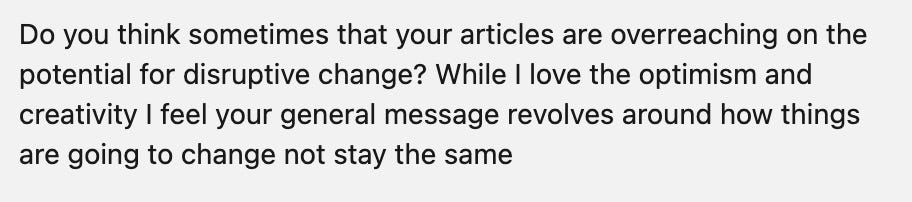
We’re <2 weeks into the year with potential new food pricing models and potential new farm operating models, yet I received this message:

I am keenly aware that writing publicly means you’ll see many of my hypotheses proven wrong, like ‘Peak Oil by 1950’ level wrong.

Actually the only thing I’m 100% confident in is that I am wildly underestimating the actual change we will see. The gap between Here and There will be significant, whether There is 1, 10, or 100 years from now.

Although it’s true that identifying what is not going to change is important, this is a newsletter for innovators in livestock, meat & dairy. The whole purpose of this newsletter is to spark & attract conversations about emerging trends and how those trends create opportunities.

The gap between Here and There, where emerging trends are still emerging, is where innovative companies, brands, and leaders live

…as long held assumptions no longer hold, as supply chains reorganize, as tech changes production methods & unlocks new business models, as consumers segment by new values.

I think of it like this: Traders love volatile markets, whether it’s the stock market, livestock market, or any other market. If markets are stable, traders don’t make money. If markets are moving, traders can make money.

Volatility creates opportunity for traders; trends create opportunity for innovators.

And IMHO, the only way to discern the actual high impact emerging trends from the noise is through dogged curiosity.

Photo from Brene Brown’s new book:

Here’s to curiosity & 2022; what a time to be alive 😉