Categories
Leadership

Prime Future 139: Working Genius

If you’ve been around here very long, you know my obsession with this idea from Allen Nation:

“The innovative farmer is seen by his farm neighbors as a lunatic farmer. And a lunatic is not seen as a role model. As a result, what the innovator does on his/her farm is literally invisible to the neighbors. This is true even if the innovation is producing visible wealth. The normal reaction to unconventional success is the old it-might-work-there-but-not-here syndrome.

The sad truth is that the vast majority of farmers prefer to fail conventionally rather than to succeed unconventionally. It is very, very difficult to be more innovative than the community in which you live.”

(Turns out Nation was paraphrasing the economist John Maynard Keynes who made the observation that most humans would rather fail conventionally than succeed unconventionally. Checks out, doesn’t it?)

Lunatic farmers make agriculture dynamic. They are the single most interesting thing this industry has going for it, IMO.

It’s fascinating talking with farmers who have a drastically different business today than they did 30, 20, or even 5 years ago. They’ve 10x’d capacity, created a new market, or redesigned their business model….or they’ve done some magical combination of all 3.

I always wonder what separates these lunatic farmers from the farmers whose businesses only incrementally change with time and the slow carving of going with the flow of traditional market forces.

A lot of things could explain the gap: attitude, skills, relationships, market timing, location, access to capital. The list goes on.

But increasingly, I think it’s all about the decision maker(s) DNA.

I’m a sucker for tools like StrengthsFinders or the Enneagram, tools that help us better understand ourselves and other people and how to be more effective doing work that involves people (aka all work). None of these tools are perfect but most of them offer some little nugget to increase self-awareness and effectiveness.

I recently found a new one called Working Geniuses by Patrick Lencioni. And it hit me that this theory likely explains a super high percentage of what makes lunatic farmers lunatics.

See it? The lunatic farmers are the ones whose Working Genius leads to 10x’ing a business, who naturally derive energy and joy from doing the things that radically drive their business whether strategic planning, forging new markets & customers, implementing win-win partnerships that allow both sides to grow their business profitably, or exploiting (in the good way) emerging trends and technology.

The lunatic farmer derives energy & joy from doing things that drain energy & joy from the average farmer.

From Patrick Lencioni’s ‘Working Genius Assessment’

Lencioni’s theory is that each person has 2 areas of Working Genius, 2 areas of Working Competency, and 2 areas of Working Frustration.

It’s not about what someone’s geniuses are, it’s about how they put them to work.

If the Working Genius model is true, then those same producers whose own Working Geniuses are the DNA that drives their business to continually higher levels also have 2 areas of Working Frustrations, things that drain their energy.

My hypothesis is that lunatic farmers with 10x capabilities are the ones who put their own geniuses to work and then find business partners with complementary working geniuses.

The book First Friends: The Powerful, Unsung (And Unelected) People Who Shaped Our Presidents illustrates this idea in politics. But the pattern is everywhere: the visionary leader with the execution-focused partner, the partnership-centric CEO with the get-it-done COO, the agronomic wunderkind working with the markets guru, the production-focused partner and the customer-focused partner, etc.

So the idea of being fiercely collaborative at an organization level is directly connected to this idea of maximizing return on all the things (opportunity, talent, capital, joy) by smartly collaborating at an individual level.

Lunatics who get 10x results do both. Long-term games with long-term people.

Categories
Leadership Supply Chain

Prime Future 138: The future is fiercely collaborative.

This week we throwback to Prime Future 68 as a welcome to new followers & as the setup for next week.


There’s a local ranching family that’s been raising cattle on the same land for 7 generations. In that time they have not sold an acre of land, not one. They have withstood droughts, drug cartel activity, wildlife predators, market crashes, high interest rates. You name it, they’ve survived it.

Some years ago they got into a lil spat with the US government over the renewal terms for grazing permits on public land, so the federal government rounded up the family’s cattle that were on public lands and kindly delivered them to the sale barn.

Someone recently summarized the family’s mentality this way, “They are  fiercely independent, they just don’t trust anyone. Then again, that’s probably how they’ve survived and why they’re still ranching.”

This struck me. I have a deep respect for the challenges producers face and the resilience they embody….but I wonder if that fierce independence won’t actually work against producers in a rapidly evolving world where collaboration is rewarded more than independence. (And though this first example is a rancher, every segment of the value chain has players with a similar mentality, a transactional ‘us vs everyone else’ mentality.)

Collaborating raises new questions, new situations, new risks to manage…and new opportunities. If done thoughtfully and effectively, new collaborators can grow the pie (and it’s individual slices) in ways that independent actors cannot.

In today’s world, mastering the art of highly effective collaboration increases the probability of survival.

Let’s start with one of the most successful examples of a systems approach, one that has stood the test of time: McDonald’s. (If you aren’t familiar with the 3 legged stool model, here’s a good primer.)

Each supply category has a limited number of suppliers that are held to very high standards but rewarded with high volumes of business, typically on a cost plus basis. Suppliers do not float in and out of the system frequently, these are not transactional relationships – they are partnerships built for the long term.

Now contrast the McDonald’s system with two alternative structures that land in different places along the continuum of Transactional to Collaborative, the independent rancher and the contract poultry grower:

  1. Let’s assume the rancher sells weaned calves at the sale barn, the epitome of price taking at the market’s daily whims. The definition of transactional – the buyer is literally whoever is willing to pay the most on any given day.
  2. Let’s assume the contract poultry grower supplies the labor and facilities, then executes the management program prescribed by the poultry integrator. The grower is paid on a $.xx/lb produced with some level of base pay that is set, and the remainder of pay determined by how the contract grower’s live performance stacks up against the flocks that are processed that week (the lottery system).

Regardless of the business (weaned pigs, broilers, or hamburger patties), it seems there are 3 core drivers around engaging in collaborative ecosystems with dedicated partners:

  1. Profit. Maybe its about finding higher value races to the top of the value pyramid, rather than vice versa. Maybe it’s about cost plus arrangements that may not maximize revenue on a given transaction, but could look smart over the long haul and the ups & downs of market cycles.
  2. Predictability. Creating predictable revenue can radically impact business planning and operations. Some would prefer to make $.1/lb day in day out, some would prefer to make $1.00/lb on 1 load knowing they might lose $.90/lb on the next.
  3. Potential (long term growth). What’s the growth potential of the ecosystem? Is this a chance to grow the pie and grow your business accordingly?

Below is a rough analysis of how different systems compare – maybe these are over or under stated, but the big idea is that there are tradeoffs under each model.

🙂=sufficient. 😃=heck yeah. 😑=maybe? 😂=that’s funny.

Of course this doesn’t capture some of the intangible tradeoffs of collaborative partnerships, like losing some degrees of freedom. I think my real point is that there are increasingly more alternative ways to approach business models and these alternatives should be considered.

  1. What is the upside potential? Downside risk?
  2. What are the tradeoffs compared with the risks of the status quo?
  3. Are those tradeoffs bearable compared to the next best alternative?

The answer to those questions will always be situation/people/goal dependent.

And I’m no Pollyana – there are risks with entering partnerships where multiple parties are reliant on one another. The obvious caveat is that not all systems are created equal; not all partners are good partners, not all collaborations are worthy bets. Sometimes the business model isn’t right, sometimes the leadership isn’t right…or any other number of reasons that a system doesn’t work out.

One of the most practical pieces of advice came from my friend’s dad: when you create a plan to enter a partnership, create the plan for how you will exit the partnership.

(Those of you much more seasoned than me are probably nodding your head vigorously at that advice since you’ve seen the dangers of not preparing for partnership dissolution in advance. “Hope for the best, prepare for the worst” and whatnot.)

A great irony from a producer standpoint is that although it might be easy to reject taking on the risk of entering partnerships, the fewer strategic alliances a producer makes with customers, by definition, the more reliant the producer is on commodity markets where price takers have zero control which introduces…risk.

Maybe the real questions are around where you want control (price? management freedom?), where you want predictability, and what type of risk you are willing to accept or are more comfortable managing.

I recently saw a list of about 30 aligned beef supply chains in the United States, here’s a snapshot of one. ‘Run our program to help us deliver a better product to our customers and we’ll all win’ is the summary idea. If you read Prime Future you know I think we’ll continue seeing more of these:

The above examples focus on how producers might engage supply chains & customers, but what about managing suppliers? I recently heard of a producer who decided to double down on supplier relationships by choosing one strategic supplier for every major input category. They gave up the transactional, shop-around-for-the-best-price-on-this-transaction in pursuit of the best supply arrangement on the next 1,000 transactions. Another dimension of a collaborative approach.

What does collaboration look like in Agtech?

Now let’s talk about where a collaborative mindset can drive progress in agtech:

  • Among co-founders – its doable to be a solo founder but as someone who hit The Great Wall of Burnout trying this route, I can tell you it is HARD and there is not an ounce of virtue in trying to defy the odds by being a solo founder.
  • Among founders and venture investors – there are huge tradeoffs in choosing to bootstrap a business which typically means slow and steady growth versus raising venture capital and committing to the high growth model. Neither is right or wrong, they are just different models with different paths.
  • Among founders and early customers – That early feedback from first customers – and how founders respond – can set the entire trajectory of an early stage company. Ask any successful tech company and they will tell you about the early customers who made them.
  • Among big companies and startups – each brings something to the table in terms of successfully scaling innovation, figuring out how to get the best of each can unlock magic.
  • Among startups and startups – the punishment for tech forward producers right now is that every single hardware/software product tends to have its own login. What farmer wants to login to multiple systems to manage their business? Zero. But not every company can be THE platform. This will drive partnerships that may not be what every company wants, but will drive customer experience and <drumroll please> grow the pie of tech adoption.

The best summary of those last points came from a recent Future of Ag podcast interview with Jim Ethington, an early employee of Climate Corp who is now CEO of Arable:

“We could have said we can’t afford to give up a piece of this pie and we’re going to go it alone but that’s not the path that moves the industry forward. …we can all be good at our pieces and hey sometimes we compete, most of the time we can collaborate but that’s what moves the industry forward.…being able to put the puzzle pieces together where 1+1 = 3 for the customer.

What if they try to replace us? Come in with the assumption that a) it doesn’t matter because this integration is what the customer wants – start with the customer and work backwards, and they want one integrated system. …and b) when this plays out even at the largest companies in the world…guess what their roadmap is full. ….everybody’s roadmap is packed – don’t flatter yourself they aren’t going to go build your product. And if they do, they were probably going to anyway and your partnership didn’t do anything to accelerate it. I think you have to let go a little bit and go back to the customer problem, growing the pie, making this a better overall technology space….and put aside the natural fears of what risks does this pose to us. The benefits outweigh the risks because those fears usually aren’t as real as you think.”

Does an independence-at-all-cost mentality create the trajectory to thrive in the ag economy of the future?

There’s perseverance in independence that will get you somewhere.

But my hypothesis is that moving forward it will be the smart collaborators who channel that same perseverance for the sake of a larger business objective who will win; those who grow the pie in a way that creates long term value for every link in their chain.

…aka the spoils will go to the effective collaborators. The collaborative’ists, if you will.

“If you want to go fast go alone; if you want to go far go together.”

What a time to be alive 😉


Did you miss early editions of Prime Future?

Access an ebook with editions 1 through 81 here: Prime Future PDF

Get the ebook

Categories
Leadership

Prime Future 132: A learning list

I’m in full 2022 wrap-up mode which means trying to capture all the learnings from another year while mentally preparing for a brand-new one.

My favorite new habit this year was to keep a running list of books I read and a few takeaways from each one, a learning list, of sorts. I love this habit so much and want to keep it going for the rest of my life.

So today’s newsletter is a hodgepodge sample from that list:

"All drama in leadership and life is caused by the need to be right." – The 15 Commitments of Conscious Leadership. Ooph, does this resonate deeply with anyone else or just me?? 😵‍💫

“Always measure backwards. When we compare our current position against where we’d like to be (the gap), we tend to get frustrated. When we measure our current position against where we started, we tend to be deeply motivated because we see progress.” – The Gap & the Gain by Dan Sullivan.

WD Farr was one of the first cattle feeders to bring the feed to the cattle, instead of the other way around. He was also a catalyst for meat grading, which was a game changer in the US beef industry in creating a standard that gave consumers confidence in the consistency of the eating experience. Perhaps most poignantly, WD believed that “cattle would have to be bred and sold on a performance basis like hybrid seed corn. ….would increase the quality and yield of slaughtered animals, reducing the fatty wastes that increased the price of meat to consumers. Unfortunately, the beef industry works on averages. The poor, inefficient animals in every herd drag down the good animals. I do not believe any industry can exist on averages for a long period of time.” – Cowboy in the Boardroom by WD Farr.

An early innovation in meat packing was moving from vertical cross-species plants (aka multi-story) to horizontal, single-story, single-specie packing plants, and the simultaneous move from plants near population centers to plants near animals, which was enabled by refrigerated transport. – Meat Then & Now by Dell Allen.

The skill of optimal quitting is what separates amateur and pro poker players. A common misconception is that quitting will slow or stop our progress but the reverse is true. By not quitting you miss the opportunity to get closer to your goals. When you stick with something when there are other opportunities out there, that slows you down. Quitting gets you where you want to go faster.” – Annie Duke in Quit (some additional thoughts in the context of starting & growing businesses)

Change your identity to change your behavior and habits. In order to build the habit of going to the gym, I have to first see myself as someone who has the habit of going to the gym. Or as someone who takes smart risks and builds businesses. Etc, etc. etc. See myself as someone who _____ in order to have the motivation to build the habits of someone who _____. – James Clear in Atomic Habits (paraphrased)

Be My Guest is an autobiography by Conrad Hilton, as in the hotel guy. Forget flash in the pan tech founders, this was a story about building something that lasts and building it one hotel at a time. But interestingly one of the takeaways was to know your investors before you take their money: one of Conrad’s investors didn’t like how a deal had turned out post-1930s economic depression so he walked into the hotel and shot Conrad’s business partner. Yikes.

The 'technology' that changed the landscape and power dynamics of the US Plains was when the Spanish introduced horses into North America, which completely transformed the way some Native American tribes operated, particularly the Comanches who were virtually unstoppable when mounted on horseback and therefore reigned supreme across the plains for 200+ years until the Texans/US military came along in the mid-1800s. The intersection between this and the early cattle industry is that when the buffalo were cleared from the Plains, the Comanche’s food source and way of life went with them, along with many other Indian tribes, so they had no choice but to surrender to reservations. – Empire of the Summer Moon by SC Gwynne

Three things from Accidental Superpower by Peter Zeihan:

  1. Geographic features determined every country’s culture, economy, and politics, particularly waterways for trade.
  2. Because of each province’s unique geographic features, Canadian provinces are more economically integrated vertically with the US than horizontally with one another.
  3. The Japanese occupied all the economically relevant regions of China during WW2. (I had never heard about this and need to learn more, any good book recs?)

The Zimbabwe economy shrunk by 50% in 5 years when Mugabe rose to power in the 90's and took land from large commercial farmers and gave it in small pieces to new farmers who neither knew how to farm, nor how to farm effectively. The impact was drastic and horrific for the people of Zimbabwe. – When a Crocodile Eats the Sun by Peter Godwin (it’s a memoir about his experience during Mugabe’s rise).

Jews were not even allowed to own property throughout Europe in the 1400s-1700s so being a merchant or trader was the only option available. Interestingly for some of those early pioneering souls who came to America to escape anti-semitism, they found those merchant and trading skills were a superpower they could put to work in the growing early commerce of America…and they built entire industries and lasting institutions. Amazing. – Tower of Gold: How One Jewish Immigrant named Isaias Hellman Built California by Frances Dinkelspiel (I am a sucker for an immigrant success story and this one is epic.)

You think the meat industry is the only industry with extreme concentration? Lol. It’s actually true of most industries today. Monopolized by David Dayen is fascinating but almost makes you want to curl up in the fetal position, read at your own risk.

“The opposite of distraction is not focus, it is traction towards our goals. The opposite of distraction is momentum.” – Four Thousand Weeks by Oliver Burkeman.

The Revolutionary War was not two-dimensional, the American militia vs. the British military. It was multi-dimensional chess with each side vying for additional support from Europe (France, Spain) and locally from various Indian tribes. Truthfully my takeaway here is that few things are black and white, there's often way more than 2 sides to any complex story. – The Taking of Jemima Boone by Matthew Pearl

“Find your foxhole people. These are the people you want in the foxhole with you when you go into comedy battle. Find these people, be around them, and be one of them. One of the signs of these foxhole people is that they find positive stories in the world around them. They do it reflexively. …had decided there was something good before he had decided what was good. He assumed there was a silver lining and then he found it.” – How to be the Greatest Improviser On Earth by Will Hines.

After WW1 the German Mark held just 4% of it's pre-WW1 value. I’d never heard a number put to this before, and it makes the post-WW1 economic challenges that set up the rise of Hitler even more clear. – The Warburgs by Ron Chernow (This also adds context to the history told in The Alchemy of Air about that same time period when synthetic fertilizer (invented in Germany and primarily manufactured there) was exploding, commercially.)

The Warburgs was a phenomenal book about an incredibly resilient family that kept getting back up and building every time their business was destroyed by factors outside their control, aka economic depressions, WW1, and WW2. One of the offspring of the lineage was obsessed with outcompeting his cousin, and the author summarized it this way: “Siegmund Warburg died, a deeply unhappy man devoured by a dream.” This made me think of the book Wanting by Luke Burgiss about the power of mimetic desire in our lives and how damaging it can be when left unchecked.

Execution matters. The famous rallying speech that Churchill gave was not only not praised at the time, it was actually criticized because Churchill was slurring his words and sounded sluggish. It was because he had a cigar in his mouth and couldn't be bothered to remove it, despite his advisors’ counsel. (obviously not an issue in the grand scheme because hi hello it was Churchill and he got the job done, but still an interesting example of why details matter) – The Splendid and the Vile by Erik Larson

And finally, Midnight in Chernobyl by Adam Higginbotham was basically a 400-page guide in how NOT to do leadership. The secrecy, the bureaucracy, the blaming and shaming, and the CYA mentality instead of focusing on containing this massive problem with massive consequences. A total failure of leadership, from the low-level plant supervisor to the very tip-top of the government regime.

What did you learn from your own 2022 reading?

Book recs welcome here 🙂

Categories
Leadership

Prime Future 127: more Ridiculous Generosity

I wrote about Ridiculous Generosity last year & I believe it, even more, this year.

I’m grateful you’re here.


Prime Future 77: Ridiculous Generosity (link)

It’s Thanksgiving week in America and if the pilgrims had celebrated with prime rib instead of turkey, it would be my definitive favorite holiday. Alas, I still love the idea of pausing life to be grateful even if it means eating turkey.

Gratitude inevitably leads to generosity.

A mentor of mine was recently talking about business relationships and said “I may have made some decisions that looked dumb to outsiders, but my bent towards generosity has never once disappointed me.

I love that idea. When you say the word generosity, people usually think of things like donating to a charity. But there’s another aspect of generosity that is rarely discussed but is just as powerful. It’s relational generosity or generosity of influence.

Andy Stanley talks about the leadership principle of generously leveraging your influence on behalf of other people which reminds me of this:

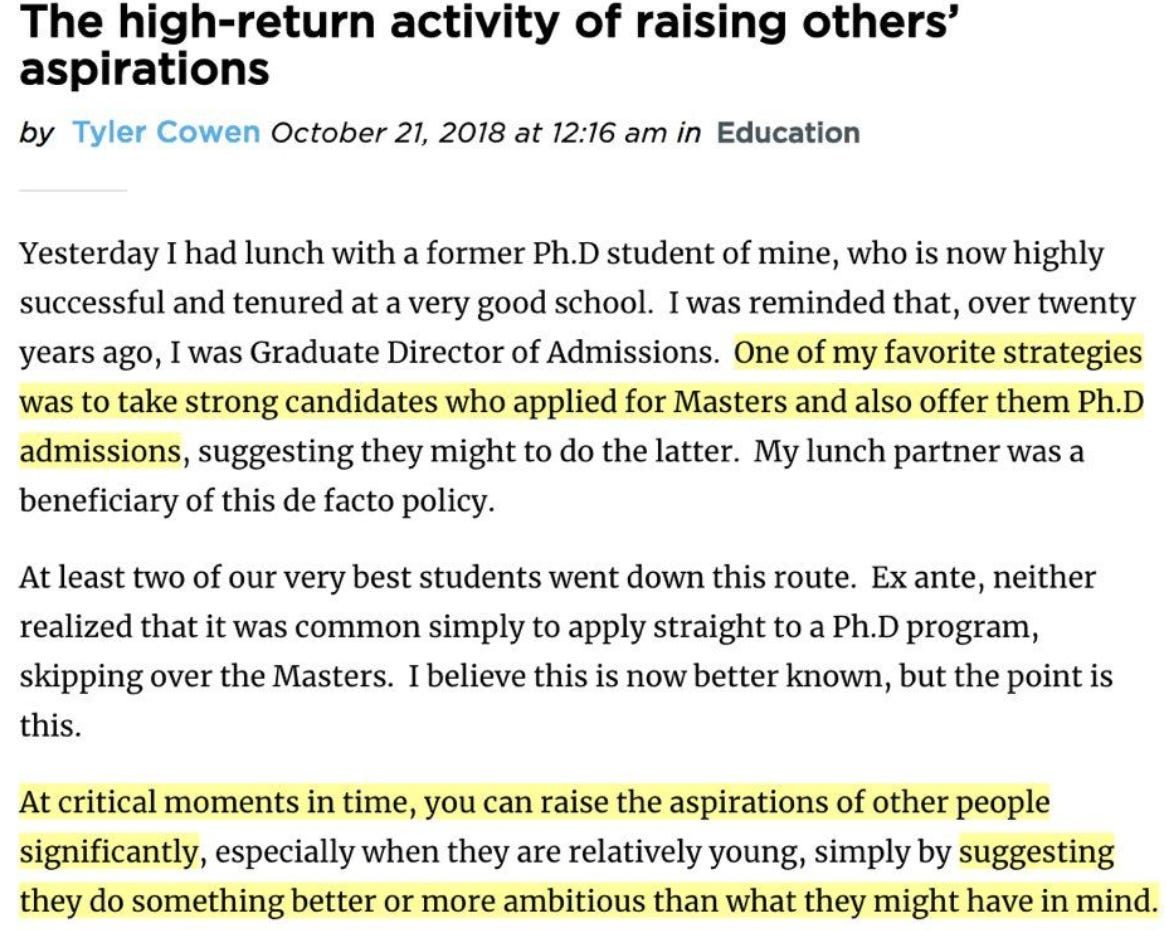
“At critical moments in time, you can raise the aspirations of other people significantly”

I know that people can create an inflection point in someone else’s career with generosity because I’ve experienced it again and again. When I was young and dumb and clueless (so like, yesterday), people invested in me with their time and wisdom. And people connected me with other people. And all of those people, bit by bit, completely expanded my view of the world and the possible.

People have shown me Ridiculous Generosity.

The leaders I respect & admire exercise Ridiculous Generosity, it’s core to their ethos. Ridiculous Generosity is a mental model of how to engage the world, a life philosophy.

My hypothesis is that Ridiculous Generosity is rooted in an Abundance Mentality.

Folks with a scarcity mindset perceive that if you win, then they lose…so of course they don’t help anyone else. But those with an abundance mentality perceive that not only is there room for everyone to win, there is room to grow the pie so that everyone wins bigger.

Ridiculous generosity is the other side of the ‘play long-term games with long-term people’ coin.

Playing long-term games with long-term people means putting an abundance mentality to work even when a scarcity mentality tries to creep in. It means helping people today whether the payoff is in 15 minutes, 15 years, or the payoff never happens.

Because of the Ridiculous Generosity I’m so grateful to have received, few things in life bring me more joy than making thoughtful connections for other people. Here’s how I’ve seen Ridiculous Generosity in action:

  • make the thoughtful & well-timed intro (PSA: only after both sides opt-in)
  • share the learning
  • send the 10 word text to answer the question
  • offer the meaningful advice or insight
  • share the link to the friend’s new project
  • grab coffee with the newbie
  • have the brainstorming session
  • give the feedback to the person who asks for the feedback, even when it makes you a bit uncomfortable
“Being a feedback magnet is a game changer in your career. 1. Feedback is the only way to see your blind spots. 2. Your colleagues have feedback for you, but they’re not saying it b/c it’s uncomfortable for them.”

Have I mentioned this is still aspirational for me and I don’t say this as someone who has this nailed? This is #goals.

Ridiculous Generosity isn’t necessarily about the big business decisions or the decisions that cost real dollars, time, political capital, or reputation risk. Though it could bleed into those through a relentless focus on long-term win-wins.

The real power of Ridiculous Generosity is in the daily interactions that cost little to nothing besides bending toward generosity.

You might be thinking this is all fine and well, but we each have finite time and finite focus. I 100% agree. Even if we wanted to help everyone, we can’t….the time math doesn’t work. So Ridiculous Generosity *has* to have boundaries around it. The two big ones for me are:

(1) Not everyone receives Ridiculous Generosity. It’s kinda like qualifying sales leads, only in this case it’s qualifying people asking for a favor. Maybe you only show Ridiculous Generosity to people you already have a relationship with, or only to people who’ve shown that they are serious-minded, or only to the cold outreacher who put in the effort with a thoughtful ask that shows they’ve done their homework. Maybe when the random person reaches out asking for a call to talk about x, you ask them to first email the specific questions they’d like to discuss. (Funny thing, this is where a lot of requests suddenly go silent because the person wasn’t serious about it so the qualifying filter paid off.)

(2) Ridiculous Generosity has time boundaries. There are times when you can barely squeeze another email into the day, let another phone call or coffee date. And that’s ok. If it’s someone you want to help and you don’t have the mental or emotional or calendar capacity right now? Tell them to check back in some specific time frame. If it’s someone that you really don’t want to help? Tell them that. Well, soften it and say it kindly but yeah, let them know this is not something you will be helping on. Even when we can't be as generous as we'd like, we can always be polite.

This actually reminds me of when we talked about the idea of discernment and that knowing WHEN to do something can be higher impact than knowing WHAT to do.

If I were to rewrite the Ecclesiastes framework for people building & creating, it would look something like this… There is a right time for everything.

A time to expand optionality and a time to hyper commit.

A time to ignore to the skeptics and a time to listen carefully.

A time to meticulously plan and a time to just👏🏽get👏🏽started👏🏽.

A time to generously schedule intro calls and a time to ruthlessly guard your calendar.

A time to talk to every single sales leads and a time to relentlessly qualify leads.

A time to burn the ships and a time to hedge your bet.

Lastly, make it easy for people to help you.

Some ideas:

  • Send an email that they can forward on to make the intro you are hoping for.
  • Follow up after the intro to let them know the outcome.
  • With people you trust, be clear about where you’re trying to go – if people know they can help.
  • Just ask politely, recognizing that you are asking for a favor. People who demand or expect Ridiculous Generosity don’t get it. An extreme example is that I once worked for a company that had a corporate bully in a senior position who was eventually ‘invited’ to leave the company. The bully then wanted an intro to the new company I had joined but instead of asking me for an intro, he sent me an email telling me to make an intro. lol nah bro.

(Most) people like to help people. And we all like to help people who help us. I find it interesting that generosity is a bit of a currency in both the startup world and in the ag world, maybe there’s a correlation between people doing hard things and an embracing of generosity?

Here’s to more abundance mentality.

Here’s to turning gratitude into Ridiculous Generosity.

Categories
Leadership

Prime Future 126: I quit.

Today’s newsletter is less learning out loud & more processing out loud.

Annie Duke is a former professional poker player. She’s written a couple of great books on decision-making frameworks but her latest book, Quit: the power of knowing when to walk away, is next level.

Before we get to why Quit spoke to my soul, here are my favorite ideas from the book:

(1) Quit and grit are two sides of the same decision.

“Grit keeps you working on worthwhile things, but it also keeps you working on things that are not worthwhile.”

The central idea is that our culture celebrates grit even tho sometimes quitting is the better decision. The superpower is in knowing when something is no longer worthwhile, no longer worth gritting it out…knowing when it’s time to quit.

This isn't quitting when the going gets tough, as it always will in anything worth doing. This is building the really hard-to-build muscle of knowing when to grit and when to quit, how to avoid quitting too early OR too late.

(2) Build the skill of optimal quitting.

“The skill of optimal quitting is what separates amateur and pro poker players. The desire for certainty, to know the outcome, is what keeps us playing to the end. Having the option to quit helps you explore more and learn more to find the thing you want to grit out.

Quitting on time feels like quitting too early but when you quit you live to fight another day. If you feel like it’s a close call between persevering and quitting, quitting is likely the right choice. Quit while you still have a choice.”

(3) When you quit what’s not working, you can find what will work, faster.

“A common misconception is that quitting will slow or stop our progress but the reverse is true. By not quitting you miss the opportunity to get closer to your goals. When you stick with something when there are other opportunities out there, that slows you down. Quitting gets you where you want to go faster.”

(4) Put the decision to grit or quit in the context of the long game.

“We don’t like to close accounts/games in the loss. But remember that poker is one long game, and life is one long game.”

(5) Escalation of commitment & sunk cost fallacy can wreck our ability to make an optimal grit or quit decision.

The more time, energy, and money we put into something, the more invested we get emotionally. This is the trap of sunk costs.

If I spend another 6 months trying to make something work, I am more likely to spend a subsequent 6 months because I’ve escalated my commitment by spending 6 more months on something.

This is why the sunk cost fallacy causes us to often make sub-optimal decisions about grit or quit. I stay in this market, with this team, with this company, etc etc etc because I’ve already invested so much effort here.

Another way we escalate our commitment is by making something part of our identity.

“When we make something part of our identity it’s even harder to quit. Cognitive and motivational factors make it hard to change your mind or quit a venture, because it is part of your identity. Would shutting down this business make it a mistake to have started?”

Duke offers examples around politics (if I put yard signs up for a politician then learn new negative information about that politician, it’s harder to take the yard sign down because I’ve made my support of that candidate part of my identity to the neighborhood) and business (a founder who built his company in public while frequently railing against venture capital and extolling the virtues of bootstrapping, so when he had the opportunity and need to take venture capital to win his category, he missed it b/c he was so entrenched in the identity of being a bootstrapped founder. Even tho his company got out-competed as a result.)

The two big muscles to build are:

💪🏽 1 – The ability to discern whether grit or quit is the best path.

💪🏽 2 – The ability to act when quit is the best path…the ability to walk away.

Sometimes quitting makes sense because something about the world changed, or the context around the thing. Sometimes it’s because we changed, maybe our context changed or life season changed, or we refined our long-term goals.

Startups, by definition, enter unknown territory. There are so many things you can’t know when you start, that you only learn once you’re in it. Sometimes you realize there’s more potential value to be created for an even larger market, sometimes the opposite. Sometimes you realize it will take longer than anticipated, or that you’re too early for the market. Startups are an ongoing flow of new information informing a series of ongoing grit-or-quit decisions.

So is production agriculture, where grit-or-quit decisions range from deciding whether to quit the status quo to pursue a new market, a new customer, a new business model, new genetics, new facilities styles, etc etc etc.

For producers, maybe the better way to say grit-or-quit decisions is to call them status quo-or-no decisions. Going back to the idea that it’s easier to fail conventionally than to succeed unconventionally (aka quit the status quo in some way), this makes lunatic farmers all the more extraordinary.

Ok so 3 reflections as I process this book…

(1) Knowing when to grit or quit is a more critical skill for new products/companies/business models than it is for established products/companies/business models.

Duke refers to an idea from Alphabet’s X, the moonshot factory to “train the monkey first”. Translation: if your goal is to train a monkey to jump over fire on a pedestal, you already know how to build a pedestal, so don’t build the pedestal until you find out if you can train the monkey, which is the hard part.

So “train the monkey” is shorthand for do the hard thing first, so you know whether to continue on to the easy part, or to quit and move to the next hard thing.

It’s easy to confuse activity with progress, but being busy with easy things just punts the decision to grit-or-quit….which we know makes the decision even harder because of our escalation of commitment & the sunk cost fallacy!

(2) Quitting in the short run can sometimes be the best way to grit in the long runespecially if you’re playing long-term games with long-term people.

As I was writing, I stumbled on a founder announcing that he’s shutting down his current company because they realized they couldn’t do in the market what would make it worthwhile to grit:

This is a founder whose first company (that he left to start this company) is seemingly successful, so he likely has a good feel of the difference between “if we dig in we can breakthrough this problem” and “this problem isn’t worth overcoming”.

(3) We make hundreds of implicit grit-or-quit decisions every day.

There are grit or quit decisions that are small, like whether to keep working a sales channel or keep using a specific genetic line. And then there are big grit or quit decisions, like jumping industries or rethinking our business model.

My hardest quit decision ever was to shut down my first venture. Somehow, by some miracle, this nobody from nowhere kid had found a massive problem that needed solving. We had some customers, a few investors, a product and a team. I was doing The Thing.

I spent ~30 months working on it, and if I had been more discerning at that time about whether to grit or quit, I would have spent <6 months on it. I say that with not one ounce of regret, and of course with the benefit of hindsight.

But the signs were there, I just didn’t want to see them. I wanted to do The Thing and if we could just work harder or be smarter, we could figure it out….right?!?! Wrong.

When I decided to quit, ~40% of investors’ money was still in the bank. We didn’t run out of cash; I spent too much of myself trying to make this one thing work that by the time I realized I would need to take a completely different approach, I didn’t have it in me to shift gears. I ran out of mental and emotional energy, I had nothing more to give to this problem/customer/company.

So I returned the remaining capital to investors and shut the virtual doors.

I knew in my bones it was the right thing to do, but OOPH it felt like I was making a naive/foolish/bad decision. I had never heard of someone returning capital like that because the only startup stories you hear are about either an exit or running out of cash. The message I interpreted from the startup ecosystem was ‘real founders don’t return capital, they keep going and figure it out…they grit it out.’

There have only been two times I’ve had external validation of my decision. The first was a few years after the fact when one of the investors said he had multiple active early-stage investments where the startups had no chance of survival but the founders were clearly going to spend every last dollar, and he appreciated that I returned the capital once the writing on the wall became too prominent to ignore. (He also said he’d invest in my next venture so I hope he’s reading this and still thinks that😉)

The second was reading Annie Duke’s book where she says:

“There is no honor in spending investor capital when you know the company is failing. Returning capital increases odds investors will back you again. Founders also feel like they owe it to employees to keep going but life’s too short to keep going when something is failing, for investors and employees.

Once it’s clear the venture isn’t going to be successful, everyone should get out – founders, investors, employees.

Don’t spend good time after bad, or good money after bad."

Shutting down a company is a particularly heavy decision because there are investors and employees and customers involved. And ego, so much ego. So much self-identity. So much escalation of commitment.

But again, this whole idea is NOT simply quitting when the going gets tough, as it always does in anything worth doing. It’s about building the really hard-to-build muscle of knowing when to grit and when to quit (and to what degree), arguably one of the hardest things for an innovator to distinguish.

Maybe I only liked this book so much because it provided confirmation bias…but I think it’s more than that. Knowing when to quit, and when to grit, is this wildly important skill that NO ONE TALKS ABOUT even though every day we implicitly make hundreds of grit-or-quit decisions.

The book ended with the punch line, “Winners quit a lot. That’s how they win.”

So that’s my new #goal, to wisely wield those two little words like a scalpel, carving out a path of effectiveness and impact over the long run:

I quit.

Categories
Business Model Innovation Leadership

Prime Future 112: Growth: DNA trait or decision point?

Sanderson Farms began as a humble farm supply store in 1947 while Wayne Farms traces back to a feed milling operation started in 1895. I wonder what the founders of these businesses would have said their ambition was for these companies, way back when? You probably saw the recent announcement about the newly merged Wayne-Sanderson Farms, now the 3rd largest poultry producer in the US.

On the one hand, it’s hard to imagine that the early founders of what are now the biggest companies in the space set out to become what they became.

On the other hand, growth orientation is a DNA trait. Or is it?

We recently talked about the Business Model Canvas and the 9 building blocks around business model innovation. It’s a great framework, but I think there is a 10th building block that’s missing: ambition.

The last several years I’ve had one foot in ag where economies of scale continue to drive consolidation, and one foot in tech where startups create a vision to someday become a billion-dollar company to raise venture capital.

In both worlds, sometimes it seems like growth is the answer…no matter the question.

Why is it that some organizations hit the ground running towards scale either by leveraging the business with debt or by selling portions of the business as equity, while other businesses rock along for decades or generations without taking risk?

I think much of it has to do with ambition. The ambition level of the founder, investors, board, and/or leadership team. When I spoke with Greg Bethard, CEO of High Plains Ponderosa Dairy, I asked him how he thinks about growth. Here’s what he said:

“Growth is not for everybody. We have embraced growth; as a business our ownership has decided we want to grow. We’re all in it to get a good ROI, and I look at this as if we want to attract partners to invest in our business so we have capital to grow then we need to deliver a good ROI.

If you aren’t growing it gets harder to deliver a good return because your equity levels get higher. Its really hard to get a great ROI if you own a lot of your business and have very little debt. But if you are growing all the time and fairly highly leveraged then you can get a good ROI.

Now that comes with risk, obviously the higher the risk you should get a better return. Every partnership has to decide how much risk they are willing to accept, how leveraged are we willing to be, and you have to find the happy spot where everyone is comfortable.”

Greg mentioned a book that he and his board read as they began scaling the business, No Man’s Land: Where growing companies fail.

“No Man’s Land is that period when a company is too big to be small and too small to be big.”

The author describes No Man’s Land as the awkward teenage phase for a company. The majority of the book is about how to move through No Man’s Land effectively, but the author points out that companies have a decision point of whether to move into & through No Man’s Land.

Not every company is going to make it out, not every company should even try.

I think this has applications for both ag producers and tech founders. In a venture world that celebrates growth at all costs and an ag industry that assumes economies of scale are always the best path to profit, there’s the sometimes ignored idea that not every company can scale and/or not every company should scale.

There are two questions:

  1. Do you want to grow the business? That’s a personal preference question.
  2. If so, should you grow the business? That’s a financial & business model question.

And these questions are only relevant when the founder is more interested in working on the business rather than working in the business. If the founder would rather drive tractor than find new customers, or rather work cattle than recruit talent, or rather write lines of code than think about how to reduce CAC….then maybe growth isn’t the path.

But where growth is the intentionally chosen path, No Man’s Land lays out 4 traps that entrepreneurs run into and ideas for getting past those traps. Here are my takeaways:

Trap #1: Market misalignment

  • Market misalignment is “when a gap opens between the promises made to customers and the operations required to satisfy them.”
  • Careful consideration has to be made about which promises to extend to which customers. Chasing any customer may be fine in the early days, but it will wreck a business trying to scale.
  • The correct decisions here will keep you growing through No Man’s Land, while the wrong ones will kill you. Deciding which promises to make to which customers is strategic planning in its essence.
  • Scale the system for value delivery by breaking it down step by step to make it repeatable, and profitably.

Trap #2: Companies in No Man’s Land risk outgrowing their money.

  • Undercapitalization is not a cause of death, it is a symptom of being perceived as too risky to raise capital.
  • What most entrepreneurs fail to realize is that the growth itself generates the need for capital. Look around and you’ll find many rapid-growth firms that are rolling in profits, yet have no cash on hand. Even when a business is and remains profitable, growth requires infusions of capital, for the very reason that growth eats up cash flow.”
  • Equity investors need confidence in the upside potential, while lenders need confidence that the downside risk is managed. Choose wisely which path to take.

Trap #3: Companies in No Man’s Land usually outgrow existing management.

  • To make it through No Man’s Land, companies have to make the switch from hiring cheap labor to hiring someone trained as an expert to do the thing. This usually means hiring someone who learned how to do the thing on someone else’s dime and can immediately step in to begin executing.

Trap #4: Companies in No Man’s Land often outgrow their model.

  • You have to know how your company will make money as you scale, how will you be more profitable at higher volumes? Do the math. Let the math provide another important indicator of whether this business should be scaled up.
  • “Distribution channels – the mechanism to identify and acquire a new customer – are often by far the most expensive components of the business model, costing even more than delivering the value proposition.”
  • “Is your business viable at greater and greater scale, or do you risk growing yourself out of business? Are the fruits of growth work taking the risk of making infrastructure investments up front?”
  • As a machine for making money and creating value, how does it work now and how will it work at scale?

“If an entrepreneur doesn’t find a way to get through No Man’s Land, the company goes back to being small or goes under.”

I appreciated Greg’s recommendation because the book gives a helpful framework for thinking about the predictable risks of growth, but perhaps the most helpful are the questions about when and why to make the intentional decision to grow, or not grow. To grow and scale towards becoming an Industry Giant, or to refine and improve to be a Small Giant. Neither better or worse, just different objectives based on the business and individuals. Neither has the corner of the market on high ambition.

It’s only in the last couple of years that I’ve even entertained the idea that maybe growth is not the only measure of success, or the absolute measure of ambition. Books like Built to Sell: Creating a Business That Can Thrive Without You or Small Giants: Companies that Choose to Be Great instead of Big offer alternatives to the idea that scale = success.

There are other measures of success, including balancing financial objectives with impact objectives or with lifestyle design.

One of my favorite things about spending time with producers of all stripes is that you know when you’re in the presence of excellence. You know when you’re talking with a cattle feeder who is completely dialed in and optimizing every aspect of their business, or a seedstock producer who is proving out a new business model, or a poultry company that is rethinking what ‘best in class’ even means. Sometimes those are the big companies and sometimes those are the companies that you just know will overtake the big guys someday in some way in at least some markets, because they’re just better.

So maybe excellence is the real ambition flex.

Categories
Leadership Supply Chain

Prime Future 90: The outset of a new era for meat packers & food retailers?

I’m part of a group chat titled “The Advisory Board”. We live in different parts of the country but we’ve all known each other since high school. Over the last several years this friend group has evolved into something you might call a mastermind group or peer group. We approach the world with equal curiosity, ambition, & bullishness on agriculture….and from vastly different perspectives.

This group is about helping each other get where we want to go, and encouraging each other in the journey. One guy in the group describes it as “just about becoming better, in every area of life”.

It’s part sounding board, part therapy, part financial planning, part business coaching…its every bit as ridiculous and awesome as it sounds.

I’m wrapping up a retreat with this group that was like a 3 day mental IV of motivation and courage from all the brainstorming and game planning amidst Montana mountain views.

As a result, for today’s Prime Future I’m throwing back to some thoughts on vertical integration that are the backdrop for next week’s discussion – stay tuned.

Someday I’ll write about the ingredients for a great retreat like this but an important one is good views

The outset of a new era for meat packers & food retailers?

(Originally published in 2021)

We tend to think of the livestock, meat & milk business as part of an inevitable march towards increased consolidation and increased integration.

(Note: those are 2 related but very separate concepts. Consolidation is when a company buys a competitor, vertical integration is when a company buys a supplier or customer.)

Along with many other processors, a poultry integrator recently announced increased wages for processing plant employees and truck drivers. Because poultry is so vertically integrated, I’ve just assumed that most poultry co’s own the trucks and trailers to transport eggs from breeder farm to hatchery, chicks from hatchery to growout farms, feed from mill to farms, and live haul to take birds from farm to plant.

However, what I’ve learned is that there is actually a shift away from company owned truck fleets because of the management and capital required to keep those assets on the books. While some truck drivers are still employed directly by the integrator, like for delivering chicks to farms, and some of the trucks and/or trailers are company owned, more and more of these activities are outsourced to third parties.

Interesting. Here is an example, albeit potentially small, of reducing vertical integration by outsourcing at least some portion of a reallly critical activity.

One data point may not indicate a trend, but the whiff of vertical disintegration in trucking & logistics for meat & poultry companies does raise some questions:

  1. Why are the integrators moving away from owning trucking capacity?
  2. How will truck driver shortages of 2020-2021 (and likely 2022) impact that trend?
  3. Is this a one off trend or a part of something larger? Are integrators divesting assets in other important-but-not-core activities?

More importantly, given the chaos in labor markets & truck driver shortages of 2020-2021 (and likely 2022), how will this impact the ownership model for integrators moving forward?

“There are only two ways to make money in business: one is to bundle; the other is to unbundle.” The tech industry loves that quote, and it’s usually used in the context of bundling & unbundling consumer products, e.g. cable TV vs Netflix. Sometimes it’s used in the context of bundling & unbundling companies to create shareholder value, e.g. GE of 1990 vs GE of 2021.

What if it also applies to how we think about supply chains? Such as, oh idk, commodity supply chains like meat, milk & poultry? We could even use the alternative phrases of vertical integration & vertical disintegration to describe bundling & unbundling.

Metrics: what financial metrics drive vertical integration?

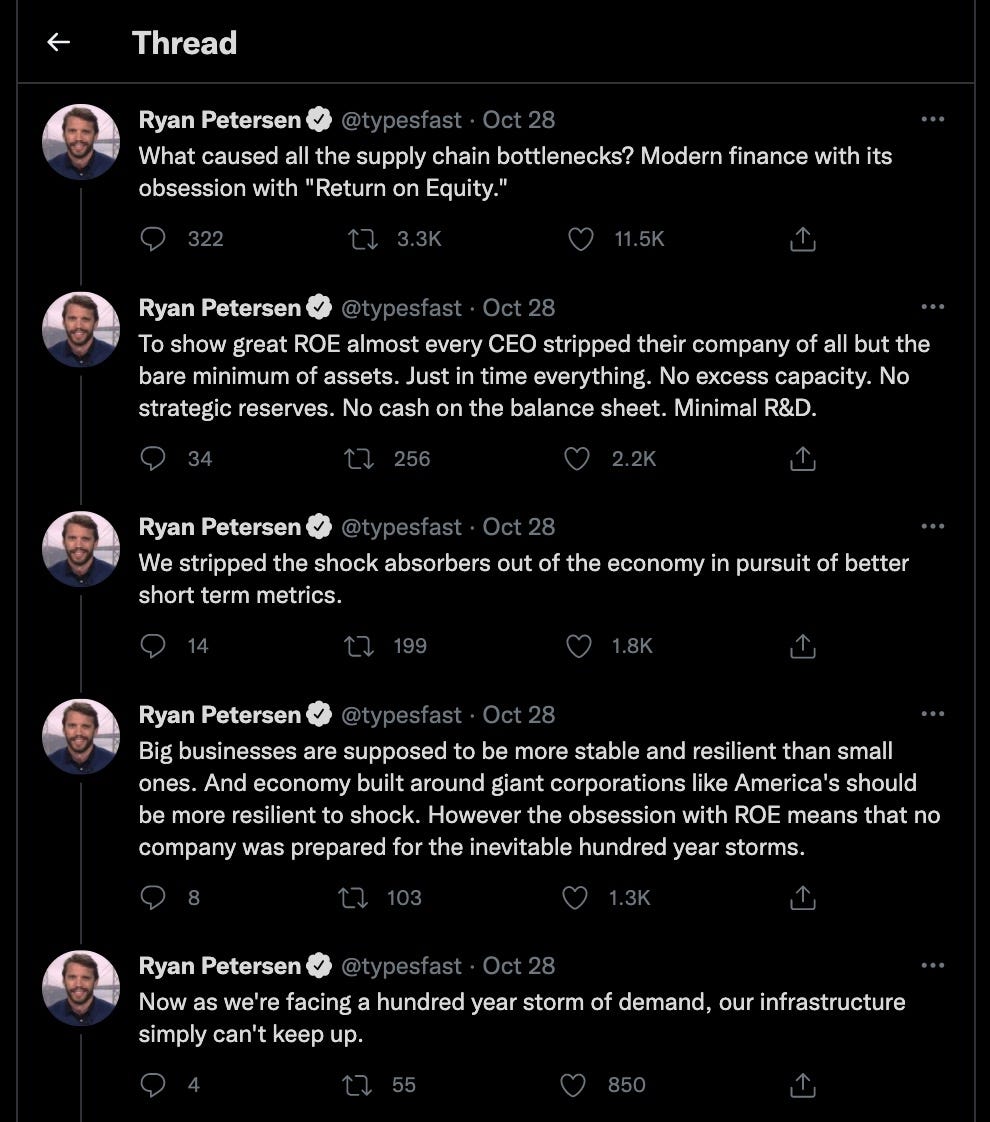
An interesting example of vertical disintegration happened in the US beef business a few years ago as packers spun off their cattle feeding capacity. Why? Because feeding cattle is massively capital intensive and depending on where we are in the cattle cycle, can negatively impact Return on Equity, a key finance metric.

It’s not a direct corollary to meat, but here’s an interesting thread on that concept; replace ‘supply chain’ and ‘logistics’ with ‘meat’ and see if some of this doesn’t resonate:

Yet over the same time frame that packers divested their cattle feeding businesses, let’s call it the last 10 years, retailers have increased their degree of vertical integration in protein with examples like Walmart’s milk plants and Costco’s chicken plant. Also over the same time frame, packers have moved further downstream into further processing, e.g. case ready plants. Mixed signals, eh?

Cold storage represents another dichotomy in vertical integration.

According to the Global Cold Chain Alliance, cold chain operators see insourcing (customers building their own facilities for cold storage) as a top 3 threat to the business behind driver & workforce shortage and balancing supply & demand. Yet these same third party logistics providers in the cold chain space see that increased customer outsourcing represents a growth opportunity.

Which is it?

When is it which?

(Interestingly two other growth drivers for cold chain ahead of customer outsourcing were robotics & automation and growth of ecommerce…obvious but also 👀)

There are probably a million factors that can impact a management team’s decision to increase/decrease vertical integration, things like:

  • market conditions
  • company financial health
  • company ownership structure
  • company strategy
  • relative risk level
  • supplier structure
  • net cash position
  • cost of capital
  • competitive landscape

etc etc etc etc etc…..

My working hypothesis is that ultimately the two driving dimensions for vertical integration are:

1) risk vs control - what is the risk of not having control of this link in the supply chain?

2) reduced cost vs added value - will owning this link in the supply chain reduce cost or increase revenue?

….sometimes those two sets of dimensions are at odds with one another. But here’s the thing – that laundry list of factors above? Those are true or false at a given point in time, not in perpetuity. So the structure of the industry should have some ebb and flow over time with regards to the degree of vertical integration. Some hypotheticals:

  • If land prices fall 50% in the next 5 years, would poultry integrators decide to buy the farm ground to grow corn & soy themselves?
  • If fed cattle prices increase 60%, would beef packers get back in the cattle feeding game?
  • What would need to be true to cause pork processors to own their own cold storage instead of leasing capacity as needed?
  • What would need to be be true to lead pork integrators to divest their growout operations? Sow farms?

Or, is it possible that as packers/integrators increase their core business through consolidation, that it makes more sense to decrease integration? I’ll leave that one to economists and CEO’s.

Back to the original question, how will the current transportation crisis impact the future movement of livestock, meat & milk?

My hypothesis is that we could see a shift back to company owned logistics as a way to control risk, given the massive logistics & labor risk the last 18 months have revealed. At least until autonomous trucking becomes a thing, then we should see more business model innovation unleashed…

…because, keep in mind, this whole discussion about the future of supply chain & logistics is set against a backdrop of not only how rapidly the tech is accelerating but how that technology is enabling new business models, like the one mentioned last week of the WeWork model for freight warehousing. (If you’re not familiar, WeWork is a startup that takes long term leases on commercial office buildings and sells short term leases for customers wanting flex office space. WeWork is also a deliciously disastrous startup trainwreck story for reasons other than their business model.)

Use WeWork or Uber or Airbnb or whatever other consumer business model you want, but the question is, how will those sharing-economy type business models drift into asset heavy, large scale, B2B manufacturing/disassembly businesses? The options used to be either lease or buy the asset, but having more variations in both of those options could change the risk/reward calculus of owning or outsourcing certain parts of the process involved in getting meat, poultry & milk to end customers.

Alternatively, having more predictability could change the calculus. Another example from last week was the idea of freight tech companies that are moving all the pen & paper or Excel based processes to digital, and improving not only visibility of information but of actual cargo in transit. How will those moves towards digitization reduce the risks that integrators perceive, ultimately enabling them to have high confidence in those suppliers to do the activities that need doing but without the integrator having that capability on their own books? Not just in trucking either.

On a final note, consider this perspective from Seizing the Middle: Chess Strategy:

Rockefeller’s strategy was part of a wider transition to a new type of industry, beginning in the 1840s and ending with the crash of the 1920s. Businesses started “seizing the middle” and taking control of the resources they depended on. A single company could take charge of everything from the natural resources required to make a product to the transport systems necessary to deliver it to customers. The implications of this were dramatic.

…the change in business practices allowed managers to start thinking like chess players: a few moves ahead. Being able to anticipate and plan had the undeniably significant effect of allowing companies to invest more in research and development because they could forecast where current trends headed:

“In allocating resources for future production and distribution, the new methods extended the time horizon of the top managers. Entrepreneurs who personally managed large industrials tended, like the owners of smaller, traditional enterprises, to make their plans on the basis of current market and business conditions. . . . The central sales and purchasing offices provided forecasts of future demand and availability of resources.”

To control the game, one tries to control as much of the board as possible. At the outset, using your pieces to seize the middle of the playing field is a great strategy, because it gives you the widest possible vantage point from which to control the movement of the other pieces.

But maybe that word ‘outset’ is the key here. The above description of Standard Oil (and many other businesses across many commodity segments) was reflected in principal in how the meat industry organized itself at the outset….but we aren’t at the outset of the meat business anymore – it’s an old, established business.

So perhaps we are at the outset of a new era. One with new alignments and new business models and new considerations that will inform how ‘vertical integration 2.0’ shapes up across meat, milk & poultry.

What a time to be alive!

Categories
Leadership

Prime Future 86: Let’s not kid ourselves – 2 narratives that need to go.

A wise industry leader recently described the elaborate R&D system within their production system as having one primary purpose, to “know I’m not kidding myself.” #goals

There are 2 pervasive ideas floating around the ag industry that are the epitome of kidding ourselves. They get thrown around on social media, at trade shows, and anywhere else producers gather. They are two sides of the same coin:

  1. The idea that farmers need to be thanked.
  2. The idea that consumers need to be educated.

Let’s talk about why those ideas are destructive, how they are connected, and the empowering narrative that should replace them.

‘Thank a farmer’ is not just a harmless pro-industry sentiment, it’s hubris:

  1. It’s industry level self-aggrandizing, and self-aggrandizement is not endearing to anyone but the aggrandizing. This drives the wedge further between producer and end user, mentally.
  2. Do you thank a plumber? an electrician? a trucker? a software engineer? a grocery store stocker? or any of the other jobs that keep a well-functioning society humming along? Implicit in the ‘thank a farmer’ mentality is the idea that the work of farmers is more important than the work of anyone else.
  3. Most importantly, it egregiously flips the narrative from “what have I done lately for my customers?” to “what have my customers done lately for me?”

And, obviously, no producer is in ag to be thanked. They might be in the business of agriculture because….

  • The financial returns meet your objectives.
  • Like the business, or the people.
  • Like the lifestyle it allows you to live.
  • Feel a sense of purpose and pride in producing something tangible.
  • See land as the best long term investment and agriculture as an industry that will always exist. People gotta eat.

…or a million other compelling reasons. Needing an external pat on the back is not one of them. It’s a silly & superficial premise to begin with.

Related, here’s why the idea of ‘educating consumers’ is also destructive:

  1. Abraham Lincoln established the land grant university system in 1862 which means we have 160 years of agricultural research backing up every aspect of how we produce food. And then we dump that 160 years of research onto the unsuspecting consumer that just was looking for the slightest reason to feel even better about buying pork loin at the meat case. Not ideal.
  2. It’s arrogant. It puts the burden on consumers to learn something that they may or may not be interested in learning, because we want them to do so.
  3. It’s hubris. It assumes that once consumers know what we know, then they’ll see it our way. Look I also prefer grain finished beef but if there’s a market for grass finished beef, for the love of capitalism, somebody produce some grass finished beef!
  4. Which consumers are we talking about? Consumers are not a monolith – there are a million sub-segments, that continue to further sub-segment.

Producers & processors who talk about educating consumers are kidding themselves. That’s not a thing. That’s an expensive path and a terrible use of time and capital. It’s a great way to spin our wheels and end up talking amongst ourselves with righteous indignation, lamenting those poor dummy consumers who aren’t buying our product as we think they ought. Sigh…

Do you see how these 2 ideas are connected?

Both narratives put producers at the center of the universe, expecting to bend consumer demands to the will of the producer.

But that’s not how capitalism works.

Whether we have trade associations to thank for generating these two ideas and embedding them in the psyche of American agriculture, or whether they were already embedded and trade associations simply tap into them, I do not know. But it’s time for these ideas to go.

I’m convinced the mentality behind these two ideas is what keeps folks complaining that it’s not how it used to be, instead of finding the opportunity in how it will be.

The alternative narrative is one that is as familiar to forward thinking producers as the air they breathe. It’s what every free market enterprise in the world has to do.

Create new value.

Market new value.

Capture new value.

No other industry educates, they M-A-R-K-E-T.

Forward thinking producers & processors are enterprising value creators that anticipate their customers’ wants & needs, and deliver accordingly.

Create new value. Market new value. Capture new value. Until that value is commoditized (look, its the nature of the business) and then find new value. Repeat forever, or at least as long as you want to be in this game.

Enterprising value creators don’t defend, they create. Don’t justify, they adapt. Don’t feel stuck, they pioneer.

They don’t kid themselves.

If industry associations want to move the needle in the right direction, the first step is to scrap every scheduled social media post or campaign that includes these outdated and misguided concepts.

I suppose it’s ironic I’m writing about this topic since the producers that drink their own koolaid are not the ones interested in emerging trends, technology & innovation in livestock, meat, and dairy. Maybe I just needed to get this off my chest. 🙃

Back to emerging trends next week. What a time to be alive!

Categories
Leadership

Prime Future 81: Three macro-meat dynamics to watch in 2022

There are 3 macro-meat dynamics I’ll be following closely as we enter the new year.

(1) Will meat & livestock forge a new economic model?

Will retail shoppers continue paying what they’re paying at the meat case? If so, what does that mean for the traditional high throughput/low cost model of the packers? And if the packers’ model changes, what does that mean for those who supply live animals to packers?

My granddad tells the story of a young farmer in the ’70s who bought a set of feeder cattle. They guy was excited about his new venture, especially since he saw this as a low risk investment – the cattle market had reached a new normal, it was never going back down. To this optimistic young producer, the market had found a new floor. You are cringing, aren’t you? You know how this ends.

Sure enough, not 60 days later and the market did what the market does, serving a heaping helping of humble pie.

I can’t imagine what made me think of this story…

(2) Will the packers forge a new operating model?

Tyson recently announced that one of their plants is piloting a 27 hour work week that would allow plant employees to qualify for full time benefits, as a way to attract people. The next day they announced a $1.3B investment in automation.

Changes are afoot in how processing plants do the work of disassembling carcasses.

(3) Are we on the cusp of an infinite consumer market bifurcation?

Remember the ‘beef: it’s whats for dinner’ campaign? It was wildly successful as a mass market campaign in selling the mass category of beef.

But mass categories and mass campaigns are over.

We're in an era of niche, hyper targeted markets and aligned supply chains will allow brand owners to serve certain segments of customers by aligning incentives throughout the entire value chain to meet a specific customer group's objectives. Objectives which are always nuanced, and could even be competing.

Take the retail shopper who wants to purchase grass fed beef because they don’t like the idea of feedlots. Does that same customer also care about methane emissions? Because if that customer were optimizing for lowest methane emissions per steak, they would buy steak from grain finished cattle. How’s that for nuance?!

Brands are going to have to do the (really) hard and messy work of teasing out who actually cares about what attributes, and then aligning their supply chain and marketing accordingly.

My only prediction is that 2022 is going to be a fun year to be in the biz 😎 I’m taking next week off so I’ll meet you back here in the new year. Happy holidays!


My holiday reading:

  1. The Truth Machine: The Blockchain and the Future of Everything.
  2. The AI First Company: How to Compete and Win with Artificial Intelligence.
  3. Wanting: The power of mimetic desire in everyday life. Fair warning, this book is about why we want what we want and it will mess with your mind. It offers a compelling explanation of why we want the toy that the other kid picks up. The idea of mimesis, and how it drives behavior of individuals and markets, is likely to be very relevant over the next decade as the role of animal protein sorts itself out.

Tis the season for…a life retreat.

Last year I wrote about my favorite life hack, an annual life retreat. It still holds:

Hopefully you are sliding into holiday mode and the most troublesome thing on your mind is nailing the ratio of rosemary:thyme:garlic for the prime rib. Me too.

I’m deviating from our normal topics to share one of my favorite end of the year traditions: a Life Retreat. It’s one of the highest life ROI ways to invest a few days, carving out time to step away from daily life to distill my learnings from the year ending and gear up for the year ahead. It’s my best chance to recalibrate day to day life with long term objectives, to pressure test the trajectory I’m on with the trajectory I want to be on.

In my experience, the real keys to crafting a high impact Life Retreat are:

  • Take 2-3 days. Any thing less doesn’t allow you to completely separate from day to day life.
  • A relaxing setting, for me it’s a mountain range somewhere.
  • Really good food + abundant charcuterie. This is critical.
  • A good porch view for optimal coffee drinking & contemplation.
  • The perfect mix of hiking to clear the mind & reflect, and down time to journal or whiteboard or whatever seems like the best way to mind map.
  • Capturing high/lows from the year wrapping up & the lessons/learnings to carry forward & put to work.
  • Identify in advance the big questions/topics you want to mentally wrestle down.
  • A mix of inspiring & educational books/podcasts.
Categories
Leadership

Prime Future 77: Ridiculous Generosity

It’s Thanksgiving week in America and if the pilgrims had celebrated with prime rib instead of turkey, it would be my definitive favorite holiday. Alas, I still love the idea of pausing life to be grateful even if it means eating turkey.

Gratitude inevitably leads to generosity.

A mentor of mine was recently talking about business relationships, and said “I may have made some decisions that looked dumb to outsiders, but my bent towards generosity has never once disappointed me.

I love that idea. When you say the word generosity, people usually think of things like donating to a charity. But there’s another aspect of generosity that is rarely discussed but just as powerful. It’s relational generosity, or generosity of influence.

Andy Stanley talks about the leadership principle of generously leveraging your influence on behalf of other people which reminds me of this:

“At critical moments in time, you can raise the aspirations of other people significantly”

I know that people can create an inflection point in someone else’s career with generosity because I’ve experienced it again and again. When I was young and dumb and clueless (so like, yesterday), people invested in me with their time and wisdom. And people connected me with other people. And all of those people, bit by bit, completely expanded my view of the world and the possible.

People have shown me Ridiculous Generosity.

The leaders I respect & admire exercise Ridiculous Generosity, it’s core to their ethos. Ridiculous Generosity is a mental model of how to engage the world, a life philosophy.

My hypothesis is that it’s rooted in abundance mentality.

Folks with a scarcity mindset perceive that if you win, then they lose…so of course they don’t help anyone else. But those with an abundance mentality perceive that not only is there room for everyone to win, there is room to grow the pie so that everyone wins bigger.

Ridiculous generosity is the other side of the ‘play long term games with long term people’ coin.

Playing long term games with long term people means putting an abundance mentality to work even when a scarcity mentality tries to creep in. It means helping people today whether the pay off is in 15 minutes, 15 years, or the pay off never happens.

Because of the Ridiculous Generosity I’m so grateful to have received, few things in life bring me more joy than making thoughtful connections for other people. Here’s how I’ve seen Ridiculous Generosity in action:

  • make the thoughtful & well timed intro (psa: only after both sides opt in)
  • share the learning
  • send the 10 word text to answer the question
  • offer the meaningful advice or insight
  • share the link to the friend’s new project
  • grab coffee with the newbie
  • have the brainstorming session
  • give the feedback (to the person who asks for the feedback, even when it makes you a bit uncomfortable)

Have I mentioned this is still aspirational for me and I don’t say this as someone who has this nailed? This is #goals.

Ridiculous Generosity isn’t necessarily about the big business decisions or the decisions that cost real dollars, time, political capital, or reputation risk. Though it could bleed into those through a relentless focus on long term win-wins.

The real power of Ridiculous Generosity is in the daily interactions that cost little to nothing besides bending towards generosity.

You might be thinking this is all fine and well, but we each have finite time and finite focus. I’d 100% agree. Even if we wanted to help everyone, we can’t….the time math doesn’t work. So Ridiculous Generosity *has* to have boundaries around it. The two big ones for me are:

(1) Not everyone receives Ridiculous Generosity. It’s kinda like qualifying sales leads, only in this case it’s qualifying people asking for a favor. Maybe you only show Ridiculous Generosity to people you already have a relationship with, or only to people who’ve shown that they are serious minded, or only to the cold outreacher who put in the effort with a thoughtful ask that shows they’ve done their homework. Maybe when the random person reaches out asking for a call to talk about x, you ask them to first email the specific questions they’d like to discuss. (Funny thing, this is where a lot of requests suddenly go silent because the person wasn’t serious about it so the qualifying filter paid off.)

(2) Ridiculous Generosity has time boundaries. There are times when you can barely squeeze another email into the day, let another phone call or coffee date. And that’s ok. If it’s someone you want to help and you don’t have the mental or emotional or calendar capacity right now? Tell them to check back in some specific time frame. If it’s someone that you really don’t want to help? Tell them that. Well, soften it and say it kindly but yeah, let them know this is not something you will be helping on. Even when we can't be as generous as we'd like, we can always be polite.

This actually reminds me of when we talked about the idea of discernment and that knowing WHEN to do something can be higher impact than knowing WHAT to do.

If I were to rewrite the Ecclesiastes framework for people building & creating, it would look something like this… There is a right time for everything.

A time to expand optionality and a time to hyper commit.

A time to ignore to the skeptics and a time to listen carefully.

A time to meticulously plan and a time to just👏🏽get👏🏽started👏🏽.

A time to generously schedule intro calls and a time to ruthlessly guard your calendar.

A time to talk to every single sales leads and a time to relentlessly qualify leads.

A time to burn the ships and a time to hedge your bet.

Lastly, make it easy for people to help you.

Some ideas:

  • Send an email that they can forward on to make the intro you are hoping for.
  • Follow up after the intro to let them know the outcome.
  • With people you trust, be clear about where you’re trying to go – if people know they can help.
  • Just ask politely, recognizing that you are asking for a favor. People who demand or expect Ridiculous Generosity don’t get it. An extreme example is that I once worked for a company that had a corporate bully in a senior position who was eventually ‘invited’ to leave the company. The bully then wanted an intro to the new company I had joined but instead of asking me for an intro, he sent me an email telling me to make an intro. lol nope

(Most) people like to help people. And we all like to help people who help us. I find it interesting that generosity is a bit of a currency in both the startup world and in the ag world, maybe there’s a correlation between people doing hard things and an embracing of generosity?

Here’s to more abundance mentality.

Here’s to turning gratitude into Ridiculous Generosity.


Get the first 50 editions of Prime Future in 1 ebook:

Get the ebook!