Categories
AgTech Artificial Intelligence Genetics

Prime Future 141: 7 acres —> 1 takeaway

The hosts of my favorite podcast, Acquired, talk about the idea that actual tech enablement always shows up in a company’s P&L, whether in the form of decreased cost structure or increased revenue. If it doesn’t show up in the P&L, the business isn’t truly tech-enabled. A lot of non-native tech companies want to be tech companies; few have the financials to prove it.

Set that idea aside for just a moment.

I recently had the privilege to tour Bayer’s new plant breeding facility outside Tucson. They describe the facility as enabling the transition from selecting genetics to designing genetics, which Bayer calls precision plant breeding.

Photo from Bayer’s website

The facility is 7 acres under greenhouse glass, replacing the need for 20,000 acres of farm ground. And because 365 days of the year make up the growing season, they get 3-4 entire crop cycles per year rather than 1. The facility is automated from start to finish, including full traceability for every seed that is planted into a germination tray all the way to seeds that are shipped out to be planted in field trials.

Not to mention, every seed is ‘chipped’, meaning a tiny sliver of the kernel is sliced off in order to run genomics testing so that selection decisions can be made from the combination of phenotype and genotype data.

The combination of these capabilities allows them to capture more data, apply high-powered analytics, and make better and faster decisions.

The name of the plant genetics game is speed, balanced against accuracy, so you can imagine how these capabilities complement one another. Bayer describes the net impact as moving 15x faster, realizing 4x genetic gain, and accelerating the genetic cycle by 30%, which has a compounding effect.

One of the presenters explained that achieving those 15x, 4x, and 30% outcomes is possible because of the emergence & convergence of multiple technologies simultaneously: greenhouse robotics & automation, plant genotyping, machine learning, massive cloud computing capacity, etc.

A very short time ago, the idea of capturing thousands of data points on every seed planted would have been completely unwieldy, let alone to do predictive analytics with that scale of data.

My takeaway is that this facility Bayer has assembled is not unique because of any individual technology but because of an incredibly rich tech stack.

It's not any one technology that is unlocking their genetic acceleration; it's the portfolio of technologies and how that portfolio has been assembled.

This is instructive for companies up and down the animal protein value chain…or any other value chain, tbh.

While a technology here or a technology there can create real value, competitive advantage is carved out both by assembling a tech stack, or a portfolio of tech solutions, that fits the company’s strategy.

You might even say that adopting a single technology solution is a way to create short-term competitive advantage, while assembling a strategic tech stack is a way to create long-term competitive advantage.

As I walked through the facility with trays of corn plants at various stages of development moving on tracks overhead from one part of the greenhouse to the next, I kept thinking how difficult it would be to replicate what Bayer has created and, perhaps more importantly, to replicate how they are using it.

That’s a competitive advantage; that’s a real moat…in this case, the moat is around their innovation engine. That seems likely to cast an even longer-term moat shadow.

Circling back to the idea from the Acquired podcast. While the Bayer presenters didn’t speak to this specifically, my hypothesis is that Bayer will see the impact of this precision breeding capability show up in the P&L primarily in the form of increased revenue as they launch more products of higher value. I think the Acquired podcast hosts would say that business is transitioning to become a truly tech-enabled business.

This is an extreme example, of course. Not every dairy or feedyard or poultry integrator is going to be able to make an investment like this, for starters, because those businesses do not have the same margin structure as an R&D-driven crop input company.

But the principle holds:

Short-term competitive advantage can be created by adopting individual technologies; long-term competitive advantage is created by assembling a portfolio of technologies that unlock a company’s business model strategy.

What a time to be alive😉


Categories
Business Model Innovation Genetics

Prime Future 67: When does beef x dairy show up at the meat case?

Every company on the face of the planet (and someday on Mars) does 3 things:

  1. buys stuff to
  2. make stuff to
  3. sell stuff

Using that oversimplified framework, in our last stop in this series let’s look at the downstream implications of ‘beef on dairy’ for cattle feeders, packers, and retailers.

Keep in mind, we’re talking about a max of ~5 million out of ~25 million fed cattle per year in the US.

Feeders gonna feed.

Success in cattle feeding is based on a 3 variable equation:

  1. Quantity & price of lbs out the door (selling cattle right)
  2. Minus the quantity & price of lbs in the door (buying cattle right)
  3. Minus the cost of lbs added at the feedyard (feeding & managing cattle right)

Those 3 levers make feedyards the segment in the beef value chain with the most flexibility. That flexibility makes cattle feeding a reeeeally dynamic business allowing feeders to shift strategy with trends in the market, the cattle cycle, or grain prices. It’s also what makes cattle feeding really hard.

When it comes to feeding native cattle (beef), dairy, or beef x dairy crosses, cattle feeders find what works as they triangulate risk profile on the buy, feeding & management, and relationships/proximity to plants that process certain types of cattle. There are both the management & nutrition elements of feeding different or new-to-you types of cattle that can take some time in learning how to adjust lever #3 above, cost of gain. But just as important are levers #1 and #2 which are driven by the relationships and partnerships and arrangements that surround a cattle feeder’s strategy as it relates to how they buy and how they sell cattle. All 3 levers have some degree of learning curve when it comes to beefxdairy, though waaay less than a beef cattle feeder jumping into feeding dairy cattle.

My hypothesis is that because large dairies are leading the way with ‘beef on dairy’, the animals tend to move as large lots under negotiated agreements rather than moving as smaller lots through sale barns. The result is increased visibility to production history, and decreased risk….not a bad combo for a cattle feeder.

One opportunity for cattle feeders is if these large dairy systems look to maintain ownership of cattle through the supply chain to capture more value all the way to the packer, will that create more low risk custom feeding opportunities. If the balance of feedyard owned cattle vs custom feeding cattle for others tends to cycle with the broader cattle cycle and feed price fluctuations, could this increase the amount of predictable custom fed business? Maybe, maybe not.

~5 million dairy calves have been part of the beef value chain for decades. All ‘beef on dairy’ does is create an opportunity to level up, to get the best of beef and dairy genetics for performance in a feedyard and in the plant. Shifting from 280 days in a feedyard for Holsteins to <180 days in a feedyard for Hogus cattle is, um, a big deal.

One aside: For the segment of dairy cows that are bred to a beef bull using AI, the math doesn’t (yet) make sense to use sexed semen so 50% of those offspring will be heifers. Heifers are typically considered less profitable for a feedyard than steers. If/when it becomes economical to use sexed semen for all calves from a dairy that are headed into the beef value chain, there will be another inflection point. The view on heifers is another example of the difference in beef goals vs (traditional) dairy goals, since heifers are significantly more valuable to the dairy producer.

Packers gonna pack…but at what price?

We talked about the BIG idea of beef on dairy value chains to accelerate aligned supply chains in beef since they are absolutely critical to maximizing the value of beef x dairy carcasses. Beef on dairy value chains *have* to have a direct relationship with the packer. This partnership mentality, from producer to calf ranch to feedyard to packer, is essential to ensuring beef-dairy cattle are priced according to the value of the carcass, with its beef characteristics.

But as long as the ‘right’ genetics have been selected to drive desirable carcass traits the packers are looking for, then these animals should be priced like their native peers. If the dairy’ness has been offset by the terminal beef genetics, then once the animal arrives at the packing plant there *should* be no subsequent difference in process or how that beef is sold. It’s just beef by the time the carcass is disassembled and prepared for the meat case at retail.

Which leads us to….

Retailers gonna…cringe a bit.

To the extent beef x dairy meat went into mainstream channels & programs at the packer, then they show up in the meat case just like meat from any native (beef) animal. Zero impact there.

The real question is, will retail brands be built around beef on dairy?

Here are the reasons FOR beef x dairy focused brands:

  1. Consistency in supply, consistency in product given the tight dairy gene pool. The consumer will get the same experience every.single.time. That seems brand’able.
  2. Transparency into supply given the ‘aligned supply chain’ nature of this beast that is required. Want to know how this animal was raised, where it’s been, how it was fed? We gotchu.
  3. Sustainability. Let’s say for illustrative purposes (don’t @ me) that each cow uses 1 unit of environment per year. The beef cow produces 1 unit of food supply per year with a calf. So we can loosely say that beef = 1:1 output to input ratio. But wait a sec, here comes the dairy cow who also uses 1 unit of environment per year but she produces 1 unit of food supply per year through milk production PLUS 1 unit of food supply with a high value beef x dairy calf. Dairy = 2:1 output to input ratio. The dairy cow is the super star when you frame it that way.

It’s a made-for-the-meat-case story.

But there’s a catch: The calf ranch.

Regardless of how well cared for the calves are, kept out of the elements, given appropriate feed and water and nutrition…brand new baby calves in hutches isn’t something thats likely to play well in a social media world that runs on sound bites & spin rather than nuance. Until there’s an alternative to the current calf rearing link in the supply chain, there’s likely to be limited retailer / brand appetite for marketing beef x dairy crosses in a direct way.

And yet, given how great the value proposition is for a fully aligned beef x dairy supply chain from dairy to meat case, I have to believe that someone is going to find a meat case friendly solution for calf rearing.

And when that happens? Game on.

Summary

We’ve covered a lot of ground in this 5 part series – I have learned so much from all the people who’ve shared their insights along the way. My takeaway from the series is that beef on dairy isn’t everything, but it is definitively something:

the 3 ideas that make beef-on-dairy punch above its weight class:

  1. Beef x Dairy cross carcasses are as good or better than straight beef carcasses. (Think of it as having your cake and eating it too, but ya know, beef.)
  2. Beef-dairy crosses hold a consistency advantage over the traditional fragmented beef value chain.
  3. Beef-dairy cross value chains are forcing new partnerships in order to capture full value at the packer level.

Which is all fine and well, until we come back to the math of beef on dairy. If we are really only talking about 5M calves annually, out of 25 million total fed cattle, it raises the question of….so what?

What happens with 5M beef dairy crosses is interesting, but the really fun part will be seeing how the 5M could influence the 20M.

Imagine that cattle feeders and packers and retailers get used to all those benefits mentioned above that are inherent to the beef x dairy value chain. Now use the exceptionally limited amount of imagination to picture those expectations bleeding over into the other 80% of beef, the natives. Not much imagination required, huh?

The unknown is how the beef value chain will respond and how long it will take to catch up & recreate the rapidly accelerating advantages of the beef on dairy value chain. Is this a 30 year dynamic or a 5 year dynamic? TBD.


ICYM the rest of the series

The first 4 of this 5 part series on how the ‘beef on dairy’ genetics strategy could impact the beef & dairy industry in the United States:

(1)  How the ‘beef on dairy’ genetics strategy will impact cow-calf producersSpoiler alert: not much, mathematically speaking.

(2) What’s driving this beef on dairy thing from the dairy producers POVtldr: its complicated.

(3) 💡 3 reasons why dairy is the new beefIt’s not about the 5M, it’s about how the 5M influence the remaining 20M fed cattle.

(4) If dairy is the new beef, where do the alts fit? A look at how alternative milk and meat market share might impact milk and meat prices now that the two are even more interdependent.

GET THE BEEF-ON-DAIRY EBOOK 🐄


I’m interested in all things technology, innovation, and every element of the animal protein value chain. I grew up on a farm in Arizona, spent my early career with Elanco, Cargill, & McDonald’s before moving into the world of early stage Agtech startups.

I’m currently on the Merck Animal Health Ventures team. Prime Future is where I learn out loud. It represents my personal views only, which are subject to change…’strong convictions, loosely held’.

Thanks for being here,

Janette Barnard

Categories
Business Model Innovation Genetics

Prime Future 66: If dairy is the new beef, where do the alts fit?

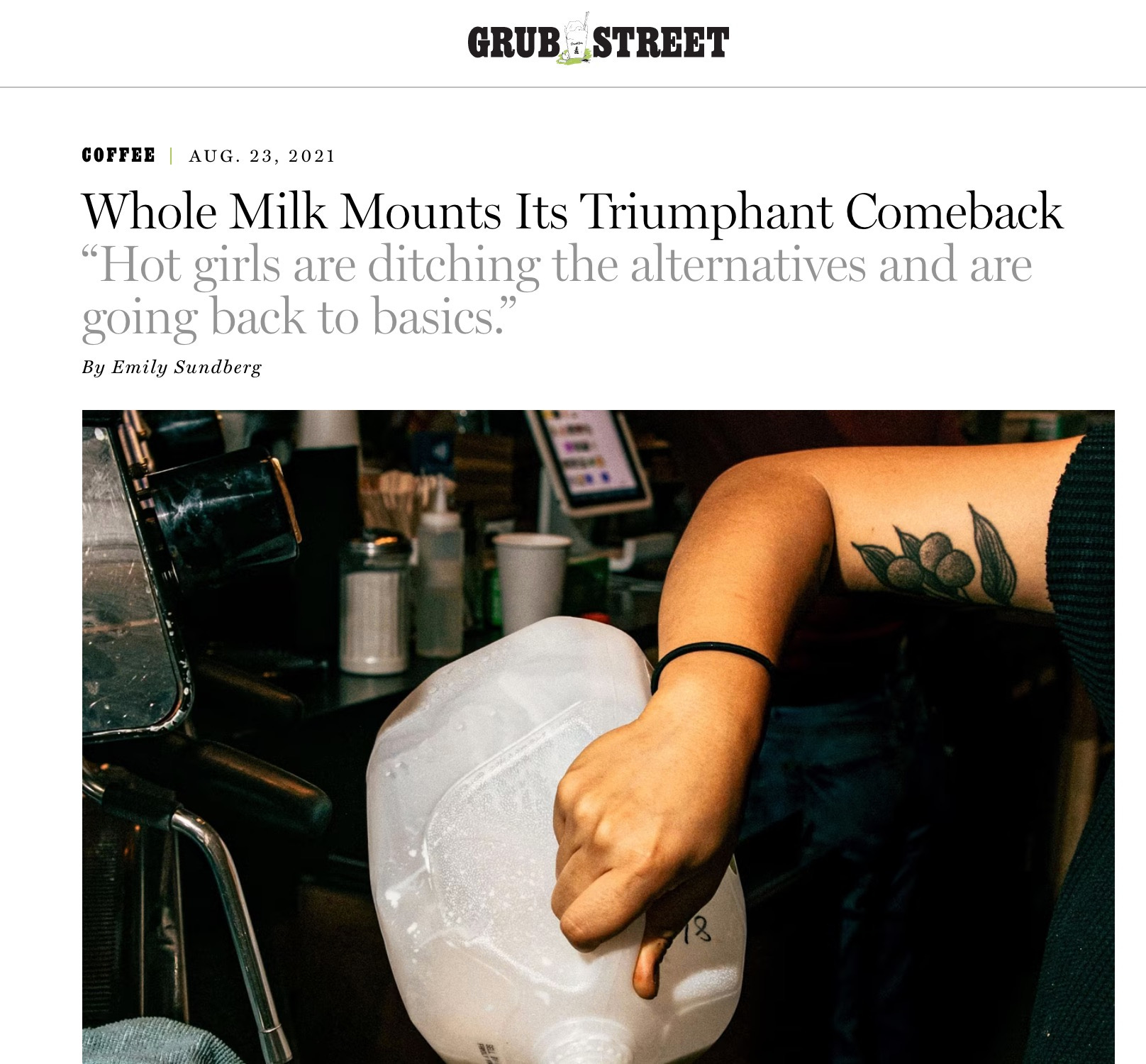
Move over hippies and hipsters, man buns and punk rock. The new counter culture move is….drinking milk?

“I traveled around Europe this summer. I drank icy frappes on the beaches of Greece and stirred foamy café au lait at the bistros of Paris. I was in a simpler, more sensible world, one without an alt mylk or nondairy creamer in sight. The real international delight, I realized, is pouring whole, full-dairy milk into your coffee; it is perhaps the most civilized activity in which a person can partake.”

….her answer edged on spiritual fulfillment. “There’s this quest for absolution in the foods we eat,” she said. “I think consumers were fed this lie by what I call the Goop Industrial Complex that if you cut dairy from your diet you will have more energy, clearer skin, and you will never ever fart ever again. But the case against dairy ignores many of the complexities of our food system, and I think people are starting to realize that.”

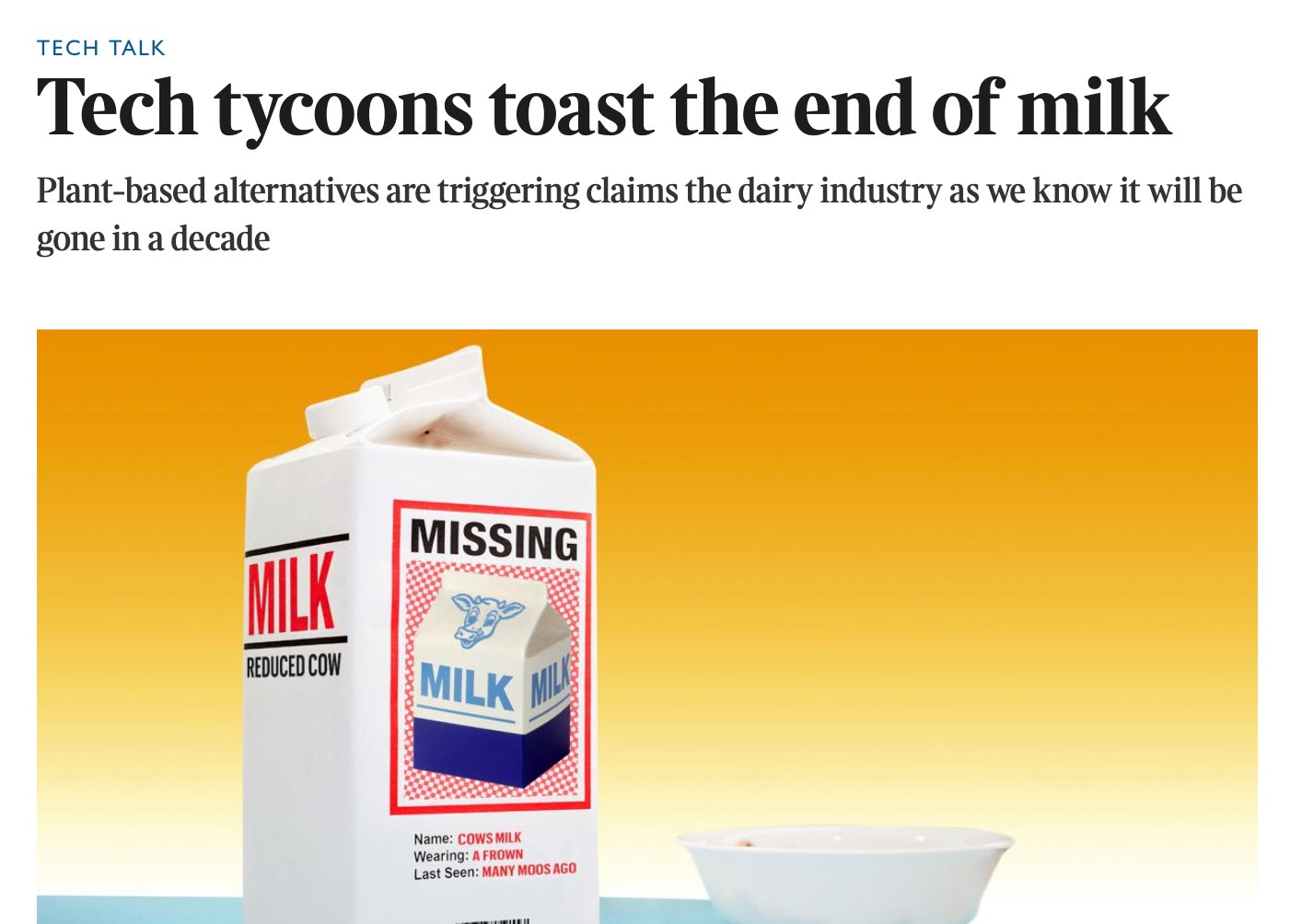
Now set that against this other recent headline:

When I hear people talking about the ultimate demise of animal protein as we know it, I assume it’s either an alternative protein investor who has capital on the line, or someone who wants to be seen as a forward thinker, even in the industry. It sounds more futurist to describe a future without plant fed animal protein than it is to say “I think there’s a market for plant based or cell cultured protein but not necessarily at the expense of plant fed protein.” It sounds more contrarian to say “livestock production will end in 10 years” than it is to say here are the markets where alternative protein is likely to take share but here’s where it’s unlikely to gain traction.

There’s little reward for a nuanced position in most conversations right now though…

Consider this quote by Jeff Bezos:

“I very frequently get the question: “What’s going to change in the next 10 years?” That’s a very interesting question.

I almost never get the question: “What’s not going to change in the next 10 years?” And I submit to you that that second question is actually the more important of the two.

You can build a business strategy around the things that are stable in time. In our retail business, we know that customers want low prices, and I know that’s going to be true 10 years from now. They want fast delivery; they want vast selection. It’s impossible to imagine a future 10 years from now where a customer comes up and says, “Jeff I love Amazon, I just wish the prices were a little higher.” Or, “I love Amazon, I just wish you’d deliver a little slower.” Impossible.

So we know the energy we put into these things today will still be paying off dividends for our customers 10 years from now. When you have something that you know is true, even over the long term, you can afford to put a lot of energy into it.”

How great is that?

That framing is likely to generate the richness of a whole lotta nuance, the tension of simultaneously asking what will change and what will remain the same. And when it comes to the impact of alternative proteins in milk or meat, it’s largely TBD.

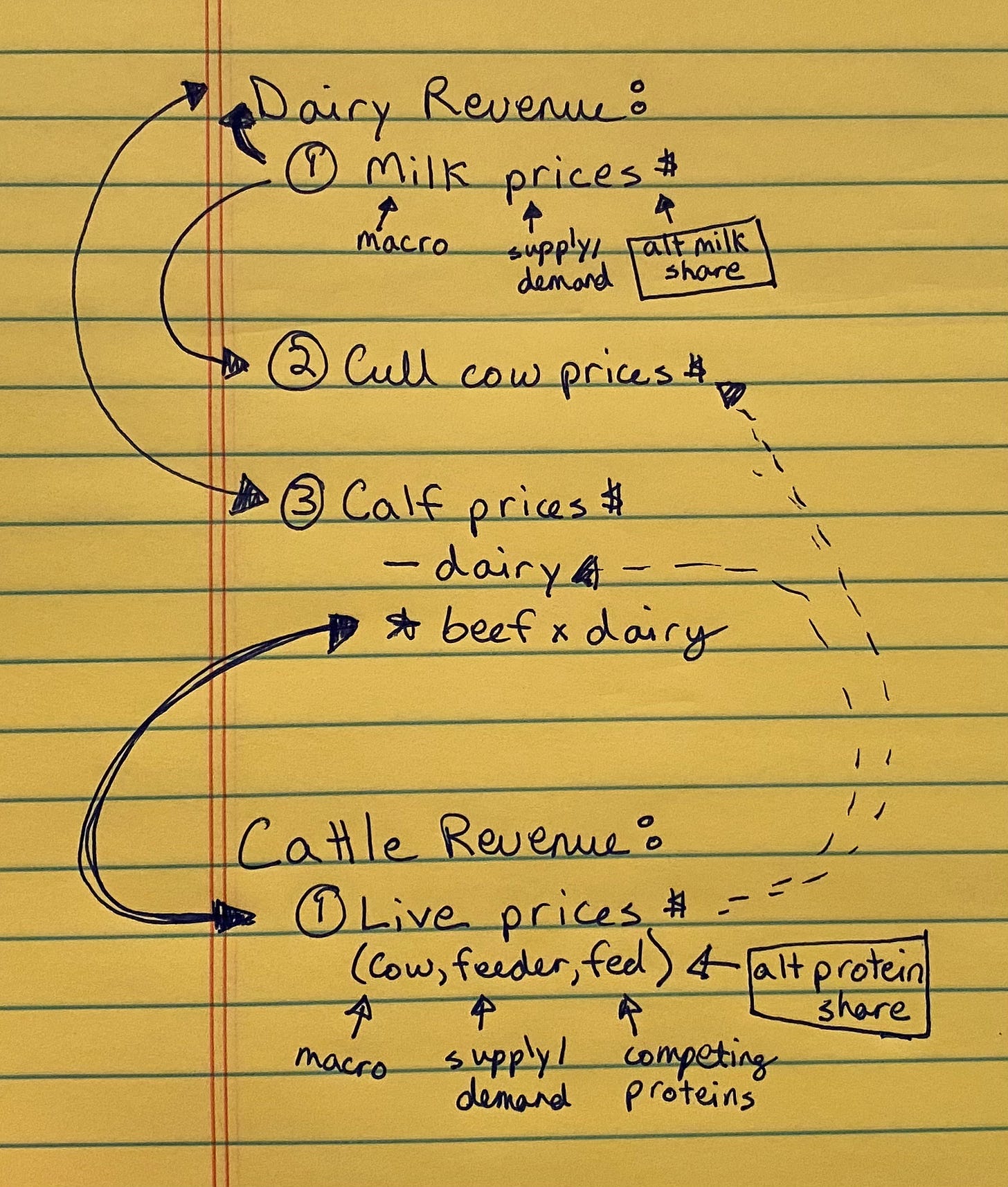
How do alternative milks & alternative meats fit with our ‘beef on dairy’ series?

Kinda like this:

This is obviously a wildly oversimplified drawing of wildly complex markets. Pricing for beef, pork, chicken, eggs, and milk have always been dynamic. These are competitive, commodity driven markets with so many interdependencies with macro factors and grain markets and processing capacity and export markets, and, and.

Alternative milks have captured up to 16% market share, depending on who you ask. Does that impact dairy milk prices? You betcha. Now what happens if something similar happens in meat over the next 3-10 years, will it impact meat prices? You betcha. I put a square around both of them above because they are x factors moving forwards, unknownslet’s ignore those who speak with certainty about the future (in either direction) and assume the impact will fall somewhere between ‘zero’ and ‘destruction’.

Market share for alternative milk has been a driver of milk prices, and market share for alternative meat could become a driver of meat prices…but what if market share for alternative milk becomes an indirect driver of meat prices and market share of alternative meat becomes an indirect driver of milk prices. 🤯

What is the increasing link between beef and dairy? The increasing supply of beef-dairy crosses flowing from dairy producers into the beef value chain.

I suppose the potential mega trend is that protein markets could get even messier with more x factors:

  • What happens to beef prices when a rancher generates more revenue selling carbon credits than selling weaned calves?
  • What happens to infrastructure heavy industries with super high asset specificity when the fickleness of consumer fads bears down in unpredictable ways?
  • What happens to dairy profitability when plant based ground chicken gets traction?
  • What happens to the broader animal protein industry when the ethanol mandate disappears? increases?
  • What happens to cattle feeder profitability when plant based milk loses market share?

I think I’m with Bezos:

It’s important to ask what will change in 10 years; it’s critical to ask what will stay the same.

Kick this to the nuanced thinkers in your network to see what they’d add to this discussion:


ICYM the ‘beef on dairy’ series so far

  1. If dairy is the new beef, are cow-calf producers necessary? (link)
  2. If dairy is the new beef, what are the dairy drivers? (link)
  3. 💡3 reasons why dairy is the new beef (link)

GET THE BEEF-ON-DAIRY EBOOK 🐄


I’m interested in all things technology, innovation, and every link in the animal protein value chain. I grew up on a farm in Arizona, spent my early career with Elanco, Cargill, & McDonald’s before moving into the world of early stage Agtech startups.

I’m currently on the Merck Animal Health Ventures team. Prime Future is where I learn out loud. It represents my personal views only, which are subject to change…’strong convictions, loosely held’.

Thanks for being here,

Janette Barnard

Categories
Business Model Innovation Genetics

Prime Future 65: 💡3 reasons why dairy is the new beef

First we looked at how the ‘beef on dairy’ genetics strategy will impact cow-calf producersSpoiler alert: not much, mathematically speaking.

Then we looked at what’s driving this beef on dairy thing from the dairy producers POVtldr: its complicated.

I’ve been exploring the implications for cattle feeders, packers, and retailers and next week we’ll talk about those. But first I have to share 3 big aha’s that have jumped out as potential beef industry game changers…here we go.

(1) Beef is better, right? …right??

I started this series with an assumption that beef breeds create better beef carcasses than dairy breeds, or dairy x beef crossbreds. (It seems reasonable, doesn’t it?)

But here’s the surprising little secret: Beef x Dairy cross carcasses are as good or better than straight beef carcasses, or ‘natives’ as the people say.

Texas Tech recently published trials looking at how beef-dairy crosses perform in feedyards and in the plant, and my takeaway was that beef-dairy can increase total pounds without sacrificing quality grades, when managed correctly. That’s a big deal. Imagine being able to sell 100 additional pounds of meat per animal with minimal yield impact.

Someone framed it this way: milk production and red meat yield are antagonistic traits and tend to move in opposition directions, while marbling and milk production are complementary traits and tend to go hand in hand.  The beef on dairy genetics jigsaw puzzle allows dairy producers to make decisions that get the best of beef and dairy breeds, to use ‘elite terminally focused genetics’ on the beef side that offset the dairy deficiencies. For example, one variation on a beef on dairy program might be to use Limousine sire genetics (high red meat yield) on Jersey females (high marbling). All breed genetics are not the same, that’s just one example of how the jigsaw puzzle can be put together.

It’s how dairy producers thread the needle to keep the best of dairy genetics so milk production isn’t negatively impacted one ounce (which would be a complete deal breaker for dairies, obvs), while driving towards carcasses that have zero hint of dairy’ness to them and are therefore just as valuable as carcasses from beef genetics.

(2) Consistency is the name of the beef on dairy game

There are 3 elements of consistency that beef on dairy can offer to the beef value chain:

  • Year round continuous supply of calves to the feedyard, and then to the plant.
  • Genetic consistency given how narrow the genetic base of dairy cattle are since AI has been used so widely for so long.
  • Management consistency – while a beef animal could move through 2-3 sale barns between weaning and arriving at the feedyard, beef-dairy crosses are much less likely to go through a sale barn at all. They’re more likely to move in large lots from calf ranch to grow yard to feedyard, or directly from calf ranch to feedyard with consistent management in each phase.

The US beef industry has been wildly successful at increasing consistency of meat so that the consumer experience is what the consumer expects, every time. And yet, there is still a lot of variability in genetics and production systems and feeding and management and, and, and. With 800k+ cow-calf producers and animals changing hands multiple times, high variability is somewhat of a given.

But beef dairy crosses offer the exact opposite of fragmented traditional beef production. This segment offers a hyper consistency of product which can only be net positive for processors, retailers, and consumer eating experience…which is net positive for all players upstream.

(3) Max value capture requires aligned supply chains

Value is only value when it’s recognized by the buyer, in this case the packer. The value chasm is wide between a dairy animal and a beef animal, so the challenge for beef-dairy animals is to get them priced like a native. One producer said it this way, “packers are looking for a reason to price a beef-dairy cross like a dairy animal. You have to get the animals on a grid to get a base price where it should be.”

The beef-dairy value equation is driven by the price the packer is willing to pay; the value of the animal to the packer determines the value of the animal when it first hits the ground. If the packer doesn’t recognize the value of a beef-dairy carcass, then the beef on dairy strategy doesn’t pencil out for the dairy producer.

Capturing full value of the beef-dairy animal requires closely aligned partnerships all the way through the value chain to the packer. Aka aligned supply chains or coordinated supply chains. Prime Future readers who have been around for a while know I have a borderline obsession with how aligned supply chains can create better outcomes for producers and consumers. We’ve talked about them here and here, with this key idea:

“Traceability is meaningless until somebody will pay for it. The industry has thrown around the t word for at least a decade with extremely limited success in finding the right use case & corresponding business case. Like all innovations, until the right business case surfaces it’ll never happen. However, coordinated supply chains likely are the business case that supports traceability particularly when the data flows in both directions so producers get better feedback on how animals perform in the feedyard/plant, and consumers get relevant cues about how the animal was produced.”

But beef on dairy looks like it just miiight be the breakthrough use case to drive supply chain alignment and as a byproduct, traceability.

For dairy producers to maximize the value of beef-dairy crosses, dairy producers have to create supply chain partnerships for the long term where everyone involved is incentivized to ‘stick with it’ in order to create a consistent system, and to mature the whole system over time. (one of my other favorite ideas is playing long term games with long term people – traditional transactional won’t work here!)

Will it be surprising if Dairy Beef aligned supply chains grow and consolidate over time to find the efficiencies of scale without the capital intensity of true vertical integration? Not at all, that’s the nature of the agriculture game.

So there they are, the 3 ideas that make beef-on-dairy shine:

  1. Beef x Dairy cross carcasses are as good or better than straight beef carcasses. (Think of it as having your cake and eating it too, but ya know, beef.)
  2. Beef-dairy crosses hold a consistency advantage over the traditional fragmented beef value chain.
  3. Beef-dairy cross value chains are forcing new partnerships in order to capture full value at the packer level.

Which is all fine and well, until we come back to the math of beef on dairy. If we are really only talking about 5M calves annually, out of 25 million total fed cattle, it raises the question of….so what?

What happens with 5M beef dairy crosses is interesting, but the really fun part will be seeing how the 5M could influence the 20M.

It’s almost like The Innovators Dilemma, but at an industry level. Here’s my short summary of The Innovator’s Dilemma:

“When big companies are disrupted by upstarts, many assume it was because the big co didn’t see what the upstart saw, e.g. Kodak, Blockbuster. But author Dr. Clayton Christenson argues that big companies see the early trends just fine, they just are not positioned, structured, or incentivized to act on early trends. Leaders at established companies have to focus on market share and profitability of today’s largest customers. This is rational behavior. But it also makes it easy for incumbents to miss emerging trends.”

Here’s a recent take on that idea:

“The reason big new things sneak by incumbents is that the next big thing always starts out being dismissed as a “toy.” This is one of the main insights of Clay Christensen’s “disruptive technology” theory. This theory starts with the observation that technologies tend to get better at a faster rate than users’ needs increase. From this simple insight follows all kinds of interesting conclusions about how markets and products change over time. Disruptive technologies are dismissed as toys because when they are first launched they “undershoot” user needs. The first telephone could only carry voices a mile or two. The leading telco of the time, Western Union, passed on acquiring the phone because they didn’t see how it could possibly be useful to businesses and railroads – their primary customers.”

Now read that paragraph again but where it says ‘toy’ insert ‘just beef-dairy crosses which is a tiny fraction of the beef supply, no worries’.

Imagine that cattle feeders and packers and retailers get used to all those benefits mentioned above that are inherent to the beef x dairy value chain. Now use an exceptionally limited amount of imagination to picture those expectations bleeding over into the other 80% of beef, the natives. Not much imagination required, huh?

The unknown is how the beef value chain will respond and how long it will take to catch up & recreate the rapidly accelerating advantages of the beef on dairy value chain. Is this a 30 year dynamic or a 5 year dynamic? TBD.

Perhaps beef on dairy is to beef what ABF chicken was to the US chicken industry 5-7 years ago when it was still a tiny percentage, before the tiny percentage influenced the majority. Without a doubt, there are new emerging trends in pork and poultry…maybe not as clearly emerging as beef on dairy yet, but emerging nonetheless. What are those emerging trends you see?


Get the beef-on-dairy ebook 🐄


Total Addressable Market (TAM) for Beef on Dairy (updated)

  • The US dairy industry has been steady state for a while at 9.4M dairy cows.
  • If the herd turnover rate is closer to 40%, then we need 3.76 million replacement heifers annually.
  • But…..there’s another number here, ‘return to replacement’ which is what % of heifers born intended to be replacements actually go back into the herd. If that number is closer to 80%, then the industry really needs 4.7 million heifers to be born annually.
  • Assuming replacement heifers are created via sexed dairy semen and the remaining calves born annually will be bred to beef genetics for a beef dairy cross calf, that means the upward limit on cross calves is 4.7 million. Let's call it 5 million just for a clean number.
  • And though it ranges, let’s use the number 25 million cattle fed on feedyards annually. So beef on dairy as a percent of total fed cattle looks like it will max out at 20%, at least in the US industry.

Beef on dairy TAM = ~5M beef x dairy calves out of ~25M total fed cattle


I’m interested in all things technology, innovation, and every element of the animal protein value chain. I grew up on a farm in Arizona, spent my early career with Elanco, Cargill, & McDonald’s before moving into the world of early stage Agtech startups.

I’m currently on the Merck Animal Health Ventures team. Prime Future is where I learn out loud. It represents my personal views only, which are subject to change…’strong convictions, loosely held’.

Thanks for being here,

Janette Barnard

Categories
Genetics

Prime Future 64: If dairy is the new beef, what are the dairy drivers?

We kicked off our series on the ‘beef on dairy’ genetics strategy by asking if cow-calf producers face an existential threat as more dairies deploy the strategy.

The math led us to an unequivocal rejection of that hypothesis, but also to the conclusion that if this beef on dairy thing continues to be a thing, it will mean some things to the beef industry.

The discussion raised a lot of great points, including these:

(Pork & poultry friends, stay with us because ultimately this is a discussion about value chains and diverging markets and aligning incentives from producer profitability to customer outcomes.)

Decision points

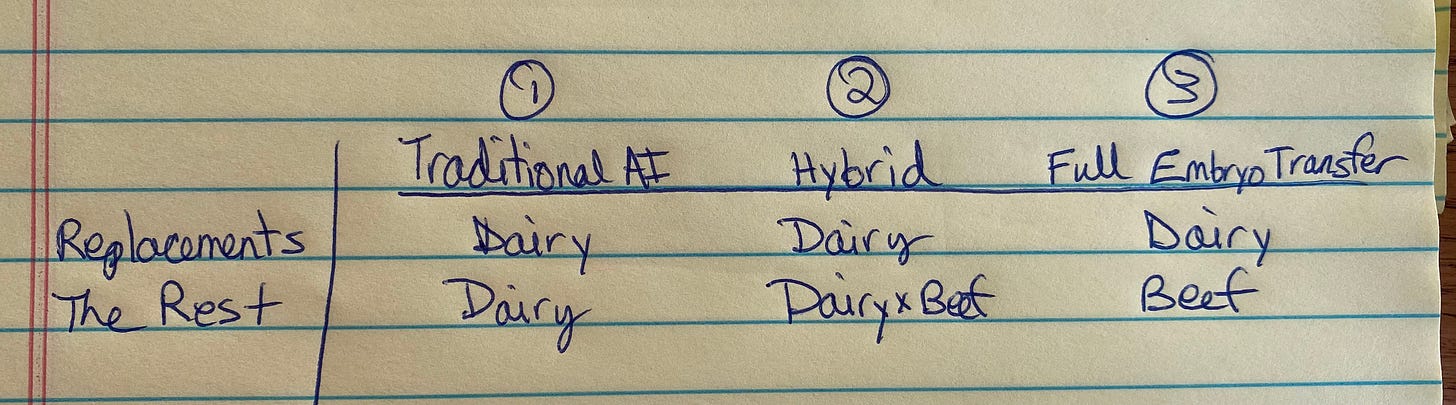
Let’s look at the series of decision points that a dairy producer navigates that ultimately leads to a Dairy, Beef, or Beef x Dairy calf output.

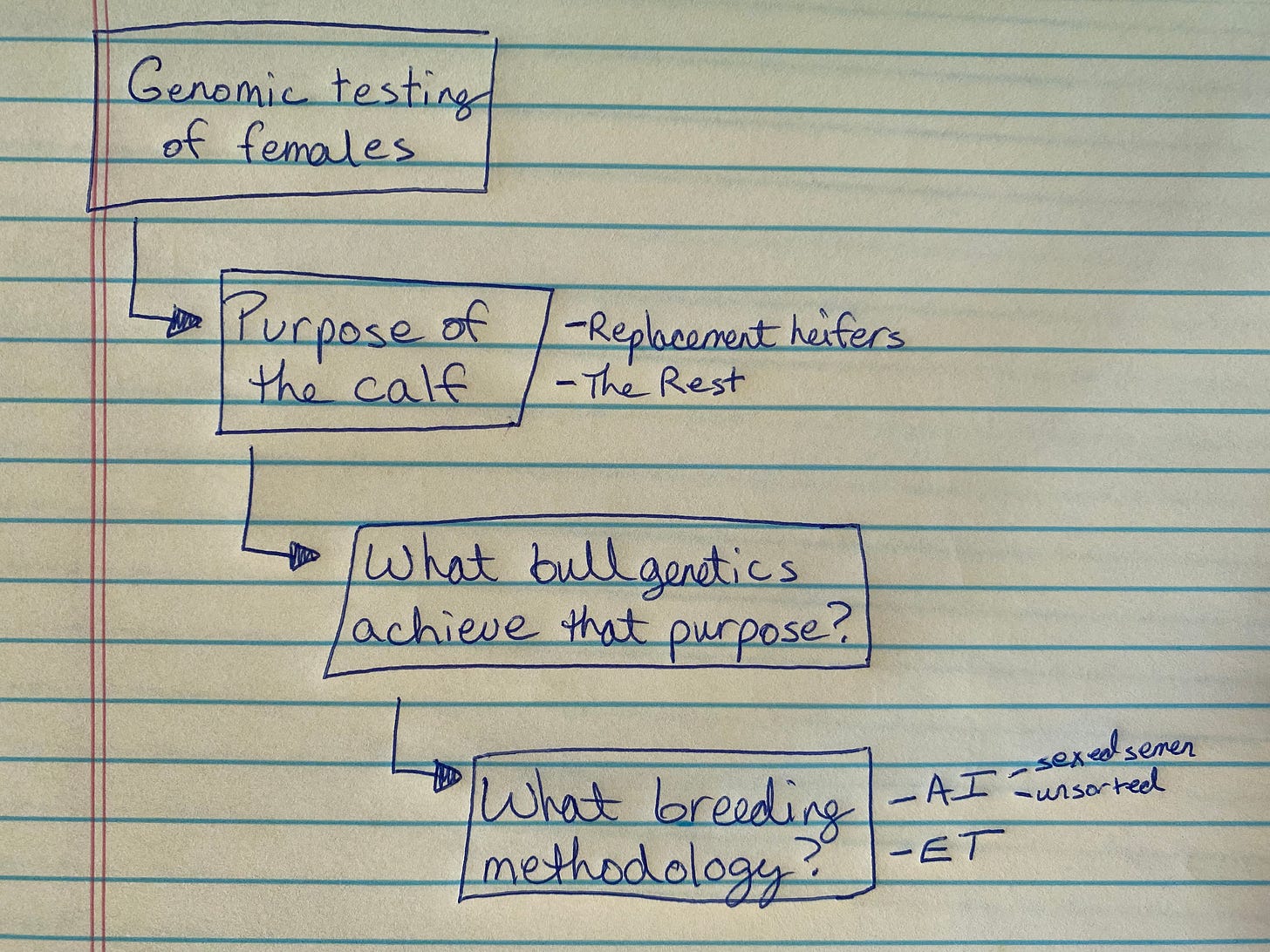
I set out to create a simple decision tree to illustrate the discrete decisions in building a genetics strategy and execution plan. But – shocker – turns out that it’s more complicated than that, way more complicated. So instead here’s a rough sketch of the high level decision flow as I understand it:

AI = artificial insemination. ET = embryo transfer.

Let’s break that down.

What is the genetic potential of this cow/heifer?

Until genomic testing became wide spread, the decision of which bull genetics to use via AI was the primary decision – that was kinda it. Genomic testing flipped the script by unlocking a preliminary decision point about every female. Genomic testing allows the producer to understand the right place in the dairy’s genetic program for each individual heifer/cow based on her genetic potential. This serves as the foundation of the strategy because it sets up the next question….

What is the purpose of the calf?

If genomic testing indicates a heifer/cow is top shelf genetically, the producer will likely make breeding decisions with the objective of getting a replacement heifer from her. If she’s not, then she just needs to produce a non-replacement heifer calf, one of ‘The Rest’. The question ‘what is the purpose of the calf?’ leads us to 3 layers:

  1. Get the cow lactating. This is the obvious purpose of breeding a cow on a dairy farm but I’m calling it out here to keep the main thing the main thing: milk production. All calves share this purpose. But now we can further subdivide to:
  2. Produce Replacement Heifers. This is the long term play, to optimize the herd over time by doubling down on dams that are genetically superior to continue advancing the quality of the herd.
  3. Capture value from ‘The Rest’ of the calves. This is about optimizing short term revenue by optimizing the value of offspring that are not bred specifically for replacement heifers. Let’s say a Holstein calf is worth $60 and a Holstein x Angus calf is worth $175….we can breed a cow for either output but the $115 differential represent real dollars on the table that in a thin margin environment can make really meaningful impact on profitability. (Should we call that Holstein x Angus a ‘Hogus’? A ‘Hangus’? Nah?)

So the genomic testing of the dam dictates the purpose of the offspring which leads to…

What bull genetics achieve the purpose?

The purpose of the calf – Replacement Heifer or The Rest – drives the decision on what bull genetics are required to achieve that purpose. Primo or average dairy sire? Primo or average beef sire? This is the same decision point that dairy producers have been exercising since adopting AI as the path to genetic improvement, decades ago…there are just more options now for breeding methodology.

And that leads us to the mechanics….

What breeding methodology is right?

This decision point bifurcates (<— favorite word in the English language) into:

  1. AI or ET?
  2. If AI, whether to use sexed semen or non sorted semen? Sexed semen is the enabling technology for separating a dairy herd and using replacement heifer

The outcomes of this portfolio of (admittedly oversimplified) decisions delivers ~5 million calves annually into the US that fit into the following 3 buckets:

  1. Dairy calves
  2. Beef x Dairy cross calves
  3. Beef calves

We don’t really know how many calves dairies produce for each bucket today, but we DO know the Dairy bucket is decreasing as the Dairy x Beef bucket increases. Which leads to that 3rd bucket of straight beef calves where the value of the calf converges with breeding technology….

Technology + Market

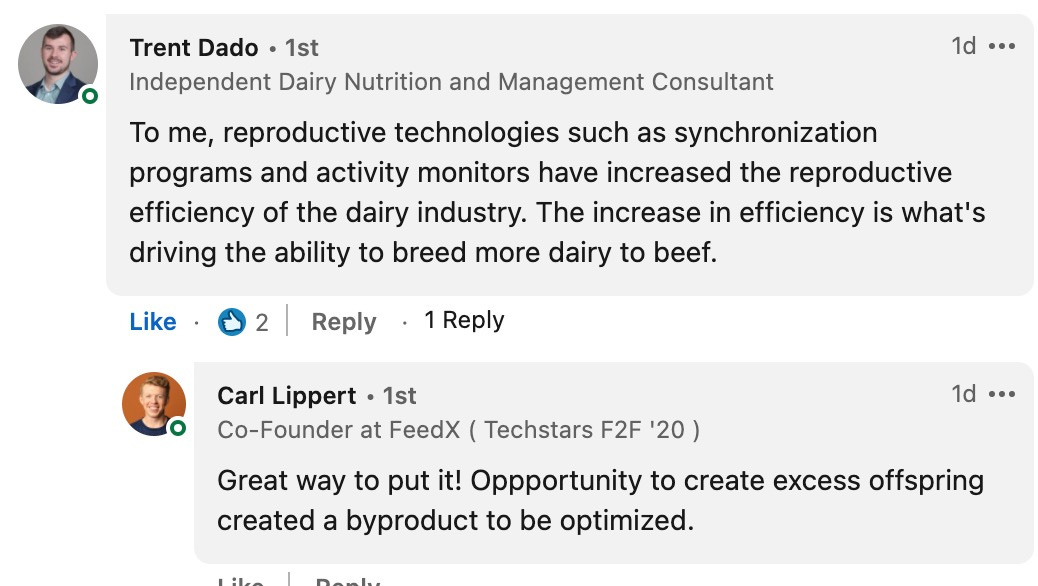
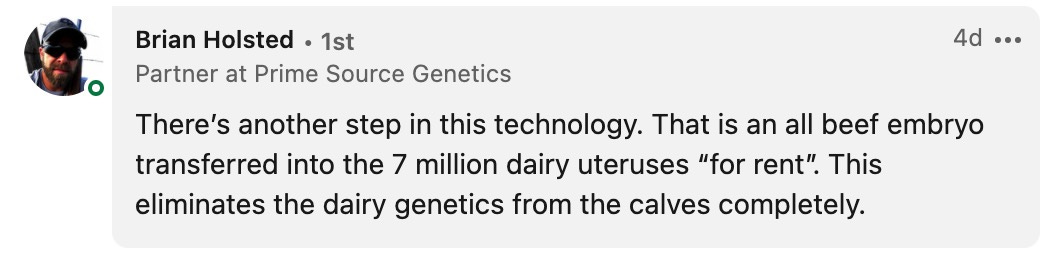
In the comments above from LinkedIn, the idea of 7 million dairy uteruses ‘for rent’ was mentioned. The idea would be that 3M of the 10M dairy cows would be bred for replacement heifers, and the remaining dairy cows would be recipient cows for a beef x beef embryo. That’s the extreme scenario where breeding technology (embryo transfer) and market optimization (produce as many higher value beef calves as possible) intersect.

Here’s a visualization of how each breeding methodology & genetics strategy could impact ‘The Rest’ of calves produced by dairies, that extreme scenario is at the far right:

Think about that – what if there was a shift from the left scenario of ~5M straight DAIRY calves (let’s say this was the default scenario until the last decade when beef on dairy began growing) to that far right scenario where there are ~7M straight BEEF calves entering the value chain? 🤯

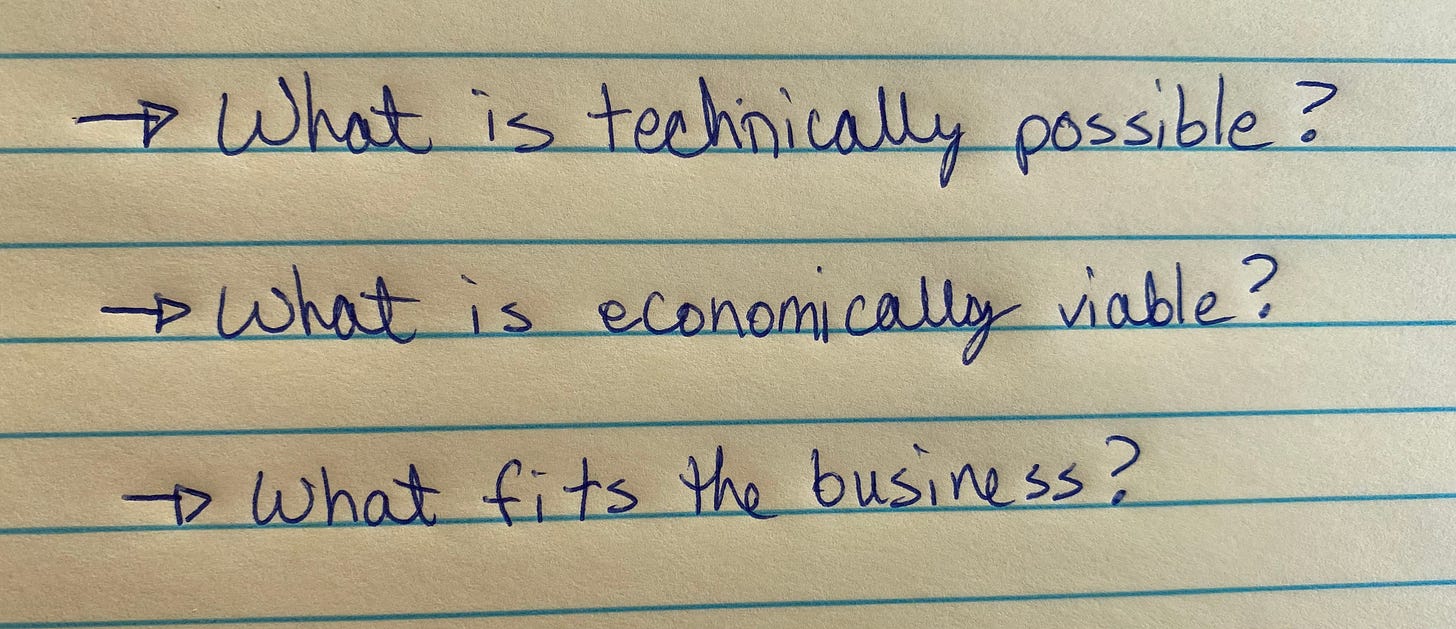
But while embryo transfer for 100% of the US dairy herd might be technologically possible, is it viable economically? Where is the market meaningfully incentivizing adoption of that type of program?

Again this is over simplified, but ultimately the dairy producer is navigating these 3 screens to design their genetics strategy:

‘What fits the business’ can be any operational criteria from cost (cash flow management) to facilities to staffing, etc. that an individual dairy would have. No news flash here but ANY innovation at the farm level has to fit the day in day out operations of the farm.

Compound Genetics

Interest isn’t the only thing that compounds, so does genetic improvement. If the more complex genetic strategies lead to an annual increase of x% more genetic improvement than traditional strategies, then over time that x% improvement will compound. And if the more complex strategies lend themselves to larger dairies who can implement those strategies more cost effectively, how will this impact further consolidation?

Wisdom of the crowd

I hope you are geeking out on this topic as much as I am, it’s fascinating, right?? As I continue digging in, here are questions I’d love to get your perspective on:

  • What decision points are missing above?
  • What are the frameworks that innovative producers are using to make those decisions?
  • How do the decision points for dairy producers vary among different types of dairy farms?
  • How is this trend playing out in other dairy & beef producing regions of the world?

I’m interested in all things technology, innovation, and every element of the animal protein value chain. I grew up on a farm in Arizona, spent my early career with Elanco, Cargill, & McDonald’s before moving into the world of early stage Agtech startups.

I’m currently on the Merck Animal Health Ventures team. Prime Future is where I learn out loud. It represents my personal views only, which are subject to change…’strong convictions, loosely held’.

Thanks for being here,

Janette Barnard

Categories
Animal AgTech Genetics

Prime Future 63: If dairy is the new beef, are cow-calf producers necessary?

Hypothesis: the biggest threat to cow-calf producers is neither packer consolidation nor alternative proteins. The biggest threat to cow-calf producers is dairy producers who are increasingly deploying the 'beef on dairy' genetics strategy which will allow them to own the beef calf market, creating an existential threat for cow-calf producers.

That was my hypothesis when I sat down to write this piece.

Before we get into whether this hypothesis is reasonable or not, here’s a quick review of the beef on dairy strategy:

“In dairy herds, a sustainable breeding strategy could combine usage of sexed semen to generate replacement heifers only, and usage of beef semen on all dams that are not suitable for generating replacements. This results in increased genetic gain in dairy herd, increased value of beef output from the dairy herd, and reduced greenhouse gas emissions from beef.”

(We recently looked into the 3 mega phases of genetics revolution in dairy cattle that led to the beef on dairy trend.)

One more idea before we get to whether cow-calf producers have a future or not, an idea from “Loonshots: How to Nurture the Crazy Ideas That Win Wars, Cure Diseases, and Transform Industries” is that innovation falls in two buckets:

  • P-type innovation which are product innovations, like the invention of the jet engine
  • S-type innovation which are business model innovations, like the idea of an airline that would not use the hub & spoke model and only offer low cost direct flights

The interesting thing about the beef-on-dairy strategy is that the two enabling technologies were P-type innovations: genomics and sexed semen.

But now as producers adopt those products, we’re looking at S-type innovations playing out in real time which is likely to lead to more S-type innovations across beef and dairy value chains.

Back to my hypothesis. Let’s do some napkin math, and use the most extreme assumption that 100% of US dairy producers will apply the beef on dairy strategy to 100% of their herd. (For the purpose of thinking about the potential impacts of a trend, it’s helpful to play it out to the extremes even if highly unlikely.)

Using extreme and very round numbers, here’s some math:

  • There are 10 million dairy cows in the US. Let’s say 30% of those cows are replaced by heifers every year. All 10 million cows need to have a calf, but only 3M of those calves need to be female to be kept as replacement heifers and maintain current production levels (10M * .3 = 3M). Let’s say the remaining 7M calves NOT being kept as replacement heifers flow into the beef value chain (10M – 3M = 7M).
  • If today there are ~5M dairy calves that flow into the beef supply chain already, or ~50% of the 10M dairy calves born annually then it looks like beef-on-dairy only adds 2M additional beef-dairy cross calves per year into the beef value chain (7M – 5M = 2M). However a big caveat is that there is already a reasonable % of the 5M dairy calves that are actually beef-dairy crosses, though there’s no good estimate of what that number is. Regardless…
  • If ~25M beef animals are finished in feedyards annually, and the most dairy can contribute (in pure dairy or beef-dairy crosses) is 7M then that leaves a minimum of 18M calves per year needed from cow-calf producers.

Napkin math shows that my hypothesis that dairy producers pose an existential threat to cow-calf producers is wrong.

Cow-calf producers will continue to be a necessary segment of the beef value chain.

But even if beef-on-dairy does not create an existential threat to cow-calf producers, there will be implications and ripples felt across the beef and dairy industries. This week’s newsletter is the start of a series exploring those implications and ripples.

Here are some questions I’m interested in:

  • How viable is the sustainability hypothesis behind on beef-on-dairy? Cargill is making a bet on beef on dairy as a sustainability play, will others?
  • What are the limiting factors for beef-on-dairy growth?
  • Alternative milk now has ~16% share of the milk market, if beef and dairy become even more enmeshed than they already are, how could change in milk demand impact beef? If the primary link today is ground beef, what happens when the link expands?
  • What does it mean for cattle feeders to have 3 distinct types of potential calves to feed: beef, dairy, beef-dairy crosses? For packers to have those 3 types of fed cattle to process?
  • What are the positive/negative impacts felt through the value chain from an increase in beef on dairy? From dairy producers to feedyards to packers.
  • How will profit drivers be impacted? From live performance metrics to carcass yield and grade. How will management of these metrics change?

If you have insights or opinions on any of those questions, please reach out – I’d love to get your thoughts. Or, if you have other questions to explore about this space.

An important caveat to this conversation is that beef-on-dairy is not new. It was first discussed in the early 2000’s and how slowly increased over time. But it feels like we’re at an inflection point and adoption is accelerating rapidly.

“The future is here, it’s just unevenly distributed.”


I’m interested in all things technology, innovation, and every element of the animal protein value chain. I grew up on a farm in Arizona, spent my early career with Elanco, Cargill, & McDonald’s before moving into the world of early stage startups.

I’m currently on the Merck Animal Health Ventures team. Prime Future is where I learn out loud. It represents my personal views only, which are subject to change…’strong convictions, loosely held’.

Thanks for being here,

Janette Barnard
Categories
Animal AgTech Genetics

Prime Future 59: Will CRISPR find its legs in livestock?

My interest in science took a nose dive in high school biology when life science seemed contained to owl pellets and dead frogs, which didn’t seem to be the stuff of world changing significance. But reading the new Walter Isaacson book “The Code Breaker” on the people & events that led to the discovery of CRISPR had a much more inspiring effect than Mrs. Rigg’s biology class. Even though the book focuses on the potential uses of CRISPR in humans, my mind has been spinning around the potential uses in livestock.

First, what is CRISPR? It describes a a type of DNA sequences, more specifically:

“CRISPR systems were a way that bacteria acquired immunity to viruses. …found that bacteria with the CRISPR spacer sequences seemed to be immune from infection by a virus that had the same sequence. CRISPR associated enzymes (Cas) enable the system to cut and paste new memories of viruses that attack bacteria. They also create short segments of RNA that can guide a scissors-like enzyme to a dangerous virus and cut up its genetic material. Presto!”

If DNA is kinda there for documentation, RNA is the molecular workhorse, hustling & getting the right messages to the right places. The understanding of how CRISPR segments of DNA give RNA the information to get to work was the foundation that led scientists to ask how CRISPR could be used for gene editing by directing RNA to make good things happen. (or at least that’s my non-scientific understanding)

It doesn’t take much creativity to imagine the many ethical questions around any type of gene editing or the ways RNA could be re-directed for questionable or downright terrible uses. (Interestingly, Isaacson says the US Department of Defense is one of the major funders of CRISPR research, centered around finding ways to prevent its misuse.) But we’ll leave those questions to others, we’re interested in possibilities.

The Isaacson book focuses on human uses for CRISPR, only using the word agriculture once and almost as an afterthought. So, let’s brainstorm how a tiny little biochemical thingamajig could be used to make a potentially big impact in livestock, meat & dairy.

(Heads up: I’m not constraining this list to any nonsensical details like what’s scientifically possible 🙃)

  • Efficiency. The most obvious and least exciting use for CRISPR is to improve efficiency of production metrics like growth rates or feed conversion or carcass yield. Could beef someday have the same feed conversion as chicken, or even fish?
  • Quality improvements. Can gene editing increase meat tenderness in certain cuts? Increase flavor in pork? Eliminate that nagging issue of woody breast in chicken? Could CRISPR unlock the Honeycrisp apple of the meat case?
  • Health management. Imagine if you could eliminate Mastitis in dairy cows, or BRD in beef cattle, or ASF or PRRS in swine, or Coccidiosis in poultry…all of which have massive economic impact around the globe.
  • Methane emissions.  Could CRISPR gene editing somehow (magically?) reduce methane emissions and put that whole issue to pasture?
  • Demand response. Imagine you could use gene editing to get more of what the market is asking for, like more loin per carcass for a higher ratio of high value middle meats in beef & pork. Or let’s throw common sense to the wind – what if you could get more wings per bird? That would look pretty good in times when wings trade at $3/lb and breast meat trades at $1.

Let’s say some of those applications are scientifically possible. The next question is, what applications will be allowed? There are two stakeholder groups that will ultimately determine the future of CRISPR in livestock, and the importance of each simply cannot be overstated.

The only way CRISPR can make a meaningful impact is if both regulators and consumers embrace the technology.

  1. Regulators. What will the regulatory framework for CRISPR gene editing in livestock look like and who will oversee it? How will different countries approach it? For use in humans, scientists think of CRISPR having 3 different uses: to prevent disease, to treat disease, or for enhancements like making your offspring taller, smarter, stronger, etc. (Obviously there are varied opinions among the CRISPR scientific community about using it only for disease prevention & treatment to alleviate human suffering, rather than selecting for certain characteristics because we can.) Another screen, and debated distinction, is whether gene editing will impact only that patient/generation (somatic editing) or if it will impact that patient/generation and all future offspring (germline editing). If similar screens are applied in livestock, the list of possible CRISPR use cases would change.
  2. Consumers. If GMOs in plant breeding signals how CRISPR might be viewed in livestock, then the odds of widespread consumer acceptance of CRISPR editing in livestock are less than my chances of competing in the 2021 Olympics. The staggering advantages of GMO’s in crop production – less resource use per unit of production – have not satisfied the anti-GMO camp enough to offset their concerns of genetic modification. Good science has not been enough for a good outcome.

However, there’s one factor in livestock that isn’t part of the equation for crops, and that is animal welfare. How will the risk/reward equation adjust itself if CRISPR provides ways to reduce animal disease and therefore improve animal well being?

More broadly, what can we learn about what not to do from the GMO plant situation? Could meat companies more effectively market CRISPR enabled results than seed companies marketed GMO enabled yield increases? An ominous sign for any scientific breakthrough is the amount of COVID vaccine disinformation readily consumed via social media, then digested & regurgitated even by smart & logical people. So I don’t know, maybe we just can’t have nice things?

Ultimately societal consensus around how CRISPR should be used in humans is likely to drive the degree of acceptance of CRISPR use in livestock.

The book was particularly interesting in light of the role RNA has played in fighting COVID. Isaacson summarizes the mRNA vaccine technology, “Now scientists had found a way to enlist RNA’s most basic biological function in order to turn our cells into manufacturing plants for the spike protein that would stimulate our immunity to the coronavirus.”

There was also a lot of work done on using CRISPR as a diagnostic tool for COVID, ideally as an at home test with immediate results. Isaacson highlights the belief of some CRISPR scientists who believe the technology will ‘democratize biology for human health’ through personalized diagnostics for in home use:

“The development of home testing kits has a potential impact beyond the fight against COVID: bringing biology into the home, the way that personal computers in the 1970’s brought digital products and services into people’s daily lives and consciousness. Home testing kits could become the platform, operating system, and form factor that will allow us to weave the wonders of molecular biology into our daily lives. Developers and entrepreneurs may someday be able to use CRISPR-based home testing kits as platforms on which to build a variety of biomedical apps: virus detection, disease diagnosis, cancer screening, nutritional analysis, microbiome assessments, and genetic tests.”

Whether or not – or at what time horizon – that happens, if it can happen in human use why can’t it happen in some modified way in livestock?

What’s your hypothesis on where, how, & why CRISPR could be useful in livestock?


I’m interested in all things technology, innovation, and every element of the animal protein value chain. I grew up on a farm in Arizona, spent my early career with Elanco, Cargill, & McDonald’s before moving into the world of early stage startups.

I’m currently on the Merck Animal Health Ventures team. Prime Future is where I learn out loud. It represents my personal views only, which are subject to change…’strong convictions, loosely held’.

Thanks for being here,

Janette Barnard
Categories
Genetics

Prime Future 58: Cattle collision: where the digital revolution meets the genetic revolution

My working hypothesis is that the best way to imagine the future is to better understand the past and what’s led to the present. “What got us Here won’t get us There” is undeniably true. Yet, understanding the how’s & why’s that got us Here might provide nuanced clues about getting There.

With that, let’s take a quick tour through two seemingly disconnected histories to grab the takeaways most relevant to the future of livestock production.

Digital revolution

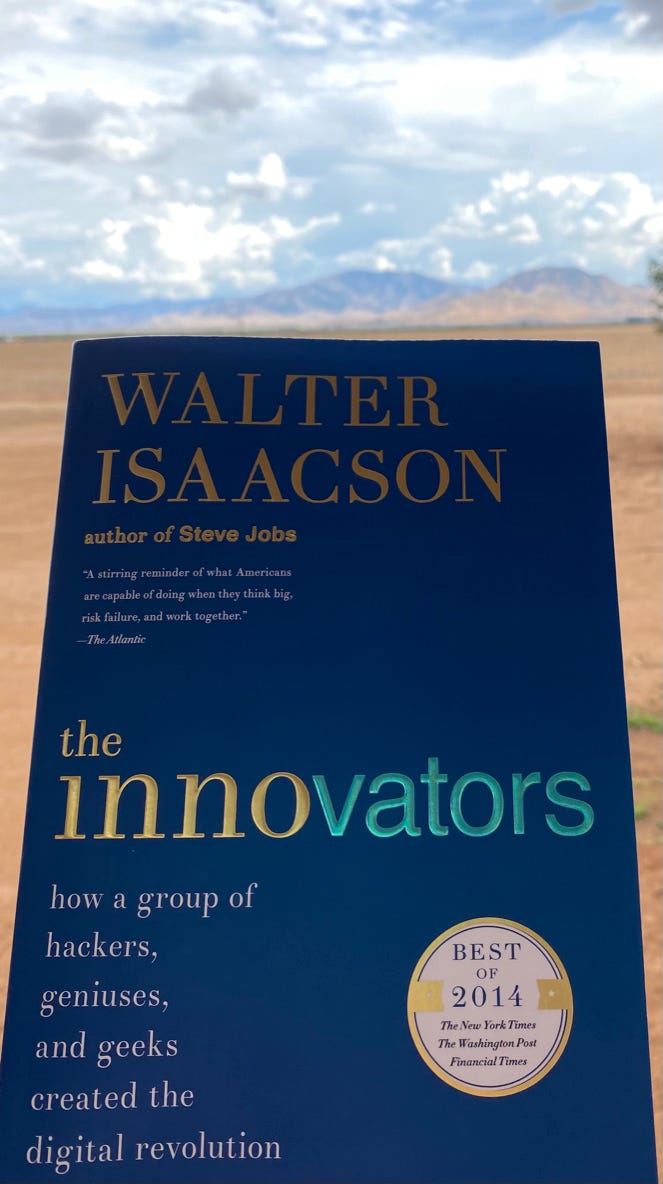
In The Innovators, author Walter Isaacson walks through the many breakthroughs (both obviously significant and seemingly small) from the 1850’s to today that have led to the digital revolution. Here’s the cliff notes on that progression:

  • The computer. Although the idea for a computing machine was first published in 1837, the 1890 consensus was tabulated in 1 year rather than 8 years by using a primitive computer designed by a fella that later founded a company that would become IBM.
  • Transistor. “The advent of transistors and the subsequent innovations that allowed millions of them to be etched into tiny microchips, meant that the processing power could be nestled inside the nose cone of rocket ships and in computers that sit on your lap.” Discovered in AT&T’s Bell Labs, the transistor allowed the cost and complexity of computers to massively shrink. Pocket radios were the use case that made transistors widely used which dropped the cost further.
  • Microchip. The microchip was an integrated circuit that simplified the computer’s innards down from 10,000 little components with 100,000 hand soldered wires connecting them. Another critical step in increasing power, decreasing complexity & size, and decreasing cost. The military & NASA were the first big customers, using microchips for missiles & rockets until the cost of microchips declined enough for consumer products. The market that was tapped to create high demand – and reliable demand – in order to decrease the cost per microchip? Pocket calculators.
  • Internet. The concept of a decentralized network of connected computers was developed in the 1940’s but ARPA made it happen in the late 1960’s, largely for military and academic institutions – individuals still didn’t have computers until…
  • Personal computer. The Steve Jobs part of the story most of us know – his genius was to make the computer accessible to individuals who wanted to open a box and pull out a machine that could be turned on and immediately usable, instead of the hobbyist computer junkies who wanted to build the computer themselves and were the entire market up to that point.
  • Software. The Bill Gates part of the story you may know also. His genius was realizing that hardware would become a commodity, but software is what unlocks value….he certainly wasn’t wrong about that.
  • World wide web. The development of this protocol unlocked the internet in ways that led to our daily experience online today.
  • Cloud computing (this one isn’t included in the book but IMO is as significant as the others)
10/10 recommend this 👆🏼

What does all of that have to do with cattle genetics? Good question….

Cattle Genetics Revolution

I recently spoke with Jerry Thompson and Matthew Cleveland of Genus ABS who generously shared their insights on the 4 big innovation waves that have hit cattle genetics.

Artificial Insemination & EPD’s

What led to widespread adoption of AI in dairy production? (Side note: livestock and tech have *very* different meanings for the letters AI.)

Quick note on EPD’s: Expected progeny differences are predictions of the genetic transmitting ability of a parent to its offspring and are used to make selection decisions for traits desired in the herd. Expected progeny differences (EPDs) have been applied to improve the genetics of beef cattle for almost four decades.

Here’s how Cleveland & Thompson describe the EPD phenomena:

“The ability to calculate EPD’s drastically accelerated AI adoption. AI has been used since the 60’s and 70’s, but in the 80’s and 90’s EPD’s took off as a function of computing power to implement them. We knew how to do EPD’s before but couldn’t do them at scale because the equations were too big. You could calculate for 5 animals by hand but beyond that it was super difficult. That began changing in the early to mid 80’s drove that when universities started putting together computing clusters which enabled calculation of EPD’s. We’ve known for hundreds of years about selective breeding and looking at animal performance but EPD’s were a huge driver of genetic change.”

AI adoption was accelerated by EPD’s which were accelerated by advancements in computing power.

Genomics

Some brief background on genomics from the good folks in extension:

Recently, genomic testing for beef cattle has evolved to include “high-throughput” testing, meaning that thousands of markers (or single nucleotide polymorphisms, or SNPs) are read from an animal’s DNA. Producers need only to submit a blood, hair, or tissue sample from an animal to the breed association. After collection and submission to the respective breed association, samples are submitted to the genotyping laboratory where several thousand markers are read from the DNA extracted from the samples. The most common genomic test available for cattle reads around 50,000 DNA markers or SNPs using a technology embedded in a small chip called a SNP chip.

Having the ability to read thousands of SNPs is a tremendous advantage for producers because most economically important traits like calving ease, dry matter intake, feed efficiency, hot carcass weight, marbling score, and tenderness are controlled by many genes as opposed to a single gene like hide color or horned status. This means that many modern tests can make predictions about the genetic merit of an animal more precisely and at a younger age than traditional expected progeny difference (EPD).

I asked Cleveland & Thompson, what brought about the rise of genomics in cattle?

“Genomics allows rapid genetic progress and have had a huge impact in dairy. Although we’ve been using genomics for close to 30 years, it was on an extremely limited scale because of limited genomic information and cost. The idea of incorporating genomics in commercial breeding programs was published in 2001, but it was largely theoretical. But in 2008, the price of genotyping went down and the first chip became available (for testing of many traits at once). USDA put together groups to genotype the first 1,400 bulls. This started the process toward low cost genotyping with fast computing power. There was great foresight from USDA.

In dairy, genomics have become ubiquitous not only for selection of sires, but also for ranking of commercial herd and selection of dams. We’ve seen hundreds of dairy bull breeders consolidate because the cost to play has gone up massively. You see the genetics companies building in house programs and proprietary genetics just like the pig industry did. The massive consolidation has been easy because of low number of breeds and common selection criteria, plus breeding decisions made on public indices.”

I hadn’t fully appreciated how genomics completely flipped old time lines for genetic progress on their head, nor the level of precision in decision making that genomics unlocks. In Cleveland’s words, here’s why that matters so much:

“The implications are that the rate of improvement continues to accelerate. Whereas historically you needed 5 years to get proof (of animal performance), now producers can make selection decisions a week after birth. Both in terms of genetics at a specialized breeding company and within your own herd to select which cows to breed. So you immediately know the next generation. As calves are born, you conduct genetic testing, rank the calves, then make your sell or keep decisions. Repeat.

Earlier decisions, faster decisions, better decisions….which creates an easy ROI in dairy.

Sexed semen —> Beef on Dairy

Here’s an overview of sexed semen – what it is and why it matters – from NIH:

“In dairy farming, there is surplus production of unwanted male calves. Incorporating sexed semen into the breeding program can minimize the number of unwanted male dairy calves and reduce dystocia. Sexed semen can be used to generate herd replacements and additional heifers for herd expansion at a faster rate from within the herd, thereby minimizing biosecurity risks associated with bringing in animals from different herds. Furthermore, the use of sexed semen can increase herd genetic gain compared with use of non-sorted semen. In dairy herds, a sustainable breeding strategy could combine usage of sexed semen to generate replacements only, and usage of beef semen on all dams that are not suitable for generating replacements. This results in increased genetic gain in dairy herd, increased value of beef output from the dairy herd, and reduced greenhouse gas emissions from beef.”

Here’s Thompson & Cleveland’s take on the timing & implications of sexed semen in dairy and the rise of beef on dairy breeding programs:

“The idea of sexed semen was 1st presented around 2003. We launched an alternative tech 5 years ago that has accelerated the use of sexed semen, and beef as a strategy for dairy. It is the most profitable option by driving genetic improvement in replacement heifers while maximizing value by creating high value dairy beef calves. There has been massive adoption of sexed semen in beef while sales of conventional dairy semen decrease rapidly. The advanced producers are using the sexed semen and beef strategy which we expect to become ubiquitous in the next 5 years.”

Ok so there’s a 30,000 foot summary of the 3 recent phases of dairy genetics innovation:

  • Phase 1: AI enabled producers to level up their genetics every time a breeding decision is made.
  • Phase 2: Genomics allow producers to assess an animal’s genetic promise as soon as a calf is on the ground which allows them to make faster & better breed/sell decisions.
  • Phase 3: Sexed semen allows producers to only breed dams with the best genetics for replacement heifers and to breed all other dairy cows with beef genetics for a higher value calf.

Meanwhile <10% of beef producers are using AI, let alone more advanced genetic technologies. What would make AI economically meaningful in North America beef industry?

According to Cleveland & Thompson:

“Adoption of AI in beef is not a value proposition question – the value is there. It is a logistics question and an industry mentality question. Accessing additional labor to AI is one barrier for the 700k+ producers in North America.

The beef industry is a long way from having breeding programs like in pigs and poultry with dam lines for maternal traits and sire lines for terminal generations. If that changed, then we’d potentially see increased AI adoption in beef.

Even though beef AI numbers are still low and not moving significantly, some producers have not had bulls on their property since the 1960’s and are solely using AI.”

Although the two histories certainly overlap, the parallels speak to how innovation comes about. What are the takeaways from the digital & genetic revolution in cattle?

  1. 'The street finds its own use for things' is a phrase Isaacson uses in The Innovators. I love it. It’s the idea that technology is just technology without the right market, business model, pricing model, and context. Computing power for calculating EPD’s in cattle….can we all agree that was not a use case anywhere on the radar of the early creators of computers? The street finds its own use.
  2. The future is here, it’s just not evenly distributed.’ Beef on dairy is being talked about more today, even tho it’s existed as a concept for 20+ years. Pick 10 other technologies that will likely play a big role in the future and they are probably just now in their awkward adolescent years finding their place in the world, from Artificial Intelligence to Machine Learning to blockchain to CRISPR….they’re here, they’re not yet everywhere though.
  3. Collaboration. Whether among institutions (academia, govt, individuals, big companies or startups) or among individuals, all of these innovations evolved through collaboration. As Isaacson says, “The main lesson to draw from the birth of computers is that innovation is usually a group effort, involving collaboration between visionaries and engineers, and that creativity comes from drawing on many sources. Only in storybooks do inventions come like a thunderbolt.”
  4. Execution > ideas. Many people had the idea of the computer (or almost any other invention) but few brought it to life. Execution is where the magic happens – like the mastermind behind getting microchips into personal calculators knowing that would create high demand which would allow them to decrease the cost which would allow them to find more use cases…brilliant.
  5. Most innovation is evolutionary rather than revolutionary. New breakthroughs build on previous breakthroughs. We’re all standing on the shoulders of giants.

I’m interested in all things technology, innovation, and every element of the animal protein value chain. I grew up on a farm in Arizona, spent my early career with Elanco, Cargill, & McDonald’s before moving into the world of early stage startups and venture capital.

I’m currently on the Merck Animal Health Ventures team. Prime Future is where I learn out loud. It represents my personal views only, which are subject to change….strong convictions, loosely held.

Thanks for being here,

Janette Barnard

Categories
Genetics

Prime Future 53: The defensive get disrupted.

The big idea last week in Where’s the Honeycrisp of the meat case? was:

Most genetic progress in livestock centers around live performance, not end product outcomes that the consumer can see, taste, and experience directly. We usually talk progress in terms of live performance metrics: Feed conversion. Growth rates. Calving ease. Hatchability. Outside of decreasing cost, none of these are attributes you can see at the meat case. So where’s the meat case equivalent of the Honeycrisp apple?

And there were some big opinions about that! Here are a few interesting responses:

  1. It will take some time and $$ and some smart Elon Musk thinkers and genetic engineers to move us in that direction. Wagyu and Akaushia  are examples to me of ‘Honey Crisp of beef’. While many of us have paid the big bucks for a ribeye from these, few have tried a hamburger. I have always thought of hamburger as being the product of cull beef and dairy cattle and very little difference in taste except the 90/10 being the least tasty; however, the first time i had hamburger from Wagyu and Akaushia i was amazed at the awesome taste experience!”
  2. “I totally agree with the sentiment however on the protein side I think there is one honeycrisp…the rotisserie chicken.” This is an interesting point. I was thinking about product innovation from a genetics perspective specifically, but perhaps it’s true that the primary innovation that the consumer experiences directly is in further processing. Increasingly meat, especially chicken, is more of a ‘blank canvas’ for further processing than anything else. But what about the 50% of chicken sold fresh, which is an even higher % in beef & pork?
  3. “The beef industry has made great strides in presenting a more consistent product over the past 30 years.  We may not yet have created the Honeycrisp, but at least the consumer no longer fears that 1 steak in 5 will turn out to be a Granny Smith inside.” This point about increased consistency is not insignificant. But in a what-have-you-done-for-me-lately market, is ‘you’re way less likely to be disappointed’ really the message you wanna double down on? As critical as it is, consistency is a table stakes value proposition…not a market opener or grower.

Before we move on, know that I love your feedback and comments, even pushback.

The pushback on this topic could be summarized as dismay with a heaping helping of industry self-righteousness from those compelled to verbally defend the status quo against the words of a heretic. Those defensive responses got me thinking about disruption….

What are characteristics of markets that are ripe for disruption?

  • high margin
  • mediocre product
  • no branding
  • poor customer experience

Let’s add another characteristic to this list: defensiveness.

The defensive get disrupted.

It’s true, isn’t it? At an individual level, it’s true of the person that is more interested in defending past performance rather than continuously learning. It’s true at a company level, when defending existing business happens at the expense of preparing for the future.

And it’s true at an industry level. This week industry leaders shared articles on social media about the ‘big win against alternative meat’ as states pass bills to regulate the definition of meat. Seriously, do we really think the best defense in a dynamic market is to take the protectionist path and regulate our way to long term relevance?

There has to be a better way, a longer term path to be carved to sustained competitive advantage. Like, I dunno, just go make the product better, whatever better means for your specific market. Doesn’t increased value creation via innovation sound like a higher probability move in the long term game?

But ‘disruption’ is a word that makes me cringe. It’s wildly overused and glamorized, and most ‘disruptions’ aren’t actually disruptive. They are incremental. I haven’t seen a good definition between the two types, but I kinda think of it as incremental innovation helps a customer do this thing in way that is better/faster/cheaper while disruptive innovation changes the thing to be done. That’s not a perfect working definition tho. Maybe the distinction is more about magnitude of impact.

Regardless, when it comes to innovation I think curiosity is the real driver. The smartest people I know are the ones who ask questions they don’t know the answer to, or ask new questions about what they do know….there’s an openness, a constant updating in their mental model as they take in new information or assimilate existing information in new ways.

They also play the long game. In “The Infinite Game”, author Simon Sinek draws the contrast between finite games which have clear rules and a defined start & end, like a football game, and infinite games with no clear end because the goal is to earn the right to continue playing the game, like business.

There are pockets of the meat industry playing an infinite game and leaning all the way into the hard work of innovating along every possible dimension – market, product, brand, supply chain, customer experience, and so on. Like Tyson’s announcement this week around their Chairman Reserve premium pork brand now selling individually wrapped tomahawk chops in Target. Like OSI working with Impossible Foods as a manufacturing partner. Like the new McClaren Farms brand in Walmart.

And then, there are pockets of the industry that are busy metaphorically explaining how an apples-to-cattle comparison doesn’t even make sense. They are relying on short term advantages that could easily shift away, treating the game as a finite one with a foregone conclusion in their favor.

Let’s see which of those groups ends up with better outcomes as the game plays on…


Prime Future is where I learn out loud about the big dynamics around livestock & meat. I’m on the Merck Animal Health Ventures team but this newsletter represents my personal views only.


Prime Future Summary

You can get the first 47 editions of Prime Future in 1 PDF here, check it out:

Download Prime Future PDF

Categories
Genetics

Meat eaters don’t care about livestock genetics, could they?

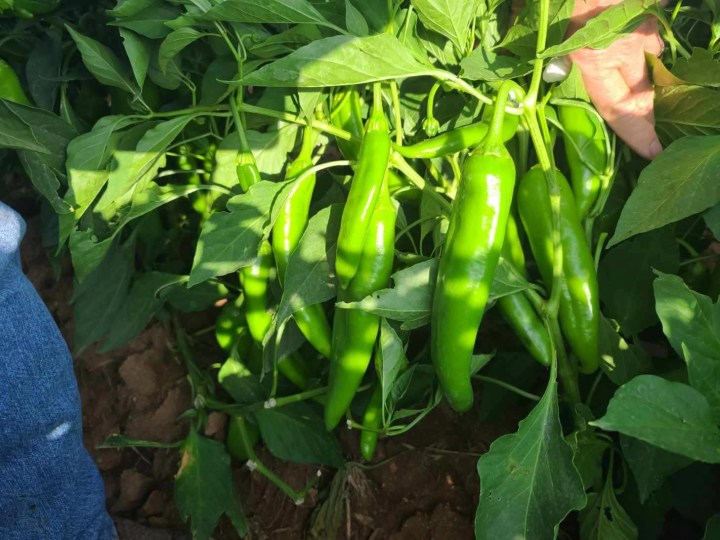
In the 1950’s my grandparents began growing green chili peppers in the high desert of southeast Arizona with its warm summer days, cool evenings, and dirt ditch irrigation.  The limiting factor for pepper market growth was the inconsistency of the heat – a consumer would get a really hot chili one meal and a mild chili the next. That lack of predictability in eating experience was problematic. So in the 1980’s my uncle began working on chili genetics and eventually isolated the heat gene to produce chili varieties with consistently predictable heat levels, whether hot or mild. 

Chances are that when you think of green chilis you think of Hatch, New Mexico. Hatch and green chilis have become synonymous. Yet Hatch green chilis are grown from, you guessed it, Arizona seed. But no one knows Curry Farms, the source of 90% of green chili pepper genetics in North America. They know Hatch as the source of all good and perfect pepper flavor. 

That’s because chili growers in New Mexico decided about 30 years ago to begin branding peppers, to highlight the region. It worked. This is the power of a marketing strategy to build a brand & differentiate even in a market where differentiation is challenging.

And this “no one downstream from the farmer cares about the genetics source” is s a story that plays out similarly across all segments of ag. 

When you buy Coca-Cola with HFCS you don’t know <or care> if that HFCS is from corn grown from DeKalb or Pioneer seed. When you buy chicken in a tray pack you don’t know <or care> whether those are Cobb or Ross genetics. When I buy Wright brand bacon, I don’t know <or care> if that pork is from Topigs or PIC genetics.

Genetics sources have historically been a behind the scenes layer in food production, completely removed from downstream value chain players and the consumer’s sphere of interest or concern.

But, that may be changing in meat & poultry.

Brands have claimed differentiation in production practices (antibiotic free, grass fed, free range, etc), processing, or even breed (Certified Angus). Two examples suggest that specific genetics may be the next branding trend:

  1. Walmart’s new supply chain, Prime Pursuits is built around 44 Farms Genetics. Not just Angus genetics, but a specific supplier of Angus genetics. Many consumers that don’t know an Angus from a Holstein know Angus because of CAB’s success. This move is Walmart’s bet that consumers who learned to care about buying Angus beef can and will learn to care about buying 44 Farms beef.
  2. Cook’s Venture, a genetics first business model. Its a D2C chicken upstart built around the company’s own Heritage breed. Whether you agree or disagree with their positioning around slow growing chickens, the premise of a value proposition marketed to consumers that highlights the genetics themselves – not the characteristics of the output of the genetics – is noteworthy.

If genetics is the next claim for branded meat, how does genetic technology fit into the equation?  There’s a lot to unpack in that question that we’ll save for another day, but here’s a glimpse at how CRISPR could play a role in scaling genetic brands:

“Otley’s team’s new approach, which they’ve been developing for six years, is to essentially turn a not-so-prize sire into a prize one by altering it genetically. Using the CRISPR-Cas9 gene-editing tool they produced mice, pigs, goats, and cattle that lack the gene NANOS2, which controls male fertility, but not female.

The result is a sterile male that produces no sperm. The team then transplanted sperm-producing stem cells from a donor animal into the sterile animal’s testes. The recipient animal then produced sperm containing only the donor’s genetic information.”

If genetics is the next claim for branded meat, what segment of the value chain is best positioned to drive? Will it be seedstock producer driven or does it have to come from downstream players already in foodservice/retail? What new alignments will this create? I’m guessing the owner of 44 Farms would never have guessed that Walmart would be a business partner yet here we are.

Yet we all know 2 data points do not make a trend and this could be an irrelevant discussion. However, the idea of branding genetics to the consumer is another example of the larger trend of coordinated  supply chains as the path to differentiation, higher margin for producers, and higher value for consumers. More on this topic next week with insights directly from the mastermind behind the new Walmart beef supply chain…

Processing…
Success! You're on the list.