Categories
Meat Regenerative Agriculture Supply Chain

Prime Future 120: Game over, polyester.

I don’t know if I’m just noticing it more, or if there has actually been a serious increase in buzz around the topic of sustainability and the fashion industry in recent months. Either way, sustainability at the intersection of textiles, agriculture, and oil & gas industries seems to be a *super* complex topic.

I’m no expert in any of this, but all roads lead to livestock so here we are…learning out loud.

Spoiler alert: there are reasons to believe livestock could be a big part of the solution.

Let’s start with a summary of the fashion industry’s sustainability problem, according to Bloomberg:

“The fashion industry might not be the first that comes to mind as a superuser of fossil fuels. But modern textiles rely heavily on petrochemical products that come from many of the same oil and gas companies driving greenhouse gas emissions. Today, in fact, fashion accounts for up to 10% of global carbon dioxide output — more than international flights and shipping combined.

Eighty-seven percent of the total fiber input used for clothing is ultimately incinerated or sent to a landfill. Textiles are the second-largest product group made from petrochemical plastics behind packaging, making up 15% of all petrochemical products.

When it comes to the environmental impacts of the industry, fast fashion is often blamed. But high-end brands originate trends and generate demand for new styles, which are then mass produced by fast fashion companies for a fraction of the cost.

Polyester has overtaken cotton as the main textile fiber of the 21st century, ending hundreds of years of cotton’s dominance. The global market for polyester yarn is expected to grow from $106 billion in 2022 to $174.7 billion by 2032.

Polyester requires a large amount of energy to produce. In 2015, polyester production for clothing emitted 282 billion tons of carbon dioxide, triple that of cotton."

Or as this article framed it:

“Producing clothing and footwear leads to 8 percent of GHGs (greenhouse gases).

The first-mover innovators are guiding the industry out of its linear ‘make-sell-dispose’ approach towards business models that are more circular and eco-friendly. Business model innovations cover reduction, reuse, repair, recycling, and sharing. It transforms the way business is undertaken and value is generated by attempting to drastically limit the resources and material inputs required in the industry’s value chain and minimising the ecological impact of its activities. The new model adheres to the principles of sufficiency and a circular economy.”

Much of the fashion & sustainability “innovation” has centered around re-shaping buying habits, e.g. buying second-hand clothes or buying higher-quality pieces that last longer, with plenty of startups focused on changing how consumers shop for clothes more sustainably. And that drive to escape the fast fashion model makes sense.

But my original question when I started down this rabbit hole was, why is there not more focus on the actual materials used in manufacturing clothes? More specifically, why are natural fibers like wool not playing a central part in the fashion sustainability conversation?

Initial research led me to Woolmark, “the global authority on Merino wool and owns the Woolmark logo, a quality assurance symbol applied to more than 5 billion products.” According to their website, in 1955 ~95% of major textile fibers were natural (wool, cotton, cellulose) and 5% were oil based synthetics.

Today, it’s more like 30% natural fibers and 70% oil based synthetics. 😵‍💫

(Oh, and 10/10 recommend this 1-minute video from their brilliant campaign, “Wear wool, not fossil fuels.” The video is kinda weird but so well done.)

But where I geeked out is watching this 12-minute video about ALL of the potential fiber applications for wool, not just in fashion. Spoiler alert: there are a lot.

First of all, wool prices have been low for decades since they boomed with the Korean War (a lot of soldiers fighting in a cold region meant astronomical demand for wool uniforms to keep soldiers warm) and then bottomed with the post-Korean war erosion of demand for lamb meat AND the explosion of synthetic materials for clothing manufacturing, beginning with polyester.

In the video, the question is asked of what’s the advantage of wool and what are the advantages of plastics. The advantages of wool, among others, are that it’s biodegradable, fire retardant, and odor resistant. Meanwhile, plastics are….cheap.

Where the video gets really interesting is in the description of new technology to create pellets made of wool, Shear Edge, that can be made into thousands of products – basically any product that would otherwise be made from fiberglass. Shear Edge shows examples from kayaks to ice chests to pigments, which go into everything from cosmetics to industrial applications. Pretty wild stuff.

In a world obsessed with natural and renewable, how is a reversion to wool not an obvious mega trend in textiles manufacturing?

This will be interesting to see how it plays out. In 10 years, will natural fibers be at 40% of total textile fibers? 50%? Or are consumer purchase decisions not going to match what they say on surveys about sustainability as a driver of purchase decisions, and polyester maintains its dominance?

In the very real battle between what people say they want and what they are willing to pay for, which will win? TBD.

The most interesting question is, what innovations will drive wool costs closer to those of synthetic fibers to reduce or eliminate the price tradeoff?

Clothing mostly uses fine wool that is softer. Strong or course wool is what’s used for things like carpet, or used to be used for these more rugged or even industrial applications until plastic-based materials took off. And although higher quality meat characteristics tend to be correlated with stronger/coarser wool, that seems like the kind of problem that genetics companies must be tackling, right? Somebody(s) must be working on the beef x dairy equivalent for the sheep industry with meat x wool genetics?

The beauty of broadening applications for wool by applying new technology and processes is that it’s a classic example of using the whole buffalo, so to speak, with what seems like real potential to satisfy customer and consumer demand AND drive market value for farmers.

Or as the Woolmark guy put it “We are taking the waste of low-value wool, and deriving value for farmers with it.”

JR Simplot would be so proud.

And once again, what’s old is new? What a time to be alive 😉

This is obviously the tip of the iceberg so if you are working on any of these topics, please reach out – I’d love to learn more about what’s happening in this space and how and why. For all I know, I’m just a sucker buying the party line from an industry association because I want to believe livestock is the future of everything….
Categories
Meat

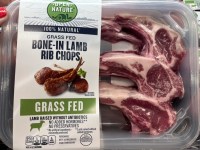
Prime Future 95: Is lamb the Cinderella of the meat case?

With Easter approaching, lamb meat is on the move in grocery stores. It’s always bumfuzzled me that lamb doesn’t get much love in the US where, for most consumers, it is a special occasion kind of meat, if that.

Today we explore why (1) lamb might be the most underrated protein, (2) there’s more than meats the eye to this so-called niche protein, and (3) the humans are fickle.

The backstory on lamb production in the US (it’s a doozy)

Per capita beef consumption in the US is 67 pounds. Per capita lamb consumption is ~1 pound.

In 2019, US domestic lamb sales were $433 million. Beef sales that year were ~$30 billion.

In 1884 there were 62 million people in the United States and 51 million sheep. Today there are 330 million people in the US and 6 million sheep.

What drove the sheep population off a cliff? Here’s a quick synopsis from an article that’s worth the read:

Americans are among the world’s top consumers of beef, pork, and poultry and near the bottom when it comes to sheep. In 2020, according to the US Department of Agriculture Economic Research Service, on average Americans consumed less than one pound of lamb or mutton per capita. Why does lamb make only seasonal appearances on the American table? Why do Americans prefer other meats to lamb? And why, in a famously dynamic country, has this preference lasted for hundreds of years?

The Spanish conquistadors brought the first sheep to North America in the 16th century, when they arrived in present-day New Mexico. In the early 17th century, English, Dutch, and Swedish settlers brought sheep to the East Coast and from there brought sheep elsewhere in North America. Sheep met the settlers’ immediate needs for wool to weave into fabric for cold-weather wear, as well as for meat. Sheep were eaten seasonally in the spring and summer on the farms where they were raised. Beyond that there was little or no market for mutton in the United States.

In the early 19th century, sheep farming developed into a larger industry because of an increased demand for wool in both national and international markets. By 1830 the wool-manufacturing industry occupied an important place in the American economy. This resulted in increased meat output, as sheep were slaughtered at the end of their wool-producing years. At that time, the meat industry was locally concentrated: Farmers sold the animals to nearby butcher shops. For many more years, however, meat was a secondary product to wool.

From the 1860s on, as the nation industrialized, urbanized, and grew wealthier amid a wave of European immigration, demand for mutton rose.

Sheep meat markets developed in major cities such as Boston, Philadelphia, and New York. Mutton and lamb, more expensive than other meats, were more appealing to the upper classes, so for much of the 19th century, sheep meat was a rich person’s meal.

In the 1880s and 1890s, young lamb meat gained some popularity as a festive food among the upper classes. An industry, known as a “hothouse,” developed on the East Coast and in the Midwest for young lambs, which reached the market by Christmas. Most were slaughtered by early spring. It was a prosperous business that remained seasonal.

Greater production reduced some costs and lowered prices, making sheep meat more affordable for low-income households. But beef and pork production also increased, and those meats became cheaper, too. Beef sold the best. The large meatpackers that had come to dominate the industry after the development of refrigerated railcars focused on beef cattle.

Lamb and mutton’s cachet among the wealthy didn’t last long. Americans came to see mutton as an inferior substitute for beef and pork — you ate it only when there was nothing better available.

And then the nails in the coffin, WW1 and WW2.

During the First World War, an “eat no meat” campaign in 1917 discouraged eating sheep that were needed for wool. The mature sheep slaughtered during wartime meat shortages didn’t help sheep’s reputation — they had a strong flavor and a tough texture.

Americans’ aversion to lamb and mutton persisted. A century later, lamb remains an acquired taste in America, making only seasonal appearances at Easter and Christmas.”

Here’s what Twitter had to say about the anti-mutton movement after WW2:

This lines up with a fantastic Bloomberg back story as well:

“Lamb has been saddled with a bad rap in the U.S. ever since World War II, when returning servicemen wanted nothing to do with it after years of canned mutton. “We’re still a niche protein when compared to beef, pork or chicken,” said Anders Hemphill, vice president of marketing at Superior Farms based in Sacramento, California. Typically, he said, “Americans eat 60 pounds of beef, 100 pounds of chicken, 50 pounds of pork—and 1.1 pounds of lamb.”

So Americans just don’t like lamb anymore? False.

From the same Bloomberg article:

But that number has been steadily rising in recent years—up from a low of 0.6 pounds per person in 2011, he said. “The pandemic has caused that number to bump up more,” Hemphill said. So why the lockdown renaissance? Adventurous millennial eaters and home chefs willing and able to spend more time cooking have fueled a good portion of retail demand.

But there’s another factor that’s been boosting lamb’s popularity in recent years—growing demand among first-generation Americans from the Middle East and southern Europe, where lamb is closer to a staple.

The rise of several Mediterranean fast casual restaurants has also helped fuel demand. As Covid-19 increased retail sales last summer, Superior Farms invested millions of dollars to get facilities ramped up to meet the retail demand, Hemphill said. One lesson learned from the pandemic, he explained, is that survival is “about being nimble and able to adapt quickly.”

“Unless we [U.S. producers] start farming lamb in additional areas, I don’t know how it keeps up with growing demand over the next 10-20 years,” said Smith.

Ok, so rising demand in the US without a clear path to satisfying that demand domestically? Interesting.

Especially since Australia’s lamb industry has an export super power. Some of that is live export to the Middle East for Halal slaughter, but much of it is.

“The value of Australian sheep meat exports is forecast to reach $4.4 billion in 2021–22. This is being driven by strong sheep meat exports to the United States. Between July and November 2021, exports to the United States were 45% higher than the same time in 2020. In the United States, meat prices have been rising faster than general price inflation and domestic sheep meat production has been relatively low. These two factors have been driving up the value of Australia’s sheep meat exports to the country.

China and the United States are Australia’s largest sheep meat export markets, in which we compete with New Zealand. New Zealand is the largest exporter of sheep meat to China and the second largest exporter of sheep meat to the United States.”

Set the above context next to the fact that 60% of fresh lamb sold in the US is imported.

This raises two questions:

  1. Could lamb be an every day protein instead of a special occasion protein once again in the US?
  2. If there is so much growing demand in the US, why is the invisible hand not doing its job and increasing domestic production?

I don’t have answers to those questions, but one thing is for sure…

People are fickle.

We humans tend to like what other humans like. We like what other humans in our sub-cultures like. We like what we know.

But if it's true that pendulums swing (and it is), I wonder when the pendulum will swing back to an increased popularity of lamb in the US.

What if lamb is the cinderella of the American meat case?

Sheep grazing in New Zealand…so cool, right?!

I say this quietly, but…livestock producers are also fickle.

I grew up hearing macho cowboys hate on sheep. The sheep growers vs cattle growers battles of the western United States are legend and the attitude has lived on in a lot of geographies. (Absurd, but legend. If you want some weird American history, here’s the history of the “sheep wars” from 1870 – 1920.)

Yet there is growing evidence that grazing sheep and cattle either together or sequentially, can be a way to maximize grass utilization since sheep will eat what cattle will not. If graziers’ objective is to maximize value creation from grass, and grazing sheep in addition to cattle is one way to do that, why hasn’t the US seen more of this….particularly given the challenging cow-calf economics of the last few years?

I’m guessing the answer to that question is as rooted in culture as the reasons that the US eats <1 lb of lamb per capita while Mongolia eats 88+ lbs.

We clearly just scratched the surface about lamb, but there are a lot of threads to pull about the role of the sheep industry. Especially as you look around the world where different output carries different value:

  • Lamb 😋
  • Mutton 🤢
  • Live export animals for local Halal slaughter (oh hey Australia)
  • Wool
  • And perhaps most importantly because Manchego is my spirit cheese…milk. (Interestingly there are <200 sheep dairies in the US, all tiny, because that is a suuuper tough business to be in.)

Name another animal with that much built in diversification of revenue streams!

Though, of course, most producers select breeds that optimize whether the primary output is meat or wool. And we haven’t even touched on the wool industry yet, which is a minuscule ~$40M industry in the United States. But that’s not surprising in a historical context either: “The demand for wool has declined since the mid-1940s with the advent of synthetic fibers.”

All that to say, Happy Easter and what a time to be alive 😃


Bonus: Was the herd dog the OG innovation in sheep production?