My working hypothesis is that the best way to imagine the future is to better understand the past and what’s led to the present. “What got us Here won’t get us There” is undeniably true. Yet, understanding the how’s & why’s that got us Here might provide nuanced clues about getting There.
With that, let’s take a quick tour through two seemingly disconnected histories to grab the takeaways most relevant to the future of livestock production.
Digital revolution
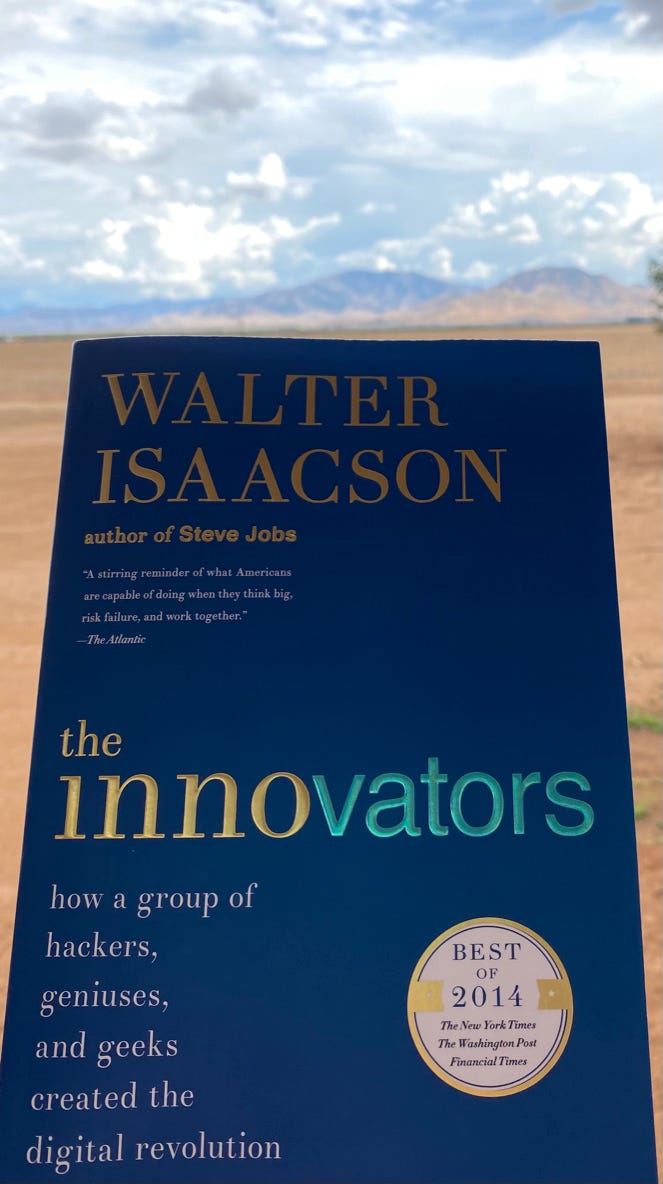
In The Innovators, author Walter Isaacson walks through the many breakthroughs (both obviously significant and seemingly small) from the 1850’s to today that have led to the digital revolution. Here’s the cliff notes on that progression:
- The computer. Although the idea for a computing machine was first published in 1837, the 1890 consensus was tabulated in 1 year rather than 8 years by using a primitive computer designed by a fella that later founded a company that would become IBM.
- Transistor. “The advent of transistors and the subsequent innovations that allowed millions of them to be etched into tiny microchips, meant that the processing power could be nestled inside the nose cone of rocket ships and in computers that sit on your lap.” Discovered in AT&T’s Bell Labs, the transistor allowed the cost and complexity of computers to massively shrink. Pocket radios were the use case that made transistors widely used which dropped the cost further.
- Microchip. The microchip was an integrated circuit that simplified the computer’s innards down from 10,000 little components with 100,000 hand soldered wires connecting them. Another critical step in increasing power, decreasing complexity & size, and decreasing cost. The military & NASA were the first big customers, using microchips for missiles & rockets until the cost of microchips declined enough for consumer products. The market that was tapped to create high demand – and reliable demand – in order to decrease the cost per microchip? Pocket calculators.
- Internet. The concept of a decentralized network of connected computers was developed in the 1940’s but ARPA made it happen in the late 1960’s, largely for military and academic institutions – individuals still didn’t have computers until…
- Personal computer. The Steve Jobs part of the story most of us know – his genius was to make the computer accessible to individuals who wanted to open a box and pull out a machine that could be turned on and immediately usable, instead of the hobbyist computer junkies who wanted to build the computer themselves and were the entire market up to that point.
- Software. The Bill Gates part of the story you may know also. His genius was realizing that hardware would become a commodity, but software is what unlocks value….he certainly wasn’t wrong about that.
- World wide web. The development of this protocol unlocked the internet in ways that led to our daily experience online today.
- Cloud computing (this one isn’t included in the book but IMO is as significant as the others)
What does all of that have to do with cattle genetics? Good question….
Cattle Genetics Revolution
I recently spoke with Jerry Thompson and Matthew Cleveland of Genus ABS who generously shared their insights on the 4 big innovation waves that have hit cattle genetics.
Artificial Insemination & EPD’s
What led to widespread adoption of AI in dairy production? (Side note: livestock and tech have *very* different meanings for the letters AI.)
Quick note on EPD’s: Expected progeny differences are predictions of the genetic transmitting ability of a parent to its offspring and are used to make selection decisions for traits desired in the herd. Expected progeny differences (EPDs) have been applied to improve the genetics of beef cattle for almost four decades.
Here’s how Cleveland & Thompson describe the EPD phenomena:
“The ability to calculate EPD’s drastically accelerated AI adoption. AI has been used since the 60’s and 70’s, but in the 80’s and 90’s EPD’s took off as a
function of computing power to implement them. We knew how to do EPD’s before but couldn’t do them at scale because the equations were too big. You could calculate for 5 animals by hand but beyond that it was super difficult. That began changing in the early to mid 80’s drove that when universities started putting together computing clusters which enabled calculation of EPD’s. We’ve known for hundreds of years about selective breeding and looking at animal performance but EPD’s were a huge driver of genetic change.”
AI adoption was accelerated by EPD’s which were accelerated by advancements in computing power.
Genomics
Some brief background on genomics from the good folks in extension:
Recently, genomic testing for beef cattle has evolved to include “high-throughput” testing, meaning that thousands of markers (or single nucleotide polymorphisms, or SNPs) are read from an animal’s DNA. Producers need only to submit a blood, hair, or tissue sample from an animal to the breed association. After collection and submission to the respective breed association, samples are submitted to the genotyping laboratory where several thousand markers are read from the DNA extracted from the samples.
The most common genomic test available for cattle reads around 50,000 DNA markers or SNPs using a technology embedded in a small chip called a SNP chip.Having the ability to read thousands of SNPs is a tremendous advantage for producers because most economically important traits like calving ease, dry matter intake, feed efficiency, hot carcass weight, marbling score, and tenderness are controlled by many genes as opposed to a single gene like hide color or horned status. This means that many modern tests can make predictions about the genetic merit of an animal more precisely and at a younger age than traditional expected progeny difference (EPD).
I asked Cleveland & Thompson, what brought about the rise of genomics in cattle?
“Genomics allows rapid genetic progress and have had a huge impact in dairy. Although we’ve been using genomics for close to 30 years, it was on an extremely limited scale because of limited genomic information and cost. The idea of incorporating genomics in commercial breeding programs was published in 2001, but it was largely theoretical. But in 2008, the price of genotyping went down and the first chip became available (for testing of many traits at once). USDA put together groups to genotype the first 1,400 bulls. This started the process toward low cost genotyping with fast computing power. There was great foresight from USDA.
In dairy, genomics have become ubiquitous not only for selection of sires, but also for ranking of commercial herd and selection of dams. We’ve seen hundreds of dairy bull breeders consolidate because the cost to play has gone up massively. You see the genetics companies building in house programs and proprietary genetics just like the pig industry did. The massive consolidation has been easy because of low number of breeds and common selection criteria, plus breeding decisions made on public indices.”
I hadn’t fully appreciated how genomics completely flipped old time lines for genetic progress on their head, nor the level of precision in decision making that genomics unlocks. In Cleveland’s words, here’s why that matters so much:
“The implications are that the rate of improvement continues to accelerate. Whereas historically you needed 5 years to get proof (of animal performance), now producers can make selection decisions a week after birth. Both in terms of genetics at a specialized breeding company and within your own herd to select which cows to breed. So you immediately know the next generation. As calves are born, you conduct genetic testing, rank the calves, then make your sell or keep decisions. Repeat.”
Earlier decisions, faster decisions, better decisions….which creates an easy ROI in dairy.
Sexed semen —> Beef on Dairy
Here’s an overview of sexed semen – what it is and why it matters – from NIH:
“In dairy farming, there is surplus production of unwanted male calves. Incorporating sexed semen into the breeding program can minimize the number of unwanted male dairy calves and reduce dystocia. Sexed semen can be used to generate herd replacements and additional heifers for herd expansion at a faster rate from within the herd, thereby minimizing biosecurity risks associated with bringing in animals from different herds. Furthermore, the use of sexed semen can increase herd genetic gain compared with use of non-sorted semen. In dairy herds, a sustainable breeding strategy could combine usage of sexed semen to generate replacements only, and usage of beef semen on all dams that are not suitable for generating replacements. This results in increased genetic gain in dairy herd, increased value of beef output from the dairy herd, and reduced greenhouse gas emissions from beef.”
Here’s Thompson & Cleveland’s take on the timing & implications of sexed semen in dairy and the rise of beef on dairy breeding programs:
“The idea of sexed semen was 1st presented around 2003. We launched an alternative tech 5 years ago that has accelerated the use of sexed semen, and beef as a strategy for dairy. It is the most profitable option by driving genetic improvement in replacement heifers while maximizing value by creating high value dairy beef calves. There has been massive adoption of sexed semen in beef while sales of conventional dairy semen decrease rapidly. The advanced producers are using the sexed semen and beef strategy which we expect to become ubiquitous in the next 5 years.”
Ok so there’s a 30,000 foot summary of the 3 recent phases of dairy genetics innovation:
- Phase 1: AI enabled producers to level up their genetics every time a breeding decision is made.
- Phase 2: Genomics allow producers to assess an animal’s genetic promise as soon as a calf is on the ground which allows them to make faster & better breed/sell decisions.
- Phase 3: Sexed semen allows producers to only breed dams with the best genetics for replacement heifers and to breed all other dairy cows with beef genetics for a higher value calf.
Meanwhile <10% of beef producers are using AI, let alone more advanced genetic technologies. What would make AI economically meaningful in North America beef industry?
According to Cleveland & Thompson:
“Adoption of AI in beef is not a value proposition question – the value is there. It is a logistics question and an industry mentality question. Accessing additional labor to AI is one barrier for the 700k+ producers in North America.
The beef industry is a long way from having breeding programs like in pigs and poultry with dam lines for maternal traits and sire lines for terminal generations. If that changed, then we’d potentially see increased AI adoption in beef.
Even though beef AI numbers are still low and not moving significantly, some producers have not had bulls on their property since the 1960’s and are solely using AI.”
Although the two histories certainly overlap, the parallels speak to how innovation comes about. What are the takeaways from the digital & genetic revolution in cattle?
'The street finds its own use for things'is a phrase Isaacson uses in The Innovators. I love it. It’s the idea that technology is just technology without the right market, business model, pricing model, and context. Computing power for calculating EPD’s in cattle….can we all agree that was not a use case anywhere on the radar of the early creators of computers? The street finds its own use.- ‘The future is here, it’s just not evenly distributed.’ Beef on dairy is being talked about more today, even tho it’s existed as a concept for 20+ years. Pick 10 other technologies that will likely play a big role in the future and they are probably just now in their awkward adolescent years finding their place in the world, from Artificial Intelligence to Machine Learning to blockchain to CRISPR….they’re here, they’re not yet everywhere though.
- Collaboration. Whether among institutions (academia, govt, individuals, big companies or startups) or among individuals, all of these innovations evolved through collaboration. As Isaacson says, “The main lesson to draw from the birth of computers is that innovation is usually a group effort, involving collaboration between visionaries and engineers, and that creativity comes from drawing on many sources. Only in storybooks do inventions come like a thunderbolt.”
- Execution > ideas. Many people had the idea of the computer (or almost any other invention) but few brought it to life. Execution is where the magic happens – like the mastermind behind getting microchips into personal calculators knowing that would create high demand which would allow them to decrease the cost which would allow them to find more use cases…brilliant.
- Most innovation is evolutionary rather than revolutionary. New breakthroughs build on previous breakthroughs. We’re all standing on the shoulders of giants.
I’m interested in all things technology, innovation, and every element of the animal protein value chain. I grew up on a farm in Arizona, spent my early career with Elanco, Cargill, & McDonald’s before moving into the world of early stage startups and venture capital.
I’m currently on the Merck Animal Health Ventures team. Prime Future is where I learn out loud. It represents my personal views only, which are subject to change….strong convictions, loosely held.
Thanks for being here,
Janette Barnard