Categories
Business Model Innovation Genetics

Prime Future 67: When does beef x dairy show up at the meat case?

Every company on the face of the planet (and someday on Mars) does 3 things:

  1. buys stuff to
  2. make stuff to
  3. sell stuff

Using that oversimplified framework, in our last stop in this series let’s look at the downstream implications of ‘beef on dairy’ for cattle feeders, packers, and retailers.

Keep in mind, we’re talking about a max of ~5 million out of ~25 million fed cattle per year in the US.

Feeders gonna feed.

Success in cattle feeding is based on a 3 variable equation:

  1. Quantity & price of lbs out the door (selling cattle right)
  2. Minus the quantity & price of lbs in the door (buying cattle right)
  3. Minus the cost of lbs added at the feedyard (feeding & managing cattle right)

Those 3 levers make feedyards the segment in the beef value chain with the most flexibility. That flexibility makes cattle feeding a reeeeally dynamic business allowing feeders to shift strategy with trends in the market, the cattle cycle, or grain prices. It’s also what makes cattle feeding really hard.

When it comes to feeding native cattle (beef), dairy, or beef x dairy crosses, cattle feeders find what works as they triangulate risk profile on the buy, feeding & management, and relationships/proximity to plants that process certain types of cattle. There are both the management & nutrition elements of feeding different or new-to-you types of cattle that can take some time in learning how to adjust lever #3 above, cost of gain. But just as important are levers #1 and #2 which are driven by the relationships and partnerships and arrangements that surround a cattle feeder’s strategy as it relates to how they buy and how they sell cattle. All 3 levers have some degree of learning curve when it comes to beefxdairy, though waaay less than a beef cattle feeder jumping into feeding dairy cattle.

My hypothesis is that because large dairies are leading the way with ‘beef on dairy’, the animals tend to move as large lots under negotiated agreements rather than moving as smaller lots through sale barns. The result is increased visibility to production history, and decreased risk….not a bad combo for a cattle feeder.

One opportunity for cattle feeders is if these large dairy systems look to maintain ownership of cattle through the supply chain to capture more value all the way to the packer, will that create more low risk custom feeding opportunities. If the balance of feedyard owned cattle vs custom feeding cattle for others tends to cycle with the broader cattle cycle and feed price fluctuations, could this increase the amount of predictable custom fed business? Maybe, maybe not.

~5 million dairy calves have been part of the beef value chain for decades. All ‘beef on dairy’ does is create an opportunity to level up, to get the best of beef and dairy genetics for performance in a feedyard and in the plant. Shifting from 280 days in a feedyard for Holsteins to <180 days in a feedyard for Hogus cattle is, um, a big deal.

One aside: For the segment of dairy cows that are bred to a beef bull using AI, the math doesn’t (yet) make sense to use sexed semen so 50% of those offspring will be heifers. Heifers are typically considered less profitable for a feedyard than steers. If/when it becomes economical to use sexed semen for all calves from a dairy that are headed into the beef value chain, there will be another inflection point. The view on heifers is another example of the difference in beef goals vs (traditional) dairy goals, since heifers are significantly more valuable to the dairy producer.

Packers gonna pack…but at what price?

We talked about the BIG idea of beef on dairy value chains to accelerate aligned supply chains in beef since they are absolutely critical to maximizing the value of beef x dairy carcasses. Beef on dairy value chains *have* to have a direct relationship with the packer. This partnership mentality, from producer to calf ranch to feedyard to packer, is essential to ensuring beef-dairy cattle are priced according to the value of the carcass, with its beef characteristics.

But as long as the ‘right’ genetics have been selected to drive desirable carcass traits the packers are looking for, then these animals should be priced like their native peers. If the dairy’ness has been offset by the terminal beef genetics, then once the animal arrives at the packing plant there *should* be no subsequent difference in process or how that beef is sold. It’s just beef by the time the carcass is disassembled and prepared for the meat case at retail.

Which leads us to….

Retailers gonna…cringe a bit.

To the extent beef x dairy meat went into mainstream channels & programs at the packer, then they show up in the meat case just like meat from any native (beef) animal. Zero impact there.

The real question is, will retail brands be built around beef on dairy?

Here are the reasons FOR beef x dairy focused brands:

  1. Consistency in supply, consistency in product given the tight dairy gene pool. The consumer will get the same experience every.single.time. That seems brand’able.
  2. Transparency into supply given the ‘aligned supply chain’ nature of this beast that is required. Want to know how this animal was raised, where it’s been, how it was fed? We gotchu.
  3. Sustainability. Let’s say for illustrative purposes (don’t @ me) that each cow uses 1 unit of environment per year. The beef cow produces 1 unit of food supply per year with a calf. So we can loosely say that beef = 1:1 output to input ratio. But wait a sec, here comes the dairy cow who also uses 1 unit of environment per year but she produces 1 unit of food supply per year through milk production PLUS 1 unit of food supply with a high value beef x dairy calf. Dairy = 2:1 output to input ratio. The dairy cow is the super star when you frame it that way.

It’s a made-for-the-meat-case story.

But there’s a catch: The calf ranch.

Regardless of how well cared for the calves are, kept out of the elements, given appropriate feed and water and nutrition…brand new baby calves in hutches isn’t something thats likely to play well in a social media world that runs on sound bites & spin rather than nuance. Until there’s an alternative to the current calf rearing link in the supply chain, there’s likely to be limited retailer / brand appetite for marketing beef x dairy crosses in a direct way.

And yet, given how great the value proposition is for a fully aligned beef x dairy supply chain from dairy to meat case, I have to believe that someone is going to find a meat case friendly solution for calf rearing.

And when that happens? Game on.

Summary

We’ve covered a lot of ground in this 5 part series – I have learned so much from all the people who’ve shared their insights along the way. My takeaway from the series is that beef on dairy isn’t everything, but it is definitively something:

the 3 ideas that make beef-on-dairy punch above its weight class:

  1. Beef x Dairy cross carcasses are as good or better than straight beef carcasses. (Think of it as having your cake and eating it too, but ya know, beef.)
  2. Beef-dairy crosses hold a consistency advantage over the traditional fragmented beef value chain.
  3. Beef-dairy cross value chains are forcing new partnerships in order to capture full value at the packer level.

Which is all fine and well, until we come back to the math of beef on dairy. If we are really only talking about 5M calves annually, out of 25 million total fed cattle, it raises the question of….so what?

What happens with 5M beef dairy crosses is interesting, but the really fun part will be seeing how the 5M could influence the 20M.

Imagine that cattle feeders and packers and retailers get used to all those benefits mentioned above that are inherent to the beef x dairy value chain. Now use the exceptionally limited amount of imagination to picture those expectations bleeding over into the other 80% of beef, the natives. Not much imagination required, huh?

The unknown is how the beef value chain will respond and how long it will take to catch up & recreate the rapidly accelerating advantages of the beef on dairy value chain. Is this a 30 year dynamic or a 5 year dynamic? TBD.


ICYM the rest of the series

The first 4 of this 5 part series on how the ‘beef on dairy’ genetics strategy could impact the beef & dairy industry in the United States:

(1)  How the ‘beef on dairy’ genetics strategy will impact cow-calf producersSpoiler alert: not much, mathematically speaking.

(2) What’s driving this beef on dairy thing from the dairy producers POVtldr: its complicated.

(3) 💡 3 reasons why dairy is the new beefIt’s not about the 5M, it’s about how the 5M influence the remaining 20M fed cattle.

(4) If dairy is the new beef, where do the alts fit? A look at how alternative milk and meat market share might impact milk and meat prices now that the two are even more interdependent.

GET THE BEEF-ON-DAIRY EBOOK 🐄


I’m interested in all things technology, innovation, and every element of the animal protein value chain. I grew up on a farm in Arizona, spent my early career with Elanco, Cargill, & McDonald’s before moving into the world of early stage Agtech startups.

I’m currently on the Merck Animal Health Ventures team. Prime Future is where I learn out loud. It represents my personal views only, which are subject to change…’strong convictions, loosely held’.

Thanks for being here,

Janette Barnard

Categories
Business Model Innovation Genetics

Prime Future 66: If dairy is the new beef, where do the alts fit?

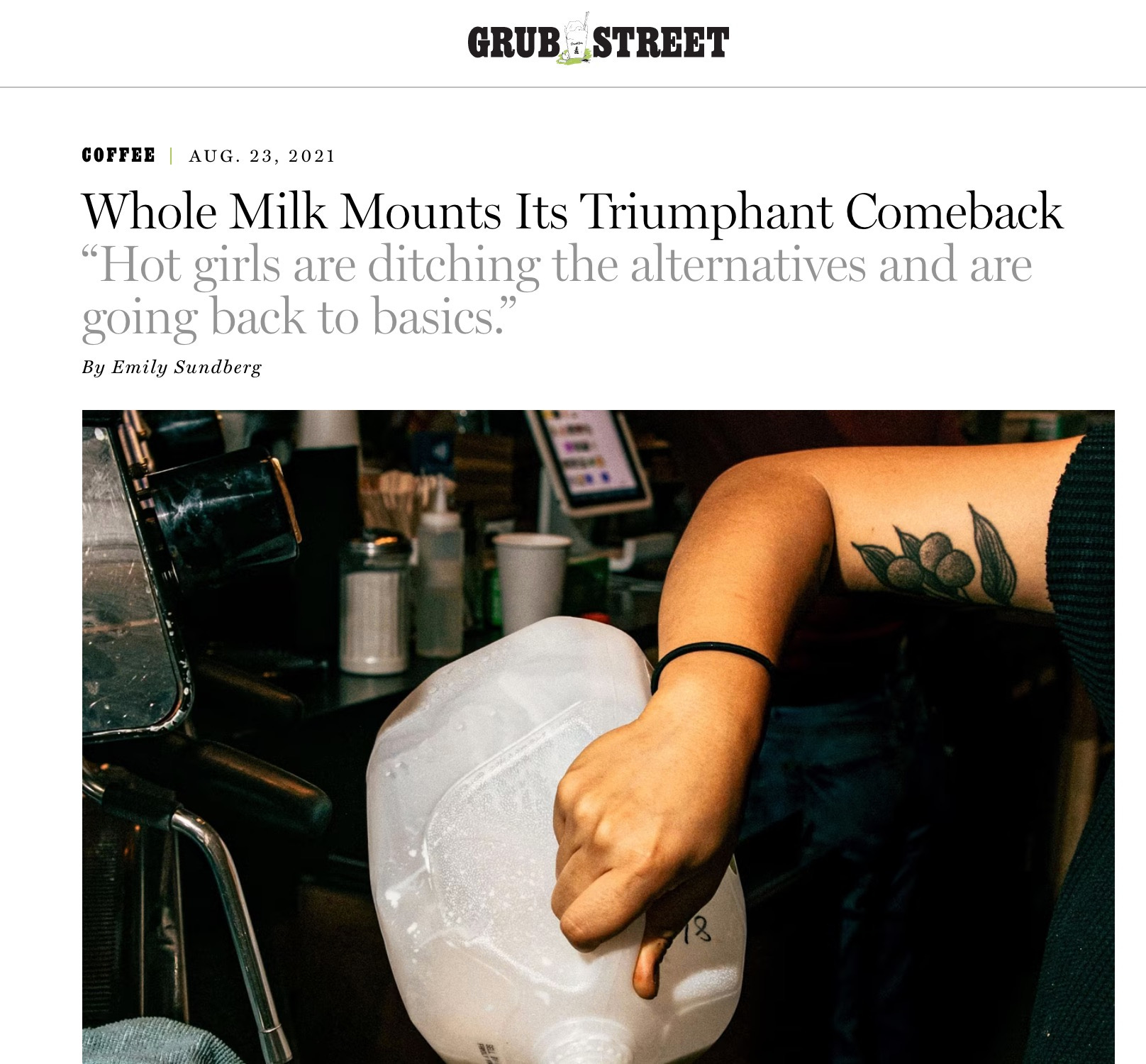
Move over hippies and hipsters, man buns and punk rock. The new counter culture move is….drinking milk?

“I traveled around Europe this summer. I drank icy frappes on the beaches of Greece and stirred foamy café au lait at the bistros of Paris. I was in a simpler, more sensible world, one without an alt mylk or nondairy creamer in sight. The real international delight, I realized, is pouring whole, full-dairy milk into your coffee; it is perhaps the most civilized activity in which a person can partake.”

….her answer edged on spiritual fulfillment. “There’s this quest for absolution in the foods we eat,” she said. “I think consumers were fed this lie by what I call the Goop Industrial Complex that if you cut dairy from your diet you will have more energy, clearer skin, and you will never ever fart ever again. But the case against dairy ignores many of the complexities of our food system, and I think people are starting to realize that.”

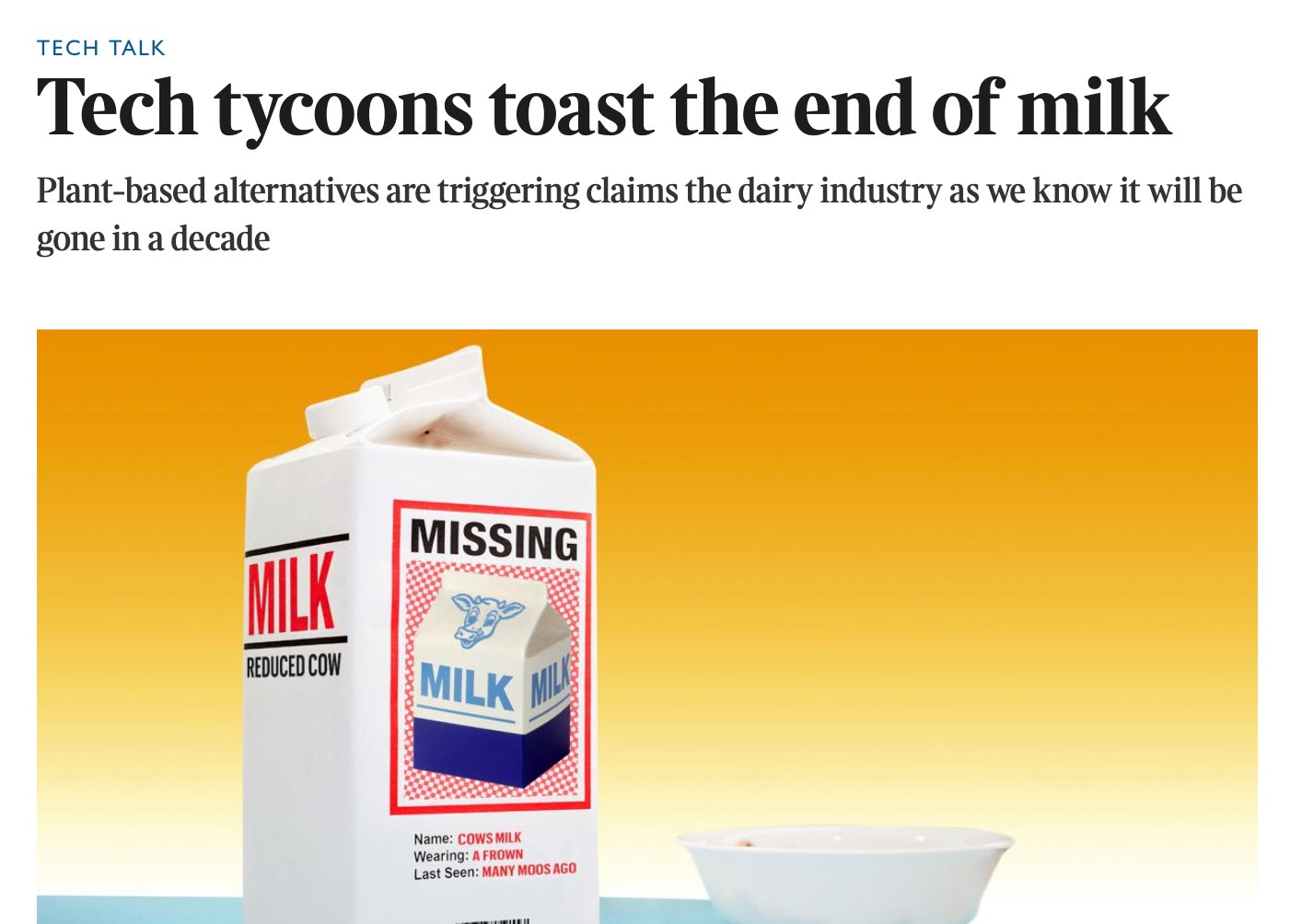
Now set that against this other recent headline:

When I hear people talking about the ultimate demise of animal protein as we know it, I assume it’s either an alternative protein investor who has capital on the line, or someone who wants to be seen as a forward thinker, even in the industry. It sounds more futurist to describe a future without plant fed animal protein than it is to say “I think there’s a market for plant based or cell cultured protein but not necessarily at the expense of plant fed protein.” It sounds more contrarian to say “livestock production will end in 10 years” than it is to say here are the markets where alternative protein is likely to take share but here’s where it’s unlikely to gain traction.

There’s little reward for a nuanced position in most conversations right now though…

Consider this quote by Jeff Bezos:

“I very frequently get the question: “What’s going to change in the next 10 years?” That’s a very interesting question.

I almost never get the question: “What’s not going to change in the next 10 years?” And I submit to you that that second question is actually the more important of the two.

You can build a business strategy around the things that are stable in time. In our retail business, we know that customers want low prices, and I know that’s going to be true 10 years from now. They want fast delivery; they want vast selection. It’s impossible to imagine a future 10 years from now where a customer comes up and says, “Jeff I love Amazon, I just wish the prices were a little higher.” Or, “I love Amazon, I just wish you’d deliver a little slower.” Impossible.

So we know the energy we put into these things today will still be paying off dividends for our customers 10 years from now. When you have something that you know is true, even over the long term, you can afford to put a lot of energy into it.”

How great is that?

That framing is likely to generate the richness of a whole lotta nuance, the tension of simultaneously asking what will change and what will remain the same. And when it comes to the impact of alternative proteins in milk or meat, it’s largely TBD.

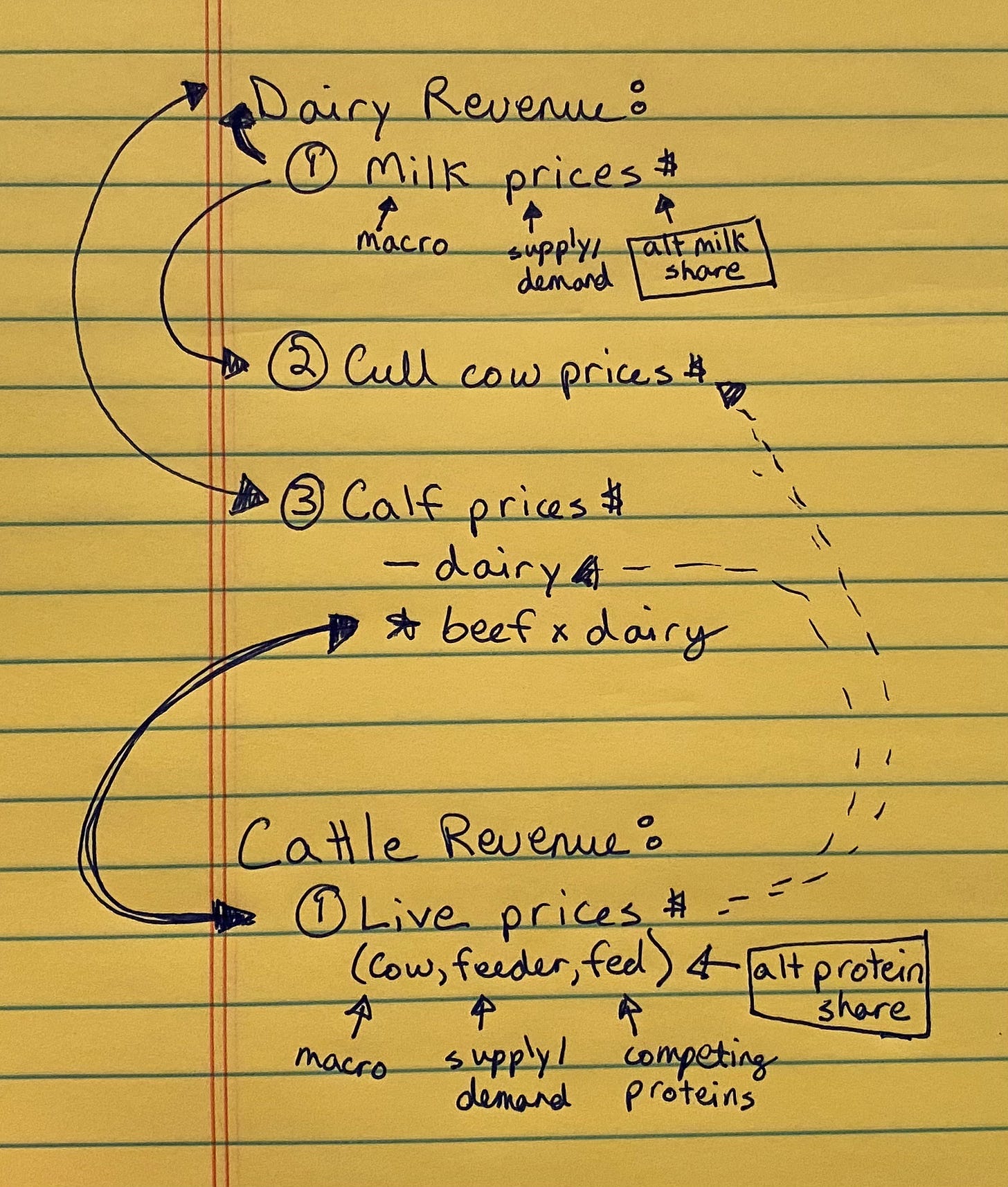
How do alternative milks & alternative meats fit with our ‘beef on dairy’ series?

Kinda like this:

This is obviously a wildly oversimplified drawing of wildly complex markets. Pricing for beef, pork, chicken, eggs, and milk have always been dynamic. These are competitive, commodity driven markets with so many interdependencies with macro factors and grain markets and processing capacity and export markets, and, and.

Alternative milks have captured up to 16% market share, depending on who you ask. Does that impact dairy milk prices? You betcha. Now what happens if something similar happens in meat over the next 3-10 years, will it impact meat prices? You betcha. I put a square around both of them above because they are x factors moving forwards, unknownslet’s ignore those who speak with certainty about the future (in either direction) and assume the impact will fall somewhere between ‘zero’ and ‘destruction’.

Market share for alternative milk has been a driver of milk prices, and market share for alternative meat could become a driver of meat prices…but what if market share for alternative milk becomes an indirect driver of meat prices and market share of alternative meat becomes an indirect driver of milk prices. 🤯

What is the increasing link between beef and dairy? The increasing supply of beef-dairy crosses flowing from dairy producers into the beef value chain.

I suppose the potential mega trend is that protein markets could get even messier with more x factors:

  • What happens to beef prices when a rancher generates more revenue selling carbon credits than selling weaned calves?
  • What happens to infrastructure heavy industries with super high asset specificity when the fickleness of consumer fads bears down in unpredictable ways?
  • What happens to dairy profitability when plant based ground chicken gets traction?
  • What happens to the broader animal protein industry when the ethanol mandate disappears? increases?
  • What happens to cattle feeder profitability when plant based milk loses market share?

I think I’m with Bezos:

It’s important to ask what will change in 10 years; it’s critical to ask what will stay the same.

Kick this to the nuanced thinkers in your network to see what they’d add to this discussion:


ICYM the ‘beef on dairy’ series so far

  1. If dairy is the new beef, are cow-calf producers necessary? (link)
  2. If dairy is the new beef, what are the dairy drivers? (link)
  3. 💡3 reasons why dairy is the new beef (link)

GET THE BEEF-ON-DAIRY EBOOK 🐄


I’m interested in all things technology, innovation, and every link in the animal protein value chain. I grew up on a farm in Arizona, spent my early career with Elanco, Cargill, & McDonald’s before moving into the world of early stage Agtech startups.

I’m currently on the Merck Animal Health Ventures team. Prime Future is where I learn out loud. It represents my personal views only, which are subject to change…’strong convictions, loosely held’.

Thanks for being here,

Janette Barnard
Categories
Business Model Innovation Genetics

Prime Future 65: 💡3 reasons why dairy is the new beef

First we looked at how the ‘beef on dairy’ genetics strategy will impact cow-calf producersSpoiler alert: not much, mathematically speaking.

Then we looked at what’s driving this beef on dairy thing from the dairy producers POVtldr: its complicated.

I’ve been exploring the implications for cattle feeders, packers, and retailers and next week we’ll talk about those. But first I have to share 3 big aha’s that have jumped out as potential beef industry game changers…here we go.

(1) Beef is better, right? …right??

I started this series with an assumption that beef breeds create better beef carcasses than dairy breeds, or dairy x beef crossbreds. (It seems reasonable, doesn’t it?)

But here’s the surprising little secret: Beef x Dairy cross carcasses are as good or better than straight beef carcasses, or ‘natives’ as the people say.

Texas Tech recently published trials looking at how beef-dairy crosses perform in feedyards and in the plant, and my takeaway was that beef-dairy can increase total pounds without sacrificing quality grades, when managed correctly. That’s a big deal. Imagine being able to sell 100 additional pounds of meat per animal with minimal yield impact.

Someone framed it this way: milk production and red meat yield are antagonistic traits and tend to move in opposition directions, while marbling and milk production are complementary traits and tend to go hand in hand.  The beef on dairy genetics jigsaw puzzle allows dairy producers to make decisions that get the best of beef and dairy breeds, to use ‘elite terminally focused genetics’ on the beef side that offset the dairy deficiencies. For example, one variation on a beef on dairy program might be to use Limousine sire genetics (high red meat yield) on Jersey females (high marbling). All breed genetics are not the same, that’s just one example of how the jigsaw puzzle can be put together.

It’s how dairy producers thread the needle to keep the best of dairy genetics so milk production isn’t negatively impacted one ounce (which would be a complete deal breaker for dairies, obvs), while driving towards carcasses that have zero hint of dairy’ness to them and are therefore just as valuable as carcasses from beef genetics.

(2) Consistency is the name of the beef on dairy game

There are 3 elements of consistency that beef on dairy can offer to the beef value chain:

  • Year round continuous supply of calves to the feedyard, and then to the plant.
  • Genetic consistency given how narrow the genetic base of dairy cattle are since AI has been used so widely for so long.
  • Management consistency – while a beef animal could move through 2-3 sale barns between weaning and arriving at the feedyard, beef-dairy crosses are much less likely to go through a sale barn at all. They’re more likely to move in large lots from calf ranch to grow yard to feedyard, or directly from calf ranch to feedyard with consistent management in each phase.

The US beef industry has been wildly successful at increasing consistency of meat so that the consumer experience is what the consumer expects, every time. And yet, there is still a lot of variability in genetics and production systems and feeding and management and, and, and. With 800k+ cow-calf producers and animals changing hands multiple times, high variability is somewhat of a given.

But beef dairy crosses offer the exact opposite of fragmented traditional beef production. This segment offers a hyper consistency of product which can only be net positive for processors, retailers, and consumer eating experience…which is net positive for all players upstream.

(3) Max value capture requires aligned supply chains

Value is only value when it’s recognized by the buyer, in this case the packer. The value chasm is wide between a dairy animal and a beef animal, so the challenge for beef-dairy animals is to get them priced like a native. One producer said it this way, “packers are looking for a reason to price a beef-dairy cross like a dairy animal. You have to get the animals on a grid to get a base price where it should be.”

The beef-dairy value equation is driven by the price the packer is willing to pay; the value of the animal to the packer determines the value of the animal when it first hits the ground. If the packer doesn’t recognize the value of a beef-dairy carcass, then the beef on dairy strategy doesn’t pencil out for the dairy producer.

Capturing full value of the beef-dairy animal requires closely aligned partnerships all the way through the value chain to the packer. Aka aligned supply chains or coordinated supply chains. Prime Future readers who have been around for a while know I have a borderline obsession with how aligned supply chains can create better outcomes for producers and consumers. We’ve talked about them here and here, with this key idea:

“Traceability is meaningless until somebody will pay for it. The industry has thrown around the t word for at least a decade with extremely limited success in finding the right use case & corresponding business case. Like all innovations, until the right business case surfaces it’ll never happen. However, coordinated supply chains likely are the business case that supports traceability particularly when the data flows in both directions so producers get better feedback on how animals perform in the feedyard/plant, and consumers get relevant cues about how the animal was produced.”

But beef on dairy looks like it just miiight be the breakthrough use case to drive supply chain alignment and as a byproduct, traceability.

For dairy producers to maximize the value of beef-dairy crosses, dairy producers have to create supply chain partnerships for the long term where everyone involved is incentivized to ‘stick with it’ in order to create a consistent system, and to mature the whole system over time. (one of my other favorite ideas is playing long term games with long term people – traditional transactional won’t work here!)

Will it be surprising if Dairy Beef aligned supply chains grow and consolidate over time to find the efficiencies of scale without the capital intensity of true vertical integration? Not at all, that’s the nature of the agriculture game.

So there they are, the 3 ideas that make beef-on-dairy shine:

  1. Beef x Dairy cross carcasses are as good or better than straight beef carcasses. (Think of it as having your cake and eating it too, but ya know, beef.)
  2. Beef-dairy crosses hold a consistency advantage over the traditional fragmented beef value chain.
  3. Beef-dairy cross value chains are forcing new partnerships in order to capture full value at the packer level.

Which is all fine and well, until we come back to the math of beef on dairy. If we are really only talking about 5M calves annually, out of 25 million total fed cattle, it raises the question of….so what?

What happens with 5M beef dairy crosses is interesting, but the really fun part will be seeing how the 5M could influence the 20M.

It’s almost like The Innovators Dilemma, but at an industry level. Here’s my short summary of The Innovator’s Dilemma:

“When big companies are disrupted by upstarts, many assume it was because the big co didn’t see what the upstart saw, e.g. Kodak, Blockbuster. But author Dr. Clayton Christenson argues that big companies see the early trends just fine, they just are not positioned, structured, or incentivized to act on early trends. Leaders at established companies have to focus on market share and profitability of today’s largest customers. This is rational behavior. But it also makes it easy for incumbents to miss emerging trends.”

Here’s a recent take on that idea:

“The reason big new things sneak by incumbents is that the next big thing always starts out being dismissed as a “toy.” This is one of the main insights of Clay Christensen’s “disruptive technology” theory. This theory starts with the observation that technologies tend to get better at a faster rate than users’ needs increase. From this simple insight follows all kinds of interesting conclusions about how markets and products change over time. Disruptive technologies are dismissed as toys because when they are first launched they “undershoot” user needs. The first telephone could only carry voices a mile or two. The leading telco of the time, Western Union, passed on acquiring the phone because they didn’t see how it could possibly be useful to businesses and railroads – their primary customers.”

Now read that paragraph again but where it says ‘toy’ insert ‘just beef-dairy crosses which is a tiny fraction of the beef supply, no worries’.

Imagine that cattle feeders and packers and retailers get used to all those benefits mentioned above that are inherent to the beef x dairy value chain. Now use an exceptionally limited amount of imagination to picture those expectations bleeding over into the other 80% of beef, the natives. Not much imagination required, huh?

The unknown is how the beef value chain will respond and how long it will take to catch up & recreate the rapidly accelerating advantages of the beef on dairy value chain. Is this a 30 year dynamic or a 5 year dynamic? TBD.

Perhaps beef on dairy is to beef what ABF chicken was to the US chicken industry 5-7 years ago when it was still a tiny percentage, before the tiny percentage influenced the majority. Without a doubt, there are new emerging trends in pork and poultry…maybe not as clearly emerging as beef on dairy yet, but emerging nonetheless. What are those emerging trends you see?


Get the beef-on-dairy ebook 🐄


Total Addressable Market (TAM) for Beef on Dairy (updated)

  • The US dairy industry has been steady state for a while at 9.4M dairy cows.
  • If the herd turnover rate is closer to 40%, then we need 3.76 million replacement heifers annually.
  • But…..there’s another number here, ‘return to replacement’ which is what % of heifers born intended to be replacements actually go back into the herd. If that number is closer to 80%, then the industry really needs 4.7 million heifers to be born annually.
  • Assuming replacement heifers are created via sexed dairy semen and the remaining calves born annually will be bred to beef genetics for a beef dairy cross calf, that means the upward limit on cross calves is 4.7 million. Let's call it 5 million just for a clean number.
  • And though it ranges, let’s use the number 25 million cattle fed on feedyards annually. So beef on dairy as a percent of total fed cattle looks like it will max out at 20%, at least in the US industry.

Beef on dairy TAM = ~5M beef x dairy calves out of ~25M total fed cattle


I’m interested in all things technology, innovation, and every element of the animal protein value chain. I grew up on a farm in Arizona, spent my early career with Elanco, Cargill, & McDonald’s before moving into the world of early stage Agtech startups.

I’m currently on the Merck Animal Health Ventures team. Prime Future is where I learn out loud. It represents my personal views only, which are subject to change…’strong convictions, loosely held’.

Thanks for being here,

Janette Barnard
Categories
Genetics

Prime Future 64: If dairy is the new beef, what are the dairy drivers?

We kicked off our series on the ‘beef on dairy’ genetics strategy by asking if cow-calf producers face an existential threat as more dairies deploy the strategy.

The math led us to an unequivocal rejection of that hypothesis, but also to the conclusion that if this beef on dairy thing continues to be a thing, it will mean some things to the beef industry.

The discussion raised a lot of great points, including these:

(Pork & poultry friends, stay with us because ultimately this is a discussion about value chains and diverging markets and aligning incentives from producer profitability to customer outcomes.)

Decision points

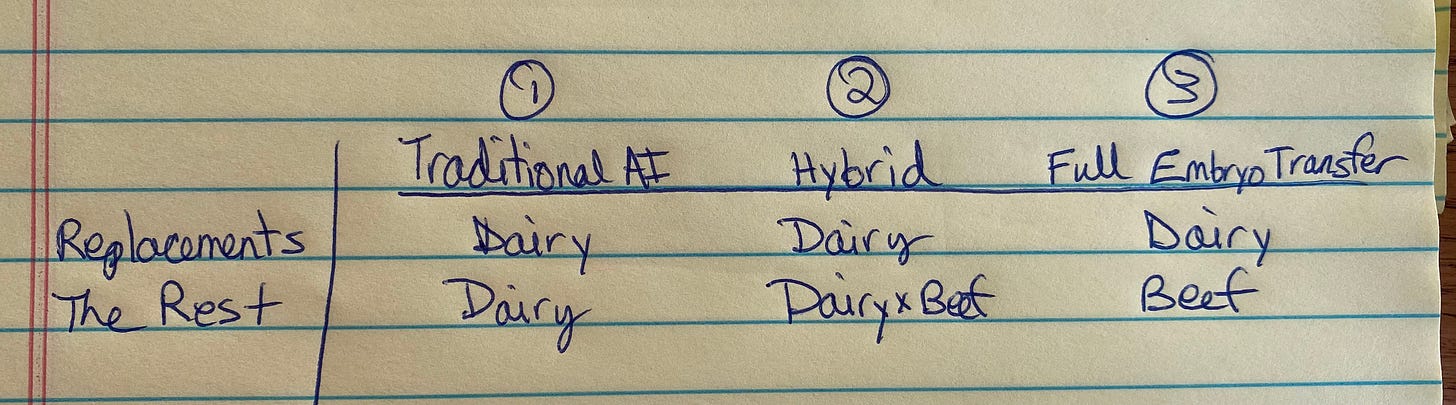
Let’s look at the series of decision points that a dairy producer navigates that ultimately leads to a Dairy, Beef, or Beef x Dairy calf output.

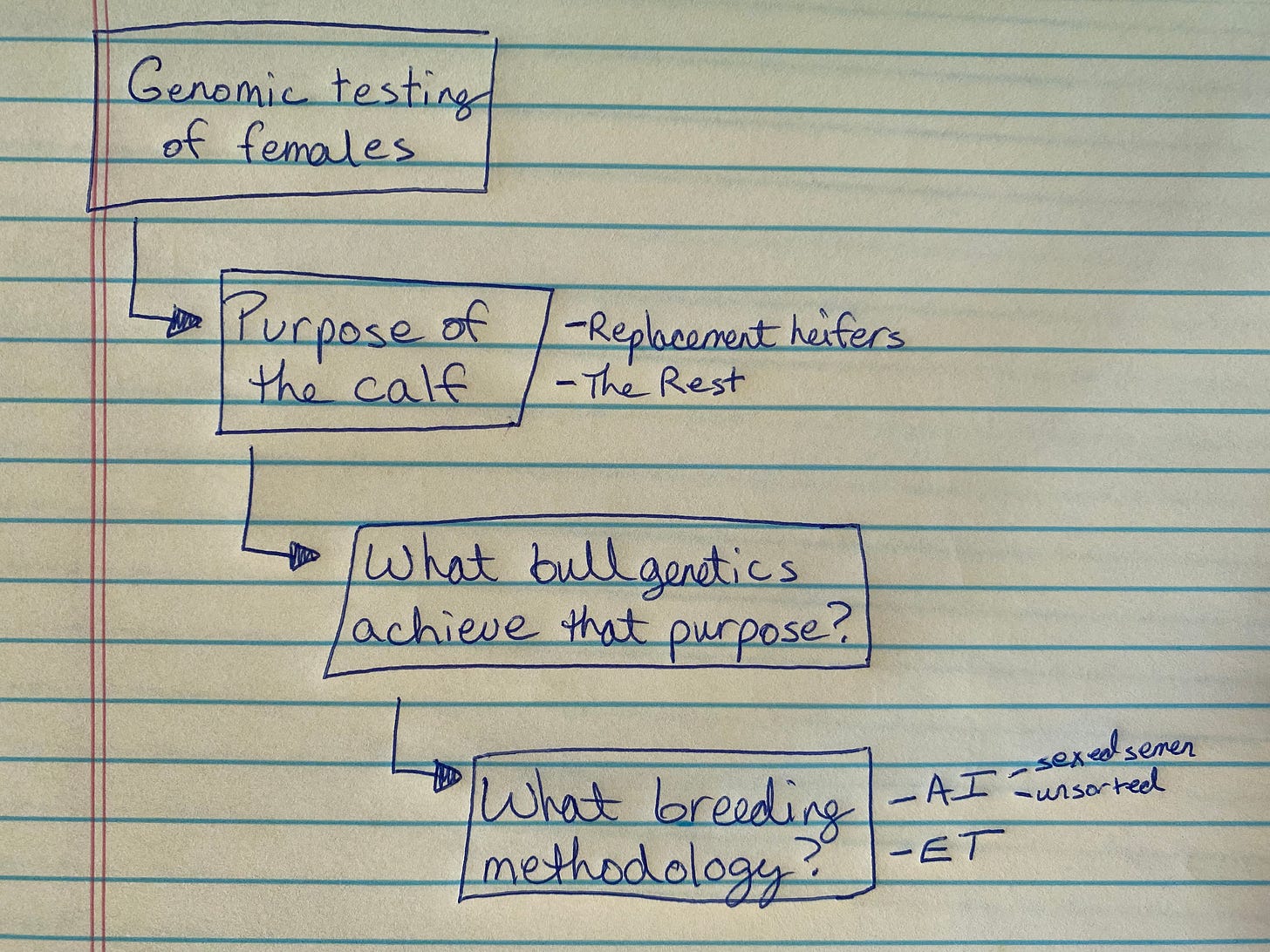
I set out to create a simple decision tree to illustrate the discrete decisions in building a genetics strategy and execution plan. But – shocker – turns out that it’s more complicated than that, way more complicated. So instead here’s a rough sketch of the high level decision flow as I understand it:

AI = artificial insemination. ET = embryo transfer.

Let’s break that down.

What is the genetic potential of this cow/heifer?

Until genomic testing became wide spread, the decision of which bull genetics to use via AI was the primary decision – that was kinda it. Genomic testing flipped the script by unlocking a preliminary decision point about every female. Genomic testing allows the producer to understand the right place in the dairy’s genetic program for each individual heifer/cow based on her genetic potential. This serves as the foundation of the strategy because it sets up the next question….

What is the purpose of the calf?

If genomic testing indicates a heifer/cow is top shelf genetically, the producer will likely make breeding decisions with the objective of getting a replacement heifer from her. If she’s not, then she just needs to produce a non-replacement heifer calf, one of ‘The Rest’. The question ‘what is the purpose of the calf?’ leads us to 3 layers:

  1. Get the cow lactating. This is the obvious purpose of breeding a cow on a dairy farm but I’m calling it out here to keep the main thing the main thing: milk production. All calves share this purpose. But now we can further subdivide to:
  2. Produce Replacement Heifers. This is the long term play, to optimize the herd over time by doubling down on dams that are genetically superior to continue advancing the quality of the herd.
  3. Capture value from ‘The Rest’ of the calves. This is about optimizing short term revenue by optimizing the value of offspring that are not bred specifically for replacement heifers. Let’s say a Holstein calf is worth $60 and a Holstein x Angus calf is worth $175….we can breed a cow for either output but the $115 differential represent real dollars on the table that in a thin margin environment can make really meaningful impact on profitability. (Should we call that Holstein x Angus a ‘Hogus’? A ‘Hangus’? Nah?)

So the genomic testing of the dam dictates the purpose of the offspring which leads to…

What bull genetics achieve the purpose?

The purpose of the calf – Replacement Heifer or The Rest – drives the decision on what bull genetics are required to achieve that purpose. Primo or average dairy sire? Primo or average beef sire? This is the same decision point that dairy producers have been exercising since adopting AI as the path to genetic improvement, decades ago…there are just more options now for breeding methodology.

And that leads us to the mechanics….

What breeding methodology is right?

This decision point bifurcates (<— favorite word in the English language) into:

  1. AI or ET?
  2. If AI, whether to use sexed semen or non sorted semen? Sexed semen is the enabling technology for separating a dairy herd and using replacement heifer

The outcomes of this portfolio of (admittedly oversimplified) decisions delivers ~5 million calves annually into the US that fit into the following 3 buckets:

  1. Dairy calves
  2. Beef x Dairy cross calves
  3. Beef calves

We don’t really know how many calves dairies produce for each bucket today, but we DO know the Dairy bucket is decreasing as the Dairy x Beef bucket increases. Which leads to that 3rd bucket of straight beef calves where the value of the calf converges with breeding technology….

Technology + Market

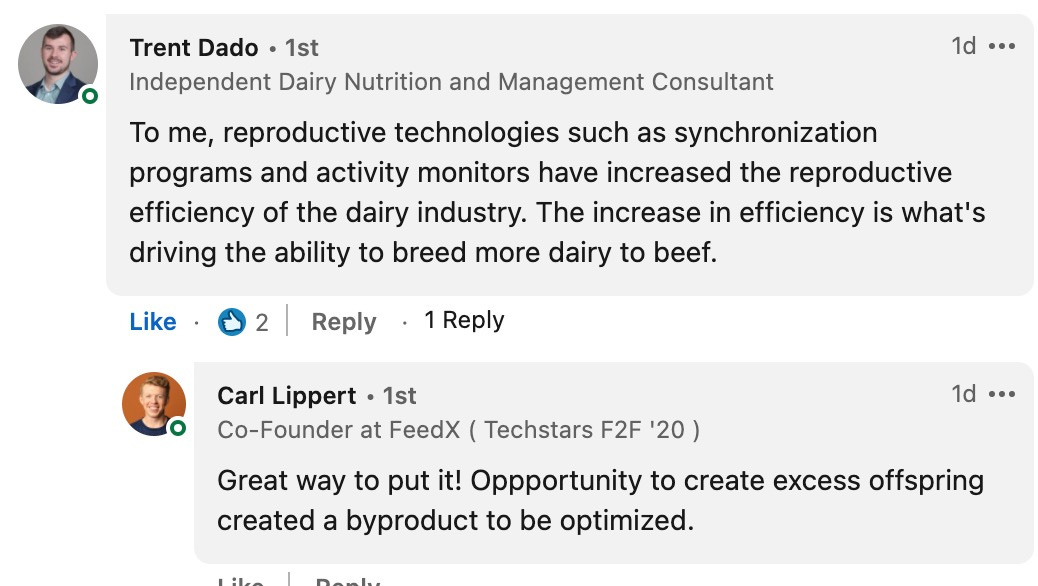
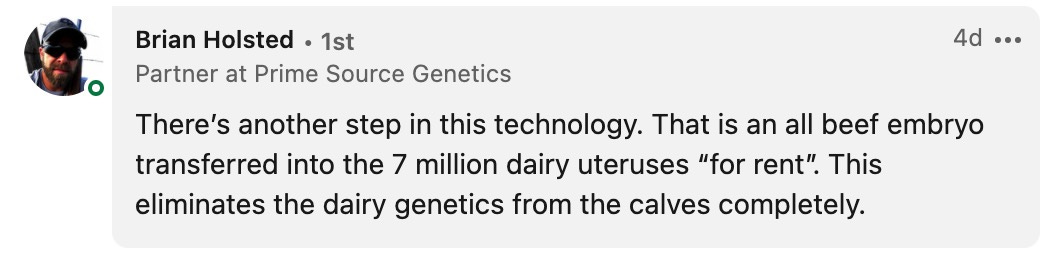
In the comments above from LinkedIn, the idea of 7 million dairy uteruses ‘for rent’ was mentioned. The idea would be that 3M of the 10M dairy cows would be bred for replacement heifers, and the remaining dairy cows would be recipient cows for a beef x beef embryo. That’s the extreme scenario where breeding technology (embryo transfer) and market optimization (produce as many higher value beef calves as possible) intersect.

Here’s a visualization of how each breeding methodology & genetics strategy could impact ‘The Rest’ of calves produced by dairies, that extreme scenario is at the far right:

Think about that – what if there was a shift from the left scenario of ~5M straight DAIRY calves (let’s say this was the default scenario until the last decade when beef on dairy began growing) to that far right scenario where there are ~7M straight BEEF calves entering the value chain? 🤯

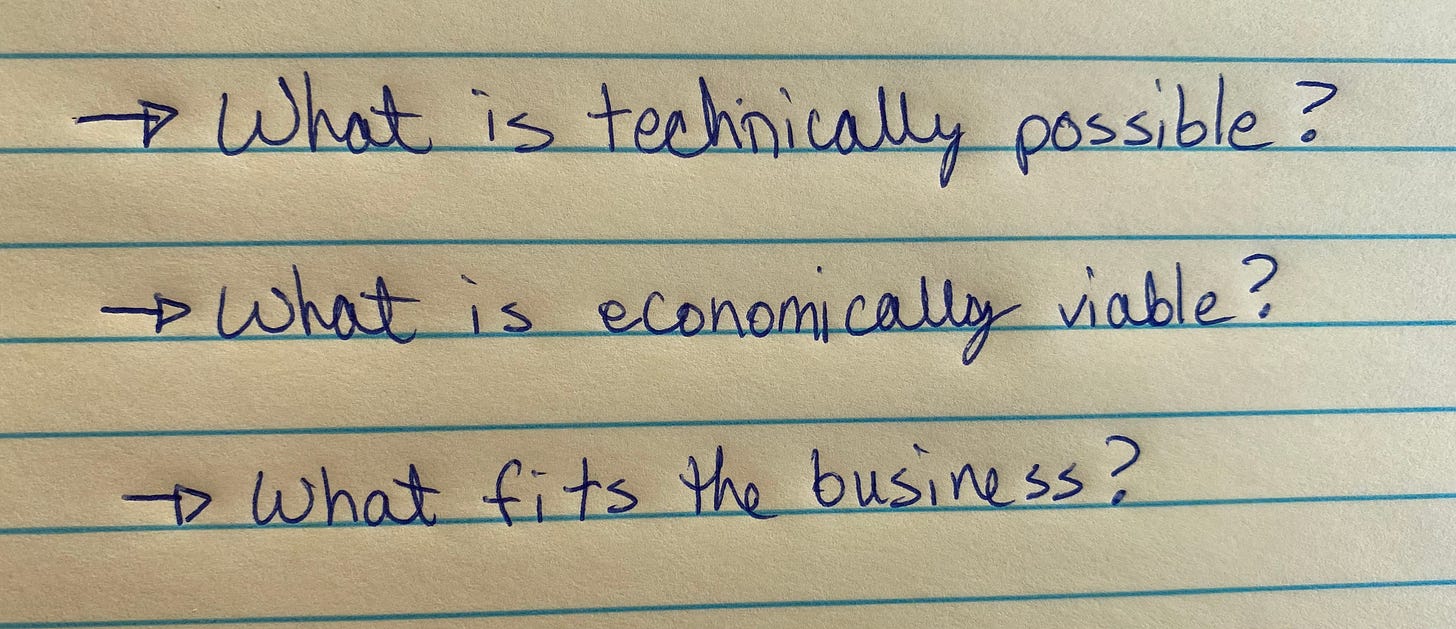
But while embryo transfer for 100% of the US dairy herd might be technologically possible, is it viable economically? Where is the market meaningfully incentivizing adoption of that type of program?

Again this is over simplified, but ultimately the dairy producer is navigating these 3 screens to design their genetics strategy:

‘What fits the business’ can be any operational criteria from cost (cash flow management) to facilities to staffing, etc. that an individual dairy would have. No news flash here but ANY innovation at the farm level has to fit the day in day out operations of the farm.

Compound Genetics

Interest isn’t the only thing that compounds, so does genetic improvement. If the more complex genetic strategies lead to an annual increase of x% more genetic improvement than traditional strategies, then over time that x% improvement will compound. And if the more complex strategies lend themselves to larger dairies who can implement those strategies more cost effectively, how will this impact further consolidation?

Wisdom of the crowd

I hope you are geeking out on this topic as much as I am, it’s fascinating, right?? As I continue digging in, here are questions I’d love to get your perspective on:

  • What decision points are missing above?
  • What are the frameworks that innovative producers are using to make those decisions?
  • How do the decision points for dairy producers vary among different types of dairy farms?
  • How is this trend playing out in other dairy & beef producing regions of the world?

I’m interested in all things technology, innovation, and every element of the animal protein value chain. I grew up on a farm in Arizona, spent my early career with Elanco, Cargill, & McDonald’s before moving into the world of early stage Agtech startups.

I’m currently on the Merck Animal Health Ventures team. Prime Future is where I learn out loud. It represents my personal views only, which are subject to change…’strong convictions, loosely held’.

Thanks for being here,

Janette Barnard
Categories
Animal AgTech Genetics

Prime Future 63: If dairy is the new beef, are cow-calf producers necessary?

Hypothesis: the biggest threat to cow-calf producers is neither packer consolidation nor alternative proteins. The biggest threat to cow-calf producers is dairy producers who are increasingly deploying the 'beef on dairy' genetics strategy which will allow them to own the beef calf market, creating an existential threat for cow-calf producers.

That was my hypothesis when I sat down to write this piece.

Before we get into whether this hypothesis is reasonable or not, here’s a quick review of the beef on dairy strategy:

“In dairy herds, a sustainable breeding strategy could combine usage of sexed semen to generate replacement heifers only, and usage of beef semen on all dams that are not suitable for generating replacements. This results in increased genetic gain in dairy herd, increased value of beef output from the dairy herd, and reduced greenhouse gas emissions from beef.”

(We recently looked into the 3 mega phases of genetics revolution in dairy cattle that led to the beef on dairy trend.)

One more idea before we get to whether cow-calf producers have a future or not, an idea from “Loonshots: How to Nurture the Crazy Ideas That Win Wars, Cure Diseases, and Transform Industries” is that innovation falls in two buckets:

  • P-type innovation which are product innovations, like the invention of the jet engine
  • S-type innovation which are business model innovations, like the idea of an airline that would not use the hub & spoke model and only offer low cost direct flights

The interesting thing about the beef-on-dairy strategy is that the two enabling technologies were P-type innovations: genomics and sexed semen.

But now as producers adopt those products, we’re looking at S-type innovations playing out in real time which is likely to lead to more S-type innovations across beef and dairy value chains.

Back to my hypothesis. Let’s do some napkin math, and use the most extreme assumption that 100% of US dairy producers will apply the beef on dairy strategy to 100% of their herd. (For the purpose of thinking about the potential impacts of a trend, it’s helpful to play it out to the extremes even if highly unlikely.)

Using extreme and very round numbers, here’s some math:

  • There are 10 million dairy cows in the US. Let’s say 30% of those cows are replaced by heifers every year. All 10 million cows need to have a calf, but only 3M of those calves need to be female to be kept as replacement heifers and maintain current production levels (10M * .3 = 3M). Let’s say the remaining 7M calves NOT being kept as replacement heifers flow into the beef value chain (10M – 3M = 7M).
  • If today there are ~5M dairy calves that flow into the beef supply chain already, or ~50% of the 10M dairy calves born annually then it looks like beef-on-dairy only adds 2M additional beef-dairy cross calves per year into the beef value chain (7M – 5M = 2M). However a big caveat is that there is already a reasonable % of the 5M dairy calves that are actually beef-dairy crosses, though there’s no good estimate of what that number is. Regardless…
  • If ~25M beef animals are finished in feedyards annually, and the most dairy can contribute (in pure dairy or beef-dairy crosses) is 7M then that leaves a minimum of 18M calves per year needed from cow-calf producers.

Napkin math shows that my hypothesis that dairy producers pose an existential threat to cow-calf producers is wrong.

Cow-calf producers will continue to be a necessary segment of the beef value chain.

But even if beef-on-dairy does not create an existential threat to cow-calf producers, there will be implications and ripples felt across the beef and dairy industries. This week’s newsletter is the start of a series exploring those implications and ripples.

Here are some questions I’m interested in:

  • How viable is the sustainability hypothesis behind on beef-on-dairy? Cargill is making a bet on beef on dairy as a sustainability play, will others?
  • What are the limiting factors for beef-on-dairy growth?
  • Alternative milk now has ~16% share of the milk market, if beef and dairy become even more enmeshed than they already are, how could change in milk demand impact beef? If the primary link today is ground beef, what happens when the link expands?
  • What does it mean for cattle feeders to have 3 distinct types of potential calves to feed: beef, dairy, beef-dairy crosses? For packers to have those 3 types of fed cattle to process?
  • What are the positive/negative impacts felt through the value chain from an increase in beef on dairy? From dairy producers to feedyards to packers.
  • How will profit drivers be impacted? From live performance metrics to carcass yield and grade. How will management of these metrics change?

If you have insights or opinions on any of those questions, please reach out – I’d love to get your thoughts. Or, if you have other questions to explore about this space.

An important caveat to this conversation is that beef-on-dairy is not new. It was first discussed in the early 2000’s and how slowly increased over time. But it feels like we’re at an inflection point and adoption is accelerating rapidly.

“The future is here, it’s just unevenly distributed.”


I’m interested in all things technology, innovation, and every element of the animal protein value chain. I grew up on a farm in Arizona, spent my early career with Elanco, Cargill, & McDonald’s before moving into the world of early stage startups.

I’m currently on the Merck Animal Health Ventures team. Prime Future is where I learn out loud. It represents my personal views only, which are subject to change…’strong convictions, loosely held’.

Thanks for being here,

Janette Barnard