


This Business Breakdown podcast episode about John Deere is worth the listen for anyone who…well, it’s worth it for anyone. Farmer & investor Matt Coutts talks about Deere’s transition to a technology company, from product strategy to commercial strategy.
An interesting product note is that Deere now has more software engineers than other engineers. 👀
On the commercial front, Deere has publicly stated a goal to transition to 10% recurring revenue. (Here’s what Sarah Nolet and Upstream Ag Insight’s Shane Thomas had to say about this.)
But relevant to our discussion today, Coutts highlighted Deere’s advantage not just in product but also in distribution of both farm equipment and technology.
The distribution model in farm equipment is to sell through a dealer network. Dealers take the capital intensive inventory, build the relationship to sell directly to farmers, and also service equipment. Deere has relationships with dealers who have relationships with farmers. Coutts says one Deere advantage is having a larger dealer network than their competitors which means farmers might only be 50 miles from a Deere dealership instead of 150 miles. This especially matters when it comes to needing timely repairs in season.
And specifically from a technology perspective, Deere has more tractors in field than competitors so that base of existing tractors is the target market for technology.
Sounds pretty flywheel’ish, doesn’t it?
Deere obviously built the brand on product quality. But we all know that the best product doesn’t necessarily win. Often it’s the company with the best distribution that wins.
Truth be told, Deere having the advantage in both product and distribution is downright impressive.

Today we dig into the whats and hows of distribution & why distribution can be the innovation lever to unlock super powers.
This is a discussion that is central to developing new business models, whether the product is physical, digital, or service-based.
What does distribution mean, really?
Distribution is sometimes reduced to the delivery of the physical product, but there are three relevant functions tied (in varying degrees) to distribution:
- Customer acquisition & demand creation.
- Physical movement & delivery of a product or service.
- Customer relationship to support anything post-sale.
Sometimes when people say distribution they mean all 3 elements. Sometimes they just mean 2, or 1 & 2 only, or 2 & 3 only. Often it’s a catch all term for the go to market plan.
(And sometimes the 3 are tied closely together, sometimes they are independent of one another, depending on the product, market, etc.)
Scale is often considered THE distribution advantage. There are so many examples of this from John Deere, to Standard Oil’s grip on the railroads as the method of elbowing out competitors (legality aside) to be the dominant oil player across the US, to the packers whose diversification across sales channels and geographies allowed them to better weather the overnight slow down of foodservice sales in 2020.
But innovation in distribution can be what disrupts the incumbents, or at least allows upstarts to compete with incumbents. A few examples:
- Before Sam Walton got a hold of the retail & grocery business, the model was for manufacturers to ship product directly to stores. Sam flipped the model on its head by scaling up the distribution center as the inventory buffer between manufacturers and stores, increasing SKUs while lowering costs.
- Author Ryan Holiday writes books and newsletters, including a monthly email with book recommendations. I buy at least 1 book every month from his recommendations and not once has he led me astray. So in a contrarian move with horrible luck of timing, Ryan opened a physical book store in March 2020. A physical book store in an Amazon world, that’s crazy! And yet, Ryan has thousands of subscribers on his monthly book recommendation email so instead of linking each book title to Amazon, he links it to his own shop’s website.
Immediate distributionreach beyond the 4 walls of his book store in little ol’ Bastrop, Texas. Beautiful. - Bill Gates is a billionaire because of his early insight that licensing software was the better business than hardware which was on a path to commoditization. Microsoft was the first software company to reach $1B in revenues because of a licensing agreement with IBM in which every PC sold included Microsoft software. Even now in a cloud based world, the vast majority of Microsoft revenue is from licensing software.
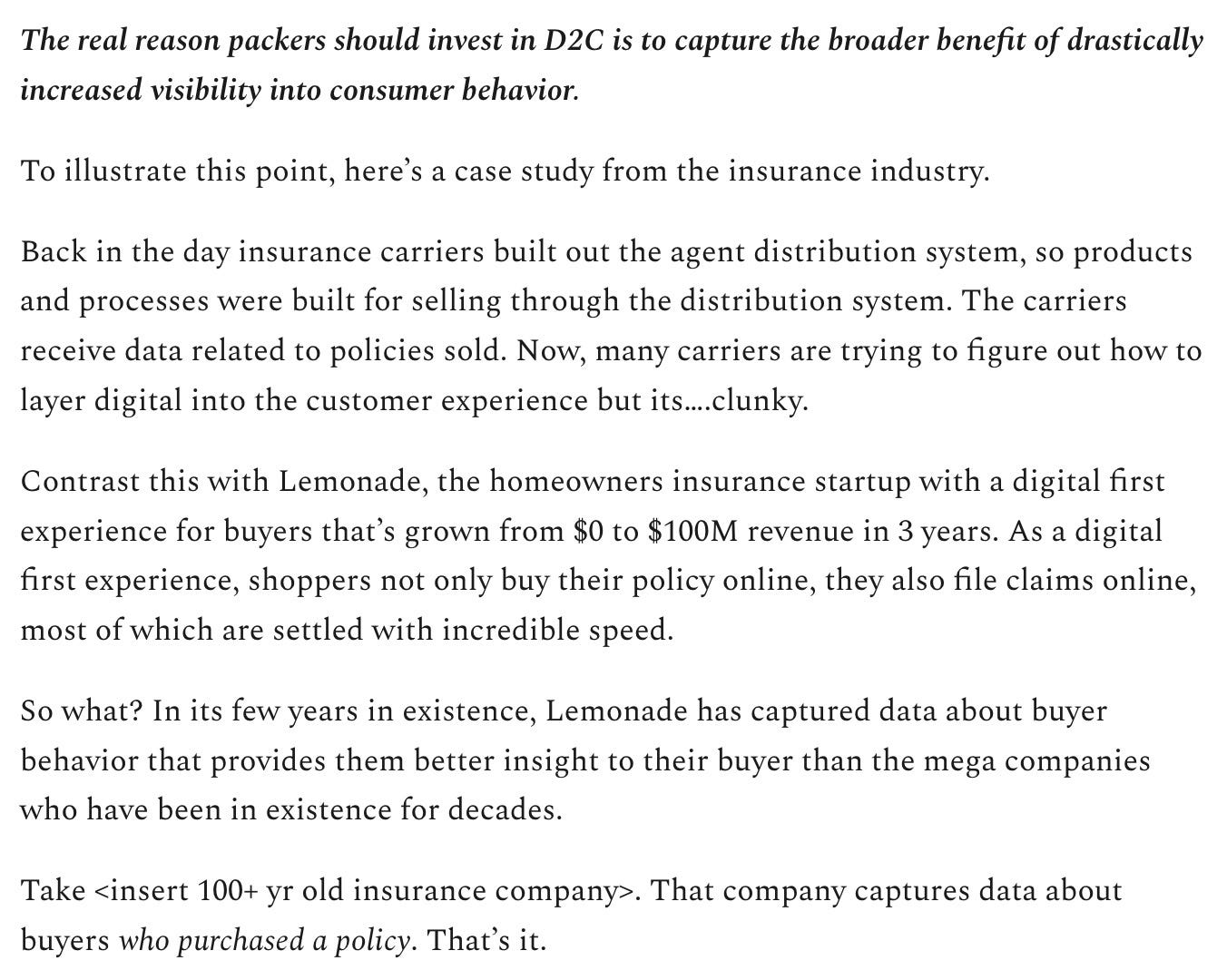
- Digital only banks like Chime or insurance companies like Hippo. In the very first edition of Prime Future, I wrote this about digital first insurer Lemonade:

Distribution can be the glue to a new business model…
I recently talked with the CEO of Walden Local Meat out of New England, Philip Giampietro. Here are the basics of Walden Local’s business model:
- Walden Local is an ‘animal share’ with a membership model. Join the club and get a % of an animal(s) on a monthly basis. The key here is balancing the entire carcass across members, both grinds and middle meats.
- Source livestock directly from local farms (how define local) and local processors. Since local processing capacity is a bottleneck for businesses like this, balancing the timing of market ready livestock with processing availability with demand from customers is critical.
- The kicker? Walden manages their own logistics. Walden owned vans & trucks pick up meat at the processing plants and deliver meat to members.
Walden’s distribution strategy is core to their business model. Presumably owning the fleet and managing the logistics of delivery is not the cheapest way to do things, not by a long shot. But here’s why they do it:
- Typical delivery services have 2% damaged deliveries. If you’re trying to replace the trip to the grocery store, the right product has to be delivered at the right time. Controlling logistics, including last mile delivery, allows Walden to have <.2% damaged deliveries. This keeps customers happy which keeps customers out of the meat case at their local grocery store.
- The delivery fleet doubles as rolling bill boards through target neighborhoods.
- If you’re selling a product on a local ethos, then having a rando FedEx or UPS truck deliver your product feels a bit disconnected. So having a Walden Local vehicle deliver your order by a Walden Local employee feels on brand.
We can debate the scalability of their model. But for Walden Local, their distribution model impacts how they get new customers, how they get product to customers, and how they support customers.
The Walden example raises the question, what metric(s) are we optimizing via distribution?
- Cost
- Time/speed
- Customer experience (control for quality/precision of customer experience, build customer connection, etc)
This reminds me of the product triangle we’ve all seen. You can pick 2 of the following 3 variables: price, speed, quality. But you can’t have all 3.

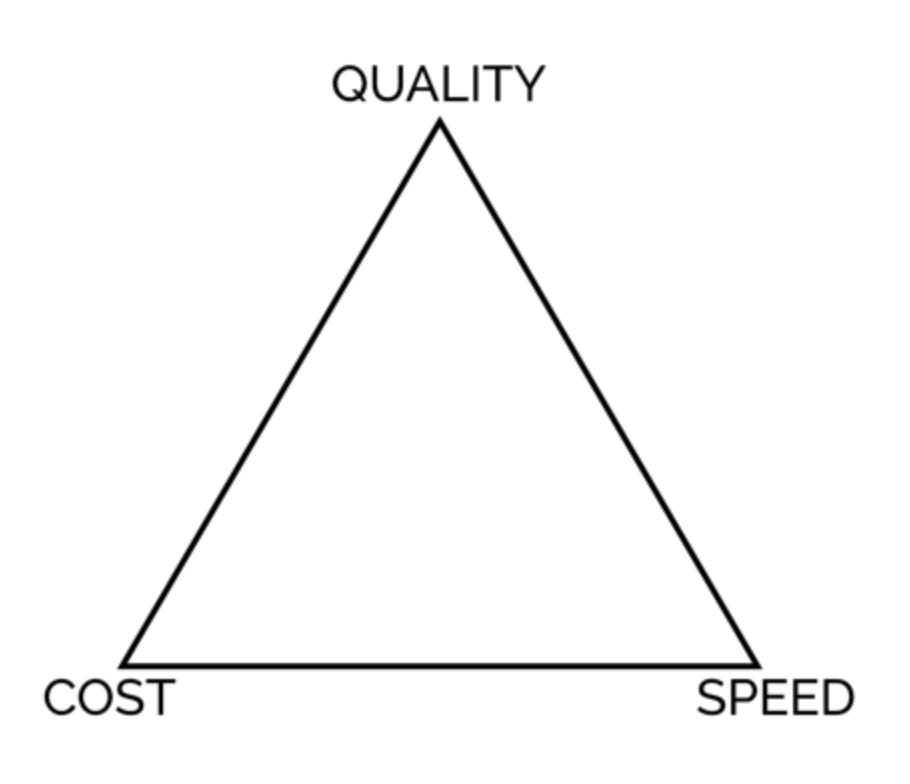
I’ve always thought of the application of this triangle in regards to the product/service itself, but what if it also applies to distribution models.
When it comes to rethinking old school assumptions about distribution for new business models, this article by the maestro Marc Andreesen outlines a decision tree. Most of the questions in the decision tree are kinda obvious as a function of your product and target customer/market:
- Product:
- Physical product (perishable? Liquid? 4 legged? In a bin? In a bag?) vs services vs software
- Target customer:
- Who is our target customer? What’s true about them? How do we reach them? Profitably?
But the non-obvious questions are around business model:
- What role does distribution play in our business model?
- How do different distribution options impact the business model’s ability to produce?
- How does pulling on the distribution lever impact other levers like total addressable market (TAM), lead gen, NPS, operational efficiency, supplier relationships, etc?
Distribution is an interesting lever to innovate around because it is so central to the customer experience and the e-n-t-i-r-e business model.
Distribution is the unsexy, boring lever at the center of a lot of companies & industries that can have huge impact when that lever is applied differently.
Distribution innovation can be the secret key to unlock flywheel superpowers.
One last thing. There’s an interesting phenomenon playing out for companies who’s primary customer acquisition channel is paid digital ads. In the early days of social media, you could build a brand & a business faster/cheaper online by putting ads on Facebook and Google. Now paid online ads are a super competitive channel and the cost per ad / cost per new customer has skyrocketed. Some estimate that startups spend as much as $.40 of every $1 of venture capital on digital advertising. That is going to be an increasingly challenging model of customer acquisition if we are in fact at the beginning of a market downturn where capital – whether debt or equity – is more expensive.
What will the next distribution innovation wave be?
What a time to be alive😉
My caveat to all of this is that distribution is not a topic I’ve spent much time thinking about as an isolated concept.